
In this section
Offers for readers
Follow the news from interest
The comment stream
Recent comments
- 1 of 20777
- ››
Editors choice
- 1 of 295
- ››
Finance sector jobs
Reporting to the Senior Manager Operational Risk Effectiveness and Assurance, the key focu...more
New Zealand
Reporting to the Head of Finance - Retail and Business Bank the key focus of this role is ...more
New Zealand
This role in consultation with the Financial Controller provides financial, strategic and ...more
New Zealand
If you are motivated by the prospect of seeing the big picture, developing your team and m...more
New Zealand

The news stream
Latest news
Most commented
- BNZ cuts most fixed mortgage rates 48
- 90 seconds at 9 am 43
- English wants more house builds 30
- Fonterra cuts payout forecast 30
- Budget tax moves to target high income NZers 29
- Thursday's Top 10 with NZ Mint 26
- Wednesday's Top 10 with NZ Mint 24
- Amanda's Take Five for Wednesday 23
- 90 seconds at 9 am 21
- NZ to borrow more if crisis worsens-Key 19
Most viewed
Top 10 at 10: Bollard's impotence on NZ$; Vampire Squid was bald; US complacency; Dilbert
Here are my Top 10 links from around Internet at 10am. I welcome your additions and comments below or please send me your suggestions for tomorrow's Top 10 at 10 to bernard.hickey@interest.co.nz We take credit for everything at interest.co.nz
1. Impotent? - Reserve Bank Governor Alan Bollard signalled to Parliament's Finance and Expenditure select committee yesterday that there wasn't much he could do to influence the New Zealand dollar's inexorable rise in the short term, BusinessWire reported. Interestingly, Deputy Governor Grant Spencer was reported as saying the RBNZ didn't want to increase its exposure to the US dollar either, suggesting it's unlikely to sell Kiwi$ to buy US$ to push our exchange rate lower.
At Parliament's Finance and Expenditure Committee, the Reserve Bank Governor said any rate hike on his part probably wouldn't have much of an impact on the kiwi dollar, as the markets have already started pricing in rising interest rates. "We don't want to see the New Zealand dollar being put under unnecessary pressure again," Bollard said. "If and when we were to increase rates would you see that impact on New Zealand dollar? No, actually the markets already think quite a long way ahead of where we see monetary policy." He also warned that the bank couldn't intervene without taking longer view to the consequences of its actions. "You shouldn't be short-term overactivist and then regret it in the medium term," he said. At the same hearing, Deputy Governor Grant Spencer confirmed New Zealand's central bank was trying to move its assets away from the greenback as the world's reserve currency remained out of favour with investors. "We're trying to reduce our exposure to U.S. dollars as it heads south," Spencer said.
2. Finally - It seems the US government has worked out that the public are incandescent with rage over bankers jumping back on the bonus bandwagon so soon after the financial crisis' apparent end. The 'Pay Tsar' will order 7 bailed out banks to cut executive salaries about 50%, Bloomberg is reporting.
Cash salaries for the 25 highest-paid employees will be slashed 90 percent under Feinberg's plan, which will be announced this week, one of the people said today on condition of anonymity. Employees at the derivatives unit of American International Group Inc., blamed for insurer's near-collapse last year, can receive no more than $200,000 in total pay, one of the people said. Feinberg, 63, who was special master of the September 11th Victim Compensation Fund, was named to the Obama administration pay position in June. Executive compensation came under scrutiny after companies got billions of dollars in federal aid last year amid the worst financial crisis since the Great Depression. Public outrage flared in March after New York-based AIG paid $165 million in bonuses to employees of the derivatives unit. All perks such as limousine service and private aircraft valued at more than $25,000 must be approved by Feinberg, one of the people said.
3. Yes Sir! - This is a fascinating piece on NPR about Iran's Revolutionary Guards Corps (IRGC) and how it has quietly taken over the Iranian economy as a business. This would be one boss you wouldn't talk back to. However, it is a real challenge for any attempts to reform the economy and the democracy. For example, the IRGC now owns the mobile phone networks...no more Twitter protests... HT Troy Barsten via email
Last month, the IRGC took an $8 billion controlling interest in Iran's main telecommunications company. Given that there are an estimated 30 million cell phones in Iran, the investment is likely to prove lucrative. The acquisition also means the Revolutionary Guards will be better positioned to control Internet access and monitor private communications in Iran. Between its gradual displacement of the private business sector, its growing capability to monitor and control the opposition movement, and its potential control of black market and smuggling networks, the IRGC has come to be seen by reformers as a major obstacle to Iran's democratization. "Such an organization would not like to have a democratic state, especially if there is transparency and accountability," Nafisi says. "They like to have their shadow economy."
4. New hegemony - Irwin Stelzer at The Times speculates on how America could soon be in the position that Britain was soon after World War 2 when it had to beg the Americans for more money. Now the Americans will have to beg the Chinese. HT Troy via email.
Instead, they (the Chinese) see themselves in the position that America was in vis-Ã -vis Britain in 1946. America is deeply in debt and digging itself in deeper every day. China, America's principal creditor, is worried that Obama and his successors will attempt to pay back the more than $1 trillion they owe in wildly depreciated dollars. So it wants to see some plan coming out of the White House that will begin to reduce the deficit and, eventually, the national debt. No such plan exists. Obama, who styles himself a "transformational president", intends to keep the spending taps wide open. Unfortunately the old adage that if you owe your banker a huge sum you have him where you want him is not true "” not if the Chinese are your creditor. So it should be no surprise that Obama is the first president to refuse to receive the Dalai Lama, the Tibetan leader, despite the urgings of the celebrity luvvies who helped fund the president's election campaign. Or that America no longer presses the Chinese regime on human rights. All in an effort to keep the Chinese happy, and lending. Which brings us back to Keynes, Truman and the post-war world. Unless there is a big change in American economic policy, and soon, our version of the great British economist "” White House adviser Larry Summers, Treasury secretary Tim Geithner, or Federal Reserve Board chairman Ben Bernanke, or all three "” will head to Beijing to negotiate terms that will persuade the Chinese not to call in all their IOUs. The Chinese are likely to be less kind than we were and insist on terms that would sap our economic, and therefore military strength for years to come.
Related Topics
5. Print baby print - Paul Krugman at the New York Times believes America should keep its 'ZIRP' (Zero Interest Rate Policy) until the jobless rate is back under 7%. He also wants more money printing. Krugman points to an interesting study that says actual monetary conditions in America remain very tight. Remember, Krugman is closely read by the Team Obama. The problem for the rest of the world is that this cheap American money is being exported hand over fist. But we don't vote in America... HT Steven Jones via email.
Basically, this says that much of the Fed's loosening has been offset by troubles in the financial system, so that actual credit hasn't gotten much looser at all. And this in turn means that the zero-rate policy isn't nearly as expansionary as it might seem. That doesn't mean that the Fed funds rate has no effect; it means, rather, that you need a lower Fed funds rate to get any given effect. If credit-market troubles persist, this adds up to another reason to keep rates at zero for a long time "” possibly even after a Taylor rule suggests they should finaly start going up.
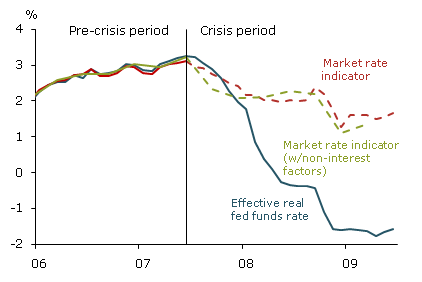
6. Vampire squid report - Felix Salmon from Reuters delves deeply into Andrew Ross Sorkin's now infamous book detailing who spoke to who about what and when during last year's crisis. Sorkin finds US Treasury Secretary Henry Paulson (and former Goldman Sachs CEO) was donkey deep inside Goldman's strategy while managing the collapse of a rival. The squid lives. Here's the comments from the book.
If all that weren't enough to deal with, [Lehman president Bart] McDade had just had a baffling conversation with [CEO Dick] Fuld, who informed him that Paulson had called him directly to suggest that the firm open up its books to Goldman Sachs. The way Fuld described it, Goldman was effectively advising Treasury. Paulson was also demanding a thorough review of Lehman's confidential numbers, courtesy of Goldman Sachs. McDade, though never much of a Goldman conspiracy theorist, found Fuld's report discomfiting, but moments later was on the phone with Harvey Schwartz, Goldman's head of capital markets. "I'm following up at Hank's request," he began. After another perplexing conversation, McDade walked down the hall and told Alex Kirk to immediately call Schwartz at Goldman, instructing him to set up a meeting and getting them to sign a confidentiality agreement. "This is coming directly from Paulson," he explained.
Oh dear. Salmon concludes:
In many ways, this is worse than Paulson's meeting with Goldman's board: in this case, Paulson is forcing Lehman to open its books fully to a direct competitor, for no obvious reason. And in this case it's not at all obvious that Paulson got a sign off from Treasury's general counsel before doing so. I suspect this is what happens when you do all your business by phone rather than by email: you're so comfortable with the fact that you're not leaving any kind of paper trail, it becomes much easier to cross the line and abuse your position as the most powerful Treasury secretary in living memory to the benefit of your former firm.
Cue public outrage in America...maybe. 7. Complacency abounds - Niall Ferguson makes the excellent point on Yahoo's TechTicker that America is being complacent about the Chinese always being there to buy its worthless bonds. The Chinese are rapidly diversifying their assets into hard commodities and developing their internal markets, Ferguson says. With no trade surplus the Chinese would stop buying. Anyone betting against a New Zealand dollar at US$1 by end of this decade? HT Greg Elliott via email.
"The idea they don't have anywhere else to go or would shoot themselves in the foot if there were a steep decline in the dollar or appreciation of their currency reassures many people in Washington "˜we can relax'," he says. "An appreciation of the renminbi may reduce value of their international reserves but increases the value of every other asset the Chinese own," most notably the commodity assets they have been buying all over the world. China's "current strategy is to diversify out of dollars and into commodities," Ferguson says. Furthermore, China's recent pact with Brazil to conduct trade in their local currencies is a "sign of the times." Perhaps most importantly, China's massive stimulus program is helping to generate internal consumption in the People's Republic, meaning local manufacturers are less dependent on exports. Because of the "rapid growth" of Chinese domestic consumption, Ferguson predicts China's international trade surplus could be gone by next year. "People in Washington rather assume because the U.S. consumer was so dominant there really isn't a substitute," Ferguson says. But China's trade surplus stood at $12.9 billion in September, down about 56% from a year earlier, according to MarketWatch.com.
8. Lost soul - Paul B Farrell at MarketWatch.com has written this magnum opus titled 'Death of Soul of Capitalism' which is getting plenty of attention. He details 20 reasons why America has lost its soul, starting with this... HT Sargon Elias via email.
1. Collapse is now inevitable Capitalism has been the engine driving America and the global economies for over two centuries. Faber predicts its collapse will trigger global "wars, massive government-debt defaults, and the impoverishment of large segments of Western society." Faber knows that capitalism is not working, capitalism has peaked, and the collapse of capitalism is "inevitable." When? He hesitates: "But what I don't know is whether this final collapse, which is inevitable, will occur tomorrow, or in five or 10 years, and whether it will occur with the Dow at 100,000 and gold at $50,000 per ounce or even confiscated, or with the Dow at 3,000 and gold at $1,000." But the end is inevitable, a historical imperative.
This could end up being viewed as the week when dollar weakness became too much for the rest of the world to bear, setting the scene for tense encounters at the upcoming meeting of finance ministers from the world's 20 largest economies. Brazil has now imposed a tax on some foreign-exchange inflows. The Bank of Canada has cranked up its negative tone on the strength of the Canadian dollar. And a whole slew of European officials have practically begged the U.S. to step in and boost the buck.
10. Sign 'o' the times - A 90 year old American man has been forced back to work after 25 years of retirement because he lost everything in the Bernie Madoff scandal, AP reports in this video. The former business owner now hands out flyers to customers entering a grocery store and earns US$10 an hour working 30 hours a week. How many other retired people are having to go back to work here in New Zealand after finance company collapses?

92 Comments
Kiwis – including a few
Kiwis "“ including a few commentators here "“ need a reality check. A low value currency = a low value country. Simple really. If someone said that your house should be half its current value, then how would that make you "better off"? However, a lot of people see a lower NZD as the answer "“ which is avoiding the root of all the problems to start with. The root problem is global debt and govts everywhere who want to pretend that it will go away without consequences. Debt levels and down-the-road inflation pressures make 1929 look like a panacea. Bollard and other central bank leaders have two simple choices over the next 5-10 years:
1) Keep interest rates low and inflate the money supply "“ a bit of a "drug" to deal with the problem short-term. The consequences of this course of action? Massive inflation and wealth destruction on a huge scale "“ not to mention the probable demise of fiat currencies in their current form (USD, NZD, etc). Central banks and govts are loath (but probably, like a heroin addict, unable and unwilling to reverse course) to go down this path as it will likely take away a lot of their power (i.e. the ability to print money and spend at will). They are deluded in thinking that they will be able to "manage" it (a bit like Mugabe).
2) Raise interest rates to restore confidence in currencies and provide a return for savers (who are sorely needed and almost extinct). The consequences of this course of action? Many bankruptcies and massive asset value writedowns and a big reduction in govt (read less welfare largesse, etc), but ultimately a return to reality and future growth from a firmer foundation.
My guess is that the public and govts will opt for option 1. A case of "who cares about the country"¦what's in it for me?" Be careful what you wish for"¦ultimately we will get exactly what we deserve.
Ferguson and Farrell are right.
Ferguson and Farrell are right. The reason is simple. There are now not the real resources to underpin the (assumed to be worth something) paper wealth.
China will certainly see her equity held in US notes diminish, just as the US will certainly realise that it can't climb out of the hole - there simply isn't the oil-fuelled time left to repay even their existing debt.
We've always fought over resources, but the US will most likely start this one. The most powerful force, when diminishing, should always 'go' early. Age of Empires, lesson one. It also solves the resource and debt problem - Who wins, squares the books.
Nothing can be done about
Nothing can be done about the impact of speculators on our dollar, my arse, we can stop acting like subversive slaves to the international dictum handed down by the international financial institutions of the privately owned central banking network, this dictum is nothing but a commercial pyramid scam via predatory lending of created credit on a massive scale. Although not the entire reform needed, introducing capital flow controls overnight, decreeing that any money being exchanged for kiwi dollars cant be exchanged back for a period of 30 days. Malaysia used it, against IMF advice, to come through the best in the Asian Debt Crisis. The IMF with egg on its face has now, or atleast did for awhile, change its stance:
"The International Monetary Fund, the fierce advocate of financial orthodoxy on the international scene, appears to have had a change of heart.
A new study by the IMF suggests that capital controls - where countries seek to limit the flow of foreign investment in and out of their borders - may not be such a bad thing after all. "
http://news.bbc.co.uk/2/hi/business/600227.stm
More signs of stress in
More signs of stress in rural-land. Allied Farmers has been naughty:
http://www.nzx.com/news/markets/2989582/Allied-Farmers-in-breach
@Andy - this is interesting:
"Allied also revealed today that it had been in discussion with various parties about "consolidation" in the rural and finance sectors - possibly utilising Allied's position as an NZX-listed company."
Good link , Iain ,
Good link , Iain , but 9 years old , year 2000 . Also admission that control of currency flow can be expensive to administer , may only be effective over short time frames , and may be circumvented by sophisticated investors . Also , it needs be combined with economic reform ............ And we are waitng for that . Do you place much credence in the IMF , they have fierce critics ( who doesn't ! ) ?
@Roger - I nominate "despair"
@Roger - I nominate "despair" as today's word
PowerdownKiwi makes an interesting observation...
"there simply isn't the oil-fuelled time left to repay even their existing debt."...
Meanwhile average P/E on S&P500 is 140...
The Gods must be Crazy!
@Ludwig: "Simple really. If someone
@Ludwig: "Simple really. If someone said that your house should be half its current value, then how would that make you "better off"? "
Simple, I live in my house, its value is immaterial. At what point are you deciding its value? ie We just had/have a huge bubble, the house was never really ever worth that much...
1) Keep interest rates low and inflate the money supply "“ a bit of a "drug" to deal with the problem short-term. The consequences of this course of action? Massive inflation and wealth destruction on a huge scale "“
We may not see "massive" inflation this is your assumption, maybe stag-flation...whos wealth destruction and was it ever real? ie its paper speculation/hegde money, its not based on the real economy, hence its destruction is "possibly" for the better.
"Raise interest rates to restore confidence in currencies and provide a return for savers
regards
Steven
@Paul Krugman The New York
@Paul Krugman
The New York Times needs to stop snorting his own diluted crack. Why can't they just admit that money printing was a ridiculous idea and move on and then allow the excess credit to decouple itself from the system. Frakin' Keynesians need to pull their heads out. It's the calm before the storm folks"¦
Do you suppose Allieds discussions
Do you suppose Allieds discussions on "consolidation" in the rural and finance sectors... are with PGW?
Trev : Cannot use "
Trev : Cannot use " despair " as word of the day , because it is our National word . Land of the long white face . Also , I believe that " despair " is mentioned in the HAKA . ( with despair , I defeat you ) . And " despair " makes 12 or 13 appearances in the National anthem ( I stand to be corrected , " in despair , by our fair to average land , girt by sea " )
Girt ........ OK , instead ?
How soon before Monopoly banknotes
How soon before Monopoly banknotes are worth more than the ones printed by the Fed? What price the Chatham islands? Anyone wanna buy a railway sleeper...free rails!
Jelly Key is offering to give the teachers a lead and yessssir he intends telling all National MPs, they are set to fund a wage rise for the hard working Parliamentary staff, out of their own fat salaries.
Well done that man.
Yes it is, Troy! I
Yes it is, Troy! I see the Elliot Wave chaps are getting REALLY excited; and the Fibonacci numbers are falling into line ( depends which stats. you look at though!) and besides, it's full moon on 3rd November. Laugh if you will but 15/9/08 was; so was 11/3/09.
Heh heh , hee ,
Heh heh , hee , hee ........... Thank's for the invite . Wanna gummy bear ?
@Harriet take you pick, there
@Harriet
take you pick, there are so many Black Swans flying about (Iran, USD, the second real estate bomb, Eastern EU bankruptcy, full moon, etc) we will have to soon cull a few just to control the rare event population.
@RT - how about "Contrafibularities"?
Usage: "I offer my sincere contrafibularities"
@Harriet - how can the numbers be falling into line if it depends on which numbers you look at? That said if the markets fall on Nov 3rd, you get to be finance minister and governor of the RBNZ.
How about we have us
How about we have us Gummy Bears for currency. Think of the benefits.
Today's word could be speculate.
If you are wanting to invest, I s'pec u late.
Good stuff powerdown. More wit
Good stuff powerdown. More wit please folks.
Ain't noisy data a sod?
Today's word could be speculate.
If you are wanting to invest, I s'pec u late.
It could be improved, we
It could be improved, we all know that. Just off the NZMEA press, enjoy.
'More to this than the US dollar'
Policy makers and officials are choosing to ignore the rise in the New Zealand dollar on the basis that it is a US dollar weakness story. That is simply an excuse for inaction say the New Zealand Manufacturers and Exporters Association (NZMEA). The Reserve Bank of New Zealand (RBNZ) Governor Dr. Alan Bollard commented to the Finance and Expenditure Select Committee yesterday that the strength of the kiwi against the US dollar is being driven chiefly by that currency's weakness and there was little the central bank could do to bring the currency down.
[Graphs missing - they are in the document here of same title listed here http://www.mea.org.nz/media/pressreleases.aspx ]
NZMEA Chief Executive John Walley says, "The New Zealand dollar has risen significantly against all of our major trading partners since March, but we have continued to see warnings and no action on this issue."
The RBNZ June Monetary Policy Statement: "A stronger dollar at a time of weak global growth risks delaying or even reversing the projected increase in exports, putting the sustainability of recovery at risk."
The RBNZ September Monetary Policy Statement: "If the exchange rate were to continue its recent appreciation and/or the recovery in house prices were to undermine the improvement in household savings, then the sustainability of the present recovery will be brought into question."
"Sooner or later we need to see action on this issue," says Mr. Walley. "The report to the Select Committee yesterday saw a rerun of the 2007 Select Committee Inquiry merry-go-round between the politicians and the Reserve Bank officials. The politicians ask what can be done, the Reserve Bank says nothing and neither side takes any responsibility for the problem."
"Perhaps we need to pay our public servants in US dollars to see some leadership on this matter."
Roger, the US Colonial Scrip
Roger, the US Colonial Scrip was from the 1700s, NZ Promissory Notes from 1845, Public Credit used to build state houses in NZ 1938, all were the solution then to the same problems faced today for the same reason, thus 2000 is not that long ago really.
I did say that Capital Flow Controls are only part of the needed reforms, namely a return to NZ reclaiming the right to issue our own "powered money base" interest free.
Colonial Scrip:
"The colonies created their own money, called Colonial Scrip, before this happened. This money was government-issued fiat currency and had little or no inherent value, as Colonial Scrip was not backed by a Gold or Silver Standard. Some Colonies, such as Pennsylvania and New York, were responsible and issued only enough notes to keep trade healthy, thus keeping the notes at par with gold. Other Colonies had different systems with less discretion and had inflation issues."
As much as I loath using Wikipedia, my studies concur with this;
http://en.wikipedia.org/wiki/Currency_Act
NZ Prommissory Notes:
"his only alternative to stopping payment was to issue paper money. In doing so he trusted that the current depression would pass and that the development of the country's resources would in the end enable it to maintain itself unaided."
http://publiccreditorbust.blog.com/2009/05/30/new-zealands-third-governo...
NZ Public Credit used to build State Housing:
"The philosophy"¦"¦was that as the money was created for productive purposes no loss could occur if it were not repaid from one department to another. Meanwhile, during construction, tradesmen had been paid wages which had been spent and absorbed into the economy. But it was solid money backed by the creation of assets. People had been kept fully employed while the government built homes for the people."
http://publiccreditorbust.blog.com/2009/09/11/michael-joseph-savage-expl...
@Wally I tired to implement
@Wally
I tired to implement Gummy bear and Jelly belly monetary policy but I went bankrupt within a week. :(
@Trev: It depends on which
@Trev:
It depends on which indicators one uses. ie: using the S&P from a March low of 666.08 a 61.8% retracement = 1077.7. But that was breached a couple of days ago. I tend to follow the less technically liked Dow - from 6440.08 = 10,420, which I have time to acheive before 3/11. But, hey, I'm a lunatic!
" I offer my contrafibularities
" I offer my contrafibularities , " said the lady , who had just missed her appointment with the optometrist . " I will spec-u-later " he replied !
“Raise interest rates to restore
"Raise interest rates to restore confidence in currencies and provide a return for savers
I dont agree.....a) Interest rate is not that important to the confidence of the currency. b) There is no guarantee for savers also I wonder/worry about the effect of the carry trade on NZ if its higher in NZ v the USA and the USA $ is depreciating....hence i dont think its wise to be out of sync with the rest of the world too far.
When will the bulk of
When will the bulk of economists wake up to what the real problem is. Far too much government interference in our lives. This is what is killing our economy. The high / low dollar are symptoms of successive National and Labour governments' failure to do more to impose adequate value-for-money disciplines on new and existing government expenditure - financed by taxation which is theft.
Gerald Scully (1941 "“ 2009) was one of the most prolific, innovative and imaginative economists of our age. One of his most important contributions was the "Scully Curve." Jerry showed that the size of government can contribute to economic growth in a nation's early stages, but at some point, the size of government becomes a burden "“ reducing the rate of growth and causing national income to be lower than it otherwise would be.
In Jerry's estimate, the optimal size of government is about 21% of national income. Since all developed countries are above this level, they all are making huge sacrifices in terms of lost income and economic well being "“ making even low income families worse off than they otherwise would have been.
Rather that say “nothing can
Rather that say "nothing can be done" what should be said is:
"within the limited framework we have backed on an act of faith, and choices we chose to make "“ we chose to do nothing"
I have an infinite supply of some old emperors cloths for sale, any takers?
Rather that say “nothing can
Rather that say "nothing can be done" what should be said is:
"within the limited framework we have backed on an act of faith, and choices we chose to make "“ nothing can be done"
I have an infinite supply of emperor's new clothes for sale, any takers?
@mouse: RE: oil left, the
@mouse: RE: oil left, the danger is there is a huge assumption that our children will be better off than us and hence be able to pay off debt easier, hence we are passing them our debt...that's a immoral and dangerous falsehood IMHO...
If I were my kids in about say 20 years I'd tell the Govn of the day to default on any loan/debt taken out today and say well chase my parents for the $ you stupidly lent them.
The assumption by these "economists" and "pollies" is of course that world GDP will continue to grow, but that needs cheap fuel in amounts to match GDP growth, so 2% GDP growth == 2% more oil used...if oil is dropping at 5% (and its likely its going to be 8% per annum )then GDP will also be decreasing 5% per annum...so our kids could be in a bad way...let alone the costs of the baby boomers retiring or excessive population...or anything else bad....so paying back the debt? I dont see how...ie some ppl say debase the (USD) currency so the debt is worth less, but if all the other countries do the same?
regards
This from WSJ: http://online.wsj.com/article/SB12561504672479950
This from WSJ:
http://online.wsj.com/article/SB125615046724799501.html
"This could end up being viewed as the week when dollar weakness became too much for the rest of the world to bear, setting the scene for tense encounters at the upcoming meeting of finance ministers from the world's 20 largest economies.
Brazil has now imposed a tax on some foreign-exchange inflows. The Bank of Canada has cranked up its negative tone on the strength of the Canadian dollar. And a whole slew of European officials have practically begged the U.S. to step in and boost the buck.
This chorus of pain marks a rise in international pressure on the U.S. to live up to its oft-quoted "strong-dollar policy," after central banks in South Korea, Taiwan, the Philippines, Thailand, Indonesia and Hong Kong all stepped in to weaken their currencies against the greenback earlier this month."
And then you get this from the same article:
"Some authorities around the world are more sanguine about dollar weakness, with the Reserve Bank of New Zealand Governor Alan Bollard stating this week that the strength of the New Zealand dollar was no impediment to raising interest rates."
So why are we so different from the rest of the world?????????????????
@Sally: This is a Libertarian
@Sally: This is a Libertarian point of view...its a tiny minority that hold an extreme economic and political point of view of dubious if not illogical though. Its not wanted by 99%+ of the population...and this isnt www.politics.co.nz...
@Neil C: yes it looks
@Neil C: yes it looks bad....the US cant prop up its dollar, foreign central banks cant either.
We are different in that the rest of the world is trying to debase their currency in order to get an advantage but the USA is out doing them....
Steven - so what advantage
Steven - so what advantage is the rest of the world trying to get that we apparently don't need???
Les - neither side wanting
Les - neither side wanting to take any responsibility for the problem reminds me of an old classic
http://www.youtube.com/watch?v=dIto5mwDLxo&NR=1'
@Sally To take your point
@Sally
To take your point to an extreme lets look at ultimate government intervention: Military and tactical law enforcement spending both foreign and domestic. It's going to be hard to stop the foreign war agenda. Why? Because to stop the war would be a substantial increase in the unemployment figures domestically but just how substantial? Lets take a look:
US Military spending: $700 Billion/yr
As a comparison China or Russia only spend $60 Billion/yr
Total US military personnel per capita is 11.0
If the US had as many military personnel per capita as China the US would have to half the total military personnel per capita from 11.0 to 5.0. The US currently has 4 million so that would be a reduction to 2 million. There would also be various others out of work that would no longer be needed to support the military that would mean another 1.5 million in redundant private sector employment pool would have to go.
A total of 3.5 million jobs lost which equals the total lost in the economic down turn of 2008. Obama is stuck with large military intervention oversees because bringing them back now means much higher unemployment domestically. It gets worse. If the US were to decriminalize drugs and halt the drug war you could count the 80% of non-violent drug offender in US prisons right now. That is another 1.5 million people that would be otherwise looking for work. You would also need to include all the jobs created by the drug war. That would be at least another 1 million in various law enforcement, prison personnel, and technology development sectors. All said there would be 6 million people out of work plus the 3.5 million currently out of work. So if the US government were to shrink overnight they would instantly have 25% unemployment.
Obama is damned if does or damned if he doesn't.
Chairman - cracker! However, it
Chairman - cracker! However, it might be a little more simple than that:
http://www.interest.co.nz/ratesblog/index.php/2009/10/21/opinion-kiwi-dr...
"You say, [Walter said] "Les, John, Selwyn obvioulsy the Breakfast comments on TVone made not much of an impact here- hmm one has to ask questions. [My reply to Walter] That might be because some see this as pointless discussion, [because - they are told it is, and believe it, without question] .... just as with restistance to change regarding a more balanced taxation structure, there will be those with a vested interest in not disturbing the status quo "“ that is those who enjoy inflation, volatility and a high dollar. I wonder who that might be?"
The two issues - wonky tax structure, wonky monetary policy - are joined at the hip.
Les, I’m not saying you
Les,
I'm not saying you are wrong, of course government policy as far as Export/ Manufacturing concern should/ must, even has an obligation to introduce better market conditions.
Revenues are shrinking and so the government should "“ unnecessary spending has to stop. I personally hope the general public plus the media of NZ is beginning to be political motivated, peacefully legislate for changes- and hopefully not only when it is too late turning into riots.
Again - it shows how important culture changes are.
Cheers Walter
Oh, God people listen to
Oh, God people listen to that !
http://www.greens.org.nz/speeches/keep-manufacturing-nz-more-good-econom...
..that guy could be Walter's brother - but interestingly he's is right !
Who is stealing, who's script ?
Cheers Walter
Steven is right, which makes
Steven is right, which makes Sally wrong.
Sally, economists got it wrong for a more fundamental reason. They only saw energy as whatever % of the whole. As if we could still do OK without it.
Take a look around you. Everything you see needs and needed energy. So, as Steven says, now that global depletion rates have peaked, so too has the amount that you can physically do.
Not only are supplies declining, the quality of the remainder is going to incrementally decrease, and oil exporters are going to use more of their supply internally.
Your comment is to do with how the pie is divvied up, we are on about the more fundamental one: what will we eat when the pies are gone?
I'd trade the cow in for those magic beans, and go for a resource consent quick - the beanstalk will contravene the building envelope, and someone will object for sure. Just focus on the golden eggs....
Walter - nice link. Hadn't
Walter - nice link. Hadn't seen that before, it was when I was topside. Greens have always been more pro-manufacturing than either of the mainstream left or right. Not bad for a 'Sheetey'. Cheers, Les.
..and again it shows people
..and again it shows people should not classify politicians by left, right or colours - but what they stand for -
MMP should remain - but at least the referendum should be held only when the government financially is in better shape in 25 years from now. Another case of government wasting taxpayers money.
Les, I didn't read you
Les, I didn't read you comment before I placed mine above. I couldn't find the word "Sheetey" in any dictionary, please explain.
@Neil C: A very good
@Neil C: A very good Q....Quantitative easing is money printing and at best of questionable value...the difference is I guess that the US is regarded as a safe financial haven and large so its Govn can abuse the currency and mostly get away with it (but i think they have passed that stage (or will soon myself)....NZ isnt that lucky. Right now I suppose other Govn's are so desperate that devaluing seems the only option so its like the kettle calling the pot black. They (EU etc) are just miffed because someone else (ie the US) is doing it better/quicker than them, should be one to watch out for, the tactics of the GDepression (beggar thy neighbour) might yet come back to haunt us. On the other hand NZ is basically sound and not overly in [future] debt so our Govn and RB is trying to keep it that way....I think our exporters can scream all they want, we cant do anything...
By end of the month:
http://www.youtube.com/watch?v=X17wfLXaREE&NR=1
Someone in here? said? he/she
Someone in here? said? he/she predicted USD - NZD parity a while back....
I'm curious, anyone want to take bets either way? and/or how far is it away?
Another piece said the US had to devalue by 50% to pay off its debt, it couldnt manage 60T but 30Trillion of debt was doable....so if our Govn and RB keep value in NZD currency over the next decade parity does indeed seem probable.
So maybe a long term strategy for exporters is to stop whining and forget the US & EU markets, 1) its going to collapse (US anyway), expensive fuel oil will make it to costly to ship and 3) NZ goods will be expensive there...
regards
Steven there is a much
Steven there is a much simpler explanation: other countries see more value in their productive sectors being competitive than we do. Defies all logic really, given that we have so much debt to service.
The trick is not to
The trick is not to lose the expertise - particularly the engineering/lateral thinking genre.
We are looking at big, fast changes, and there will be more than enough to do to keep everyone occupied. After all, the change must happen within a decade.
The key to reduced exporting is to reduce importing - 'taint rocket science!
One of the Channel Islands had a novel way of paying folk - I guess you'd call it fiat - just after WW2. They wanted to build a hall, but no money. Everyone pitched in, goods or labour, and were issued with chits. Chits became entry tickets to shows at the hall, everyone happy. Except the IRD, one presumes.
Steven --- you need to
Steven --- you need to realise that exporter's trade into most Asian countries
( except Japan ) , the Middle East etc is also done in US dollars. ( Thats what the reserve currency issue is all about ).
If NZ cannot trade with other countries in the future as you seem to be implying because of the cost oil etc then what do you suggest we do -- just roll over !
Ross ...cost oil etc then
Ross ...cost oil etc then what do you suggest we do "” just roll over
..then we are rather in however position. :-)
Ross - what's wrong with
Ross - what's wrong with exporting from Hanilton to Wellington? it's what we do with Pollies now.....
If you're into betting ahead: local food prouction and it's transportation, public transport between major centres, energy efficiency in all disciplines, electronic education, coastal shipping, smart resource re-use, local (home/micro) renewable energy...
All will be in demand. All are under-supplied.
For instance, I've got a panel on the side of my house (cost about $100 in bits) gives me 1.5 kilowatts free heat (it catches 3.5) every morning. Forever. It would probably be worth doing to 80% of existing NZ dwellings. How many 'tradies' would that employ?
I wouldn't be involved in super-highways or ribbon development on high-class soils though.. roads and garaged suburbia require oil. So too does the packaging of every item on your supermarket shelves. Now, come up with a replacement for that - and you'd be well off indeed!
Walter - 'Sheetey' = sheet-metal
Walter - 'Sheetey' = sheet-metal worker. He started out as a tradesman.
Seen these things... now this
Seen these things... now this is the sort of stuff NZ Inc should be making and exporting...>http://archives.subscribermail.com/msg/29fb9c43fd53482484f6e5ce4695fe78.htm
<a href="http://www.debtconsolidationcare.com/signup/index.html?
Learn from more than 166000 people how hey got out of debt?
..thanks Les. mouse exactly renewable
..thanks Les.
mouse
exactly renewable energy is one big potential sector for NZ manufacturer, but again in nowadays of immense worldwide competition the government should provide assistance to make sure the sector is successful and can develop.
http://www.interest.co.nz/ratesblog/index.php/2009/10/15/bernard-hickey-...
@Harriet Interesting full moon theory.
@Harriet
Interesting full moon theory. Alternatively, how about the 9th of November (9/11)?. Meanwhile Jim Sinclair (if I've counted correctly), based on Martin Armstrong's predictions reckons the 7th of November.
Should be an interesting month.
Dom : If the world's
Dom : If the world's economies fall into a cataclysmic firey pit of hell , does it really matter if it is the 7'th rather than the 9'th of November ............ Have a gummy bear , and then howl at the moon .
I feel very interesting story
I feel very interesting story full with proper description. But i feel its really very pathetic 166000 are in bet.. For make over some strong plan should be established. http://www.paramountlimousine.com
@Neil C: "simpler explanation" I
@Neil C: "simpler explanation" I dont agree, I think for NZ to de-value / QE would only be necessary in extreme circumstances ie others are more desperate so Pollies are gambling as riskly as Wall Street that it will ocme out right...as they are in far worse shape, our RB and Pollies are sitting tight. I dont think anyone in NZ thinks the exporters are any where near valueless but when the tide is against you and you are a garin of sand, there isnt a thing you can do....To fix this Bollard would have to effectivley bail out the World by buying USD.....100s of Billions of $....buying into a market where the USD is losing money....ie its cheaper next week....cant be done...it would be cheaper to let the exporters work tax free and more likely to succeed....and thats too drastic to contemplate.
@Ross: As per what China
@Ross: As per what China and Russia are talking about....exchange directly...
"If NZ cannot trade with other countries in the future as you seem to be implying because of the cost oil etc then what do you suggest we do "” just roll over !"
I would change that from implying to stating...international trade will be a fraction of what it is today....within 10 but definatly 20 years we will be trading with each other ie within NZ...
Globalisation is based on cheap energy and great logistics...as an example, steel from china is cheaper than US steel because labour is cheaper there despite bunker fuel costs, but when oil is three times the price? well it doesnt work
@Ross: Oil supply will drop
@Ross: Oil supply will drop at about 5% per annum from the peak in July 2008, yet demand pressure is 2~3%+ per annum...so that's a 8% shortfall, thats going to drive up the price again.....Oil when it gets to 4~6% of GDP sends the economy into a recession, oh wait....we are at $81+............thats the lower bound of 4%....oops...
We are now in the time of oil price volitility cycling about that recession point...its with us until we decouple GDP from fossil fuels...
So to be clear from my point of view we are participating in a paradym shift in how the world operates, globalisation, the 3000mile salad and even capitalsim are passing, none can survive on expensive inputs...so what do you suggest we do about it?
regards
Re: No.3-twitter and democracy: On
Re: No.3-twitter and democracy:
On October 1, FBI anti-terrorism agents backed by police helicopters raided the Queens, New York, home of Elliot Madison...Madison had been arrested for using Twitter to pass information between protesters at the G20 summit.
Indeed, a real challenge for any attempts to reform economy and the democracy
Bollard is right, why would
Bollard is right, why would you buy USD? it would be our NZD's down the drain.
Of course he can't realistically do much to influence our currency against the USD, nor can most other central bankers either.
The USD is being sold off big time, and is going down against just about every other currency too.
To try to blame that on Bollard is ridiculous.
Steven - "If liberty means
Steven - "If liberty means anything at all, it means the right to tell people what they do not want to hear." George Orwell. Your impolite comments at 2.05pm IMHO show a closed mind.
""Whenever you find yourself on the side of the majority it is time to pause and reflect." Mark Twain
Sally : Don't take it
Sally : Don't take it personally , Steven is forthright in his opinion of others' views ( i.e. rude ! ) . As it happens , I agree with your earlier comments .......... And we're less than 1 % of the population .......... Obvious that his Mom isn't putting enough gummy bears in his lunch box !
Sally - I wonder. I
Sally - I wonder.
I would suggest that the closed - or at least the small - minds are the ones who swallow the two-worders. Tax Cuts, Nanny State, Bloated Bureaucracy, that sort of thing. Those are the folk that short-byte style of spin is aimed at.
Even if we had no government and no cost thereof, you wouldn't notice the fiscal difference, except for one thing. That is the tendency for 'the market' to trend to monopolies, of left ungoverned.
Did you notice that it was taxpayers who bailed out (temporarily) the banking system world-wide? And it's the taxpayers who will be bailing out the big emitters with our new-look ETS. If carbon found it's natural price (there's not enough 'sink' in the world to go around) that underwrite would cost you more than your current taxes.
Don't worry, the current system won't hold up long enough for that to happen.
Orwell wrote some good stuff. Didn't he do 'The Road to Wigan Pier'?
Interesting article on Iran. I
Interesting article on Iran. I had the pleasure of visiting there earlier this year and can report that the Iranian people just work around their governments sanctions and the outside worlds as best as possible. Having had to work in isolation they are very enterprising. People were very friendly and want to interact with foreigners. Satellite TV is viewed from the US and although Facebook is banned within days software had been circulated to allow access. I saw modern Bosch kitchen appliances - ovens and range hoods etc ..so there is not a total shutdown from the west and the underground trade of alcohol, although subtle, is alive and well..... the population is young and enterprising ( more than 60 % are aged under 30) ...eventually things will change ....
Take a look at what
Take a look at what Selwyn has put up, it's so real and so much clarity.
Where are we heading?
http://www.interest.co.nz/ratesblog/index.php/2009/10/22/90-seconds-at-9...
Thanks Selwyn for sharing the presentation.
Obviously in many other countries
Obviously in many other countries going back to stronger manufacturing activities is now fact.
http://www.themanufacturer.com/uk/content/9667/UK_manufacturing_still_im...
As we cannot and should not compete with products from low wage countries such as China, NZ should concentrate starting up manufacturing widgets to reduce imports and cut expenses. This change will lead to many more positive results for the country. Please read:
http://www.interest.co.nz/ratesblog/index.php/2009/10/15/bernard-hickey-...
I think the government and private sectors should build on stronger economic relationship with international companies already presented here in New Zealand. "Model countries" such as Singapore/ Switzerland/ Australia should be considered also. This includes exchanges on the bases of diplomatic, industrial "know- how" and co- operation between the parties.
Walter
Walter...let us imagine for a
Walter...let us imagine for a moment that you have the scientific skills and knowledge, along with the private capital to research the medical potential in sealife unique to NZ waters....and after years of effort you discover a valuable resource. Why would you NOT develop the discover here in NZ but make every effort to do so somewhere else?
Wally, I would definitely use
Wally,
I would definitely use that potential here in NZ and of course build on that.
The problem with this blog site is, often article from blogger don't make 100% sense without reading other articles. So, please read my articles with the link I provided for better understanding what I mean.
Just answer the question Walter...why
Just answer the question Walter...why would you NOT do development in NZ...?
Wally Of course I would
Wally
Of course I would develop here in NZ- that's what I write all the time we must add new segments and develop sustainable industries here in NZ.
My intention with the comment 12:27am is:
Obviously New Zealand has to make contracts with overseas companies in the Billions. Okay, say 550 millions for a railway system in Wellington. The government could/ should use its diplomatic skill and demand from ABB certain conditions such as technical skill exchange or even have parts of the rolling stock made here in NZ etc.
Walter
@Sally: A closed mind wont
@Sally: A closed mind wont look at alternatives, an open mind has looked and come to a conclusion, there is a difference....I work on the principle of balance and not extremism....ie a bit of libertarian, a bit of socialism and a bit of free markets/capitalism a bit of big Govn....and vary those %s depending on the situation/scenario. To blindly believe that the extremist Libertarian point of view suits all ppl and ocietys in all situations is illogical and farcical.
To counter Orwell, liberty is the equal right not to be forced to listen...ie brain washed for an extremist point of view is no better whether its Mao or Libertarian, or Fundie Christian or Islamic...
I agree with MT in context, ppl should reflect and challenge their beliefs and point of view, however its pretty obvious that minorities of the extremist sort like Libertarian never do so...ie fanatics are blind to logic and humanity.
In terms of rude, well you are pretty much saying that 99% of the population are wrong and stupid for not listening to the Libertarian Messiah(s). I consider it reasonable to be clear that 99% of the population of which I am one, don't agree with your wild and extreme statements and economics.
I enjoy economic posts and points of view in here where based on sound information, reasoning and logic....they actually temper and broaden my outlook and thoughts, I welcome such posts...
regards
"The problem with this blog
"The problem with this blog site is, often article from blogger don't make 100% sense without reading other articles."
Spot on. And who has the time to read it.
@Elle: Agree, I have liked
@Elle: Agree, I have liked the Iranian ppl ive met, I also like Americans ( a bit less so though, they so think the world owes them)....but both are let down by loony Government.
regards
"we must add new segments
"we must add new segments and develop sustainable industries here in NZ"...yes I understand all that Walter...my point is that this necessity has been banging up against a concrete wall of govt stupidity and vested interest greed for so long that most Kiwi with any capital to invest...send it offshore. They have learnt from what has been going on, or rather not going on !
A classic of the kind
A classic of the kind of stuff we ought to be encouraging is to be see at:
powerhousewind
have a look at it on you-tube........
Yes Wally, we agree. One
Yes Wally, we agree. One of my reasons why I'm here and try to blow the concrete wall - as a nation we can't carry on like that. We have to learn otherwise we are going to be bankrupt within 2 years.
Again, spend a little time and please read my articles and others here and I'm sure from your point of view, you can add some interesting new ideas.:
http://www.interest.co.nz/ratesblog/index.php/2009/10/15/bernard-hickey-...
Walter - re. your chat
Walter - re. your chat with Wally, just because it's a good idea technically, don't mean it'll get done if the INCENTIVE is not present commercially - and as Wally has pointed out, successive governments provide anything but real, useful INCENTIVE to invest in productive enterprise here in NZ. Sure, it's great that some people do, but MORE would happen with a more level investment landscape. This can either be achieved by removing bias in the structure, OR by counter-balancing that bias with INCENTIVES for the 'winning behaviours' that make productive enterprises happen. DO BOTH and we are cooking on gas. However, given the low probability of government having the guts to remove the existing biases, then providing the counter-balance option - INCENTIVISE 'winning behaviours' - would see NZ improve productivity.
Cheers, Les.
Lockwood needs help. What to
Lockwood needs help. What to call List MPs.....BH will judge the best and the worst of ideas...please refrain from throwing bombs......
Wally, BACK SCRATCHERS is my
Wally,
BACK SCRATCHERS is my pick.
@Steven To answer your question,
@Steven
To answer your question, I was one of the few on this blog who have been betting on USD/NSD price parity. I believe the kiwi is severely undervalued.
Troy I bet on it
Troy
I bet on it going through the roof too. I feel sorry for the exporters though.
I met some old friends yesterday(French). They had a report from a french ag student who stayed on a dairy farm as part of his study in 2007. The report was fascinating as the student was amazed at the spending habits of the dairy farmers,holidays overseas,new cars (V8 of course) helicopters,just money money everywher, fighting to buy more land ,borrow,borrow. He made a comparison to farmers in Europe where you never see that kind of wealth being made farming. The students were amazed at what was going on in NZ. My french friend said that while times are tough in rural NZ he had no tears in his eyes.
I always watch for people who think farmers are stupid and they can do it better,invariably locals farm the way they do for good reasons ,lessons learnt over many years .
Beware the fly by nighter who knows all.
http://www.stuff.co.nz/national/farming/2992064/Eric-Watson-to-milk-US-m...
Ya can bet the Farm
Ya can bet the Farm on it.
Troy I would love to
Troy I would love to hear how you believe NZ would be able to service it's debt and (here's a radical thought) actually pay some of it back if NZD:USD were at parity. Our current account deficit is our Achilles' heel.
Roger re http://www.interest.co.nz/ratesblog/index.php/2009/10/2
Roger re
http://www.interest.co.nz/ratesblog/index.php/2009/10/22/top-10-at-10-bo...
and further to my reply
http://www.interest.co.nz/ratesblog/index.php/2009/10/22/top-10-at-10-bo...
I should stress before I carry on, as I hate gross generalism, that what I say of the IMF is not to imply that everyone in the institution are slaveminded mongrels, only that a number of its most influential officers are. The above is backed up by the number of decent people of senior rank that have come out in recent times to disclose their disgusting actions to the world.
Roger, You asked in reference to discussing Capital Flow Controls, if I think the IMF are creditable advisors. No I do not, I think the IMF is an intrical part in the predatory lending practices of the privately owned central banking network, where they loan nations more created credit than they know they can repay, and when the inevitable debt repayment crisis comes, they suggest solutions that always involve the selling of your necessities of life to transnational corporations which are majority stakeholder owned by themselves. Manipulation of target nations currencies, I believe are very much part of the scheme of things to facilitate the debt repayment crisis.
Thus, that is why I believe Capital Flow Controls are the way to go, because Ex Worldbank Cheif economist, turned whistleblower, Joseph Stiglitz:
http://www.newint.org/features/2004/03/01/imf-failure/
after he had left the Worldbank, advised Malaysia to go against IMF advice and introduce Capital Flow Controls during the Asian debt crisis. They did, and came through the crisis better than most. The IMF then were forced to begrudgingly admit it was a successful measure. I say begrudgingly. because I believe although it was a foil to there plans, it would have looked very suspect had they not admitted it worked.
Overnight statement, any foreign currency exchanged into Kiwi dollars cant be exchanged back to any other currency for a minimum of 30 days. Speculators gone, those chasing fair and reasonable dividends from realsector businesses reamain.
Thanks Iain , I shall
Thanks Iain , I shall have a look at those links in the morning . I am watching with interest that the latest mantra on this site is to follow the Singapore model . Fraught with risk , if we got an incompetent at the top ........... Oooh , we do , Jelly Key ! ( not forgetting you Helen , you are just as culpable too , honey )
@ Iain, I recalled that
@ Iain,
I recalled that during the Asian Financial (currency) crisis around 1998/99 thereabout, Malaysia pegged their currency to the USD and "game-over". They succeeded in stabilising the currency battle at that time and continue to stay peg to USD more or less. Somehow, they succeeded, game over for speculators!
andrewj <blockquote> Troy I bet
andrewj
If that is your bet, how are you positioning yourself financially should this come to pass?
Joseph Stiglitz appears to be
Joseph Stiglitz appears to be hitting the nerve , with his globalization theories , 'cos the folk on CNBC disparage him so much . They being citizens , and Pollyanna promoters , of the great American dream .