
The comment stream

Recent comments

Join the Interest community to be a registered commenter so you can:
- Edit your comments
- Avoid the CAPTCHA
- Vote on comments
Register Here

Already registered? log back in here ..

Forgotten your password? No problem! Click here

Finance sector jobs

Manager Operational Effectiveness and Assurance IT
Reporting to the Senior Manager Operational Risk Effectiveness and Assurance, the key focu...more
New Zealand
Financial Controller
Reporting to the Head of Finance - Retail and Business Bank the key focus of this role is ...more
New Zealand
Manager Finance Corporate Core - 12 Month Contract role
This role in consultation with the Financial Controller provides financial, strategic and ...more
New Zealand
IT Audit Manager - Internal Audit - Auckland
If you are motivated by the prospect of seeing the big picture, developing your team and m...more
New Zealand
efinancialcareers.com

Reader poll

Should you fix your mortgage now or stay floating?

Choices

RBNZ says fixed mortgage rates OK, but floating rates should be lower (Update 3)

Posted in News

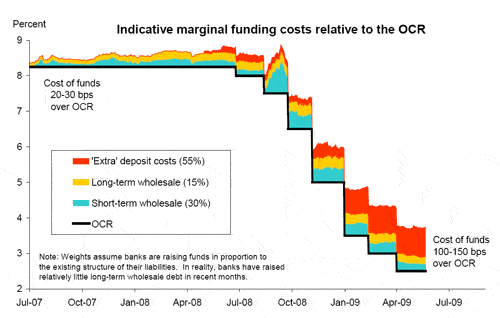
The Reserve Bank said a large part of the recent cuts in the Official Cash Rate had been passed on to household and business borrowing rates, but 100-150 basis points of higher marginal funding costs had offset some of the 575 basis points of OCR cuts. Floating mortgage rates have dropped to an average 6.34% now from 10.64% just before the OCR cuts from 8.25% to 2.5% started in July last year. That means the OCR has dropped 575 basis points, while the floating mortgage rate has fallen 430 basis points. That 145 basis point gap is at the upper end of the Reserve Bank's 100-150 basis point estimate of the increase in funding costs. The Reserve Bank made the point repeatedly in its analysis that banks focused on marginal funding costs in their interest rates decisions, rather than the average funding costs relied on in the Westpac analysis.

Marginal funding costs have increased to around 100-150 basis points over the OCR from around 20-30 basis points over the OCR prior to the onset of the global financial crisis (see chart below). That means upwards of about 100-150 basis points of the 575 basis point reductions in the OCR have been offset by increased funding spreads.

It was critical of Westpac's analysis.

There is useful information in the Westpac analysis of bank funding costs, but we take issue with the use of average funding costs as an appropriate basis for marginal pricing decisions. The interest rate on a bank's latest loan will more likely reflect current marginal funding costs than historical average costs.

The Reserve Bank analysis included a chart below showing indicative marginal funding costs marginal to the Official Cash Rate. This highlighted the extra costs of term deposits in recent months, but the declining margins on foreign wholesale funding. The Reserve Bank highlighted three funding channels where costs had increased for banks. Firstly, deposit rates had risen in recent months despite the falling OCR as banks competed for local funds against various bond issues
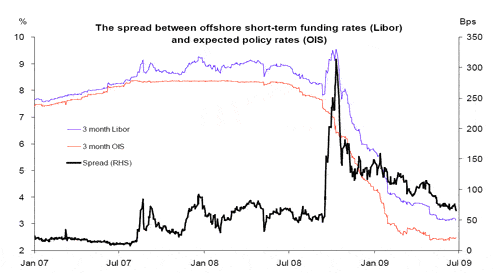
Six-month deposit rates were generally priced at around 40 basis points below six-month bank bill rates prior to 2008, but have recently risen to more than 100 basis points over bank bills.

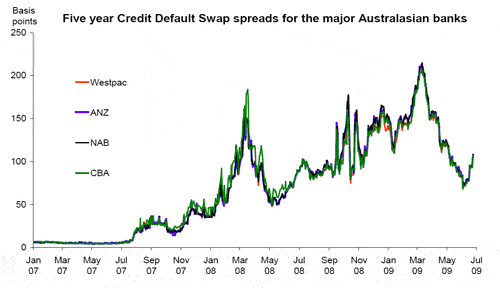
Secondly, short term wholesale funding had become very expensive in the immediate aftermath of the Lehman Brothers collapse, but had eased back in recent months as central banks pumped liquidity into global credit markets. Finally, long term wholesale funding costs had also risen since the Global Financial Crisis, although they had fallen from post-crisis highs as well.
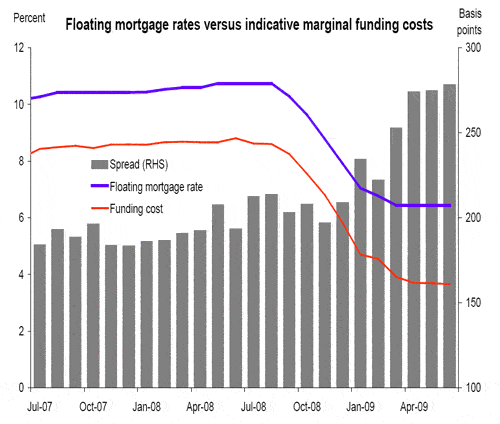
The Reserve Bank then showed a chart comparing marginal funding costs with floating mortgage rates. The grey bars are a measure of the net interest 'profit' margin on this lending.

Over the past several months the floating mortgage rate has lagged the fall in the marginal funding cost indicator, with the spread between the two widening. However, it is difficult to draw conclusions about this spread going forward "“ particularly given uncertainties around the exact composition of marginal funding costs at any particular time.
The Reserve Bank then published a chart showing what was happening to the marginal funding costs compared to fixed mortgage rates. Again, the grey bars show the profit margin on this lending. The Reserve Bank again took issue with the Westpac analysis around the issue of marginal funding costs.
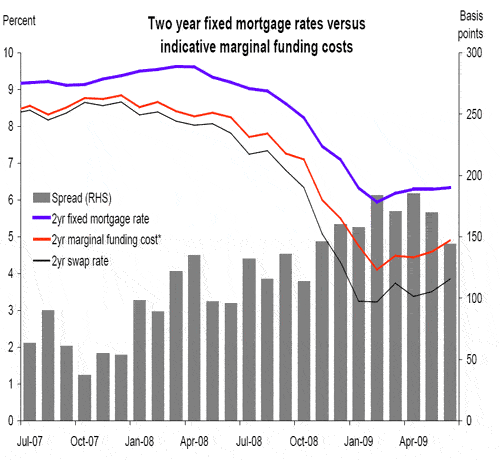
There is undoubtedly some smoothing of pricing on new loans relative to the short-term movements in marginal funding costs. Notably, banks did not raise rates in response to the implicit increase in marginal funding costs associated with the sharp widening in wholesale funding spreads during late 2008 "“ although the banks actually raised little, if any, wholesale funding during that period. However, the cost of funding existing loans is not the appropriate reference point for pricing new loans, particularly when the underlying wholesale interest rates are falling rapidly due to cuts in the OCR.

The Reserve Bank pointed out that its new Prudential Liquidity policy had pushed some banks to lengthen their funding and raise more domestically, which had increased their funding costs.

The shift the banks have made themselves over the past six months or so to more stable "˜core' funding sources has increased their marginal cost of funds, particularly through higher deposit margins. The new liquidity policy is consistent with this trend and will reinforce it over the long term. Some banks are already meeting the required core funding ratio and the others will have a two-year transition period. Accordingly, we do not expect the new liquidity policy to have a significant further impact on the banks' cost of funds. The policy is only likely to really bite in a cyclical upturn, when the banks might be tempted to revert to inappropriately heavy reliance on the short-term offshore markets to fund a rapid credit expansion.

And here's the Reserve Bank conclusion.

In contrast to many other countries during the global financial crisis, a large part of the OCR cuts have been passed on to household and business borrowing rates, reflecting the soundness of New Zealand banks. Marginal funding costs for banks have increased relative to the OCR, reflecting increased spreads for deposit and wholesale funding. We estimate that these increased spreads have offset 100-150 basis points of the reductions in the OCR. The factors influencing the banks' pricing decisions are complex and involve a range of trade-offs. On the one hand, banks must ensure that they earn an adequate rate of return on lending to reflect the underlying credit risks. On the other hand, if margins on loans are expanded unduly, this is likely to carry costs for the macro-economy and can hinder the efforts of monetary policy to stimulate economic activity. On balance, we believe the pricing of the banks' fixed-rate lending products is reasonable given the underlying cost of funds and taking into account the margins typically earned on these products over time. However, the pricing of floating-rate mortgages appears unusually high over recent months and we believe there is some scope for further reductions in these rates without compromising the viability of this lending.

Here's a link to a similar study of bank margins in Australia by the Reserve Bank of Australia. My view The core of the Reserve Bank's argument is embodied in the fifth chart showing the difference between "indicative marginal funding costs" and floating mortgage rates. The grey bars are the key measure for the Reserve Bank when it argues the banks have kept floating rates too high. I have asked the Reserve Bank for the spreadsheet underpinning this measure of the "indicative marginal funding cost" to see what it's made up of. The second chart gives an indication and includes some assumptions, including that 55% was 'extra deposit' costs, 15% was long term wholesale costs and 30% was short term wholesale funding costs. Also the Reserve Bank put the following note on the chart:

Weights assume banks are raising funds in proportion to the existing structure of their liabilities. In reality, banks have raised relatively little long-term wholesale debt in recent months.

The implication from this note is that the banks are funding from cheaper short term wholesale markets and from cheaper term deposits rather than expensive long term funding. The Reserve Bank doesn't know what the mix of the marginal funding costs is, particularly for April, May and June because the banks have not reported them yet. It is trying to find out. The activity in the market suggests the banks are taking notice of the Reserve Bank's direction to raise more of their funds from domestic retail savers through term deposits rather than hot short term money on foreign wholesale markets. That means the banks are competing hard for term deposits and this is pushing up their funding costs. Kiwibank announced today it was lifting its 4 month and 1 year rates to 4.6%. The average bank 1 year term deposit rate was 3.96% in February when the OCR was 3.5%. Since then the OCR has been cut to 2.5%, meaning this 'spread' has widened to 210 points from around 50 points. So what does this all mean? The Reserve Bank has made some assumptions and from that is saying that short term lending rates are higher than they should be. It doesn't say how much higher. Its problem is that its own analysis says that marginal funding costs have risen around 100 to 150 basis points relative to the OCR. When you look at the floating mortgage rate it is 145 basis points above where it should be if there had been no financial crisis. So where is the profiteering? The fifth chart appears to show the 'spread' rising around 75 basis basis points from its 'natural' level in the last three to four months. This is the key point. The Reserve Bank is suggesting that the banks are 'overcharging' around 22% of home owners (those with NZ$36.8 billion of mortgages on floating rates) by around 75 basis points or around NZ$275 million a year. This sounds like a big number, but a few tweaks in the Reserve Bank's assumptions or differences with reality could wipe that out. It is not the mass profiteering that politicians have implicated. It's also not the smoking gun that some might have hoped for. There's also an argument to say it's a price worth paying for the banks still growing lending at a time when banks elsewhere around the world are contracting lending and foreclosing on homeowners willy nilly. Your views and insights? We welcome comments and any further insights on this article and its source documents in the comments field below. Or if you want to remain under the radar please email bernard.hickey@interest.co.nz and we'll be in touch. We practice a form of collaborative journalism that aims to include the insights and expertise of our readers to improve our articles. That includes clearly identifying any errors and correcting them. We also update articles with relevant new information and commentary and will label our articles Update 2 etc. We know we don't know everything and we know we're not always right. We appreciate your help in constantly improving and deepening the knowledge and debate on interest.co.nz.

We welcome your help to improve our coverage of this issue. Any examples or experiences to relate? Any links to other news, data or research to shed more light on this? Any insight or views on what might happen next or what should happen next? Any errors to correct?

We welcome your comments below. If you are not already registered, please register to comment in the box on the right or click on the "'Register" link at the bottom of the comments. Remember we welcome robust, respectful and insightful debate. We don't welcome abusive or defamatory comments and will de-register those repeatedly making these comments.

84 Comments

That's a nice juxtaposition on

That's a nice juxtaposition on your main page Bernard - an RBNZ chart claiming to show that floating mortgage rates are too high because term deposit rates are less than 4%; followed by "Kiwibank raises deposit rates to 4.6%". Buh-bye, margins...

So the answer to the question

So the answer to the question asked in this article:

http://www.interest.co.nz/news/have-your-say-should-parliament-have-laun...

Is simply, YES, they should have. Because if you think JK imploring them to "try a bit harder", or Alan B pointing out that:

"...the pricing of floating-rate mortgages appears unusually high over recent months and we believe there is some scope for further reductions in these rates without compromising the viability of this lending."

Will actually have any impact - GET REAL! Standby for something like this in the next few days:

http://www.stuff.co.nz/sunday-star-times/business/2543110/Banks-feel-the...

And then no real change and more pointless jawboning thereafter.

Who is running this country?

Lets face it business lending

Lets face it business lending from banks is around 10% ,seems to me with the OCR 2.5% THE BANKS ARE GOUGING BIG TIME.

Good article, Bernard. To me

Good article, Bernard. To me the RBNZ email looked like they were trying to get themselves off the hook. In that, like you, they see that if they continue with a hard line against the Aussie banks' rates, the banks will simply reduce rates for part of their lending, but introduce a quota system for that part.
If a borrower wants a cheaper floating rate they only have to go down the road to Kiwibank; what's all the wailing about?

jill - yes: http://www.interest.co.nz/ratesblog/index.php/2009/0

jill - yes:

http://www.interest.co.nz/ratesblog/index.php/2009/06/16/inside-the-fina...

See information Bernard pointed out to me.

"try a bit harder" - about as much use as the Jobs Summit. (Sad thing the last lot were no better.)

Let the jawboning begin: http://www.stuff.co.nz/the-press/news/2

Let the jawboning begin:

http://www.stuff.co.nz/the-press/news/2569733/Pressure-on-banks-to-cut-f...

"Prime Minister John Key said yesterday that he was "trapped in an arm wrestle" between the trading banks, which denied they were padding their margins, and the Reserve Bank, which believed floating mortgage rates should be lower."

It's not difficult to have sympathy given he's an ex-plumber and may not really understand what's going on.

"He said the Reserve Bank was best-placed to find solutions to the problem, and it should discuss them with Finance Minister Bill English.
Key did not favour regulation."

Classic plumbers response - "I know it's leaking, but you need to talk with the drain-layer now."

"The Reserve Bank said that while banks must ensure they earn an adequate rate of return on lending, "if margins on loans are expanded unduly, this is likely to carry costs for the macro-economy and can hinder the efforts of monetary policy to stimulate economic activity".

It said it was continuing to talk to the banks "in order to clarify recent trends" and would report back in November." [What's happening then - another 'Jobs Summit' - might well need another by then.]

How many households and businesses might be under water by November?

Look, next time we elect a new Prime Minister let's go for someone who understands a bit more about econnomics and finance - seems like this one can't even deal with the odd few drips, never mind ....

Who is running this country?

"There’s also an argument to

"There's also an argument to say it's a price worth paying for" For the floaters? yeah right, thanks for that...

I mean where is the risk to the banks in a floater? they can raise the rate anytime they want, so little risk. Fixed interest rates are funded short term for longer terms....inherently there is risk there....more risk I would contend than in floating, therefore the spread should be larger in fixed, instead its "about right"....I really dont see why a flaoter should be paying 75 to 100 points (at least) to carry all the risk....

Jill: "Lets face it business lending from banks is around 10%" depends on how its lent...if its short term overdraft for fairly small amounts then yes, seems a bit OTT....however lending long term loans going into a bad recession with large cash flow problems and greatly (debt) over-geared businesses? Also look at the business bonds, they are paying 8+%. These are rates the businesses themselves are willing to pay investors to get capital....(and I think giving capital to someone to fund operational costs is nuts).....

John Kelly: Kiwibank has run out of money to do significantly more mortgages....it needs a cash injection....but its about the lowest at 5.99%....TSB isnt bad either.....but the days of 80%+ loans are gone....many ppl are in that boat, they cant move.

Les: How many households and businesses might be under water by November? - depends on a lot of things...houses with neg just have to sit tight, its small businesses who are in turn employers I am worried about....cash flow is always bad, and bigger companies tend to use smaller ones as free piggy banks....

steven - "its small businesses

steven - "its small businesses who are in turn employers I am worried about" - yes, it's because NZMEA recognise the value of, and empathise with both large and small productive enterprises/exporters as part of coherrent supply-chains, that I sponsor NZMEA and was keen to promote their business banking survey, in various places on this website. It's seems strange that Business New Zealand are so quiet on this matter:

http://www.stuff.co.nz/the-press/business/2424982/Banks-urged-to-show-an...

Or does it? Anyway, go Fed. Farmers - let's not wait till November:

http://www.mortgagerates.co.nz/article/976495342/farmers-prepare-to-squa...

As for:

"This is the time to start moving to solutions. If the Reserve Bank has some, let's present them to the Government," Mr Key said. (From Press article I quoted above.)

Various solutions have been presented to rectify NZ's ineffective monetary policy, but:

English defies the evidence on monetary policy, 20th Feb 2009, see here:

http://www.mea.org.nz/media/pressreleases.aspx

So what should we expect?

Les Rudd
Invited Member
NZMEA

Steven Yes, Kiwibank have had

Steven

Yes, Kiwibank have had to introduce a 'quota' for floating rates. So will any other bank that reduces their floating rate. There is only a very limited amount of NZ deposit funds that are prepared to accept <5% interest, so there is only a very limited amount of mortgage money around at <6.5%. It's not rocket science.

Alan bollard is trying to

Alan bollard is trying to justify why his magic wand is not working.

It never has and it never will. Remember his talking down the housing market in 2005/2006 ? His raising interest rates to 8% to "cool" the economy ? They all never worked. If anything worked it was perception. The market didn't "cool" but "crash" and not because of RBNZ interest rates policy...it's because the world came crashing down and dragged NZ with it.

Every Politician and Goverment officials thinks they can decide to something and everybody will follow....sorry folks there's no money where your mouth is !!
You also no longer have a big stick to carry while talking softly....(that's why they are shouting loudly and crying "shame" at the Bankers?)

The simple raeson why floating rates are high is because:
1. Banks want to make as much as they could to recover existing and future losses...

2. Interest rates is going up not down despite what every Central Banker wants to do, this will cause more business to drop dead and banks to write off losses...which business? ( I bet farm lending is one of them).We don't know so max the margins now and put up the reserves for future losses.

The simple solution for NZ is simply don't borrow if you can't afford it....if you can't make enough money to keep up with your interest payments, don't borrow...close your business. We are already too indebted a nation as it is...asking the drug dealer to lower his price so that you can have another shot of high is stupid and will eventually kill you !!

“This is the time to

"This is the time to start moving to solutions. If the Reserve Bank has some, let's present them to the Government," Mr Key said.

The Aussie cartel won't play ball on long term rates because they are pissed Labour terminated their tax rort. They have a perceived loss to recoup. John Key is waiting for RB to suggest he strengthen local kiwi banks with additional low cost capital.

http://www.stuff.co.nz/the-press/business/2576155/Banks-likely-t

http://www.stuff.co.nz/the-press/business/2576155/Banks-likely-to-tough-...

"The Reserve Bank concludes in this report that margins on floating rates are too high.

So what? There doesn't seem to be much point in using this rate at the moment. A far better option, if you want a short term rate, is to pick a six month term.

Westpac is offering six-months at 5.39% compared to its 6.49% floating rate, and Kiwibank is offering 5.45% v 5.99%.

The Westpac rate is fascinating as the spread, at 110 point is huge. I would also suggest that this is showing banks are mispricing floating rates. I can't understand why there is such a big spread between the two rates - surely the cost of funding for the two isn't that different?

You have to wonder if the banks are squirming over all this discussion and analysis over rates and margins.

Probably they are. But they may well decide to "tough it out" as the politicians and the regulators can't make up their minds what to do, and in the end probably won't do anything; and actually can't do anything other than to regulate rates."

Squirming? Hardly, leave that to RBNZ and govt - no wrong again, they couldn't really care less.

Correct - "politicians and the regulators can't make up their minds what to do, and in the end probably won't do anything"

It's time we really backed

It's time we really backed our own nation.

We beg for money printed into existence in foreign lands, against dubious assets, that are loaned into high yielding countries like New Zealand and our economy goes backwards as a result.

A quick look at the UK market and you could borrow 15 year fixed money at 3.87 %.

So ask why we are borrowing at 6.49% on floating. Our economy may not be world class right now but the UK is not exactly stella. This premium is unjustified and bank enquiry, for the people by the people would expose exactly that point.

Only 85% of the respondents in the NZEMA survey wanted it. I guess thats a minor point really as it just says the doers know they are being done.

Selwyn Did you check out

Selwyn
Did you check out the terms of that deal in the UK? Currently mortgage interest rates range from 2.75 - 9+%, a huge variation that is determined by perceived risk. The sub 4% deals are usually for those with more than 40% equity/deposit (think 60-70% in 2007 terms), secure paid employment (hmmm), spotless credit history (no late payments ever) and considerable other risk lowering factors (like keeping 50K on term deposit with that bank). As you will quickly be able to work out, only a tiny % qualifies for these deals and the ones that do probably don't need it. Banks are still not lending here - all that QE money has gone into big black hole called the banking industry. Banks are now exacerbating their own exposure to the malaise in the general economy (which they created). You can only imagine how taxpayers are feeling. Bankers currently share the social status of paedophiles with MP's (left & right) bumping along the bottom of the social ranks. I guess what astounds me is that Aussie banks are still lending in NZ, although I do assume they have strategy to suddenly pull the plug. They can't be that stupid - can they? I vote former G S's employee Aleynikov - most ethical player of the year. The irony is he will end up in jail.

Official interest rates and mortgage

Official interest rates and mortgage rates compared worldwide

http://www.nzherald.co.nz/business/news/article.cfm?c_id=3&objectid=1058...

Just think, things could be a whole lot worse if in NZ we couldn't write off residential property losses against income and we had a effective asset taxation, eg CGT/LVT or both. Crumbs, if those two aspects of our taxation structure were REVERSED - maybe we'd only be able to MEET THE MARKET or AFFORD to pay at rates similar to our peers who do 'ring fence' property investment losses and have asset taxation. Meaning our i.rates could be lower - to the benefit of many KIWIS* especially those trying to run productive enterprises in our 'asset tax haven'..

Maybe that extra 'gouge dosh' wouldn't be simply gifted across the Tasman to the 4B's shareholders, but instead be used here in NZ to the benefot of us all - business, pensioners, X&Y's and FHB's. Plus, our currency would trade lower and be less volatile. Think about it.

* even savers.... Think about it

Joe - you said "The

Joe - you said "The Aussie cartel won't play ball on long term rates because they are pissed Labour terminated their tax rort. They have a perceived loss to recoup. John Key is waiting for RB to suggest he strengthen local kiwi banks with additional low cost capital."

I would suggest you got the first bit right but the put up or shutup comment by JK to the reserve bank was less about give me something to fight the international banking network as it was about shut up and except what is generally accdepted worldwide best practice.
Because incase everyone hasn't figured it out just quite yet, he works for them, not for us. He is here to ensure what is left of our national assets ends up in private hands. Kiwibank will not be used to protect, but will be one of the first to go as it give us a means to distribute our own money supply in quick time should the sheoples of this nation realise we have the sovereign right in existing legislation to do so.

"John launched his investment banking career in New Zealand in the mid 80s. After 10 years in the New Zealand market he headed offshore, working in Singapore, London and Sydney for US investment banking giant Merrill Lynch. During that time he was in charge of a number of business units including global foreign exchange and European bond and derivative trading. In 1999 John was invited to join the Foreign Exchange Committee of the Federal Reserve Bank of NY and on two occasions undertook management studies at Harvard University in Boston."
http://www.beehive.govt.nz/minister/john+key?bio=1
Career
Investment banker, New Zealand for 10 years
Investment banker, Merrill Lynch 1995-2001
Member, Foreign Exchange Committee of the Federal Reserve Bank of New York 1999-2001
http://www.parliament.nz/en-NZ/MPP/MPs/MPs/b/e/f/49MP78101-Key-John.htm
John Key - The Unauthorised Biography
Weekend Herald Sat July 19 2008
Into the big time
Bellotti made him global head of foreign exchange and he revolutionised the "blue blood" investment banking sector. "There was this massive opportunity to cross-sell the firm," says Key.
"We'd go to these fund managers and we'd talk to them about equities, but we wouldn't necessarily leverage foreign exchange - and when we did, they'd say our capability wasn't that good.
"So I wandered up to London and said, 'we're going to go interbank FX - make prices to the other banks'. Morgan Stanley, Goldman Sachs and Merrill Lynch, the blue-blood investment banks, didn't do that," he explains. "We actually took on the big banks, Citibank, Chase, then we went and hired their staff and went to their clients and told them 'look, we've got all those same capabilities as Citibank in FX and options. Plus we had this beautiful thing going because we were the first to supply margin trading to big hedge funds. We had the capability to cross-sell them several products using one bit of margin."....................Back in the late 1990s Key was in his element, working at the centre of the universe for FX. He presided over around 140 dealers trading billions of dollars a day. The Asian markets came in in the morning and New York in the afternoon. "Within two years we went from being 43 in euromoney to number three," Key says...............Geoff Massam, a New Zealander then running the IT part of Merrill Lynch's FX business, now with Deutsche Bank in Connecticut, remembers how Key would be on the phone to the Governor of the Reserve Bank, Don Brash: "Though he wouldn't do it in a name-dropping way - he was talking to people like that all the time."
Massam believes Key's knowledge of the global economy would give him a "huge advantage" in running the country.

Yet JK claims claims he never had a clue of the global impending global economic turmoil and is now using it as an excuse to renege on most everything they campaigned on and is now brought back the asset salesmen under instruction from our receivers, his banker brethren.

Go on Ian, say what

Go on Ian, say what you really mean. Don't hold back... but is JK the right target.

Selwyn the man claims that

Selwyn the man claims that what caused the current global credit crunch happened after his watch at Merrill and FED, but on radio live interveiw with Willy and JT he said that the blame sits with decades of bad banking practice out of Wall St;
John Key - The Unauthorised Biography
Weekend Herald Sat July 19 2008
Into the big time
Remembers Bellotti: "I brought him to London and he shot the lights out there too. Within three to four years Merrill Lynch, London, was regarded as one of the premier businesses."
Key explains: "I had a whole lot of people working for me who were at the cutting edge of delivering quite complex and new and innovative products. They tended to either be a new product or into a new market, usually the emerging markets, Russia, Brazil, Argentina. I wasn't the guy sitting there dreaming it all up, but I was the guy who was responsible for those people." Did he foresee the problems which resulted in the sub-prime crisis? "Was it hard to predict? Not really."
The products which underpinned the sub-prime boom - then bust - were hatched in 2004-2005, long after Key had left Merrill. Indeed, he says when he went back to London in 2007 he was "horrified" at the level of risk Merrill was running. "It was enormous and I just didn't think that enough had changed to warrant that level of risk."

Willy Jackson and John Tamahere interveiwed John Key on afternoon of 5 Nov 2008. Here is an answer given by John Key re what caused the credit crisis. It should be remembered that at about this time in the election campaign he was batting away questions from Labour in regard to his career at Merril Lynch 7 years ago as being that long ago there is no way he could be tied to having any contribution to the current Credit Crisis;
Caller Matty asked John Key what he thought got the world into this position(Credit Crisis) John Key replied;
"Relatively quickly, you had a massive expansion of credit over the last decade or two, so basically the banks have gone and leant miles of money engaged in very risky behaviour, they have done it to to much of an extreme and whats happened is that eventually the chickens have come home to roost and its all imploded and yup, you know Wall St its got to take rensponsibility for its own excesses and its got it wrong, the good news is from New Zealands point of view is our banks haven't really engaged in that kind of behaviour and dont have exposure to the kind of counter parties that fell over, but unfortunately Mum and Dad owe a lot of money, not the government, the governments not at all indebted really, but Mum and Dad are and whats happened is that liquidity to fund their borrowing is drying up".
John Tamahere asks;
"Ok, oh, exposure to the Australian banks".
John Key replied;
"Yeh, look I tell you the thing with the Australian banks is, it, um we need to, ah in one sense weve got a bit of strength funnily enough, I know people, I mean I support KiwiBank, we are not selling it, we never going to sell it, but, but I do support the fact that because the Australian banks have quite a big part of our market, because they a bigger, theyre just bigger organisations thay can actually weather these storms a little bit, theres some upsides, I know a lot of people dont like them, but there are some upsides to having them in our economy. Secondly, we just got to make sure that, that wholesale guarantee which allows the New Zealand subsidiaries in their own name to be able to raise capital to be able to operate and weve got work with, not because we are trying bailout the banks, no one should be under that illusion, but if they cant borrow they cant lend and our economy is going into depression if that is the case."

I am not out to nail anyone in this nation who does not deserve it.
Both the major parties in this country are holding a phoney war as they both cant debate the real issues in public because they are both complicate in the cause of our ever increasing subservence to foreign lenders, acceptable if those foreign lenders did something to earn what they loan and lend it in good faith with consideration for both sides of the contract, but completely unacceptable when they are abusing the conditions of credit surrounding a credit creation mechanism and making something that should work to improve the lifes of all only work to improve the lifes of a tiny few.

Have a nice day, I am off to get back on the hamster wheel to earn my 35c after debt servicing portion of tax, rates and debt priced into goods and services.

Selwyn - also read this,

Selwyn - also read this, then tell me I'm wrong?
http://www.interest.co.nz/ratesblog/index.php/2009/07/08/special-report-...

Bollard wants banks to front

Bollard wants banks to front up over rates

http://www.nzherald.co.nz/business/news/article.cfm?c_id=3&objectid=1058...

"Government MPs voted against an inquiry into banks' variable rate mortgage margins this month despite hearing from Reserve Bank Governor Alan Bollard that an explanation from them would be "very helpful".

Funny that, eh...

"When asked by Labour Party finance spokesman David Cunliffe how he felt, "in the full light of inquiry" if Parliament were to "seek to shine some sunlight on banks' accounts", Dr Bollard said: "It would be very helpful if the select committee were to hear from the banks on this."

Funny that, eh....

"In its report published yesterday, the committee urged banks to reduce their short-term lending rates further.

Urged to "try a bit harder" - this is funny, quite laughable in fact - dream on dudes....

"Unduly high interest rate costs could lead to the closure of businesses that may be fundamentally sound but may be experiencing short-term liquidity problems due to the current economic environment."

Not so funny, eh....

Who is running this country?

It's not an ex-plumber is it?

http://www.interest.co.nz/ratesblog/index.php/2009/07/06/rbnz-says-fixed...

Hang on Les, “Unduly high

Hang on Les, "Unduly high interest rate costs could lead to the closure of businesses that may be fundamentally sound but may be experiencing short-term liquidity problems due to the current economic environment."
is doublespeak for :
'some businesses were massively overleveraged and gambled on the cheap and easy credit continuing forever and had bloody awful financial management and were failures waiting to happen and therefore were fundamentallly UNSOUND and their liquidity problems are entrenched and they cannot trade their way out of their debt positions, so the banks should prop them up with more cheap credit and we can all pretend nothing ever happened and the bosses running them can go on creaming fat salaries and wasting resources.

Yeh Wally, there'll no doubt

Yeh Wally, there'll no doubt be some like that.

However, the kinds of businesses I'm thinking of are typically more conservative, because they know they are up agin it most of the time anyway - taxation and resultant investment dynamics in no way favour them, just as mon. pol (NZD vol.) does not; eg. sme (even some larger) techs. and exporters. My concern is that if banks are effectively charging 'gouge' level rates, instead of 'market' rates, they get canned unnecessarily - when these are typically the kinds of businesses we need to nurture to help broaden and re-risk our export mix. If they get canned at 'market' rates - yeh, tough, that's Mr Market doing the evolutionary adaptive thing. Which is why I'd not advocate 'subsidisation' beyond gap closure in market-failure situations, hence the banging of another drum around asset taxation and asking people to consider the damage done to the wider productive sector (as well as NZ Inc) by 'the subsidy that got away'.

It's the "Unduly.." bit that is the concern - and Dr B seems to be sending smoke signals loud and clear - so why can't the plumber and the drain-layer get some water on the fire to dampen things down a bit?

But that's the point Les,

But that's the point Les, "the kinds of businesses I'm thinking of" as you say are the very ones that should have planned for a downturn and reduced their debt positions long before the collapse. Instead, what we have is a screaming demand for more credit to be provided at lower rates. Utterly insane behaviour for any bank to compound its stupid lending behaviour in the bubble, with yet more of the same in an obvious depression event that sees Mr Market dishing out the dirt on those that built their profit palaces on other peoples money. And that goes for Noddyland as well. We as a country are on the receiving end of a bloody good bashing thanks to stupid useless govt for the last 9 years.

“Banging of another drum around

"Banging of another drum around asset taxation and asking people to consider the damage done to the wider productive sector"

Les, would you agree that shifting or widening the tax burden increases local inflationary pressures?

Wally, maybe this sentence: “Unduly

Wally, maybe this sentence:

"Unduly high interest rate costs could lead to the closure of businesses that may be fundamentally sound but may be experiencing short-term liquidity problems due to the current economic environment."

may have been more accurate with the addition of, ..."and in their particular cases, problems caused by interest rates above a rational market rate."

We may have to agree to disagree perhaps, but I do fully agree with the last sentence in your previous comment - things could be a whole lot better for NZ. It seems ironic that our plumber and drain-layer are getting so much of a panning after only nine months on a very difficult site, a site left by a couple of cowboys and with more foundational, structural and 'leakiness' than we may yet be able to cope with.

In addition to the bank

In addition to the bank margin argument, perhaps there is an opportunity where banks could offer additional types of mortgage products to be competitive. One thing I would like to see is more published discounted rates based on the amount of capital the home owner fronts up with. I know some banks partially offer this (with a little "*" by the rate), but typically this is something that needs to be negotiated.

This could be good for the economy as it would encourage homeowners not to over commit, and encourage them to reduce their debt to get better rates.

However I guess there is a valid reason why we don't see this in NZ (perhaps the market is too small?).

Chairman - "would [I] agree

Chairman - "would [I] agree that shifting or widening the tax burden increases local inflationary pressures?" Assuming you by "local inflationary pressures" you mean increased property prices if a CGT were applied - no. It would mean some specualtive investment would be deterred and some funds invested elsewhere, meaning less speculative funds chasing up house prices and asset bubbles. The effect is described here using another means, but the result, particularly in NZ's context of a sparse investment landscape, would be the same:

http://www.interest.co.nz/ratesblog/index.php/2009/07/06/opinion-local-g...

(I'd be keen to see us do that kind of thing too, that is, a robust, money volume tool to supplement the OCR.)

The benefit of broader taxation is:

http://www.interest.co.nz/ratesblog/index.php/2009/07/06/opinion-local-g...

Who wouldn't we want a flat tax of 23%?

Surely that'd be good for individual income earners and businesses that derive their income primarily by productive efforts rather than say, capital gain via passive/low-profitability asset investement?

The former two groups subsidise the latter - via 'the subsidy that got away' - why should they tolerate that situation?

Cheers, Les.

When they become available the

When they become available the bank disclosure statements for the full year (June 09) should tell an interesting story that is not evident just yet. ;-)

Les, I have no problem

Les, I have no problem with CGT; it's a land value tax that raises concerns

However, in saying that, a CGT is not guaranteed to stop speculation and could have the opposite effect with some or all of the tax burden being added to the price of housing as vendors try to recoup costs.

We would all like to see a lower tax rate but not if the larger picture simply means we'll be paying more elsewhere to cover the shortfall.

There is also concern about the benefits of the tax shift heading offshore.

Les, here is something to

Les, here is something to ponder - A more cost effective way to divert investment funding into production.

Speculation needs funding and a more cost effective way to ensure investment funding is diverted into the productive sector is by addressing the funding itself.

To correct the imbalance, the financing of funds needs to be prioritised. Loans for production that targets offshore revenue should be favoured as opposed to funding speculation.

Yes but how Chairman. Regulation!

Yes but how Chairman. Regulation! We can see the problems but banks are not there to help us they are there to make a profit. Unless you have a magic formula I suspect that's not going to change

Chairman - "a CGT is

Chairman - "a CGT is not guaranteed to stop speculation and could have the opposite effect with some or all of the tax burden being added to the price of housing as vendors try to recoup costs."

Consider this from this paper 'Asset Tax and Productivity - updated, 26 Nov 2008' that I referred you to at:

http://www.interest.co.nz/ratesblog/index.php/2009/06/26/bernard-hickey-...

"The absence of tax would see investment flow to the most productive areas of the economy, and all investment decisions would be driven by the anticipated tax-free return. In the presence of taxes, investment returns must take tax into account, which alters the investment choice between different classes of assets, distorts decisionmaking, and often acts as the critical element that determines a particular investment."

Given our enconomy is a bit like a three-legged milking stool:- primaries - with low value add component and some operators dependent on asset cap. gains to make it worthwhile; tourism - again, asset laden; property investment - say no more. So with no effective asset taxation, where would you invest funds, in an economy like NZ's? Change that and watch the apparent value of said assets normalise to more rational levels consistent with their ability to generate returns from productive activity.

"We would all like to see a lower tax rate but not if the larger picture simply means we'll be paying more elsewhere to cover the shortfall."

Why not? Why should individual income earners and businesses that derive their income primarily by productive efforts subsidise those not being taxed on capital gain? The subsidisation effect must be significant to equate to a flat tax of 23% across ALL revenue streams - don't y' think?

"There is also concern about the benefits of the tax shift heading offshore."

I covered that in the thread linked above.

"To correct the imbalance, the financing of funds needs to be prioritised. Loans for production that targets offshore revenue should be favoured as opposed to funding speculation."

Which brings me to:

"Assuming tax will always be with us, the objective could be to minimise the taxation impact on investment decisions, or perhaps to encourage the behaviours that might lead to more desirable investment outcomes in the medium term, including spill-over benefits. In general, taxation distorts investment decisions, so the question is should tax policy seek to minimise distortions or should certain distortions be targeted as desirable?" From the paper mentioned above.

Forget targetted loans and grants - it's better done by tax crediting 'winning behaviours', given if they ain't making the revenue with good market focused products and services, they ain't winning in the market - don't support em'. If Mr Market has picked em' as winners, because they are behaving in winning ways - let em' keep more of the revenue they generate to re-invest in doing more of the same. In this regard I'd also tax credit private 3rd party funding that support companies engaging in 'winning behaviours'. Again, Mr Market decides - and Mr Market is better at these decisions than civil servants and indeed certain types of lenders who have no skin in the game because they are only using OPM with zippo consequence to them.

Cheers, Les.

Les, I agree with the

Les, I agree with the CGT issue, but you can address that by using the revenue collected from CGT to go towards say a first home owners grant to build a house. This will rebalance prices and reduce speculation while still adding to the housing stock, which is more productive than simple housing transactions.

It also helps Gen X & Y purchase the family home.

Israel, IMO I think grants

Israel,

IMO I think grants to FHB's would result in a direct increase (inflation of) the market floor price, by the value of said grant/grant's effect, and therefore have a neutral, if not, reducing effect on affordability.

With specualtion deterred in the FHB market, affordability would improve, likewise the same if we can simply we keep more of our own cash to do with what we choose, (23%) which for some would be investment in productive activity, of increased/increasing value, meaning returns and incomes improve, thereby addressing both ends of the affordability ratio. Add in effective monetary policy and appropriately deconstrain land supply and the only Grants we'll need is on the rocks with a good cigar.

Cheers, Les.

Les, this is the problem

Les, this is the problem I see. In New Zealand, many individual income earners and those that own businesses (the large majority of NZ businesses are small) are also landlords.

Why would they want to pay a new tax on land that only generates rents which is already taxed?

And it's only natural to presume they will try to recoup the burden, hence inflationary pressures will be passed on back to the productive sector eliminating the benefits trying to be achieved (reducing production costs).

Moreover, many feel safe being landlords and with the current economic climate and state of market regulation, don't really fancy investing in production. If they can pass the tax burden on they won't divert in a hurry.

Targeted tax subsidies for New Zealand owned companies that meet strict criteria are fine (to an extent) because the shortfall will be met by the overall long-term gain.

Regulation? Indeed, when correcting imbalances

Regulation?

Indeed, when correcting imbalances balanced regulation is needed.

Selwyn, there are times when private sector interest needs to be brought into line with the overall national interest.

If this was done long ago we wouldn't be facing half the problems we face today.

Chairman - responding to your

Chairman - responding to your points July 9th, 2009 at 6:39 pm , see:

http://www.interest.co.nz/ratesblog/index.php/2009/06/26/bernard-hickey-...

"there are times when private sector interest needs to be brought into line with the overall national interest."

Yep, about 60% of taxpayers as I recall, from an assessment made by Bernand in a discussion article I referred you to in the Alison Mau thread, where we covered the same ground.

Yes, if 'the sudsidy that got away' had been caught and dealt with by now, you are right we'd not have to deal with many of the problems that now face us.

Cheers, Les.

MP's deliver banks another wet

MP's deliver banks another wet bus ticket slap

http://www.sharechat.co.nz/article/387bd5a0/mp-s-deliver-banks-another-w...

"The select committee that baulked at holding an inquiry into whether trading banks are unduly holding up interest rates has issued a report expressing deep concern about the banks' behaviour."

Hmmm, funny that.... Move along that bus...

Talks held on growth of Kiwibank

http://www.stuff.co.nz/national/politics/2580792/Talks-held-on-growth-of...

"The Government has discussed expanding Kiwibank amid calls for it to beef up the state-owned bank to help push interest rates lower.

Kiwibank spokesman Bruce Thompson confirmed discussions had taken place between Kiwibank parent company NZ Post and the Government on its progress and growth."

"The Reserve Bank has repeatedly urged banks to cut rates, after they ignored a 50 basis-point cut to the official cash rates in April, taking it to 2.5 per cent.

Analysts have pointed to Kiwibank's influence last year, when it led rates cuts and aggressively competed for business, suggesting a capital injection from the Government could spark another round of cuts."

Analysts? Any plumber or drain-layer could have come to this conclusion - but will No.1 and No. 2 see how to deal with the leak?

(Never say never I guess.)

John Armstrong: National sees little

John Armstrong: National sees little profit in bank row

http://www.nzherald.co.nz/opinion/news/article.cfm?c_id=466&objectid=105...

"Technically, the decision by Parliament's finance and expenditure select committee not to investigate why the banks had not passed on the Reserve Bank's last cut in the official cash rate to those with floating mortgages was one for the committee's members to make.

But everyone knows the National-Act-Maori Party majority was following the Finance Minister's dictates in shooting down the initiative promoted by David Cunliffe, Labour's finance spokesman."

Hmmm, I thought one purpose of Select Committees to be independent enough from government to provided the kind of checks and balances other democracies enjoy via a second house?

Funny that...

Bernard, good article. Can't see

Bernard, good article.

Can't see brick wall for houses

http://blogs.nzherald.co.nz/blog/show-me-money/2009/7/11/cant-see-brick-...

"but few people are looking at how much the banks are lending and connecting that to what is happening in the housing market."

Maybe it is as they say, they are not profiteering at the margin and so to make a decent crust simply have to ramp up the volume? What other reasons could there be. They can of course because monetary policy is ineffectual with has no effective money volume control.

"Egged on by the Reserve Bank's record cut in the OCR, banks are pumping up the housing bubble again with low fixed mortgage rates. New Zealand has learned nothing in the past two years of hand-wringing about over-valued housing and how unbalanced the economy has become."

Yep, ineffective monetary policy....

English defies the evidence on monetary policy, 20th Feb 2009, see here:
http://www.mea.org.nz/media/pressreleases.aspx

"Yet again, the New Zealand obsession with borrowing money to buy property has trumped any shift to invest in productive assets that will grow the nation's wealth and incomes over the long run."

"Meanwhile the domestic, consuming, uncompetitive parts of our economy continue to forge ahead of our productive, competitive parts of the economy."

"When will it stop? Eventually our ability to repay our foreign debt will overwhelm us and finally be noticed by a ratings agency which won't be sweet-talked by a Prime Minister."

Not to worry, they'll probably just tell us to, "try a bit harder" - it seems to be working for some.

Who is running this country?

John Walley: Regulators must address

John Walley: Regulators must address wide unhappiness with banks

http://www.nzherald.co.nz/business/news/article.cfm?c_id=3&objectid=1058...

Extracts:

"A circle of complaints, reprimands and inaction has developed around behaviour of the banking sector since the dramatic drop in the Official Cash Rate (OCR) over the past year.

In a survey carried out by the New Zealand Manufacturers and Exporters Association (NZMEA), 86 per cent of respondents supported an inquiry into competition in our banking sector, the role of Kiwibank, the factors that negatively affect the real economy and the volatility of our currency.

The obvious solution to this problem is for the Government to increase the state backing of Kiwibank so that it can increase its market share. Kiwibank also gives the Government a vehicle with which it can look to increase competitiveness in the retail banking sector.

Balancing the tax take is part of the solution to the excessive demand for credit. If capital gains are taxed along with all other forms of income, then it will become less attractive for investors to borrow in order to invest in that asset class. This will also have the added advantage of freeing up more credit for the real economy, which helps to grow real wealth and spread that wealth around through more and better employment.

The Reserve Bank needs an additional tool to restrict access to credit. This tool would limit credit volumes in addition to controlling the price of credit as the OCR does currently. Several methods of volume control have been suggested, including a Variable Excise Tax, a variable savings scheme and a variable GST rate. These options all have the same effect of reducing the volume of money when inflation is high and increasing the volume when inflationary pressures subside.

An additional option is for the Reserve Bank to vary the reserve ratios it requires banks to carry according to the economic circumstances. This would mean that higher reserve ratios would be carried over "boom" years and these would be lowered in times of limited credit.

Opposition to an inquiry is difficult to understand, given the obvious impact of credit problems on the economy. As Finance Minister Bill English has said, the tradeable sector of the economy has been in recession for five years. Monetary policy issues and broader policy incentives are at the heart of this problem."

A submission for your Top Ten at 10 Bernard! A must I would have thought...

Cheers, Les.

(PS - I think there's even some stuff in this one about 'the subsidy that got away' - hit the link...)

Les, as your link suggested,

Les, as your link suggested, an effective capital gains tax coupled with additional tools to restrict the access to credit would meet the desired objective. Putting an end to the "subsidy that got away"

A land tax however, is akin to robbing Peter to pay Paul. In New Zealand, many skilled people and business operators are also landowners. Will they buy into this musical tax (a new land value tax on land owned to see income tax reduced)?

Placing the tax burden on New Zealand landowners while reducing (foreign owned but locally operated) company tax won't help the balance of payments.

Is a musical tax (a shift to a land value tax) really the best we can come up with?

Will it really produce the overall desired results?

Chairman - I think we

Chairman - I think we are agreed that we do need asset taxation, to rebalance investment incentive away from simply holing passive assets, toward productive activity. No matter how such might be applied, whether a CGT, LVT or mixture of both, care would need to be taken not to cause perversion of the rebalancing objective. However, it could be done, if there is the will, there is certainly precedent, as many have observed, and there are the clear thinking minds available. The problem at present is the will.

As for your point about more earnings heading off-shore because of a lower corporation tax, I suggest this in itself in an outcome of our inadequate policies over the years, leading to less sovereign ownership. The relevant polices need to be changed, as discussed, here and elsewhere. I don't think corporation tax should have been greater and we should not increase it simply to retain more earnings onshore. I guess you are not suggesting that.

Cheers, Les.

Scoring points from left-field http://www.nzherald.co.nz/busines

Scoring points from left-field

http://www.nzherald.co.nz/business/news/article.cfm?c_id=3&objectid=1058...

"To the Finance Minister's retorts that there was little to be done and an inquiry by backbench MPs was not going to bring down interest rates, Cunliffe fairly pointed out that if banks did not pass on OCR cuts then monetary policy was not working and perhaps it was time to ask whether the OCR was the appropriate tool.

The exchange had been triggered by a question from the floor about how, if at all, the Government could address the volatile kiwi dollar - one of the major concerns of Mood of the Boardroom survey respondents.

One has to admire English for his honesty, but "we're open to suggestions" is possibly not what business wanted to hear."

Oh Bill puleeze, pull the other one....

Les, Bill is not a

Les,
Bill is not a stupid man and he has been around for a long time so knows the ropes.

So why is he out of step with both the Left (Cunliffee and co) and apparently the right (if the boardroom survey is anything to go by) and his officials everywhere on the subject of a review on banking practices / Monetary policy and ill add Kiwi Bank and the exchange rate to round it out into something worth doing.

If you want some suggestions Bill....."Have an enquiry along the lines of the 1956 Royal Commission and let's identify "accurately" what the problems are and then we can progress to solutions and you can carry the entire country with you.

It really begs a huge question why Bill won't do this and if anyone knows the answer, PEC, NZMEA, Treasury and the Governor of Reserve Bank are all ears. Is Bill that smart that he doesn't have to answer to us. Sounds a tad arrogant to me and that's what we said of the last Government, so it's a pot hole Bill should surely avoid.

You’re right Les, I’m not

You're right Les, I'm not suggesting that. Nevertheless, capital flight (in the form of profit heading offshore) is significant. It's detrimental to our economy and growing annually. The last thing we can afford to do is to inanely add to its growth, therefore should not be overlooked in the parliamentary process.

"Care would need to be taken not to cause perversion of the rebalancing objective"

Indeed.

Chairman - "capital flight (in

Chairman - "capital flight (in the form of profit heading offshore) is significant." I agree, and we need to take a lt view on fixing it. To me that means lower corp tax and incentives for 'winning behaviours' so that more firms develop and are maintained in NZ ownership. We've drapped the ball on that one, time to pick it back up. Cheers, Les.

Selwyn - "Have an inquiry

Selwyn - "Have an inquiry along the lines of the 1956 Royal Commission and let's identify "accurately" what the problems are and then we can progress to solutions and you can carry the entire country with you."

Sounds like a good idea. Given recent performance however Bill might need some help to get this off the ground.

I reckon a CIR could help him out - because I don't see it happening any other way, and because such are not binding, it may not happen even with a CIR. However, election results are binding ....

1) Anyway, who would be up for signing a petition for a CIR to initiate the kind of inquiry into NZ's banking system mooted above?

(Note - the recent NZMEA banking survey sat at 86% in favour on the related question in that work.)

86% support inquiry into financial sector - survey, 2nd July 2009, here:

http://www.mea.org.nz/media/pressreleases.aspx

2) Any other suggestions for an appropriate referendum question/s?

3) Would you like to be a signature collection co-ordinator?

If so indicate your commitment here on Interest .co.nz and via:

http://www.mea.org.nz/contact.aspx?subject=Feedback

Put 'Volunteer CIR signature collection co-ordinator' in the text box and if we need to go this route we'll get back to you.

Don't forget our real problem is not Bill E, John K, David C, Phil G, Alan A, the 4 Auzzie Banks - it is our own APATHY.

Please pass this comment on via email to folk you think might want to help and ask them to respond to the three questions I've asked here.

Cheers, Les.

What's required Les....Is it 300K

What's required Les....Is it 300K signatures or a different figure?

Les I'm not a fan

Les

I'm not a fan of parliamentary inquiries or commissions or CIRs.
Happy for a debate, but I don't want my money spent providing a platform for embedded interests to yell at each other.
I also think our banking system is not broken.
Our tax system is broken.
Our economy is unbalanced.
We'll be forced to rebalance by a credit rating downgrade.
A pity. But the market has a way of working itself out.

cheers
Bernard

Selwyn - the rules say,

Selwyn - the rules say, "A referendum is required if 10% of enrolled electors sign a petition calling for a referendum." - which I believe approximates to 300k, which I recall was the kind of figure mentioned re. the current CIR re smacking.

Bernard - hear what you say - if you want to remove my comment, that's fine by me. We'll understand.

Cheers, Les.

Les, incentives for ‘winning behaviours’

Les, incentives for "˜winning behaviours' don't necessarily have to be tax incentives. But yes, we do need to further develop our export sector.

This is where I think government participation is needed. The government is better placed (having the resources) to help get some new productive investment ventures off the ground.

I'm sure you heard the talk about listing SOEs, giving mum and dad investors something to invest in. Well, instead of selling us something we already own and trying to capitalise off ourselves (paying more for power so we can earn a better return), we need to be looking at new exporting ventures.

This will not only widen the scope of investment but will give many more an opportunity to earn capital offshore.

Chairman - from my comment

Chairman - from my comment July 9th, 2009 at 1:19 pm

"Forget targetted loans and grants - it's better done by tax crediting "˜winning behaviours', given if they ain't making the revenue with good market focused products and services, they ain't winning in the market - don't support em'. If Mr Market has picked em' as winners, because they are behaving in winning ways - let em' keep more of the revenue they generate to re-invest in doing more of the same. In this regard I'd also tax credit private 3rd party funding that support companies engaging in "˜winning behaviours'. Again, Mr Market decides - and Mr Market is better at these decisions than civil servants and indeed certain types of lenders who have no skin in the game because they are only using OPM with zippo consequence to them."

"Mr Market is better at these decisions than civil servants" - just look at the colossal wasted opportunity perped by the last government... They tried a 'centrally planned economy' approach - it didn't work. So hence my point,"let em' keep more of the revenue they generate to re-invest in doing more of the same."

Cheers, Les.

Bernard says.... 1. I also

Bernard says....

1. I also think our banking system is not broken.
2. Our tax system is broken.
3. Our economy is unbalanced.
4. We'll be forced to rebalance by a credit rating downgrade.
5. A pity. But the market has a way of working itself out.

Well Bernard the banking system working (or not) is an opinion based statement. 2, 3 we agree on and 4 and 5 may are probable after JKs less than stella speech today. All Hat and no Horse I think is the saying.

Banks are working as it always have, except that we now have huge global's able to play games with small economies like New Zealand.

Small local banks are our friends (in days of old) as they ate from the same rice bowl. Economy bad, they do bad, economy good they do good, that's not the case today.

Perhaps we should replace your opinion (and mine) with qualified debate. We have a lot of beliefs in New Zealand and I just want some solid facts from an independent source so I would strongly support an enquiry of any kind.

“Forget targeted loans and grants”

"Forget targeted loans and grants"

I'm talking productive investment "“ not grants and loans. Hands on stuff not hand outs.

Instead of having a government sitting back telling us there is going to be ten years of deficits, it would be nice to hear they also had some offshore revenue generating plans.

Considering the current economic climate, the government are far better place to get some new investment projects off the ground. It's about government backing its people and the people backing government.

It's far more effective than listing SOEs.

Les, totally relying on the

Les, totally relying on the private sector to pull us through is flawed ideology.

As has clearly been shown before, the interest of the private sector doesn't always align with the national interest, therefore cannot totally be relied upon.

Letting them keep more of the revenue they generate doesn't necessarily mean they will use it for reinvestment.

Remember what you said: "Care would need to be taken not to cause perversion of the rebalancing objective"

What's stopping a company we help get established (through tax cuts) from later laying off staff and heading offshore or selling out to foreign owners?

With government as a major stakeholder and mum and dad investors, there is no chance of them heading offshore and if they did sell out we all get to share in the return.

Before even considering a tax incentive to divert investment, the charade (link below) will need to be addressed if you want market perception to ever change.
http://www.stuff.co.nz/business/opinion/blogs/stirring-the-pot/2568458/K...

People will feel far more confident investing with the government involved.

Bernard - if you, "think

Bernard - if you, "think our banking system is not broken." fine, but how much better off might we be, do you think, if we had Kiwibank operating in the same way and to the same purpose as the USA's only state own bank, the Bank of North Dakota?

http://www.interest.co.nz/ratesblog/index.php/2009/07/14/opinon-why-nzs-...

An appropriate inquiry might generate a more accurate answer to this question, but am keen to hear what you, or anyone else, have to say.

Cheers, Les.

The banking system isn’t broken,

The banking system isn't broken, it's just their interest doesn't happen to align with the national interest - that's the problem.

Chairman - my first response

Chairman - my first response to your comment is, please have a read of the book reviews I refer to here:

http://www.interest.co.nz/ratesblog/index.php/2009/03/24/auditors-truste...

However, in brief:

"totally relying on the private sector to pull us through is flawed ideology." - agreed, see the section in 'The Origin of Wealth' book review about the end of left v. right.

"the interest of the private sector doesn't always align with the national interest, therefore cannot totally be relied upon." - agreed, I take you've been keeping up with the discussion of privately owned bank operations in NZ and how we might use Kiwibank to serve the country more effectively.

"Letting them keep more of the revenue they generate doesn't necessarily mean they will use it for reinvestment." - if it's tied to incentives for specific activities, not a problem, other countries get such incentives to work, why can't we?

"What's stopping a company we help get established (through tax cuts) from later laying off staff and heading offshore or selling out to foreign owners?" - your prescription of focused loans, or say grants hasn't stopped this. What would stop it is mon.pol and taxation policy conducive to business growth, in NZ - then they'd stop.

"With government as a major stakeholder and mum and dad investors, there is no chance of them heading offshore and if they did sell out we all get to share in the return."- what size type of entity are you talking about? I'm thinking SMEs and larger privately owned and run businesses. Perhaps you are thinking utilities and infrastructure? Which might mean we are talking at crossed-purposes, and if you are thinking that way, given NZ markets in said areas tend to conditions of monopoly, I think privatisation does not solve the problems we have faced, plus as you say, it leans toward losing sovreignty of critical assets.

Having just whizzed through this quick like, I'm thinking you come more from a big state point of view and I prefer smaller, and that might be part of our difference of opinion, so... let me know how you think we differ in thinking once you've read and had a think about the book reviews of referred you to.

Cheers, Les.

Chairman - "The banking system

Chairman - "The banking system isn't broken, it's just their interest doesn't happen to align with the national interest - that's the problem."

Monetary policy is meant to effect that alignment. It has failed and the structure of it will continue to fail us. An inquiry into the banking system would help identify solutions.

What do you think Bernard?

A Royal Commission into Monetary,

A Royal Commission into Monetary, Banking and Credit Systems streamed online and available on demand, in order that the populous is privy to every submission in order that they can make a fully informed decision based on its merits. Not like past inquiries where submissions and findings were kept very, very quiet.

Bernard: “I also think our

Bernard: "I also think our banking system is not broken."

In part I agree. At least we haven't had the excesses of Wall St but then that was due to human greed let rip. The banking system is working exactly as it was designed to work. Unfortunately for us.
Money is created out of thin air. It is issued as "credit" in the form of loans to you, to me. But it is all debt. Privately owned trading banks create it, for profit, when this could be for a public service. Yes, you can read how trading banks purchase up to 40% of their money off-shore but from wherever they purchase it, a bank (parent bank?) has created it out of thin air. And banks have a monopoly.
Privately owned banks create money when you sign that contract and have $10K put into your account. You have to pay it back of course, but with interest. Unfortunately no money is ever created by banks to cover the interest. So all of those people with their $10K loans are having to find the money to pay back $10K plus interest"¦.someone HAS to lose. Someone will go bankrupt and this need not have anything to do with poor business practice etc. The fact is, there is not enough money. Money is scarce. Recognise that thought? It's designed that way. It fosters (excessive) competition (and exploitation) because if there is not enough to go around, then you had better get plenty in case you're the one who misses out.
If all the bank loans were paid back tomorrow there would be no money in existence apart from the 3% issued by our Reserve Bank. That money is issued debt free. Put another way, every dollar in your wallet, your bank account, is a debt owed by someone.
But it gets worse. I deposit $1 in the bank, which becomes the reserve and the bank can issue 9 times that sum, out of thin air. It is accepted into the economy but that money "steals value from existing money, diminishing the value of each dollar." This is inflation, and inflation is a hidden tax. Google Modern Money Mechanics for the Youtube movie about the fractional reserve banking system. It's 10 mins long and forms part of Zeitgeist Addendum the first 45 mins of which is well worth watching. Also google Money as Debt, 47 mins. Money as Debt part 2 has been issued but is not yet available online.
James Robertson has estimated, year 2000, that this system was worth UK49 billlion pounds and US$114 billion annually. Remember the figures Jim Anderton reeled off to Federated Farmers the other week? 11.7 billion left NZ last year bound for overseas owners. And their contribution to NZ's real economy?
Apologies for the length but I haven't seen fractional reserve banking taken into account in comments above.

Sue your comments are timely...."but

Sue your comments are timely...."but I haven't seen fractional reserve banking taken into account in comments above"

Many are aware of how credit is created by banks and there reserve ratios etc but because many aren't it can muddy the waters.

Isn't it interesting that it's our desire for debt that allows banks to create the money, to fuel property inflation, creating capital gain and justifying the original debt. It's a virtuous circle for some and some want to protect it for obvious reasons.

Its not hard to work out how banks make superior profits no matter what's happening in the economy until there is a run on the bank. Suddenly the 8-10% reserves don't cover it.

This is one of the best kept secrets in modern society and it amazes me how little we all know about the creation of the life blood of our economy.

Sue - "I deposit $1

Sue - "I deposit $1 in the bank, which becomes the reserve and the bank can issue 9 times that sum, out of thin air."

Something that continues to perplex me, perhaps because of years of, I guess programming as it were, is that when bank people describe their funding systems it always seems that they only have available to lend out, what they have taken in by savers deposits or from overseas lenders. So it seems their arguement to justify not being able to pass on the full scale of OCR rate cuts, is indeed quite plausible when they complain that funds from overseas lenders are costing them more - BUT, if they can just 'fractionate' money out of thin air, as it were, that complaint seems a lot less valid - or am I missing something?

As for fractional reserve banking not being mentioned above, it has been questioned elsewhere:

http://www.interest.co.nz/ratesblog/index.php/2009/06/23/poll-result-45-...

Cheers, Les.

Hi Sue - welcome aboard,

Hi Sue - welcome aboard, great to have another financially literate person enter the fray. Thanks to a growing number of financially literate people, debate regarding the reform of monetary, banking and credit systems has been par for the course around here for many months now.

Selwyn - "Isn’t it interesting

Selwyn - "Isn't it interesting that it's our desire for debt that allows banks to create the money, to fuel property inflation, creating capital gain and justifying the original debt. It's a virtuous circle for some and some want to protect it for obvious reasons."

"Its not hard to work out how banks make superior profits no matter what's happening in the economy..."

I guess not.

As I've commented elsewhere on Interest .co, there are of course those who derive their wealth from inflation, and therefore have no interest in effectively controlling it. So I guess that might be another reason this key problem receives so little interest from some, and is so definitely resisted by others.

As we know, having an effective credit/money volume control (pushing back against profligate fractionation) would help enormously, but why would the banks want that?

Good question 'roelof' - "The question that I ask is, How was money supply ever allowed to grow at rates like 15% "¦???" From:

http://www.interest.co.nz/ratesblog/index.php/2009/07/15/economic-weathe...

So we can suggest all we like Bill:

"The exchange had been triggered by a question from the floor about how, if at all, the Government could address the volatile kiwi dollar - one of the major concerns of Mood of the Boardroom survey respondents.

One has to admire English for his honesty, but "we're open to suggestions" is possibly not what business wanted to hear."

(See my comment here July 15th, 2009 at 9:45 am)

But we know, that you know, that we know, you won't, or maybe can't change:

English defies the evidence on monetary policy, 20th Feb 2009, see here:

http://www.mea.org.nz/media/pressreleases.aspx

Who is running this country?

No wonder you don't want an inquiry, and as Iain Parker points out, especially with the expansive, far reaching communications available today, who knows what people might think?

http://www.interest.co.nz/ratesblog/index.php/2009/07/15/have-your-say-k...

Thinking - nearly as powerful as communication.

9 months into a 36

9 months into a 36 month term this government is not performing to the public's expectation. Would have expected more with a quarter of the current term already passed.

Admittedly, there is an imbalance

Admittedly, there is an imbalance (tradable - non-tradable) that needs correcting; therefore New Zealand needs to further develop its exporting sector. Sadly, many property investors (if your relying on them to divert) wouldn't have a clue how to go about it. Many are currently working and haven't the time to be hands on, and many simply don't trust the casino known as the market (NZX)

Due to a lack of financial knowledge, a punitive tax in property to reward productive investment may merely see many more investors going broke. That won't help the recovery.

This is why the government needs to get involved. They need to lead the way, building investor confidence, giving guidance, and bringing the public on board.

With interest rates down (discouraging savings) and banks restarting the housing bubble, now would be the time for the government to act. Regulate the banks and provide some exporting opportunities for investors to participate in.

This will help correct the imbalance while also generating new offshore revenue streams for the government itself (meaning the less they have to tax us locals "“ no musical tax required)

Big government?

The term big government is so often used in a derogatory way (such as controlling communist states) but lets closer examine what the term really means and what the alternatives are.

The better the democratic system the better government it will produce. Government should not be something to be afraid of (if it is, then you've merely produced a bad government, which comes back to public astuteness or a flawed democratic system) but admittedly, we don't want them involved in every aspect of our lives. (Big brother/nanny state)

I see a lot of people advocating Kiwibank, which is government participation in the market and was a product of an improved democratic system.

There are certain vital sectors within the economy that need to be in public control. Banking is indeed one of them and really tops the list.

What would enhance the benefits of government participation in the market is the structural set up and service model of the enterprise supplied. Locally, providing a public service model thereby reducing inflationary pressures and improving our international competitiveness. Internationally, our sights should be set on maximising gains.

Yes, New Zealand is a prime example (the New Zealand experiment) of how things have gone drastically wrong.

Level playing fields are not created through free markets; they are regulated, allowing market participants to freely operate within those balanced regulations.

I think it's great you keep yourself informed and agree with a lot of what you say. However, I find some of your comments conflicting. You say you prefer small government yet seem to understand that small government has in fact created many of our current underling structural problems - banking for one.

Take away big government and it will be quickly replaced by big business. And when big business interests fail to align with the national interest you are left with little recourse "“ sound familiar?

There is not much difference between a tax cut and a grant. If a tax cut is tied to incentives for specific activities; then it's a targeted cut and not an overall cut, which in this case, an overall cut is far less effective in achieving the desired results.

Don’t write them off just

Don't write them off just yet Bank Manager, public pressure has a habit of bringing out the best (and the worst) in our Politian's.

Key is playing the President role at the moment, trying not to get his hands dirty but eventually he will have to own some hard decisions. Then and only then will we know what the future holds for National and our country under National.

Right now it's Bill at the tiller and John's drinking cool aid with corporate New Zealand. In his speech yesterday I think there was a strong scent of CGT to his world class tax system. I think he just might realize that the stakes are higher than political popularity but he needs a second term to get his mandate to sell the SOEs. He's playing a smart political game but I think time is not going to be his friend on this one.

Come on Bank Manager, wake

Come on Bank Manager, wake up to the rort going on. The Beehive inhabitants have but one goal in mind and it is to own the Beehive 9th floor. NOTHING else matters and anything else that is a threat to the 'one goal' must be sorted. To the extent that the economy is 'SEEN as being' a disfunctional manure pile of debt, represents a threat OK,
so the decision has been made to deal with the fact that the economy is 'SEEN this way'. QED, convince the peasants that the govt has a strategy to make everything right. Once that new image is created and cemented into the peasant grey matter, the problem no longer exists! See, easy stuff.

Chairman - I don't think

Chairman - I don't think we are as poles apart as our clash of language might imply. So hear what you say and respect your concerns.

Regarding the review 'The Origin of Wealth', do you have any comments on the section about 'Politics and Policy "“ The End of Left versus Right' that includes 'Left-wing Utopias and Free Market Fantasies'?

Also, any comments on the 'winning behaviours' aligning to the evolutionary mechanism of a complex adaptive system, and how that fits with the development needs of productive enterprises? (About middle of the piece.)

Cheers, Les.

Theory and policy needs to

Theory and policy needs to match reality otherwise it will fail when put into practice.

"The role of the state is to create an institutional framework that supports the evolutionary mechanisms that underpin markets, striking a balance between cooperation and competition while best shaping their character to serve the needs of society."

Yes, while that sounds good it overlooks reality. The damage created by the lost of public control of vital sectors within our economy and the lost of the public service model is directly behind many of the roadblocks our productive recovery faces today, which explains why government participation is needed in this area.

And New Zealand's makeup (described above, mum and dad property investors, weak market perception, lack of exporting know how etc...) strongly suggests the need for government participation in other areas as well.

"˜Left-wing Utopias and Free Market Fantasies' - It's about striking a balance.

Economics is not a complete science and the reason why so many get it wrong is simply because they fail to take into account all the variables. That's why these debates are good, they help to widen people's scope.

Yes, ultimately the market decides who's going to win or lose, but you need to be in to win. And there is clearly a need for government to get into the game.

Getting back to the real

Getting back to the real world, the graph showing long term wholesale funding cost positions leaves me in no doubt rates are set to rise. Nothing to do with the current 2.4% rate of inflation. It's the international cost of credit when supply does not meet demand.

It is good to see

It is good to see bank capital reserve ratios being brought into this discussion by Sue et al. There are some good concise descriptions of the various tier definitions and ratios on Wikipedia.

Recently Rabobank paid me over 8.7% to provide them with some Tier 1 funds. From memory, BNZ were prepared to offer 9.1% last year for something similar. Westpac called and offered me 6.5% for a 5year deposit.

With these sorts of interest rates available, it seems unlikely that many Kiwis will be prepared to put their savings in a term deposit earning less than 5% per annum. So borrowers can forget cheap floating mortgages. Unless that is, the banks decide to fund floating mortgages differently, which would present an interesting dilemma for the Reserve Bank.

I agree with Wally, too. Unless there is another wave of seriously bad news, which is quite possible, the international cost of credit is likely to rise, and rise significantly.

Kiwibank need to move quickly to become competitive. They must be losing market share at present which is a shame, as they've been a success story to date, and many of us hope they represent the future for NZ banking.

On a somewhat different tack, I keep wondering what if anything the RBNZ can do about the banks' habit of borrowing from Belgian Dentists to lend to Kiwi property purchasers. Clearly such an arrangement was not envisaged in historical governance models. Do the NZ authorities have a practical way to reduce this practice?

Chairman - "The damage created

Chairman - "The damage created by the lost of public control of vital sectors within our economy ....etc, etc." I don't disagree, see:

http://www.interest.co.nz/ratesblog/index.php/2009/05/08/opinion-why-pri...

It is indeed about striking a balance, and being able to understand our context, and the context from whence certain ideas originate, and then how best to apply them - or ignore them! See what I've written in the closing section of my review of John Kay's book 'Culture and Prospertity'. Cracking book - uses NZ and Argentina as examples of countries once rich, but now become poor - maybe John Key's been reading it? Re. his "third division" assessment of NZ. Good on him for that - recognising the problem is half-way to solving it, something the last gov. did not do. (Don't think much of his solutions so far, but he's not lost his opportunity to change yet - 2 yrs 3 months to go.)

You didn't comment on, " "˜winning behaviours' aligning to the evolutionary mechanism of a complex adaptive system, and how that fits with the development needs of productive enterprises?"

Those behaviours certainly aren't theoretical and are significant in NZMEA's policy advocation to improve the productive sector. That and the policy points have been articulated and endorsed by people who understand productive enterprises.

Go to: http://www.mea.org.nz/about.aspx and see who I'm talking about, click on the link 'Staff Governance' - no theorists there, just doers.

Cheers, Les.

Hmm - finally it is

Hmm - finally it is good to see Les (NZMEA) fired up a little bit - talking about the real economy = manufacturing and it's gain/potential for NZ !

Walter - ha, ha -

Walter - ha, ha - hey mate, I'm trying not to spontaneoulsy combust! Sure some of the stuff we wax on about here doesn't smell of cutting fluid and leave us covered in swarf, but it's just as important, if not more so. If we don't fix mon.pol and sort taxation, we can design, develop, cut, drill, turn, mill and grind all we like, but doing so alone just won't cut it - so apologies if I get a little boring.

Cheers, Les.

(You get get the man out of engineering, but you can't engineering out of the man.)

In my home-country Switzerland running

In my home-country Switzerland running a business myself, I and many Swiss are surrounded by a manufacturer spirit - it is part of culture.
First of all it is about developing a culture - not about taxation. The NZMEA should be constantly on the nose of the media educating and encouraging.

Walter - yep, culture is

Walter - yep, culture is important, look where we are and where we need to get. Read the book reviews I've referred to above, 'Culture and Proserity' by John Kay and 'The Origin of Wealth' by Eric Beinhocker.

If people think a few good folk will rush off to the design office, development suite/labs or factory to bash out a few widgets and that will solve things, I think they'll be disappointed - if the issues raised here are not resolved:

http://www.interest.co.nz/ratesblog/index.php/2009/07/16/opinion-why-the...

What reasons do you have to think NZ can make adequate progress without resolving these issues?

Cheers, Les.

How ideas originate. A well

How ideas originate.

A well functioning market is competitive, and true competition not only promotes efficiencies but also helps foster inspiration and innovation.

Sadly, New Zealand's local economy lacks competition. However, internationally,competition is mounting.

The opportunities to add value and advance our position through science and technological advancements mustn't be ignored.

"˜Winning behaviours' need to be fostered as well as being supported. But there are different ways to achieve this.

Firstly, creating a culture of understanding needs to be promoted at an early age. If we wish to take the nation forward we need the public to be onboard. If one plants good seeds they will grow.

While government participation is needed, we also need an environment that encourages entrepreneurship to flourish, installing a mindset capable of spotting tomorrow's opportunities in a world that is fast-paced and highly uncertain.

Rather than giving away grants (which can create a dependency on government handouts) government should get involved. Prudently taking a share holding (by providing capital or other resources a company may need to help get it off the ground or expand) so as the government can also fiscally benefit from any potential return.

In some cases, tax cuts can reduce a company's incentive to improve returns, why work harder when you know taxpayers are going to improve your return?

Yes, we must encourage adaptive behavior that leads to growth enabling pluralism, but ultimately private businesses must be able to stand on their own two feet when participating in the market.

If they can't, then there should be an avenue for them to see if government wants to come on board.

We can't afford to have private business becoming reliant on public handouts but if they have a sound business plan but need a little helping hand, then government should at least be prepared to look at it and should be willing to come onboard if the plan has sound investment potential.

Tax is also a tool that evens out the distribution of wealth. The pervious boom saw a large number of company profits soar (with a significant amount heading offshore) while wages lagged behind. Effectively, our internationally low incomes have been subsidising company profits for sometime now. Which is another major imbalance that needs correcting.

Given the circumstances (low incomes subsidising company profits) giving these companies more taxpayer handouts is rather questionable. Moreover, given the current slowdown it's hard to see incomes improving. With wages being allowed to lag behind in the pervious boom, it's highly unlike that tax cuts up top will trickle down in the bust.

The trickle down theory is flawed; wealth trickles up and once at the top becomes consolidated. Cuts at the top are rarely passed down. If wealth really trickled down the number of starving people at the bottom wouldn't be increasing.

Although we don't want to punish productive investment with a punitive and imbalanced tax system, we have to be extremely careful how we go about correcting the tax balance.

Even with a more balanced tax system, at the end of the day, private companies have to make it on their own abilities. Though, government should be there to help (educate and guide with policy structures that allow adaptive behavior, help with international marketing and opening international gateways, and in some cases even getting onboard) but it's the market place that will ultimately be the one who decides who's going to win.

If banks reduce margins and

If banks reduce margins and charge less for floating mortgage rates then they will have to increase margin on longer term fixed rates and charge more for those - it's a bit of a balancing act!

Chairman - some great slogans

Chairman - some great slogans and I'm glad to see you are using the language of CAS.

"Rather than giving away grants (which can create a dependency on government handouts) government should get involved. Prudently taking a share holding (by providing capital or other resources a company may need to help get it off the ground or expand) so as the government can also fiscally benefit from any potential return."

OK, so we must be talking about private companies now. The closest I want to see govt. to private companies in the investment space is a lower tax and incentives for 'winning behaviours'. Having govt. involved in such a direct way would no doubt come with the same kinds of strings as grants and again, we are back to picking winners, as in who to and who wouldn't they not invest in? One way I think govt. could be more directly involved (and I use the word directly very loosely) is by backing privately run venture/investment trusts, see idea in Number 6 here:

http://www.interest.co.nz/ratesblog/index.php/2009/04/15/opinion-how-tou...

"In some cases, tax cuts can reduce a company's incentive to improve returns, why work harder when you know taxpayers are going to improve your return?"

What, huh, your'e kidding me right? Anyway, if you are equating cuts to incentives, nope, they only get the 'cut' (as I think you are terming it) if they exhibit the appropriate behaviour, ie. investment in people*, product development, (ie R&D), patents, process and plant (faster depreciation). *Leadership educatation focusing on market 'pulled' product/service development.

"Yes, we must encourage adaptive behaviour that leads to growth enabling pluralism, but ultimately private businesses must be able to stand on their own two feet when participating in the market."

Yep, hence the point about them reinvesting their own cash generated from their own efforts in said market - what is not "standing on their own two-feet" about that?

"Although we don't want to punish productive investment with a punitive and imbalanced tax system, we have to be extremely careful how we go about correcting the tax balance."

I agree, we just need to be very, very careful we include effective asset taxation and head toward a broad, flat tax of low to mid-20's. Add in the 'winning behaviour' incentives and hey presto, more legs on our three-legged milking stool of an economy.

Cheers, Les.

The Bank Manager - there's

The Bank Manager - there's an idea, if fixed were more expensive maybe more people would use floating, and, you never know maybe mon.pol might regain some of the potency negated by such a high proportion of fixed in NZ???

But who would that be good for?

But more importantly I guess, who wouldn't it be good for?