
The comment stream

Join the Interest community to be a registered commenter so you can:
- Edit your comments
- Avoid the CAPTCHA
- Vote on comments
Register Here

Already registered? log back in here ..

Forgotten your password? No problem! Click here

Finance sector jobs

Senior Liability Underwriting Manager
Lead from the front utilising your strategic, technical and leadership qualities within th...more
New Zealand
Senior Liability Product Underwriter - Product Management
Lead from the front utilising your technical expertise in this highly attractive senior li...more
New Zealand
High Performing Senior Liability UnderwriterHigh Performing Senior Liability Underwriter
Customer focus, high performance, exceeding client expectations and achieving profitable g...more
New Zealand
Head of Retail Credit -Wellington, NZ
Key leadership position in the bank. Be a part of one of the fastest growing banks in New ...more
New Zealand
efinancialcareers.com

Reader poll

Should you fix your mortgage now or stay floating?

Choices

Top 10 at 10: Yellowing shoots of recovery; Fool's Gold; California a fiscal basketcase; William Black is back

Posted in News

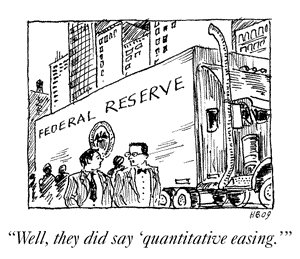
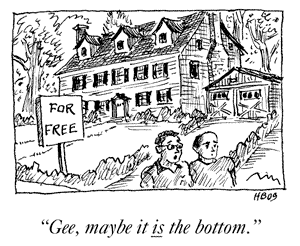
Here's my Top 10 links at 10am. I welcome your additions below. I've scattered through today's post a couple of excellent cartoons from Grant's Interest Rate Observer, one of the world's great publications (I'm not kidding). 1. Here's my view at NZHerald.co.nz on how those who want lower bank profits should be careful what they wish for. 2. The history is being written now of those dark days in September when the world came to the brink of a catastrophic financial collapse. This piece in the New York Times' Dealbook reveals what when on behind the scenes when Henry Paulson forced the 9 biggest US banks to accept government money. 3. The US banks are far from out of the woods, and even ratings agencies such as Standard and Poor's are saying this, Dealbook reports.
The 19 biggest banks may have passed the Treasury's stress tests on how they would weather a deep recession, but Standard & Poor's, the credit rating agency, thinks that many banks are far from a recovery and that the banking crisis has merely entered a new phase. In a series of reports after the Treasury reported the results of the stress tests, S.&P. has hammered home the point that the nation's banks still face significant headwinds going forward, despite the relatively upbeat report from the government on the state of the banking system. In the short term, banks will still have to contend with losses and troubles associated with the deteriorating economy, S.&P. said. In the long term, it said, tighter government regulation and a greater focus on capital adequacy will hinder the banks' ability to generate the huge profits they were used to.
4. Reuters reports S&P saying the banking crisis could go on for another 4 years. Here's a taste.

A day after saying big U.S. banks probably needed to raise only one-fourth the capital demanded by the government, Standard & Poor's said the nation's banking crisis has "merely entered a new phase" and might not end before 2013. The credit rating agency said the industry is being propped up by hundreds of billions of dollars of government support, especially for lenders considered too important to the financial system to fail. While efforts to spur lending, take bad assets off banks' balance sheets, and restart the market for packaging and selling securities may help the sector, S&P said banks will have a tough time surviving absent a bigger capital cushion than regulators require. "There's nothing to say that this banking crisis can't go on for another three or four years," S&P Managing Director Tanya Azarchs said.

5. Nouriel Roubini's RGE Monitor says the green shoots of recovery are more like yellowing weeds.

Many commentators are suggesting that the recent data from the manufacturing, housing market, labor markets suggest that the "˜green shoots' of an economic recovery are blossoming. While there do seem to be some signs of improvement, ie that the pace of contraction has slowed, the most recent data may still suggest that the global economic contraction is still in full swing with a very severe, a deep and protracted U-shaped recession. Although the outlook for global manufacturing and service sectors is still consistent with a significant fall in global GDP, the pace of contraction began to slow towards the end of Q1, even in Europe and Japan which have lagged the U.S. and China. Globally, surveys suggest that the manufacturing outlook has improved from the freefall of the end of Q4 2008 and early 2009. Some emerging economies like China may now be experiencing expansion based on government investment, but those of most advanced economies remain well in contraction territory. In part, inventory adjustment following the sharp destocking could contribute to a revival in demand, but a real increase in end user demand needed for a sustainable fast-paced recovery could be far off. Another necessary condition for a global recovery is a bottoming in not only the U.S. but also global housing markets. So far in most markets, housing prices seem far from their bottom and the outstanding inventory continues to be very high.

6. The Belgian government is considering its second bailout for Belgian bank KBC because it is expected to report a further 1 billion euros in writedowns from toxic debt instruments, the FT.com reports.

A government spokesman confirmed that the country's most senior ministers were meeting to consider further guarantees amid expectations that KBC will write down a further €1bn on its debt portfolio. The bail-out would come on top of a €3.5bn injection in the bank in October , followed up by a further €2bn in January by the Flemish regional government.

7. Gillian Tett is an assistant editor of the Financial Times and has just written a book called Fool's Gold that talks about how JP Morgan Chase was heavily involved in the financial engineering that caused the Credit Crunch, but was clever enough not to get burnt too badly. She also has some sobering words on any banking system recovery in this video on Marketwatch.

8. California is a complete basket case and has asked the US Federal Government for assistance from the TARP, the pot of gold used to bail out banks, , MarketWatch reports. The Mayor of LA has declared a state of emergency, saying the city could run out cash by November the LA Times (which is currently in bankruptcy protection) reports Meanwhile Barack Obama says the US budget deficit is unsustainable and interest rates are likely to rise as foreign lenders demand higher returns in this Bloomberg report. Maybe he should stop borrowing so much then... Here's a taste from the great man. He's right. Long term interest rates are rising. But he should take some of the blame.

President Barack Obama, calling current deficit spending "unsustainable," warned of skyrocketing interest rates for consumers if the U.S. continues to finance government by borrowing from other countries. "We can't keep on just borrowing from China," Obama said at a town-hall meeting in Rio Rancho, New Mexico, outside Albuquerque. "We have to pay interest on that debt, and that means we are mortgaging our children's future with more and more debt." Holders of U.S. debt will eventually "get tired" of buying it, causing interest rates on everything from auto loans to home mortgages to increase, Obama said. "It will have a dampening effect on our economy."

Here's an excellent John Darkow cartoon at the Columbia Daily Tribune. 9. Bloomberg reports that Advanta, a US credit card provider for small businesses, has shut down the accounts of 1 million customers to preserve capital. The 11th biggest credit card group in the United States has cut off the cards so they will not work on new transactions. HT Mish. 10. Here's the now legendary former US regulator William Black talking about the Global Financial Crisis, with Bloomberg. HT Option ARMageddon. A cracking interview for anyone interested in the state of the US banks. Well worth 4 minutes of your time.

We welcome your help to improve our coverage of this issue. Any examples or experiences to relate? Any links to other news, data or research to shed more light on this? Any insight or views on what might happen next or what should happen next? Any errors to correct?

We welcome your comments below. If you are not already registered, please register to comment in the box on the right or click on the "'Register" link at the bottom of the comments. Remember we welcome robust, respectful and insightful debate. We don't welcome abusive or defamatory comments and will de-register those repeatedly making these comments.

1 Comments

grrrr.... watching that makes me

grrrr.... watching that makes me angry. Heads need to roll !

what happened to the edit

what happened to the edit function ?

Bernard, Nice collection. I enjoy

Bernard,

Nice collection. I enjoy this morning briefing as saves time though generally puts me off my breakfast :-)

The strong theme coming from all these reports is that the banks are still walking corpses. The deleveraging process will take many years which will make it all the more painful. Unemployment really is key which is why Europe will take a very bad hit as well as the US and UK.

It does however offer opportunities for a small economy like NZ. We can be nimble and respond quickly to changes in the marketplace. Off course we have the property bubble albatross weighing round our necks.

And as for our overseas debt.......how long will we put up with it?

"I welcome your additions below."

"I welcome your additions below."

Also hear Ganesh Nana tell it like it is on morning report:

http://www.radionz.co.nz/__data/assets/audio_item/0006/1944960/mnr-20090...

Last night's 20/20 show had

Last night's 20/20 show had an eye-opener into the homeless situation in the US. Estimates are for 1,000,000 homeless children by the end of this year. It featured the story behind this YouTube clip;

http://www.youtube.com/watch?v=_WMTTrOrKVI

And a tour around one of the homeless shelters in LA.

What stood out for me was that many of those families struggling are struggling because of one job loss in a normally two working parent family. Additionally, there is talk of people working two jobs not being able to make rent payments. Something is dreadfully wrong when wages are so poor that they do not provide a living wage.

It seems so socially unjust to me when in a country as advanced as the US - so many of its ordinary citizens aspire to get back into the workforce for jobs that they know will earn less than a living wage - the "logic" being I suppose that something/anything is better than nothing. This seems to be the new American psyche - there is no future for our children in that.

Frightening piece of how even

Frightening piece of how even a supposidly aware financial reporter in the US dug himeslf into a debt pit (its long but worth a read):

http://www.nytimes.com/2009/05/17/magazine/17foreclosure-t.html?pagewant...

Now multiply that by millions of people..........

Bernard, William Black was worth

Bernard, William Black was worth the 9.05 mins (you cited 4mins!).

If NZ'zzzzzs financial system is in any way part of the systemic ponzi scheme he deducted exists we are in real strife (many writers on this site have claimed it is) .

Hard questions we need to ask:

How many farming loans sustainability was made on prospective income of a inflating economy while chasing buckets of fools gold at he foot of the Fonterra rainbow?
How many home loans are based on two income projections?
How many business loans were made on cooked books and optimistic projections?
How many are losing equity in their homes to maintain ailing businesses?
How many are eating equity to survive and when will that larder empty?
How many former mortgage free pensioners had companies plunder their equity?
How many pensioners have had their $ supplement.. interest generated income wither?
How many 'liars loans' do we sitting there?...far more than a few if mortgagee sales and bankruptcies are indicators
How many NZ children are suffering in economically disintegrating home circumstances?

If we have many 'liarsloans" then perhaps Banksters, developers, real estate agents, mortgage brokers, and accountants and lawyers have aquiested to be a rather dubious factor, if, as Black points out little verification of submitted detail was made on the virtual reality foundation .

How many will be locked away for fraud and misrepresentation (apart from a few finance house rogues)?

While banks controlled from abroad blindly continue to profit in a parasitic manner I suspect the the imagined tank of NZ$$$$$ they are sucking on will run dry.

Kate agree socially unjust for children whol suffer. They have no voice...I mentioned that months ago that even before the economic conundrum 20% of NZ's children came from home on or below the poverty line. NZ has the Rank solution!

Kate - if you can

Kate - if you can find these books, they are well worth the read:

Elizabeth Warren - The Two income Trap

James Scurlock - Maxed Out

Or you can get a quick once over here:

http://www.youtube.com/watch?v=6borpDebEHc

The USA is in deep and for a long time.

Andy - that article is

Andy - that article is amazing! And through all that, never a mention of even contemplating selling the house? Surely the time to put it on the market would have been at the time of getting the re-valuation (as at least the asset had increased in value!) - but instead they re-financed to pay off credit card debt! And then promptly started re-spending on the cards!

Unbelievable stupidity.... what got them was vanity - too vain to accept the great American dream, in the dream colonial-style American house, in the dream leafy suburb, with the dream kids in their designer clothes, going to the dream American school with other kids from families probably equally in debt up to their eyeballs ... was only that - a dream.

Great link above Andy. One

Great link above Andy. One of the most thoughtful pieces I have read on the housing bubble/bust:
At any other time in history, the idea of someone like me borrowing more than $400,000 would have seemed insane.

Kate: "It seems so socially

Kate:
"It seems so socially unjust to me when in a country as advanced as the US ..."

As advanced....is it?
Has it been for some time?
Or is it just a matter of "tell people something enough times they will believe it" propaganda.
US prison rate, crime rate, slum rates, urban terrorism, its economic failure.
Just because 'Rome' can fix Hubble, has the biggest guns, this doesntmean it is as advanced.
We live in times where we believe what we are told and learn and no longer question the faddility

Raf:
"It does however offer opportunities for a small economy like NZ. We can be nimble and respond quickly to changes in the marketplace. Off course we have the property bubble albatross weighing round our necks."

Yes, but step back "the property bubble albatross weighing round our necks."
Step back, is it really as big as we make out?
Mortgage sales are up what 3x times, but the numbers are not exactly catastrophic per head of population or total $ value.
Forced sales, recession or not thats what happens with a bad business call...
What does weigh heavy is employment, real production, and how THAT effects taxation, social services.
Those who remain employed, able to service loans greater than the home is worth will struggle, but be ok...simply responsibility for poor judgement.
Housing Investors the same...and these homes now become..eventually more affordable to those who couldnt.
The property collapse is a long term positive, not a "bubble albatross weighing round our necks"

Raf: “It does however offer

Raf:
"It does however offer opportunities for a small economy like NZ. We can be nimble and respond quickly to changes in the marketplace. Off course we have the property bubble albatross weighing round our necks."

Sadly, our major exporters and export producers do not think like that. They still think in terms of commodities.

New Zealand needs better leaders, better thinking and better management, but our education system does not generate them and the sad reality is that the politicians do not care.

Hey, look at this baby

Hey, look at this baby showing changes on employment patterns in the US. Pretty graphic! Click on the start arrow at the top to see the flow.

http://tipstrategies.com/archive/geography-of-jobs/

Steps, I agree wholeheartedly that

Steps,

I agree wholeheartedly that property prices coming down is a good thing in general i.e. where prices reflect general equivalence with yields and returns on other forms of capital.

Of course it may not be good news for those who have mortgages or have borrowed against the perceived value of their houses but that's the way it goes.

My concern is more the impact on the banking system but I agree employment is the biggest issue which is why the US is going to be buried for a long time and the UK as well.

Trev,

Food will continue to be important as a global product but you're right we can do much better in generating income from high and low technologies as well as showing others how to build a self sustaining economy.

Andy, that article is terrific.

Andy, that article is terrific. Personal accounts like this bring the discussion back down to earth. I wonder how many kiwis are also hanging on by their fingertips at the moment? We may not have had the subprime mortgage mania, but there were still plenty of other ways for ordinary folk to have overstretched themselves (eg endless hire purchase opportunities with deferred payment plans, multiple credit cards with ever-increasing limits, mortgages used as credit faciities, investment properties with negative equity). The next few months will be very telling, methinks.

Gillian Tett is very refreshing. I previously linked to a lecture she gave to the London School of Economics here and have ordered her book from Amazon.

Next month the second tranche

Next month the second tranche of AltA and OptionArm mortgages ($30b US) will begin to be reset. Another $60b will reset next year. At today's rates the average mortgage will soar 63% overnight. Many of these homeowners will not qualify for the increase and be forced into foreclosure; this on top of the 8 million homes in foreclosure at the present.

As China quietly dumps their US Treasuries in favour of Gold, just who is going to bankroll US debt? At the very least, higher borrowing costs are just around the corner for debtor nations like New Zealand.

Philly, The explosive graph (employment

Philly, The explosive graph (employment implosion) is scary and even scarier if fueled by social implications bound in Andy's link and other graphic images of human misery being portrayed...it is no longer about digits and number crunching but uncontrollable social consequences

... my chaos theory rantings back in Oct 08 were not just idle banter......the perpetuating disaster will leave a lot of debris in its wake...surely that is now patently obvious.

Oh, and none of that

Oh, and none of that stuff has been factored into Geithner's Stress Test. It is beyond me how $7trillion in rotten assets among the top 19 banks can be dealt with if they only have to raise $75 billion in new capital. Green shoots? Bottoms?

Good lord Andy, that article

Good lord Andy, that article you provided a link to was astonishing. I wasn't surprised to read that the author succumbed to a panic attack towards the end - I was almost having panic attacks just reading it!

More visibility of stories like that is needed. Too many people make purely emotional decisions about property - it's just incredible how the financial reality can be ignored even by those who should know better. Just the thought of ending up in the predicament described by the author sends chills down my spine.

I've just been reading in the NZ Herald news that average Auckland property sales values have shot up $60K this month when compared to the same time last year? How on earth has that happened? Are people stark raving barmy?

Trev, I'm glad I clicked

Trev, I'm glad I clicked on your link.

It is to a Jefferson Memorial lecture which Elizabeth Warren gave two years ago, entitled "The Collapse of the Middle Class". Her analysis is superb and casts a new light on severe financial pressures that the US middle classes face today (which in many respects will ring true for NZ). These are issues which we shouldn't ignore, but for some reason don't pay enough attention. Perhaps because they are so mainstream that they don't interest our drama-addicted society.

One of her more jawdropping findings - more US children born into two-parent families will experience the bankruptcy of one or more of their parents than will experience their parents' divorce. Why is that not more obvious? Apparently because you can't hide divorce, but you can hide bankruptcy.

Mozart - people might be

Mozart - people might be barmy or those figures are skewed
I suspect a bit of both
I think some people have believed the real estate hype and think they must buy NOW
Herd mentality
Don't worry, as unemployment rises things will drop back again
this little surge won't be sustained

Sorry to break the comment

Sorry to break the comment trend of increasingly sagging jaw, heaving stomach, and churning intestines.

At least that's what I take from the above. Doomsterism.

Cheer up, chaps and chapesses.

- we don't have the toxic mortgage products which in the uS will re-set and re-cast (see doctorhousingbubble for the finer details, he's been on this jag for a year or three).

- we grow our own food and are sitting on or near a very great deal of oil, gas, and coal-to-liquid fuel inputs.

- we aren't so mired in the infantilism so evident in UK and Europe, where the masses will do anything, anything to keep their 8 weeks holiday and hooses in Spain. Except actually work, or have enough kids to keep them paid and healthy in their dotage.

- We have a happy cheer-germ leader, and that attitude is priceless at a time like this.

- We are served by the Four Pillars of Oz in terms of banks, and they're in the top 20 world-wide. (Don't even think about KB, whose biz activities are farmed out to one of the US ZombieBanks - Citi).

- We have a friendly neighbour, and massive markets in Asia.

- And we can probably come to grips with our new Asian overlords, who aren't running a Debt Star - take a stroll down Broadway. Feel threatened?

Sits back, folds arms, awaits the torrent of bile. Have ter continue the bodily metaphor shtick, what?

waymad - why would anyone

waymad - why would anyone give you shtick for being optimistic?

I'd definitely offer you pity instead, if your optimism sees you spending up large on 'tick' and then re-financing that debt into a larger mortgage on your property - but I certainly wouldn't give you shtick.

Heck, it's your choice entirely if you want to find yourself living in a tent someday (which is where that couple in the US might find themselves shortly)!

:-)

Kate & Andy, you have

Kate & Andy, you have both given me very thought provoking things to look at.
An amazing video and a very good read.
Thank you :)

Hey guys have you heard

Hey guys have you heard the latest? Seems the boffins at Nasa have had a gork through the Hubble and spotted the US recovery some 10 billion light years away.

Trev - re. your points

Trev - re. your points at May 15th, 2009 at 1:11 pm, how can those issues be fixed? Anyone? The question is how, not what, and most know the why - so how?

Nikki - Sorry I only

Nikki - Sorry I only posted the link. I got interrupted and clicked submit thinking I had finished and the edit function has gone....

Les - I seriously doubt the agricultural co-op's can be fixed. Too much capital tied up in old fixed assets (meat plants etc), too much defending of positions that clearly do not work (Silver Fern Farms making a few million profit on sales of $1 billion) and so on and so forth. And where would fresh capital come from? Farmers?

Maybe from the ashes of collapse some new structure/s could arise. This happenned with the collapses of Weddel et al.

It is a very complex issue. NZ needs to lift it's game, work smarter and more productively etc (much of what Raf said). We also need to stop producing commerce and law grads at the cost of scientists, engineers and IT workers. Education and attitude are the keys.

Anyway, enough ranting, I'm off drinking, it is Friday and I still have a job!

I see Tony Alexander today

I see Tony Alexander today calling Bernard's predictions "strange"
Of course Bernard will never be directly critical of Alexander on this blog because there is obviously a relationship with BNZ (BNZ Economists on this forum)

Trev - helpful response. Don't

Trev - helpful response. Don't foget the the two Nurofen, can of Coke/Red-Bull and pint of water before hitting the sack. Enjoy your night, cheers, Les.

(Bernard - I think that prescription might be another good recession tip - some might need a good drink going forward and that is how to avoid a hang-over - so I'm told that is...)

Waymad - I think you

Waymad - I think you are way off, you said;
"we grow our own food and are sitting on or near a very great deal of oil, gas, and coal-to-liquid fuel inputs."

Increasingly foreign corporates grow their food on land brought off us, if we cant pay we dont get their food. When the Queen St farmers have their way with Fontera, get it listed on the stock exchange so they can reap maximum capital gain from selling to foreign elite, the situation will be worse.
As for Oil and Gas, because it is decreed we do not have enough money to pay for our own exploration, we get a little from selling exploration licenses to oil moguls, then when they find some we recieve roughly 10% in royalties.
Dont even think about taking anything back in the national interest when the poo hits the fan, the cost of fighting them and the World Trade Organisation when they sue us for expropriating their assets, would further increase the grip the internationalist receivers have upon us now.

"- we don’t have the

"- we don't have the toxic mortgage products which in the uS will re-set and re-cast (see doctorhousingbubble for the finer details, he's been on this jag for a year or three).-Waymad"

No, but our banks have borrowed billions of dollars from overseas and when the interest rates rise to combat inflation caused through the lending countries printing money we will suffer just as much.

Amazing article on the US reporter. I blame his wife:)

This will go down as

This will go down as the most fraudulent period in American business history, it makes Enron look like small fry.
How can people still be out there saying that you don't need regulation and that it just gets in the way of the market and that the market always knows best.
If the market knows best, the American and much of the worlds financial system would no longer exist.

Phil, sounds like you are

Phil,
sounds like you are an intelligent man who might be interested in this;
http://www.pbs.org/wgbh/pages/frontline/shows/wallstreet/weill/demise.html

Thanks Ian, interesting read, in

Thanks Ian, interesting read, in the states it seems if a corporation or group is big enough or has enough money, when they lobby hard enough they generally get what they want.
Maybe the general public are quite supportive of big organisations in the US.

While I think business needs to be nurtured and helped, it shouldn't be bowed down to at every turn, like often seems to be the case in the states.
Big business will generally push the limits as much as possible, until they are forced not to do things.
In fact if you watch the movie "The corporation" you will see they are legally obliged to put the profits before almost anything else, including the good of the community.

Must watch video if you

Must watch video if you wish to understand the fraud at the center of the US housing market crash (and thus one of the prime causative agents for the recession). Will prosecutions be launched as this information comes out in the open?

http://www.youtube.com/watch?v=6khYSTqHrqM&eurl=http%3A%2F%2Fwww.calcula...

(via Calculated Risk)

Not many green shoots in

Not many green shoots in Europe it would appear:

http://www.telegraph.co.uk/finance/economics/5331129/Europe-in-deepest-r...

This just blew me away

This just blew me away - I had no idea just how bad it is in the US. Here's a slideshow which lists the US States with the Highest Rates of Foreclosure - giving the number of foreclosures as "one in every x households".

Nevada as number one has one in every 68 households in foreclosure. But it's not just the desert States and California - Colorado, Illinois and a number of others I'd never have expected to see are in there.

http://www.cnbc.com/id/29655038?slide=11

When you consider these numbers in terms of the number of households in the feeder district for say a primary school in New Zealand - you'd have at least 1-2 kids in each of the schools in those neighbourhoods whose family was facing foreclosure.

good link Trev isint it

good link Trev isint it funny that the morning business shows on TV and the endless newspaper blurbs dont report on this stuff
Baz

Thx for yer kind words,

Thx for yer kind words, Kate and co. Playing Polyanna to the Kunstler wannabe's out there is always great fun.

I can sympathise wiv those who feel the need to constantly reinforce a certain Weltanschuung, being occasionally tempted into That pit meself. But Chicken Littleism wears thin after a while.

I prefer, 'Be of good cheer, Snoopy', as a working mantra.

Thanks for that video Andy,

Thanks for that video Andy, that helps connect the dots even more, I knew that the world's biggest idiot George Bush would have had a big part in this.
It's no surprise that the biggest sub prime lender was Bush's biggest 2004 election campaign contributor.
That helps explain all the financial deregulation during those years, no doubt he made it as easy as possible for his sub prime lending buddies.

Trev - following on from

Trev - following on from May 15th, 2009 at 7:49 pm & May 15th, 2009 at 1:11 pm, see:

http://www.stuff.co.nz/sunday-star-times/business/2415677/Rod-Oram-Hazy-...

"While it's good to see some more ambition and action, many problems arise. The sectors do have strategies, but they are stuck in commodities and low technology, and the government has no economic development strategy, so chaos and bad tax-funded investment is rife in its decision-making.

These dysfunctional dynamics have hit home with a vengeance over the past 10 days. Here are some worrying examples of what's going on."

And read on in the article.

I'm not usually a great supporter of Rod O's 'solutions sets', or 'How2s', (too much 'picking winners' and central planning) however, as in this article I do find his 'Whats & Whys' fairly valid, which also corroborate the lack of vision for effective change.

And, let's hope PWC can be a more useful in the forthcoming tax review:

http://www.interest.co.nz/ratesblog/index.php/2009/05/08/have-your-say-w...

Thanks for the link Les.

Thanks for the link Les. I cannot see PWC adding anything useful, although tax reform might be something they can comment on.

Maybe PWC realised that the value that can be added to agricultural products is limited and therefore they made no recommendations in terms of $$$.

That $30 billion of debt in the dairy industry is frightening.

I've pinched myself several times

I've pinched myself several times and it appears I'm not dreaming:

NZ farmers invite Johnny Rotten to visit cows

http://www.nzherald.co.nz/business/news/article.cfm?c_id=3&objectid=1057...

Anyway, weak strategies are one thing, but tactically, I'm not sure highlighting, "the higher fat content" is going to be such a great selling point with said markets also suffering obesity 'epidemics'?

Trev, et al - another

Trev, et al - another one for you, and look at the date:

Brian Gaynor: Big picture doesn't mean a 45-inch TV

http://www.nzherald.co.nz/business/news/article.cfm?c_id=3&objectid=1051...

".... the outgoing chief of the New Zealand Institute, was quoted as saying: "My view increasingly over the last several years is that the real challenge facing New Zealand is that we don't know what we actually want as a country."

and

"The New Zealand economy is rudderless, there is no consensus on the direction it should take."

An election, change of gov., some external economic pressure, a 'Jobs Summit' - what's changing? (Am not meaning to heap coals on the heads of the present gov., the last one was, and would have been no better, in my opinion.)

As for any 'vision' coming out of the forthcoming tax review, it'd probably not be a great idea to bet against Wally's view, here:

http://www.interest.co.nz/ratesblog/index.php/2009/05/08/have-your-say-w...

"Come on, get real. It's no more than a diversion and an old tool to keep the peasants happy arguing while Stalin drives a tank over the top of them all."

(Plus read his other 'Yes Minister' skits.)

maybe we will go the

If we don't address our

If we don't address our overseas borrowing then yes we will go the same way as Ireland and Iceland for that matter.

But we can avoid that if we take the appropriate action.

I recall Helen Clark and

I recall Helen Clark and her govt stating that they wanted NZ to be more like Ireland, but I could not find a quote to back that up. I did find this:

"HELEN CLARK "“ Prime Minister
Well we set it out first as a vision for New Zealand in the growth and innovation framework February 2002 and we've worked to build on that ever since, and I set out in the Prime Minister's Statement which I give as Prime Minister in February each year, what the detailed programme of the government this year would be around that and I went through the major review of business taxation which is due to hit the presses just a little after the middle of the year, I went through the Broad Band issues, said New Zealand couldn't tolerate being the dunce in the class in terms of slow rollout of fast internet access for Kiwis, I of course instanced areas like skills which are so critical, the high skilled workforces, high value economy equivalent, I mentioned science and research, I mentioned the major regulatory review, a whole lot of things which when you add up together really do input into a higher value New Zealand economy, and that's where we've gotta go."

From here: http://www.agendatv.co.nz/Site/agenda/transcripts/2006/2006-05-20.aspx

which reinforces my earlier comments about the rubbish leadership NZ has endured. She talks a good game, but we are nowhere near the goals expressed by Helen - and that is 7 years after they had their "vision".

Trev, U R correct. H&Co

Trev, U R correct. H&Co did put for Ireland up on a pedestal for NZ to aspire to..I remember H's comment too about tendering Ireland as a model. I remember NZ TV (2004-5? 20/20??) documentary showed the phenomenal growth,wealth and prosperity of Ireland.

'Visions' like mirages rely on the warping reality. Surreal movies, religious dogma, and Walt Disney have all surreptitiously lead our minds to seek the promi$ed land and holy grail of $$$$ (Japan pronounced.. holly gale...JP is politically Disney for sure..Mickey Mouse for PM). NZ isn't the only country with rubbish leadership.. when world leaders meet is the viral economic delusion it is passed on as they shake hands?

And what is reality,well we are about to face it.....

Ah yes the knowledge economy,

Ah yes the knowledge economy, thanks Aunty Helen, we now know we are in a plie of poo.

Thanks TONZ. Pleased to know

Thanks TONZ. Pleased to know one part of my memory is working.

Trev & Tonz, I remember

Trev & Tonz,
I remember reading an article in the Herald heralding the Irish wonder economy. I remember at the time thinking how utterly stupid it was. I can't remember who wrote it. I wish I could.

I'd like to know why people who come up with this stupidity aren't held to account when it is proved to be so wrong. I think they should be.

Could it have been this one :)

Brian Gaynor: Exports help Emerald Isle rise and shine
Saturday May 12, 2007
http://www.nzherald.co.nz/company-taxation/news/article.cfm?c_id=691&obj...

New Zealand and Ireland have a great deal in common. They both have 4.2 million inhabitants, traditional agriculture bases and are two small island countries with large and dominant neighbours.

These characteristics benefited New Zealand in the past but are now perceived as economic disadvantages, whereas the Irish economy has been transformed into the Celtic Tiger.

Why have the two countries moved in completely opposite directions as far as economic performance is concerned and has New Zealand anything to learn from Ireland?
.
.
.
The New Zealand economy desperately needs a circuit-breaker to restore economic confidence to a level that encourages productive investment and weans investors away from residential property.

KiwiSaver is a start but it doesn't go far enough. There needs to be a far more proactive and realistic approach towards encouraging exports.

And the tax incentives available to residential property need to be abolished and incentives developed to encourage productive investment.

Ireland has taken bold steps in these areas and benefited hugely as a result.

Is Finance Minister Michael Cullen courageous enough to unveil a circuit-breaker for the New Zealand economy in next week's Budget?

;)

Steve, maybe it was this

Steve,
maybe it was this one?

http://www.nzherald.co.nz/company-taxation/news/article.cfm?c_id=691&obj...

Hat Tip to Iain Parker who posted it a while back

And in case you were

And in case you were wondering what might have happened in Ireland since that 2005 article on Ireland, or even the 2007 article, you might wish to read the following from the AU BusinessSpectator site

http://www.businessspectator.com.au/bs.nsf/Article/Bank-of-Ireland-expec...

"DUBLIN - Bank of Ireland reported an 80 per cent drop in full-year underlying earnings per share (EPS) on Tuesday and raised its expected three-year bad debt charge to six billion euros ($US8.08 billion) as recession intensifies.

A question mark hangs over the future independence of Ireland's largest bank by assets due to its exposure to commercial developers stung by a protracted property market crash and it warned that there was a downside risk to its six billion euros estimate.

Three months ago, Bank of Ireland was estimating a bad debt charge of 4.5 billion euros in the three year period to March 2011 but warned that there was a downside risk of a further 1.5 billion euros.

...
The bank, whose principal market is recession-wracked Ireland, warned that the financial year to March 2010 would be another difficult one.

"We expect lower levels of new business activity, higher impairment charges and further pressure on liability spreads," the company said in its statement."

Gibber, It wasn't, but your

Gibber,
It wasn't, but your two posts make the point :)

I can't believe that Celtic Tiger has laid down and died, when did that happen? LOL