

New information released by the Reserve Bank suggests the net worth of New Zealand households is 27% higher than previously estimated, the Retirement Policy and Research Centre says.
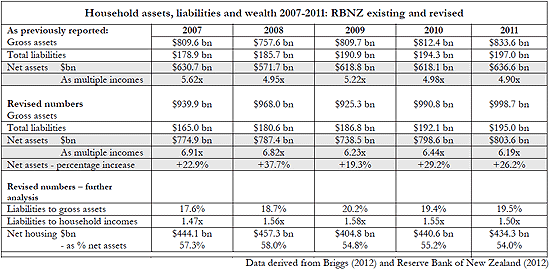
In a report released today entitled a PensionBriefing: New evidence on household wealth from the Reserve Bank, the Centre's co-director, Michael Littlewood, says the new information pushes total gross assets up by 19.8%, total liabilities down by 1%, and means net housing is now 54% of net worth.
Littlewood says the fresh information comes via a Reserve Bank Bulletin article by Phil Briggs and adds to existing data from the Reserve Bank's annual 'Household financial assets and liabilities, housing value and net wealth' reports. Briggs' article helps fill in some "gaps" including households’ equity in unincorporated businesses and unlisted companies, currency holdings, and unfunded equity in public sector superannuation schemes.
"Some assets are still not included," Littlewood says. "These cover overseas property directly owned by New Zealand households, non-equity overseas financial assets and consumer durables."
However, the effect of the newly included assets is to lift gross household assets, as of December 31, 2011 to NZ$998.6 billion, up from the Reserve Bank’s previously reported NZ$833.6 billion.
This is a 19.8% increase. Households’ net wealth rises to NZ$803.6 billion, an increase of 26.2%, from the previously reported NZ$636.6 billion.
“The previously published numbers over the five years 2007 to 2011 missed between one fifth and one third of households’ net assets," says Littlewood. "However, the previously published data on liabilities was reasonably close. In fact, the revised liability numbers are slightly lower. All this means that the ‘missing’ assets are a straight addition to all households’ net worth as the Reserve Bank reports that.”
Meanwhile, Littlewood says the total borrowing of households, including student loans, runs at about one fifth of gross assets. Or, expressed another way, total liabilities are about 1.5 times household incomes across the five years covered. Littlewood suggests neither of these measures seem excessive.
The additional data shows total net housing holdings, including rental properties and baches, range between 54% (in 2011) and 58% (in 2008) of total net worth across the five years 2007-2011. Prior to the new data becoming available, it had appeared that net housing assets were 69.6% of total net assets in 2011.
“Until the remaining gaps in the data are filled, the latest household wealth numbers can be regarded as conservative. As with the addition of the ‘missing’ data noted in this PensionBriefing, new assets will probably be added directly to net worth,” says Littlewood. "There still some data gaps to fill so even these new numbers are conservative estimates of the likely actual position at December 31, 2011."
Measured in relation to current household disposable income, he says net wealth has increased by 78% in real terms in the 31 years to December 31, 2011.
"New Zealanders are probably used to hearing they are not good savers, that they rely too much on housing and have borrowed too much. Those messages provided the policy backdrop for initiatives like the New Zealand Superannuation Fund and KiwiSaver," Littlewood says. "The evidence for this received wisdom is actually very unclear."
10 Comments
My house is not a burger or a banana. I cannot eat it.
My house is not a holiday trip to Tahiti. I cannot enjoy it.
My wealth may increase but my disposible income has been roaring down the hill.
...... why would yer wanna eat a burger , anyway ? ..... life's too short for that rubbish , buddy ....
Have a nice laska instead ....... ahhhhhhhhhhhhhh .......... yummmmmmmm .....
“The previously published numbers over the five years 2007 to 2011 missed between one fifth and one third of households’ net assets," says Littlewood. "However, the previously published data on liabilities was reasonably close. In fact, the revised liability numbers are slightly lower. All this means that the ‘missing’ assets are a straight addition to all households’ net worth as the Reserve Bank reports that.”
Meanwhile, Littlewood says the total borrowing of households, including student loans, runs at about one fifth of gross assets. Or, expressed another way, total liabilities are about 1.5 times household incomes across the five years covered. Littlewood suggests neither of these measures seem excessive.
Miraculous!!! - so the banks can claim more assets in their drive to ever encumber them with interest expense. What a lucky find. Who is taking personal responsibility for prior omissions of discovery? I bet a few European nations wish such acts of negligence could be uncovered.
I suppose international currency traders will now capitalise the previously 'missing' assets, if they have not done so already? Maybe John Key was right not to worry about the elevated levels of the NZD/USD currency pair.
Stephen
Good points again. The data is among the most relevant I've seen to counter strong arguments for a more active exchange rate management policy. The fact that NZ apparently has increased its net assets over the last 4 years is helpful, and a modest surprise. It is probably countered by a similar rise in government net debt over the same period , but nevertheless is better than I might have imagined. I still would argue it could be better still with at least a stable exchange rate preference, to give exporters etc a message to hang in there and keep investing. For all that, the news is better than I thought.
Wonder who will be first to use that information to advocate the individuals should borrow more. Or the Government should print. Bernard ? Bernard ? where are you ?
Well I'll be darned. Hughey is part right. There is indeed a lot of not-underwritten 'wealth' hereabouts.
Wealth is the ability to buy processed parts of the planet. If you 'double' the 'value' of an existing item such as a house, you neither change what the house is, not the amount of planet for sale. Presumably you just inflated away the 'value' of the $.
What Hugh doesn't address, is where that process goes, and ends. Meaning that what he is complaining about, along with what he laments, are hangovers from before peak.
I'd question just how guaranteed these other 'assets' are. They too, have to buy 'bits of the planet' at some point, or compete for same in an inflation-producing, value-reducing, manner.
In response to Hugh, I have debated a lot as to why NZ's housing cost relative to income is so much higher than the US, and whether this is sustainable. I know of one US-based global economist I regulaly speak with, who has been predicting a housing crash in NZ (and Australia) every year for the past 4 years! However, there are a few fundamental differences between NZ & the US;
1. Land supply - the Resource Management Act and local council "Building Prevention Teams" restrict the amount of land that can be developed and increase the cost to create new supply
2. Building costs - NZ's building costs are horrendous as the result of too few players in the market. (I have often thought there must be a business in importing kitset McMansions from the US). Again, this restricts supply of new stock.
3. Net positive immigration creating more demand. Many people buying houses are returning expats who have more money than they would have otherwise saved locally or are people from economies where Auckland housing looks like a bargain relative to their own cities.
4. NZ'ers reallly love to own their own home and place a emotionally (rather than rationally) high degree of importance on this.
5. In NZ we pay a lot less for education, health and heating than the US. We are also pretty tight with our consuming. This leaves us with more disposable income to spend on what we love - housing!
6. Incomes are low in NZ relative to the US cities. That is, if NZ average incomes increased to international levels, this problem would be solved! :-)
I also do not believe that any of these factors are going to change drastically anytime soon, and nor do I believe that interest rates will hike up drastically in the median term, which means that NZ housing should stay relatively stable with moderate growth prospects.
One last point, wealth is a relative term. While NZer's may be poorer on paper than other international cities, in most cases we are a lot wealthier with the quality of life we lead.
Did you actually read the article? It identifies an increase in the figures for household wealth (not an increase in household wealth) over what was previously thought - but not because of property price inflation. It explains very clearly that the increase comes about because New Zealanders own more wealth in forms other than property than had previously been accounted for.
None of this is to disprove or argue against your case that house and land prices are higher than they need to be in New Zealand due to regulatory constraints. I agree with you on that. But this article is about something different.
Let me count the days until David Shearer and the Tax 'Em Until They Squeal Party find a way to tap into all that wealth ........
...... ooooops , silly Gummy .... they already have , their Capital Gains Tax ......
Don't say you weren't warned , when the 2014 election rolls around !
Given the US failure to prosecute vast subterfuge at Honky Shonky BC, I wouldn't bet the farm (or lifestyle block or allotment) on ComCom here revving up up the Trust-Buster engine any time soon....despite the Juicy Duopolies in food retailing and building materials which are such obvious targets.
Ineptocrats much prefer nice salaries, guaranteed pensions, and quiet lives.
We welcome your comments below. If you are not already registered, please register to comment
Remember we welcome robust, respectful and insightful debate. We don't welcome abusive or defamatory comments and will de-register those repeatedly making such comments. Our current comment policy is here.