

By Bernard Hickey
For 30 years economic policy-makers thought that redistributing income was a bad idea. They thought raising taxes on the rich and giving money to the poor was like putting sand in the gears of the economy.
They thought it discouraged people from striving to improve themselves and made the economy less efficient.
It was this thinking that drove the movement towards a flat tax in the mid-1980s and powered the current Government's big 'tax switch' in 2010 that cut income taxes for the highest earners and increased the GST rate to 15%.
The standard prescription from the biggest brains at the International Monetary Fund, the OECD and the World Bank was that any country interested in boosting long term economic growth should cut taxes and reduce the size of government.
But then the Global Financial Crisis hit and now even the biggest brains at these think-tanks are re-thinking their views on redistributing income.
It turns out rising income inequality actually puts sand in the gears of the economy.
When poor and middle income households find their incomes are flat or falling they compensate by borrowing more. Eventually they can't borrow any more and some can't afford to pay the interest on the debt they built up.
This is the Global Financial Crisis (GFC) in a nutshell, particularly in America.
Secondly, when those on higher incomes get an even bigger share of the national income they tend to save more of it rather than spend it.
This 'hoarding' of cash often slows consumption growth and can make financial systems less stable, particularly when it's sent across borders in 'hot' money flows that can disappear as fast as they arrive.
This week the IMF, a bastion of fiscal conservatism and pro-market policies for decades, released a paper titled "Redistribution, Inequality and Growth." It concluded after looking at a fresh set of data on pre and post tax incomes across countries large and small found that more equal countries grew faster over the long run.
The study also found that those Governments that did redistribute incomes didn't actually hurt their economies, apart from the most extreme examples such as Zimbabwe.
"Thus the combined direct and indirect effects of redistribution - including the growth effects of the resulting lower inequality - are, on average, pro-growth," the IMF said.
It's this sort of research and the debate around clearly growing inequality in America and other big developed countries that is encouraging the Labour/Green Opposition to try to make inequality a big election issue.
So far it hasn't got much traction. The Government has simply denied that inequality has worsened on its watch.
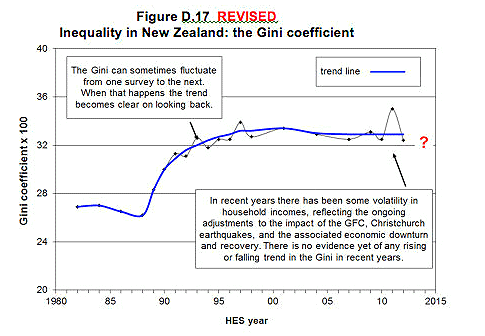
It has pointed to the Ministry of Social Development's analysis of Household Economic Survey figures from 1982 to 2012 that showed post-tax income inequality worsened dramatically from the mid 1980s to the mid 1990s, and has been basically stable ever since.
The figures even show a slight improvement from the mid 2000s as a ramp up of redistribution of income through Working For Families and other transfers lifted post-tax household incomes for lower to middle income groups.
The Government's argument is that New Zealand is different to the likes of America and it has good point.
The introduction of Working For Families, our publicly-funded health and education systems, a relatively high minimum wage, accommodation supplements and New Zealand Superannuation have stopped much of the rot that has set in in America.
The Government's retention of these social safety nets since 2008 and its decision to run big budget deficits from 2009 to 2013 to cushion the blows from the GFC and the Canterbury Earthquakes have stopped post-tax income inequality from getting worse.
But it also hasn't done much to reduce post-tax income inequality, which the IMF says would improve economic growth prospects. The figures the Government relies on have also taken a battering this week. Statistics New Zealand and the Treasury revealed an error in their analysis of the data used in the MSD report that meant they had double-counted accommodation supplements.
The corrected figures show inequality, using the internationally accepted Gini measure, was marginally higher than previously estimated, but not enough to change the basically flat trend.
Despite the Government's rearguard action, this issue will not go away. The growing debate about inequality elsewhere and the latest IMF report have changed the landscape under the Government.
Inequality is not only a threat to economic growth, but an opportunity. Politicians can now credibly argue that reducing inequality is more than just about fairness. It can also be a way to increase the economy's growth potential.
The politics of envy can morph into the politics of growth.
---------------------------------------------------------------------------
This column was first run in the Herald on Sunday. It is used here with permission.
We welcome your comments below. If you are not already registered, please register to comment
Remember we welcome robust, respectful and insightful debate. We don't welcome abusive or defamatory comments and will de-register those repeatedly making such comments. Our current comment policy is here.