
By Bernard Hickey
Remember mid 2003?
It was just before the Rugby World Cup in Australia. Carlos Spencer had yet to fire that amazing between-the-legs pass for Joe Rokocoko to score in the quarter-final against South Africa. George Gregan had yet to taunt Byron Kelleher with his "four more years boys, four more years" sledge in the semi-final a week later.
New Zealand was in the middle of a migration boom in July 2003 with net migration hitting 33,300.
The median house price in Auckland had just risen 15% to NZ$298,000 and the average floating mortgage rate was 7%, but was about to rise.
The average two year fixed mortgage rate was 6.13%.
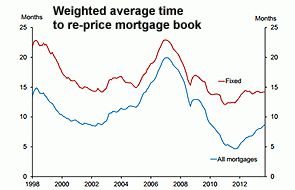
The weighted average time before a mortgage had to be repriced was 9.9 months because most borrowers were either still floating or on short term fixed rates.
Something big and unthinkable was about to happen, and it wasn't just watching Carlos throw that pass to Stirling Mortlock and then losing THAT match to Australia.
The migration boom, massive foreign borrowing by banks and rising floating interest rates were about to dramatically shift the behaviour of home owners and force the Reserve Bank to push much harder on its interest rate brake than it wanted just four years later.
Borrowers started fixing on longer term mortgages in droves through late 2003 because banks were offering much cheaper fixed deals.
Those banks could easily borrow very cheaply on international markets because markets had become very stable and credit was plentiful. This period became known in financial circles as the 'Great Moderation'.
The arrival of Kiwibank sparked a rash of competition between banks that saw them slash their profit margins to fall over themselves to offer cut-price fixed rate deals to win customers.
The race to fix drove the average time to reprice a mortgage to a peak of 19.9 months just four years later.
By mid 2007 the median house price in Auckland had jumped 49% to NZ$448,000 and the Reserve Bank was in real muddle. Its rate hikes through 2004 and 2005 had only limited impact. By the time it became clear that the massive fixing of rates through that period had insulated borrowers from the rate hikes and made the bank's monetary policy brake pedal 'spongy', it was too late.
The bank was forced into four further quick rate hikes in succession from March to July 2007.
This sprint higher sent floating rates over 10.5% by early 2008 and dragged up the average two year fixed rates to 9.6%. This, combined with a drought, was more than enough to drive the economy into recession, even before the Global Financial Crisis had hit.
Fast forward to mid 2014 and we are in eerily familiar territory.
New Zealand is in the middle of another migration boom with a net 34,400 arriving in the year to April. The median house price in Auckland is NZ$611,000, up 14.6% from a year ago.
Global financial markets are entering another extended period of calm with plenty of easy and cheap credit to be found.
Some are calling it the Second 'Great Moderation.'
Earlier this week ANZ's Australian parent was able to borrow US$2.25 billion in New York at an interest rate of 1.25%.
New Zealand's banks have started competing much harder to win market share by offering cut price fixed rate mortgages. They can do this because their profit margins are healthy and they are able to find cheap funding overseas and locally.
They are now loading up their discounts onto their two and three year fixed rate deals. The difference in bank profit margins between floating and fixed is startling. Westpac CEO Peter Clare told me last month the profit margins on floating mortgages are around 150 basis points, while the profit margins on fixed rate mortgages can be as low as 50 basis points.
The end result is that two and three year fixed rate mortgage rates have now been cut to around 5.8%, well below floating mortgage rates, which have risen three times in as many months to 6.5%.
Just as in 2003, the average two year mortgage rate is 80 basis points cheaper than the floating rate and the average time to reprice is 9.9 months.
The market is now ripe for a repeat of the rush into longer term fixed mortgages seen between 2003 and 2007.
Anyone with a mortgage would be mad to ignore the big gap that has opened up between longer term fixed and floating rates and the opportunity to 'claim' some of that profit margin off the banks.
At the end of April there were NZ$131.7 billion worth of mortgages that were either floating or fixed for less than a year. There was just NZ$61.1 billion on terms longer than one year.
The opportunity is enormous.
If just half of those floating mortgages were to switch to two year fixed rates those borrowers would save themselves over NZ$500 million in interest costs each year, and by extension reduce the bank profits by the same amount.
The Reserve Bank was remarkably sanguine at its announcement this week about the risk of another rush to fix and the resulting dilution of the power of monetary policy to slow down the economy. "We still think it carries quite a punch," Governor Graeme Wheeler said of his main OCR tool, pointing to the average time to reprice mortgages of 9.9 months. His predecessor Alan Bollard didn't give the fixed vs floating issue a second thought back in mid 2003, but within four years he was referring to the lack of traction when welcoming a Parliamentary inquiry into the then persistently high exchange rate, which was at least partly caused by foreign borrowing to fund cheap fixed mortgages.
The banks and their regulator would argue this time it's different. Banks are now forced by a Reserve Bank-mandated core funding ratio rule to avoid relying too heavily on cheap short-term foreign funds.
The banks are also seeing heavy flows of local term deposits to fund their local mortgage books, which are growing at an annual rate of 5.4%, rather than the 13% rate seen in mid 2003.
But still, few thought in 2003 that house prices would double within a decade or that the All Blacks would lose to Australia and France in semi and quarter finals in the next two World Cups.
Let's hope history does not repeat.
-------------------------------------------
A version of this article also appears in the Herald on Sunday. It is here with permission.
We welcome your comments below. If you are not already registered, please register to comment
Remember we welcome robust, respectful and insightful debate. We don't welcome abusive or defamatory comments and will de-register those repeatedly making such comments. Our current comment policy is here.