

 By Roger J Kerr
Events and trends in Japan have largely been irrelevant to interpreting and analysing global forces on the NZD/USD exchange rate over recent years.
The total focus has been on investment market “risk-on/risk-off” moods, European blow-ups/risk aversion that have this year caused safe haven capital flows towards the AUD and NZD, commodity price shifts and Chinese economic developments.
The aforementioned forces determine Aussie dollar movements and the NZD/USD rate follows the AUD/USD exchange rate.
However, there is now a fresh wind of change blowing through political and economic corridors in Japan that will have direct implications for our currency market and values.
Outside political changes and events in Japan, there appears to be massive changes taking place at the central bank, the Bank of Japan (BoJ), to take more affirmative action to get the economy going after years of slumber.
Central to those changes is the recognition and need for a weaker Yen exchange rate against the USD.
Current BoJ Governor Masaaki Shirakawa is due to step down in April and this will allow the new broom to embark on bond buying and money printing that the Japanese have only played at to date.
The Yen has always strengthened over the past three to four years since the GFC when investment market volatility has increased and Japanese institutions have rapidly return money to the “safety” of home.
Over recent months volatility in investment and financial markets has decreased substantially and the Yen is slowly losing its status as a safe haven currency to retreat to.
Adding to the widely anticipated and inevitable Yen currency weakness is the possibility of Japan suffering another sovereign credit rating downgrade to below their current AA- level. Such a downgrade would force local investment houses to send funds out of Japan to higher rated securities.
The Yen has already weakened from 77.50 to 81.50 against the USD and appears destined for further weakness towards 85.00 in the lead up to their general election on 16 December.
The political uncertainties are real and their monetary policy is becoming much more aggressive.
There is even talk of sub-zero interest rates for loans to encourage economic activity and investment - that is, you get paid to borrow money.
When official policy gets to this point it is very hard to see the currency strengthening.
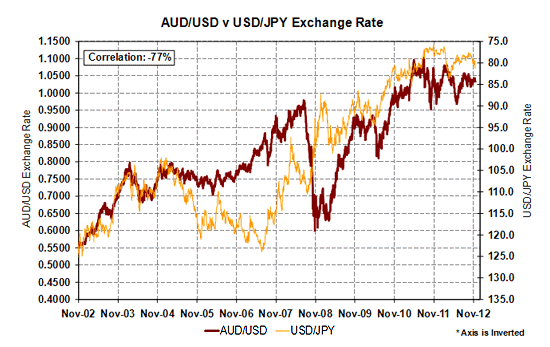
The correlation between the JPY/USD exchange rate and the AUD/USD rate has been forgotten about as Chinese drivers of the Aussie currency and economy have dominated. However, Australia still depends heavily on Japan and the Aussie looks likely to follow the Yen to a lower value against the USD (see chart).
Yen connected currencies such as the Singapore dollar and Thai Bhatt can be expected to weaken against the USD along with the Yen.
------------------------------------------------------------------------------------------------------------------------------
To subscribe to our daily Currency Rate Sheet email, enter your email address here.
------------------------------------------------------------------------------------------------------------------------------
* Roger J Kerr is a partner at PwC. He specialises in fixed interest securities and is a commentator on economics and markets. More commentary and useful information on fixed interest investing can be found at rogeradvice.com
No chart with that title exists.
We welcome your comments below. If you are not already registered, please register to comment
Remember we welcome robust, respectful and insightful debate. We don't welcome abusive or defamatory comments and will de-register those repeatedly making such comments. Our current comment policy is here.