

Here's my Top 10 items from around the Internet over the last week or so. As always, we welcome your additions in the comments below or via email to bernard.hickey@interest.co.nz.
See all previous Top 10s here.
My must read today is #9 from Martin Wolf on the subject of Quantitative Easing, who 'creates' money and how banking really works. Have a great Easter.

1. A missing middle class? - One of the great achievements of the last 20 years or so has been the growth of incomes in emerging markets such as China and Latin America.
A growing middle class are demanding consumer goods and services, and luckily for us protein and tourism.
The growth of China's middle class is one of the major reasons New Zealand's economy has fared as well as it has in the last five years.
It has happened at the same time as intense pressure on the real incomes of the middle classes in developed economies, particularly in America.
But the FT's Shawn Donnan and John Burn-Murdoch reckon there's a good chance about one billion of the newly minted middle class could fall back into poverty because of slowing growth rates in the emerging markets.
New Zealand is relying on the continued unbroken growth of these middle classes for its future so it's well worth a read.
One of the things that concerns development economists is that, even before economies began to slow, the “churn” between those below and those immediately above the poverty line remained high. According to the World Bank, in countries such as Indonesia more than half of those below the poverty line were above it the year before.
The International Labor Organisation said it was already seeing the effect of slow growth in emerging economies, with the number of workers worldwide in extreme poverty declining only 2.7 per cent in 2013, one of the slowest rates seen over the past decade.
In an interview, Kaushik Basu, the World Bank’s chief economist, warned that many of those people who had emerged from poverty in recent years remained “very vulnerable” to slipping back. He also said the world economy faced risks, including the possibility that China’s growth could slow even more than it has already, something that would have big repercussions for the developing world.
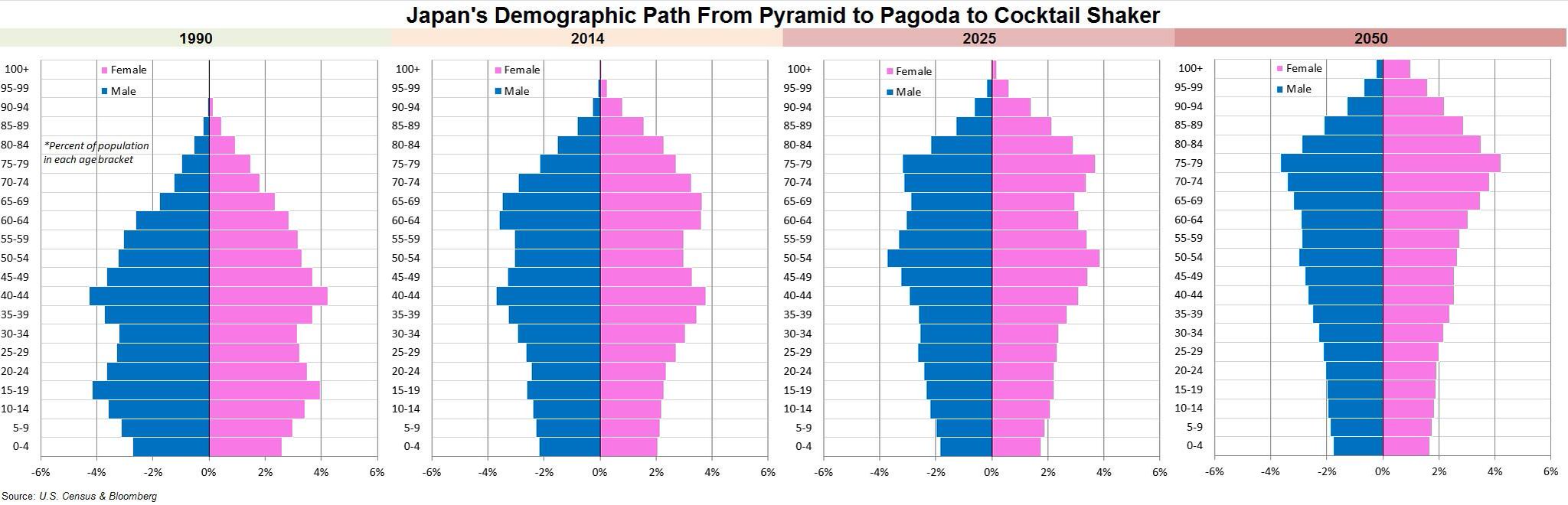
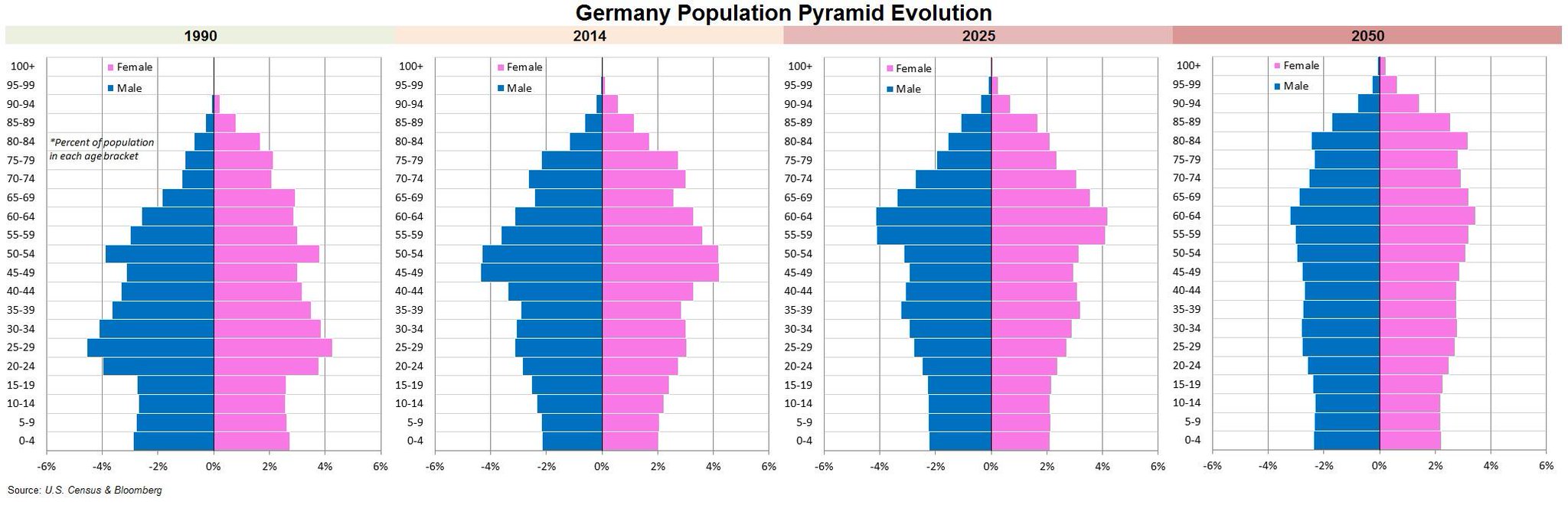
2. The pig in the python of ageing - Sometimes it's worth looking at the age structure charts of the major economies to get a sense of how economies, incomes, savings, jobs and politics are changing.
These charts are worth a look to see the scale of the issues, particularly in China and Germany. Japan is the baseline.

3. China's growth slows - Chinese GDP grew at an annual rate of 7.4% in the March quarter, a tad slower than its previous target, but slightly above the median economist forecast. Credit growth also fell 19% from a year ago, Bloomberg reports.
An extended slowdown would put pressure on Premier Li Keqiang to add stimulus or ease up on efforts to curb financial risks and property-price gains after this month outlining spending and tax relief to support growth. A weaker Chinese economy would limit a pickup in global expansion forecast by the International Monetary Fund and restrain demand for commodities including copper and iron ore.
4. So where's the stimulus? - Everyone is waiting and waiting for a significant Chinese stimulus to get Chinese growth going again. There've been a few murmurings, but nothing much yet.
Here's Business Spectator with a look at why the stimulus may not come and why it's a good thing.
5. Here comes the carry trade again - BNZ Chief Economist Tony Alexander points in his weekly update to the growing pressure on the New Zealand dollar from yield hungry investors looking for higher interest rates somewhere else.
Investors will reignite the carry trade whereby they borrow in a low interest rate country and invest in a high rate country to gain extra yield while taking what they think can be a managed exchange rate risk. That means ongoing support for the NZ dollar, especially with our economic growth story going to be so good for the next three years that investors will consider the exchange rate risk inherent in the carry trade to be very low.
In addition, the global search for property is leading investors to NZ with Chinese families in particular looking for stores of value for their rising wealth away from the control of the CCP. The level of foreign buying of residential and commercial property in NZ is going to continue to rise and that will not only push property prices higher and deepen the affordability debate, it will again give additional support to the NZ dollar.
6. Too big to fail is too big to ignore - Martin Wolf at the FT hits the nail on the head in this piece about the problem of banks being too big to fail and why leverage needs to be restricted ever lower.
The Reserve Bank and our Government continue to persist with the figleaf of Open Bank Resolution, which allows the Government and the banks to continue to kid themselves, voters and depositors that moral hazard exists and banks would not be rescued.
It's just baloney. While our Government is solvent, it will of course bail out the banks. We have a track record overseas to rely on and the repo facility set up by the Reserve Bank in late 2008 and early 2009 proved it here in New Zealand.
Here's Wolf on the problem of too big to fail overseas, which is arguably bigger than here, but not as much as most would have you believe.
No solvent government will allow its entire banking industry to collapse. Leveraged institutions whose liabilities are more liquid than their assets are inescapably vulnerable to panics. In a panic, it will be hard to distinguish illiquidity from insolvency. These three points shape my views: the state stands behind banking even though it might not stand behind individual institutions.
One of the obstacles to making the bearing of losses by creditors credible is “too big to fail” – the challenge posed by banks that are individually systemic. A question about post-crisis regulation is whether this risk is gone. The answer is no. Mark Carney, governor of the Bank of England and chairman of the Financial Stability Board, himself agrees that “firms and markets are beginning to adjust to authorities’ determination to end too-big-to-fail. However, the problem is not yet solved.”
7. The Great Moderation v 2.0 - Gavyn Davies looks in this FT blog at whether the world is now entering a second era of 'Great Moderaton' where growth is moderate and lasts for a long time with low inflation.
Brilliant. Until....
I've bolded the important bit. All very topical given #5 above.
Here's Davies:
Prolonged periods of moderate expansion, with very low interest rates, usually prove to be good for risk assets, including credit, carry currencies and equities.
Of course, none of this precludes the possibility that the current expansion and bull market will end the same way as occurred in 2008, with a “Minsky moment” in a financial system that has reached too far into risk assets. There are some worrying signs of this in the recent froth in the IPO market for internet and biotech stocks, which now seems set to correct quite sharply. But overall global equity market valuations do not seem to be in bubble territory yet.
Central banks will have to watch all this increasingly carefully, since GM 2.0 could certainly result in an excessive reach for yield and other forms of dangerous risk-taking. It already seems clear that the markets have not learned their lesson in this regard, and both the Fed and the Bank of England look likely to deploy regulatory and capital controls to discourage excessive risk-taking fairly soon. A major question for investors will be whether the bull market can survive such measures, which were of course conspicuously missing in the cycles of GM 1.0.
8. A melting pot of charts and people - This is an excellent infographic from Statistics NZ showing the different population structures of the different ethnic groups as measured in last year's census. The pigs in the pythons are at vastly different stages, which is a good thing overall.

9. How banks and money really work - Here's Martin Wolf again riffing on the Bank of England paper on how the money system really works that has everyone talking about. It is an essential read.
Banks are not just financial intermediaries. The act of saving does not increase deposits in banks. If your employer pays you, the deposit merely shifts from its account to yours. This does not affect the quantity of money; additional money is instead a byproduct of lending. What makes banks special is that their liabilities are money – a universally acceptable IOU. In the UK, 97 per cent of broad money consists of bank deposits mostly created by such bank lending. Banks really do “print” money. But when customers repay, it is torn up.
Second, the “money multiplier” linking lending to bank reserves is a myth. In the past when bank notes could be freely exchanged for gold, that relationship might have been close. Strict reserve ratios could yet re-establish it. But that is not how banking operates today. In a fiat (or government-made) monetary system, the central bank creates reserves at will. It will then supply the banks with the reserves they need (at a price) to settle payments obligations.
Quantitative easing – the purchase of assets by the central bank – will expand the broad money supply. It does so by replacing, say, government bonds held by the public with bank deposits and in the process expands the reserves of the banks at the central bank. This will increase broad money, other things being equal. But since there is no money multiplier, the impact on the money supply can be – and indeed has recently been – modest. The main impact of QE is on the relative prices of assets. In particular, the policy raises the prices of financial assets and lowers their yield. The justification for this is that at the zero lower bound normal monetary policy is no longer effective. So the central bank tries to lower yields on a wider range of assets.
This is not just academic. Understanding the monetary system is essential. One reason is that it would eliminate unjustified fears of hyperinflation. That might occur if the central bank created too much money. But in recent years the growth of money held by the public has been too slow not too fast. In the absence of a money multiplier, there is no reason for this to change.
A still stronger reason is that subcontracting the job of creating money to private profit-seeking businesses is not the only possible monetary system. It may not be even the best one. Indeed, there is a case for letting the state create money directly. I plan to address such possibilities in a future column.
10. Totally Jon Stewart on the Ukrainian crisis - The Friday Funny. Or not very, depending on who you are.
We welcome your comments below. If you are not already registered, please register to comment
Remember we welcome robust, respectful and insightful debate. We don't welcome abusive or defamatory comments and will de-register those repeatedly making such comments. Our current comment policy is here.