
By Cameron Preston*
This month marks the 4th anniversary of the February 2011 earthquake and the halfway point in the settlement of residential “over EQC cap” claims held by the private insurance industry.
Back in March 2013 the Insurance Council of New Zealand (ICNZ) was at pains to convince people that there “is no insurance monster out there trying to delay, deny and defend” and such beliefs are urban myth.
Mr Tim Grafton, CEO of the ICNZ stated:
“They are not getting financially better off by delaying claims…Demand surge cost inflation will run to double digits [and will] be far in excess of any money retained by insurers and reinsurers in the bank earning less than 3% after tax on their bank deposits.”
It is no secret that the 20th Century’s most successful investor, Warren Buffett, uses his company - Berkshire Hathaway’s - insurance and reinsurance businesses to generate a significant amount of “float” which he puts to work investing across his other businesses.
Building “float” allows Berkshire Hathaway to effectively operate with zero debt which is key to its extraordinary success.
Mr Buffett writes an annual letter to all his shareholders personally, and in his last letter he explains to his shareholders the idea of “float”:
“Berkshire’s extensive insurance operation again operated at an underwriting profit in 2013 – that makes 11 years in a row – and increased its float. During that 11-year stretch, our float – money that doesn’t belong to us but that we can invest for Berkshire’s benefit – has grown from $41 billion to $77 billion. Concurrently, our underwriting profit has aggregated $22 billion pre-tax, including $3 billion realized in 2013. And all of this all began with our 1967 purchase of National Indemnity for $8.6 million.”
What Mr Buffett is differentiating for his shareholders is two sources of profit from Berkshire’s insurance and reinsurance operations:
(1) Underwriting Profit – That is the traditional profit after deducting the cost of claims made in any one year from the premium revenue earned; and
(2) Investment Profit – As insurers receive premiums (including reinsurance recoveries) upfront and pay claims later, this leaves them with large sums – money called “float” that will eventually go to others. Meanwhile, insurers get to invest this float for their benefit. – It is “free money”.
Mr Buffett goes on to explain:
“If our revolving float is both costless and long-enduring, which I believe it will be, the true value of this liability is dramatically less than the accounting liability…. we would happily pay to purchase an insurance operation possessing float of similar quality to that we have – to be far in excess of its historic carrying value.”
This goes some way to explain why Mr Buffett was interested in AMI when it was put on the block in 2011.
So that brings us back to the ICNZ statement that NZ insurers “are not getting financially better off by delaying claims”.
To understand whether that statement is an urban myth, let’s look at insurance giant IAG’s NZ Division results since 2006, separating underwriting profits and losses and investment revenue (in AUD):
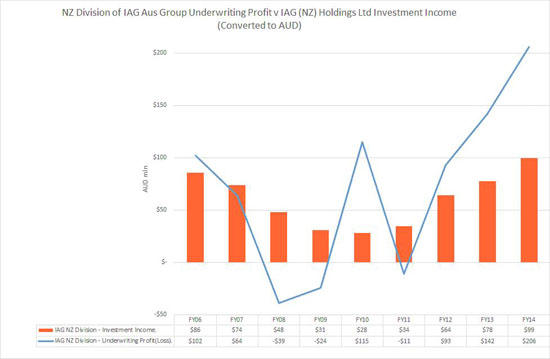
You can clearly see the underwriting losses (the blue line) that occurred after the GFC (this is part of the normal insurance cycle – ie people tend to claim on insurance more when the times are tough) was compounded by lower investment returns at the same time as financial markets tanked (the orange bars).
However since the Canterbury earthquakes in 2011, a year in which IAG’s underwriting loss was very small thanks to reinsurance, both underwriting profit and investment income have exploded.
Underwriting profit last year was double what it was in 2006, thanks in large part to substantial premium increases.
However the Canterbury earthquakes instantly boosted IAG’s “float” as an influx of recoveries were made from reinsurers.
By not paying out on claims in a timely fashion, IAG was able to hold on to this increased “float” and use it to earn investment returns. Last year that equated to investment revenue of AUD$100 million attributable to IAG’s NZ Division.
And that is only what IAG are declaring. It would not be a huge surprise to this writer if the AUD$100 million recorded in IAG NZ Holdings Limited’s financial statements is only part of the total investment revenue from the increased float.
Total investment revenue for the Group last year was AUD$360 million, however IAG admitted just before Christmas that their Canterbury earthquake liability has been undercooked for a second time.
Even if IAG’s NZ accounts are taken at face value, you can see that it is in fact a myth that IAG is not currently financially better off by delaying claim settlement.
Whether demand surge kicks into double digits is yet to be seen.
At present most folk seem to be happy to believe the ICNZ’s statement that somehow by insurers holding onto claim payments for 4 years plus, instead of paying them out means “they are aren’t financially better off”.
I think Mr Buffett would disagree.
He has built his empire on that very premise.
Although in Mr Buffett’s defence he does state:
“Unfortunately, the wish of all insurers to achieve this happy result creates intense competition, so vigorous in most years that it causes the P/C industry as a whole to operate at a significant underwriting loss. This loss, in effect, is what the industry pays to hold its float.”
That intense competition is the element we lack here in New Zealand.
The lack of that important element is no urban myth, and it appears that competition or regulation is the only way to tame this particular insurance monster.
No doubt Mr Buffett would admire how this insurance monster is currently staying afloat, trouble is, he knows they have a propensity to sink pretty quickly too.
---------------------------------------
* Cameron Preston is a Christchurch homeowner who has longstanding unresolved quake insurance claims.
We welcome your comments below. If you are not already registered, please register to comment
Remember we welcome robust, respectful and insightful debate. We don't welcome abusive or defamatory comments and will de-register those repeatedly making such comments. Our current comment policy is here.