The comment stream

Recent comments

Join the Interest community to be a registered commenter so you can:
- Edit your comments
- Avoid the CAPTCHA
- Vote on comments
Register Here

Already registered? log back in here ..

Forgotten your password? No problem! Click here

Finance sector jobs

Senior Liability Underwriting Manager
Lead from the front utilising your strategic, technical and leadership qualities within th...more
New Zealand
Senior Liability Product Underwriter - Product Management
Lead from the front utilising your technical expertise in this highly attractive senior li...more
New Zealand
High Performing Senior Liability UnderwriterHigh Performing Senior Liability Underwriter
Customer focus, high performance, exceeding client expectations and achieving profitable g...more
New Zealand
Head of Retail Credit -Wellington, NZ
Key leadership position in the bank. Be a part of one of the fastest growing banks in New ...more
New Zealand
efinancialcareers.com

Reader poll

Should you fix your mortgage now or stay floating?

Choices

Opinion: Why measuring and publishing school performance data is a good idea

Posted in News

By Infometrics economist Adolf Stroombergen The prospect of measuring school performance by testing students to national standards has upset many teachers and educationalists. There seem to be three main fears:

  • Labelling a child as a failure is not going to improve their learning.
  • Teachers will teach to the test, resulting in students receiving a narrower education.
  • Schools will be unfairly compared with one another.

The first concern really has nothing to do with national testing and can be easily addressed in the classroom. Especially at primary school level, the main role for testing is the formative assessment of student progress "“ an iterative process of measuring how individual students are progressing and designing programmes that meet their individual needs and learning styles.

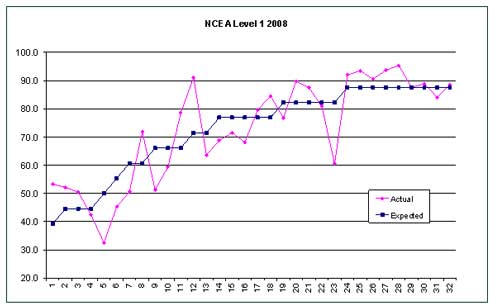
Teaching to the test is indeed a retrograde step if those tests are predictable and formulaic. Modern testing systems such as asTTle (Assessment Tools for Teaching and Learning), however, consist of a databank of thousands of questions with the option for teachers to select random questions stratified by degree of difficulty and by subject sub-component, such as algebra or comprehension. The probability of two tests being the same is remote, meaning that "˜teaching to the test' as we currently understand it is virtually impossible. To an economist the third concern raised above is more interesting. Comparisons between schools need to be based on value-added, something that economists are used to measuring. Value-added is a critical concept. We don't assess a company's performance by its gross value of sales. We net out what it pays for its inputs so that we can assess how much value it is adding to those inputs. Our standard of living depends on allocating resources to those industries that can use them most efficiently. This applies to schools too. As taxpayers we want to see schools securing the highest possible academic achievement from their students, thereby giving them more choice about career options and eventually contributing to raising our collective quality of life. (I assume for the moment that academic achievement is the sole criterion of a school's success.) Comparing the raw academic results of a decile 10 school with those of a decile 1 school is unlikely to tell you anything other than that the students at the former are likely to have all the developmental and educational advantages that usually accompany high parental income, educated parents, no overcrowding at home, and so on. The accompanying graph shows last year's Level 1 NCEA pass rates for 32 colleges in the Dominion Post's circulation area. The first interesting feature of the graph is that a best fit trend through all the points is approximately linear and is upward sloping, providing a prima facie case that school decile is positively correlated with academic achievement. The second interesting feature is that there are some marked divergences from the trend. For example School 23 appears to provide much less value-added than would be expected purely on the basis of its decile rating, whilst School 12, a decile 7 school, performs better than expected and indeed better than some decile 10 schools. Hence a first approximation to a school's value-added is the distance between the actual result and the statistically fitted trend line. But in this simple model all schools in a given decile are treated as having identical student bodies, which is clearly not true. Other potentially important factors should be included in the model. For example:

  • Insufficient gradation in the decile rating. How similar are students in the 91st and 99th percentiles?
  • The variability within a school's decile rating may be as important as the average. Two schools could have the same average decile, but one could be much more homogeneous in terms of its mix of students than the other, perhaps providing an easier teaching environment.
  • Size of school - do larger schools allow gains from economies of scale in the delivery of education, or does size detract from personal interaction between staff and student?
  • Single sex or co-educational.
  • Small sample limitations - data across all secondary schools in New Zealand would yield more robust inferences.
  • Variation over time - a single year may be unrepresentative for any given school because of particular circumstances in that year.

Accordingly, a number of refinements would be required before an accurate measure of a school's value-added can be established. This presents a challenge to education researchers and to the media who report exam results. Trying to stop publication of school test scores or making access to them difficult is not a solution. Secrecy only instigates rumour and misinformation. Far better to make the information readily accessible and encourage researchers to compete with each other to see who can estimate the most robust measures of value-added and identify which schools really are performing best. The recent publication of data on hospital waiting times and other performance measures provides a parallel in the health sector. And, returning to the earlier point about how school success should be defined, we may see multi-dimensional analyses that incorporate not just a school's academic achievement, but how its students achieve on the sports field or in cultural domains. ________________ * Infometrics is an economic information and forecasting company based in Wellington. To find out more, see its website here. This piece first appeared in the Dominion Post.
We welcome your help to improve our coverage of this issue. Any examples or experiences to relate? Any links to other news, data or research to shed more light on this? Any insight or views on what might happen next or what should happen next? Any errors to correct?

We welcome your comments below. If you are not already registered, please register to comment in the box on the right or click on the "'Register" link at the bottom of the comments. Remember we welcome robust, respectful and insightful debate. We don't welcome abusive or defamatory comments and will de-register those repeatedly making these comments.

12 Comments

Measuring value added by looking

Measuring value added by looking at NCEA level 1 results. Interesting, forgotten Cambridge High have we?

Hmmm, I think I'll base

Hmmm, I think I'll base my views on education from the input of educational specialists (most of whom are dead-set against these standards and testing) rather than an economist.

Third para "easily addressed in the classroom". Really? Would love to hear how and where the evidence is to prove the point.

Totally agree Sam_M.

Totally agree Sam_M.

Well said Sam_M, the economics

Well said Sam_M, the economics profession has hardly covered itself with glory in the last 2 years and as for economists being good at measuring ANYTHING, let alone something as nebulous as "value-added" - well just tell that to any investor who trusted a ratings company on Lehmanns/AIG/Bear Stearns (or more locally Hanover). A little less hubris would be appropriate "as an economist..."

For the record - I was at school during the "testiing revolution" in British schools during the 1990s and my parents taught through it. in virtually everybodys view it was a disataster and thankfully the politicians have finally started listening to the teachers in the face of indisputable evidence that unending standardized national tests has a la significantly detrimental effect on teaching outcomes. It massively reduces the amount of time available for actual learning as opposed to test preparation/practice/taking/de-briefing. As to the perils of "teaching to the test" - this does not refer to learning a rote set of questions as the author seems to believe. It's about the fact that students are expected hit set goals and know certain facts at certain times. Hence any teaching programme that seeks to develop actual learning skills or exploit opportunities to pursue avenues that are not on the narrowly defined syllabus (e.g. making use of your local nature resrve/university science outreach/visiting author etc.) is devalued and ultimately eliminated form the pupils schooling experience.

NZ is widely recognised as providing a school education that ranks in the top 2 or 3 in the world. It ain't broke - don't you dare try to fix it.

Interesting. This assumes all schools

Interesting.
This assumes all schools are playing the game and declaring their NCEA results. There are a number who have discovered how to" massage" the results. As an ex-teacher, I watched the systems carefully weeding those who were non-attending/achieving so they would not show in the statistics and therefore lead to a lowering of results.Anecdotal evidence is that this practice is especially common amongst high-decile schools...
I amgine such a thing will be possible with the new tests for primary schools, in spite of Adolf's belief to the contrary....

Bernard: you shouldn't dignify these

Bernard: you shouldn't dignify these burblings from a person who has no expertise in education by giving him a spot on your site. If if you must, for heavens sake give the opposing view from someone with at least a modicum of standing in the field

Cheers

The biggest concern with principals

The biggest concern with principals are those in lower decile schools
Take an intermediate low decile, pulls its students also from low decile where parental support lacks, and in many case teacher quality does to..
The student enter the school below ave..yes they may have acceptable or very good increases before moving onto high school.
But when ERO come in and see the school is not getting acceptable levels on national stands that school and staff is rated low...even thu the 'initial product' has substantial progress on the 'final product'

This is a legitimate argument, but should not be one against a national standard at different levels.

"Labelling a child as a failure is not going to improve their learning. "
This argument is just politically correct BS, and one of the main reasons our students have fallen back over the last 30 yrs....children respond to targets in varying degrees.
A good teacher has the ability to not just stand in front of a class and spout information but also motivate student to achieve....
We had a shortage of teachers from the 1980s, big recruitment which has and is resulting in too many 'teachers' who should be rocket scientists or drain diggers.
We have now evolved that these 'teachers' in the natural way things work dont get employed in high decile schools and are now in the low decile, compounding the situation.

Another thing is schools do not have, anymore, a national curriculum that is set with the future needs of the country at heart...
A classic example is the mass introduction of computers and ICT....with Wood work and metal work rooms being or have been converted to a ICT room....and shortages of qualified tradesmen.
Tradesmen.....these where the Dummies at school who took the 'technical coarses'
It is these guys who now run very successful businesss
Yeah we looked on them as the "failures" and "no hoppers"up to 30/40 yrs ago
The PC argument about "failures" did not apply back then.

We have bulling and other issues at far greater levels than 39 yrs ago
Why? because some students are good with their hands not their heads, they are bored, they can not be constructive with a hammer or welder...no interest in computer, and play up.

Damn when School Cert and UE maths 40 yrs ago is now being taught in 2nd yr Uni something is very wrong.

Ever since the "new maths" philosophy was introduced in schools back in '68 /69 we have seen an ever increasing degradation in the quality of our children's education with PC BS
Over the last near 30yrs I have been on BoTs, PTA, and worked in schools as axillary staff and IT, from very much a "fly on the wall" perspective, childen and family at Uni, and still have my old SC and UE exam papers and books...An socaily stong ties with Principals, and teachers, off the record.
If social engineering is to be done, it is commonsence that education is going to be the core place to start....all the posts anti the social egineering over the 30 odd yrs in other areas are just symtoms of what has happened in education.

I cant remember who said

I cant remember who said ..words to the effect "A county's success depends on the quality of education to the future needs of the country and the middle classes"
Might have been Bebby or Frasier....Bebby retired or died late 50s or 70s???
It was bebbys initiative and drive that created one of the best education systems and methods in the world and NZ prospered from the 1940s thru to the early 70s

We have an increasing lower class, decreasing middle class and our country has been going down hill slowly for the last 40 yrs

Coincidence?...Einstein would say "not"

Adolf ..you need some real

Adolf ..you need some real teaching experience..come back when you have completed a full five years.

"you shouldn’t dignify these burblings

"you shouldn't dignify these burblings from a person who has no expertise in education by giving him a spot on your site"

Adolf does have a significant amount of experience in the education industry.

I suspect you should look at focusing your critique on the ideas you don't agree with, instead of attacking the person.

Furthermore, I believe the point of the article is:

"Far better to make the information readily accessible and encourage researchers to compete with each other to see who can estimate the most robust measures of value-added and identify which schools really are performing best."

So information on schools should be transparent and accessible (rather then just relying on NCEA level 1 results and focusing on other factors). We would agree with this conclusion in ANY other industry - why not education?

I think I will try

I think I will try to recommend this post to my friends and family, cuz it's really helpful. ugg bailey button UGG Cardy Oatmeal
ugg short lace up boots

Adolf says " (I assume

Adolf says " (I assume for the moment that academic achievement is the sole criterion of a school's success.) "
This manager's view is that you get what you measure, which is both a promise, and a threat.
I'd suggest that academic success isn't the main output we should seek from schools; that academic success is really a by-product of an education that does 3 things
1. Teaches people that they are capable of learning new things. i.e. gives them confidence in their ability to learn more about anything. Some parents do that for their children. Good teachers do it for those who don't get it from home. Too many kids never get it.
2. Motivates them to want to learn more things about a range of subjects. This is about encouraging them to believe that all the hard work of study is worth the effort over a lifetime. Success, academic or otherwise, is believed to be "10% inspiration, and 90% perspiration", and if we can't encourage ourselves, and our children to believe in putting in the hard yards, then measuring the results isn't going to achieve very much.
3. Teaches them specific learning skills and knowledge (content) in the subjects they are studying.

I think Adolph (and some pretty high profile schools) are focused mainly on (3) (and having successful sports teams) and that 1 & 2 are both much harder to measure, and much more important for individuals quality of life ( and economic success)

Second point is that I hear about too many educational and other institutions focused on academic qualification, rather than competence in the job. They recruit by qualification, they pay by qualification and experience, and so they devalue competence. Middle level tertiary institutions are an example, where teaching expertise is much less highly valued than academic qualification. I suggest that competence is largely about (1) and (2) above. And competence is what creates economic value.