In this section
Offers for readers
The comment stream
Recent comments
- 1 of 19065
- ››
Editors choice
- 1 of 274
- ››
Finance sector jobs
Dimensional Fund Advisors are an international asset management firm with offices in the U...more
Australia
ISS, a subsidiary of MSCI Inc, is currently seeking a full-time Research Analyst. This pos...more
Australia
This private equity firm has an operational focus and works closely with their portfolio, ...more
Australia
Top Tier Global Fund Manager, Compliance Monitoring, Reporting and Policy Development, Att...more
Australia

The news stream
Latest news
Most commented
- Tuesday's Top 10 with NZ Mint 47
- Wednesday's Top 10 with NZ Mint 32
- A $72K losing position? 32
- Crafar Farms OIO approval justified 27
- Home loan affordability better in Dec 22
- 90 seconds at 9 am with BNZ 21
- Amanda's Take Five for Tuesday 12
- NZ economic growth still underestimated 11
- Govt lifts minimum wage 50 cts to $13.50 an hour 9
- Amanda's Take Five for Wednesday 8
Most viewed
Interest on Twitter
Opinion: How to get around the problem of falling goods exports
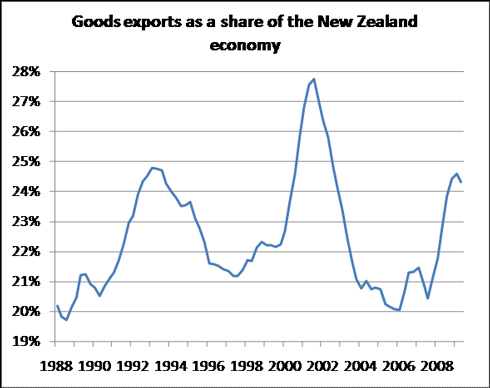
By Infometrics economist John Carran Let's be clear, goods exports make a valuable contribution to New Zealand's economy. They make up around 78 percent of total exports and 24 percent of GDP. On the whole, goods exporters are more productive than their domestic-focused counterparts. They expand domestic production beyond that possible from a sole focus on New Zealand's tiny market. They battle through large and volatile swings in the exchange rate, high transport costs, and stupid self-interested trade barriers in overseas markets. Goods exporters are certainly worthy of admiration. But let's not get overly obsessed about the contribution goods exports make to New Zealand's economy. It is one of the many cogs upon which the success of the economy depends.
Goods exports' share of the economy has swung around a bit over the past two decades. But if you remove the peaks and troughs, the medium-term trend is relatively modest as the chart indicates. Arguably, this trend has been biased upward by the extraordinarily high commodity prices in the early to mid parts of this decade, which substantially boosted the prices and production of commodity based goods exports. However, there are two big developments that are likely to prevent goods exports being the powerhouse in the future that many wish. The first development is that as New Zealand gets richer there will be a natural tendency to move away from goods production toward the provision of services, which are predominantly domestically focused. Goods producers tend to be more productive than service providers in wealthier countries allowing goods producers to pay higher wages without substantially raising prices. Service providers on the other hand are forced to push up their prices by more to meet rising pay demands. Over time this drives down goods prices relative to services prices resulting in a decrease in the share of goods in output. Related to this first development working against the export of goods are the shift of manufacturing production offshore to take advantage of cheaper cost structures and be closer to overseas markets, and a greater preference for services (for example, discretionary healthcare, eating out and financial services) as populations become wealthier. Static or declining trends in the shares of goods exports in the economy are evident in rich countries like Australia, Canada, Norway, Sweden, Britain, and United States. The second development that is against the export of goods is New Zealand's ageing population. In the future there will be a dwindling proportion of people of working age. There won't be the supply of labour to sustain large scale production of goods in New Zealand to the extent necessary to boost goods exports as a share of the economy. A larger share of those of working age will be sucked into industries servicing retirees such as healthcare, retirement accommodation, retail, and financial services. Greater immigration will help meet the needs of an ageing population at the margin, but the tide of older people is so great that it will take an unfeasibly large and sustained inflow of people to counter the diminished share of workers. For those that see the export of goods as the salvation of New Zealand's economy this might all seem rather gloomy. But the situation can be brighter than this. In a world where production is increasingly sourced from low cost countries more important than what's produced in New Zealand is how much income New Zealanders earn from all sources. It is possible for New Zealand to become wealthier with a lower share of goods exports if productivity is raised across all its industries and if New Zealanders invest wisely in assets here and overseas. New Zealanders need to become owners not just of high yielding domestic assets, but also overseas assets either through ownership of shares or through direct stakes in overseas based operations. There will always be parts of New Zealand's export sector that will do well. Some of our primary producers are striving and succeeding at raising the value of their exports through innovative products that leverage our country's comparative advantages. There are some high profile high-tech manufacturing export successes. But for every export success story there will be a fading star. Overall shrinkage of our goods exports as a share of the total economy is likely to be inevitable in the longer term. The government can assist goods exporters to make the most of the environment they face by continuing to work bilaterally and multilaterally to reduce trade barriers, and reduce its influence on the exchange rate by keeping public spending in check. But policies that primarily seek to counter the dominant forces working against the production of lower value goods exports in New Zealand will be counter-productive. Better to focus on boosting the mediocre productivity of New Zealand's domestic sectors and improving New Zealanders' investment performance.
________________ * Infometrics is an economic information and forecasting company based in Wellington. To find out more, see its website here. This piece first appeared in the Dominion Post on October 10, 2009.
20 Comments
Is that clueless waffle supposed
Is that clueless waffle supposed to guide our salvation?
Interesting points John This reinforces
Interesting points John
This reinforces the need to rebalance our economy away from unproductive investment in land and property and towards investment in high wage goods and services sectors, preferably exporters.
The vision of a low wage economy simply servicing the baby boomers is a bleak one
cheers
Bernard
Many counter arguments listed here:
http://www.mea.org.nz/media/viewpoint.aspx
Just take your pick.
Enjoy.
Oh dear...where to start. How
Oh dear...where to start.
How about here...
"The first development is that as New Zealand gets richer there will be a natural tendency to move away from goods production toward the provision of services"
How do you suppose New Zealand gets richer if all we do is take debt, buy houses and then service those debts? Don't we have to get an income from somewhere 1st?
And John Key's refusal to
And John Key's refusal to allow a flat tax is gonna assist us in boosting exports ? When are we going to lower tax on production , and raise it on consumption . Who needs a taxation taskforce to advise you to what is the bleeding obvious !
John Carran says "The government
John Carran says "The government can assist goods exporters to make the most of the environment they face by continuing to work bilaterally and multilaterally to reduce trade barriers" - actually it doesn't help exporters of high value goods much at all.Trade barriers are all about compliance issues in the elaborately transformed manufacturing space. Governments like NZ can't do much in here. If you think I'm wrong ask John Walley at NZMEA how things are going with the China FTA.
He also says that due to NZ's aging population "There won't be the supply of labour to sustain large scale production of goods in New Zealand to the extent necessary to boost goods exports as a share of the economy" Missing the point again. ETM requires less labour per dollar of goods made than other economic activity AND there isn't a need for large scale production activity in NZ anyway. That's not where we need to be. We need to be in niche activity. In this area we are very competitive so his assertion that over time there is a "shift of manufacturing production offshore to take advantage of cheaper cost structures" is only correct for long run product lines that isn't where we need to be anyway.
It all sounds like text book economics stemming from looking in the rear vision mirror of the industrialised nations history and expecting the new world order to be just a repeat of the old journey they went on. It already isn't like that except in places like China and India where they are following the old model because they have massive populations that are unskilled, underfed and look exactly like the status of the old industrialised nations. Perhaps they can repeat the journey. We need different thinking and it won't come from old text books.
Designers don't design your great future products by looking at what went before, nor do they do it by following the market researchers' reports about what the customers want. They do it by thinking up ideas the people can't ask for because they don't know they exist yet. If economists want to help they would be better thinking about what we can do that is different from what we have been doing and what the other failed states continue to do to see if they can design a way out of the current mess. Very hard to do with all the competing complex things in an economy but it has to be done non the less and economists that are more than accountants types or statistics gatherers should be the best equiped to tackle it. There are some great thinkers out there like John Kay and Eric D. Beinhocker but somehow they don't seem to get much traction in commentators thoughts in this country
For the serious student, reviews
For the serious student, reviews of works relevant to NZ by John Kay and Eric D. Beinhocker, here:
http://www.mea.org.nz/document.ashx?id=637
Enjoy.
Great post Brian W. You
Great post Brian W. You are absolutely right. Its all about niches for most NZ companies and as you say working on needs not wants. The text book economists just need to look at the IT industry for examples ( I'm not part of it ). But Nokia and co did not go out and do alot of market research and focus groups etc to develop texting ( for example ) because the consumer would not have had any idea of what could do or how it could develop -- there are scores of such examples.
Les, Novo, Roger and Brian:
Thanks for the support. The article came branded with the name of a major economics consultancy and needed to be challenged. And lets not forget that the failure of neo-classical economics has been a major contributor to the mess NZ finds itself in - more of the same failed theory is unlikely to contribute to an answer.
No-one has asked me to be specific about why I considered the article clueless. The above comments provide some answers, but I feel I should add the following:
a) Neither competition nor our current account deficit get mentioned
b) John Carran is proposing:
More immigrants, all requiring imports of fuel, food, materials for housing, etc. but also:
c) The impact of that combination on our current account deficit will be...? So:
Don't worry, with neo-classical economics the economy can grow on credit forever.
PeterR - I read through
PeterR - I read through your comments with my 'tin-hat' on expecting comments like, what a bag o' shite, absolute b*ll*cks, complete w*ankers, does GM really employ these tw*ts, where is he - on a Kawka somewhere, who's side are they on?, any PI guys?; but I have to say you impressed me with your restraint. You are probably the kind of gentleman I cannot be, good on you, for your restraint. Hey, have you seen this:
http://www.interest.co.nz/ratesblog/index.php/2009/10/13/economic-weathe...
Where is Gareth?
Thanks Les: Time helps with
Thanks Les:
Time helps with the restraint - there were 4.5 hours between my two comments. Besides, you have probably made your point when the website's editor has to come to the rescue of an article.
It would be interesting to know if Infometrics still in any way reflects Gareth Morgan's thinking.
Excellent thoughts PeterR. "The first
Excellent thoughts PeterR.
"The first development is that as New Zealand gets richer " - a very strange statement. As long as we have so many reliant on taxpayer handouts and the continual wasteful government expenditure there is no way for us to get richer. Perhaps the writer believes that increasing our wealth through inflation makes us richer.
Is this guy for real?
Is this guy for real? From what I can gather he's suggesting we'll be able to shrink goods exports, buy up other countries' assets and expect them to do all the productive work for us while we potter around in NZ buying property and working for the service sector. This seems totally unrealistic, weird and kind of colonialist!
Good to read some critical
Good to read some critical comments, I would be rather more cutting however thanks to the good thread to date, no need.
PeterR. I think you explained
PeterR. I think you explained your answer very clearly. I am still too in shock that this article was written by any sane person to begin with. So many holes in the article to know where to start.
In an economy where you
In an economy where you make huge capital gains on land and buildings it is known to be unsustainable. This has been very clear in Agriculture over the years, with many farms making a return of 2.5% or less (probably kept up with inflation), however they did very well on the whole as land values soared (esp dairy, due to large bank lending).
The problem with this? Farm production was seen as a byproduct to finance capital land value increases (where the real money was made). Instead of farmers increasing the production of their existing farms through development work etc, they instead brought more farms with bank loans. The result? a lot of poor performing farms that are now overburdened with debt and pretty much owned by the banks!
How this effects the low wage economy? puts tight margins on these farms and they tend to minimise labour cost. Farm workers are probably amongst the lowest paid in the country for the long hours that they put into their work..........
Farmers invest in land and
Farmers invest in land and not development! this applies to not just farms...
It is not the capital value on the balance sheet that is critical, but the profit on the profit and loss sheet...
Over leverage and the net profit in dollar value is stuffed.
Farms , like business are not a capital ivestment, they are to return a net profit, not a capital gain.
The difference between a good farmer and a "queen st " farmer
Farms are meant to be
Farms are meant to be returning a profit.......but most of that is being spent on interest payments! Things are way out of balance between land values and what the land can actually return in annual profit/ha, even when the payout has been good. That is why people who lease farms never do as good as the land owner..... but I believe this is going to change big time in the next few years when farm values will go down and the incentive to spend money on increasing production will go up.
I ask this question.....why are so many farmers only regrassing 5% of their farm per year as long as history dates back, when it has been clearly shown that there is a profit gain to be made through production. see pasturerenwal website, NZ stands to make millions more through farmers increasing pasture renewal to 15% per year. Answer: because they have been spending this money on buying the neighbours farm........or are not interested because they compare it to the capital gain they are making and see it as 'nothing' or simply are not interested in spending money on their farms.
Yes NZ should become the
Yes NZ should become the 7th state of Australia.......I wonder how much interest money made from the Aussie owned banks goes across the Tasman every day?
Today we pay the price of the past (having to sell our banks) and unfortunately we are in a big financial trap as a nation. Aussie banks would own the majority of NZ
"Yes NZ should become the
"Yes NZ should become the 7th state of Australia"
We would end up being the 'poor state' like or worse than Tazzy, because we dont have the big resource reserves of most of the Aussie States.