Top 10 at 10: Negative interest rates for UK?; Vampire Squid probe; China a giant ponzi scheme; Dilbert

6th Aug 09, 12:56pm
by
Here's my Top 10 from around the Internet at 10am. I welcome your additions in the comments below and please send any suggestions for tomorrow's Top 10 at 10 to bernard.hickey@interest.co.nz . Apologies for the delay. A few commitments this morning. We believe honesty does not impede sales.
 1. Finally the US government is grinding into gear to investigate pay and flash trading at Goldman 'Vampire Squid' Sachs, Reuters reported. We wonder if the Goldmanites inside the Beltway will allow it to get very far or deep. Either way, it will be fun to watch.
The firm set aside $6.65 billion in the quarter for compensation expenses, adding to a firestorm of criticism about pay practices on Wall Street. So far this year Goldman has set aside $11.3 billion for compensation. As the firm faces unwanted attention for its bonus pool, Goldman CEO Lloyd Blankfein told his staff to be cautious about making large purchases, the New York Post reported on Tuesday. Michael Holland, a money manager with Holland & Co in New York City, called the government's inquiry about compensation "a symbol" of Washington's interest in curbing Wall Street pay. "Politics is a major part of the life of Lloyd Blankfein and his cohorts," said Holland. "I think this is a preview of things to come."2. The Telegraph's Economics Editor Edmund Conway points out that British banks now have more money parked with the Bank of England than the amount of cash flowing around the economy. This is a first, as the chart below shows. Conway points to a solution: charging banks negative interest rates for having money with the Bank of England (ie the banks pay the BoE to leave money in the bank...) I'm not sure I agree, but it shows how big a problem the UK economy has. HT via email Ross Palmer.

The graph - in conjunction with what we know about how much banks are lending out to people (ie not much) - underlines the following dilemma: the BoE is pumping billions of pounds worth of cash into the economy, money that is supposed to be stimulating growth and yanking the country back out of recession. That wall of latent cash truly is massive, and must strike fear into the heart of any inflation hawks out there. But much to the BoE's annoyance, banks are hoarding much of it, leaving vast quantities in their reserves. As I've said a number of times in previous blogs, it is a similar issue to the one the Bank of Japan faced as it experimented with quantitative easing (QE) in the late 1990s and early 2000s. Now Charles Goodhart, a former Bank policymaker and someone with an impeccable reputation, has come along with a suggestion: why not start charging the banks for holding large amounts of reserves with the Bank? In effect, he is proposing negative interest rates for these banks. At the moment they receive interest on those reserves at the Bank rate (ie 0.5pc), which is hardly generous but then is no deterrent to leaving the cash safely in the bank. If, as Goodhart suggests, you charge them a 0.5pc fee on every pound above a certain amount, it would encourage them to go out and use that cash lending to businesses and people, hopefully combating the credit crunch.3. Rolfe Winkler at Reuters has done the unthinkable for any columnist in the United States. He has criticised Warren Buffett in a piece titled 'Buffett's betrayal'. His beef is that Buffett protests not to like government interference and bailouts, but he and Berkshire Hathaway are massively benefiting from these bailouts via various stakes in banks and insurers. Winkler backs his argument up with a revealing table.

It takes remarkable chutzpah to lobby for bailouts, make trades seeking to profit from them, and then complain that those doing so put you at a disadvantage. What saddens me is that Buffett is uniquely positioned to lobby for better public policy, but he's chosen to spend his considerable political capital protecting his own holdings. If we learn one lesson from this episode, it's that banks should carry substantially more capital than may be necessary. You would think Buffett would agree. He has always emphasized investing with a "margin of safety" "” so why shouldn't banks lend with one? Yet he mocked Tim Geithner's stress tests, which forced banks to replenish their capital. Why? Is it because his banks are drastically undercapitalized? The more capital they're forced to raise, the more his stake is diluted.4. Here's a fascinating piece from UBS economist Paul Donovan via FTAlphaville on why governments can't inflate their way out of a debt problem. Many bondholders fear governments will choose to print money to inflate their way out of a trouble, leaving them with worthless paper. But Donovan says governments won't get away with it because they are continually having to reissue debt and the price (interest rates) will race away ahead of them. Essentially governments won't be able to afford it because the rising interest costs will make money printing unsustainable.
5. Mish at Global Economic Analysis points out that US tax revenues have suffered their biggest drop since the Depression.As an example, the US can expect to roll over almost 45 per cent of its debt in the next 12 months and some 55 per cent over the course of the next two years. So according to UBS, if there is an inflation surge in the next 12 months, the US government would expect that to be reflected in higher borrowing costs "” thus negating any 'sympathetic' inflation-impact on its national debt. There's also the issue of TIPS, or index-linked (inflation-linked) securities. The idea that governments can readily inflate their way out of their debt problems is a misnomer "” arising, perhaps, from confusion between the fate of the individual bondholder and the response of the collective market. An individual holder of a long duration bond will lose out as a result of inflation. However, modern governments can not rely on markets to remain collectively indifferent to inflation. Inflation will raise the nominal cost of borrowing (of course) but through the inflation uncertainty risk premium it will also add to the real cost of borrowing. The higher debt service cost becomes a problem for a government that is pursuing an inflation strategy because government debt does have to be rolled over. Unless a government is willing to pursue hyper-inflation as a strategy, raising inflation will not reduce the government debt burden. Indeed, history indicates that the reverse result will be achieved.
Recession? What recession? This is a depression. No it's not the great depression, but this is no ordinary recession as measured by housing, jobs, the stock market, the CPI, auto sales, and now federal tax revenues.6. Remember the video where snippets of Peter Schiff were put together showing he was right. Here's a video fisking of Federal Reserve Chairman Ben Bernanke's comments from the years before the US housing collapse showing he was utterly wrong. It's glorious and damning. The guy should not be reappointed. Here's a sample of Bernanke's views on the US housing market from 2005.
You can see some types of speculation: investors turning over condos quickly. Those sorts of things you see in some local areas. I'm hopeful "” I'm confident, in fact, that the bank regulators will pay close attention to the kinds of loans that are being made, and make sure that underwriting is done right. But I do think this is mostly a localized problem, and not something that's going to affect the national economy.Oy Vey! Watch this and weep. HT Mises.org 7. Here's my first link to a Chinese language site. Here former Morgan Stanley analyst and China guru Andy Xie says the Chinese growth this year is all a lie, or at least a Ponzi scheme. The site is in Chinese characters but the comments themselves are in English.
Chinese stock and property markets have bubbled up again. It was fueled by bank lending and inflation fear. I think that Chinese stocks and properties are 50-100% overvalued. The odds are that both will adjust in the fourth quarter. However, both might flare up again sometime next year. Fluctuating within a long bubble could be the dominant trend for the foreseeable future. The bursting will happen when the US dollar becomes strong again. The catalyst could be serious inflation that forces the Fed to raise interest rate. Chinese asset markets have become a giant Ponzi scheme. The prices are supported by appreciation expectation. As more people and liquidity are sucked in, the resulting surging prices validate the expectation, which prompts more people to join the party. This sort of bubble ends when there isn't enough liquidity to feed the beast.8. Meanwhile China has just uncovered a US$702 million fraud by a bank executive that involves a bank part owned by HSBC, the FT reports.
Liu Changming, former president of BoComm's Guangzhou headquarters, fled the country soon after authorities launched an investigation in late 2007, according to state officials and people familiar with the case. He is still on the run in spite of a global alert issued through Interpol to apprehend him. According to people familiar with the case, the loans were channelled through subsidiary companies of Canton Properties without the knowledge of shareholders, who were told the company had no unpaid bank debt. After Mr Wang disappeared in August 2008, Canton Properties suspended its shares and most of the company's board members, including Sir David Brewer, former lord mayor of London, resigned.9. This is stunning. Reuters reports that 48% (yes almost half) of all US home owners are expected to be in negative equity by 2011. HT Blair Rogers via Twitter.
"We project the next phase of the housing decline will have a far greater impact on prime borrowers," Deutsche analysts Karen Weaver and Ying Shen said in the report. Of prime conforming loans, 41 percent will be "underwater" by the first quarter of 2011, up from 16 percent at the end of the first quarter 2009, it said. Forty-six percent of prime jumbo loans will be larger than their properties' value, up from 29 percent, it said. "The impact of this is significant given that these markets have the largest share of the total mortgage market outstanding," the analysts said. Prime jumbo loans make up 13 percent of the total market. Deutsche's dire assessment comes amid a bolt of evidence in recent months that point to stabilization in the U.S. housing market after three years of price drops.10. Here's a fun cartoon from the Washington Post.
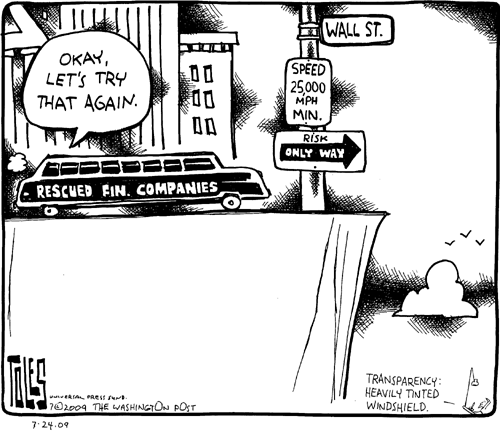
We welcome your comments below. If you are not already registered, please register to comment
Remember we welcome robust, respectful and insightful debate. We don't welcome abusive or defamatory comments and will de-register those repeatedly making such comments. Our current comment policy is here.