
In this section
Offers for readers
Follow the news from interest
The comment stream
Recent comments
- 1 of 20818
- ››
Editors choice
- 1 of 295
- ››
Finance sector jobs
Lead from the front utilising your strategic, technical and leadership qualities within th...more
New Zealand
Lead from the front utilising your technical expertise in this highly attractive senior li...more
New Zealand
Customer focus, high performance, exceeding client expectations and achieving profitable g...more
New Zealand
Key leadership position in the bank. Be a part of one of the fastest growing banks in New ...more
New Zealand

The news stream
Latest news
Most commented
- Fonterra to tighten TAF rules 67
- Govt eyes NZ$1.4b revenue grab 58
- English defends current account blowout 56
- 90 seconds at 9 am 51
- BNZ cuts most fixed mortgage rates 48
- 90 seconds at 9 am 43
- Thursday's Top 10 with NZ Mint 38
- Budget 2012 reactions 36
- Budget tax moves to target high income NZers 29
- Wednesday's Top 10 with NZ Mint 24
Most viewed
Top 10 at 10: Carbon trading delay?; Weimar-style inflation?; Citi hikes salaries; Dilbert; TheOnion
Here's my Top 10 Internet links at 10am. I welcome your additions in the comments below. I'm glad I'm not having a tax audit.
1. The US Federal Reserve held its key rate at 0-0.25% overnight and said the pace of the economic decline was slowing. It reiterated it would keep the rate at "exceptionally low levels for an extended period" and it still planned to keep buying back bonds and printing money. Here is the Fed Statement.
2. Brian Fallow at the NZHerald has a nice summary and update on where New Zealand is with a carbon emissions trading scheme and were we fit into the various schemes being formed (or not) around the globe. He concludes we should probably push ahead with some sort of emissions trading scheme here rather than waiting to see where the chips fall overseas. He suggests we wouldn't have any power at the post 2012 negotiating table if we did nothing. But would we have any power anyway?
3. The IRD has NZ$4 billion worth of tax debt on its books from 202,000 cases, the NZ Herald points out. Yikes. And we thought our banks had a problem with dairy debt.
4. Roeland van den Bergh at the DomPost (via Stuff) has an interesting piece on how one in five mortgage borrowers can't move bank because they are too indebted to pass the test at a new bank.
5. Former Brook Asset Management Executive Chairman Simon Botherway has some strong words on the prospects for inflation in a comment piece in BusinessDay (via Stuff). His argument is that competitive devaluations by central banks elsewhere may force the NZ, Australian and Canadian central banks into money-printing devaluations to push their currencies lower. He even uses the dreaded Weimar word
The sovereign nations, institutional investors and hedge funds (remember them?) who have been in the vanguard of this migration, are already seeking refuge in assets whose integrity and value is upheld by a central bank they can trust. Over the past three months or so, since the announcement of money printing in the US, Europe and the UK, bond holders in those countries have been punished whereas the commodity currency investors have been richly rewarded. In fact, the rate of appreciation of the commodity currencies has been amongst the fastest on record.
Related Topics
But in their eager rush for the shelter of the commodity currencies, investors are too readily dismissing the angst being articulated, regularly and unambiguously, by the monetary authorities in the commodity countries. The RBNZ, RBA and Canadian central bank have all expressed dismay at the strength of their respective currencies and the implicit monetary policy tightening threat that such appreciation poses to their own sluggish economies.
6. Tyler Durden at ZeroHedge points to a Rolling Stone article by Matt Taibi which says Goldman Sachs "has engineered every major market manipulation since the Great Depression - and they're about to do it again." And here's Felix Salmon's take on the article too. It's a must read for anyone with anything to do with Goldman Sachs, which should be everyone involved in financial markets. Here's this opening salvo, which does indicate a point of view... Polemic can be fun and useful.
The world's most powerful investment bank is a great vampire squid wrapped around the face of humanity, relentlessly jamming its blood funnel into anything that smells like money.
7. Rolfe Winker (once OptionARMageddon and now at Reuters) points out Citigroup is raising (!) base salaries.
Ugh. The fact that any Citi employees are getting raises is beyond obnoxious since, by definition, every dollar they earn comes directly or indirectly via taxpayers.
Particularly irksome is that these raises are going to supposedly "high-value" employees"”traders and bankers"”the guys who broke Citi's balance sheet in the first place.
That government-backed banks are allowed to operate hedge funds remains beyond comprehension. Now Citi is jacking up pay so their traders don't jump ship. One great way to manage risk at Citi, and to wind down taxpayer support, would be to let the bank's prop desk die by attrition, which may happen if Obama can keep pay in check.
8. Now French house prices are collapsing too, FTAlphaville points out. Brilliant. I've always wanted a house in the south of France...
9. Matt Nolan at TVHE wonders whether Westpac's economists admitted collusion in their detailed defence of bank margins. The response from Michael Gordon at Westpac makes for some interesting reading.
At the end Westpac says that it, and other banks, have been pricing at average cost instead of marginal cost "“ so they have been pricing based on the cost of credit to them, not the cost of sourcing additional credit to make loans.
Now, according to Westpac the average cost is higher than the marginal cost, and all banks have seemingly agreed to do this even though since the marginal cost of credit is below the current "price" an individual bank could "defect" and make some money. Is it me, or has Westpac blatantly admitted to collusion here?
Westpac has said that it, and other banks, have implicitly agreed to set interest rates at a higher level than marginal cost "“ which I presume must be closer to the collusive price than marginal cost as otherwise it wouldn't stick.
Now I didn't think the banks were colluding, but if Westpac is willing to go ahead and admit it then "¦
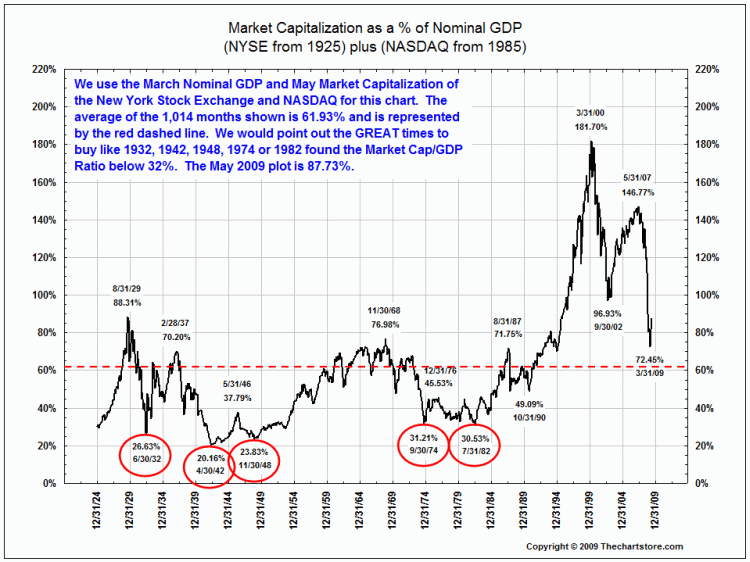
10. Barry Ritholz at The Big Picture has some great charts on stock market capitalisation to GDP ratios going back to the 1920s. It seems to show the market is still over valued.
10 (bonus). William Pesek at Bloomberg reports on the problems entrepreneurs in Asia are having getting money out of 'bankers who are swine'. HT Ross.
Here's TheOnion on Barack Obama having a performance review with every single American worker. I love the comment about google docs.
Obama To Hold Job Performance Review With Every American Worker

1 Comments
Item 5. Yes, but what
Item 5. Yes, but what if the investments are going into the companies producing the commodities! That is a different issue. Much safer to own a % of a NZ fish export company than to own NZ govt bonds. I agree. How long before this becomes market thinking. Up will go the Kiwi as investment floods in to buy the stock. And why not. It's as cheap as chips. In steps Bollard to QE the Kiwi down. Too late mate. Damages the govt bond issue effort and puts up the cost of credit for all in a country deeply deeply in debt to start with. Will Bollard print down the Kiwi? Not bloody likely.
Simon Botherway is correct, a
Simon Botherway is correct, a massive correction is coming, we just don't know when it will come. (it's like Christian believing that Jesus will come again but not when?)...
But I would disagree about how this will happen.
Meantime as RBNZ sits on their hands, our current account deficit balloons into the hyperspace....and when the crunch finally comes we have REALLY UNPAYABLE debts and the currency then sinks into hell anyway....
Our exports are dying because commodity prices have gone down..
Our farm producers (remember Frank Sullivan?) are dying because the high exchange rate gives them nothing by the time they convert their exports into NZ$....
We need "tough love" economics....low exchange rate to encourage exports to repay our external debts and high interest rates to discourgae spendthrift....it's between a rock and a hard place....will RBNZ has the guts to jump into devaluation ??
No, I don't believe they have the guts to trigger a bigger recession than now and so the slow drift into Hell goes on..... Or until the market decides we become "Iceland of South Pacific"....by the way title "Iceland of Pacific " had already gone to California.
Watch the waves of financial tsunami ???
Now that Queen Helen is
Now that Queen Helen is ensconced in the world's biggest socialist bludge ( the U.N. ) , is there anyone left in this country who still believes in the carbon emissions malarky ?
Unfortunately, Roger T, about half
Unfortunately, Roger T, about half a squillion scholokids/grandkids/kids and other assorted livestock. They've been exposed to the gentle persuasions of everyone from Al Gore to Keef Locke. And as the Jesuits say, give me the boy until the age of seven, I'll hand you the man.
There are three baleful legacies of the former Gubmint which will haunt us for a long, long time:
- the entrenchment of a raging entitlement mentality amongst that large segment of the populace who can, by definition, contribute least to real economic output.
- the debasement of science by funding and other perverse incentives, into a handmaiden of the oligarchy.
- the encouragement of Magical Thinking, which again by definition is not rational.
The interaction of these three results in a closed and defensive world-view, which nevertheless demands (and presently gets) all of the external inputs it needs - cash, goodies, attention, and voting power.
Still, as a wise common tater noted on another thread, what cannot last, won't. And welfare as we know it, cannot.
But the transition phase shall surely be Interesting (which is why this belongs right here on Interest.co.nz, heh). The thought experiment would be to make all welfare subject to sign-off from localised judging panels drawn solely from Tax Producers. There would be some wailing and gnashing of teeth, I'd predict.
But, ter get back to Carboniferous Fings, the basis for the whole shebang is a combination of points 2 and 3 - science which is pointed at foregone if wrong conclusions by skweed funding, and a goddly dose of Magical Thinking. Because Correlation ain't Causation, and the world seems ter be cooling. Just read the drumbeat from those with skin in the game (e.g. stormx.com). Cool equals less yeilds. Equals less food.
Fun awaits....
waymad : couldn't have put
waymad : couldn't have put it better myself. Bless you !
Hard to beat this as
Hard to beat this as a headline: Depressed banker missing 'with two shotguns'
http://www.telegraph.co.uk/news/uknews/5626604/Depressed-banker-missing-...
He's only gone off to
He's only gone off to securitize them, Will. Probably to Argentina. Apparently that's the new Apdalachian Trail?
Roger, Waymad - enjoy: Sunspots
Roger, Waymad - enjoy:
Sunspots spell end of climate myth
http://www.stuff.co.nz/business/713743
“The problem with socialism is
"The problem with socialism is that you eventually, run out of other people's money." "“ Margaret Thatcher
hey waymad..?
Thankyou Les : good to
Thankyou Les : good to read this article again. Refreshes the mind on all the bogus stuff put about by do-gooders who wish to pillage the established economies, in the mistaken belief that throwing that money at the world's impoverished nations, will bring them up to our standard of living. Absolute nonsense of course, as socialism is fatally flawed by the simple fact that it doesn't work. Tried, many times, failed, same number of times. Bless Augie Auer : you were so right ! Global warming is utter bollocks.
"But in their eager rush
"But in their eager rush for the shelter of the commodity currencies, investors"
Hmm, I'm not sure about that. Yes there may be some movement into the apparent shelter of commodity currencies, but it looks to me more like a risk reversal. Since the stock markets bounced the Yen carry trade was reignited.
I think time will tell. When risk aversion returns on stock market drops, if the commodity currencies drop back to where they were the idea of them as a shelter will be proved wrong.
I have always assumed competitive devaluation. Is that not the remit of the central bank organisation?
Re. point 9 Bernard aren't
Re. point 9 Bernard aren't you a bit peeved that Westpac's Michael Gordon saw fit to grace Matt Nolan's blog with a comment but is nowhere to be seen on interest.co.nz? If you could get him to do the honours you might want to ask him to answer this question from Les Rudd:
"It'd be interesting to know more about these two aspects, particularly, how much debt/money retail banks can/do write (fractionate?) into existence for given levels of reserves?"
http://www.interest.co.nz/ratesblog/index.php/2009/06/23/poll-result-45-...
or is that Westpac's "dirty little secret"?
Neil C Many thanks for
Neil C
Many thanks for the comment.
You're assuming Michael Gordon doesn't comment on the blog, but you're right he hasn't (and probably won't) reply to that direct point.
He's very welcome. We have a very open door.
cheers
Bernard
Thanks for reply Bernard. I
Thanks for reply Bernard. I suspect he thinks that the bloggers on your site are not docile enough. I would take that as a compliment if I were you.
neil c - Girol Karacaoglu
neil c - Girol Karacaoglu has answered our questions, see:
http://www.interest.co.nz/ratesblog/index.php/2009/06/23/westpac-economi...
"It should shift the mechanism for controlling credit growth away from the OCR to counter-cyclical quantitative controls such as capital and liquidity ratios on banks."
Typing that letter from The Press was tedious, but interesting stuff nonetheless.
One indeed wonders just how much the anatomy of government might grow:
http://blogs.nzherald.co.nz/blog/show-me-money/2009/6/24/maybe-governmen...
"Can our economy grow fast enough to catch up with Australia with the current economic structures? Do we need to reform the way government and the private sector interact? Do we need to change the structure of the tax system? How could we do it to encourage productive investment in wealth generating assets that reduce our current account deficit rather than encourage more building of townhouses and baches by the beach that increase our foreign debts?
How do we avoid taxing our youngest and brightest to death to pay for the gold-plated pension and health schemes for the baby-boomers? How do we avoid becoming a retirement village in the South Pacific with some boiling mud and green paddocks for scenic effect?"
Why don't we also recognise that present monetary policy does not work?
"The current OCR- centred monetary policy is causing excessive volatility in our currency at the expense of our productive export sectors and to the benefit of bank treasury departments - the only ones that profit from currency volatility." Said Girol Karacaoglu.
Bernard, sorting mon.pol should be part of any prescription for economic re-structuring in NZ, how about broadening yours and making this Number 11? See:
Bernard Hickey: Ten tips to tax NZ out of dire straits [link through from Bernard's anatomical article.]
Les, "Bernard, sorting mon.pol should
Les,
"Bernard, sorting mon.pol should be part of any prescription for economic re-structuring in NZ, how about broadening yours and making this Number 11? See:"
Indeed number 11 may be the most important prescription on the list though the other 10 are of high importance also.
I think we will see a review of monetary policy, debt management and our banking systems in the near future. However, this will be best addressed informally rather than by another wasteful "inquiry". Let's be honest, Select Committees do not always have the requisite expertise to deal with this issue.
Just get some informed bods around a table and thrash it out.
raf, No matter how we
raf,
No matter how we come up with the answers, for me the key issue is ensuring solutions are such that they are generally acceptable, they stick and don't get wound back as soon as the next convenient election rolls around. Therefore a long lasting healthy impact. That's means talented and honest communication as much as it does good analysis and policy development.
So we might be stuffed on two fronts then?
I'm sure it can be done, let's be hopefull.
Cheers, Les.
Loved the review I thought
Loved the review I thought the same I cannot challenge it in anyway. Have you got a list of your current review for me to read? I have also created some reviews for you to read on my blog...