In this section
Offers for readers
The comment stream
Recent comments
- 1 of 19105
- ››
Editors choice
- 1 of 276
- ››
Finance sector jobs
At NAB, it's all about our people reaching their full potential. And that means we drive t...more
Australia
Senior Financial Planning professional to join our Business Banking team in Bondi....more
Australia
At NAB, it's all about our people reaching their full potential. And in MLC and NAB Wealth...more
Australia
Successful applicants will have the opportunity to work with this leading Australian Advis...more
Australia

The news stream
Latest news
Most commented
- 90 seconds at 9 am with BNZ 116
- Wednesday's Top 10 with NZ Mint 78
- Friday's Top 10 with NZ Mint 29
- The problems with NZ's energy use 20
- Amanda's Take Five for Wednesday 19
- More bank mortgage rate cuts 16
- Govt lifts minimum wage 50 cts to $13.50 an hour 16
- Thursday's Top 10 with NZ Mint 15
- 90 seconds at 9 am with BNZ 14
- Full time jobs fall 13,000 in Dec qtr 14
Most viewed
Interest on Twitter
Top 10 at 10: Real estate agents should use google; China's ghost city; Japan's debt mountain; Dilbert

Here are my Top 10 links from around the Internet at 10am. I welcome your additions and comments below or please send suggestions for Wednesday's Top 10 at 10 to bernard.hickey@interest.co.nz We never have to pretend to be inspired at Interest .co.nz
1. Due Diligence - The fallout is now raining down in Southland over the collapse of a whiffy deal involving a Maori hapu backed by Dubai money to buy 28 Southland farms. The Otago Daily Times reports Federated Farmers as criticising the real estate agents involved for not doing much due diligence on the buyers. Google is a wonderful tool...
Federated Farmers rural security spokesman and Southland farmer David Rose said a cursory check would have found the involvement in the hapu buying the land of convicted fraudster Shane Wenzel and the failure to complete the $150 million deal showed the need for higher professional standards in the real estate sector.
"When a simple Google search revealed a convicted Australian criminal was associated with the people fronting this deal, you can see why Federated Farmers was more than sceptical," he said.
But the agent trying to close the deal, John Wright of LJ Hooker, in Invercargill, disagreed, saying the proposal was not conventional and required different thinking. "It saddens me that Federated Farmers continue to grandstand on the Arab-hapu project, using old conventional thinking around something that is far from conventional."
An Auckland hapu with financing from Dubai proposed to buy 28 farms in Southland and enter into a 99-year food supply contract with the Dubai interests. The deal fell over last week due to the hapu failing to meet deadlines and a breakdown in communication.
2. China's ghost city - Regular readers might recall my links earlier this year to an Al Jazeera story about the empty city of Ordos in China where the government had spent money in a 'bridges to nowhere' style to artificially boost the economy. There was some controversy about the story and some people inside China (possibly connected to the government) said Ordos was plenty full.
Related Topics
Now we have Geoff Dyer from the Financial Times reporting on the new city of Chenggong in the southwest of China, which he says is almost completely empty. The picture (left) is better than a thousand words.
Construction started in 2003 and the results are now apparent in 13 immaculate local government buildings, each clad in marble tiles. A high school boasts an impressive indoor swimming pool and several of the region’s main universities have built large campuses. Pristine high-rise apartment blocks stand in rows, their new windows glinting in the subtropical sun.
The one drawback: at the moment, Chenggong is almost completely empty. Its wide streets are all but bereft of traffic, a bank branch has no customers and leaves collect in the foyers of the municipal offices.
It is places such as Chenggong that are starting to divide opinion about what is really happening in the Chinese economy. China was the big winner from the global crisis, with its economy expanding by 8.7 per cent last year amid recession elsewhere. But as the country returns from its lunar New Year holiday, divisions are emerging over the long-term impact of the stimulus package implemented by Beijing to carry it through the international downturn.
While some regard China as having made forward-looking investments in infrastructure and urban planning that will lay the foundations for a new burst of growth, others fear last year’s recovery is really a mirage based on an investment bubble. It is also a crucial question for the fragile global economy. If China’s rebound were to fizzle, it could easily drag the rest of the world into a double-dip recession.
3. Chart of the day - The dark red line is America's current jobs recession, which is way worse than anything seen since at least World War II.
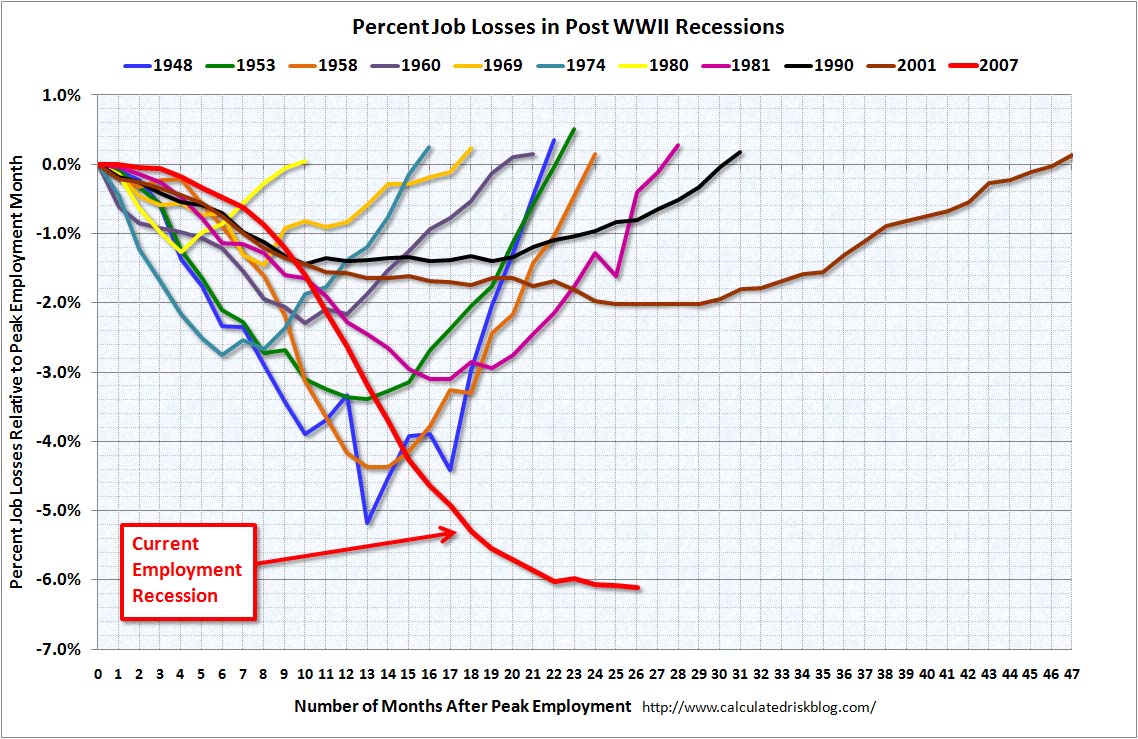
4. Bond vigilantes - Paul Krugman at the New York Times looks at why some countries get pinged by the bond vigilantes when their net debt is over 100% of GDP and why others don't. It's all about confidence in politicians. New Zealand's net debt is set to rise well over 100%, but we're ok it seems because foreign investors believe our politicians and we're underwritten by Australia.
So what’s the problem? Confidence. If bond investors start to lose confidence in a country’s eventual willingness to run even the small primary surpluses needed to service a large debt, they’ll demand higher rates, which requires much larger primary surpluses, and you can go into a death spiral.
So what determines confidence? The actual level of debt has some influence — but it’s not as if there’s a red line, where you cross 90 or 100 percent of GDP and kablooie; see the chart above. Instead, it has a lot to do with the perceived responsibility of the political elite.
What this means is that if you’re worried about the US fiscal position, you should not be focused on this year’s deficit, let alone the 0.07% of GDP in unemployment benefits Bunning tried to stop. You should, instead, worry about when investors will lose confidence in a country where one party insists both that raising taxes is anathema and that trying to rein in Medicare spending means creating death panels.
5. Changing our ways - James Kwak from Baseline Scenario has a review of Yves Smith's new book ECONned and likes the basic idea that America's lust for cheap debt and consumption needs to be turned around.
There’s another point that Smith makes that I found particularly memorable. She tells the fictional story of XCrop, a new, bioengineered food that is nutritionally complete and cheap to produce — a solution to malnutrition and obesity all in one. But twenty years after becoming popular, and after having become the mainstay of the food system (replacing today’s current staples), XCrop is found to have serious harmful effects on human health. Shifting back to today’s foods would be healthier, but it would be difficult and expensive.
Recent financial technology, Smith says, is like XCrop. The point she is making is that our policy objective should not be to get us back to the good old days of cheap mortgages and widespread securitization as quickly as possible so we can return to the outsized consumption of the past decade. We need to have a healthier financial system, and to get there we have to give up the wonder food that turned out to be so harmful to the economy. Instead, however, Smith argues that much of the government has been captured by the financial services industry — the inventors and manufacturers of XCrop. And so, at the end of the day, and despite the central role that free market economic orthodoxy played in producing the crisis, the problem we face is ultimately one of politics.

6. Japanese debt - There have been so many warnings about Japan's debt situation getting out of control that eventually one of them will come true. Here's the latest from The Telegraph's Edmund Conway in Japan. He makes the point that Japan's domestic savings rate is dropping as the population ages and soon local savers won't be able to buy all those Japanese government bonds.
People have been predicting an apocalypse for the Japanese budget for at least a decade, and year by year, the country has defied such warnings. The government has been able to sustain a textbook unsustainable level of debt because the debtholders have been willing to lend it money at interest rates of between 1pc and 2pc, compared with rates of over 4pc throughout much of Europe, and more than 6pc in Greece. And the reason those creditors have done so? Because 95pc of them are Japanese.
This peculiarity of Japanese government debt – that it is vastly owned by Japanese citizens – has protected it from the discipline that would be imposed by international investors. However, a growing number of experts think this buffer will soon come to an end. The savings rate in Japan, which stood at around 14pc in the early 1990s, is now below 4pc – one of the lowest in the OECD.
According to Naoyuki Yoshino, professor at Keio University, the country may have only four years until the stock of savings is overtaken by the supply of debt, meaning it will suddenly have to start selling a larger chunk of its debt to outside investors, potentially triggering a sharp increase in interest rates.
“When those rates start to rise, then we would have to slash government spending,” he says.
7. Canary in the mine - Japan's debt crisis may not be that far away, according to Societe Generale's Dylan Grice in a research note pointed to by FTAlphaville. The biggest buyer of Japanese bonds (JGBs) is now having to borrow money itself. And Japan's bond mountain has an awfully short average maturity of just six years compared to Britain's 14 years.
The biggest JGB holder on the planet – the Government Pension Investment Fund (GPIF) – which has already admitted it’s no longer able to roll maturing bonds, has announced that it will open credit lines so it doesn’t have to sell them to fund its obligations…
To spell that out: we are going into a year in which the government has ¥213 trillion (US$2.3 trln) of bonds to roll over… and the biggest holder of JGBs is openly admitting he has no new inflows of money.
8. Totally irrelevant picture - There's an elephant in the room. I welcome your thoughts on which is the biggest Elephant in New Zealand's room.
9. Somewhat irrelevant video - Dave Carroll is the country singer who did the now-famous United Breaks Guitars video on Youtube. It has become a seminal moment in customers exercising their power via social media (8.05 mln views and 13.1 mln links on Google). The trouble for United is that this is not going away. Carroll has done a fresh one. He's still mad. And so are lots of other people. Not a bad little ditty. Just a corporate PR nightmare. Good.
10. Totally relevant video - Who would have thunk it. China's house prices are now unaffordable. Looks like a bubble to me. HT Hugh via email. This video is from Al Jazeera


81 Comments
Biggest elephant in NZ's room
Biggest elephant in NZ's room - Increasing proportion of population dependent on Govt welfare and over-reliance on the excessive taxation of a small proportion of the population (i.e. the productive sector). All this at a time when the ability of Governments to borrow is about to hit the wall (a nice little domino effect).
<b>Ordos</b> may be empty ,
Ordos may be empty , but I'll bet London-to-a-brick that THEIR buildings don't leak . Happy to accommodate the world's driest mice .
Ten marks to Key..."John Key
Ten marks to Key..."John Key is defending the plan that will lock out Aucklanders in favour of unelected directors"..Herald.
When you have done with them Mr Key...move on to central govt. The sooner we get rid of pollies and their pork slicers, the better.
Biggest elephant in NS's room
Biggest elephant in NS's room - DEBT - DEBT - DEBT -
Without elaborating on this theme - bloggers here know the implications - or at least have an inkling what it all means.
I really don't like this
I really don't like this biased "ghost city" story. I am from China and I know some new suburb/district in large cities do look like that.
In fact a similar "empty" picture can be taken in Hamilton without trying too hard.
By the way Chenggong is not a "city", it is a new suburb of Kunming. Kunming is the capital of Yunnan province and has a population of 6.5 million.
I just google Chenggong (it is called 呈贡 if you can read Chinese) and find out It was called Chenggong County before and was merged to the fast expanding Kunming city in 2003. Chenggong county was firstly built by the local indigenous people in 107 BC.
This new Chenggong suburb is roughly 1/10 the size of Auckland and has about 1 million people living in it.
So much for the ghost city.
Good one Brien..I thought it
Good one Brien..I thought it was a crap story too...oh and biggest Elephant in the room...not the gargantuan pile of debt folks....it's central govt and their mates in local govt...I see Key has made a start in Auckland on ridding us of this pest called democracy...keep it going John...we wanna see fewer pigs at the trough in wgtn too.
The obvious elephant in the
The obvious elephant in the room is too obvious to mention.
http://news.theage.com.au/breaking-news-business/portugal-adds-a
http://news.theage.com.au/breaking-news-business/portugal-adds-austerity...
Just have to insert these titbits:
"Portugal announced new austerity measures on Monday to avoid a debt crisis like the one engulfing Greece, cutting welfare benefits and government hiring as well as selling assets and raising taxes on the well-off.
The plan "rests, essentially, on a reduction in public spending," Teixeira dos Santos told a news conference.
Portugal's budget deficit is projected to have hit a record 9.3 per cent of gross domestic product last year,
Portugal's public debt is expected to climb to 85.4 per cent of GDP this year".....
Sorry...what are the projected NZ stats again????
Wally NZ public debt still
Wally
NZ public debt still below 25% of GDP. It's all the private debt that is the problem. Almost another 80%, taking us well over 100% within 4 years, English says
cheers
Bernard
The troubled PIGS of the
The troubled PIGS of the EU - Portugal, Ireland, Greece, Spain.
Two big elephants. New Zealand's
Two big elephants. New Zealand's private Debt and the stated intention of central banks around world and now very similar comments from John Key to try to inflate away that Debt, ie transfer it to savers young and old and probably future tax payers. This whole process sucks.
Thanks BH...what a nice start
Thanks BH...what a nice start to the day...we are leading at least of one of the PIIGS.
Well done Brien , for
Well done Brien , for correcting the stupid story. We need to see more of the MSM pulled up on their inaccurate spin. My brother and sister in law live in Kuming -- they love the place.
Good on you Brien, if
Good on you Brien, if your right the tide has gone out and there are a whole lot of people with no clothes on.
Good to see that city has been around for a few thousand years, shows our lack of wisdom and the me, now and here mentality which runs this country.
Finally.... the day of reckoning
Finally.... the day of reckoning has arrived for the ratings agencies....wonder what other cases are lurking in the halls of justice!
http://www.theage.com.au/business/agency-ratings-put-to-the-legal-test-2...
Well said <b>Brien</b> : I
Well said Brien : I hauled Hickey over the coals one other time he ran the Ordos story , but he assured me that his source was impeccably reliable .
Biggest Elephant in the Room : Our government ! Too big , too stupid , too self-serving ! [ a plague upon your houses' , both National & Labour ]
Where the gosh-darn heck is SORE-LOSER : C'mon out of the shadows / putcha caps-lock on / and have a good rant . Missing your contributions !
<b>BRISCOES</b> have announced a $
BRISCOES have announced a $ 21 million dollar profit for the year ended 31/12/09 . ( an 81 % improvement on the previous year's result ) . Revenue was up 7.3 % for the year . Rod Duke : " ..........we are cautiously optimistic that we will continue to build on the improvements in operating and financial performance we made through 2009-2010 . "
I agree the government is
I agree the government is not very efficient. I hope National and Act can bring on further reform!!
PS: Roger I am glad that you clarified National and Labour as "your" government, I wouldn't believe you have any connection to the Chinese government as BH alleged, anyway.
^o^
Tony Alexander is also 'pushing'
Tony Alexander is also 'pushing' the strange logic that if investors sell rentals then they'll be a shortage of rentals for rent and thus rents will rise.
I've written to him and asked him to explain; hopefully I'll get an answer that will explain why I’m so dumb that I can't see this logic.
Believe it or not, even TV one's business show had 'an expert' on the other day saying the same thing and was allowed to 'get away with it'.
Bernard when you're next on TV PLEASE challenge the 'experts' to explain why this is so and also ask the interviewers why they allow these 'experts' to make such a claim as if it was actually so !!! Poor journalism or am I just thick?
Cheers
www.lyricscrawler.com/song/72414.html [ for Brien &
www.lyricscrawler.com/song/72414.html
[ for Brien & Trev . Enjoy ! ]
Excellent - "A fourteen, a
Excellent - "A fourteen, a seven, a nine and lychees."
'Onya RT.
Nice spot Brien. I was
Nice spot Brien. I was skeptical on the story - especially when you see how many people live in China! Hell, if they do ever find a ghost city that looks that good I think I'd consider retiring!
On a similarly topic - great video at the end, Bernard. I would draw some parallels to NZ! House slaves! Gotta love that name..
Are we not forgetting that
Are we not forgetting that in the final analysis a nations real wealth is in its capacity to produce goods and services.
I've just spend a month
I've just spend a month in Kunming. Great city. Fast growing with lots and lots of business happening. Doing business there I feel i had the whole of NZ's population with in a bus ride away. However the house prices there have risen by a lot in the last few year and all the chinese firend i have spoken to seem to thing prices are only going one way. Every one is telling you that it is 100% certain you will make money if you buy now. I have considered buying an apartment there but not so sure anymore.
Dont have to worry about
Dont have to worry about biggest elephant,its the crap pile its gonna leave!!!@ Kev, Goebbles would have been proud of so called unbiazed TV Einz!!
@Jakub "Every one is telling
@Jakub "Every one is telling you that it is 100% certain you will make money if you buy now"
Sounds like a good time to sell!
@Jakub, I am sure they
@Jakub,
I am sure they have some very nice apartments in Kunming, but you have to be very careful to buy in a market where everyone else is rushing in. The current property bubble in China actually makes me fear. Especially when the Chinese Government starts to impose so many new policies to limit the property market.
@Roger: great song thank you!
Dear Doubters on Chengong I
Dear Doubters on Chengong
I suggest you challenge the authority of the Financial Times and the reporter in question.
You could have a go at Al Jazeera, but I suspect the FT has a fairly high level of credibility.
Also have a look at this from Patrick Chovanec on this article. He is a closely watched a professor at Tsinghua University's School of Economics and Management in Beijing.
http://chovanec.wordpress.com/2010/03/02/bubble-in-shangri-la/
He describes the article as excellent and adds his own detail from on the ground there.
"Many real estate “bulls” in China will admit that stockpiling exists, but contend it is restricted to Beijing and Shanghai, which serve as magnets for wealth from all over the country. In second and third-tier cities, they argue, people are buying places to live, and the growth is sustainable. Putting statistics aside, just on the basis of what I’ve observed traveling around China, I’ve always been reluctant to credit this argument. I’ve seen plenty of places in the provinces, in second, third, or even fourth-tier cities like Ordos (in Inner Mongolia) and now Chenggong (in the remote southwest) where people – for better or worse — appear to be investing in residential real estate, not to live in, but as a store of wealth. If there’s an overhang in the residential real estate sector, it is happening across China, and is not confined to Beijing and Shanghai."
cheers
Bernard
Predatory Lending is a major
Predatory Lending is a major contributor to the economic turmoil we are currently experiencing.
Here is an example of what I am talking about:
Scott Veerkamp / Predatory Lending (Franklin Township School Board Member.)
Please review this information from U.S. Senator Jeff Merkley regarding deceptive lending practices:
"Steering payments were made to brokers who enticed unsuspecting homeowners into deceptive and expensive mortgages. These secret bonus payments, often called Yield Spread Premiums, turned home mortgages into a SCAM."
The Center for Responsible Lending says YSP "steals equity from struggling families."
1. Scott collected nearly $10,000 on two separate mortgages using YSP and junk fees. 2. This is an average of $5,000 per loan. 3. The median value of the properties was $135,000. 4. Clearly, this type of lending represents a major ripoff for consumers.
http://merkley.senate.gov/newsroom/press/release/?id=A09C6A80-537A-4EB1-...
Bernard --the way I read
Bernard --the way I read Chovanec's comments is that it is more to do with realestate speculation ( should sound very familiar to NZers ) than an empty city. We have to remember the Chinese do things on a much larger scale than NZ. Kunming before this development was not much bigger than Christchurch with 4-5 million people.
As an aside , they have just built ( in about 12 mths) one of the largest wind farms my brother -in law has seen ( he has travelled very widely)-- they don't muck around when they do something.
The elephant in the room
The elephant in the room for me is that companies, with their Ltd status make huge cockups ( the financial industry a la hanover and building industry a la builders and their suppliers) usually manage to escape any liablity. We need regualtors with the teeth and balls to pursue ther individuals behind these companies so they cannot fold up the firm and disappear. Of course you need some limits on liability, but there must be a way to discipline people.
As Iain P said in anothert post today re housing, but I think this attitude would help to create a business environment that rewards excellence and punishes crapness.
"Before the innocent taxpayer doles out a cent, the shareholders of suppliers of the time, Govt regulators, architechs, inspectors, valuers, builders should have been removed of every cent of profit they gained from occasions they never fulfilled their contractual or legal obligations, no just changing names and carrying on their merry way, every trust they are involved with cracked open"
Hi BH, I personally don't
Hi BH,
I personally don't care about FT's creditability, but I believe copying & pasting such an article here will hurt interest.co.nz's creditability.
I didn't challenge the "property stockpiling" thing, what I am against is the statement that Chenggong is "almost completely empty" --- I don't think this statement is appropriate given the fact that Chenggong has 1 million population living in a area equivalent to 1/10 the size of Auckland.
If you could image a reporter who took a photo from the car-park of Sylvia Park shopping centre at 6:30 on Saturday morning, and set the camera focus on some "for lease" signs, and come up with the following story on today's newspaper:
"Citizens Evacuated to Tonga to Avoid Deadly H1N1 Virus Blow-out and the Country is Completely Dead"
----then you will know where I am coming from.
Japan has some massive issues
Japan has some massive issues ahead of it. The twin tsunamis of debt and demographics are going to cause some enormous havoc. Politicians don't know what to do, and the usual racism and xenophobia means immigration is still not on the agenda.
The 'Japan Shock' ain't far off my friends.
@Kevin There will not be
@Kevin
There will not be a rental shortage if investors sell, but should the population grow by a few percent and these extra people will be needing accomodation, not all can or want to buy. This will then lead to a situation where there will be a shortage of rental accomodation. Its all supply and demand, if the population doesn't grow then there won't be a problem.
Unfortunately this appears not to be the case and so there will need to be some investors to provide the housing for these extra people and should they decline this opportunity then there will be a shortage.
I have ignored the problem of skilled tradesman, lead times, housing being in the right areas etc but only focused on given the population growth forecasts there will be a shortage due to no investors buying/creatng housing for rent.
Housing will not create itself and not all these new people want to or can afford to buy.
I think the problem isn't
I think the problem isn't democracy but our democratic culture. For example we rely on television programs that lack rigour and politicians can demolish a question before it is even asked.
Do you think it's wise
Do you think it's wise to bring in 'all these new people' at the moment, John, with an unemployment rate of 7.3%, and rising at last call? If we bring in those that can afford to buy all these new houses you suggest, what will they do? Being rich; owning a house in a foreign land and doing nothing isn't much fun. Holidays only last for so long.
@ Kevin Rents will rise
@ Kevin
Rents will rise because the supply of housing will not keep up with the increase in the number of households.
The heat that has, until recently, been generated by investors at the bottom of the housing market has kept the middle and upper end on the boil, so allowing Mr&Mrs Average and Mr&MrsWelloff to sell for a good price to pay for their respective new-build dream homes. Hence, a good flow of additions to the stock.
The investors have now fled, and not as many of the Averages and Welloffs are getting the necessary price any more. Therefore, the number of new houses has fallen.
@ Johnny Having lived in
@ Johnny
Having lived in Japan, I agree with you that it has some major issues to address, most notably a febble and beaucratic political system unable to make the necessary changes. You are also correct about the reluctance for immigration. However, I would contend that its humongous population base may prove to be a benefit, rather than a curse. The Japanese are conformist and I think in a time of crisis, their humongous culture will stick together and look after each other for the greater good of the country. I suspect that to address the crisis, the democratic government structure that the US installed after WWII will be pushed aside in favour of a stronger form of leadership (such as that in Singapore) and the population will back them. Also, a declining population is likely to a benefit in a resource constrained world. Japan has a high-quality population base i.e. on the whole they are well educated, diciplined and hard working. While they are aging, they are healthly, and have advanced technology and infrastructure. I often came across people in their 70's and 80's doing voluntary work cleaning the parks etc.
I am much more concerned about the stability of those countries which have diverse individualist polulation bases with massive divides in wealth and quality and where the only thing holding them together is raw capitalism. What is more frightening is that their polulation growth is low quality. Remember, the polulation growth in our educated, skilled demographics is like that of Japan - declining (as people have fewer children and have them later). The polulation growth is actually the low social-economic demographic which are totally dependent on the govt welfare. When the government goes bankrupt and declining resources mean that the basics of food, water, energy and shelter become unaffordable for this polulation base, what do you think will happen. Do you think the higher-demographics will voluntary support them or do you think their could be a revolution?
Thanks Nicholas, not a good
Thanks Nicholas, not a good idea at all, not a good idea to do a lot of things that are being done, but I am not in charge of setting the environment that drives behaviour. Its easy for me, I am an observer and critic and unfortunately not a good one at that.
Brien from Hamilton This is
Brien from Hamilton
This is the quote from the FT reporter.
"Chenggong is almost completely empty. Its wide streets are all but bereft of traffic, a bank branch has no customers and leaves collect in the foyers of the municipal offices."
I'll back that any day. I worked as an editor in Singapore handling copy from reporters in China and also spent some time reporting and editing copy from Beijing itself. I'd trust the FT any day over comments from others.
Patrick Chovanec is also no mug. He's been there and says this is an excellent report. Read the full report and Chovanec's comments. They are balanced and nuanced. They even agree there may be an aspect of 'build it and they will come' to this infrastructure spending.
But to simply deny that the credit explosion in China last year won't cause any problems is just head in the sand stuff.
cheers
Bernard
speaking with a friend in
speaking with a friend in china, one of the investment strategies over there is to build a poorly constructed house, no need to have tenants, just wait 1-3 years and the govt will pay 3 times the price of construction to be able to bulldoze it and put up their own housing/structures on the plot of land.
Seems like a good way of stoking the GDP fire, but, not a very efficient use of resources and doesn't this all have to end somewhere?
Advised my friend against it, but, they are all on the bubble, can't see the needle coming to pop it.....
Bernard if you stump up
Bernard if you stump up the airfare im happy to go take a look and help put the matter to rest.
There's two elephants in the
There's two elephants in the New Zealand room:
Welfare Dependency & Foreign Debt - now running at over $ 325 billion gross and increasing by roughly $ 1 billion per month.
Compound interest, Time and maybe higher interest rates will deliver the Tsunami.
The only question is when.
It will be precipitated by what Sir Anthony Eden called " Events - Old Boy " and will hit us when we least expect it.
@Doubter: but the net amount
@Doubter: but the net amount of homes has not changed.
So if we have say 10,000 homes and 6000 are rentals and 4000 owner occupiers and the rental brigade sell 1000 then say 500 go back to rentals and 500 become owner occupiers then we end up with a 5500 / 4500 split, its still 10,000 houses all occupied.
Or if the present 6:1 ratio of income to cost stays I supposed that ratio of rentals to home owners stays, however if we get a 40% drop in the house value such that we are at 3:1 ratio then the ratio could change, more ppl could aford to buy and landlords would then have lower rents because the capital outlay is less to support...but those houses are still going to be occupied.
So when ppl say rents will rise that isnt a given IMHO....they could actually drop or more likely stay static as ppls wages are static, indeed if we get deflation and higher un-employment then ppls wages will drop and rents will have to drop.
Which begs the Q are the landlords selling at present because of the possible changes in May or are they thinking that rents could come under huge pressure and have to fall as we face dip MKII...all while interest might climb, ignoring what the OCR does...
regards
Some of my relations in
Some of my relations in China seem to be on the property cant drop in value bandwagon, when I talk to them it seems crazy...
China isn't communist but its
China isn't communist but its still a command economy with layers of central, regional and local bureaucracy, hardly a recipe I would have thought for efficient use of capitaland resources, especially when you throw in endemic corruption. Surely its like Nazi Germany in the 1930's. A repressive totalitarian government building impressive public works and a financial and business elite doing very nicely thank you. At first glance its admirable that so many low income people have been able to move to better paying work in the cities, and that the middle class has been able to grow, but there are not enough natural resources on this planet to give all Chinese the level of affluence of the west, let alone India and the rest of Asia. At some point when those expectations are not met, it has to implode into chaos, revolution and war. It always does.
Agree with From the Sidelines on Japan. They're a homogenous society that will pull together. China, Europe and the US will explode before they do. Ever thought what would happen if the US had to bring home millions of milllitary personnel to no jobs and a bankrupt veterans system. A hundred Timothy McVeigh's, damaged and bitter but well armed and trained. First state to leave the Union?
Exactly the same property speculation
Exactly the same property speculation was rife in Hong Kong through the 1990s right up until the bubble burst in 1998. I remember my close colleague buying his under construction apartment before it soared out of his reach (against my advice to wait and see). By the time it was complete it was worth less than he'd paid.
I also recall the 'hongs' fire-sale in mid-98: 30% off and still boasting about the huge profits they were making.
Apart from the Asian contagion, one of the reasons HK property prices collapsed was that Tung Chee Hwa first action as HK's first Chinese CE was to 'solve the housing crisis' by building more government apartments. Boom!
Steven / Dpoubter I can't
Steven / Dpoubter
I can't see many investment properties becoming owner occupied.
Not many people would want to be owner occupiers in many of these shoeboxes they call investment properties
Most of them will be bought by investors again, but at markedly lower prices
NZ's elephant in the room
NZ's elephant in the room is Fonterra and the over-leverage in the ag industry IMO. Watch out below if commodity prices plunge.
<b>Bernie</b> : As per Kojak
Bernie : As per Kojak & Rob Alloway , you need to " keep-your-hair-on " , so for stress relief , repeat after me : I like Chinese , they only come up to your knees ( ankles , in your case , Big Guy ) , yet they're always friendly , and ready to please ....................I like Chinese food , the waiters never are rude .....
Chenggong....pretty surreal. Looks like a
Chenggong....pretty surreal. Looks like a place where a neutron bomb went off
Bit reminiscent of Japan where cities built roads to nowhere in the middle of the countryside to boost the economy / secure more funding for the next financial year
I suspect a bubble has developed in China, we will have to see whether it explodes or just deflates slightly.
Hopefully for the sake of the world economy it will be the latter.
Here's an interesitng question.... Has
Here's an interesitng question....
Has the boom in property prices in China been a result of excessive land use regulation, or speculative fervour
I wonder when google did
I wonder when google did their last map updates?...note they dont have a street veiw for Chenggong
What is interesting is that for such a high population there is very little traffic or cars parked
It says on the bottom
It says on the bottom lright of the google map (satelite image) - when the photo was taken.
Bernard & Brien -- to
Bernard & Brien -- to help the debate I emailed my brother in law who lives in Kunming and he sent me the following reply :
This area is the new city for Kunming . City govt is moving out there along with most of the Universities. s This will effectively mean about 500,000 people going out ,Is huge developments out there with lots of apartments . Most would be sold but the Chinese tend to leave them empty as they are investments , Property bubble is another issue. Area also has big commercial and recreational zones
This area is and will be far from being a ghost town but can see where the view comes from . Light rail presently being put in which will also make a difference
So I think the FT should have done abit more research.
"Light rail presently being put
"Light rail presently being put in which will also make a difference "
Wow, that is forward thinking. Could we borrow their Mayor and Council for Auckland?
Yez all wrong.....he says demurely.
@ Stevek "Ever thought what
@ Stevek
"Ever thought what would happen if the US had to bring home millions of milllitary personnel to no jobs and a bankrupt veterans system".
Very good point. I hadn;t thought about that. History does repeat - I seem to recall Rome faced a similar issue when it started to collaspe.
The whole world is going
The whole world is going through an unprecedented real estate boom for the last 10 years. It is primarily fueled by monetization of US debt and easy credit. We are quite lucky all the money as been poured into real estate and not used to speculate in commodities that much. (Remember the petrol prices!)
The biggest elephant in the
The biggest elephant in the room, is the failure of folk to understand the exponential function.
Interesting, that.....
Most folk are compound-confounded.
We should perhaps include Albert Bartlett's little lecture in economics 101.
Which is why productivity gains, efficiencies, even wiping govt. out completely, none of it is enough now. And won't be from here on.
So hard to get it across, eh?
If there was enough of everything, there would be no need to contemplate any of the above. No need for the NZX to eye off SOE's, no need for anyone to eye off anything. The mere fact that they have had to, indicated the proximity of the end-game.
And the old economics saw about scarcity forcing substitution at some elevated price, only worked while there was supply of resources or alternatives, such that they underwrote the 'doubling-times' involved. It failed - completely - to factor in a finite planet.
It's that simple. We're at the wall that Malthus described, now. He was never disproved (mathematically he can't be), just delayed.
Maybe the elephant could also be called "denial of reality".
The less clear question is what happens to the now unrepayable debt.
What the world needs is
What the world needs is million strong (violent?) demonstrations in Germany and Brussels against PIGS bailouts and in Washington, Los Angeles, Chicago & London over the bank bailouts to wake politicians up everywhere that the "privatising the profit, socialising the losses" mentality of the financial elite can't continue. Shake the bastards to the core I say.
I'd despair for NZ if it wasn't worse just about everywhere else. When the global ponzi financial order finally collapses, next cycle or the one after, NZ will be one of the best places to be. Depressing but I fear inevitable.
Regards Elephants in the room:
Regards Elephants in the room: We have many, and of more than one species - cause and consequence at least. A couple not so far mentioned as such are our leadership deficit, broad systemic failure, and the true state of the balance sheets of entities ranging from banks to SOEs to large corporates and the RBNZ.
@Will: I worry about fontera
@Will: I worry about fontera as well...it has no need of debt at all and they dont seem to be paying it down..
regards
@PDKiwi: you sound like a
@PDKiwi: you sound like a stuck record mate......but you know you can lead a horse to water but you cannot make it drink......hmmm I wonder how hard it is to ride a horse....guess I should learn....funny how the generation who's experience we will probably need the most is now almost past...
regards
Listen to this shit from
Listen to this shit from BE
http://www.youtube.com/watch?v=bw13g_I1-wQ
@PeterR & et al, elephants
@PeterR & et al, elephants in the room I would say are the bleeding obvious ones no one talks about.....we (as in its in the popular press as well) talk a lot about debt, BBs retiring and some AGW yet the biggest thing that is going to impact businesses and our lives is peak oil....
No other event is going to irreversably impact our lives yet I see very few ppl commenting on its effects to businesses and daily lives. ie risk and impact....like courier services unsustainable at >$2 a litre certianly $3...so why are ppl not getting out of such businesses? such prices are a few years away at most.....taxis? car mechanics? cars will be a luxury for the few.....the prius is what $45k? I couldnt afford 1/2 that, bought a house within 5min of public transport....tourism? flying will go back to as it was between the wars, something the very rich do on occasion...so why do we want to own Air NewZealand? sell it to the ozzies quick!
We have a lot of tallow, spare land for bio-fuels, we should have enough plant in place to meet a critical % of our needs, Labour had the right idea with insisting on a small % be biofuel and National scrapped it....like duh.....we need more hydro and more wind and tide, deal with the RMA and the NIMBIES. We need to re-invent how we work and um work (forget retirement and big holidays) to suit the energy supply and its cost...
Some of the right retards in the USA say "wind isnt suitable for our daily lives, just when we need it at 6pm it drops off"....so the choice is in the future use renewable and cheap (its all relative) power when its available or pay a horrendious cost for the limited fossil-fuel powered supply available at that time....if wind power is 25cents and fossil is 75cents ppl will change. Or the choice is what? a "not negoitiable lifestyle" can only be maintained with guns and lives in foreign lands, just who is going to be willing to pay in blood? bring back conscription maybe? for the poor of course.........hmm most interesting will the BBs with their voting block force the youngsters into the military to keep them in comfort? just how far can the democratic system be abused before it ceases? as the libertarians say tyranny of the masses (or some such)
regards
Steven = yeah, sorry. I
Steven = yeah, sorry. I wait, and wait..... I worked all this out in the '70's, and approximately when it would hit.
I guess it's just a bit frustrating now - now that it actually hit - that they don't see it even yet!
I had a horse once - 8 years old, an unbroken half-draught. Let's just say I'll stick to me bike!
Cheers
The elephant in our room
The elephant in our room has been there since the day NZ was settled by Europeans. We have not now nor ever had sufficient capital to take our economy beyond its agricultural/extraction/immigration driven roots.
We dont own our banks, the vast majority of succesful $50 mio businesses get sold off so we have a chronic shortage of $500/5000 mio businesses that you find in abundance here in Northern Europe, and we borrow like crazy from offshore to buy each others houses.
And I dont buy the tyranny of distance/we're so small excuse making - for decades we were one of the 5 richest economies in the world. Try and imagine how different NZ would be today if in that time we had been saving around 10% of our incomes as they do now in Oz, Singapore, Scandinavia. Our kids would be studying now to fill jobs at the NZ head offices of our local banks or high tech manufacturers or a global shipping company or some other industry we have hocked off. Instead now they will have to go to Sydney, HK or London.
If the NZ economy was a person you'd say its stuck in its 20's, moved out and bought its 1st (crappy) house with borrowed money and spending more than it earns, covered by borrowing from the grown-ups. It thinks enjoying life is more important than preparing for the future, prefers a job working out in the fresh air and not wearing a tie in an office and it doesn't spend much time thinking about coming generations.
Justice, Stephen. So BE is
Justice, Stephen.
So BE is building more roads with money we have to borrow in the hope that people will still be able to afford to use them. I mentioned leadership deficit and systemic failure.
I am less concerned about peak oil than increasing government costs. The former we will in time adapt to. The latter is relentless, hard to avoid and destroying the productive economy - again, leadership deficit and systemic failure.
@PeterR: Well BE also talks
@PeterR: Well BE also talks about more power cables, which I think are essential where more roads are a waste of time...given their expected life...like 10 at most 15years. Power cables cost energy to put in, doing it while energy isnt taht expensive will help us enormously.
"I am less concerned about peak oil than increasing government costs. The former we will in time adapt to."
Then you need to read more on peak oil...if there is one event in our future with the biggest impact and likeyhood of collapsing our society/civilisation this is it.....the biggest reason is we need a massive amount of fossil fuels to eat...
The issue you just flew over...."we will in time adapt to" the oil industry gives us 85mbpd....the entire system is huge...and cost many many billions...but the biggest point is we dont make oil, we refine it...so essentially the oil is free, its making it useful that counts and the cost of making it useful is about 15:1 ie 1 barrel of oil to make 15 into something useful, but to adapt we will need time and as aalude to something to adapt to...at least 10 years if not twenty....if we are onthe plataeu of peak oil which we are then we are 10 years too late to avoid severe disruption and for some death by starvation...
"The latter is relentless, hard to avoid and destroying the productive economy " what you describe is the drop in production after peak oil....Consider that for an economy to grow we need oil supply to grow...its linked at the hip...if it cant grow our entire ponzi finance scheme is doomed....
PDK says he realised this in the 1970s, I wish I had in at least the nineties because I would be doing things significantly different than I am today, but Im locked in now.
regards
Steven - have a listen
Steven - have a listen to Morning Report. As usual, the intelligent one is Cameron Bagrie. I reckon he 'gets it', and I've thought that for a while.
Otherwise, there was Carmel Fisher - talking of lack of growth opportunities, so cashed-up companies will acquire each other to 'grow'. Like Kraft/Cadbury. This is happening in the oil industry too. Jostling under zero-sum lid, I'd call it.
Then a senior economist, commenting on oil. You say I sound like a cracked record - well, when economists understand the exponential growth thing, I'll shut up. You should podcast his comments - "there's growth in China, but not in the West, so oil isn't a worry. Completely ignores the fact that every day that goes by, we burn 85 million 44-gallon drums of it, removed forever from the inventory.
He doubts prices will return to 2008 levels - well, he can't have growth and a constrained supply and no rise in prices. He's seems to have a problem with relativity of exponential numbers, a very common trait. Remember Malthus is, and always was, right. Staving off the day, is very different from disproving!
Not sure it's going to get better, either. We are now to assault tertiary learning, to take the blinkered 3r's output from schools, and turn out productive little units. Not the same as thinking ones, not the same at all. At least our leaders won't have to worry about feeling inferior.
Still, you'd have the think the collapse will arrive before the echelon emerges - the macro maths sez so, anyway.
Bernard prefers some FT reporter's
Bernard prefers some FT reporter's personal feeling to solid stats number, which is interesting.
@Ross,
Very helpful information, thank you!
Steven, Your arguments are I
Steven,
Your arguments are I think based on an assumption that I believe "growth" is a good thing, or at least a given. That is wide of the mark. The way we use the term "growth" is a good indicator of the user's understanding. Growth such as in more people is stupid and crude. Growth through technology can mean more from lower resource use - quite different. In agriculture growth has normally meant higher production from increased resource use.
I am not counting on the world's consumption "growing" very much over the next ten years. That is probably a good thing depending on what sorts of growth we get.
We don't need huge amounts of oil to produce food. We use huge amounts of oil - much of it wastefully - because it is cheap and there are a lot of vested interests in our doing so.
We especially don't need food from ruminant animals which are the least efficient producers. There is room to adapt in food production, and there is enough work around to suggest farming can be more profitable with lower resource use - once you can address the systemic failure that exist through agriculture.
In terms of oil, the cost has been so low that we have had little incentive not to waste it. It has been so cheap that governments can tax it heavily and we still use too much. So I am not bothered if the price increases - that will be a good thing especially if it forces us to use resources better. Killing consumption and economic growth? So what. Adapt or die.
PeterR - true - but
PeterR - true - but do you not think the fiscal system relies on energy to do things? If those things are discretionary, does it make any difference to the barrel-to-$ underwriting?
If not, then economic growth has hit it's straps, apart from efficiencies. From here on in, the strong devour the weak, but no grow.
My question has always been: Can loans, debt and interest repayment be continured beyond the peak supply of energy?
Seems to me the question is valid regardless of whether the loan is for business plant, or an overseas trip.
powerdownkiwi, Good question, and I
powerdownkiwi,
Good question, and I have a good answer - but it will have to wait till this evening. No time now.
powerdownkiwi, I think we broadly
powerdownkiwi,
I think we broadly agree on the destructiveness of compounding anything. Debt and wealth being a couple of the few things we as a culture expect to grow exponentially.
Those with wealth (countries, corporates or individuals) assume wealth should compound. That requires compounding growth - something that worked (from the perspective of the wealthy) so long as there were new colonies, populations, or resources to exploit. Which there were for a few centuries up till the early 1970's.
But there are limits to compounding growth and they were for all practical purposes reached.
From there growth became increasingly notional. Currencies were debased. Inflation grew. Credit expanded. "New" wealth was created in anything from personalised plates to radio spectrum to IP. For the last 10 years growth came largely through asset bubbles, government spending and drawing down consumption from the future.
Much of that notional "growth" is now collapsing with deflation as it must - the event only ever being a question of timing. We have already arrived at the point where debt cannot be repaid - irrespective of the availability and price of oil or the efforts of governments and central banks.
If peak oil had occurred before now then it may well have forced the deflationary collapse to occur earlier. Whether loans, debt and interest repayment could be continured beyond the peak supply of energy is now a moot point because we got there before we reached peak oil.
Thanks PeterR. You have given
Thanks PeterR. You have given me something to think over today. I agree with you but struggle to see a way out with Chinese wages so low and so many of them. Where to from here (after the deflation)?
The politicians answer
http://www.stuff.co.nz/national/politics/3432588/National-opens-door-for...
Andrewj, The leadership deficit I
Andrewj,
The leadership deficit I mentioned earlier appears to keep building its claim to be the biggest elephant in the room.
I gave up expecting our
I gave up expecting our leadership to lead us out of this a couple of years ago.
heya! I believe the data
heya! I believe the data posted on your site is key, I have favorited you =D
Yay! The loser spammer scum
Yay!
The loser spammer scum monkeys are back!
Oooo ooooo, swinging from branches, scratching their arses and flinging poo around the internet.
Oooo oooo ooooo!