
The comment stream

Recent comments

Join the Interest community to be a registered commenter so you can:
- Edit your comments
- Avoid the CAPTCHA
- Vote on comments
Register Here

Already registered? log back in here ..

Forgotten your password? No problem! Click here

Finance sector jobs

Manager Operational Effectiveness and Assurance IT
Reporting to the Senior Manager Operational Risk Effectiveness and Assurance, the key focu...more
New Zealand
Financial Controller
Reporting to the Head of Finance - Retail and Business Bank the key focus of this role is ...more
New Zealand
Manager Finance Corporate Core - 12 Month Contract role
This role in consultation with the Financial Controller provides financial, strategic and ...more
New Zealand
IT Audit Manager - Internal Audit - Auckland
If you are motivated by the prospect of seeing the big picture, developing your team and m...more
New Zealand
efinancialcareers.com

Reader poll

Should you fix your mortgage now or stay floating?

Choices

QV reports prices falling; ASB survey shows price expectations down; Mortgagee sales up too

Posted in News Updated

Prices are gradually falling, QV reports.

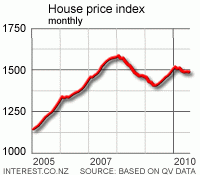
Property values have fallen 0.8% across New Zealand since March and are now down 4.7% from their peak of late 2007, Quotable Value (QV) reported in its July report.

(Updated with ASB survey showing fewer expecting prices to rise, Terralink figures showing mortgagee sales up to 5% of total sales in June)

The government owned valuer said an increasing number of buyers were withdrawing from the market because of fears about interest rates or problems finding finance.

It said prices were likely to keep falling as the inventory of unsold property continued to build.

“The number of house sales in recent months has dropped around one third from the same time last year, and is also around one third below the long term average. We are now approaching similar levels of sales as during 2008 at the height of the recession” said QV.co.nz Research Director Jonno Ingerson.

“Unlike 2008 when the overwhelming negative sentiment of the global economic crisis drove house values down, we are now seeing more of a ‘do-nothing’ sentiment. According to QV Valuers, an increasing number of people appear to be shelving plans to buy houses and are instead focussing on reducing debt," Ingerson said.

"Of those potential buyers that remain active, some are finding it difficult to secure lending from banks, while others feel they are in the driving seat, have time to do their research, and only make sharp offers” he said.

“The lack of buyer demand, combined with an increasing supply of unsold houses is causing values to gradually drop. This is in contrast to 2008 when values declined sharply.”

Ingerson said the property market was typically slower over the winter months.

"Some of the home owners and potential buyers we have spoken to remain concerned about potential interest rate rises and job security. Market activity is likely to remain slow over the coming months, and we may not even see the traditional spring upsurge in activity. If this is the case then we would expect to see values continue to ease back,” he said.

While values have declined according to the QV index, the average sales price increased slightly from $404,715 to $407,191.
This increase in average price is due relatively fewer lower value properties selling over recent months.

QV said the index was a more reliable measure of value change as it is not based on average sales prices and is not affected by which parts of the market are more or less active.

Most of the main centres were showing a similar trend over the last year with values increasing through until March then easing since.

Prices falling across the country

As a result values are still above the same time last year, although the gap is closing.

Auckland area values are 6.9 percent above last year, down from the 7.9 percent reported last month. Recent declines in values in the Wellington area mean that values are now only 3.2 percent above last year, down from the 5.4 percent reported last month.

Values have been flat in recent months in Christchurch and are now 4.6 percent above last year. Dunedin values are now 3.7 percent above last year, down from the 5.8 percent reported last month. In contrast to the other main centres, values in both Hamilton and Tauranga have been relatively stable for the last year.

As a result Hamilton is only 0.3 percent above last year and Tauranga 0.5 percent.

Values in most of the provincial centres remain above the same time last year, although the gap is closing. Napier (4.7 percent), New Plymouth (4.3), Wanganui (2.6%), Palmerston North (2.3) Nelson (3.1) and Invercargill (5.3) all remain above last year. Rotorua (1.4 percent), Gisborne (0.6 percent) and Queenstown Lakes (-0.2) all have values similar to the same time last year.

Values in Whangarei have continued to drop since late 2009 and are now 2.6 percent below the same time last year.

See the full QV report with regional reports and the full QV spreadsheet here.

ASB Housing Confidence

Meanwhile, ASB released its quarterly housing confidence survey showing housing confidence was broadly unchanged, but that more respondents expected house prices to fall and fewer expected prices to rise.

See the full survey results here.

ASB Chief Economist Nick Tuffley said a net 29% of respondents said now was a good time to buy a house, unchanged from the previous quarter.

“Expectations for further rises in house prices have fallen across the regions, with the decline particularly evident in Auckland,” Tuffley said.

“A net 19 percent of people we surveyed across New Zealand expected prices to increase, down from a net 35 percent last quarter," he said, adding the South Island continued to have the highest price expectation across the regions.

"The survey also shows growing awareness across the regions of future interest rate rises, which is likely to be pulling down optimism. Almost three quarters of respondents expect interest rates to rise."

“This result is in line with recent data showing signs of a continued slow down in housing market activity. Nonetheless, house prices remain resilient even though potential sellers appear to be holding off putting their houses on the market.

The median number of days taken to sell a house had continued to edge up and was now above the long-term average.

“We expect the outlook for the housing market will remain subdued given waning housing turnover. Beyond 2010, we forecast weak house price growth, tempered somewhat by population growth and net migration.”

Mortgagee sales rising

Also, Terralink reported registered mortgagee sales rose to 264 or 5% of total sales in May  from 246 or 4.5% of sales in April.

Terralink Managing Director Mike Donald said there has been a significant change in the type of property owners who are being forced to sell.

“Not only is there an increase in the number of mortgagee sales of properties owned by individuals rather than companies or mulitple owners, but more and more of those individuals are losing their only property – and more than likely it’s their family home," Donald said.

“We all thought last year was a bad year for mortgagee sales when we reached record high numbers. Most of those were property investors who had over-extended themselves during the property boom. This year the pain has shifted to ordinary New Zealand families,” Donald said.

In May last year just under 50% of mortgagee sales were for properties owned by an individual. A year later that number has increased to 62%, and one in five of those forced sales was held by an individual who only owned one property.

Donald said property owners from the Bay of Plenty, Waikato and Manawatu were hit the hardest in May.

“There were 31 mortgagee sales, more than one a day in the Bay of Plenty - up from 15 the month before. In Manawatu there were 21 forced sales, compared to 12 the month before. In the Waikato there were 51 forced sales in May, up from 28 in April. “It isn’t just the main centres that are being affected, times are tough in the regions too.”

Donald said mortgagee sales were usually the end result of many months of financial hardship for the property owner and pressure on property owners was likely to continue for some time yet.

See the full report here at Zoodle.

We welcome your help to improve our coverage of this issue. Any examples or experiences to relate? Any links to other news, data or research to shed more light on this? Any insight or views on what might happen next or what should happen next? Any errors to correct?

We welcome your comments below. If you are not already registered, please register to comment in the box on the right or click on the "'Register" link at the bottom of the comments. Remember we welcome robust, respectful and insightful debate. We don't welcome abusive or defamatory comments and will de-register those repeatedly making these comments.

163 Comments

Oh happy days!  Noddyland is

Oh happy days!  Noddyland is officially worthless.

Better hope the market keeps

Better hope the market keeps going Wally. Your pension depends on it. No retirement for you if the pension stops.

I can only see the house

I can only see the house price up in the near future. The 15% GST will push up the house price by 2% if not more.

Or else prices will fall

Or else prices will fall because the GST increase will drive more buyers out of the market, thereby forcing sellers to lower their expectations in a bid to lure the buyers back in.

These figures were expected

These figures were expected by most people...not a big surprise

Auckland appears to be doing better than the rest of NZ

Where's Wally?

He's on top of you as always.

He's on top of you as always.

I dont get it-we are in the

I dont get it-we are in the throes of  the deepest recession in decades and houses prices have risen across the country over the last 12 months. Which ever way you look at it there has been no big plunge in values as certain ( ahem!) people close to this site have forecast and the market could at worst be said to be "flat" . If these twiddly rises and drops are all we see then be content. When it comes to presenting balanced news it's seems that the lunatics are running the asylum.

It must be getting hard to

It must be getting hard to spruik property in a falling market eh Mr N. I imagine your getting clients coming to you more and more frequently who say 'why did you advise me to buy yesterday when I could have bought cheaper today'? Give it another year and a) they will be really p****ed off with you and b) there will be precious few of them.

If you don't know what saved the housing market from complete collapse in early 2009 and produced the dead cat bounce then you really are......

But anyway here is a clue - try record low interest rates.

Problem for you is that it was a one off.

Oh I forgot. Take a close

Oh I forgot. Take a close look at the QV graph BH placed towards the end of that piece and then take a look at this graph Mr N.

http://en.wikipedia.org/wiki/File:Stages_of_a_bubble.png

Tell me what you see?

You've been busy putting your clients into the 'bull trap' phase (with the 'return to normal' mantra). I hope you have some form of advisor insurance because I suspect a fair few of them aren't going to like you very much in a few years time...........

I absolutely 100% agree.  We

I absolutely 100% agree.  We are at the start of a long cold hard fall in values.

Why? Because sales volumes

Why? Because sales volumes are down? I don't think it is surprising that employed people who can cover the mortgage don't want to sell there house at a loss. I'd rather give up sky tv, 40G internet plan, and sell the fishing boat and 2nd car than lose $$$ on the sale of the house only to have to buy another or pay a similar amount rent.

Its a hard slow grind from here and it won't be fun. But I would not expect prices to go down anymore than 5%.

And after you've given up all

And after you've given up all life's little luxuries; then what?

I don't need those things to

I don't need those things to be happy and it won't last forever.

And what happens once you've

And what happens once you've given up life's little luxuries in a desperate bid to survive only to discover it still isn't enough?

People were sailing very close to the wind during the bubble years, when everything was perfect and they could do no wrong...now everything is turning to s**t and they can't seem to do anything right.

Cancelling the Sky subscription and cutting back on chardonnay isn't going to save them, because they have vast debt and absolutely nothing in reserve.

I get it..those who read the

I get it..those who read the stats dont take into a/c the types of buyers and sellers changing and the types/values of property changing.

If one take the same property that sold in 2006/2007 and compare to what it sold for in the last 18 months, and overall drop around 18 to 20%

With the speculators out, all that remains is the traditional 1st home buyer, the buyer up/down grading, and the professional investor playing around with their portfolio.

Hence with the speculator borrowing 100% is out of the market, and in many cases has been burnt..not much different to the 80s crash.

Bottom line thu, the property market deserves as much attention as ...stamp collecting, art, classic cars, it just back to a normal market place, except many are still over leveraged and paying the price for very shoddy business practices.

"I dont get it..." Finally

"I dont get it..."

Finally some honesty from Olly Newland!

LOL

LOL

Ollyn,         where I think

Ollyn,

        where I think Bernard and others (myself included) miscalculated was in the level of effort that would be put into propping up the housing market by the level interest rates were dropped to and the money the government has been borrowing to pump into the economy.

And that was possible to a large degree coz the government didn't have too much debt and the GFC allowed the Reserve Bank to drop interest rates hard and fast.

The government is working on the debt situation now. Much of the silver that was sold to pay off the last lump of government debt is not available...  The can has been kicked down the road.  I am thinking there is a decent chance there may be one more boom left in the New Zealand housing market before there is a need for default on a large scale.

In the 1980's when NZ sold its silver the problem was excessive public debt. This timei its been excessive private debt.

It appears we are working towards the double hitter next time.

HINT:  It's a good time to

HINT:  It's a good time to own silver....and gold.  There is a silver lining to all this, and it's good as gold.  Get it?

As QV said it is going to be

As QV said it is going to be death by a thousand cuts. Slowly but surely over a couple of years or so and as confirmed by ASB Bank and Westpac. The usual recovery in spring will not happen as a lot more people are planning to put their property on the market then which will put more pressure on the vendors. That is the best case scenario. The worst case scenario is that in spring with the so much more on the market that we have one or two months of more than just a little drop as we have been experiencing because of stiff competition to get the buyers bidding on your property.

And Paul Holmes says the

And Paul Holmes says the economy has ground to a halt. All very anecdoctal, but he seems to have caught the mood...

"Suddenly, last weekend, I came to understand something of how bad things are with us. The figures released this week just confirm it. I don't know what to do about it but in the last six weeks the economy ground to a halt."


http://www.nzherald.co.nz/business/news/article.cfm?c_id=3&objectid=10664400&ref=twitter

cheers

Bernard

Bernard One for your 10

Bernard

One for your 10 oçlock round up:

http://www.theenergyreport.com/pub/na/7005


Pretty scary but very well argued.

Paul Holmes is right, the

Paul Holmes is right, the economy is on the verge of double dipping.

New car sales must be the prime example: down significantly despite a coming price hike thanks to GST.  We should be seeing new car, durable goods and most retail sales spiking upwards as buyers try to beat GST, instead we see nothing of the sort.

We are lined up for a very depressed 2011.

My pick is the RBNZ will (has) missed the boat (again) and the OCR will probably make it to 3.5% before it starts dropping again next year.  Very troubled times ahead possible with a bit of stagflation on the horizon?

Anecdoctal? Oh, right up your

Anecdoctal? Oh, right up your alley then.

andyyh: i dont "spruik"

andyyh: i dont "spruik" property to any body. I neither buy, sell or tell people to buy or sell. I give them the facts, do the research and let them make up their own minds which way they want to go. If they choose to buy I advise them on the best methods. If they wish to sell - like wise. Every client makes his or her mind up based on the actual facts and circumstances of each case and not based on hysterics, news media hype or third hand scuttlebut.

I wouldn't have a problem

I wouldn't have a problem with you if you WERE giving them the facts Mr N.

Your post at the weekend demonstrated clearly that you are not.

He's selling the 'advice'.

He's selling the 'advice'. Not giving it.

True. As Sinclair said: It

True.

As Sinclair said:

It is difficult to get a man to understand something, when his salary depends upon his not understanding it!

Saying he's not spruiking for

Saying he's not spruiking for RE sales is just weaselry.  He's spruiking for his advice, books, and seminars.  I'll bet they have a 'no responsibility taken if wrong' disclaimer.

Absolutely agree.Mr newland

Absolutely agree.Mr newland has clearly demonstrated that he will manufacture any data to support his view ,whilst dismissing the facts that mount daily in regards not only to the state of real estate but the general economy within New Zealand.As you note today Mr Newland this may be the greatest recession New Zealand has seen in the previous thirty years,which is contrary to your statements of the weekend?

Didn't bernard do that when

Didn't bernard do that when he quoted one sale in his area that sold for 30% below its RV and tired to claim the market had fallen by 30%

nice approach might help your

nice approach might help your defense when this market tanks and someone wants to sue you ass

The only worthless thing

The only worthless thing here, is the toe rag who posted using my name at 6.44 and 6.52

Don't worry Wally, we knew it

Don't worry Wally, we knew it wasn't you. We know you are too busy these days organising your pension to make your retirement work financially, too busy to post here.

It doesn't need to be

It doesn't need to be organised anon...you pay me through your taxes!...shall we save the beaurocratic costs and just have you set up an auto payment to me?....I shall probably buy shares in an aussie Uranium outfit with it. I know you will approve.

Wally, Hang in there. We aim

Wally,

Hang in there. We aim to have registration for commenters within a couple of days. That will stop this malarkey.

cheers

Bernard

Good progress Bernard. But

Good progress Bernard.

But watch your site visits and posts fall dramatically as a result.

And I predict the comments will be blander and more like CNBC, where everyone agrees with everyone else. Less entertainment here as a result.

Do you mean that people

Do you mean that people haven't got the guts to stand by their opinion? Nah, I'm sure it'll still be very entertaining.

Quite the contrary

Quite the contrary Anony............. it's been difficult at times for me to know if I have offended the one I set out to.........

Thanks Bernard, about time

Thanks Bernard, about time

Did somebody call?

Did somebody call?

Thank you Bernard and

Thank you Bernard and QV.


This report is OK by me. No collapse in prices, no surge to sell by investors or others. Instead, in the worst recession since the Depression, thousands of houses are being bought and sold and prices are ... rising.

Well I never, who'ed have thought it given the commentary by so many on this site.

PS: As an aside, what's going on with those rental prices though? Very interesting.

Rents in real terms are

Rents in real terms are falling.Very interesting

Agree.  History repeats. 

Agree.  History repeats.  Rents rise with inflation.  Wages have to rise before rents can go up.  Ridiculous property valuations were due largely to easy bank lending.  If you could fog a mirror, you could have the dream of owning property.  That opened the door to many who had no business owning.  Many mortgagee sales will be these very people. 

The tax driver indicator: when the taxi driver is giving you investment advice on any investment, whether it be property, stocks, or gold, it's time to SELL.  There were plenty of taxi drivers and shoe shine boys saying how great real estate is in 2007. 

"Wages have to rise before

"Wages have to rise before rents can go up" Happy Renter, with all due respect that is simply not true. I have been renting out properties since the early '80's and find that supply and demand is the only thing that really makes a difference. In the second half of 08 the was a big over supply of properties to rent and twice I lowered rent to secure suitable tenants. Within 9 months the situation turned around and by February an ad for a good property would produce an inbox full of suitable applicants willing to pay the asking rent (or more sometimes).  I wish you no ill fortune, but suspect your monicker could be evolving from Happy Renter, to Renter, then Nervous Renter, Homeless Renter and finally Recent Purchaser.

I stand corrected.  I agree

I stand corrected.  I agree that supply and demand trumps everything.  We should probably re-visit the conversation in 9 months, to see if the economy is any better this time around.  i don't think this is your "average" recession.

The latest Department of

The latest Department of Building and Housing stats in the interactive charts here

http://www.interest.co.nz/charts/real-estate/rents-median

show rents rising a bit in Auckland and flat nationally.

cheers

Bernard

And using Barfoots data

And using Barfoots data Auckland average rents in January 2008 were $396 ,thirty months later have motored to $408.Will they rise next month?

you should be ashamed of

you should be ashamed of yourself, olly, cause you're not really a bad bloke...but you know as well as anyone that you can bend some stats. to suit your pitch...and you are!

why you would want to lead the occasional fool into believing that in this current overall economic climate , that buying property is a good idea , is beyond me and fiscal common sense?

how do you spell "conscience"?

i heard the QV guy talking on the radio this morning about these figures and he said that there would be no bounceback in spring and they could only see clouds in the foreseeable future as the prop. slowly and peacefully slid down.


anyway, here's this morning NZHERALD's take on the subject

and olly...learn how to spell," Karma" maybe?

http://www.nzherald.co.nz/nz/news/article.cfm?c_id=1&objectid=10664635

I thought it was too early

I thought it was too early for you Wally !


BH, any chance of getting the full QV report and breakdown, I can't find Waitakere City in the stats, Cheers

28 (now 29) year old, Here's

28 (now 29) year old,

Here's the spreadsheet with all the numbers

http://www.interest.co.nz/sites/default/files/Copy%20of%20July%2010%20RP...

It shows Waitakere up 5.2% from a year ago in July, compared with up 6.2% from a year ago in June. That implies a 1% or so drop in July.


cheers

Bernard

I suspect a reduction in the

I suspect a reduction in the new home input costs has become a 'must happen soon' situation, if the building sector is to see an end to the decline in demand. Yes it would mark another drift into deflation, but it would be a normal market trend and it would save jobs!

Actually, land costs are the

Actually, land costs are the problem.  It's what made prices rediculous in this bubble-boom.  Raw land will be what becomes cheaper, faster, actually.  This is what has to happen.  Politicians, in their infinite wisdom, will probably open up more land for development to "re-start" development, but also drive down land prices. 

I actually have a theory.  Do with it what you like.  People in the future will demand higher quality construction, so the value of a cracker box, tin shed will be what reverts to the mean faster than a quality built house- which are few and far between.  Energy savings does matter, and an awful lot of the crap New Zealand has to offer should be really torn down.  I will not pay more than land value for a lot of existing housing stock- or land value less tear-down cost.  Remodeling costs a whole lot more than building new, as well.  Why would I want the headache of updating a house that should be torn down?  I'll wait for the right deal on a quality house, once prices have come down enough.  Either that or I will keep renting until they do.  They will, eventually, if history is any guide.  All things revert to the mean, and that's where wages and borrowing costs come into play.  Not looking good on that front. 

Insulation- crap

Single pane windows- crap

Interior moisture levels- crap (and unhealthy)

Heating and air conditioning- crap

Untreated lumber- crap

Average bedroom size- crap

Bathroom size- crap

Flooring- crap- except Kauri- hard to find

All things considered, OLD housing stock will stagnate in price, and newer housing stock will sell first, but it will be years, even decades before we see the prices paid for tin shed in 2007.  Those should be torn down- too old and too many repairs to make current.  Houses built in the late 70's and early 80's are probably alright, but outside of that, it's mostly crap.  There wasn't a whole lot built after 2005, as the new building codes were implemented.  If crap is all that is for sale, and I can rent for less than the BURDEN of owning, then I will rent until the cows come home.  It's easier, and it's CHEAPER. 

I look at a lot of rental stock and just wonder how low rents have to go before people will rent some of this garbage, especially with all these newly crowned, not by choice, first-time landlords entering the market with their properties- the one's that couldn't sell, owned by people thinking they will just "rent the property for a while" and "wait for the market to improve."  Ha! 

For this reason, as a Happy Renter, I can expect to get more and more for my rental dollar, as more and more people decide to rent and "wait for the market to get better."  I can look forward to coninuing to live in nicer and nicer houses, all subsidized by property owners who don't know any better...who refused to lower their price to get their property sold.  This year we moved ourselves to a nicer house for less rent.  Since we pay more than "average" for rent around these parts in the BOP, we get a whole lot more house for our dollar than those paying the average, currently around $300 per week.  If we were to buy the house we are renting now, it would cost significantly more each week for the so-called "priviledge" of making payments to a bank.  I think I'll keep my powder dry.  It's currently invested in GOLD, since 2008.   

I expect next year we will be moving into an even nicer house for the same amount of rent, as property values decline, more (and nicer) properties come for rent, and average renters refuse to pay higher rent, as they worry for their jobs. 

This is a structural economic decline.  There is too much bad debt for the real healing to begin.  The "reset" button has yet to be pushed.  It will be many years before things are rosy again.  So love your family and hug your friends and neighbors, as we are far from being out of this.  I'm afraid it could get worse, because I am not seeing any real solutions being offered on the other side of the planet.  It's all turning to custard.  Where is it NOT?  New Zealand?  Australia?  China?  The European Union?  Ha!  If anything they are worse! 

I think many who made the Tasman jump will live to regret the decision soon enough.  Grass may appear greener, but that could be healthy weeds.  Give it a few months, and we'll re-evaluate.  This is my current interpretation of the tea leaves.   

Agreed, nice post

Agreed, nice post

HR if you invested in gold in

HR if you invested in gold in '08 your return for for speculation is currently about 3.5% pa. Not that  flash really and just as much downside talk around as goldbug spruiking at the moment. 

Av gold price '08 USD850 ( www.kitco.com ) = NZD1545 (@ .55 as it was)

Todays price USD1208 = NZD1654 (@ .73)  7% increase in 2 years. Your transaction costs on buying, storing and insurance would eat up most of that increase. How on earth has that been paying your rent if as, quoting your 1.14pm post  "It's currently invested in GOLD, since 2008".  Love to hear your explanation.    

The long and short of it is,

The long and short of it is, return OF capital, not return ON capital.  Preservation is the name of the game.  I don't want to get in a fight with you about timing and currency exchange rates, because my #1 goal was to PRESERVE PURCHASING POWER.  It should be your goal as well.  Will the banks flood the market with easy money?  What does that do to your purchasing power.  Yes, the Kiwi dollar is usually strong, being that it is considered a "commodity currency."  Who could have known that in 2008?  It goes up and it goes down, sometimes a lot.  So if you pick and choose your timing, you can say that I "haven't made that much," but if you change the entry point by a few months, you can say the gains have been huge.  Nobody out there gets it right 100% of the time.  I picked a strategy and placed my bet- that strategy being PROTECT MY PURCHASING POWER.  It will come in handy when gold is $5000 an ounce and you can't get your hands on any.  That with people and banks selling their houses for whatever they can get.  I think it's coming. 

I have some cash set aside for living expense.  Living cheaply.  Waiting...

But let's compare that to having $400K, say, "invested" in a rent house in 2008.  There would be no increase in value.  The return would be crappy, and I'd be doing maintenance, a further loss.  If I had a mortgage to pay it would be worse.  I don't want to subsidize tenants right now, not till this market has popped sufficiently.   Quality of life and all that. 

Happy Renter -  Maaate, what

Happy Renter -  Maaate, what your saying just doesn't stack up.  First it's that your "powder" is all nicely dry as it's invested in gold. So I point out that gold couldn't possibly pay the rent. So now you have lots of cash earning you interest to pay the rent. (But remember most your "powder" is in gold. )To pay your rent you would need about 500k in deposits unless what you call acceptable living standards are way below what my tenants enjoy.

This is all anonymous maate, so let us know. How much on term deposit and who with? The more you type the more it looks like someone just making it all up.  Sad.  


You don't have to reply on

You don't have to reply on 'I' to fund a cash lifestyle. A plan can have  'P' set aside for use in the present as well.

It's all supply and demand,

It's all supply and demand, just like you pointed out in your previous post, however, in a much larger market, that being money.  

I think that, perhaps, you have a limited view on what constitutes "money,"  What is "money" exactly?  Where does it come from?  How is it valued?  How is it DE-valued.  Answer me that, and I think you would understand why I am invested in gold.  Gold is the UNIVERSALLY accepted currency.  It is convertable, and valued, everywhere around the planet.  Let's go back 2000 years, with gold in hand, and $500K in NZD.  You could buy something with the gold, but not so with the $500K in NZD.  Now let's fast forward a few years and ask the same question.  What could I buy with the gold, and what could I buy with $500K in NZD?  Can you answer me that?  Who determines the value of the money in your wallet?  What if, all of a sudden, the money supply doubled?  Tripled?  Quadrupled?  This would not be the first time in history.  Zimbabwe is an extreme example, but a recent one.  Germany (Wiemar Republic) after WWI is another, and helped the rise of Hilter as people's spending power was decimated by the bank printing press.  

I think, by the  quality of your response, you are not educated on this subject.  I believe you should be.  I am saying this because I care.  You could be at the forefront as gold makes its run.  It will be historic.  It already is.  It has more than quadrupled since 2002.  It adjusts mostly to the amount of confidence lost in paper money, and the amount of money printed.  

HAVE YOU NOT THOUGHT ABOUT THIS???  

Just how uneducated most people are on this board about money only confirms my suspicions, and makes me that much more certain that I made the right choice and got out of any fiat based currency altogether.  Any money in a bank account, while earning interest, could be lost to the printing press.  What good is it to place the money at 5% when the cost of groceries goes up by 10%?  How many people even understand what that means?  All you PI's should learn....quickly. 

How many of you have even heard of Rudolph von Havenstein?  you should learn that name http://www.zerohedge.com/article/albert-edwards-explains-how-leading-indicator-already-back-recession-territory-and-why-japan

Hmmm - So, no cash in the

Hmmm - So, no cash in the bank eh? You put all those vast profits from selling your property(s?) at the peak into gold. That hugely productive investment that relies 100% on capital gains and produces zero income while waiting. 

You say "What will NZD500k buy you in the future?" Well according to you, oh wise one, it will buy houses to burn, remember. You keep telling us, less and less dollars will buy more and more house. Although now, if I translate from HR burble correctly, you are saying you have none of this about-to-be-defaced cash stuff. After spamming this board with your nonsense for months you have now tied yourself in a big knot.  Get it off your chest HR, what's the real story?


You obviously don't

You obviously don't understand what I am writing about, and it goes over your head.   That's ok.  It only confirms my suspicion that gold will go much higher than it is now, and housing prices will correct more than people think.  I suggest learning more on the subjects I discuss, instead of attacking me, because it only makes you look stupid. 

Here is a good place to start  http://www.interest.co.nz/news/top-10-10-12-gold-link-house-prices-detro...

Happy Renter, you are

Happy Renter, you are obsessively fixated with housing. Something is wrong mate.

Are you trying to convert the world to renting? Are you desperately spruiking renting?

Relax man. There is more to life than houses.

Go and watch your kids play sport, play some music, buy coffee at a shop with no houses nearby.

Please.

No anonymous you and your PI

No anonymous you and your PI mates who are generally from very average working and income backgrounds are the ones fixated with property as you all see it as a means of trying to get ahead as you do not have the ability to get out there and get ahead through earning a better than average income. This is my experience of the PI's I have dealt with to date. They were besotted with the idea of negative gearing although some of them did not realise what that meant until they realised they had to supplement their loan repayments from their wages and with the idea of getting working for families and capital gain of course. Now they have none of these and suprise, more and more of them are putting their beloved rentals on the market. Wait to spring and it will be worse for them when a tidal wave of listings hits the market. Then there will be some real blood on the floor and it won't belong to the buyers believe me.

..and just to make life

..and just to make life easier for this debate here's the telling phrase from the QV report as per this morning's Herald article:


The national average house sale price rose to $407,191 last month - from $404,715 in June - but this was because fewer lower-value properties were sold.

and another

and another anecdote...Jennian Homes said this morning that the new building starts were the worst in their living memory.

now, there's a plus stat. for Olly's supply and demand rave.

lotsa olly's and wally's on here, huh??

Keep the eyes open Rob...you

Keep the eyes open Rob...you might be the first to see, a home builder advert on tv, that points to them reducing their fee...my goodness could it come to that...a property builder trimming the fat....what a shock they would all receive ...from a dying industry they might get a reprieve.

Hello deflation our old friend...come back to get us on the mend!

http://www.landlords.co.nz/re

http://www.landlords.co.nz/read-article.php?article_id=3789

What these guys think: No big crash, wait and see, market flat, in the mean time rents going up.

yeah, soon they will call

yeah, soon they will call themselves Debtlords!!!

Bernard, there is this thing

Bernard, there is this thing called the seasonal adjustment factor that real economists use, and if you used it you'd see that house prices actually didn't fall over the last 3 months, and that prices are up on last year by quite a bit (sure due to a change in mix of higher prices selling, but the same argument applies to lower volumes with lower cheap houses selling).


BH and interest.co.nz - reporting facts with as much intregity as Fox News.

Which is great news for

Which is great news for property investors - assuming of course that they all bought milti-million dollar homes to rent out...

O.K TEAM..HERE'S TODAYS

O.K TEAM..HERE'S TODAYS BREAKDOWN OF THE QV REPORT JUST IN!

it's a bit long but useful?


Monday 9 August 2010

Property values in the six main centres either flat-lined or declined in July, according to the latest figures from Quotable Value.

To view the regions quickly, use the links below:

Auckland
Hamilton
Tauranga
Wellington
Christchurch
Dunedin

Auckland
QV's Residential Price Index for July shows that property values in the Auckland region have continued to decrease, having now dropped by 0.8% since March this year. In contrast, values increased by 7.8% in the eight months to March.

Consequently, values now sit 6.9% above the same time last year, but 2.5% below the market peak of late 2007 as the graph below illustrates:

Glenda Whitehead of QV Valuations said: "In Auckland, participants in the market place remain cautious.  Since the beginning of this year, there has been neither an overall negative or positive sentiment, more a wait-and-see approach.  This has caused a lack of momentum, and as a consequence, values achieved at sale are easing. 

"Vendors wanting to sell need to make their properties and their asking prices attractive to potential buyers. Some feedback suggests people are still worried about job security and interest rates rises. Interestingly, those who presently own property are seeking advice about values, before making decisions to sell, hold, renovate or extend their homes. 

"Along with most market players' lack of urgency to act, banks appear to be sticking to their tougher lending criteria, including insisting on reasonable deposits or equity levels. This lack of availability of easy credit may also be contributing to the slower momentum felt since the start of this year," Whitehead said.

"In Waitakere, activity is subdued, with sold signs scarce. Properties in lower value, less popular areas appear to be taking a long time to sell. However, in contrast, there is a lack of stock in popular pockets of the residential market on the North Shore, perhaps as potential vendors hold off hoping for a better time to sell. Auckland and Manukau cities show similar buyer and seller patterns to the North Shore," Whitehead said.

QV's Residential Price Index is calculated using sales data from the 3 months leading up to the month being reported. It is not the same as the average sales price, which fluctuates in line with the mix of properties selling in upper or lower price brackets. The average sales price for the Auckland region in July was $539,084.

Hamilton
QV's Residential Price Index for July shows that property values in Hamilton remain relatively stable.

Unlike most other major centres, Hamilton did not continue to experience significant value recovery from mid to late 2009. Subsequently, values are now 0.3% above the same time last year, but 8.7% below the market peak of 2007, as the graph below illustrates:

Richard Allen of QV Valuations said: "Residential property values have essentially flat-lined in Hamilton over the past year. Although experiencing a brief recovery from the low point in early 2009, Hamilton has not experienced the market recovery seen in other major centres to March this year.

"It appears that uncertainty in the economic recovery, coupled with the speculation that there will be another increase in interest rates, is continuing to dampen demand and stifle the residential market. This is evidenced by very low sales volumes in the city over the last few months."

QV's Residential Price Index is calculated using sales data from the three months leading up to the month being reported. It is not the same as the average sales price, which fluctuates in line with the mix of properties selling in upper or lower price brackets. The average sales price for the Hamilton region in July was $352,576.

Tauranga
QV's Residential Price Index for July shows that property values in Tauranga remain relatively stable.

Unlike most other major centres, Tauranga did not see significant value gains in 2009. Subsequently, values are now 0.5% above the same time last year, but 10% below the market peak of late 2007 as the graph below illustrates:

Shayne Donovan-Grammer of QV Valuations said: "Market activity in the Tauranga region is light at present. This is partly due to the season, but current economic conditions are also playing their part. With a reduction in demand, prices are gently easing, not significantly, but certainly enough to be noticeable.

"Some of the potential buyers have been held back to some degree by stricter lending criteria. There continues to be a lack of interest by investors as the current environment is against them with rising interest rates, no immediate prospect for capital appreciation and a lack of incentives and allowances.

"To put the last few years into perspective, from pre-boom to peak, property prices in Tauranga increased by an average of 54%. From the peak of the market to now the market has come back by about 10%. This reinforces that property is a medium to long term investment and can still be an attractive option if managed with this in mind," Donovan-Grammer said.

QV's Residential Price Index is calculated using sales data from the 3 months leading up to the month being reported. It is not the same as the average sales price, which fluctuates in line with the mix of properties selling in upper or lower price brackets. The average sales price for Tauranga in July was $415,971.

Wellington
QV's Residential Price Index for July shows that property values in the Wellington region have continued to decrease, having now dropped by 1.9% since March this year. In contrast, values increased by 5.2% in the eight months to March.

Consequently, values now sit 3.2% above the same time last year, but 5.0% below the market peak of early 2008 as the graph below illustrates:

Kerry Buckeridge of QV Valuations said: "The Wellington market is currently very slow.  As our latest statistics show, the trajectory of Wellington values over the last six months has been downward, and our gut feel on the ground supports this.

"There is little market activity from either buyers or sellers. Early in the year a flood of listings hit the market which resulted in supply outstripping demand. 

"Subsequently, some of this excess stock has moved, however, this does not appear to have bolstered the market in any way. Real Estate agents report both listing and sales activity to be rather slow," Buckeridge said.

"Sellers appear to be avoiding listing properties unless they really have to, while buyers are proving to be hard to motivate into action. Many potential purchasers watch the market for months before making a move, and when they do, they avoid properties which have negative characteristics. We are also hearing that banks are being very cautious. New home buyers in particular need a substantial deposit and a good banking history if they are to be approved for mortgage finance," Buckeridge said.

"As in any market, we are also hearing of isolated transactions apparently going against the broader trend. In such cases these properties achieve multiple offers and sell for good prices.  Inevitably these are properties with features enabling them to stand out from the crowd and hence spark the interest of buyers," he said.

QV's Residential Price Index is calculated using sales data from the three months leading up to the month being reported. It is not the same as the average sales price, which fluctuates in line with the mix of properties selling in upper or lower price brackets. The average sales price for the Wellington region in July was $457,472.

Christchurch
QV's Residential Price Index for July shows property values in Christchurch have continued to be stable. They have now been relatively steady since February, after increasing since early 2009.

Consequently, values now sit 4.6% above the same time last year, and 3.0% below the market peak of 2007 as the graph below illustrates:

Melanie Swallow of QV Valuations said: "House prices have remained fairly static in Christchurch for the past six months. The signs of a more traditional, seasonally influenced market are beginning to emerge, with what appears to have been a correction in the entry-level part of the market.

"The growth experienced from July 2009 to January 2010 was largely fuelled by pressure in the entry level part of the market being driven by a shortage of stock as vendors sat on their hands. In that period, some very good sale prices were achieved, particularly through the auction process. As more listings came to market this situation dissipated, which is seen in the beginning of the flat line in house values," she said.

"Anecdotal comments from agents and bankers are that properties are taking longer to sell, with no-price-marketing a common theme. There still appears to be some disparity between vendors and purchasers, with the reduction in asking prices being made by vendors still not enough to hook purchaser dollars. Some would-be purchasers also struggle to get finance," Swallow said.

"The upper end of the market is very static, with low sales volumes and depressed prices.  The cost to build a million dollar home is often outweighing its market value.  There are two drivers behind this. First, the amount of choice and variety available for sale in Canterbury in this segment of the market is limited, and second, softer demand means few purchasers are trading up. We expect this to improve, but not in the immediate future. The lifestyle sector also remains flat to date," Swallow said.

QV's Residential Price Index is calculated using sales data from the 3 months leading up to the month being reported. It is not the same as the average sales price, which fluctuates in line with the mix of properties selling in upper or lower price brackets. The average sales price for Christchurch in July was $365,304.

Dunedin
QV's Residential Price Index for July shows that property values in Dunedin have decreased, having now dropped by 1.1% since March this year. In contrast, values increased by 4.7% in the 8 months to March.

Consequently, values now sit 3.7% above the same time last year, but 3.9% below the market peak of 2008 as the graph below illustrates:

Tim Gibson of QV Valuations said: "The Dunedin property market has continued to slow in the month of July. Local real estate agents are also reporting a decrease in the activity of interested parties during recently held open homes within Dunedin city. This is typically for the lower to mid value bracket properties.

"Existing home owners are the most dominant player in the market at present, with a higher than usual number involved in transactions recently. A current over-supply of stock prevails in Dunedin, due to the low volume of active and potential purchasers. For those in a strong financial position, it can be been seen as a good time to upgrade due to greater bargaining power on the buyer side," Gibson said.

"There also appears to be a drop in interest shown by first home buyers. The reason for this can be put down to a wait-and-see approach, as well as some difficulty in raising the required finance to purchase. Some potential purchasers have no doubt been put off by pending interest rate increases," he said.

QV's Residential Price Index is calculated using sales data from the three months leading up to the month being reported. It is not the same as the average sales price, which fluctuates in line with the mix of properties selling in upper or lower price brackets. The average sales price for Dunedin in July was $273,719.

"The trend is your

"The trend is your friend"

“The number of house sales in recent months has dropped around one third from the same time last year, and is also around one third below the long term average (LTA)". So how come the LTA is important when it comes to sales turnover ( ie: they will rise from here; "We're below trend"), but it doesn't apply to the LTA for actual prices? (It does, of course) 

Short term trends are volitile; the last 3 years is building a  downward momentum over that time though. And the Long Term trend for prices is WAY below where we are today. To make the Long Term Trend ( you know; house prices always rise) valid we have to get a dose of what the turnover figures are showing now. ie: an ove-shoot to the downside. So a massive drop in prices is on the cards over time before we get back to the long term rising pattern.

  Auckland (A)


Auckland (A) #

8.6

9.9

625,267

- Auckland City (Central)

10.5

12.1

582,845

- Auckland City (East)

8.5

10.3

759,492

- Auckland City (South)

7.8

8.5

548,845

HI All I am living in Auckland Central. I am happy with the data above cut and pasted form the QV report.

Sorry all the format changed

Sorry all the format changed after save button clicked.

The first number is annual change for Jun, second is for July, the third one is the ave. price.


""In Waitakere, activity is

""In Waitakere, activity is subdued, with sold signs scarce. Properties in lower value, less popular areas appear to be taking a long time to sell. However, in contrast, there is a lack of stock in popular pockets of the residential market on the North Shore, perhaps as potential vendors hold off hoping for a better time to sell. Auckland and Manukau cities show similar buyer and seller patterns to the North Shore," Whitehead said."

This is what I see, plenty of houses for sale on the North Shore but no one wanting to touch the bulk of them, which appear to be rentals, asking around $400k - $500k but no interest. 

However, when a half-decent family home comes on the market between the $500k - $700k there is excitement, they seem to be such a rarity.

People should stop lumping

People should stop lumping property investors and property speculators into one lot.  how about we start referering them as PI and PS.  They are a bit like dogs and cats, both domesticated pets but totally diffreent species.

DomPost on Saturday had an excellent article on the shortage of rental properties and Housing NZ isn't coping well.  Long term they will need private sector to provide more rental accomodation. 

...here's an EXTRACT fresh in

...here's an EXTRACT fresh in this morning from ASB economist Nick Tuffley from their overall housing report...READ ON :


A number of influences are expected to constrain the housing market over the next couple of years. As previously mentioned, the announcement in the May Budget of the removal of the ability to claim depreciation on buildings will reduce rental investment demand.


In addition, mortgage rates are expected to gradually rise over the year. Already, there are signs that growing awareness that interest rates will increase is weighing on housing demand. Meanwhile, the relatively stronger Australian labour market has encouraged NZ workers to move across the Tasman. This increase in departures to Australia has meant slowing net migration, which will weigh on housing demand over the coming year. -10-50510152025Apr-93Apr-97Apr-01Apr-05Apr-09Source: REINZ,NZ MEDIAN HOUSE PRICE (stratified, annual change 3mma)%1.01.52.02.5Jan-01Jan-03Jan-05Jan-07Jan-09912151821Source: : Barfoot Thompson, Realestate.co.nz AucklandNEW HOUSING LISTINGS(thousands, seasonally adjusted)

Nationwide (rhs)


Correction in house price to income ratio will occur largely through growth in incomes.

To the extent that house prices are already high relative to incomes and rents, we expect some correction in these ratios, but mainly via growth in incomes and rents. There are clear signs that households are collectively ‘deleveraging’, with household debt falling relative to incomes. This reflects the fact that households are now seeking to spend within their means.


Partly offsetting these effects are some factors which are supportive for house prices. We expect a recovery in employment and wage growth, which will give more households the means to buy their first home or to trade up. Meanwhile, supply of housing is expected to remain low. This reflects both the current low number of new listings on the market and the fact that there will only be a modest level of housing construction over the coming years.

The balance of these factors points to the housing market remaining soft over the next couple of years, both in terms of the pace of sales turnover and house price growth. However, there are few signs that there will be an oversupply of new housing over the next couple of years.

In summary,

Housing confidence was broadly unchanged over the three months to July.

Expectations for further gains in house prices have fallen across the regions, with the decline particularly evident in Auckland.

Recent data show signs of continued slowing in housing market momentum, as expectations of rising interest rates weigh on housing demand. Nonetheless, house prices remain resilient as potential sellers hold off putting their houses on the market.

Beyond 2010, we expect weak house price growth, although population growth will provide some support. Net migration will be a key influence on housing demand over the coming years.

NZ Housing Confidence

6 August 2010

4

For more …

ASB commentary on housing and home loan rates.

Commentary on the housing market and on home loan rates go

The best bit in that ASB

The best bit in that ASB summary is that I appear to be in for a big pay rise.

FYI I have updated this

FYI I have updated this article above with detail from the ASB Housing Confidence Survey and the Terralink Mortgagee sales.

Many thanks Rob of the North for those details.

cheers

Bernard
 

Bernard, thank you for

Bernard, thank you for your informative and certainly entertaining site.

I can't help but notice your desperation to post reports about property and spin them as badly as you can to make the property market, a pet hate of yours, look as bad as you can.

Sorry Bernard but it just is not working. Despite you doing your best to spread the bad word, the market isn't tanking, collapsing or anything of the sort. Since last year people on this site have been telling us the market will collapse. Yet, prices in the last year have risen.

If we are to believe the posters on your site, and you yourself, we are in a terrible recession. This means houses should be as cheap as can be relative to recent years. Sorry, but no sign of this.

You and many others on this site cannot keep "spruiking" a market collapse. Market participants are not listening.

Many will be starting to question your site's credibility if you keep calling a real estate crash.

Thank you and regards.

Er, prices in the first half

Er, prices in the first half of the year rose, since then they have been falling.  So according to you, they are rising as they are higher than last year, when in fact they have fallen for the past three months.  And looking at all the other economic indicators and leading indicators (see Rodney Dickens excellent piece last week) \\

http://www.interest.co.nz/opinion/opinion-rbnz-underestimating-impact-ta...

the signs are not good.  I’m not a doom and gloomer, I just stopped wearing rose tinted glasses in 2007.

people like the poster above

people like the poster above slamming bernard hickey, really puzzle me....all he EVER  does is present the cold hard facts from a variety of sources who present them , the stats. for better or for worse....so why do clowns like you think it's all stuff he's conjuring up out of his head.

contrarians are the best to listen to as they present the facts ; not a whole lot of spin.

but anon of the many, believe what you like and act accordingly...if you can't see the facts for the trees then it's your worry.. not bernards.

this site is a public service nearly....waaal!!

To be fair Bernard does twist

To be fair Bernard does twist the facts just like anyone in the media.  For example, this article could have been titled 'Average house price increases again'.

If instead the QV index had gone up but the average sale price had gone down (e.g. people were buying low end housing), then I am sure Bernard would have titled the article 'Average house price falls'!

But QV stated that the index

But QV stated that the index value is more accurate.  So why would the headline use the "less accurate" figure?

Agreed in this case Bernard

Agreed in this case Bernard is using the correct figure - but like I say if it was the other way around, I am sure he would use the other one.  If the index was up too, the headline would read 'Number of properties sold decreases', etc. 

The reality is the index is pretty flat, and you would expect small drops in winter, yet the headline would lead you to believe the property market is collapsing. 

..anyone want to place bets

..anyone want to place bets on the REINZ  housing figures out this Friday?

Their spin doctors will put

Their spin doctors will put the usual gloss on what is esssentially a market that is slowly and surely going backwards.

I think they will be the same

I think they will be the same - flat prices, not much selling.  It has been like this for months.

While values have declined

While values have declined according to the QV index, the average sales price increased slightly from $404,715 to $407,191.

So, sale prices actually increased? What am I missing here? Bernard, is this one of your spins again?

Every month it seems to rise

Every month it seems to rise and every month we are told it is because poeple are buying 'higher end' homes.

I was surprised when I did a

I was surprised when I did a quick calculation of the difference between renting and owning at the current interest rates.  It didn't actually seem that much more expensive to own then to rent.

The interest payments on a $400k house at 6% are $461 per week. Add rates and essential maintenence and you are looking at say $500 per week.  To rent the same house you would probably be paying about $400 per week. So a 25% premium to own.  Not really as unaffordable as everyone says. 

I have checked your figures

I have checked your figures and the interest payments on a $400,000 mortgage (25 years) are $594 per week.

Possibly Jimbo was thinking

Possibly Jimbo was thinking of buying a $400k house with an 80K (that is, 20%) deposit? The payments on a 320K loan at 6% would be a tad over 475 pw according to sorted.org.nz

I'm sure Jimbo meant ' pay

I'm sure Jimbo meant ' pay $400k cash" and that is $461 p.w. interest sacrifice @ 6%.

Jimbo is correct - read

Jimbo is correct - read "interest payment" not "mortgage payment".  6% x $400,000 = $24,000

$24,000/52 = $461

I for one am very suprised

I for one am very suprised how well the housing market in New Zealand has stood up. We downsized in early 2007 and after the financial crises of 2008 I expected house prices to rapidly decline. They didn't. The silly prices dissappeared and some people sold at around GV which seemed like a big drop but then house prices recovered rapidly in 2009.

What you've got to remember is the huge unprecidented measures central banks around the world have undertaken to prop up prices and boost confidence. This was done in the hope that a lasting recovery would take hold. It hasn't. Unemployment in the US has not receeded. House prices have not recovered and are looking weaker again. Once again banks face the threat that more of the dodgy loans they made in the last ten years could go bad

In addition the politcal pressure in the US to DO SOMETHIG about jobs has got to be rising. This could result in steps away from globalism. Even a faint sniff of tarrifs and trade wars will be enough to seriously spook the financial markets. If China suffers a financila crises commodity prices will also take a hit. ETC ETC ETC. The risks are not hard to see.

HEY WALLY PUT YOUR HEARING

HEY WALLY PUT YOUR HEARING AID IN AND STOP YELLING


or is that just so you can see


and not all is bad, only where speculators dipped their toes in too deep. the rest of the crowd are homeowners and PI's, and they will be just dandy, without any need to talk it up or down...

Gidday Pop...how nice of you

Gidday Pop...how nice of you to be so concerned...you are quite right...eyesight problem and bloody awful computer screens.....

.. and first home buyers, or

.. and first home buyers, or people who recently upgraded or those that used their house like an ATM.....  HOLD ON THATS A LOT OF PEOPLE

Why do you report this as the

Why do you report this as the property market in July 2010 - if you read the fine print of the release, it is actually based on data for the 3 months ended June

So First Nationals comments

So First Nationals comments are yet to reflect in the figures?

"Property prices had fallen in July and sales volumes remained very weak, Group General Manager John Stewart said."

After 1st of Oct. the GST

After 1st of Oct. the GST will be 15%, it will push up the new house price by $65,000 if the house building cost $500k. The will pull up the old house price as well. DOn't need to agree with me on this site.

Where do you get "push up the

Where do you get "push up the new house price by $65,000" from ? GST is rising 2.5%. That's not  $65 k. In fact I'm not sure what number your $65 k relates to!

You might like to check your

You might like to check your math Anon.

The differance (from 12.5% to 15% GST) would be $12,500 on a $500k build cost. Or $6,250 on a more typical $250,00 one.

Does not apply to the section - usually GST exempt.

 Sales price increased

 Sales price increased $404,715 to $407,191 !

Bernard, you are setting new standards here, your misleading titles are becoming very common now.


Whoever does not read atricle will  think house prices are falling, which is obviously not a case.

Other thing to recall, chaps

Other thing to recall, chaps and chapesses, is that the relationship of banks' loan books to market value, is essentially unknown at the minute.  Certainly, in the US, mark-to-market has been suspended for quite some time - the financial equivalent of putting yer fingers in yer ears and saying la-la-la very loudly.

Thta's why everyone is treading on eggshells around this whole thing:  if banks' LTVs turn negative, that sets off a whole wave of secondary and tertiary consequences.  Better to fudge and hope...

By any income-price multiple assessment, such as Hugh Pavletich's Demographia surveys, housing is still well over-valued, and the prospects of getting the income side up in compensation seem, shall we say, muted...

Call it the New Normal.

That was a very good link. 

That was a very good link.  Thank you.  I really agree with his statements about high-density planning.  It will definitely backfire over the long term, and I think he is right.  I never had a chance to read the whole report.  The whole point about density was very good, and goes a long way to explain ridiculous pricing in Vancouver and Sydney.  You can throw Auckland in there as well.  It will all backfire in the end, in the politicians infinite wisdom. 

From this I gather that the pressure relief valve will be released sooner or later, and the crash could be far worse for these cities, as people ask themselves "why do I want to pay half of my income for the so-called priviledge of living here?"  I'd rather have a life!  Then, all of a sudden, it no longer feels "cool" to live in a place like Sydney.  I'm theorizing, because I would have to find some history on what happens to ghetto's and other high density developments.  If Chicago is any indicator- the answer is "decay," followed by "tear down."   Many of their high-rise "projects" are being torn down.  They were built just 30 years ago, and received a lot of press and fanfare when they opened.  In Texas, same thing is happening.  Urban planners, for a while, believed that high density was the way to go.  You had, literally, thousands of apartments on one street.  They all looked nice when they first opened, and lots of good income earning people moved-in, AT FIRST.  A few years go by, a recession hits, and the property starts not looking as good as it once did.  It can't fetch as high of rents as it did, and now must compete with other housing stock and "shadow inventory" rentals.  It starts LOWERING TENANT STANDARDS to fill flats, which drives out all the quality residents.  It starts the inevitable downward spiral of lower quality tenants driving out higher quality tenants, and the property stays down.  That's why I think any high rise condo property is a BAD INVESTMENT. 

Apartments are ok, as long as they are surrounded by houses. 

Politicians, in their infinite wisdom, will build affordable housing to look good.  The property actually works, but the demise of the property happens shortly after the politico's leave office. 

Here's one in Chicago getting tore down in succession.  Do you think the planners ever saw this coming when they built it 40 years ago?  http://cbs2chicago.com/local/cabrini.green.tower.2.1704075.html

Here's the area in Fort Worth where all apartments were built on top of each other- some are being bought by the city and torn down, just like Chicago.  It's the only solution.  Once criminals move in, the reputation never recovers.  Would your average Auckland politician want to live in South Auckland.  They pretend to represent everybody but let's see them move into one of the "other" neighborhoods.  This is another area where politicians are full of shit.  They pretend that prejudice doesn't exist, and that everybody will just get along if put close to one another.  In America, they call it "white flight."  One estimate said that for every black family that moved into a neighborhood, 3 white families move out, and then it accelerates.  Soon the whole neighborhood is black, and stays black.  No offense to people of color, but that's how it is.  Bet against it, if you choose.  There is some really nice looking, high rise housing in downtown Auckland at a deep discount right now.  This is not to say that ALL high-density housing will go bad.  But how do you predict the direction of things 20 years from now.  Pure speculation!:

Here's Las Vegas Trail in Texas- all apartments were put together in high density when built 30 years ago- perfect story for what happens in high density over time http://www.star-telegram.com/2010/02/28/2003346/garza-time-for-residents...

White to Black- Fear and loathing in Fort Worth apartments: http://archive.fwweekly.com/content.asp?article=149

Still a problem- http://www.dallasnews.com/sharedcontent/dws/news/city/fortworth/stories/...

White flight- happens in NZ too http://en.wikipedia.org/wiki/White_flight


Oak Cliff in Dallas is also a story worth checking out.  It used to be a white, upper class neighborhood.  Then it turned black starting in the late 60's, and is still mostly occupied by people of color.  Lee Harvey Oswald was from Oak Cliff- just a bit of history. 

I think I just found my historical backing.  And this is why I will NEVER invest in "high density" property like high-rise apartments.  They only go up in value during short-lived booms, but after the first recession, go steadily in the toilet, with the only exception being well located, well maintained, and expensive high-rises. 

Have a look at Florida right now, for example.  Lots of high rise apartments there.  People aren't paying their condo dues, and the leaks and roofs don't get fixed.  Eventually, a new management will take over after the recession, and the first thing they will do is raise condo fees.  This explains why condos RARELY go up in value, only go up in booms, and when they do, it is not at the same rate as freehold property.  Check it out for yourself. 

The price of a condo in Florida could be had for next to nothing, but the condo dues cost as much or more than the mortgage payment.  That explains the low price.  I have yet to hear of a condo association ever working out, or be managed better than an individual homeowner looking after his own home.  There is always disagreement on how money is spent, and is usually spent poorly, to the detriment of property values for the condo owners, and repairs end up costing significan;ty more than they should. 

A man's home is his castle, and he usually takes care of it.  If he has freehold title, he cares for what he has.  That is much more difficult in high density housing, and why urban decay happens.  Politicians might have ideals of "everybody getting along with one another in a democractic fashion," but those are sacred cows that are soon made to mince.  It's also why Democracy usually fails, a topic for another discussion.  A lot of those apartment houses in Fort Worth, Texas the "poster child" for high density housing in the 70's, are now being torn down.  They are a fire hazard, and entire apartment complexes are vacant and havens for drug dealing.  Same can be said for Chicago "high rise apartments."  Come to think if it, you can probably throw Dallas, Texas in the mix as well, and any other place where high density housing was built.  Could Auckland be next?  It's happened before- in New York.  After the 80's recession, downtown Dallas was pretty vacant and crime-ridden.  It didn't bounce back until the 2000 boom.   Who has that long to wait and lose money?

That's why I am thinking more and more than real estate might not be a good investment for a generation, honestly.  Have fun.  The returns might not be as expected, after you factor in maintenance costs and rising rates. 

Yup.  Just watch a couple

Yup.  Just watch a couple episodes of 'The Wire'.....

North Shore is still going

North Shore is still going strong.  I was at an auction yesterday and this house in Milford with GV $460K  (last sale price $457K in 2007) was passed in at $465K.   The house sold later that day for $528K.  

Auckland central suburbs seem

Auckland central suburbs seem to be pretty hot too. Not very many for sale signs around, and when you do see one it normally has a sold sticker over the top within a week or two.

So vendors getting nervous

So vendors getting nervous and selling at the first bid then!

Yeah I'm sure that must be

Yeah I'm sure that must be what's happening...  Funny how the average selling price isn't going down though, they must be pretty good first bids.

Depends on what it is, Jimbo!

Depends on what it is, Jimbo! Not many about with a spare mill.in the back pocket, like there used to be. " Tell ya what. I'll give yas $850k."...."Done". But, hey, makes that median tick along.

Agree with Jimbo. Central

Agree with Jimbo. Central Auckland appears to have some warmth in the market. High prices going higher seems to be the direction.

Why on earth would you pay

Why on earth would you pay $528k when earlier in the day the most anyone was prepared to pay was $465k? Especially if you were the high bidder or it was the mythical 'vendors bid'. Whatever the reason; Well it's one less buyer in the market!

Yah, I've never understood

Yah, I've never understood that.

I've also never understood upping your bid after a back room haggle.  which then allows others to come over the top of you on the auction room floor if it is declared to be "on the market". If you are top bidder just say "I'll negotiate after the auction".

And be prepared to walk away.  Negotion 101. Walking away means if the person really wants to sell they will pursue you. Maybe not that day. Maybe the next day.

Your joking, a house in

Your joking, a house in Milford for $528?  Three years ago you couldn't have bought a port-a-loo in Milford for that!

From OllyN's bio: "Landmark

From OllyN's bio: "Landmark grew from $5 million to $500 million in just a few years. Along with most others, it was swept away by the cataclysmic events of 1987, which few people foresaw."

Fastforward 10 years: "Olly's property seminars briefly proved unpopular in the early 2010's when rising unemployment and interest rates combined with fundamentally overvalued property prices, resulted in the great NZ property crash, which few people foresaw"

Its good to be part of the "few people" who can actually recognise a bubble. On ya, good people of interest.co.nz

Is that the REAL Ollie

Is that the REAL Ollie Newland commenting up there, or someone doing a spoof of Ollie?

If property prices CAN rise in real terms indefinitely, then there is nothing inherently illogical about ANY Ponzi scheme. Sorry, Ollie, in the real world, all such money for nothing schemes have to come to an end somewhere along the line.

Median multiples have gone a lot higher than they have in NZ, in California, and now in Australia. California is an example that everyone SHOULD have learned from. Give our Nats some credit, they have not intervened like the Rudd mob did to "assist" first home buyers. If I remember rightly, this was a $20,000 handout that immediately drove property prices up by $100,000, leaving the first home buyer suckers $80,000 worse off. The Aussies property Ponzi will have to end somewhere too.

We should count our blessings if our "top of bubble" was "only" around a median multiple of 6. The bust will not be as messy as it could have been. Imagine Clark and Cullen throwing subsidy money at first home buyers for the last 20 months, as THEIR "fix" of the problem, and thank God for small mercies.

Ollie, if you want to know about some people who made BIIIIIIG bucks out of the property suckers in the USA, read everything you can find about John Paulson, Steve Eisman, and Kyle Bass. Read Michael Lewis' book, "The Big Short". If there is some way to "short" anything to do with property in Sydney particularly, Australasian John Paulsons will be busily doing it right now. NZ is small beer comparatively. Vancouver would be another good target for the international speculator.

Agree.  It's good to see

Agree.  It's good to see others who don't get their news only in New Zealand. 

Patrick, "....Its good to be

Patrick, "....Its good to be part of the "few people" who can actually recognise a bubble. On ya, good people of interest.co.nz....." Read this Kiwiblog thread from December 2008: http://www.kiwiblog.co.nz/2008/12/ocr_drops_15.html That was before I discovered that interest.co.nz had a blog component to it.......

Hi there, I don't want to

Hi there,

I don't want to bag anyone, i just want to ask a simple naive question.......

If i look at the 2007 valuation for a house on the Waitakere city council website and it tells me the house back then was deemed to be worth $400k and i know that that house because it's in the Waitakere is due to be revalued in September 2010, is QV telling me that if i am looking at an average house with and average lawn and an average garage, of average size with average bedrooms in a average street, that is likely to be valued in September at 2.5% (Auckland) less than the one currently listed for September 2007 ?

It seems to me at the moment, as someone who wants to buy a house, that if this is true, the most difficult battle is trying to get a seller with a $400k 2007 house with an asking price of $500k to understand that its worth $390.

Whats the reality here ?

Cheers


And even more difficult will

And even more difficult will be to get the council to charge you lower rates according to that lower house value. Although to councils it is a zero sum game I guess, if values go down they'll just up the multiplier to arrive at the number they need.

  Its well known that


Its well known that Waitakere CVs are chronically overvalued

From what I have been hearing ,  Waitakere CC are actually employing independent contractors to actually view a lot of  West Auckland properties for revaluing purposes this year rather than basing cv's solely off figures i.e. sales stats , land area etc  . What may look like a nice large valuable site on paper may not look so attractive when the council decides what percentage of land is actually useable / valuable compared to what is worthless but nice to look at native bush  


Most waitakere CV's will come down in a big way ,  I think that will give people the reality check you are asking about  

unfortunately wont flow on to cheaper rates as the rating formula will change to make up the short fall in values

So chronic over vaulation

So chronic over vaulation aside, using a councils 2007 CV and the weight of QV's estimation of -2.5% on that figure is not a million miles away from having a reasonable understanding of an 'average' properties today value...?

....and on your take on that Benny', you would want to wait till after Septembers re-valuations for another chance to get a more realistic seller pricing..?

I understand that it's not that simple because every house is different and therefore requires subjective calculations, but surely this is not a bad place to start.

If i was buying a TV i would check the shop price before i priced a Trade Me offer, so the Council/QV is the shop price right and Trade me is the market in this simple analogy?

oooh!  ooooh!  Can I answer

oooh!  ooooh!  Can I answer this one?  You tell the seller "Maybe you can call the guys at QV and ask them to buy your house.  I'm here to tell you, I write checks.  QV doesn't."  I absolutely love it when agents say "QV valuation," because I tell them to go sell the house to QV if they want to believe that garbage.  Then I walk away...

Happy Renter. Why are you

Happy Renter. Why are you talking to Real Estate Agents? Are you looking to buy a house?

I've done some calcs, and

I've done some calcs, and with 15% deposit on average house price in Well. would  be better off paying mortgage. There is risk of higher maintance cost, but rents will increase over the time and mortgage repayments decreased.

Yes, the theory that buying

Yes, the theory that buying is so unaffordable and you are better off renting is rubbish. Like you say, the first 10 years or so it might be a bit more expensive to buy, but if you were to rent your rent will probably go up for the rest of your life, where as your mortgage will come down and eventually you will owe nothing. Of course your calulations only apply at todays low interest rates - it won't take much of an increase for your mortgage payments to be a lot more than renting...

You forget, the average new

You forget, the average new homeowner stays in their house less than FIVE YEARS.  Then MOVES.  Ten years is a long time.  I've lived in, let me see, 5 different houses that I owned in the last 12 years.  Each one we thought "we'll live here forever."  Things change.

Also, have a look at an

Also, have a look at an amortization schedule.  If you are paying more than interest, even on an amortizing loan, you are basically paying all interest for the first 7 years.  How is that different than renting?  Instead of renting a house you are renting money, and praying for an increase in salary.  Might be a while.  Don't hold you breath.  Unemployment is going up.  A lot of people looking for work right now.  More housing going on the auction block. 

Renting is cheaper, dollar for dollar, until it isn't.  It won't be tomorrow.  Quit fooling yourself.  Look at the amortization schedule, then consider house maintenance costs, bad tenants, and a poor economic outlook, and you will get your answer. 

when your 60 and wondering

when your 60 and wondering how to find your rent when you can't draw a salary, you're going to look well clever rentboy.

Also, have a look at an

Also, have a look at an amortization schedule.  If you are paying more than interest, even on an amortizing loan, you are basically paying all interest for the first 7 years.  How is that different than renting?  Instead of renting a house you are renting money, and praying for an increase in salary.  Might be a while.  Don't hold your breath.  Unemployment is going up.  A lot of people looking for work right now.  More housing going on the auction block. 

Renting is cheaper, dollar for dollar, until it isn't.  It won't be tomorrow.  Quit fooling yourself.  Look at the amortization schedule, then consider house maintenance costs, bad tenants, and a poor economic outlook, and you will get your answer. 

Do not buy in Wellington! 

Do not buy in Wellington!  Think of it this way - 2007 was the peak in house prices - whereas 2010 is the peak in government servants.  The bloat in the public service is set to burst.  Only department to get bigger will be corrections - the rest will be downsized substantially.  Wellington will be gutted. 

 Suggestion:  instead of

 Suggestion:  instead of property bears we start use term property losers. Judging by comments here most of them are in fact people who missed out and can't get over it.

That is something an agent

That is something an agent would say, as it is using 'fear' to sell something, and is a tactic 'hard sellers' use. There is no such thing as 'missing out' when it comes to property, because prices will alway readjust themselves to what people earn. It may take a long time, but it will happen.

Not to mention trying to shut

Not to mention trying to shut down disagreement before it's posted by demonising disagreers rather than addressing evidence.   Like we're going to be all 'oooooh, I'd better not say anything against property investment because that'll make me a loser'.  Yeah, right.

It's highly likely that I

It's highly likely that I have bought and sold a lot more property than you have.  So my wee-wee is bigger than yours. 

The problem is many people

The problem is many people purchased houses due to the favourable tax benefits. HOwever you should never buy an investment based on that, as tax conditions change, like they have now, and will probably be changed again in the next budget. On average  NZ houses are very poorly built and insulated, so are way overvalued, especially based on our low wages. Really it is just a case of a bubble that needs to burst. A lot of people may get burnt, but that is the risk of greed and lock of spreading the risk across the investent groups.

Everyone. The truth is that

Everyone. The truth is that the people who continue to post on here against property per se. are people who are trying to get comfort from others to try and feel better about their own personal circumstances.

Happy Renter.Not so happy this morning. If your dad had such a wad of cash he would have been better to send some over to you from the U.S.A. with the advantages of the exchange rate etc. You could have been able to buy a property instead of bemoaning all current house owners.

Aw that's right he is 70 with a young family in dire straights because he bought more property.

Crap, what interest rate  is he paying on these loans?

I don't need his money.  I

I don't need his money.  I gave up on an inheritance a long time ago.  I don't know what interest rate he is paying.  I can only estimate.  Probably between 5 and 7%.  It doesn't return his equity lost, and when he tells me he has to come out of pocket $6000 a month to stay out of a mortgagee sale, I'll take his word for it. 

I don't think real estate is the best asset to keep cash in right now. 

Happy Renter. So you are very

Happy Renter. So you are very bitter towards your aged father then?

You are such an expert on the property market in U.S.A. from all your ramblings I thought you would know what interest rates were over there.

He hasn't lost any equity at all if he hasn't sold  and if he was so experienced since the 1960's in real estate he should be getting a good rental return or are you saying he knows very little?

How the heck would he need to be propping up $6000 per month.  If true he has stuffed up in some other way obviously and it isn't thru property.

Maybe child maintenance payments perhaps?

The Man's fantasy world is a

The Man's fantasy world is a weird place to visit.

He sold an apartment

He sold an apartment complex.  With cash burning a hole in his pocket, he bought 4 houses at $1M each at the top of the market, taking a 50% loan on each.  His plan was to save on taxes by taking advantage of a rule in the tax code that allows you to take up to $500K TAX FREE every 2 years on the sale of your personal residence.  He didn't/doesn't understand business cycles, and has only had temporary corrections in past markets.  Like I said about Olly, he got into real estate at the perfect time, coming out of a recession, and into the age of the baby boomers and an inflationary environment. 

On that subject, consider inflation.  What is it?  What causes it?  Do you know?  It's a MONETARY PHENOMENON.  More money printed = more paper notes for food, clothing, rent, etc.  People who don't understand call it "rising prices." 

What does this have to do with that person who just mentioned the house that sold for $4.5M that was bought for $22,000 in 1973?  Well, 1973 happens to be the exact time that the price of gold became un-fixed from the Bretton Woods agreement.  All of this is very significant, and guys like you are behind the curve on knowing this, and understanding why it is important to your portfolio.  To get a real perspective on real pricing, the price of gold was about $35 an ounce in the early 70's, and zoomed to over $800 an ounce in less than 10 years.  What does that say for the value of the dollars you are getting paid with today?  Gold in the last 10 years has more than quadrupled, and likely will quadruple again. 

Let's re-value this deal for $4.5M in terms of gold.  Let's use $35 an ounce in USD, as it was fixed since after WWII, and the price around 1973.  Not having a chart, I'll just use today's exchange rate to estimate the cost of gold in NZD.  Say it's $50 an ounce in 1973 $..  So $22,000 would buy you about 400 ounces of gold.  So 400 ounces of gold buys you a house in 1973.  Today, the price of gold is $1200 USD, or $1800 NZD.  That's about $700K for a house, buying you a nice house for 400 ounces, once again.  Would $22,000 do the same?  The money is the same, there has just been a whole lot more printed since 1973. 

Well, I'd have to say that this homeowner must have been particularly lucky at $4.5M.  That must be a fantastic location, and not your average appreciation. 

My point is, that for the same number of ounnces of gold, you could still buy a nice house in NZ today as you could in 1973,  You can't say the same for paper money!

Like you, he is subsidizing

Like you, he is subsidizing his tenants, who each pay $1500 less than the cost of the mortgage payment.  I could do the math estimates, but then I would be working for nothing.  Some people can't be convinced.  Why bother. 

The Man the fear oozes out of

The Man the fear oozes out of you more and more as each bad bit of news for you comes through. If you were not so worried you would not be commenting on this site.

Anonymous at 3.08p.m. You are

Anonymous at 3.08p.m. You are kidding? What you are doing is actually helping every property investor in this country. What you are doing is keeping tenants renting and not buying their first house which is just fine.

Your financial inadequacies are showing.

The smart tenants are

The smart tenants are currently sticking to renting as they watch prices fall the Man and waiting for the bottom which is years away so you just keep subsidising them and watch your capital retreat each month. And don't go on about return. You are in it for capital gain and are now being caught out.You should have sold out like Olly when it was peaking. Idiot.

Anon at 3.28p.m. I am amazed

Anon at 3.28p.m. I am amazed that you know my financial circumstances so well.

I am not subsidising my tenants whatsoever and if I were to sell any of my properties today I would achieve substantially more than I have paid for them, although it is not my intention to do so.

Banks are still prepared to lend to me so I can't be too bad a risk.

Why would I be selling it is a very good time to buy if you can.

Must be using the same method

Must be using the same method you use to know the financial circumstances of a bunch of strangers.  Making stuff up.

The Man you are subsidising

The Man you are subsidising your tenants as the real return on your properties if you put todays values on them would be pathetic. Unless your houses are shitters of course and accordingly you have the kind of tenants you so often talk about,lazy good for nothing bludgers who waste their benefits on things you would not dare buy like a nice tv set.

He subsidises me and unblocks

He subsidises me and unblocks my toilet.  Life is good.

That's a good one!  It's not

That's a good one!  It's not far from how I feel about my situation.  I've been a landlord long enough.  Now the shoe is on the other foot, and I kind of like it!  Easy living!  Hassle free!  weeeeee!

Anon at 3.46.  You are a

Anon at 3.46.  You are a wasted space with your attitude.

Never once said my tenants were lazy at all or bludgers.

And of course you know the properties that I own valuations somehow.

 The Man your shocking

 The Man your shocking ability to write english with the correct use of grammar shows just how uneducated you are. Proves that you deserve to be a PI who are usually from average income backgrounds and confirms why you did not have the foresight to get out of the falling market like Olly.

A couple of nice posts from

A couple of nice posts from you today, HR. One of which I shall particulaly show to the other half this evening, to reassure her that I am not Madman Alone!

You're welcome!  :)

You're welcome!  :)

Bernard - I would like you to

Bernard - I would like you to personally comment on this:  having house prices actually fallen 0.8% from March on a seasonally adjusted basis?  There is actually a mathematically correct answer to this that is irrefutable - and that answer is no - on a seasonally adjusted basis house prices are actually flat.


But how completely disingenuous is the name of your article when the index shows values increases on a year on year basis!!!! (the most accuratate description it is because of the mix).  And hell - a 0.8% price change is pretty insignificant for higher or lower - it is non news - it shows price settling nothing else.


Kate's point this afternoon

Kate's point this afternoon re:Welington property was very well made. I'm trying to convince my stubborn parents in welli to sell now before it is too late. I think house prices in Welli will be down at least 10% in 2 years. Civil servants are going to get caned there, and property is arguably even more overpriced there than it is in Auckland

Bernard, is there any way to

Bernard, is there any way to gauge the effect that Paul Holmes' New Zealand Herald column might itself have on the economy, perhaps in retail sales over the next week or month?

I'd give a deal to know what effect the pronouncements of a media figure not hitherto known for pessimism have in a small pond like this. 


Cheers

Judging by the amount of

Judging by the amount of comment Holmes might have started something .I noticed a lot of comments were criticising him for actually telling it as he honestly sees it .Like he was being naughty and by exercising free speech was somehow destroying the economy.he's certainly rattled a few cages.Were stuffed he said it.Soon the shops in Auckland will have 'for lease' signs on them just like they did after the 87 crash. At least the homeless in the shop doorways will bugger off to somewhere where theirs more small change action.

House prices will come down,

House prices will come down, they have to. Would you buy your house for what you think it's worth?

  Quotable Value says:  


Quotable Value says:   While values have declined according to the QV index, the average sales price increased slightly from $404,715 to $407,191. This increase in average price is due relatively fewer lower value properties selling over recent months. QV said the index was a more reliable measure of value change as it is not based on average sales prices and is not affected by which parts of the market are more or less active.

Terralink Managing Director Mike Donald said there has been a significant change in the type of property owners who are being forced to sell. “Not only is there an increase in the number of mortgagee sales of properties owned by individuals rather than companies or mulitple owners, but more and more of those individuals are losing their only property – and more than likely it’s their family home," Donald said.

These two quotes emphasise the major problem with any discussion about house prices.

None of us really can know what we are talking about. Simply because we are being fed figures that are unrealistic. Certainly they are figures. After all they are statistics. But they do not mean much and should not be quoted except to point out their unreliability for any useful purpose. Averages / totals can go up while values go down. Terralink shows how the makeup of the market counts a lot. But that does not come out to any significant degree in the overall statistics.

I notice that neither QV nor RE focus on stratified results for localities. I believe that lower priced properties in Auckland dropped 30% some year or two ago and that higher priced properties are now being fed into the market. The figures in total are meaningless. But if the figures are being artificially held up now because of the reporting methods, then a big drop could happen when the higher price properties run out being all sold.  That is not because there is a big drop. It is because the figures are useless. Likely the run out of higher priced properties may take some 12 to 24 months. Then the market will return to a normal spread. Then a major drop in the QV index will show up. But it will all be old history but we did not know it. Moral. Don’t trust the figures.