
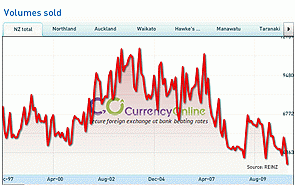
The number of nationwide house sales slumped to a new monthly low in January, with new listings and prices dropping and the average days need to sell a house jumping by eight.
The Real Estate Institute of New Zealand (REINZ) said there were just 3,252 sales in January, down from 3,666 in January 2010, the previous monthly low since REINZ records began in October 1996. January 1992.
Meanwhile, the number of new house listings coming on the market also hit a new low over the month.
The REINZ said the national median price fell by NZ$12,000 in January from December and is 2.9% down year-on-year.
The median house sale price in January was NZ$340,000 - down from NZ$352,000 in December and NZ$350,000 in January 2010.
From 39 in December, the national median for days to sell rose to 51 in January, 8 more days than in January 2010.
The REINZ figures come after Realestate.co.nz reported on February 1 that new housing listings fell nationally to a record low 8,300 in January and were down 19% from a year ago as the average asking price fell 2% in the month to NZ$406,525.
Releasing the December sales figures last month, which showed the volume of sales down 11.3% year-on-year to 4,397 and the national median sale price down 2.2% from November, REINZ chief executive Helen O’Sullivan said December sales volumes were always subject to the timing and impact of "the great New Zealand Christmas shut down."
"January’s figures will provide a better picture of market activity over summer," O'Sullivan said last month. "Anecdotally our members are reporting increased activity so it will be interesting to see how that translates into listings and sales.”
See the release from the REINZ below and click here to see the market statistics
Activity remained muted in the residential property market in January and the number of sales fell below the record low set in January of last year, in the latest statistics released today by the Real Estate Institute of New Zealand (REINZ).
“The traditionally subdued month of January was marked by the lowest ever level of new listings coming to market and turnover fell to a new low below that of January 2010,” says REINZ Chief Executive Helen O’Sullivan. “This reflects that with rental shortages in key urban areas such as Auckland and relatively low interest rates, home owners and investors alike are under no pressure to sell.”
“Good income prospects bode well for better returns on rental investments,” Helen O’Sullivan says, “But low levels of building consents don’t suggest any significant increase in new housing stock in the short term. This in turn should provide support for prices over the coming 12 months, and perhaps an opportunity for would-be investors”.
The most up to the minute statistics on movements in property prices across New Zealand, the REINZ report on sales in January shows the national median price is 2.9% down on a year ago, but still 4.6% above the 2009 figure. From $352,000 in December 2010 the national median decreased to $340,000 in January and is $10,000 below the January 2010 median of $350,000 but higher than the January 2009 median of $325,000.
From 4,397 in December 2010, the number of residential property sales declined to 3,252 in January, below the previous low of 3,666 sales recorded in January 2010.
Nationally the total value of residential sales, including sections, fell to $1.3 Billion in January from $1.9 Billion in December. The breakdown of the values of the properties sold is 73 for $1 million plus, 365 between $600,000 and $999,999, 786 between $400,000 and $599,999 and 2,028 for under $400,000.
In Northland the median price increased 2.27 per cent on the same month in 2010 and in the Auckland District is just $500 lower, or less than 1 per cent down on twelve months ago. In all other districts it decreased between 1 per cent in Southland and 17 per cent in Otago on the same month in 2010, and sales are also down in all districts when compared to January 2010.
From 39 in December, the national median for days to sell rose to 51 in January, 8 more days than in January 2010. Sales were fastest in Auckland at 41 median days and slowest in Northland where the median days to sell was 96.
Here is ASB economist Chris Tennant-Brown's take on the figures:
The housing market is typically quiet over December and January, which makes interpreting data slightly more difficult. However, the data were very weak even when the seasonal impact is taken into account. Turnover weakened further in between December and January, dropping 8% in seasonally-adjusted terms. October 2010 was actually a weaker month for turnover when the seasonal drop off in January activity is taken into account. However, the fact that the unadjusted monthly turnover was the weakest monthly turnover on record will certainly grab some headlines.
2009 was a year of recovery for the housing market. Prices rose 6.9% between January 2009 and January 2010. However, over 2010 the housing market stagnated. Prices dipped 1.6% over 2010, and January data show prices are down around 6% on the peak recorded in late 2007.
The low number of new listings shown in realestate.co.nz report released earlier in the month provides some comfort. Low listings will help to contain the overhang of houses on the market during this period of low sales turnover. However, based on the turnover in today’s REINZ report, the amount of inventory relative to turnover extended from 11.7 to 12 months. This measure, combined with the long number of days to sell continues to indicate the market remains tipped in favour of buyers, and suggests prices will be soft over the coming months.
We expect the caution shown by households in late 2010 will continue this year. We expect turnover to remain low over the coming months, and prices to remain soft, down around 5-6% on the 2007 peak.
Implications
Overall the January REINZ data was weak, but our disappointment is tempered slightly by the fact that housing data for January is heavily impacted by the holiday season. However, the data were weaker than our low expectations, and this does not bode well for activity as we now enter the busier months for the housing market. The weakness in the housing market, and the lack of traction low interest rates are having on the broader economy at present reinforces the need to keep interest rates low for the foreseeable future. We expect the RBNZ will not lift rates again until September and that the early stages of the tightening cycle will be very gradual.
(Updates with ASB comment)
Median price - REINZ
Select chart tabs
116 Comments
So do we think that there are actually less 'motivated sellers' than usual? Or are they just 'hiding in the bushes', waiting to spring out at the first sign of life? It looks like a log-jam to me; with more supply building up behind the obstruction; and the longer this goes on, the closer we are to the dam breaking. It's only a matter of time, because life doesn't stop just because the sales dry up.
Yes Nicholas, the figures don't show how many houses do NOT sell, and how many are still over priced. And they do not show that Agents are 'buying listings' by promising to achieve an unrealistic price. And that is destructive to the situation because it means that listings go 'stale' from over exposure and that makes them even harder to sell, even when the price drops to meet the market.
When the vendors finally realise that they will not get their desired price, but that selling and buying in a decending market will actually give them the opportunity to get a better deal on what they go on to buy next, then things might start to move.
I think that the current sluggishness might be caused by investors quitting their properties, or people selling off their second homes and not wanting or needing to buy back into the market.
When 'normality' (i.e. people buying and selling for life reasons only, not for investment) returns then the increased turnover will be great for the Agents, but it may not be good for prices initially because of the glut.
Whether the situation can be managed so that a glut does not happen I do not know.
Not to mention that the buyers are very very discerning at the moment. Agents are having to present half a dozen (give or take) offers to vendors before they achieve a sale. This differs from a few years ago. Agents are working very hard to achieve sales at the moment.
(I am currently in the RE industry, haven't been for most of my career though)
.
How many Real Estate agents are there in NZ ?
Lets assume for arguments sake that these figures stay the same or get worse , and if there are still 25 000 registered Real estate agents, and 36 000 houses sold a year...... lotsa people going hungry .
Another way of analysing that is to look at the monthly total national sales value figure the REINZ produce - of which the agents siphon off 2-5%. That monthly figure is a function of both the number of units (houses) sold and their value. The lower that monthly figure gets the less cash there is to go around for the agents.
For Jan 2011 that figure was $1,280,279,334
You'd have to go back all the way to Sept 2001 to find a lower monthly figure (ie before the property madness really started going).
Here in Nelson the RE agencies went on a recruiting drive in early/mid 2010 as they dumbly thought the good times were back again (there had been wholescale bloodletting amongst the agents in 2008/2009 during the first part of the slump). Guess they will be shedding staff again.
When sales are slow the real estate owners put more staff on, who only earn commission, so there are more sharks trying to find a feed.
Doesn't mean they are all going to have full stomach's.
Like dogs that ate their own vomit ( a nice analogy from the CDO market!) is the thought that R/E agents may be more than 'just going hungry'. Many, if not most, I have run across, also have a fanatical belief in the 'property always goes up' mantra, and will also have their own 'investment' portfoilios to service on their ever dwindling commissions.
As far as I can see that is the lowest monthly sales EVER for the REINZ series.
Days to sell ballooned out to 51; the last time this measure was above 50 was in the dog days of 2008/9 when the index was a crumbling.
The last time the median was at $340K was back in July 2009.
Looks like the dead cat has officially bounced and is on the way down again (just like the US and UK models).
Where is that plonker Olly to tell us now is the time to buy - just think if you had bought the average house when Olly first started spruiking 6 months ago you would already be $10-20,000 down.
What a guru.
Scrape that poor little feline up off the floor, andyh, and give it a bit of mouth-to-mouth! You may have difficulty recognising it as a cat; but it is...The REINZ tells me so.....and there may be a bounce or two left in its bloodied carcass yet!
?
double entry
andyh - it's even worse if the property owner has to sell as it would cost $15,000 in RE Agent fees, ouch!
sorry - triple entry
?
We were expecting this at 10am Monday morning :)
Have a good weekend everyone
LOL REINZ obviously thought they could dump the bad news late on a Friday so it would get less coverage.
However you cut it, its a very, very weak report.
allowed themselves as much time as possible to dream up any kind of positive spin possible!
Story now updated to reflect that it was the lowest monthly sales since REINZ records began in Oct 1996.
I've also popped in REINZ CEO Helen O'Sullivan's comments from last month when December's disappointing sales figures were released.
She said "January’s figures will provide a better picture of market activity over summer."
Even more LOLs. You are a very naughty boy.
Even a better reason to buy while prices are "low".
REINZ records began Jan 1992 didn't they Gareth?
http://apps.reinz.co.nz/reportingapp/default.aspx?RFOPTION=Report&RFCOD…
Yes, Chris you are right. Apologies. Our records go back to 1996...
Very weak, joe public is still afraid - which wont last.
But still in Auckland:
Jan 2007 Median
$415,000
Jan 2011 median
450,000
So in 4 years the median has gone up a whole ....8.4%.... Sly, investing there, SK....
Yep these PIs are sharp as tacks. Thats why Olly is their leader.
A little under 2.05% pa.
Nice use of a calculator and the lowest form of wit.
8.4% has nothing to do with me personally - merely pointing out the crash that never happened - over the years of the worst financial crisis since the '30's.
Off on the boat - tchuss - bis spater.
It will. Enjoy the boat. It may need to be sold soon.
yet.
Oh well, too bad, how sad! Best you drop your prices sellers and face the reality. It's over rover!
I’ve already had the "forever optimists" telling me "if we can just hang on until next summer I’ve heard it's going to go ballistic!" ,"cause there will be a massive shortage of homes for people to live in".
LOL, yeah whatever. Not while people can live with Mummy and Daddy or move to countries with real economies( not many), or move in with friends.
"why would they do that?" they ask so naively. Because the cost of living ,and building has become extremely unaffordable. And because they can only find part time work and have no experience to get paid a decent wage. And because the banks want so much more now for a deposit.
exactly
the difference between underlying demand (the one economists always refer to) and realisable demand is immense at present, and this gap is likely to persist for quite some time yet
Up and down – down and up – talking houses - endless to the end.
Wow, the # of sales figures are quite bad..
It's good to see the out of whack fundamentals of property are starting to correct themselves...I used to work in property and remember seeing a graph on an agents desk indicating that values double every 7 years, I think it's a Dolf De Roos quote...whatever buddy...NZ can't borrow anymore as a nation, Govt debt increased by 13 Billion last year, so private debt has to come down - it has no other direction to go, otherwise NZ gets a credit downgrade...you'd have to be delusional to be positive about property...and throw in the fact that Aus & China deferred dealing with the GFC by pumping stimulus into their economies, and it looks like they have to finally deal with it this year or next...
"and throw in the fact that Aus & China deferred dealing with the GFC by pumping stimulus into their economies, and it looks like they have to finally deal with it this year or next... "
good point. Its been thanks to some of this international and domestic (bumped up infrastructure spend, tax cuts, massive interest rate drops) stimulus that NZ house prices have not collapsed
now I'm not saying they will collapse, but now with the reality of domestic and international stimulus being behind us there is only one way for property to go - a gradual decline
Matt in Auck
You were on the lookout for a house, what 18 months ago. Did you take the plunge and buy or are you on the sidelines?
Mike
I don't like the term "sidelines" because it implies one is missing out on something if one is not participating. And with regard to housing my view is that in this new economic paradigm of great uncertainty and weakness, being debt free and with good savings is a very good place to be!
So no I haven't bought. I got very close on a couple of properties but they fell through with due diligence (some fool bought them, despite issues with works with no building consent / resource consent).
But I'm not worried by that because once my son is through college here in Auck I'll probably move to more of a provincial city, where my savings will go towards a big deposit ,especially as I see prices in most places out of Auckland dropping back over coming years.
BTW, many of my peers (professionals, early / mid thirties like me) are thinking exactly the same way.
Thanks Matt.
Good move not to buy in this environment.
When you move you'll probably have saved enough to buy outright.
Keep free of debt and you will prosper.
Thanks. Well there's plenty of property guys who would say I'm not doing the right thing, but I guess one is free to do as one pleases!
Yawn, surprised Olly hasn't been here to stir things up.
Olly would talk about the rental cues and increasing rents improving yields, making property investment great agian
Yet if it was becoming good again then surely sales would be a lot healthier
The commercial and industrial sector of the market is dead as a dodo at the moment ... so no investment there. Rural sector is on life support. BUT the latter would move a bit if vendors brought their prices down significantly, they seem to be happy to sit however. I don't know why, it is not my area of expertise.
Just a quick calc. In 1992 they had 3.5 mill people and now it's 4.4. So the 1992 population had more than 20% less people and yet still we have less sold properties. I would guess that in that 18 years there where a lot more dwellings built than 20% due to the house and apartment boom so the proportion of sales to housing unit population is even worst than identified.
You guys thinking house prices will drop consider this....If the cost of a banana rises to $10 in 2020 (could eh?) how much are we going to have to pay for a roof over our heads? Inflation is why house prices historically double every .. years. If you're holding onto the hope that house prices will fall, I respect your motivation for wanting that to happen, but the reality is that you might be way off the mark. Let's wait and see.
Let's see FYI. If incomes are commensurate with energy flows throught the system (minus possible efficiencies), then this graph gives you an idea where incomes will be in 2020:
google: Campbell 2004 scenario (maybe 'images' too)
And remember that there will be another billion people wantinghg to use the supply too, and we're talking 'per head'.
So if a banana is priced to be sellable ?????
You also have to think about the stage the baby-boomers will be at - a kid born 1945-50, will be 70-75, so a lot of those too-big 'I-am statement' houses, won't be in their ownership, and my betting is that they will be in multiple ownership (a family to every black-water connection?)
Twain was right, though - they ain't making any more land. Houses, yes. Land, no.
I think inflation (its coming) will adversely affect house prices. The average man in the street is already stretched to the limit with existing mortgages and rising cost of living. Factor in peak oil and rising food prices and he's going to be even more stretched. When interest rates rise in response to this inflation then he'll have even less money left over.
The last time we had really bad inflation, in the 1970s, we were buffetted as woman were increasingly participating in the workforce, for a number of reasons ("women's lib" being one) but also because single income households were not enough to cope with the escalating cost of living. Given we have high female work force participation now, we don't have that ability to gain more household income in response to inflation.
In addition, in the 1970s the housing market was boosted massively by the large swell of baby boomers entering house buying age.
Of course, there wil be markets within markets. As petrol soars, we'll probably see central Auckland property increase in value. Conversely, housing at the urban edges may plummet. The stuff in between will probably be fairly flat
Matt - that's the main reason we built for $50.000. We had an inkling (no, a conviction) that this would happen, and wanted to prove you could build for figures that make those quoted look stupid.
I reckon I could still - 5 years later - do 100 sqm for 50,000.
Land is a different matter - but for everyone who can't afford it, there will be a 'blocker who can't make the mortgage. They could get together....
Build 100m2 for $50,000? I dont think so! I have just gone back to the actual costing for a 136m2 brick & tile very modest unit we built. ( I build up to 30 per annum) I stripped out any vestige of profit,no floor coverings,no site work , allowance for unexpected events inc. at $2000.00 - and the answer is $136,564.00 inc. gst. And to build for that would require a flat site,friendly Build. Inspector! Good luck!
100sqm for $50K? Compliant with NZBC? Is that without labour or something? More info please - low cost housing is cool and $500 per sqm is incredably cheap.
The carpentry cost in my example is $16,376.00 inc gst. Dont be fooled - you arent going to build for anything like $500m2.
In my example if I deducted GST & carpentry cost the answer would be $107,150 - or $787.87m2.
The carpentry cost in my example is $16,376.00 inc gst. Dont be fooled - you arent going to build for anything like $500m2.
In my example if I deducted GST & carpentry cost the answer would be $107,150 - or $787.87m2.
I know you can't really build for under $1000/sqm (and that's on flat sites, multiple dwellings, larger cheap and nasties screwing down every trade), but I'd like to hear how downpowderkiwi reckon they can build for $500/sqm.
A cheap bathroom, cheap kitchen, cheap wiring, cheap plumbing and a building consent would leave about $228.50 out of the $50k for all structure, foundations, claddings, joinery, linings, insulation, painting etc. so I'm curious about the construction techniques that can make this happen.
Re-$50,000 house - Bob and Petrus1942
Bob - yes, it's ex-labour.......but the labour in the external shell (walls and roof, inside and outside, insulation, painted/finished both sides) was 42 person-hours. Myself, partner, and our two teenage boys, 10.5 hours total over 2 days.
Petrus - you don't think outside the square, obviously. My dad taught me, from a very young age, to turn a problem 'inside out, upside-down and back-to-front'.
Who said anything about timber, or brick?
Coolstore panel - coloursteel/polystyrene/coloursteel. Comes in any thickness - 50mm, 75, 100, 200. Comes with your choice of coloursteel colour (from their chart) insitde and out. We've got mist green outer walls, desert sand inner, titania ceiling and outer roof. (The roof is one panel.
Single story, the stuff needs no framing. No studs. The paint quality is up to the best gib-stopped surface, with a 20 year external guarantee internally! Only thing is a slight join line (the panels fit together with a T&G edging) every 1.2m.
Walls and roof, five years ago, for a 135 sq/m house, delivered onsite, every last tube of silicone, rivet, flashing, capping, even the spouting - $16,100 inc.
The rest depends on your attitude - too worried about what folk think of you (which is insecurity, really - cheaper to deal with that at source) and it'll cost you more to fill it. I'm telling you that we did it - with a mixture recycled and new (there's no recycled double-glazing, for instance) for 50,000 ex labour, 5 years back.
Even with labour, theres no studs, no framing, roof panels span 5 metres (and more if 200mm) which gives a good big space without beams.
Downsides? Reveal-sealing was one (and the external over-window flashing has to be thought about) and you either pre-plan wiring/services before erecting, or you use trunking. We use 200X50 macrocarpa as the skirting board, routed behind as trunking.
The solution to an arising problem, will never be found in the status quo. Think about it.
:)
An example of lateral-thinking - shower:
Take a $5 recycled, perfect-cond bath. Buy a $120 flat sheet of clear polycarbonate. Stand the poly sheet upright, curve it to fit inside the bath (tap end). Two timber uprights (mine are old oregon marquee tent-poles) with a skil-saw-slot apiece, take the edges of the polycarb. Fully flashed (it goes 50mm down the inside of the bath, and up to the ceiling) end story. Nothing to smash if big sister slips on the soap.
But all the sheeple spend how much?
OK - I used your figure of $16,100 for exterior & interior walls & roof, & added 2.2% gst. - but nothing for 5 years of inflation. I excluded carpentry labour,insulation & decoration; but included everything else from plan drawing & build. consent thru to finish - & the answer is $ 87,340.00 inc. gst - but you would end up with a house that would be extremely difficult to resell.
Petrus - re GST - i said 'inc'.
We're talking past each other - which is a polite way of saying - you miss the point.
You don't think that plan cost would be less, for example? My consent only took 3 inspections. (no pre-lining, no insulation) but of course, you need a producer statement from a CE.
I said "if you worry about what others think" You said "difficult to sell".
It's the same thing. You're well withing the square, methinks.
Although, at 87 thou, would it matter? I suspect you'd still do very well indeed - poly is 3 times the insulation of batts, and we're heading into an energy-constrained world. We have groups of folk through this house all the time - bus-loads come specially sometimes - and there would be no prob re-selling, believe me.
Not that that should ever be your criteria....... it's your home, isn't it? I think you're mixing metaphors there.
PDK's house (which I have visited) is clearly a minimalist design aimed at maximising solar heating use via its passive solar design and thereby minimising reliance on fossil or other fuels. No extras. Design of the plumbing has resulted in there actually being very little, and likewise the 12V system (no certified electrician required) is minimal. He's really thought long and hard about what is actually necessary in a home; things like carpet didn't make it (carpet would have prevented the concrete slab from working as efficiently anyway).
Speaking from experience, plumbing and electrician's bills really add up.
My partner and I were looking to buy our first house for over one year. Unfortunately there were/are NO houses like PDK's on the market. We would have bought one. It seems so many houses these days are just over-flowing with 'luxury' items that one really has to wonder about; example three bedroom houses with three/four toilets.
We could have bought land and built, but the price of land here in Christchurch (we wanted a decent size piece, not 400m^2 or whatever is on offer these days) ruled that out. In the end we bought a house+section for not too much more than the land price. Sadly this means no passive solar house, but instead we get to 'upgrade' it. Still, I would have loved to have a new passive solar house. Oh well.
Looking forward, with a looming energy crisis, I can only see the demand for this style of house increasing. Hehe, there's some 'growth' for you PDK. ;-)
Well done.
Your own labour and second hand stuff certainly helps. Presumably Bondor, or Kingspan?
Martin v - and Bob.
Martin - there's more than one way of recycling- yours looked very comfortable....
Bob - thanks......Bondor, and they were. exellent.
murray--- not trying to be smart here but you are aware of what happens to polystyrene when it,s exposed to heat ? it melt,s/liquify,s @ 120--150 c---if you,ve used it structurely a fire[radiant heat] will cause the integrity of the panel to fail.this will be compounded by the metal cladding conducting heat as well. you are at risk from inside as well as out---as you,ve commented that you have tree,s all around the house---could be a drama----as a test cut a piece of it with a grinder and you,ll see what i mean----i have a lot to do with it in commercial application,s--it,s alway,s well protected by sprinkler systems--it won,t catch fire because of the retardent but it melt,s at the drop of a hat ---cheers pw
T'was well thought of beforehand. :)
There are no services in the panel, so no source of potential fire - except for the flue - which was over-cautiously done!
If a fire happened internally - and it's hard to see how that would happen in a concrete-floor/nocarpet 12-volt house - you are either dead in bed, or outside on the lawn in your PJ's dialling State.
That goes for every wooden house in the country - I wouldn't be happy living in an old wooden villa (old lead paint, tinder-dry kauri or heart rimu, old conduit wiring or just old plastic ditto, chimney-fires in century-old lime-mortar chimneys....... )
No thanks, I'll take this in preference.
Sprinklers? Wouldnt get past the inner steel skin, could only cool that.
Structure? My one has a macrocarpa portal post-and-beam structure to carry the snow-loading. It might go, but not for a while. A budget house would only be single-storey, no need for the portal (the wall panels in mine are 6 metres tall, can bow, a 2.4 metre wall wouldn't.
No; with any house fire, you're either dead, or you're outside. Better build carefully, good circuit-breakers, eliminate places heat can build up.
Incidentally, when you cut this stuff, you use a helicopter blade in a skil-saw, cutting the metal skins. Then you drad a wire along both cuts, and it cheese-cuts the styrene. I've never seen the styrene melt/burn, and there are sparks, believe me.
Styrene's not a good thing environmentally, though. As with all things, best sealed with care, so it can do 100 years or so. Moisture (in a house this warm) is more of a threat from the inside - cooling in the evening - than the out (rain). We use a sacrificial pane of single-glazing - downstairs of course - to catch-and-drain condensation.
cheers
This is yet another classic example of someone with NO real economic knowledge. jezz
"Inflation is why house prices historically double every .. years."
What drives inflation FYI? Do you even know?
I have in my posession a 100 trillion dollar note from Zimbabwe. Does that make me rich if they still used that currency instead of USD?
Have a little think about "inflation" and do some reading.
Justice, your Dad might be the guy who told my Dad not to buy a house because they were over-priced. Back then in 1962 bananas cost about 1 cent each. My Dad didn't listen to whomever that was. That guy was proven wrong.
Do you know how much a house cost in Zimbabwe when the 100Trillion note was actually being used to buy things?
You should buy a bunch of houses.
How can you possibly lose?
And the bank will love you for it.
You are missing the effect on spending power so your thinking is wrong.......IMHO.
If a banana costs $10 in 2020 then your food bill is going to be $1000 a week, who will have the spare $ to support a big mortgage? when your food bill is three or four times its present cost?
Answer, few, result a collapse in house prices...........
What you are looking at is historically we have had pull inflation where plenty of money has been chasing to few goods....Monetary policy worked. What we have in front of us is push inflation....and MP wont work.
The difference is with pull inflation we have rising wages and hence rising goods. with push inflation the cost of production raw materials goes up so prices rise, but wages dont. The result is for every $ sucked out of your wallet to feed yourself it now becomes 2 or 3 or 4, that means other non-essentail goods have to collapse in value to make a sale....
Now throw in BB retirement sales....
Its not a hope house prices will fall, its expected...its not wanted, but its deserved...
"Wait and see", anybody who's silly enough to wait and see will get burned....this is a bear/dropping market and will drop for a long time....at least a decade probably 3. The only unknown is when the drop will really start and how fast.
To me anyone who's sensible should be having a mind shift, from looking for investment profits to minilaising losses. The idea "im rich now but expect to be a lot richer" should really be "Im rich now, I want to keep it".
In my case however its paying down debt as fast as I can, before my food bills etc double and the nasty things of course are the likes of rates....monopolies will be OK, until their client base collapses...
regards
Have house prices in Auckland even risen by 8.4% over that 4 years?
I would suggest that the newly built houses are larger on the whole than the legacy stock so the effective rise is less on average than that figure. Also vendors often put significant dollars into upgrading and presentation prior to sale.
Right now those who would have flicked a property and moved on are putting spare cash int upgrading. The low new build figures have some relevance in leaky building repairs and those upgrades.
Has anybody got some depth of information on this?
My wife got offered a job in Auckland pre Xmas which she accepted. The role was due to start in mid March so we have spent the best part of 8 weeks trying to find a nice home to rent in Auckland Grammar Zone ( 3 boys ). We flew up to Auckland 3 weeks ago ( from Nelson ) and spent 3 days ( can highly recommend the new Rydges Hotel on Federal St ) looking at 12 rentals. Varied from $650pw to $1200 , townhouses / villas / modern ... in Parnell, Mt Eden, Epsom, Remuera. Would have struggled to live in anything as a student let alone a family of 5 for less than $800pw ... others were OK but with Wife's salary virtually swallowed by rent ... whats the point. All those properties now rented. Looked at buying in Pt Chev / Westmere but competition a 3 auctions attended way too hot ... 20%+ premium on all 3 properties on our limit. Nice parts of Auckland = RED HOT property market ... sales and rentals. Abandoned move to AKL ... rented our house in Nelson on TradeMe in 36 minutes at $500pw. Purchased in Queenstown at 40% less than neighbours a gorgeous 3 bed 3 living house at high profile development ... but only 20% deposit nad balance not due til mid 2012. Wife has new job at $7k less than Auckland one. Sweet ... nad no $10k skiing holiday every year to bang on the credit card !!
Gee, with a username such as yours we'd never have suspected you'd be a shill for property with bogus stories of a hot! Hot! HOT! property market, right?
Amalgam - clearly a desperate agent who has been on the booze tonight and concocted a totally unbelievable bogus story
Gee those agents are really finding it tough ey, driven to the booze, poor sods
So where are the 3 boys going to school now? Wakatipu High? Not exactly Auckland Grammar, if that was indeed one of your priorities ( as it should be ). So you've sacrificed your children's education expectations, for the proximity of skiing for 12 weeks of the year. But good to see that you have experience the '40% drop' in property prices that is coming to the rest of the country; if they are lucky enough that 40% is all it is! Good onya, Nevasellayapropertya .
Todays figures from the REINZ are simply shocking.They vindicate selling my RE business in 2007, a business move I have been regularly rubbished on this site for doing. It is only going to get worse over the next few years. There are simply not enough people out there who are in the position to go out and borrow the funds necessary to buy what is on and what is going to come on the market.
I have been saying for months property values in NZ are generally going to drop in small amounts each month for the foreseeable future. Again I have rubbished for this line of thinking. The last three months results from the REINZ have reinforced that the market is very fragile. Any big shocks in the major economies of the world and it is going to be possibly worse for property values than the current small adjustments as each month goes by.
People are generally struggling to keep the wolf from the door. They are not in a position to borrow any more money than they currently owe. And if they go to a bank for some more finance to invest in something,the banks are being very cautious who they lend to. Things are so different from the mid 2000's.
I'll say they are cautious! I earn 120K and have a very stable job, yet even I have strugged to obtain finance when I have considered some options (and I have a very clean debt record I might add too)
What are the banks scared of?
Clearly they think prices will fall further
I don't rubbish you ex ;-) You know the koo alright
and yet the real estate economists still talk as if things are stabilising!!!
yeah, that's just the BS spin that they think will get people to list their properties.
I think that facing the truth is better all round for getting people to list and getting property sold. The RE industry and spin doctors are putting out the same old pap, and actually doing themselves more harm. They are not interpreting and responding to the current situation, which is not the same as any we have seen in our lifetimes before.
As an agent, I cringe when I see that talk. I also wring my hands in despair because it is not helping ...
As an aside, I guess that John Key being (pardon the pun) low key about the issues is the lead that the economists are following?
I'm not an estate agent .... just a typical kiwi who thought about moving to AKL !
Matt in Auck, a bank will loan you the money if you have 20-25% deposit because that is what they predict they'll drop by. It's a safety net for them. I too have been looking at houses, which I thought were over priced but when the whole market is overpriced it's tough! $600,000 houses especially. Take off 25% = $450,000. Out of a lot of the $600,000 houses I have seen I think that $450,000 is more of a realistic price. My prediction is a 25% drop will happen over the next 3 years.
DC I agree prices still seem way overvalued.
I've kept my eye on a few proprerties, also speaking to others, lots of places getting passed in at auctions below CV, I just think a lot of buyers know what fair value is, but sellers who can afford not to budge are just doing so. Hence the Mexican standoff. Prices will only drop significantly if the economy deteriorates further (quite likely), and some of these sellers become a bit more desperate
But even if prices don't drop much in nominal terms they will in real terms
agree, see my post in reply to the first post up top ^
A Bank report the other day said most mortgages were held by people who could readily afford them and as long as their jobs are ok then servicing the morgage is ok (Bank does its sums on a higher rate than currently). Most house owners don't need to drop prices to get an emergency sale, though some who own expensive beach properties may need to offload something. Those people living from one pay packet to next are not your typical house owners
DC, I agree on your $450K figure..many houses in Auckland selling for $600K would be a realistic buy at around $450K
It doesn't help that the Government has stymied the Canterbury market by refusing to allow cash settlements from EQC and forcing homeowners into a ridiculous Fletcher's pool (this will cost National A LOT of votes!) and has held up repairs plus doesn't allow owners to just move on.
In saying that though, the slowdown is widespread and mirrors the double dip seen in the overall economy. Bad news for the govt all round.
Further price falls will cripple the already beleaguered construction industry. Solutions and action are needed now, else depression is looming.
"It doesn't help that the Government has stymied the Canterbury market by refusing to allow cash settlements from EQC and forcing homeowners into a ridiculous Fletcher's pool (this will cost National A LOT of votes!) and has held up repairs plus doesn't allow owners to just move on."
You are 100% corrrect about that. They again protected the "too big too fail" company by giving them a virtual monopoly! WTF is that if not corrupt?
see below.
ChrisJ - I don't think that National are too bothered about losing votes in ChCh as it has always been a Labour stronghold. ChCh has only one elected National consituency MP, Gerry Brownlee. So there is no political return for National by spending too much money in ChCh, sad but true.
The ignorance displayed by some of the posters on this site quite takes ones breathe away,
The property market is not like a share market. In the share market you press a button and in one second, millions of dollars can be made or lost in the blink of an eye.
The property market is like a slow heavy ship that takes a very long time to change course no matter how fast the Captan turns the wheel.
Property investors must think in years or even decades, look at trends, consider long term pressures, and be very very patient.
In return the rewards are great, the security unbeatable, and profits certain.
Unfortunately the real Spruikers who appear out of nowhere
get the attention with their message that everyone can be rich by Monday by following them.
Witness the Bryers, the Richmastery's and others like them who have come and gone leaving a trail of destruction in their wake
And there are still others about to this day trying to convince the naive that riches are to e obtained by buying cheap boxes in South Auckland leased to no-hopers, or sections by weed infested lakes where the mosquitos are the only things moving.
Olly Newland gave me the best advice. He told me that property is all about timing.
A time to buy and a time to sell.
A time to hold and a time to step back .
A time to wait and a time to accumulate.
In Olly's view now is the best time to cautiously accumulate because the market is almost at its nadir.
If sales slow any further, and building consents fall even further there won't be a market in 6 months- which is nonsense of course.
Sooner or later something will break loose and the smuggeroos on the side lines will be left in the dust.
The signs are emerging that a scandal in housing will erupt within the next year or two and those who have had the foresight to see past the end of their noses will reap the rewards,
Even dumbos like our politicians can smell trouble:
"Govt questioned on Housing crisis
Labour's questioning the government's commitment to tackling New Zealand's housing shortage.
The Salvation Army's state of the nation report shows the country's housing crisis is worsening with chronic shortages forecast, particularly in Auckland.
Labour Housing spokeswoman, Moana Mackey, says another 8,000 homes a year are needed in the Auckland region alone, to keep up with demand.
link:
http://nz.news.yahoo.com/a/-/top-stories/8822370/government-questioned-…
If this lot can see that something is amiss then you can be sure that something is coming that will be big and ugly and profitable- for those who can think outside the square.
Big ship? Captain turning the wheel? It doesn't matter what the captain does in the wheel-house BigDaddy, if the ship has hit a reef ! It goes down in a matter of minutes, taking most, if not all those without a lifejacket with it. The New Zealand property market is in sight of the reef; Can't you hear the breakers? I can. That's why I launched the lifeboat years ago; just like OllyN suggest we all do, back then .He was right, as I have said before, but his timing was poor. Better to have been in the lifeboat, early, and stayed there, than to have to returned to the doomed vessel, as he appears to have done.
look at it another way
all this recognition of housing supply issues in Auckland may trigger a large supply side response, that will actually help keep house prices subdued. Perhaps a supply side overreaction
I've heard thorugh the grapevine that the new Council will look to kickstart housing by helping incentivise higher density development as well as freeing up some greenfield land. Sure there is still the issue of developer financing....
Spot on, Matt ! Shortage of supply is always met with over-production, no matter what it is. And what is in short supply? Houses of 'new build' nature, and.....listings of an 'old build' nature. That's new building and pent-up sellers both about to hit the market at some stage. And what does that give us? Excess new/old supply and still a reduced capacity to pay for it ( less debt available). That will only mean...plummeting house prices., as the excess supply meets a resticted capacity to pay for it.
BigDaddy's gonna be LittleDaddy by the time this is all over.
Stop imagining that housing is simply about supply and demand. The availability or otherwise of credit is much more important in todays overblown market.
"Property investors must think in years or even decades, look at trends, consider long term pressures, and be very very patient."
Trends and events you dont seem to be seeing,
a) Peak oil, fuel and energy price rises and shortages
b) More and more Baby boomers retiring
"something will break loose"
c) Debt tsunami
Above mean a depression and house prices collapsing........
"In return the rewards are great, the security unbeatable, and profits certain."
This was the last 40 years it was one long bull market....the next 40 look way different......
Olly is wrong this time IMHO.........the events (peak oil and debt) coming he hasnt even read about let alone understood (by his comments, or lack of them), and it seems so have you (not).......
"something is coming that will be big and ugly and profitable" indeed, in a depression (big and ugly) receivers are a boom (profitable) industry.
As someone said, the people who make real money are the ones who know when to jump into something else before it takes off....and before the old deal dies....
regards
I have been looking at properties( on Trademe) in Whangarei for some months
Last week a strange thing happened. After steadily climbing to 2100 listings over the past
8 months, over the last week or so the numbers dipped to 1037. I thought that suddenly the market must have picked up enormously or that auctions were clearing pretty fast. It seemed weird that 70 properties had just disappeared in such a short time
However, since the release of the housing data a few days ago there has been a surge of new listings and its now back to 2100. Lots of the same properties with new photos.
Has this been orchestrated to coincide with the data release and by whom?
Oops! Meant to type 2037 not 1037. Anyway up to 2112 today so still rising fast.
pp the sudden fluctuation in listings is caused by the software that agencies with bulk listings use to speed up the process of renewing their listings. They do it all off line then go on line and change them over. On the Auckland listings the number can fluctuate by a couple a hundred for several minutes.
Astounding that you would weave something so obvious into a conspiracy theory.
I would be happy to share the facts as to how real estate agents manage listings as they appear on Realestate.co.nz
We recieve data files from each of over 1,050 customer / offices around the country on a regular basis (most once a day, some bigger offices more frequently, smaller offices less frequently).
These files contain their listings in total - the system is a total data set. Each listing recieves a unique identity code in our system that matches to the office Listing ID #. In this way we can track changes and also monitor withdrawn listings (we are not actualy informed of sales, merely withdrawn).
In total an average day will see around 600 new listings (not changes, new listings) and a around the same number of withdrawns. Average actual sales per day are only around 170. So the big difference? It is because agency agreements lapse and listings get withdrawn. Real estate data systems are far too large and complex for any company to start manipulating listings. Equally critical is the fact that each listing is being viewed by an owner who does not want any changes.
As to the reason why Trade me numbers may change. It could be because of private listings. Private listings are only available on trade me and are bought for a fixed period. If a property is not relisted after 45 days they can get removed - 45 days ago was the end of December and possibly quite a few people after Christmas decided within a few days to list property that in the space of a few day were withdraw - just a possibility for the result you saw.
Alistair Helm
CEO Realestate.co.nz
The fact that the REINZ put the figures out late on a Friday afternoon was an obvious ploy to try and dampen down the shocking result from January 2011 and it has worked so far. The journalists in the Herald and the Dominion have been very quiet on this result which makes one think maybe the papers are looking after their masters, the RE firms who advertise so much in their papers. Looking back we will see that January 2011 was a very important month in this debate about where the market is going. The result is so bad the REINZ has tried to hide it and the pro property investment people have to be thinking where it is all going now. There can be no doubt in anyones mind unless they are stupid or so one eyed that property is on the verge of a long abd consistant wind down values wise. Month by month values are going to drop and it could accelerate at any time if there is a major problem in the world economy which afterall is just one big bucket. We cannot hide in NZ from the problems in the economies of the northern hemisphere.
Indeed releasing the data lateish on a a Friday was a ploy - mind you nothing stopping doing that other than their own (non-existent) integrity
And yes the papers have well and truly hidden the news
The spruikers seem almost silent on this news on this website - I guess its so bad, and so difficult to spin, although the REINZ lady did her best!!!!!
MIA,just had the Hamilton news delivered-Lodge REs advert admits that "high enquiries in Jan,have not materialised into sales,but,nows a good time to buy"............
Wierd logic ae?
As our Olly once wrote:- "its all about timing".
"the REINZ lady did her best!!!!!"
I agree, Matt, I particularly liked this bit - "home owners and investors alike are under no pressure to sell" - that's the glass half full part, the glass half empty part is that nobody is in any hurry to buy either!
It's all pretty boring really though, many here predicted the "big crash" had started in Jan 2009 when the median hit $325k. They said the same again in Jan 2010 when the volumes dropped to the low 3,000s even though the median was still $350k. Now, once again, they're all predicting the beginning of the end! I won't be surprised if next month the volumes are back over 5,000 and the median back to $350k.
zzzzzzzzzzzzzzzzzzzzzz..... Wake me up when things get interesting. I said at the beginning of 2008 that we would probably have a sideways market for 5 years or so.....
There you go, Matt, a bit of "spruiking" just to keep you happy!.....
you could well be right Murray in terms of sideways movement from 2008 to 2013
If thats in nominal terms though its quite a drop in real terms
Despite being a property guy you are pretty balanced though. Look at lnfometrics who predicted a 20% increase from 2009 to 2012 (diabolical effort!) and some of the bank economists have been talking up increases for a year or so now without them being realised
I can see why you're a bit bored by this all when nothing too dramatic has happened.
I guess some of us just get off on constantly proving the perma bulls and so called "expert" economists wrong! after all, when there is so much media and political backing for the housing phenomenon someone has to stand up and provide a voice of reason!
I like to think collectively Bernard and the posters on this site have had some wider influence
Whilst on the top of TradeMe perhaps someone could help. Have you noticed that some proprties have a section at the end entitlted: "Recent QV sales information" as-well-as a three month average for that particular region?
Well for some reason the selling prices they list are always from houses never listed on TradeMe, and the three monthly average for the North Shore has stayed the same for well over a year.
Why might they exclude TradeMe listed houses from the the "Recent QV sales information"? So you can't comapre asking price with selling price perhaps?
Why do you say that the recent sales noted on the bottom of the TradeMe ad are for houses not listed on TradeMe.
The TradeMe search for expired listings (the 'more options' part of the search engine) does not include items from the realestate classified ads - so how would you know whether the properties noted in recent sales were/were not listed on TradeMe?
The recent listings data presented on TradeMe is taken from the most recent title transfers registered with LINZ - so it is reliable. The only thing you don't know is when the recent sale actually happened. If sales in that general area are extremely few and far between - you might be looking at a sale which is many months ago. I just had a quick look at a couple in a city area - and they were for sales which took place in Q4, 2010. Then had a look in a rural residential area and they were sales which took place in 2009.
Same thing happened to the Waikato section on Trade me/real estate.co websites on older listings!
So if a listing period is 45 days on Trademe, what happens to the "time to sell stats" when the property eventually sells?
If the listing has ended/ been withdrawn, then re-listed over and over with fresh photo angles and perhaps a change of agent(s) is the time to sell stat taken from the 1st, 2nd, or 3rd re-listing?
Hey Matt in Auckland,
Just out of curiousity, have you being offering 10% less than RV? Cause I was thinking of offering that.
I am looking at the properties on the North Shore, and I can confirm that there is no rush for open homes like they were in 2008.
In fact today I went to see a house and we ended seeing another house across the street, because the agent in that house no one coming in.
Although I still vendor asking for 360K even though their RV of their unit is 285.
I am now targeting house which have been on the market for quite long. Atleast the vendor would be actually motivated to sell.
Cheers
Pritish
IndianKiwi
I've been noticing that many properties are selling around RV, or 5% under or 5% over from what I can see
I was quite interested in one property, the RV was 410K, but the agent told me the vendor bought it for 540K two years ago (I checked and that was true), and that the RV was kind of irrelevant
I guess she's kind of right, but kind of wrong. The RV is "irrelevant" in so far as a place will sell what it sells for on the market, also the RV is a high level, less specific valuation. But I think she's kind of wrong because it still provides an important yardstick
I can confirm about 5% less and over 5% part. Although I have seen sale figures going upto 10% also.
Kind of suck for the guy who bought for that much. He better live with it, cause the market is totally flat.
Whether not it is going to remain the same that is still to see
On a footnote,the wifey and me did a few garage sales this morning.All, bar one is moving to Oz!!
This sure is an ugly trend, but not unexpected, with negitive sentiment prevailing. 2011 will be a long slow grind. Purchasers are rightly so, in the drivers seat, serious vendors will have to accept what they are dished up, or, be forced to wait this cycle out, it may be along time between drinks...
Being based in Europe the picture is no better here, infact the market may be even more so in buyers favour, great buying at present with the kiwi/euro rate around .56e/nz$ long may this last.
Anyone waiting out this antipodean property cycle had better have a strong stomach. In the context of 'it's always darkest just before the dawn', it is only now, sunset.
Fascinating to see HOW LITTLE coverage there was of the abysmal figures, in this weekend's papers
So we get front page and repeated coverage of the so called rental shortage, and then a token few paragraphs hidden away on the REINZ figures
Bear in mind that it wasn't TV execs only who received sweetheart property deals in exchange for promoting real estate.
There won't be many people within outfits such as Granny Herald who didn't pile aboard the PI bandwagon.
They have been fighting a desperate rearguard action against bad property news ever since the GFC reared it's head.
No doubt Bernard could tell us some very interesting insider stories if he wasn't such a discreet guy.
It worked. The REINZ should give their PR firm a bonus. They managed to get through the weekend with 99.9% of New Zealanders none the wiser about the shocking results they put out last Friday afternoon concerning January's record lack of sales. The press have served their masters well. We obvously have no investigative journalists working from midday Fridays onwards. From now on if it is a good result it will be announced Monday . If a bad result bury it on a quiet Friday afternoon. Then it will just go away with no one the wiser. Real estate agents are just like politicians. They are very good at manipulating the press when it suits them. The press who only have the real estate industry advertising in them at present by not looking at this result and talking about it have shown just how easily they are controlled by their major clients.
Hmmm whilst I am sure that was the intent I dont think it worked that well. The falls were the 6th or 7th item (ie within the first 15 minutes) on TVNZ3 news on Friday night. Stuff.co.nz has given it decent coverage as has online NBR.
I imagine their will be more 'commentary' coverage this week from the talking heads.
Interesting that January 2009 set an all-time low volume record of 3,706 properties sold.
January 2010 set another all-time record low of 3,666.
January 2011 has now set another all-time record low of 3,252.
If it is a "seasonal slow-down" then it will be the most marked one on record - January sales are typically 15% below the average for the year, this one is more like 30% down on an already slow market.
Fear not, the spin machine is already beginning its cycle.
Malarky, they wouldn't love me if I didn't use them eh. Keep your $ in the bank a little while longer and you'll be right :)
We welcome your comments below. If you are not already registered, please register to comment
Remember we welcome robust, respectful and insightful debate. We don't welcome abusive or defamatory comments and will de-register those repeatedly making such comments. Our current comment policy is here.