
In this section
Offers for readers
Follow the news from interest
The comment stream
Recent comments
- 1 of 20829
- ››
Editors choice
- 1 of 295
- ››
Finance sector jobs
Lead from the front utilising your strategic, technical and leadership qualities within th...more
New Zealand
Lead from the front utilising your technical expertise in this highly attractive senior li...more
New Zealand
Customer focus, high performance, exceeding client expectations and achieving profitable g...more
New Zealand
Key leadership position in the bank. Be a part of one of the fastest growing banks in New ...more
New Zealand

The news stream
Latest news
Most commented
- Govt eyes NZ$1.4b revenue grab 63
- English defends current account blowout 61
- 90 seconds at 9 am 51
- Budget 2012 reactions 45
- Thursday's Top 10 with NZ Mint 38
- Friday's Top 10 with NZ Mint 32
- What covered bonds mean for ma and pa 31
- Westpac and ASB change rates down 26
- 'Next 5-10 years make or break for NZ' 23
- 90 seconds at 9 am 22
Most viewed
Housing report: Why many home owners are switching to variable
Watch on our video page here.
Watch on YouTube here. Bernard Hickey delivers a housing report in association with the BNZ on how the landscape for fixed and variable mortgages has shifted fundamentally in the last 18 months. Back before the Global Financial Crisis, banks were able to get cheap short term funding on international markets and shuffle it on to New Zealand home owners in the form of relatively low fixed mortgage rates. Back in late 2007 almost 90% of home owners had fixed rate mortgages because for the previous 8 years the rates had typically been lower than variable rates. This contrasts with the situation in Australia where more than 90% of home owners use variable rather than fixed rates because variable rates are typically lower there.
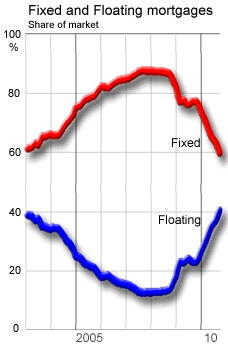
But that has all changed in New Zealand in the last 18 months as the Global Financial Crisis and moves by both central banks and global regulators have forced banks to raise more money locally and for longer terms, meaning their fixed mortgage rates have risen relative to variable rates. The average 2 year bank mortgage rate has risen from 5.9% last February to 7.2% now, while the variable rate has fallen from 6.7% to 6%. This has reversed a pecking order in place for nearly a decade. The proportion of homeowners who have variable rate mortgages has more than doubled to 26% in the last 18 months. The decision about going fixed versus variable depends on a variety of factors. If a borrower believes the Official Cash Rate set by the Reserve Bank is about to go up fast and soon then it may make sense to fix, but if the OCR is expected to stay steady for an extended period then a variable rate makes sense. Currently economists expect the OCR to remain on hold until early June or late July, before rising to around 4.25% in a year's time. Anyone who goes variable is also making a decision about whether the market will go back to 'normal'. That would depend on international markets settling down again and central bankers easing off on restrictions on capital or liquidity. Both are unlikely.
86 Comments
Sorry to butt in on
Sorry to butt in on this topic, but interesting to watch the Herald at the moment. Terrified of losing their big real estate advertisers, they are giving truckloads of room to some amazingly emotive stuff on the line of "landlords are there to provide a social service, if you take it away there will be mayhem" .
http://www.nzherald.co.nz/business/news/article.cfm?c_id=3&objectid=1062...
I'll give you an idea. It starts with "As the vitriol builds against property investors it's becoming increasingly clear that there will be many innocent bystanders injured by the mooted changes to tax law."
And the even more amazing:
http://www.nzherald.co.nz/business/news/article.cfm?c_id=3&objectid=1062...
This is solely composed of landlords being given free rein to squeal like stuck pigs about how our society would crumble if subdidies weren't paid to them. I hadn't realised, but they are operating from purely altruistic motives at the end of the day. No critical analysis from the Herald at all. I'm amazed they don't rein Brian Gaynor in.
The interesting thing is, their wailing and gnashing of teeth is obviously timed to influence Key's speech next week. Will they succeed? Or have they left their run too late?
Squealing like stuck pigs is
Squealing like stuck pigs is right, Philly. Those who are only 'profitable' due to negative gearing have been living in dreamworld, if they thought they have a sustainable business. Eventually the Piper has to be paid.
As for 'providing a social service', what rot! They don't go in to it to provide a social service, they go in to it purely for what it can do for them personally. As has been stated recently by a blogger here, there will be some carnage, but those who are professionals in the industry will continue.
Farmers stated similar sentiments when subsidies came off in the 80's. Some had to leave the land others got stronger. Now some are in deep sh.t, but this time they only have themselves to blame.
The Media these days are all tabloid as far as I am concerned. I wonder how many at The Herald are landlords?
Casual observer: I'll give you
Casual observer: I'll give you some quotes from the Herald article, it is real laff-aloud stuff
"Why should we be penalised for investing in property? We're providing a social service" [The Mother Teresa's of the investment world]
"The often-mentioned tax loss of $150 million occurred in 2008 when interest rates were at their peak. With lower interest rates, rental property will once again contribute to the tax take again in future years". [D'oh! & just how many economists are forecasting interest rates to decline from now on?]
"People will literally have nowhere to live and the Government will bankrupt itself trying to house them". [Double-d'oh!! So when all the landlords supposedly pull out, those houses are going to somehow disappear? Just how many new houses do landlords provide?]
Philly - good points. Re.,
Philly - good points. Re., "landlords are there to provide a social service, if you take it away there will be mayhem.." Hmm, I doubt the unfortunates in this wee skit would agree:
http://www.interest.co.nz/news/bernard-hickey-talks-alison-mau-tvnzs-bre...
It is not more the case that the situation is the reverse, with their taxes being used to a, "provide a social service ..." by subsidising the wealth generation of their landlords?
"if you take it away there will be mayhem.." Crap. Affordability will improve. As for the blather about landlords increasing rents, sure, the effect of resulting PAYE/corp tax cuts will neuter that reaction, and with removal of the warpage in the market it's likely young FHBs will have more of a chance to get ahead, at the auctions of ex-rentals that will start to come onto the market - as the subsidy crutches are removed.
Why wouldn't people want these benefits?
Cheers, Les.
@Philly, Les, it'll be something
@Philly, Les, it'll be something indeed if a Nats government actually address this issue. Perhaps it'll have to wait for the next Labour government, after all they are supposed be more socially just, so I'm told. Which I guess is why they never addressed this problem in their last nine years in power. Funny that .... ?? It'll be interesting to see how much of a hue and cry they'll put up when Key does jack-sh*t of any real consequence about this.
@ Philly - Those two
@ Philly
- Those two articles are the first time that the other side of the argument has been printed after months of one-sided reporting. Housing IS a social service. If investors weren't there, do you think the cost to build a house would magically drop or that the Govt would start buying up property to provide more state housing? I think not.
@ Casual
- Most investors make nothing out of rentals for many years. I've poured thousands from my personal income into my rentals for 8 years now and never taken any money out. I'm not negatively geared either.
- The motivation for investing has nothing to do with the type of service. The fact is that without so many investors, rents will rise.
The reporting on tax losses would be more informative if they said how much tax the property sector has paid over a longer term. Does anyone have those figures? Reacting to a blip over the last 2 years isn't going to help.
Dave - "The fact is
Dave - "The fact is that without so many investors, rents will rise."
As I see it, the fact is without so many investors, and without the subsidy cructhes that facilitate them as "investors" - PAYE, corp taxes can be reduced and affordability can improve, re. my 8.05am.
Why wouldn't "investors" want that?
Cheers, Les.
Dave Smyth: Refer my comment
Dave Smyth: Refer my comment earlier. Just how many houses do landlords actually build & provide to tenants? The answer from observation is close to zero. They simply buy existing houses & rent them out. If landlords exited the market, the same houses would simply be available in some different form - eg, for FHBs, presuming that they dropped in value to some level affordable to them. Hardly a bad thing, tho would be to you I suppose!
I'm not anti landlord, just don't see why they should be subsidised. They should stand on their own feet, like other business interests. & I don't see why the country should guarantee them a return. I have $$ in equities, if they crash & burn its my silly fault, not the governments.
Off to socialise for the day, so won't be replying to any other landlord's anguish, sorry!
Have a great day, get out & smell the flowers!
Cheers to all.
Les@8.42 - I agree entirely.
I think J.K will implement
I think J.K will implement big changes..Why? Because feel he genuinely cares for NZ, .Two terms will be enough for him (hopefully he will be re-elected), He has enough private income for he and his family to live happily ever after..So far he has smiled and joked but is quietly arranging changes to NZ structure without at this stage causing too much bloodletting/trauma.. The changes to the Housing etc is a good start( I am a LL) He was not called the Smiling Assassin for no reason...
"Back in late 2007 almost
"Back in late 2007 almost 90% of home owners had fixed rate mortgages because for the previous 8 years the rates had typically been lower than variable rates. This contrasts with the situation in Australia where more than 90% of home owners use variable rather than fixed rates because variable rates are typically lower there."
Bernard I believe the changes go far deeper than your rather superficial report.
NZ has been out of wack with the rest of the world for many decades...With variable higher than fixed....and variable approx 1/3 of the OCR higher.
The change was slow but I believe it started with the change in the banking 1990s regulations when they where not required to maintain the approx 1/3 deposits to loan ratio.
It is interesting to note these regulations are in effect (different label same ting) being reintroduced with the approx 25/75% ratio increasing over several yrs
I THINK NZ was in 'in wack' pre 70s with mortgages predominately on variable, then for some reason we went out of 'wack' with the rest of the world mid 70s.
Post 2007 ..,. we have slowly gone to floating...removing the deposit/lending ratios.
This is a very short time, so will we stay in wack with the rest of the world here on in, or will we return to fixed when the bank lending ratios fully kick in.
The other regulation, which was also scrapped was the requirement of deposits on high item assets..ie homes...and banks have reintroduced voluntarily.
I believe this also greatly influenced the deposits, over leveraged levels, the swap around of variable lower than fixed....I would not be surprised to see this regulation reinstated in the budget???
I havnt seen any commentators or any discussion on this.
It would certainly be an incentive for home buyers, and return to savings, shave a bit more off affordabity, and maybe even influence a return of house values closer to long term values.
Be a bit of a shock for the interim, but it would have the most effect around the the next election.
@ Les - Why would
@ Les
- Why would affordability improve? It won't change the cost of building a house. After the market is purged of investors, the older homes will simply realign prices back relative to new home costs. Tell me why, in the long term, house prices will drop??? I see no reason at all for it.
@ Philly
- Landlords mainly buy older homes. The reason they're for sale is that someone built a new home and an older home went up for sale. Think about it more... the only reason homes would drop in value is because of a sudden over-supply as landlords leave the market. Not a long term strategy for lower house prices!
Mario Says: "I think J.K
Mario Says:
"I think J.K will implement big changes..Why? Because feel he genuinely cares for NZ, .Two terms will be enough for him (hopefully he will be re-elected), He has enough private income for he and his family to live happily ever after..So far he has smiled and joked but is quietly arranging changes to NZ structure without at this stage causing too much bloodletting/trauma.. The changes to the Housing etc is a good start( I am a LL) He was not called the Smiling Assassin for no reason"¦"
"Smiling Assassin"...exactly Mario...
look at his change to education..national stds...mentions imcompentant teachers....
And yes I have seen that too often in classrooms as an IT person ..fly on the wall.
Mentions too many leaving school and arent even educated to take on basic appreticeships...and that is where he is heading..or should I say going back to.
Previous Governments have 'patched up with spending money on post teriary coarses to upskill these kids.... that are just a big rort.
Turn out educated kids . as they are meant to be, directly from the schools and scrap the post usless money spent on the coarses.
He is not one to jump up and down make a big sciene, just states the obvious, that we all know and lets the cards fall where they may... be it in his own cabinet or outside.
Key has made his money, all that is left as an ambition is to run a country and put his name in the history books along side some of our other great PMs....
It is interesting to note he is doing it in the same manner as those guys.
You are onto it Mario....the fat lady hasnt finished singing yet..by a long way.
"…mentions imcompentant teachers…" - can't
""¦mentions imcompentant teachers"¦" - can't disagree with that!!
Dave - "Why would
Dave - "Why would affordability improve?", because, " .... the only reason homes would drop in value is because of a sudden over-supply as landlords leave the market." Which is likely in the FHB/rental/ex-rental segment of the market, if/when the "subsidy crutches" are removed. Also, a more balanced tax system improves the denominator of the ratio (relatively higher incomes):
http://www.interest.co.nz/news/bernard-hickey-talks-alison-mau-tvnzs-bre...
Cheers, Les.
@ Les - That doesn't
@ Les
- That doesn't answer my question. I know prices will drop but it's a blip due to a temporary oversupply. What happens after that? You really think prices will be lower if people's incomes rise???
Dave - "You really think
Dave - "You really think prices will be lower if people's incomes rise???" Relatively higher incomes will mean affordability will improve, especially with less of the subsidy crutches enjoyed by SPIs presently. It's affordability that counts, and improving that (and the things that drive the denominator) will mean the young and FHBs might be able to get ahead and actually want to stay in NZ.
Who cares about blips, prices drops or indeed, prices. I guess it's clear some care, about their prices, hence all the noises against these improvements.
Cheers, Les.
@ Les I don't know
@ Les
I don't know what you don't get about this...
1. House prices drop temporarily due to increased supply.
2. Supply eventually gets soaked up and the market rebalances.
3. Higher incomes mean people are able to pay more, leading to higher house prices.
4. Less investors mean that demand for the remaining rentals increases, rents rise.
This is all about house prices. The point is that any tax changes will have only a temporary (blip) effect on prices.
Well I don't quite get
Well I don't quite get it: isn't the ARMs debacle what will bring down the US and with it the world economy for good and soon?
@ Dave You are looking
@ Dave
You are looking increasingly desperate.
Over the long term prices will increase!! In the foreseeable short term prices should drop. But what you fail to factor in (you are not alone here either) is what is the real change in value as opposed to the nominal value. People on this site are talking about affordability and currently houses are grossly unaffordable.
Dave Smyth, "Why would affordability
Dave Smyth,
"Why would affordability improve? It won't change the cost of building a house. "
hmm - but it mght change the cost of the land the house sits on.
We cant ignore the excessive
We cant ignore the excessive irresponsible lending by banks and failed RBNZ who did not control the inflation below 2% as they used to in the nineties. The bubbles in the housing market depends more on these systemic factors.
@ Ben If you check,
@ Ben
If you check, you'll see I've already said a few times on here that prices will drop should any tax changes come in. Short term drops will help people in the short term.
Many people on here, who have no experience in property investment apparently think they understand how it will be affected.
What is even more incredible is how they think that tax changes that are already in force in other countries will avoid property bubbles, when they didn't help one bit elsewhere.
You're referring to inflation reducing real prices. Well, good luck with that prediction.
Affordability will not be assisted by reducing rental property availability. Rents will increase, meaning deposits will be harder to scrape together.There was far too much emphasis on reducing tax toward the peak of the recent boom. Too much credit created it, not LAQC's or "tax breaks". That's a fallacy perpetuated by the uninformed.
Also, investors are being specifically targetted, which is foolish, when a huge amount of debt went on consumer borrowing and private home ownership.
@ jimmy
- I think that's already happening. There's massive over supply of sections in many parts of the country, especially Northland, where I am. If land values are to decrease, then it would be better to improve access to it.
Dave - in a rush,
Dave - in a rush, (must pick plums - arrgghh) but, wot Ben and Jimmy said, and,
"Less investors mean that demand for the remaining rentals increases, rents rise."
or,
Less tenant demand mean that demand for the remaining rentals does what ??, rents do what?? - because FHBs that were trapped as tenants because they couldn't enjoy the tax breaks their landlords could, now are able to buy, and so don't need to rent. Especially given former tenants paying less PAYE, their bosses pay less corp tax and are able to invest in higher-value add opportunities, meaning relative incomes increase, all round. Affordability improves.
It's about affordability, not prices. Higher prices doesn't stuff FHB's, lower affordability does. There's a numerator and denominator to that ratio, and if we can get some of Hugh P's thinking, sensibly, implemented ... well, Jimmy, over to you.
Cheers, Les.
les and ben.. you are
les and ben.. you are obviously not involved in any way with property .... do you really think that if houses drop 5-10% all these tenants will buy... dont make me laugh .. different investors will buy knowing how much that have to charge thus making rents go up and up...or is the government going to put restrictions on that aswell??houses are so cheap in nz .. yes thats right cheap.. land will not come down ,maybe a few sections but after that no one will sub divide and as for the cost of building your dreaming .. wake up!!!!! ... people from overseas are buying with small change these homes ... you pay more for a parking space in some eurpean cities( also used as investments ) than you do for homes here in nz .. kiwis are poor in the big wide world and you are now becoming poor in your own country... prediction ... houses keep rising and kiwis become tenants in there own country which will be owned by people outside nz
Oh dear, who is talking
Oh dear, who is talking about higher income? higher income, really? wage increases, really? so, house prices would go up, really? how? should unemployment be ignored? Oh, nevermind, house prices would still increase, right???
To float or not to
To float or not to float...that is the question! Why is Bollard going to raise the ocr and to what extent does the ocr adjustment impact on the contracts between borrowers and a lender. Let's have the explanation as to why a low ocr can ensure floating rates would stay low!!!!
@ Dave A balanced and
@ Dave
A balanced and well articulated response I take back my desperate comment. I agree with that credit availablity is the cause of this bubble and with rising interest rates and credit availability reducing will also be hte death of it. However I think that property should be treated the same as other asset classes.
@ Pedro: I have property as small part of a balanced investment portfolio
To suggest that there is a ready wave of foreign cash ready to flood our market is laughable. You obviously have not even the slightest clue about macro economics or what is actually going on in the wider world. Best you stick to your property aye!!!!
pedro - "do you really
pedro - "do you really think that if houses drop 5-10% all these tenants will buy" - If their relative purchasing power is improved because the warps are removed from the tax system, because their net income improves, because their gross income improves - why not? As I understand from the Herald article quoted above by Philly:
'Landlords fret over possible tax hit'
http://www.nzherald.co.nz/business/news/article.cfm?c_id=3&objectid=1062...
4.5% of the population would be directly negatively affected by any changes, whereas the upside to many of the rest of the population would be neutral to quite positive - lower PAYE, corp taxes, better home affordability for FHBs.
Trudy - lower corp tax means value-add exporters might be encouraged to invest and expand, hence higher incomes. Plus, such changes would translate to less upward pressure on OCR and tighten as aggressivley in future, thereby having a reducing effect on exchange rate level and volatility - good for all exporters, and in terms of vol., importers too.
Why is it considered such a bad thing to change and level the playing field here:
http://www.interest.co.nz/ratesblog/index.php/2009/06/26/bernard-hickey-...
Why?
Cheers, Les.
Bolly won't raise the OCR
Bolly won't raise the OCR anytime soon . No need to . Banks competing for savings to on lend are driving rates up . Something rare in this economy ; the law of " supply & demand " , the olde people used to call it . Been a few decades since this weird concept , the free market mechanism , has had a trial . Only a matter of time before some well intended but incompetent bureaucrats step in and cock it all up . ......... Probably soon after Labour win another election , 2014 or 2017 .
Which raises the point...has BH
Which raises the point...has BH provided some guidance on how to deposit cash in an aussie account and get the better returns...I may have missed it?
Les, You wrote, "lower corp
Les,
You wrote, "lower corp tax means value-add exporters might be encouraged to invest and expand, hence higher incomes...."
Perhaps you might want to have a look at what exporters are encountering;
http://www.interest.co.nz/news/opinion-nz-hits-5-month-low-687-usc-unemp...
Trudy - noted. It's about
Trudy - noted. It's about changing the structure of the framework, to re-balance the economy, for the medium to long term, that is, as John says:
"Until the policy framework changes to provide better stability for the traded economy investment is on hold, ... "
Sure, so the tax changes being discussed, if implemented would improve, "stability for the traded economy", and see my point also about the longer term follow through effects on exchange rate. That said, more will need to be done, particularly on the monetary system/policy side to get the full benefit of re-balancing the tax system going forward.
Cheers, Les.
Les , thats alot of
Les , thats alot of ... ifs..... IF their relative purchasing power is improved , and IF the warps are removed from the tax system, and IF thier net income improves they will be able to buy?.. well IF my auntie had balls she would be my uncle...! ... you are talking utter waffle... if the powers that be would really want to make housing affordable for young kiwis they would simply stop people from overseas buying.. ie only kiwis citizens as is in alot of countries with low income.... and how about only taxing people 19.5% after they have earned over 14000 dollars... and as far as the fixing now debate i believe nz has just come into line like most countries where floating is LOWER than fixed ... nz was the exception before the crisis and the rates have already gone up ... if they go up much more what are small buisnesses going to do .. go back into reccession???
pedro, Bingo, you have touched
pedro,
Bingo, you have touched on some important points.
There are just too many things to tackle. It is a challenge to get things working. A "second dip" may come earlier than expected.
@ Ben "However I think
@ Ben "However I think that property should be treated the same as other asset classes."
- In what way do you think property investment is treated differently to any other business?
@ Les
- Tax changes will mean less investors but once the market has rebalanced, it does *not* mean less people living in homes and therefore, no less demand for property.
- If you increase the amount of money people have in their pockets, they spend more and push prices up. Remember the first home buyers grant in Australia - that made property more affordable right?
- Affordability became an issue due to debt inflated demand that pushed prices up, not property investors. That's another oft-repeated fallacy.
If property investors are such a key source of affordability problems, why now? Why weren't they a problem in 1999 or 1989? Hint: The answer has nothing to do with tax.
pedro - "well IF my
pedro - "well IF my auntie had balls she would be my uncle" And I suggest your uncle wouldn't be too happy? Nice one, must remember that. As for too many IFs, well let's just make sure they are not and do the changes required.
Trudy - "There are just too many things to tackle. It is a challenge to get things working." So here's a plan then - let's just leave things as they are, things are bound to change for the better then - well maybe for about 4.5% of us, and 60%+ of parliamentarians .... (I Think you SPIs got nowt to worry about really - look at the stats.)
Cheers, Les.
Les, You suggested, "...So here’s
Les,
You suggested, "...So here's a plan then "“ let's just leaves things as they are,"
So, your plan is a "do nothing" plan. Sounds too familiar.
You also wrote, "(I Think you SPIs got nowt to worry about really "“ look at the stats.)" Really don't know what you are talking about.
<b>Trudy</b> : SPI are the
Trudy : SPI are the Singapore Paranormal Investigators . Les may be suggesting that you need to be one , to understand him , 'cos he is so enigmatic and spooky . ( I may be off beam with this , but it was meant in the right spirit . )
@Dave Smyth I am just
@Dave Smyth
I am just wondering how people incomes are going to increase, and what makes you think that the over supply of rentals on the market will be 'soaked up'. The great thing about this, is that many first home buyers will at last be able to buy their own home. I think that is a huge positive.
This whole 'we're performing a social service' line that some property 'professionals' are spouting, is a load of rubbish. They are doing it for the money, that is the only reason you would do it.
Currently we live in a country where many building trademen (eg. plumbers) earn more than many professionals, eg architects. This is unbalanced, as architects in many other countries earn more than people in trades. People are willing to invest in the houses they own, by pumping money into them, becuase they have always thought that prices would go up, and they can get tax benefits if they spend money on their rentals. Hence the tax payer are partly paying for these tradesmen. Once that stops, trademens incomes may go down as the work dries up, and demand drops, which may bring down the cost of building. However these tradesmen may just jump the ditch where they can get work.
Dave Smyth, "- Affordability became
Dave Smyth,
"- Affordability became an issue due to debt inflated demand that pushed prices up, not property investors. That's another oft-repeated fallacy."
hmmm - you are right about the debt bit. But how much more debt can an investor take on when they know they can offset the debt v rental shortfall at the end of the year? I woudl say quite a bit more.
@ Rob - Disposable income
@ Rob
- Disposable income will increase from tax cuts.
- The oversupply will be soaked up as population increases.
- First home buyers will get a one-off opportunity. No long term benefit.
- No one claimed to be investing in rental as a social service. That doesn't stop it being one.
- So you're saying that spending $10,000 improving a rental property to save $300 in tax a year from depreciation is a "benefit"? If I spend $50k, I could benefit even more!
Still waiting to hear how you think property investment is treated differently from other businesses for tax purposes?
@ Jimmy
As an individual, they can carry more debt but banks have stricter lending practices for investors, so less their ability to borrow per property is actually less than an individual. Most of the longer term investors I know seem to be carrying about 50% debt.
To all above I wouldn't
To all above
I wouldn't necessarily jump too hard on the NZHerald. I've been writing columns for nzherald.co.nz and Herald on Sunday being (very) critical of landlords for months. You could argue this weekend's story evens up the ledger (somewhat) I've never had any comments from editors at the Herald telling me to tone it down or rejecting columns. It's easy to accuse the media of being influenced by advertisers, but I see it very rarely in NZ.
cheers
Bernard
Luvvy , we heard you
Luvvy , we heard you on RadioSlave with that scrummy wee Scotty , Andrew , this morning . Bernie , darl , you sound so jaded . The eensy wee hissy bit about Wild Bill and John-Boy missing a good crisis , to get some much needed change done ...... Just to reassure you , we don't miss an opportunity , pop into the salon for a boof and some stress relief .
Pip Pip , Sugar !
Dave - "Tax changes will
Dave - "Tax changes will mean less investors but once the market has rebalanced, it does *not* mean less people living in homes and therefore, no less demand for property." - Correct, but once rebalanced more who would have rented will be owners of homes they could otherwise not have purchased in an uneven competition against those who had an advantage because of the warped tax system and treatment of property.
"If you increase the amount of money people have in their pockets, they spend more and push prices up. Remember the first home buyers grant in Australia "“ that made property more affordable right?" - Oz FHB grant just lifted the floor price, kind of the same effect we get with our tax bias toward property. As you've recognised, remove the effective subsidisation and that floor price will drop. Affordability would increase.
"Affordability became an issue due to debt inflated demand that pushed prices up, not property investors. That's another oft-repeated fallacy." - See above, because of the tax treatment SPIs could take on more debt than without, hence effectively raise the floor price.
"If property investors are such a key source of affordability problems, why now? Why weren't they a problem in 1999 or 1989? Hint: The answer has nothing to do with tax." - I think it has a lot to do with tax, after 1999, in particular once Cullen moved the top rate to 39%, more smart people simply became smart property 'investors'. It's a well analysed and reported dynamic. Bernard recently did an article on this, one of his summer reports I recall. (Have a search for it.)
Trudy - apologies for an ill judged attempt at a little friendly sarcasm. I'm certainly not for leaving things as they are. SPI = smart property investors, RT was not even close. (Roger, "meant in the right spirit" - a single with a peaty finish I imagine?)
I agree with 'modern', here:
http://www.interest.co.nz/ratesblog/index.php/2009/12/17/have-your-say-w...
Plus the comment above it is worth a read too, IMO.
The more I think about, the more I'm inclined to believe SPIs might actually have something to worry about, and JK and BE could well pull the triggers. The stats may be more in their favour than agin them, as while SPIs might make up 60%+ of parliament, they actually only make up a much smaller proportion of the electorate (180k) and I doubt many of them would run to Labour if JK/BE piss em' off anyway. Especially as it looks like the worm has turned on that side of the house and PG/DC would deal to this as much as it looks like BE wants to, but HC/MC never had the grit/vote margin for. (Know wot I mean RT?) Plus more of the remaining electorate stand to gain more from the proposed changes. Who knows, I'd not want to bet, it's politics after all. Let's wait and see what JK has to say.
This is worth a read too:
http://www.stuff.co.nz/sunday-star-times/opinion/3300364/Tax-reforms-vit...
Anyway it's Sunday, so Roger, over and out, Les.
@ Les Rudd - More
@ Les Rudd
- More people will own homes if investors sell down but what happens after that one-off event? Given that you agree there will be less rentals after any tax changes, how will the inevitable higher rents help people get into their first homes after that?
- You assume that property investors are willing to pay more than the average buyer. Traditionally, that's just not true. Easy credit and naive investors changed that recently but as we've seen, it's temporary... where are the investors now? They're not buying and the market hasn't dropped.
- If you think the increase in the higher tax rate was the cause, you've just provided the solution! Higher tax rates might have been an incentive but it was lending that allowed it to happen. This was a global problem... there was a global cause.
The gradual increase in rental property investment has led to lower rents. A reduction in rental investment may drop prices in the short term but after that, you're looking at higher rents. Not much good for first home buyers saving for a deposit.
@ Les from the Stuff
@ Les
from the Stuff article: "...the tax system is one of the primary means of redistributing wealth and minimising that gap between the haves and have-nots."
Argh! Yet more welfare payments they mean. Our economy is already grossly over-burdened by welfare. It undermines people's motivation to provide for themselves, encouraging them into inaction. They become dependent, or to use a word so often repeated on here... unproductive.
SPI for LES : www.spi.com.sg
But agree that an unintended consequence of Cullen's " Envy Tax " was to corrall smart and wealthy investors into trusts / LAQC's , and rental property . The ultimate " up you , we won , you lost " was that they got richer than ever , and were paying a fraction of the tax that they were prior to 1999 . Cullen is a pin-up boy , a hero to the " rich pricks ." And to this day he still will have no inkling of that outcome . A good socialist learns absolutely nothing , they don't have to , their doctrine is carved in steel .
Dave - "how will the
Dave - "how will the inevitable higher rents help people get into their first homes after that?" - I agree with analyses quoted above that refute this, I'll not bother to repeat it at this stage. (Also applies to your last point.)
"Easy credit and naive investors changed that recently" - Yes, it raised the floor price.
"They're not buying and the market hasn't dropped." - Sure, but as you acknowledge when the appropriate changes to the taxation system are made the reduction will happen, which will simply be evidence that the tax system has favoured property investment.
"you've just provided the solution!" - Amen to that, bring it down, which is purpose of rebalancing the tax system.
"Higher tax rates might have been an incentive but it was lending that allowed it to happen." - Here we go, banks being blamed again - if there were no demand, they'd not have lent what they did.
"This was a global problem"¦ there was a global cause." - Agreed, easy credit availability and capital adequacy risk weightings that naturally favour property - add in extra bias such as seen in our land supply and tax system and you end up with the unwarranted affordability levels/problems we experience. As acknowledged, change the tax system, prices to drop. Cause and effect. Change needs to happen.
Cheers, Les.
Dave 12.13pm - no, less
Dave 12.13pm - no, less welfare dependency, if people are able to enjoy lower PAYE, corp tax.
Roger - that SPI website - wow, nice one, ha, ha. Who'd a thunk it. Yep, HC/MC have so much to answer for that JK/BE are left having to sort out.
Cheers, Les.
Brian Fallow makes some useful
Brian Fallow makes some useful points about the topic we've been discussing, here:
'Tax rules bad for economy'
http://www.nzherald.co.nz/best-of-business-analysis/news/article.cfm?c_i...
One of the strongest market
One of the strongest market forces is reversion to mean. Housing prices will fall its just a matter of when and how much. This tax change is really a blessing in disguise for rental property owners. If they have to sell their houses soon they are likely to be a lot better off than they would be if they kept and sold later. Not much of an argument I know but I don't have time to go into the gross imbalances that exist globally the resolution of which will probably result in more falling asset prices.
@ Les I'd love to
@ Les
I'd love to know what "analyses" you're referring to? I can't see anyone that has said rents will go down after there are less rentals availabile.
"Yes, it raised the floor price."
- It raised prices more or less proportionately across the whole market and 67% of properties are owner occupied.
"... when the appropriate changes to the taxation system are made the reduction will happen, which will simply be evidence that the tax system has favoured property investment."
- The reduction will happen as a one-off. The tax system doesn't favour property investment - I'd be grateful if you could show me how it's treated any differently to any other business? The IRD have already publicly stated that property has no tax advantages.
"Here we go, banks being blamed again "“ if there were no demand, they'd not have lent what they did. "
- Banks are businesses. They weren't *forced* to lend money to anyone. Demand increased because banks started lending 100% and buyers pushed prices up. It's called inflation! Sometimes defined as an increase in the money supply. This by the way, is the answer to why we didn't have this boom under the same property tax laws earlier. The supply of cash wasn't increased at the same rate.
As usual, this is another example of dealing with the symptoms and not the cause. Memories are short and within 5-10 years people will be complaining about how high rents are and how difficult it is to save for a house deposit.
The report by Brian Fallow reveals a sad fact.
First he says... " It [property investment] diverts capital which might otherwise flow into businesses..."
And then..."The wealth effect as homeowners saw the value of the equity in their properties climb turbocharged consumption and stoked inflation..."
As he inadvertantly points out, Mum and Dad home owners tend to spend instead of invest. There's a huge number of what I'll call "marginal" property investors who will be the ones to sell off their properties after any tax changes. If you think they're going to rush out and buy shares, start businesses or put it in KiwiSaver, you're dreaming! I've seen it happen over and over. They will pay down their mortgages and then gradually, as they feel more secure; boats, holidays and new cars start to look more appealing.
@ Simon
- For many over-leveraged investors, yes, it's probably a good time to sell. However, for those who are lower geared, if they can hold their properties and weather the tax changes, they can look forward to higher rents and continued capital growth. Generally, property prices will double over a roughly a ten year period and rents will continue to climb, so why sell if you don't have to?
Roger Thompson Says: February 6th,
Roger Thompson Says:
February 6th, 2010 at 12:43 pm
"Bolly won't raise the OCR anytime soon"
Have you not heard of 'quantative easing' Roger?, Borrowing 200 milllion a week still equates to that. It's just as bad as printing it (currency) ourselves and we all know what effect that has on inflation. Economics 101
"- The reduction will happen
"- The reduction will happen as a one-off. The tax system doesn't favour property investment "“ I'd be grateful if you could show me how it's treated any differently to any other business? The IRD have already publicly stated that property has no tax advantages."
Right Dave, that's why I guess the IRD now have new investigation powers around property investors I guess, because they see no problem with it? Keep dreaming. For the record, 'PI' is NOT a real 'business' at all. You produce nothing!, you only suck from society! Real 'businesses' produce something, jobs, products, exports, imports. PI's just live of those that do that.
So much threshing around by
So much threshing around by the SPIs, tragic,
http://www.youtube.com/watch?v=-qseIKHvh4M
But the inevitable, is just that, inevitable, no matter what the like of Andrew King or his ilk continue to spin, bluster and scaremonger.
Sad, but so entertaining.
Justice-yr dreaming. Materials and labour
Justice-yr dreaming. Materials and labour are used to constantly upkeep rentals, just look at how many are in the service industry related to property. I bet those owning a mowing or mainainence franchise are not looking forward to any changes. Bet hardware stores arn't either. Lawers, accountants and even IRD employees look after property.
@ Justice Is that the
@ Justice
Is that the best you can do? At least stick to the facts. You clearly have no idea about property investment. You and Jacko should at least educate yourselves before you comment.
- The IRD are investigating property transactions to reveal investors who have not been declaring income and paying tax when they should have. I have no sympathy for them.
- IRD Quote on tax advantages: http://www.nzherald.co.nz/nz/news/article.cfm?c_id=1&objectid=10446318
- Property investment is the business of providing accommodation.
- I pay around $15k in rates ever year, $80k in interest repayments, thousands more every year to cover insurance, lawyers, accountants, lawnmowing, plumbers, electricians, handymen, not to mention all the hardware and parts for repairs and maintenance every year. That adds up to nearly 3 years of an average wage every year doesn't it? I guess someone is benefiting because I'm sure not spending it on myself!
Philly, thanks for pointing towards
Philly, thanks for pointing towards those articles it was very insightful learning how compassionate landlords really are. I would suggest that from an investment base of $200B a proposed $2B of tax take is but a 1% return on investment and not nearly enough to compensate our younger generations who struggle to find investment for their toil.
Personally I think that the fundamental issue is a means to pass the countries wealth from old generations to the young ~ in NZ the figures are something like, people over 50 years old have 90% of the countries money.
These aged people also wont to be cared for in retirement through pension payments paid for by the toil of their grandchildren yet the aged are not investing in new businesses ideas which create international revenue, instead they encourage a "wealthy" immigrant policy and foreign exchange borrowing by our young to boost their property values.
It is hard to see how the proposed tax take will effect the echo-system, for instance students aren't suddenly going to have extra money in there pocket so rental prices wont change at all. Also, landlords aren't going to have to sell there investments creating a housing crash because from what is reported most landlords are concerned socialists and not negatively geared.
I would suggest that the changes being implemented (not including a GST rise as reported else-where), will do what they are suppose to and create a fairer tax system while at the same time making investment in things other than property (our youth for example), more viable.
exactly justice another thing, if
exactly justice
another thing, if a property investor doesn't take the loan to buy the property then the homeowner does.How come the PI is "sucking " money out of the system while the homeowner is just "buying a house" same money from the same bank. Plus the homeowner won't be putting money in the pockets of the property managers,the accountant, the lawnmower guy, the handyman guy......
oops I mean exactly Roger
Justice you're dreaming!
Aaron, I intend to pass
Aaron, I intend to pass my rentals on to my children, so I'm doing my bit for the next lot thanks.
No i didn't go into rentals to be a social worker but my tenants have got heat pumps while I don't, and they get their gardening done while I do my own.And, one guy got three months free rent, employed mangers after that.
And no I didn't go in at 100% geared, slogged my guts out in my own business which employed up to 14 people.They all got paid as they should while myself and the other partner lived on minimal drawings for 10 years, less than the dole in fact.But when we sold we had no debt.
I urge all those under 40 to try this formula it works, if your up to it.
"to cover insurance, lawyers, accountants,
"to cover insurance, lawyers, accountants, lawnmowing, plumbers, electricians, handymen,"
"the pockets of the property managers,the accountant, the lawnmower guy, the handyman guy"¦"¦"
What is the export fraction of these activities?
Melting, fast, hence the spin, bluster and scaremongering.
Splish, splosh, splash. Melting fast.
Well jacko the fraction is
Well jacko the fraction is zero , agreed.But not everybody can be at the coalface of the export segment of the economy.Some sectors operate as support.Or do you propose that we all get busy making stuff and contract all services out to india, may be import tradespeople like the import service workers in Qtn.
on a personal note I invested in cashflow positive property for that reason-cashflow... so that I could focus on my next business which is export based, like my last one.
I believe there are a few others out there like me ( aye Dave ) the core of the icecap will remain quite solid after the neg geared folks exit the market. So get ready for that window of buying
opportunity coz its gonna be short like a heatwave.I'm sure there are a few SPIs who are preparing as well.
Oh By the way does "exporting" include sending money to aussi to be invested?
Nicola 11:26, that's my point,
Nicola 11:26, that's my point, the majority of the aged plan to pass the wealth of their property investment on to their children only when they die. In a way locking up the inheritance and limiting it to the wealth gifted them as a dead legacy, a testimonial to the struggle you and many of the elder generation personally made.
In the mean-while our children borrow money from other countries wealth and resources to fund the housing extortion of limited supply of land when our country has but 250 people per square Klm.
The aged are indirectly robbing NZ born Peter with housing inflation if he stays here, forcing him to commit to 25 years of bank interest payments at 65% of his salary. So what price do you charge for the freedom and lifestyle of your children while they are still young enough to enjoy it?
Nice little debate at midnight
Nice little debate at midnight going on :)
Good on ya Nicola, agree with what you say, I've said it befor on this blog when I'm 65 there won't be any pension. Younger folk need to get there A into G asap. At least do kiwisaver or save hard and get a deposit otherwise the Gen Xers and Gen Ys will be living below the poverty line when they are old folks
Jacko I assume you own a export manufacturing business??
Roll on tax changes, I can't wait, speculators and negative gears will be gone from the market, I thought I wouldnt be buying again until the next recession!
John Key, here's my 5c mate if your minders are reading these posts: have balls make the big tax changes but if you really want NZ to be productive and bright get your axe into the welfare system! a country of 4 million people does not need 18-19 billion dollars of core spending per annum. Get rid of working for families. One of my mates last week has turned down a payrise as it cuts into his WFF benefit!!!!Roll on big Tuesday
One other point......I reckon ANZAC day should be our national day. I see a whole lot more Kiwi flags and celebration then on Waitangi day
@Nicola, what great spin, fuss,
@Nicola, what great spin, fuss, bluster and scaremongering, you got it bad. Some sectors do operate as support, but many in the white-collar area might be considered more parasitic than supportive. It would be good to see many of the trades you mention busy making stuff, particularly constructing new homes to further improve things - I bet it'd pay better than what you pay em. As for contracting all services out to India, and importing tradespeople like the imported service workers in Qtn, oh puleeze, get real, ditch the fuss - let's stop the landbanking and constricting land supply and get building more new homes. Just think, more cheap rentals for you to acquire.
As for how come the PI is "sucking " money out of the system while the homeowner is just "buying a house", same money from the same bank." - BUT, with a tax break the homeowner can't enjoy, hence falsely elevated prices, particularly in the small end of the market. They are "sucking" money from other tax-payers, some of whom are the very people that could not compete in the market against them, to buy the same home they will end paying a mortgage on anyway - probably for an SPI also enjoying the subsidy benefit of the tenants' taxes, as well.
@28/29yo, you don't have to be an exporter to understand that NZ needs to rebalance toward exporting and the productive sector, and away from the non-productive sector where you, Nicola, Dave Smythe and the small (but noisey) SPI brigade have interests. It's not about being self-interested, it's simply about being intelligent. While continuing on as we are might be good for the likes of the small proportion of you SPIs, it's not intelligent for the rest of NZ, particularly the young and future generations.
@ Aaron "...in NZ the
@ Aaron
"...in NZ the figures are something like, people over 50 years old have 90% of the countries money."
- Probably something to do with them working many years longer for it...
- By 2030, there will be around 4 people over age 65 (and voting) for every 1 tax payer. Good luck redistributing wealth then.
"... 25 years of bank interest payments at 65% of his salary"
- no bank wil lend on that basis.
@ Jacko
"What is the export fraction of these activities?"
- Personally, I don't export. How about you? Actually, I don't know any business people that export. I guess they're all unproductive too.
- Keep trying.
The only spin and bluster seems to be coming from you! What a load of waffly old rhetoric! You just don't seem to understand how things work here. Who is going to go out and build these houses that you want? Who's paying for them? Don't you understand that builders use their skills to make a profit. If it was profitable to go out and build cheap houses for these poor suffering individuals who are "forced" into renting by evil landlords, they'd be doing it. However, from what I hear builders are struggling for work. Maybe you could go and buy some houses to help them out?
You're still working on the false assumption that house prices are being held up by property investors, which is laughable. We're not out there buying right now... honest. Go buy a house and you will see.
@Dave Smyth, let’s stop the
@Dave Smyth, let's stop the landbanking and constricting land supply - you must have missed that line. That would alter things and is also a change begging to happen as well. Why have you resorted to twisting and inappropriate labelling? Non-exporters should not be maligned as unproductive, nor landlords described as evil. Why play those kinds of games?
It's about being intelligent in how policy is changed to help rebalance the economy.
Dave - "analyses", see the
Dave - "analyses", see the comment from 'modern' I've referred to. As for less rentals being available, the point is this will be balanced by less renters being available, as some will have become FHBs, given they enter the market on a more level playing field with PIs - reduction of tax breaks for PI's.
"It raised prices more or less proportionately across the whole market and 67% of properties are owner occupied." - Are you telling me it made everybody wealthier, or that many ended up being more indebted and things were made less affordable across the whole market?
"The reduction will happen as a one-off. The tax system doesn't favour property investment "“ I'd be grateful if you could show me how it's treated any differently to any other business?" - It's a business where the customers are so because they cannot take advantage of the tax breaks that the supplier does. SPIs can offset mortgage payments against income, claim depreciation, homeowners can't.
Re. credit availability and money supply, this is also an issue that needs to be addressed, but the bigger the loophole the bigger the flow, hence the easy credit gushing to where it did. Close the loophole and less gushing goes on.
" ..within 5-10 years people will be complaining about how high rents are and how difficult it is to save for a house deposit." - you are ignoring the others factors I've laid out that counter this. I don't think there is much point repeating them.
As for "If you think they're going to rush out and buy shares, start businesses or put it in KiwiSaver, you're dreaming!" - Tax policy changes and other work (Capital Task Force) will improve the landscape of investment opportunities, it has already improved to a degree with the introduction of Kiwisaver . Your'e not suggesting we shouldn't bother with the proposed changes, because people won't change behaviour based on your past observation of an environment where the changes did not exist, are you? Or are you suggesting the people you refer to are simply not as smart as an SPI and so leave things as they are?
Cheers, Les.
@ Jacko - I think
@ Jacko
- I think that costs to develop land are higher than they need to be but I don't believe landbanking is really a problem.
- I was emphasising your attitude with the labels. That's how you come across.
- Most property investors are doing it for their retirement because they don't believe that there will be a super there for them or that what will be there will be inadequate.
- Also, the main motivation to invest in property isn't tax breaks. If you really want to know, we're in it for the ability to leverage debt. Find someone who will lend me a $1m to buy shares with a 20% deposit and I'll be in like a shot!
- The focus on tax isn't going to change anything long term.
@ Les Rudd - You're
@ Les Rudd
- You're ignoring population pressures again re: rent levels.
- I'm telling you all prices went up... not just low end properties.
"It's a business where the customers are so because they cannot take advantage of the tax breaks that the supplier does."
You may as well make that comment about any business. Ability to claim expenses is always going to be a factor in assessing the viability of an investment. Rental investment exists for lots of reasons other than tax. Aside from some tenant's preference to rent or lack of financial discipline, see my comments to Jacko about the main motivation for property investment. It isn't tax.
"Close the loophole and less gushing goes on."
- Firstly, it's not a loophole. If the Govt wants to reduce deductibility, ok. We'll have to agree to disagree about the consequences of that.
I was suggesting that most people are financially lazy and prefer instant reward over delayed gratification. It's not about intelligence, it's about attitude. Much of the later stages of the boom was created by people who thought buying rentals was a path to easy riches. They were wrong! Personally, I thought the boom was going to end in 2006.
@Dave Smyth, no problem with
@Dave Smyth, no problem with people saving, investing for retirement. But not at the expense of others' opportunities, (the young and FHBs,) which is what happens when you leverage the debt - with the turbocharging of tax breaks - that others who will end up as your tenants, can't use.
@ Jacko Do you think
@ Jacko
Do you think removing tax deductability ("breaks" is emotive and actually false), will stop property investing? It wouldn't make me sell. It would actually make PI more eliitist.
Are you suggesting that borrowing for rental investment should be banned?
- Without lending for rental investment, I can assure you we would have a housing crisis in no time at all.
@ Les - I can't
@ Les
- I can't find any links to a post by "modern"?
It's interesting how perspective changes.
It's interesting how perspective changes. This is what the Irish were being force fed several years ago:
http://www.esatclear.ie/~buildingwithbacon/housing.htm
And now here Ireland is:
http://www.globalpropertyguide.com/Europe/Ireland/Price-History
All countries are different, but the property mania infected us all.
@ Dave Smyth, I think
@ Dave Smyth, I think removing tax deductability wouldn't stop PI (and PI shouldn't be stopped) but it would mean PIs have no more advantage than the young and FHBs who can't compete with their tax-break turbocharged buying power, who end up having to become the PIs' tenants.
Borrowing for PI shouldn't be banned, but when the tax-breaks associated with PI are having an such a skewing effect on the economy and negative effect on the prospects of the young, then yes, stop what have effectively become the related tax-breaks. If said tax-breaks were not available, fewer people would be doing PI and avoiding taxation as they. This needs to change.
@ Jacko "Why have you
@ Jacko
"Why have you resorted to twisting and inappropriate labelling?"
- ..."tax-break turbocharged buying power..." ???
I see why you're looking at things this way but read my earlier comments to you regarding cost to build houses.
Any of these tax changes will work out for me in the long term. Reducing supply of rentals only helps me.
Dave - drill through the
Dave - drill through the link here:
http://www.interest.co.nz/ratesblog/index.php/2010/02/05/housing-report-...
Population pressures - I was just considering the effects of tax changes in the main, but, if you want to bring this factor in, then we need some Hugh P style thinking and meet that demand with appropriate supply. Affordability of owning and renting could be neutral or less.
Your point about price proliferation, sure, with the floor lifted, the whole lot lifts, it affects affordability across the whole spectrum.
PI, tax breaks and motivation, I agree with Jacko, it's something that has skewed the economy and that needs to be fixed. You, might have noble motivations Dave, but once Cullen did his envy tax thing to 39%, as I said before, many smart people, not surprisingly, became smart property investors. With the easy credit available it simply conspired to have more of an unbalancing effect on the economy as a whole than would otherwise have been the case, and it needs to be fixed. Taxation changes are part of the fix.
Cheers, Les.
@Dave Smyth, I'm sure many
@Dave Smyth, I'm sure many will be glad to hear things will be alright for, YOU, (Jack) in the long term. However, many others of us are concerned not just for ourselves, but those and their interests that go to make up the rest of the environment, we all have to live in, now, and in the future - hence our desire for the proposed taxation changes. And as they won't affect YOU so badly I guess John Key and Bill have your full permission to make the changes, why else would you have been so supportive of them in this discussion.
Just out of interest, if
Just out of interest, if the desires of most here are achieved, i.e. there are no landlords, house prices fall etc... where is the tax revenue going to come from for the PAYE tax cuts?
@ Les I'm not totally
@ Les
I'm not totally against tax changes for property at all. My concern has always been that any changes will overcompensate for a problem that is already correcting itself. Regarding a longer term drop in house prices, I just can't see it happening. We've already got a massive oversupply of sections in Northland and lots of builders needing work. We're lagging behind the rest of the country in recovery but prices have not plummeted.
@ Jacko
My point was that for established investors with low LVR like me, the most likely changes will be leave us in a position of (I think) higher rental income. IMHO, we're not going to see lower house prices over more than a short term and rents will rise, so I can't see these changes helping first home buyers.
28/29 yo: <i>Roll on tax
28/29 yo: Roll on tax changes, I can't wait, speculators and negative gears will be gone from the market, I thought I wouldnt be buying again until the next recession!
I suspect that many would agree this is enough of a goal. The property investment sector doesn't need to be taxed heavily per se, just ensuring it controls speculation/tax minimisation (which effectively go hand in hand, as you have to speculate on value to make a negatively geared property "work").
@ IanC - It was
@ IanC
- It was scary how many property investment noobies were buying based on tax deductibility back in 2006/7. I've seen the same kind of mania before with multi-level-marketing. Some people who got into that were obsessed with how much they were "saving" in tax, when what they were really doing was losing money.
Dave - "My concern has
Dave - "My concern has always been that any changes will overcompensate for a problem that is already correcting itself." - I understand your reasoning if you mean the housing market, but what we should also be concerned about is correcting the systemic problems that meant the tradeables sector suffered at the expense of the remainder, which has left the economy unbalanced. We need PIs IMO, but having recognised the problem the priority needs to be system solutions that mean we don't repeat the same kinds of mistake, and I hope JK/BE are going to grasp some nettles in that regard.
It's been good yarning with you.
Cheers, Les.
Hey Les, I think you're
Hey Les,
I think you're right that the public need more encouragement to invest outside of property. The removal of Govt KiwiSaver contributions won't help! Without them KS isn't so enticing!
Even with tax changes, I still think we're going to see more property booms and busts.