
Offers for readers

The comment stream

Join the Interest community to be a registered commenter so you can:
- Edit your comments
- Avoid the CAPTCHA
- Vote on comments
Register Here

Already registered? log back in here ..

Forgotten your password? No problem! Click here

Finance sector jobs

Senior Investment Operations Analyst
This position is in the Investment Operations team within MLC's Asset Management business ...more
Australia
Learning & Development Manager - Technical Programs - 12 month Contract
Provide L&D support for all technical requirements for the business banking teamBuild a st...more
Australia
Pega Development Lead
We are looking for a highly skilled Pega Development Lead, who is capable of leading a tea...more
Australia
Actuarial Advisor
You will use your actuarial and statistical expertise to provide technical advice to achie...more
Australia
efinancialcareers.com

Reader poll

Who do you think should be appointed Reserve Bank Governor to replace Alan Bollard when he retires in September?

Choices

Summer chart series: Why consumer confidence is indicating a spending surge in 2010

Posted in News

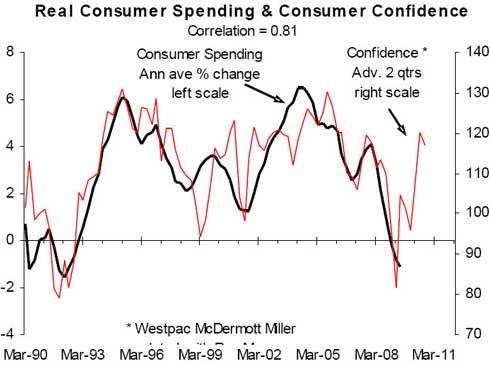
Bernard Hickey picks out 10 charts from 2009 in a series of videos to play over the Summer break. In this video he looks at the close connection over a long period between consumer confidence and consumer spending. This chart moves forward confidence to show how it is a strong predictor of consumer spending. Consumer confidence has risen sharply in the second half of 2009, indicating a sharp rise in spending through early 2010, yet the Reserve Bank is sanguine about such an increase. Rodney Dickens argues here the Reserve Bank should be more wary of such a growth and that the close connection has not been broken by consumers changing their ways.
[caption id="" align="aligncenter" width="490" caption="http://www.sra.co.nz/pdf/HousingLegacy.pdf"][/caption]
We welcome your help to improve our coverage of this issue. Any examples or experiences to relate? Any links to other news, data or research to shed more light on this? Any insight or views on what might happen next or what should happen next? Any errors to correct?

We welcome your comments below. If you are not already registered, please register to comment in the box on the right or click on the "'Register" link at the bottom of the comments. Remember we welcome robust, respectful and insightful debate. We don't welcome abusive or defamatory comments and will de-register those repeatedly making these comments.

253 Comments

I'm watching the credit aggregates.

I'm watching the credit aggregates.

http://www.interest.co.nz/charts/gallery2-40.asp

http://www.interest.co.nz/charts/gallery2-60.asp

Consumer credit is at -5% yoy..

Hard for me to see a consumer boom next yr,...????

I think the 2010 budget could also be a "handbrake" for any consumer boom.

Grazie mille! Questo articolo, me

Grazie mille! Questo articolo, me lo faccia sapere un sacco di cose che prima non ho capito!

I'm with you roelof...gst set

I'm with you roelof...gst set to rise and all those sneaky taxes, charges and govt thieving fees too...mix with the rising cost of financing debt and don't forget the Fagin fingers of the local council out to extract all they can from your wallet. 2010 is set to be the year of the retail death. English will be trying to grab the tail of the disappearing revenue rat. The savers will see the deflation in consumer prices and decide to wait another year. Gst going up will be a kick in the groin for all the trades and the revenue rat will run away all the faster.

Wally, I'd better control my

Wally, I'd better control my spending well in 2010.

I agree with Roelof... hard

I agree with Roelof... hard to see a 'boom' in consumer spending when credit growth is so weak... wage increases are going to be modest and we are all being told that the Budget will be as tight fisted as old Nordy's back in the 1950s!

Consumer spending will increase; that's part of the cyclical nature of things, but I reckon it will be like the period after the Asian Crisis... look at the chart around Mar 99... confidence increases but spending rises only very modestly and then tails off again...

No boom here!

Referring back

Referring back to:

http://www.interest.co.nz/news/top-10-10-gareth-morgan-targets-rbnz-refo...

RBNZ staff kindly referred me to:

'The Reserve Bank's new liquidity policy for banks'

http://www.rbnz.govt.nz/research/bulletin/2007_2011/2009dec72_4hoskinnei...

From page 12:

"To satisfy growing credit demand, banks will need to borrow from a variety of sources, with increased emphasis on customer deposits and longer-term markets. As a result, lending rates should automatically move higher without the Reserve Bank necessarily needing to move the official cash rate to the same extent. With short-term wholesale market rates not likely to rise as much, the attractiveness of the New Zealand dollar as a destination for "˜carry trade' investors could be reduced.18 Through these channels, the policy has the potential to have a role in assisting monetary policy."

Things have changed. Don't forget this is about first consolidating the core-funding minimum at 65% and then progressing with two more phases, to 70% and then 75%. Thankfully......, we won't be headed back to 90%. From page 11:

"For the initial implementation of the policy, locally incorporated banks are being required to maintain a one year core funding of at least 65 percent. Under current estimates, the banks all have a ratio above this minimum, but only slightly above in most cases.17 However, prior to deregulation in the 1980s, the Reserve Bank estimates that the ratio would have been significantly higher, around 90 percent."

Thankfully ...... ?

Why has there been all the hand-wringing over supplementary instruments to the OCR when the answer must have been glaringly obvious to those responsible for controlling inflation? Who are ..... ?

What, or who, would have restrained, "...those responsible for controlling inflation," from employing this change in monetary policy earlier?

If this policy changed had been enacted earlier, say 2003/4 - would the following have been higher or lower:

1) track of the OCR,

2) track and volatility of NZD,

3) house prices,

4) national debt,

5) national savings rate,

6) CAD?

Given it has been shown RBNZ won't turn into a pumpkin by midnight if it varies 'core funding', and that doing so is unambiguous in terms of 'moneytree' and fiscal policy seperation (independence) what other parameter might complement inflation targetting? Maybe CAD, in some way?

Answers to:

http://www.interest.co.nz/news/summer-chart-series-why-economic-and-tax-...

Cheers, Les.

I'm kinda hoping roelof is

I'm kinda hoping roelof is right and the credit constraints and other things will prevent another blowout.
But then the funny thing with economics is although it may seem straight forward at times, who knows what the unpredictable factor of human nature will bring to the table.

les, I think the core

les,

I think the core funding ratio is a response to the Dire liquidity issues that NZ faced during the Global crisis....( I understand that there was a point where money was very hard for NZ to borrow)
When you have banks that borrow short term and lend long term.... you are vulnerable , in terms of liquidity, during a crisis.

I think the core funding ratio is not something to play around with... The higher the better.
It should have nothing to do with controlling inflation.

What is CAD..??

cheers

Roelof
It is about the robustness of our banking system.

roelof - yep, appreciate what

roelof - yep, appreciate what precipitated the change, however the collateral benefit of better inflation control because of it, also needs more appreciation, as does the fact that RBNZ won't turn into a pumpkin at midnight if they modify this ratio as an effective credit volume control, noting that just varying the price of credit with the OCR has not been as effective as it could have been, if better volume control was also in place. CAD, current account deficit. TARA, 'there are reasonable alternatives'. So hello TARA, goodbye TINA, 'there is no alternative'. I forgot a 7th question on my list above:

7) exports.

Why not utilise it more directly to help control inflation, and improving on those seven parameters I've listed? It's not like we don't need to is it. No sarcasm meant, but for me it's about the robustness of our economy, and that means having a more robust tradeables sector, which is what our present deployment of moneytree policy has not supported. Note the difference in tradeables and non-tradeables inflation tracks. Varying, and increasing core funding, would help re-balance this, and the economy.

Cheers, Les.

(I may not be able to get back to this for a while, but happy to continue on when I can.)

Not just unpredictable Phil but

Not just unpredictable Phil but sneaky as....consider the rush to spend the cash and yes to borrow and splurge, if a rise in gst to 20% is hinted at. Just the sort of event to be on Bill's mind but he has to time it right...too early and the good data evaporates before the election...too late and he misses the voter reward for the good data event.
I suspect the overpaid boffins in Treasury will be tasked to determine the 'right' time to leak the gst 'news'. Nov first 2011 would be about right. Time then to get the good data out for the aug sept oct period. What do you think?

Les, I don't think it

Les,

I don't think it would be beneficial to play around with the core funding ratio.
Its' purpose is to help make a more resiliant and robust banking system.

Can we predict another crisis..???? Are we smart enough to play around with it , thinking that we are "controlling inflation"..??

You are suggesting that moving it around may have an affect on the volume of credit..?????
I can't see how that would work..?? You quote:

"To satisfy growing credit demand, banks will need to borrow from a variety of sources, with increased emphasis on customer deposits and longer-term markets. As a result, lending rates should automatically move higher without the Reserve Bank necessarily needing to move the official cash rate to the same extent. With short-term wholesale market rates not likely to rise as much, the attractiveness of the New Zealand dollar as a destination for "˜carry trade' investors could be reduced"

I think this might well be wishful thinking, in regards to the carry trade, in my opinion..

The immediate effect of implementing this policy will be higher deposit rates in NZ and slightly more expensive funding costs offshore....
Business as usual for the carry trade... if deposit rates are going up..???

In the end, it is NZs' insatiable demand for credit that creates all the inflationary pressures, and increases in money supply ... The GOVT is keeping up the demand for credit, as the private sector is becoming less hungry for credit.... We simply Don't save enough to meet this demand for credit. .... We have to borrow large amounts offshore....
BY Allowing Money Supply growth to be completley elastic, the reserve bank can only affect money supply by influencing our behaviour... ( our demand for credit ).
This is the the problem..... The reserve Bank has no power to affect the supply of credit. They can only try to influence demand.
When we have irrational times... money supply can grow at double digit rates.

In the face of this , having a prudential liquidity policy, is not going to make any difference to an increasing or decreasing money supply.
( just my opinion )

Cheers

Roelof

roelof - just clocked your

roelof - just clocked your comment mate. Will have to answer later, (I do have some)poss. in new year. Have a good one, cheers, Les.

PS - In the interim consider our Capital Adequacy Ratio is Basel standard 8%, but the TARAs in Singapore have theirs at 12% and if we move our 'core funding' from present 65% back to say 1980's 90%, effectively our CAR would be back around 11%. Just food for thought and then as you digest that maybe you can tell me, if I want to start a bank (with no cash-over-counter ops) could I do so with just Tier 1 capital and then loan out 12.5 (1/0.08) times that amount, albeit as per Basel II risk-weightings?

Huhhh, must go. Cheers, Les.

roelof - just quickly, more

roelof - just quickly, more food for thought, re. the RBNZ paper I'm quoting in my comment above, "˜The Reserve Bank's new liquidity policy for banks', see page 12 and box 2 where 'core funding' is defined:

"One-year core funding dollar amount = all funding with residual maturity longer than one year, including subordinated debt and related party funding, PLUS, 50 per cent of any tradable debt securities issued by the bank with original maturity of at least two years, and residual maturity (at the reporting date) between six months and one year, PLUS, "non-market funding" that can be withdrawn at sight or with residual maturity up to one year, where the percentage to be included decreases with size band, PLUS, Tier 1 capital"

Which I guess means CAR [(T1 + T2 capital)/risk] can be re-written as = ('core funding' + T2 remainder)/risk]. So notwithstanding some skullduggery in the numerator, which who knows, I suppose maybe possible, given little/light regulation of the relative component parts of 'core funding':

http://www.interest.co.nz/opinion/opinion-reforms-do-not-address-banking...

Maybe this is why some think it'd not be so useful for inflation control?

How to fix?

Cheers, Les.

Yeah good point Wally, I

Yeah good point Wally, I suppose if you had something big you wanted to buy coming up and you knew a big GST increase was coming, you would want to get in and get it before the increase.
I duno if it would change behaviour much on smaller purchases.

Look forward to that Les...

Look forward to that Les...

I'm not that knowledgable about these things.
How did you come up with the relationship between Core funding and CAR..??
ie. Core funding at 90% will give us a CAR of 11%.

I don't see the connection between the two..???
One is to do with the "quality of borrowings" ie. retail deposit base and longer term wholesale funding.
The other has to do with Capital in relation to total assets.

Not sure about what u are asking when u talk about wanting to start a bank..????
If you were Mark Hotchin... you would use as little Capital as possible..!!!!!!
If you were prudent.... you would have whatever Capital you thought was necessary, beyond the minimum requirements, to be robust and solid. ( just like any other corporate). ....
If you were prudent you would be very careful about borrowing short term and lending longer term.
You can't just simply lend out 12.5 times your capital.... Your ability to lend depends on your ability to borrow (get deposits).
The more deposits you get , and the more you lend out, in relation to your Capital base, the more vulnerable you become...

Cheers
Roelof

Oh they will try Phil..I

Oh they will try Phil..I got my wording wrong too..the leak will happen well before the change in gst date, thus giving peasants time to splurge and Stats NZ time to cook the numbers for release just before the election. It's called the 'Piggy Put'. Works a treat. Most punters chase the furniture and high tech crap along with whiteware and vehicles but it can spread to putting deposits down on house builds and reno jobs. Buying that truckload of grog and a gross of rum. Good for at least 6 months of smiles and BS in the media about recovery and growth.

les,.. 'Which I guess means

les,.. 'Which I guess means CAR [(T1 + T2 capital)/risk] can be re-written as = ("˜core funding' + T2 remainder)/risk".

NO.... I don't think that's right.

You have to remember that "core funding" represents a % of total funds loaned.
You would need to add the other funds loaned that fall outside of "core funding" definitions.

Then you end up with "total funds loaned"........ which is what is used to work out CAR anyway..

Just my view.... I'm always open to being corrected

Cheers

Roelof

roelof - I made a

roelof - I made a mistake with, "How did you come up with the relationship between Core funding and CAR..?? ie. Core funding at 90% will give us a CAR of 11%." See my 12.38pm, and I should have said something like, 'inflation effective CAR' being 90/65 times the present CAR of 8%. In other words, in terms of inflation throttling, we'd need to move CAR to 11% to have the same effect as 'core funding' at the RBNZ's estimate of 90%, in 1980's, "before deregulation". I'm certainly no whizz on all this either and just trying to learn, but as a 'kinesthetic' type that get's messy!

Plus are you absolutely sure with, "You can't just simply lend out 12.5 times your capital"¦. Your ability to lend depends on your ability to borrow (get deposits)." ??

"In July 1988, the Basle Accord removed the fractional reserve system and replaced it with the "capital adequacy system". Under the capital adequacy system, banks can lend up to a set multiple of its capital. The current rules mean a bank can issue about 12.5 times its capital. Should a bank, which is already fully loaned, wish to lend some more, it can simply issue new capital. By raising £80 million in new capital a bank can lend £1 billion. Of the £80 million, only a small proportion needs to be equity. The rest can be loan stock. In other words, by issuing a certain type of loan a bank can authorise itself to issue a great deal more." From:

#9 here, http://www.bendyson.com/the-cause-of-the-financial-crisis/how-did-we-end...

Hence my musing in that direction.

Have to sign off now, but am looking forward to carrying on with this, so would be grateful for any further thoughts, comments. Have a good night, cheers, Les.

les- " Plus are you

les- " Plus are you absolutely sure with, "You can't just simply lend out 12.5 times your capital"¦. Your ability to lend depends on your ability to borrow (get deposits)." ??

yes... I'm sure .

I understand the money multiplier effect of the banking system.
There are many "Natural" constraints that limit a banks ability to simply "create money out of thin air".
At the end of everyday the banks have to balance their books thru the "payment System".
If they have a shortfall , they can borrow overnight from The Reserve Bank.
BUT the next day or so they will have to find the money elsewhere.... They can't just "pretend it" into reality.

It is from the flow of money, "round and round" the Banking system that the money multiplier effect happens.

Just my understanding

Cheers Roelof

Roelof - thanks, yep, I

Roelof - thanks, yep, I understood the "round and round" multiplier effect from the good RBNZ paper, among others, that penny dropped a wee while ago. It was only after reading around a bit more that I developed more concern about the CAR/8% "pretend it" into reality question and wondered if there is not this other "pretend it" multiplier working along side the "round and round" one. (Good terms these, Roger T will hate em'!!) Now I'm really late to get the bike out and that's because I was lazy in the past. I thought I'd just Google the name John Tomlinson, who is the author of that article on Ben Dyson's website that I referred you to, in particular item 9. Here's an interesting page from his website, that I've not read it in detail, but he analyses some balance sheets from Barclays Bank plc and looks like (at first glance) he is proving the "pretend it" into reality question, what do you think:

http://www.honest-money.com/talk.htm

Really must go, cheers, Les.

Sydney's price rise of 12

Sydney's price rise of 12 per cent in the 11 months to November 2009 more than offset the slide of 5 per cent during 2008 after the global financial crisis. It was eclipsed only by Melbourne's rise of 17 per cent, Darwin's 15 per cent and Hobart's 14 per cent. Prices in Brisbane and Perth rose a more modest 6 per cent.

http://www.smh.com.au/business/sydney-house-prices-surge-a-record-12-200...

MELBOURNE house prices soared by

MELBOURNE house prices soared by 17 per cent in the first 11 months of 2009, outstripping growth in all other capital cities, new figures show.

The latest RP Data index, compiled from Valuer-General's figures, indicates the Melbourne median house price hit a new record of about $580,000 in November.

Interesting that Australia has capital gains tax and stamp duty that house prices rise regardless - so if such measures were adopted here it would make no difference - house prices would still rise.

http://www.smh.com.au/business/housing-prices-soar-17-to-record-20091231...

Meanwhile in the UK The

Meanwhile in the UK

The latest house price index from Nationwide suggested average values rose from £75,000 at the turn of the Millennium to £162,000 by the end of the decade.
And despite the worst recession in Britain since the Second War World, prices rose by a surprising 5.9 per cent - the equivalent of £9,000 - in 2009 after dropping by almost 16 per cent the previous year.

The turnaround in the housing market during the past 12 months has "surprised most commentators", according to Martin Gahbauer, Nationwide's chief economist

http://www.telegraph.co.uk/finance/personalfinance/6916306/Price-of-a-ho...

Les, I discovered John Tomlinson

Les,

I discovered John Tomlinson a few yrs ago... Have his stuff filed away. ( very good )
If u take the time to really study his stuff... it will help make sense of a few things.
His background story about how the banking system evolved from goldsmiths who stored gold for people and issued reciepts, gives a picture of how the modern banking system "pretends it" into reality.... In any other field , it would be fraud.

There is much misinformation out there... Conspiricy theories.. people who preach half truths... and lead us down the garden path.
"Honest money" is well worth printing out...

Also print out this speech... it is very good... helps to clarify a topic that has most of us a little bit lost at sea, in terms of understanding.

http://www.honest-money.com/images/LordCaithness-HOL0209.pdf

Cheers

Roelof

Les, Here is a link

Les,

Here is a link to a Reserve bank document.
Makes the distinction between prudential policy and Monetary policy...AND discusses some of the risks of using prudential policy for Monetary policy objectives.

http://www.rbnz.govt.nz/monpol/review/0096088.html

Roelof - thanks for spending

Roelof - thanks for spending the time to put me right. I think that 4th 'money creation' demon in the door-knob was a smudge that I've managed to wipe off, and it came about after trying to reverse think some incomplete, maybe "half truths", and misleading stuff I'd come across. (Plus me being thick at times don't help!) I've scanned some of the stuff you've recommended, thanks again. I'm waiting for some rain to re-read and study more thoroughly. That said, this learning and unlearning experience hasn't changed my general views on moneytree system and policy reform. Indeed blundering around the ratios has further confirmed my belief in the need for such - especially the sensible utilisation of 'public credit' in a 'mixed' more stable money supply system. Plus, given the actual evidence, also how we'd benefit from Kiwbank, and also regional/city council banks, operating on a similar basis to the Bank of North Dakota system, meaning we could pay less tax, and less rates. Thanks again, cheers, Les.

Les, Where I part company

Les,

Where I part company from the "free Money Brigade ", is that I believe there is no such thing as free money..... Someone ALWAYS benefits at the expense of another.

John Tomlinson explains it quite well.
Every new dollar that is created dilutes the valve of every dollar already in existence.
You need to understand this in a fundamental, basic and simple sense.
(Remember , money should be 3 things...: a medium of exchange, a unit of account, and a store of value.) How can it be a store value if we create vast amounts out of thin air?

If you can understand that as a "fist principle" then you can develop a broad understanding of how this may impact the economy at large.. ( This goes way beyond watching the CPI...etc.) This "dilution" process becomes a transfer of wealth or "value".... Increasing the money supply is like a "Tax" on all existing holders of money. Generally , it is a transfer of wealth from Savers to Borrowers.

The Primary beneficiary of new created money is the creator ( banking system or the Govt if Iain had his way). The person who gets that money next is also a major beneficiary... The benefits of that newly created money will continue to flow outwards, like a ripple ... As it ripples outward ,thru the economy, the benefit is less and less. Along the way the "market" will readjust , and everyones dollars will have less value, even the money of people who had no direct benefit from the newly created money.
This is all very unfair and inequitable.

The way this process manifests and works its' way thru an economy is as complex and varied ..... as there are shades of green.
This money creation process leads to all sorts of problems and distortions.... all the problems we have today.

The term we use to describe this process, is "Inflation". BUT this word is misused and most people ( economists) relate it to the Consumer Price Index.

Inflation is the process of increasing Money supply.... How increasing money supply impacts on our our economy goes WAY beyond hynotically watching the CPI.

The dislocation between tradable and Non tradable inflation is an example of how Money supply increases are working their way thru the economy. ( and shows the limitations of the CPI )

Non Tradable inflation is higher because the "bidding power" of "new Money" results in higher rising prices of goods and services that can only be produced in NZ.... The supply of these goods and services are , somewhat, inelastic.

With tradable inflation , the supply of goods and services are far more elastic...As we have more "bidding power", from "new money", we simply import more.

( Bernard did a post about tradable/nontradable.. He talks about one being at the expense of the other and an unbalanced economy... I don't really agree with his analysis, based just on that chart.) http://www.interest.co.nz/ratesblog/index.php/2009/12/31/summer-chart-se...

The CPI is how we try to measure the effects or impact of inflation.... not the inflation itself.
The Monetary aggregates should really be watched far more closely than they are.
Central banks and Economists have lost their way when it comes to understanding the impact that Money supply growth and debt has on an economy.

When you look at the period from may 2004 to Aug 2007 the OCR went from about 5.5% to 8%.
M3 money went from $116,000 million to $149,000 million.

That is an almost 30% increase in money supply in 3 yrs..... in the face of a rising OCR...?????

The CPI went up around 10% over that time.

Whats going on..????

If Money supply grows at 9% per yr and wages go up by 3% per yr..... What happens over the longer term..????? ( exponents and exponential growth)
Money supply doubles in about 8 yrs while wages goes up by about 28%..

I like John Tomlinsons' term "Honest Money".

Shit... I've babbled on... sorry. I'm not a teacher.... just a student of the markets...trying to learn and understand... ( These are just my views..)
Too many beers today.... I don't want to become a preacher..!!!!!!!!!

Sorry Les...
Cheers Roelof

Roelof - thanks again for

Roelof - thanks again for spending some more time on this with your 10.34pm, on the 2nd comment. I appreciate a good few of the points you make but I'll get back to you on that with a more considered response. Referring back to your 10.59pm on the 1st, so yep, here what you say, and what theRBNZ doc. says, but I'm wondering if RBNZ might need to look at rewriting some of that in the light of where they are going with 'core funding'. I found these bits interesting:

From the intro - "On the other hand, the Bank believes the active use of prudential instruments to achieve price stability is rarely effective and usually involves some loss of efficiency in the allocation of resources." - re. 'core funding' (cf) changes I wonder if they really believe that now?*

#6. ".....by applying some, albeit relatively few, rules to banks as to capital adequacy and connected exposures, and having a range of supervisory intervention powers to deal with significant problems if they arise." - It looks like things have changed, ditto above, although am concerned cf might still be loopholed given AB hasn't specified proportions of the components in cf?

# 12. "We believe that there would be potential dangers in extending the scope of existing prudential powers to pursue price stability, including a loss of clarity in the objectives." - sure, but ditto above.

# 13. "For instance, if there was a concern regarding heightened activity in the housing market, a prudential power might be exercised to increase the risk weight on bank lending for housing in the measurement of a bank's capital adequacy, the aim being to establish a disincentive to banks to lend to this sector." - OK, so they ain't faffing with risk weights in the CAR calc, but the cf change is having the same effect, and I wonder if AB has finally said enough is enough, he can get two birds with one stone here, given he's suggested (apparently in a Listener article) ustilising mortgages taxes as a supplement to OCR, maybe meaning he's not so puritanical about unambiguous moneytree and fiscal policy seperation? Plus, I recall in an Int.co article a while back by BH, something about AB mentioning restraining lending to diary - in other words very sector specific and perhaps more evidence of a less puritanical orthodoxy? (Sorry about the religious terms, but we all know it's more about faith than science.)

# 18. "While efficiency is not defined, we interpret this as requiring the Reserve Bank to:

avoid unnecessary instability or volatility in the general level of prices, asset prices, interest rates or exchange rates;" - So the kind of vol we've seen in NZD wasn't obviously wasn't considered as, "unnecessary instability or volatility." Ha, ha, yeah right.
* Bernard Hickey: Reserve Bank a world leader in setting policy

http://www.nzherald.co.nz/opinion/news/article.cfm?c_id=466&objectid=106...

"The Reserve Bank describes this side effect of the core funding ratio as an automatic stabiliser for the economy, helping to raise interest rates when the economy is heating up without the central bank having to hike the official rate. This, in turn, will help exporters by keeping the exchange rate more stable at a lower level."

However, I repeat the questions I asked in my 12.07pm, Dec 30th. Why have we had to suffer with AB having one hand tied behind his back, for so long? Hopefully he'll be able to keep this other hand free long enough to, effectively, meet more of the criteria in #18 - because with just the one hand on the OCR it's been a dismal failure, IMO - just ask the exporters, (and importers) who've suffered, or left, or not even bothered to expand, or start up.

Cheers, Les.

Wally - I'm getting to you, hopefully before TC completely traumatises you. Just be strong.

GE finance have reported that

GE finance have reported that the 15-16 year " bull-run " of Kiwi shoppers shows no sign of abating . Credit card usage is up . Christmas Eve spending was $ 226 million , 10 % up on the previous year . And Boxing Day's sales reaped another $ 77 million for retailers . ............... . If in doubt , go all out , splurge . ................. . How come I still have to buy me own gummy bears . The chintzy sods I know are spending all that moolah on themselves !

@Les, maybe instead of Bollard

@Les, maybe instead of Bollard saying, "enough is enough, {we} can get two birds with one stone here," it was more along the lines, "Dude, stuff this, like I've sorted the Brisco lady, like now let's get both these bast*rds in one hit." Hard to imagine?

http://www.stuff.co.nz/the-press/business/3194226/Bollard-buys-up-spoof-...

(Utter disgrace, you shouldn't read these.)

http://publicaddress.net/assets/PublicAddressBooks/PDFs/Preview_NZReserv...

http://www.publicaddressbooks.com/

"Why have we had to

"Why have we had to suffer with AB having one hand tied behind his back, for so long"...oh come on les...the answer stands out like the mid day sun. You don't really expect the greedy fools in govt to give the RBNZ the power to prevent them porking their way to more power...more time at the pig trough.

les- I hear what you

les- I hear what you are saying. I don't think they will rewrite that document... by much.
I still say this policy is ONLY about liquidity issues.
I really don't see how it can have much impact on price stability or the exchange rate.

I also still believe it would be foolish to play around with it.. I just can't see how moving the core funding ratio from, say 50% to 80% is going to make alot of difference.
A bit like trying to put out a fire by pissing on it.

The side effect of introducing this poicy will be a shift in interest rates of 10-20 basis points ( according to the reserve bank). ..This sould be just a "one off" adjustment.

Banks can still borrow UNLIMITED amounts of money offshore... as long as the maturity of those loans is more than 1 year.

The reality is that nothing has changed...
We still need to borrow offshore to fund our Current Account Deficit.
The Govt still need to borrow $250 mill a week to pay its' way.

That money has to come from somewhere.

We all know that using the OCR to control the CPi is a terrible tool.
It cause heaps of "collateral damage".
In the Global Economy of Capital Flows , moving the OCR to our own drumbeat, becomes counter intuitive, and we witness things happening that theory says should not happen.

I believe Alan Bollard has both hands tied behind his back because he now sees the impotence and limitations of the OCR, in a Global World .
Just like Air filling a Vacum, Money will FLOW into NZ if there is a large differential between our interest rates and those of ( mainly) Japan and USA.
He has said as much by saying he is reluctant to raise the OCR because it may cause the $NZ to rally.

Another reason, is the view that Central banks hold about allowing Money Supply to be completely elastic and that their role is to influence the demand for credit.
AND the way they do that is to create a downturn by lifting interest rates....??
To most of us that seems stange... and to most of us the collateral damage that results ... does not seem right.

In answer to your question..... It is not Alan Bollards hands that is the problem... It is the "tools" in his hands that are the problem.
He is having to use the wrong tools for the wrong job.
The way he uses those tools , or how carefully he uses those tools is not going to make much difference to the outcomes.
looking at #18 .... "avoid unnecessary instability or volatility in the general level of prices, asset prices, interest rates or exchange rates...." one would have to say that those tools don't work... that well

cheers Roelof

les... u quoted Bernards article....

les... u quoted Bernards article.... "The Reserve Bank describes this side effect of the core funding ratio as an automatic stabiliser for the economy, helping to raise interest rates when the economy is heating up without the central bank having to hike the official rate. This, in turn, will help exporters by keeping the exchange rate more stable at a lower level."

This does not make any sense to me.

It makes no difference whether the reserve Bank or the "Market" puts up interest rates..
As long as there is a difference between our rates and Japans and USAs' , and as long as we have a need to borrow, then the carry trade will carry on... The more of a differential, then one would expect upward pressure on our exchange rate.

How does high interest rates lead to a lower, stable dollar.... BUT if it is the Reserve Bank putting up the OCR .. then the NZ dollar will go up...???

Cheers Roelof

les... What I'm trying to

les... What I'm trying to say is that I don't think using prudential policy to achieve monetary policy outcomes is a road we should go down.

there are risks in doing that and the I outcomes would be that great.

I'm trying think of an analogy.... Is it a bit like playing around with the Companies Act in order to make Companies more robust..???

I do think the core funding policy is a good idea thou.... but I don't think it will make much difference to monetary policy outcomes.

Cheers Roelof

typo... ...there are risks in

typo... ...there are risks in doing that and the outcomes might NOT be that great....

Roelof - your 10.34pm, on

Roelof - your 10.34pm, on 2nd, firstly, not bad after a few beers! Thanks.

I like your point, "Central banks and Economists have lost their way when it comes to understanding the impact that Money supply growth and debt has on an economy." and from may 2004 to Aug 2007 the OCR went from about 5.5% to 8%, while M3 money increased 30% from $116,000 million to $149,000 million. I've understood that to be a hot money availability effect, that while we were increasing OCR, given the expansive shelter of fixed rate mortgages, banks could borrow short (and cheap) knowing the lag in moneytree policy deployment meant roll-over risks to lending long would be covered by the fact that OCR was only ever going in their favour, in terms of continued availability (and increased margin....) which is one of the birds AB is also taking aim at with the 'core funding' changes, it appears.

I think I've nailed seeing inflation as volume of money (as opposed to the CPI); the dilution effect caused by expansion/increased creation; wealth transfer and tax effect; plus things wot money is, although I like the idea of 'currency of contract' which I think wraps up all three quite well. The other aspect I've come to appreciate more is the increasing effect on money supply that interest on debt has. As the interest component isn't created when debt is created, it has to come from more of the same, more debt+interest, from a 'whole system' perspective that is. Which leads me onto thoughts about public credit.

If we (NZ) need a bridge to be built say, the money most probably has to be created (borrowed) to do it. (At this point let's think of this money as the 'currency of the contract', as well, but I'll continue to use the term money.) NZ borrows the money, builds the bridge and sets about repaying the debt+interest, via our taxes. The debt is backed by gov. and, the physical asset which is comprised of material, effort and information. The money supply was increased by $bridge (including interest). As the debt is repaid back, money is destroyed, but interest on the debt is still outstanding - thus left in the money supply and has expanded it by the interest component - which probably compounded a wee bit. (A lot probably.) Why is it different for RBNZ and Treasury to issue sufficient 'currency of contract' ($bridge) as debt, but with no interest payable? The job gets done; value* is created; demand for money is matched to supply of material, effort and information; money is created and is (maybe*) destroyed, but the tax payer is not hunting for yet more money/taxes to repay the interest (which will compound nicely), meaning less tax to pay in two ways - 1) we don't have to pay the interest component - $250mio pw I believe, and compounding nicely, which is the killer, and 2) the inflation this component causes is negated, hence less indirect taxation by the 'inflation' dilution demon.

*Maybe not, as equivalent value is created - currency is asset backed - it could be sold (sorry TC**) like, gold, silver a.n.other commodity and the money (creation) expansion contraint is because the asset has a finite (net present) value, like a finite chunk of a.n.other commodity that we could use as 'currency of contract'. If still not happy with run-away money expansion, AB could always see if Milton Friedman wants a ride (in the ute, nice one Jacko) - which would steer things be back to full reserve banking, as from what I've read he's agin it and maybe we should be looking at that kind of change. (Yes, Wally, when hell freezes over.) ** Maybe I wouldn't, but I'd be looking to operate things privately where possible, and perhaps be into PPPs in some places.

*Back to maybe not, let's consider how much of the debt in the present 'round-and-round' system gets retired/destroyed? It's out there doing it's job, creating value, the difference is, 99.9999% is doing so while generating interest. I want to substitute some of that 'round-and-round' money supply with interest free 'public credit', thereby doing the same job, creating value (asset-value-limited public works) - to get the tax advantages, see a more stable money supply and more stable NZD, which I think may be more probable by at least having a system of mixed public and commercial credit.

I'd not be wasting time on this if there were not evidence to support the approach. Although I have to say the idea of 'the social credit' does kinda go against the grain, as does a lot of the benefit system we have. In fact I was somewhat taken aback when GM went on about his 'Big Kahuna', which is another idea, IMO, not to be dismissed out of hand with the usual lazy TINA response. But as for 'the social credit', I find it hard to hack the idea of people just plucking money off 'The Moneytree' for nothing - so we better just leave that as the preserve of the banks, because we can trust them, can't we?

Cheers, Les.

Roelof - responding to your

Roelof - responding to your comments about core funding (cf), "How does high interest rates lead to a lower, stable dollar"¦. BUT if it is the Reserve Bank putting up the OCR .. then the NZ dollar will go up"¦???"

I had rationalised this as banks not being able to take what I had assumed was cheaper/hot offshore money, because I assumed 'the rules' included specific origin stipulations, that is, onshore/offshore. It appears they don't directly*, the closest being (I think) is the distinction between, ""˜market' and "˜non-market' funding. [where] "˜Market funding' is intended to capture the idea of professional wholesale market funding that would all be withdrawn from the bank on maturity at the first sign of problems." That is, foreign cash would scarper quickly and so it looks like such funds are less eligible (some only 50%) as cf, I think, see page 8. The pressure for 'onshore' deposits, which are more 'eligible' in the calculation, comes from a drive to get smaller "less financially sophisticated" savers dosh, see page 11, "For instance, a depositor with total deposits at the bank of less than $5million is assumed to be a less financially sophisticated personal depositor or small business, and accordingly 90 percent of such funding is allowed within the core funding total. The percentages included in each depositor size band are set out in figure 6."

Another aspect of expected improved mon.pol effectiveness and not having to raise the OCR as much, I thought comes about because more people stay on lower floating rate mortgages, (I think they hope) meaning less lag effect when the OCR 'kicks in'. (This effect/subject has been covered in Int.co in a article based on a piece by ANZ I think I recall.)

Thinking through the automatic stablizer effect, eg. credit demand increasing; it looks like banks will have to jack-up deposit rates to maintain the 'non-market' component toward approx. double (what I think is) the market component - so savings increase and up goes mortgage/loan rates with it. Which backs up, to a degree*:

"The core funding ratio in the new prudential liquidity policy drives banks to either* compete for more stable funding from non-financial customers, or* borrow in wholesale* markets for terms longer than one year. During periods of rapid credit expansion, banks will not have the same ability to borrow at short terms in the offshore money markets to supply domestic demand. To satisfy growing credit demand, banks will need to borrow from a variety of sources, with increased emphasis on customer deposits and longer-term markets. As a result, lending rates should automatically move higher without the Reserve Bank necessarily needing to move the official cash rate to the same extent. With short-term wholesale market rates not likely to rise as much, the attractiveness of the New Zealand dollar as a destination for "˜carry trade' investors could be reduced. Through these channels, the policy has the potential to have a role in assisting monetary policy."

Except * if they can get the easy-rate stuff, (the either and or) they will, so you are casting some doubt in my non-expert mind nonetheless and so it might help if they said, "..lending rates WILL automatically move higher.." and, "the policy WILL have a DEFINITE role in assisting monetary policy." But it seems they can't, maybe for the reason/market option* you highlight. Although you'd have to ask why would offshore rates get easier, and thence where is demand for NZ Inc's products? Hmmm, but maybe a Greenspan, Freddie, Fannie and Bill Clinton consortium, somewhere, somehow, might ride again perhaps and that's why RBNZ seem only semi-confident? The coulda, shoulda tone and "potential role", instead of "definite role in asssisting monetary policy."

So we could still be stuffed, and it raises more questions, the first one being, "Are you really, really sure it will have these "collateral automatic stablizer effects" because if not, let's get real and look for a robust supplement to the OCR, because it's hopeless on it's own - as we all know?" I still think they should look at my idea of RBNZ being able to vary the principal repayment rate (PPR) of ALL loans, because there'd be no sheltering from RBNZ mon.pol if we start getting bent out of shape by offshore funders providing cheap money below sensible market prices. PRR could easily be done in this digital age, it reduces rather than increases debt, has no lag effect - even fixed raters get hit, but NOT with a tax or higher interest payments they never see again. I think using such would mean most (all) folk would opt for fixed rates (they may as well to at least be shelterd from offshore i.rate vol.), which would naturally mean banks tend to take longer more 'prudent' funding (tick that box), and mon.pol is not hamstrung by any lag effect caused by fixed rate loans, just like the original architects of monetarism probably envisaged, I think.

Roll on the 29th - to probably learn, yet again, how it's really the MCI effect that controls 'general inflation' in NZ - hang the exporters - we don't need em', do we, our lecturers told us so, at Neo.lib mass this morning! (Bugger, am getting as cynical as Wally.)

Thanks Roelof, cheers, Les.

Les....who convinced you that an

Les....who convinced you that an opinion was of greater value if it filled a book and not just two lines on a page?

To paraphrase a wise man

To paraphrase a wise man : " Bloody hell , Les , we're not reading all of that ! " ............Sloe day down at the ole NZMEA ? Busy CASP'ering , or summit ?

Wally - who convinced you

Wally - who convinced you everything meaningful must only be said on bumper stickers? (Get a bigger VDU, don't be tight.) Enlighten and enjoy.

Don't be a windbag Les...remember,

Don't be a windbag Les...remember, 'Les is better'. Stick that on your Bum per!

Hi Les,.... It will take

Hi Les,.... It will take me a while to digest what you have written.. You said this:

"The other aspect I've come to appreciate more is the increasing effect on money supply that interest on debt has. As the interest component isn't created when debt is created, it has to come from more of the same, more debt+interest, from a "˜whole system' perspective that is. Which leads me onto thoughts about public credit. "

Are u sure about this..??
If we want the illusion of never ending growth... then I would kind of agree with those comments.. BUT
Surely it is possible to pay the interest component of the debt without it affecting money supply...???

Remember it is the DEMAND for CREDIT that expands or contracts the money supply.
The Reserve bank has no direct control of Money Supply. It is completley unfettered.
It is you and me, as individuals, and collectively as a nation that determines if money supply expands or contracts.... If we borrow, it expands... if we pay back, it contracts.
Obviously, if it contracts then there would probably be an economic downturn.. as we would be "tightening our belts" and repaying debt.. ( or we may be repudiating debt).

Think of yourself and your own household, and the attitudes you have to debt.
You are aware that any interest you pay on debt is a use of money that u could have spent elsewhere.
The interest on debt doesn't have an effect on Money Supply, ... it has an impact on your spending choices... you forsake consumption or saving for paying interest.
That is if you are honest and prudent.

If you are imprudent... then you maintain or improve your current lifestyle by borrowing more and more ( never ending growth ).... using the new debt to pay the interest on the old debt... ( this is like increasing your "household" money supply )
At some point your little Ponzi scheme will collapse... and you will either repudiate your debt.... or you will somehow pay it back.
At that point "money Supply" will contract.. ( your household "money supply" ).

cheers Roelof

Just a question... Les, you

Just a question...

Les, you said, (and it seems to be generally understood that) "As the debt is repaid back, money is destroyed" i.e. money is created with the issue of loan principle, and extinguished as it is repaid. The following quote from John Tomlinson suggests that this is not so, he says that the repayments only reduce the money supply as measured, but are nevertheless retained by the banks in their own accounts...

Part of the reason lies in the lack of understanding of the real nature of the system. We have been misled by errors in the very presumptions of economics. In the most basic courses on economics we have been taught that when banks lend money the money supply increases and when those loans are repaid the money supply decreases. Thus, we are told, these activities cancel each other out. We have accepted this idea and have acted on it in good faith.

But it is not true. The money supply does not decrease. It is only the measurement of the money supply that decreases. When a loan is repaid it goes into the bank's own account. The bank's own account is included under the heading "Cash in hand and balances at central banks". Look again at Tables 1 and 2. On the bank's balance sheet, like any other company, money in its own account is considered an asset and is shown on the asset side of its accounts. Customer deposits, on the other hand, are considered liabilities and appear on the liability side of the balance sheet. When economists measure the money supply, they measure the sum of Customer deposits and cash in circulation (not in the banks). But, deposits into the banks own account are not included.

http://www.honest-money.com/talk.htm

Just trying to connect the dots.

Cheers

roelof, <blockquote>The interest on debt

roelof,

The interest on debt doesn't have an effect on Money Supply, "¦ it has an impact on your spending choices"¦ you forsake consumption or saving for paying interest .... The interest on debt doesn't have an effect on [the volume of?] Money Supply, "¦ it has an impact on your spending choices"¦ you forsake consumption or saving for paying interest...using the new debt to pay the interest on the old debt"¦ ( this is like increasing your "household" money supply )...At some point your little Ponzi scheme will collapse"¦

I think that is the point, that if (national, rather than household) borrowing keeps increasing, the component of the money supply that is committed to interest payments must grow, perhaps exponentially - there is nowhere else for interest payments to come from except further borrowings (on aggregate)...is there? Hence (to a large degree), the attraction of public credit.

Cheers

Les, About public Credit... I'm

Les,

About public Credit... I'm not for it or against it. BUT it is a "TAX"... it is not free money.... Someone benefits and someone pays.

Having said that, The Govt borrowing $250 mill every week is also a tax on us and future generations. AND also the interest component of that debt.

Public Credit is NOT a magical creator of "wealth".
BUT the current system is not working very well.

I do agree that the "banking system" should not be the Primary Beneficiary of the creation of credit..
It makes sense that it should be Government and the people of New Zealand who should benefit from money creation.

BUT... how on earth could it work..??? Over time , would human nature prevail... and the money creation process abused and misused..?????

Really, if we were prudent as a country , we would live within our means.
We would have an eye on our Current acct deficit...
Warren Buffet compared Current Acct deficits to selling the "family silverware" or selling off little pieces of the "family Farm".

Public credit would not change any of that..??

Cheers Roelof

Martin H... "– there is

Martin H...

""“ there is nowhere else for interest payments to come from except further borrowings (on aggregate)"¦is there? "

Yes and No... Interst payments do not expand or contract the money supply.. It is the new borrowing ( or paying off of debt) that expands or contracts the money supply.

Prudent people ( nations) don't borrow more to pay interest.. They foresake consumption or savings to pay the interest and down pay the debt.

Borrowing money to pay interest ...and then borrowing more to pay the increasing interest costs... sounds like Bernie Madoff.... a ponzi scheme... :)

In that case there is only one outcome.. ( for poor old Bernie it is "doing Time" )

roelof, How much of the

roelof,

How much of the 250m/week of public borrowing is to pay interest? Sure, interest payments don't expand or contract the money supply, but they are becoming an increasingly bigger proportion of it... and it is effectively a Ponzi set up (isn't it?)

BUT"¦ how on earth could it work..??? Over time , would human nature prevail"¦ and the money creation process abused and misused..?????

That is a genuine concern of course, but whoever holds the vested interest is open to corruption. Is it somehow better for this to be private entities or entities of the state (that/who at least can be regulated, dismissed or voted out, and who are responsible (nominally at least) to, and motivated towards NZ inc.)

It appears that public credit would mean less of the silverware being sold to pay interest bearing debt.

Cheers

Roelof, Martin - thanks for

Roelof, Martin - thanks for taking the time to read and think about 'there are reasonable alternative' propositions. Debating stuff through and making the intellectual effort might lead to some useful co-developed ideas/outcomes. Just dropping in, will look at this more later.

Fast and Frustrated - what can we say, just not a team player eh? You should run for PM, it seems you got one of the major qualifications, NO, and I mean that dogmatically, NO. "This Wally is not for U-turning." LoL, funny indeed.

Cheers, Les.

Enjoy the sticker Les.

Enjoy the sticker Les.

Martin, in regards to your

Martin, in regards to your question to les about John Tomlinsons' assertion that paying off loans does not decrease the money supply..

my answer is yes and no....

I'm also still trying to connect all the dots....

The money creation process takes place principally through transaction accounts... which is M1 money ( I think).

I don't want to confuse things ... unless I can understand things in simple terms ,I keep my mouth shut...
I've learnt that when it comes to this money creation system , one has to question and inquire into almost everything one reads.

This a great information source as well as what John Tomlinson writes. Modern money mechanics.

http://www.archive.org/details/ModernMoneyMechanics

Cheers Roelof

Thanks Roelof <blockquote>I’ve learnt that

Thanks Roelof

I've learnt that when it comes to this money creation system , one has to question and inquire into almost everything one reads.

Well ain't that the truth! (and that's what I am doing!) But, if what Tomlinson asserts is true, then Iain P's crusade to take back control of our money supply comes into sharper focus... I will check out your link.

Cheers.

Roelof, Martin - re. the

Roelof, Martin - re. the problems with debt+interest and interest not able to be paid off without more of same, ie. debt+interest, see:

Money as Debt II Promises Unleashed (Pt4)

http://www.youtube.com/watch?v=0-O_yGEI_0U&feature=PlayList&p=879A14495D...

Part 3 is also useful, but Gringon nails it here in Pt4. (Have still to study your comments in more detail, but this expalnation seems clear.)

Wally - shame YouTube don't do a wireless version. Any response to mine, to your very, very, very funny "Pure Humbug" dismissal, on the Kiwibank does something or other thread?

Cheers, Les.

I have no problem with

I have no problem with Kiwibank Les...just with politicians being in charge of the money supply and your thinking that public/social/citizen.peasant credit would work in the real world. I would have thought that by now you would have learned the truth about the nature of people in power...it is a drug Les...very very few of them can give it up and if tweaking some extra credit via a govt controlled bank into your electorate for what we know are pork projects aimed at fattening the local vote..if this brings you more time in power..then what the hell. You need to do some research into the way power of any kind tends to warp the human mind.

Fast and Failing - your

Fast and Failing - your responses, laughable:

"with politicians being in charge of the money supply" - I didn't suggest that, look back at the comment and try again.

"your thinking that public/social/citizen.peasant credit would work in the real world." - There is evidence that is has, and it does work, as cited and referred, evidence that you continue to ignore, why? I don't want to ignore it because I think it will benefit NZ and me personally, via lower taxes. Why do you continue to ignore it?

As for the last two sentences, why don't you specifically address the points I was making about associated policy change and reform, rather than lazily ignoring them and winding out this tired dogmatic retoric?

As for power warping the human mind, sure, but what of cynisism transforming into apathy? What happens next? Oh, it's happening already, but you want to ignore that too - maybe you can afford to and don't give a damn. However many on the right side of 35-40 probably don't and won't if they come realise 'there are reasonable alternatives' (TARA) instead of the defeatist TINA dogma some, and you, continue to spout.

How about address the points in the sequential way that I addressed your original points.

Cheers, Les.

les, I watched part 3

les, I watched part 3 and part 4 of the video link you gave.
I find those videos confusing.... They don't make sense to me. ... Half truths and misleading... Parts of it I accept but other parts of it lead us down the garden path... in my view... I'll try to watch the whole series to see if I've missed something..!!

Gosh... Using Simple logic....

If the money creation mechanism , as described in those videos , is true , Then how would you explain the need for our banks to borrow off shore..??? How do you explain the need for our banks to compete for retail deposits..???
How do you explain the urgent need for Many Western Banks to recapitalize...???

The only way I have been able to "find my way in the dark", is to go right back to basics. To how the banking system evolved.
The Chicago Feds document " Modern Money Mechanics really is worth studying as is the John tomlinson stuff...
AND even then don't take anything at face value... question and enquire....

As much as there are bad things about our Monetary system , there are also many good things.
It is something that has evolved alongside the always changing Capitalist economies.
I find our modern banking system, with its' Central bank, to be an amazing thing.
It is by no means a perfect system but it is not all bad.
The reason I say this is to bring some sort of balance to the whole subject.
I don't know for sure... but I don't really buy into all this conspiricy stuff about banks and bankers.
Remember , Credit can only expand if there is a DEMAND for it.. that makes us, the people a very integral part of this whole system... We, the people have forgotton the lessons of our fathers about debt... We Have been seduced by Banks and "modern Life" to borrow ...borrow ...borrow.

Think of a finance Company.... Say they raise term investments of $1 million. How much can they lend out ...??? Answer $1 million.
Tell how they could ever lend out $10 million if they only had $1 million in deposits.

Now think of Banks... In many ways , they are no different to finance companies..
There are just one or 2 aspects which put them in a uniquely different position that enable them to "create credit".. Otherwise they have the same constraints that a finance company has.

Is ALL money loaned into existence.. ??? I don't think so... ( my understanding is that the monetary base is simple created out of thin air money). To be sure..I will email the reserve bank and ask.
I have found the reserve bank to be really helpful and open... ( I have not found any hint of conspiricy there) :)

Having said all that, there seems to be plenty of scope for change..... the trouble is that the reserve bank consults very heavily with the Banking Industry when considering change ( eg,. Core funding policy ) and then our GOVT consults heavily with the Reserve bank when considering policy... The results are probably a touch incestuous and self serving..???

Just my view...

Cheers Roelof

Good to see some indepth

Good to see some indepth debate going on, really keeps those bumper sticker boys quiet. Mind you, they only don't want to acknowledge to having read anything that is going to make their past efforts look, well, past it.
Taken a lot to catch up, so very little time before I have to hit the pillow, thus I will be committing a crime in the bumper sticker boys eyes and using some useful links to show some state in the US of A that are moving into the doey with a lot less hui and encompass the "public credit will be more inflationary" myth.

Firstly from Ellen Brown re Bank of North Dekota and encompassing info re your capital adequacy and core funding Les:
http://www.truthout.org/01031003

http://moneyaswealth.blogspot.com/2008/10/minnesota-transportation-act.html
from a website full of great stuff:
http://moneyaswealth.blogspot.com/2009/02/caution.html

http://www.khavariforgovernor.com/bankofflorida.html

Re Inflation
http://www.moneyreformparty.org.uk/money/the_economy/inflation.php

http://one-simple-idea.com/DebtAndMoney.htm

Roelof, I put it to you that the current private debt based monetary system is systemically inflationary, but in a none interest attached monetary based system new money would not automatically debase what is currently in circulation until what is in circulation exceeded sustainable supply and would infact bring down the cost of living if spent into circulation to build social infrastructure such as sustainable natural power sources?

http://www.prosperityuk.com/prosperity/articles/negcon.html

Im over you Wally my darling friend, moving on with the business in an attempt to prevent Johny Key, the central banker on sabatical, from destroying the possibility of KiwiBank becoming our lifeline to economic sovereignty. Isn't just great to see the public credit movement beginning to flurrish around the globe.

Roelof, I respectfully suggest you

Roelof,
I respectfully suggest you are struggling to comprehend the connectivity between the layers of banking and the interparty related ownership. I have little time right now but will come back and evidence my case asap. Until then you might like to take a look at my submission to the unofficial banking inquiry, especially from section 2 down re credit creation at the international level. As always I leave it mostly upto the institutions to explain it from their own mouths:
http://publiccreditorbust.blog.com/2009/08/31/iain-parkers-submission-to...

You back again..............Lawdy , don't

You back again..............Lawdy , don't they have special homes for the poor deluded paranoid delusional conspiracy theorists ? ............ At least the people who write the myriad of links you supply , can construct a coherent sentence . Just a pity that they're all writing a load of old bollix .

Now, now Wally, don't go

Now, now Wally, don't go getting all worked up because you cant work something very simple that many have now clicked on to.

In catching up on this other thread
http://www.interest.co.nz/ratesblog/index.php/2009/12/29/summer-chart-se...
No wonder you dont like getting into indepth debates, because everytime you do it exposes what a rudderless confused chappy that you are.

As for your bollix about only having to borrow if you want to, have a gander at this short and simple debunking of that myth.
To make it bumper sticker size, toggle straight down to:

WE PAY INTEREST ONLY IF WE BORROW MONEY
http://www.appropriate-economics.org/ebooks/kennedy/chap1.htm

Between the 87 election and

Between the 87 election and that in 08 the number of votes won by social credit or it's spawn dropped from about 105000 to about 1200...clearly the voting public have weighed up the theory..and tossed it in the rubbish bin of failures. But don't you let that stop you Iain and les and TC..and don't forget you are expected at the first meeting of the year for all Flat Earth Believers.

Just for Iain a special

Just for Iain a special new years treat..a chance for all the spawn to meet..
http://images.google.co.nz/images?hl=en&source=hp&q=spawn&um=1&ie=UTF-8&...

Milton who? You heard of

Milton who?

You heard of him Wally? Probably just some flake .....

"It is neither feasible nor desirable to restore a gold-or-silver coin standard, but we do need a commitment to sound money. The best arrangement currently would be to require the monetary authorities to keep the percentage rate of growth of the monetary base within a fixed range. This is a particularly difficult amendment to draft because it is so closely linked to the particular institutional structure. One version would be:

Congress shall have the power to authorize non-interest-bearing obligations of the government in the form of currency or book entries, provided that the total dollar amount outstanding increases by no more than 5 percent per year and no less than 3 percent.

Quoted from: A Program for Monetary Stability, by. Dr. Milton Friedman, Fordham University Press (N.Y. 1960, 1992), pgs. X, 66-76, 100-101; and, Free to Choose by Dr. Milton & Rose Friedman, Harcourt Brace & Co. (San Diego 1980, 1990), pgs. 307-308."

http://www.themoneymasters.com/?page_id=14

"Dear Mr. Carmack, As you know, I am entirely sympathetic with the objectives* of your Monetary Reform Act"¦You deserve a great deal of credit for carrying through so thoroughly on your own conception"¦I am impressed by your persistence and attention to detail in your successive revisions..Best wishes,

Milton Friedman" Nobel Laureate in Economics; Senior Fellow, Hoover Institution on War, Revolution and Peace

http://www.themoneymasters.com/

* Sec. 4. ONE HUNDRED PERCENT (100%) RESERVE REQUIREMENT. Section 19(b)(2)(A-D) of the Federal Reserve Act is hereby amended to raise the Reserve Requirement ratio for financial institutions, in equal monthly increments of eight and one-half percent (8.5%), to one hundred percent (100%), during the said transition period. No existing reserve requirements shall be reduced, but shall be increased as the overall Reserve Requirement ratio incremental increase surpasses them.

I wonder what the Austrians would say?

"Ideologically, [sound money] belongs in same class with political constitutions and bills of rights." In the name of civil liberty and civilization itself, the Fed should be abolished." Apparently said by, Ludwig von Mises.

Gosh Les..was Milton one of

Gosh Les..was Milton one of the 1200 or so who voted for social credit fluff in 08?

Iain - cracking links. Even

Iain - cracking links. Even though I'm not 100% sure on the history of what we have now, how it works and the conspiracy stuff I find a complete turn-off, it's that kind of 'real world' evidence that substantiates 'there are reasonable alternatives' and make it worthwhile exploring. Plus, there is so much resistance from the TINAs. Not surprsingly those innthe banking sector, they lose market share, other in the FIRE sec. would be negatively impacted too. Eg. people who need assets to keep inflating, who trade on instability, who use leverage instruments like CFD's to buy access to stock, I dunno, say copper stocks for instance. Even if one didn't enter the market that way and went physical, you'd be keen others did to generate the amplified momementum one might benefit from - Wally, what do you think, are things that 'Fast and Furious' in the copper pit? (PS - still waiting for you to address my points on that other thread.)

Roelof - yeah, I acknowledge your questions, will keep thinking and reading (when I get time now!) and as said to Iain I'm not without doubt in some areas, but they seem less important when compared to understanding the benefits of some of the ideas we've been discussing, plus when people like Milton Friedman are pulling in the same direction it helps get over the pain of putting in the effort to understand the grey bits, that clearly people like him, Ron Paul and others actually do understand - and I regard none of them as flakes, well Maggie didn't regard Milton F as a flake, of that I'm sure. Re. Freidman again, I made this comment on anther thread on Int.co:

"Bill Still and his ideas for monetary reform had good support from Milton Friedman. Nathan's Economic Edge does a review of Still's recently released "˜The Secret of Oz' doco, with article title -"IT'S NOT WHAT BACKS OUR MONEY, IT'S WHO CONTROLS ITS QUANTITY" (Apologies for capitals, just copied it from the website.)
http://economicedge.blogspot.com/2009/11/secret-of-oz-its-not-what-backs...

more here:

http://economicedge.blogspot.com/2009/11/still-report.html

The blogs comments are worth a read on both articles. In the second Bill Still explains Friedman's input to his research on the "˜Money Masters' doco:

"During the editing process of "The MoneyMasters" I called Milton Friedman. He was a prof. at Stanford at the time and he wasn't hard to get in touch with. I asked him if he'd take a look at an early version of the film and comment. When he called back he slapped me hard: "Boy, if you kill the Fed and don't fix fractional reserve banking, you've done nothing." So, we scurried around and emphasized ending fractional reserve banking to a much greater degree. This is why I worry about Ron Paul's approach. He's got everyone hating the Fed, when the real virus is fractional reserve banking practiced by the commercial banks."

Yeah, RBNZ, I found them really helpful. I must have given em' a laugh with my clumsy questions though, and they are probably still picking themselves up off the floor about the one you helped square me on. Let us know how you get on.

Cheers, Les.

"I’m not without doubt in

"I'm not without doubt in some areas"..jeez Les..not on the turn are we?
"I regard none of them as flakes"..better check out Ron Paul again Les...!

Fast and Frustrated - just

Fast and Frustrated - just learning mate, but have learnt enough to know not to listen to TINAs like you, because TARAs are here. How do things work in the copper pit? How about answer my questions in the same way I attempted to answer yours? Why can't you?

The answer Les can be

The answer Les can be found in the number of people who didn't give social credit a party vote in 08. The vote collapsed from a little over 100 thousand way back in 87 to a total almost lost under the decimal point in 08. There is your answer from the voting public. Try telling them they don't know flimflam when they smell it.
Copper is doing well and gold too..best of all pna is sitting on a huge search area that straddles the Asian mineral belts.

@ Les: I'm not sure

@ Les: I'm not sure the views of Milton Friedman are as solid as the once were.

http://www.bearishnews.com/post/2730

Steve Keen does make an

Steve Keen does make an interesting point at just after the 10min mark, about the misbelief around who controls money supply - and it isn't government, as in classic monatary policy deployment, does not work, government cannot restrain the unstable money supply. As for his view on Friedman, so what, I'm intrested in what Friedman is saying about curtailing the fractional reserve lending system - misnamed as it should be 'zip-reserve lottsa lending'.

"flimflam"? - why have other communities past and present used the principles to their benefit? "flimflam' - look what we've voted for instead since then?

If there were not the real world evidence for the benefits I'd not be interested, but the evidence is there, plain and simple. I expect to see resistence to the ideas, not from 'The Stonecutter's and shadows on the Grassy Knoll and all that bs, but people/institutions who rely on making a living from inflation of assets, high degrees of leverage and instability in the money supply - no one likes losing market share, power in instruments/frameworks that made their wealth, especially when it's passive wealth generation.

Cheers, Les.

This should cheer you up

This should cheer you up no end Les: In the UK children aged five will be given compulsory lessons on managing their finances from next year as part of a range of new measures for primary schools....what say you Les...will the social credit fluff be one of the lessons and if so will the tiny tots break out into laughter before the lesson is over?

If they are taught evidence

If they are taught evidence based decision making first, what do you think? Maybe then they'd be better informed and better qualified to vote too, what do you think? Still not addressing those points?

Les : If they teach

Les : If they teach 'em a condensed version of Warren Buffett's ways I would agree . But being merry olde England , I'm sure they'll stuff it up with a confusing mish-mash of socialism / political correctness / and Keynesiansm .

I'll put your name down

I'll put your name down to take the first class of five year olds Les.....I'm sure your 'evidence based decision making" will go down a treat.

Hey RT...how's your Canadian lot

Hey RT...how's your Canadian lot doing...I'm up 1.5 cents today!

Up 2 G today .

Up 2 G today . A $ 800 m. company , sitting on proven reserves of Cu / Au / Mo totalling $ 27 b. has a long ways to go . A 30 year mine-life . .......... . Can be as patient as our Lord , Warren Buffett .......... Where's the gummy bears ? Hmmm .

12g here. Anticipate report on

12g here. Anticipate report on gold deposit drilling at banho.

W : Trying to find

W : Trying to find PNA's total recoverable reserves of Cu / Au / Ag . Waded through Ann. Report , missed them . Any idea of reserves reported to date ?

Fast and Funny - well

Fast and Funny - well I suppose that does qualify as humour, of a sort I suppose. Shame about the lack of evidenced based, reasoned debate. Have a nice day in the pit, cheers, Les.

Roger - "I'm sure they'll stuff it up with a confusing mish-mash of socialism / political correctness / and Keynesiansm." Yeah, they'll probably be able to buy the Unit Standards from us! Plus, they'll probably get taught more about TINA than TARA, just like here too. Cheers, Les.

Not a huge deposit RT

Not a huge deposit RT but good for 10 years and low costs to extract. It's the involvement of GRAM that is a plus...possible buyout. Also scope of tenement in laos.
BanHo could add about 8 cents. If any of the other prospects proves to equal PuKham then count on a big lift in price. The massive faulted Asian mineral ranges merge under Laos and run north from there. Oz used to own the Sepon mine to the sou east.
Cheers Les..penny just dropped...you must be part owner of Ruddbank. Keep that money flowing mate.

TARA : <b>Tuscon Avian Rescue

TARA : Tuscon Avian Rescue and Adoption foundation ...............They rescue parrots , Les . Who's a pretty boy , then . Lessie wanna cracker ?

[ thanks Wally ]

Iain, http://www.appropriate-economics.org/ebooks/kennedy/chap1.

Iain,

http://www.appropriate-economics.org/ebooks/kennedy/chap1.htm

here's an example of half truths , misinformation and misleading information. ( this is the link you posted)

Do you believe what this person has written..?? Is she right..???

I believe the author is incorrect about some of the things she says... and after reading that document, one is left more confused.

She makes sense until she says..." Money does not only help the exchange of and services but can also hinder the exchange of goods and services by being kept in the hands of those who have more than they need. Thus it creates a toll gate where those who have less than they need pay a fee to those that have more money than they need. This is by no means a fair deal".

She is expressing an ideology... That paragraph has got NOTHING to do with money.

Money is money... It is a medium of exchange , a unit of account , and a store of value..... ( Whether I have got more than you is irrelevent to this discussion )

She says that we pay interest on everything we pay for.... She is using twisted logic to make her point. It is simply incorrect.

She says that Interest is the major cause of rising prices..... That is not correct.

Many "debt free Money" people believe ALL money is "loaned int existence" Do u agree with that..??
I have found that to be incorrect.

Heres' a question........ Why has Russia NOT boomed since the Revolution in 1917..??
(I can't answer the question because I have not done the work.)

Surely its' Monetary and banking systems must have "covered all the bases' in regards to the criteria that most "debt free money" people require.

Money brought into existence by the state..??? Brought into existence without interest..?? No private banking system..???? Each according to their need..??

I do know enough about our own monetary system to know that there are things wrong with it.

BUT it is not the abomination you think it is.

The evolution of double entry book keeping, the bond market, the stockmarket, banking..etc have all been part of the reasons the west has had such a proliferation of innovation and relative prosperity over the last 200 or so years.

Does that mean we should not change things... NO... Of course we should.. That is the Nature of our world.. change
Should we change our Monetary system.... I think so..
Would a debt free Money system work... ???? I don't think so.. I'm not sure. Human Nature will never change... greed and self interest will corrupt things.
I can see good reasons for Government to create money at times...

One of the reasons Central Banks moved away from controlling the Quantity of Money is because it is almost impossible to do so , with any accuracy .. The economy IS NOT a mechanical machine. It is dynamic, and dances to its own tune.
( I do believe that a Market economy is the best system for ongoing innovation and progress.)

How on earth will "debt free money" people controll the quanity..????

I'm not having a go at you here..
I'm here to learn.... And what I have learnt does not always agree with what you state as fact... and that is cool.. I am always open to being corrected and shown a different way of looking at things.

Have u ever watched these videos.. Great to get a background on how money evolved in our Capitalistic system

http://video.google.com/videoplay?docid=-545930454338776455#

It is a shame that the is so much bullshit out there about this subject.
There are some really good ideas out there ... but they get diffused among the Crap, and end up being called crap.... Thats' a shame.

Cheers Roelof

Wally - had I clicked

Wally - had I clicked the link you gave in your 9am, I would have realised sensible debate was over, childish insults were about all you had left and it was time to stop wasting time with a fundie. Sad really, thought you were better than that.

[ Note to Wally :

[ Note to Wally : If you're trekking thru the woods , and chance upon a 800 lb. bear asleep on the path - quietly go around - do not poke the Ruddy thing with a stick ! ]

No worries RT, I'll use

No worries RT, I'll use a long pole with a banker tied on the end. It has occured to me why 1200 voted for the democrats for social credit in 08....they were long sighted and having left their glasses behind, aimed for the Nats box and ticked the Nits instead.

Jeez Wally

Jeez Wally

C'mon <b>LES</b> : You're a

C'mon LES : You're a sorry arse if you're too serious . Come back and play with the Bumper Sticker Boys . ...... .

2010 , let's be men .
Don't toss out the toys
'like little boys .

Rock on !

Roger - am all for

Roger - am all for a bit of banter, but found that kind of insult to Iain a liitle hard to take. It was senseless and stupid. Notwithstanding how liberal the team are in censoring, I can't see a place for such on this kind of blog. Honestly I didn't think this topic would be that important to folk, that when frustrated things would descend into mindlessness, stupid insults like that. What a waste. Maybe I'm not taking this seriously enough and don't really appreciate the resistance there might be around this kind of topic, as it appears there was in the past. I had thought with GFC, like many in the US, people on Main Street NZ would be as pissed as those on Main Street USA, but maybe we haven't suffered like them, so folk here don't see the need, or it's just the FIRE bias in the readership? Come to think of it, I suppose those who enjoy the huge advantage they seem to have now, would fight tooth, nail and childish insult when up agin it.

By the way, I'm a little less than 800lb, but in a couple of weeks you may well find me sleeping in the forests around Marlborough, hopefully after the dogs have found a pig or two. Should be fun, but not for poor Piggles! (No offence meant BNZ.)

Cheers, Les.

Careful where you hunt Les...they

Careful where you hunt Les...they dropped 1080 everywhere and killed off countless pigs and deer. Seriously.

Yup , you're right Les

Yup , you're right Les . The 9 .00 a.m. post was not in the spirit of the site .

Hey ; your forthcoming sojourn to the delights of the Marlboughrian hinterland sounds awesome . ............Our freedom and resources , which allow us such experiences , are what makes us proud of this fine land , girt-by-sea . Excellent ! Pop the piggies with glee .

Enlighten me RT...what did I

Enlighten me RT...what did I do to make Les spit the dummy? The link is neither offensive nor rude nor crude nor shocking. He berates me for not posting long winded replies to his 'books' and is not averse to throwing in what he thinks are hurtful jabs.

Tippy toeing around the 800

Tippy toeing around the 800 lb. grizzly , I would say wot Bernard ( remember Hickey , he used to hang around here...........Heard he cleared off to Oz.............Everyone else does .........Did he leave any gummy bears in the office ? ) admonished us with , on several occassions , that humour - even if well intended - can more easily mis-fire , as words on the screen , compared to a face / face encounter . What the Bumper Sticker Boys think is funny , is of varying degrees Les funny to others . In this case , offensive to at least one .............. Ahhh , gonna inch out of here now ..............Only bears I want on me person are sweet little ones , no big furry feckers ...........................Arrrrrrrrrrrrrrrrrrrrrrh .

Give it rest Wally, This

Give it rest Wally,

This stuffs hard enough to make sense of without your constant heckling. You've posted some bloody good arguments on occasion, shame they take second place to bear baiting.

Cheers.

Wally - I'd no problem

Wally - I'd no problem with the 'good as you get' kind of mildly sarcastic smoko-room banter going on, between us. I think it helped with encouragement to get the discussion (bear) into useful places than might otherwise have been the case. However, if a debate descends to direct personal insults, whether against me or not, as far as I'm concerned it's probably the end of the debate, no matter who thinks they won, and as far as I'm concerned having the last word isn't that important it has to be an insult.

As for the comment concerned, I was only indirectly insulted by what was said, or more accurately, what was communicated. A picture speaks a 1000 words, which is a communication technique others in NZ's blogosphere have recognised. With that imagery you seemed to want to make a comment that was not just an insult, but an ugly insult as well. Whether you lost the argument or not who cares, but it seemed you'd lost the plot by that stage and I would not have wasted more time engaging with you on the subject because I would have concluded you had little else to say of any significance. Trading insults benefits no one, I've no time for it.

Roelof, Iain - will check back later to so if you've more contributions, eg. any extra info from RBNZ, Roelof.

Cheers, Les.

Why was a picture of

Why was a picture of spawn as seen by artists in a variety of medium, so ugly and insulting?. The Social Credit Secretariat was set up by Clifford Hugh Douglas in 1933 as an educational venture. By then, his major works had been published, "Economic Democracy" (1919), "Credit-Power and Democracy" (1920), "The Control and Distribution of Production" (1922), "Social Credit (1924)", "The Monopoly of Credit" (1931) and "Warning Democracy". Each of them ran to multiple editions, and became the subject of study not only in the UK but also in Canada, the USA, Australia, New Zealand, Japan, Norway and other countries."(DOUGLAS SOCIAL CREDIT SECRETARIAT)
Why is it so wrong to ascribe the term spawn to the current peddlers of the above?
Or am I missing something here!..Does this political ideal have a religious skin. Why the repulsion?
"With that imagery you seemed to want to make a comment that was not just an insult, but an ugly insult as well." ... some of us see living under a social credit controlled state as ugly!

Thankfully the vast majority of

Thankfully the vast majority of voters also see social credit ideas as silly and unworkable, as well I suspect, as very un democratic even though that term is now a part of the Party image "The NZ Democratic Party for Social Credit". What is democratic about having a govt dictate what we may do with our wealth because that is exactly what would happen under a social credit system?
The current system allows the market to determine the cost or value of money based on supply and demand with a central bank expected to control the quantity of money in supply in all its forms. This is proving very difficult given the carry trade operating within the open market with a free floating Kiwi. But it is not impossible and the RBNZ has finally evolved a core funding tool to regain control. We have the right to shift our capital anywhere in the world without having to go cap in hand to wgtn to ask a beaurocrat for an approval as was the case in the past.
If fools fail to accept the cost of their debt can rise with a change in the value of credit(floating rate)then so be it. let the lessons be learned. The same goes for stupid govt. Borrow to much(1 billion a month NZ) and a rise in the cost of that credit will destroy....ask the Greeks!.

Wally - "Why was a

Wally - "Why was a picture of spawn as seen by artists in a variety of medium, so ugly and insulting? Why is it so wrong to ascribe the term spawn to the current peddlers of the above? Or am I missing something here!..Does this political ideal have a religious skin. Why the repulsion?" I think it's a case of interpretation, but whatever you intended, insulting, and ugly or not, I would have intrepreted that comment as end of engagement on the subject. However I'm willing to carry on, because I don't interpret your values, as I sense them, as insulting or ugly, far from it, so I'd like to speak to this, ""¦ some of us see living under a social credit controlled state as ugly!"

This isn't what I am suggesting. You will have clocked myself railing against things that I see as pervasive central planning and control, which is what I think you imply in that line, so I'm not suggesting, "a social credit controlled state." What I'm talking about is a 'mixed' more stable money supply making more use of the BND approach with th likes of KB and maybe regional/city banks - to get the kind of benfits evidently North Dakotans seem to enjoy; coupled with a degree of 'public credit' to fund public works. I am not talking, a big, pervasive "..controlled state" - that, I agree, would be ugly and unwanted.

Thanks for the 1080 advice.

Cheers, Les.

Wally - I'd like to

Wally - I'd like to respond to your 7.45am as well, but that will have to wait till later today. Cheers, Les.

I to have very little

I to have very little time tonight, as this spawn has to spent most of his woken hours over the last 25 yrs busting his arse to be able to feed and house my family at debt system inflated prices, what a bad bastard I must be a Wally, your true colours are becoming more evident by the day.
I will be back asap to answer Roelofs questions, Fred from another post, do apoligise gents but can only do what I can do.

Wally, I will be back to rebut your musings also when time allows, because once again you have been reading only bumper sticker sized chunks from all over the shop and once again come up with a rudderless confusion.

We want you to rest

We want you to rest , Iain . Honest we do . Take it easy buddy . .........You work too hard . Grab an improving book and a cuppa tea : Kick back , and be good for yourself .............. Somehow , some-way , we'll muddle through , in your absence .............. Rest !

Wally - Re'your point about

Wally - Re'your point about RBNZ's "core funding tool", I think there are reasonable concerns about it's ability to adequately control inflation:

http://www.interest.co.nz/ratesblog/index.php/2009/12/30/summer-chart-se...

"What is democratic about having a govt dictate what we may do with our wealth because that is exactly what would happen under a social credit system?" To reiterate what I'm suggesting is a mixed model, I think it would look like this:

Revenue = Expenditure

Taxes + borrowings = Capex + Services

I'm saying, Capex is paid for by public-credit. Services are NOT paid for by public-credit, to do so would drive inflation, because there is infinite demand for many public services. This would be limted by our ability to pay by taxes and if necessary borrowings, as we do now. This provides 'market moderation' to demand in this mixed model. Rampant inflation would not occur by funding capex with public-credit as an asset backed value is created, that has a finite value limit. In the same way it has finite limit in a debt based system, except we would not pay interest on the debt,-and we'd not pay it on over-running projects, as we do now. The currency issued becomes 'asset value backed'. Noting taxes would not be required to fund debt+interest for capex, if necessary, we would still attract borrowings at reasonable rates, because we are better asset backed, not less so. Backed with assets that drive and underpin the creation of revenue to service borrowings.

"We have the right to shift our capital anywhere in the world without having to go cap in hand to wgtn to ask a beaurocrat for an approval as was the case in the past." It doesn't have to be like that, and when that happended before it wasn't when public credit was in use, so why does this concern invalidate the mixed model?

We also have the right to issue bills, as much as we have the right to issue bonds+interest - thanks for the reminder Mr. Lincoln, Mr. Edison.

You made the point about "social unrest" in NZ invalidating the idea of Kiwibank adopting the Bank of North Dakota approach, that I addressed here:

http://www.interest.co.nz/ratesblog/index.php/2009/12/23/bnz-kiwibank-hi...

It looks to me like ND has had it's fair share of to'ing and fro'ing, left to right, and all that:

http://en.wikipedia.org/wiki/Politics_of_North_Dakota

But in all that time neither side saw fit to kill 'The Golden Goose'.

It'd be good to get your comments please?

Cheers, Les

Wee mistake, I meant this

Wee mistake, I meant this line to read, "In the same way it has finite limit in a debt based system, except we would [not have a debt and] not pay interest on the debt - and we'd not pay it on over-running projects, as we do now.

Keep it up Les -

Keep it up Les - even I'm beginning to understand the thinking now.

Roelof "Gosh… Using Simple logic….

Roelof

"Gosh"¦ Using Simple logic"¦.

If the money creation mechanism , as described in those videos , is true , Then how would you explain the need for our banks to borrow off shore..??? How do you explain the need for our banks to compete for retail deposits..???
How do you explain the urgent need for Many Western Banks to recapitalize"¦???"

Here's my attempt at answers:

Paying off the loan principle extinguishes the money that was created by the bank. Here's why. Say you went to the bank a got a loan, before you spent the money you have a credit in your cheque account and a debit in your loan account for the same amount. After you spend the money (and say the person you pay has an account at the same bank), all that happens is that the credit in your cheque account is transferred to someone else's account. So whether the money is spent or not is immaterial, when it's paid back, it's extinguished, because you have to get some money from someone else's account (ie earn it, and therefore reduce the balance of their account) in order to pay it back. So when you pay it back it's extinguished. Paying back interest is the problem. Because there will be insufficient money in the system to pay it unless more is being loaned out all the time (ie new money has to be created), and in the long run this is impossible.

Banks borrow offshore simply because they are operating a business in a competitive environment. Deposits are deposits and if it's cheaper than competing locally (because of dumb attempt to manipulate the market price of money via the OCR) for deposits. So a NZ bank that didn't borrow offshore would be at a disadvantage. Of course it's really market arbitrage going on. The Reserve Bank has a high OCR to try an mop up liquidity and in the end this sucks money out of the rest of the world.

Banks need to grow deposits and loans in order to survive, because they charge interest - see above.

Western Banks have needed to recapitalise because of increasing levels of defaulting loans. A defaulted loan reduces the shareholders funds (less the recovery value of the collateral). It's money created by the loan but it's still real. So the shareholders have to stump up if the ratios are to be maintained.

Iain so you did read that other post. Look forward to your reply.

Blow, sorry, it's late and

Blow, sorry, it's late and I've not had bacon for a while. I forgot to add this link that Iain shared in a comment above:

http://moneyaswealth.blogspot.com/2008/10/minnesota-transportation-act.html

It's about how the state of Minnesota is looking at funding capex with public credit.

So what I've outlined above isn't really anything unique, many so called 'new ideas' rarely ever are.

Thanks KW John.

Cheers, Les.

How did Lincoln fund the

How did Lincoln fund the civil war when he faced a credit liquidity problem?

ok, JW - I fell

ok, JW - I fell for it.

http://www.webofdebt.com/articles/lincoln_obama.php

Hey - while we're at it, how about Danish mortgage bonds (don't shoot Soros - he was only the messenger)

http://online.wsj.com/article/SB122360660328622015.html

<b>John Walley</b> : A :

John Walley : A : By growing crops of genetically modified potatoes ! ............ Oooooh , hang on a mo' , by Lincoln , were you referring to the College/Uni , ...... ....... or to the geezer in the funny hats ?

Les "Revenue = Expenditure Taxes

Les

"Revenue = Expenditure

Taxes + borrowings = Capex + Services

I'm saying, Capex is paid for by public-credit. Services are NOT paid for by public-credit, to do so would drive inflation, because there is infinite demand for many public services."

I've been trying to work out what exactly is proposed by Iain and what is meant by social credit. The North Dakota example can't be it because the federal government has a monopoly on money through legal tender. If it (social credit) involved removal of legal tender then contractors building the bridges would be paid in notes that they won't know the value of till presented. Beneficiaries would be paid in notes that might not be accepted at the supermarket. But would the IRD ever accept a situation where notes of uncertain value would be acceptable, they will always demand "sound money".

There's lots of links and discussions about the RB "liquidity policy". The banks will work their way around it, daily/weekly/monthly rules around a set of calculations? Just a whole lot of work for bureaucrats grinding out numbers and reports.

Les....why in NZ in 08

Les....why in NZ in 08 did so few vote for something you say offers so much? North Dakota has used its bank to be tax collector and credit overlord in the state since the start of the 1900s, so why didn't many other states follow this pathway? That's tens of millions versus how many voters in ND?
You should look into the reasons why the dollar was allowed to float.
What is the difference between Kiwibank paying a dividend to the govt and the NDB system...Kiwibank is not the IRD....the NDB is the North Dakota tax dept. Do you really want the bank you borrow from or save with, also being in charge of deciding whether to do a tax audit on you....I don't.

Just for Les and Iain

Just for Les and Iain and TC..they love to post links so this is for them...maybe..just maybe they will read the bloke's qualifications as well as his conclusions!! Maybe!
http://mitchell-langbert.blogspot.com/2007/09/hillary-clinton-revives-ma...

RT, what did you think

RT, what did you think about pna?

OK . Had studied them

OK . Had studied them up a few months back , when GS recommended them to me . Given that my pick had a similar market cap. , but seemingly much larger resource in the ground , I stuck with it . The lower expenses ( cheaper labour ) of PNA is a bonus . Also , I suspect , alot less red-tape to negotiate , than my lot in Canada ................ -25 'c winds can slow the guys down a bit , too .

Either way , we are each in the munny . And I'm picking we'll be a hoo'ah lot richer by year's end , than silly sods up to their eye-balls in residential property . ...............Go copper / Rah Rah Rah . Hooooooo ha !

Funny that...pna cops a wet

Funny that...pna cops a wet season that shuts down some activity. I await the BanHo gold deposit revaluation move which must happen soon. According to GS the Pukham mine is into richer copper ore this year and next. I just wish I were in Laos and able to keep an ear open when the drilling crews hit the pubs after work. Any of those 'prospects' could be a boomer. Been a super two days with 20K a day but I know it will fluctuate. Hope the union members at that big hole in South America stay out for 6 months!

John - I think equally

John - I think equally important questions are, why did he need to take the course of action he did? Do we face similar problems today? How could we deal with it? How might poor ole' Iceland, have to deal with it? Should we let ourselves slip that far down the greasey pole before we follow in Lincoln's footsteps?

Fred - "I've been trying to work out what exactly is proposed by Iain and what is meant by social credit. The North Dakota example can't be it because ...." I'm sure Iain can elaborate more when he gets time. I've interpreted social and public credit differently. I've been looking at look at 'social credit' as credit issued in direct support of society via funding issued to programmes, services and individuals, and I'm not keen on thsi for the reason outlined above, however, in concept, I'd not be agin Gareth Morgan's 'Big Kahuna' where he is suggesting abolishing the likes of WINZ and associated departments and every individual being issued with a minimum income, that he saw as a reverse tax, hence supported by tax, not direct issue of money. I've been looking at 'public credit' as credit issued directly in support of public infrastructure (capex), which I am in favour of, for the reasons outlined above. BND, I see it as loosely related to the concept given the purpose of the bank, and I'm in support of such as a model for KB and even regional/city council banks - because I'd like to see my rates reduced, as well as my taxes. I see public credit issued as legal tender, just as Lincoln's 'Greenbacks' were. Plus see the 'The MINNESOTA TRANSPORTATION ACT' link above. (Their capitals not mine.) Re. RBNZ's liquidity policy, as I was reminded, and think at present, the potential of the collateral benefits of it being complementary to OCR are not clear.

Wally - "....why in NZ in 08 did so few vote for something you say offers so much?" I think the Libertarian approach has much to offer too, but they seemed to get a similar vote, I suspect for the same reason - people are not sufficiently informed of their ideas. Why that might be is another debate.

"... so why didn't many other states follow this pathway? That's tens of millions versus how many voters in ND?" I don't know. Seems dumb to me.

"You should look into the reasons why the dollar was allowed to float." I've no problems with it floating, but I rather it's momentum dynamic is more related to the flows of real goods and services, as opposed to the 'casino' world Paul Gringon refers to as he shows how banks are very much involved in the mega-leverage, mega-money world of derivatives trading, that for NZ means our dollar is traded somewhere near 130x GDP, or just over double that as a real trade factor. So all for floating and retaining the SOVERIEGNTY of our dollar.

"What is the difference between Kiwibank paying a dividend to the govt and the NDB system"¦Kiwibank is not the IRD"¦.the NDB is the North Dakota tax dept." Happy for KB to pay a divi to the taxpayer as BND does to the state of ND. KB need not be the IRD, it's just that to make KB work in the same way gov. would say bye, bye Westpac and put all same transactions through KB, as ND put theirs through BND. I'd not envisaged abolishing IRD. A divi is one thing, but what I'm more interested in, is the demonstrable community/business development focus of BND. Plus their approach to student loans looks useful, among other things, in the evidence provided in the links.

"Do you really want the bank you borrow from or save with, also being in charge of deciding whether to do a tax audit on you"¦.I don't." See above, they can do an audit on me any time they like, why are you concerned about same?

As for the Mitchell Langbert link, well you've seen my views on what I've interpreted as 'social credit', so not interested in 'baby bonds' etc, Plus he pulls this out, "Obviously, a national divided will not come from any "credit surplus" (and it will not be free, as Hillary seems to believe). [See Gareth's 'Big Kahuna' and how it's paid for and the cut-backs in state size we could achieve, Les.] Nor would any central office have the ability to calculate the amount of credit that should be circulating. [Hence only deploy directly issued credit to fund public capex. Les.] Nor should prices be related to the cost of production. [Certainly not used for public services, as I've outlined, the market and our ability to pay decides. Les.] "

and this, "While banking and the paper money system are statist institutions that ought to be abolished, a simple way to do so is a gold or other standard such as a fixed monetary rule." Nope, no need, our currency would be asset value backed, by NZ Inc's assets, that support generation of revenue and weath - gold doesn't do this, unless you just hold it hoping for inflation as the supply is manipulated, in the same way private credit, can be; or invest in goldmine stock, or similar. Besides who controls the gold, controls the game - back to square one.

Evidence is the qualifications I'm interested in Wally, and there is plenty of that to support the benefit of ideas we are discussing.

Cheers, Les

"Why that might be is

"Why that might be is another debate" ...no Les it goes to the heart of the matter. The people have decided and social/public credit lost. They do not want a bar of it.
"Seems dumb to me"...same again Les...tens of millions in this case say "NO"...but you say they must fail to understand otherwise they would support it. That's what you think and you told us so here..."I suspect for the same reason "“ people are not sufficiently informed of their ideas".
It does not wash Les. The ideas have been dismissed by the people. Stop telling the people they don't know as much as you and that if they did they would support this social/public credit foolishness.

Wally, you are perfect example

Wally, you are perfect example how brain washing works.
You ever miss 6 o'clock news?

Ah so Shaun son, yes

Ah so Shaun son, yes I miss news every time I fro brick at tv. We have very clean brain also. You want chips with that?

Wally - remember, "... it’s

Wally - remember, "... it's a good job I asked, because I certainly didn't, "know jolly well what the reasons are", that you thought, I thought." So do you really think you know what people thought about social and public credit, and also libertarianism, say, at the last election? Do you know if they were properly informed about these three subjects? I don't remember seeing anything like the same kind of coverage other parties and their ideas had in MSM, do you?

As for BND and the other US states not following that example. This is the same US that has a running battle with privates banks for nigh on 200 years until an, admittedley naive President ratified the Fed Reserve Bill nearly 100 years ago. People/communities can have short memories, especially over that time period and not with much spare capacity to commit appropriately to the collective memory, given the real social unrest seen in that country in general the 20th century, not to mention the inadequacies of MSM - so good on Ron Paul et al. Plus in all that time of political turbulence, between left and right, ND did not kill it's 'Golden Goose' - I think that speaks volumes.

Shaun - ditto.

Cheers, Les.

My copper stock is up

My copper stock is up another 2 % overnight . But am getting hammered on the exchange rate - unlike the gardener - I don't hedge . US down to 74 c NZ today . And as you say , all power to the Southern Chuqui Union Members ( S.C.U.M. ) . They'll be getting chilly , but no chilli , in Chile , today .

"I don’t remember seeing anything

"I don't remember seeing anything like the same kind of coverage other parties and their ideas had in MSM, do you"..thankfully no but since you mention this matter of coverage, it's high time political parties had their access to taxpayer money taken off them.
Socred had no cred so it got almost no cash. Thems the way the pennies drop in this democracy Les. I am no liberwhatsitarian.

"Socred had no cred so

"Socred had no cred so it got almost no cash."

I'm supporting particular themes in that concept that people like Abraham Lincoln did, the people of Guernsey and ND have also, and NZ did in the past. I don't care about Socred and whatever they may have hamstrung themselves with in terms of policy or organisation. Yawn.

Recognising things are less simple, less linear and tending to an equilibrium state, as per orthodox theories of economics, leads me to the 'complex adaptive systems' approach, unabashed 'cherry picking' and perhaps being seen to behave like a sphere in a two-dimensional world.

I wonder if we are going around in time wasting cirles now Wally, and if it's perhaps time to disengage, in an agreeable way?

Cheers, Les.

PS - I never suspected you as a Libertarian, more especially after you suggested finishing Mark and I off in the oven!

Les How do you distinguish

Les

How do you distinguish between "social credit" and "public credit". Are you suggesting that a "public credit" could be issued to allow infrastructure to be built. So this would be a bond of some sort, and we already have these, Governments and Local bodies can issue bonds and "raise money" to pay for public works. I go to Iain's website and it railing against the evil banking system, but no clear description of what it is about. What is "debt free" money. Here's the ironic thing. All money in circulation is an unrealised demand on labour. If something is debt free, there's nothing owing on it, and there is no money in circulation. Take a public work for example. A bridge over a river. Issue a bond to pay for it and the Government/municipality has to pay the coupon rate, and if it matures, the principle, at some stage. But that's OK we have the bridge to pay for it and could raise funds through tolls to pay the coupon/principle, so there's no burden on the taxpayer to pay. But note that there is still a demand on labour to earn the money to pay for the use of the bridge. And note that an investor still (even if it's the public and not the evil banking system) has an ability spend "saved money" so there is money in circulation.

When something is debt free, and for this bridge to be debt free after it's construction, the government (or the owner) would have to spend money that it already had, ie saved money, and in doing so would extinguish money that previously existed.

Now what if the Government/municipality just printed the paper notes (or we had some electronic means in place to do this) to pay for this infrastructure, and paid them direct to the builder. So this is now a bond with a zero coupon rate provided "free of charge" to the builder of the bridge (it's not free actually the builder traded them for the labour). Is this the debt free money that Iain talks about? But what would happen to these notes, the builder needs to convince someone else to accept them, you could present them back to the owner of the bridge and they would say "oh it's debt free" you don't own it and even if you did you cant take it away, or charge anyone to use it . . . because it's debt free. The only way these notes would be worth anything is if they could be used to clear taxes. And by doing so the money/notes would be extinguished. When something is debt free there is no money in circulation - by definition.

And this really points to the conundrum (and flaw, possibly fatal) associated with the current economic system. Debt free "assets" such as public infrastructure, oil in the ground, water, fresh air, sunlight, forests, the sea, have no money associated with them at all, they are part of the economic system but are not connected to it, because you don't have to pay anyone to use it (unless it's taxed and this is an artificial payment). The other flaw is an interest rate greater than the actual growth of the economy. Anyway, I await Iain's response to my earlier question.

Fred - "Are you suggesting

Fred - "Are you suggesting that a "public credit" could be issued to allow infrastructure to be built.". Yes, and only that, for the 'inflation restraining' reasons stated above.

"So this would be a bond of some sort, ... " No, because we can issue a bill (with no debt and no interest) just as we can issue a bond, yielding a debt. This would be the same as bank credit, but issued by RBNZ to Treasury. This credit would be exactly like Lincoln's 'Greenbacks', but electronic bankcredit, and so as you say,

"The only way these notes would be worth anything is if they could be used to clear taxes." Correct, just like private bank credit and just like Lincoln's 'Greenbacks'. It might help you to swot around that and the Guernsey example on Ellen Brown's website.

I hope that helps. Cheers, Les.

But what I don't understand

But what I don't understand is why public credit/debt free money needs to be anything other than bona fide NZ dollars - particularly if issued by a BND type institution. It seems that BND creates public credit in the same way that private banks create credit - through the fractional reserve system. As the bank is owned by the state, the capital assets of the state are the banks capital, and reserves are funded by handling state cash - "the state and all its agencies must deposit their funds in the bank." If pub-cred is used to create assets, the asset 'backs' the 'created' money and so is not inflationary. The principle is repaid to the state bank by the state. Further funds are created for distribution through bank profits.

OK so far?

Cheers

Les A zero coupon bill

Les

A zero coupon bill is a banknote. So the the debt free (tagged to only be spent on worthy infrastructure) note issued by the RB to treasury is worth what? when it's eventually presented back to the RB.

This system is therefore this:

- RB can print a note at will and issue to treasury, subject to the proposed use of it meeting certain criteria.
- Someone (probably a politician) decides on the priority of merit of all competing investment options.
- Only those that meet the "debt free" criteria are chosen (ie they pay for themselves).
- The money in circulation is backed by real assets . . . but what does that actually mean.

The problem is, as I said earlier, any $ in circulation is, in reality, an unrealised demand on labour (ie it's realised as a demand when the owner of it attempts to spend it) and it needs to be extinguished at some point in time when it is redeemed back to the issuer.

This amounts to the state being the/a banker . . . fine, but here I sit with Wally and Mark Hubbard, let the state compete with other bankers, and let them all issue their own "market money".

Thanks I have read the Ellen Brown and the Thomas Greco links, but will continue.

Storeman - Bona fide $NZ ? exactly how many should there be and what do you do if there are too many, who is left with the non bona fide notes. Bretton Woods at the end of the war faced this question. And the US said yes our $ will be bona fide, trust us, because we will back it up with gold (fixed at whatever it was) $27 per ounce. They reneged in 1973, and now it's backed up by the most powerful military force in the world . . . until . . .

Interview with BND president: <blockquote>EH:

Interview with BND president:

EH: Our funding model, our deposit model is really what is unique as the engine that drives that bank. And that is we are the depository for all state tax collections and fees. And so we have a captive deposit base, we pay a competitive rate to the state treasurer. And I would bet that that would be one of the most difficult things to wrestle away from the private sector"”those opportunities to bid on public funds. But that's only one portion of it. We take those funds and then, really what separates us is that we plow those deposits back into the state of North Dakota in the form of loans. We invest back into the state in economic development type of activities. We grow our state through that mechanism.

http://motherjones.com/mojo/2009/03/how-nation%E2%80%99s-only-state-owne...

What issues do you see any issue with this model?

Fred Said ;.. "Paying off

Fred Said ;.. "Paying off the loan principle extinguishes the money that was created by the bank. Here's why. Say you went to the bank a got a loan, before you spent the money you have a credit in your cheque account and a debit in your loan account for the same amount. After you spend the money (and say the person you pay has an account at the same bank), all that happens is that the credit in your cheque account is transferred to someone else's account. So whether the money is spent or not is immaterial, when it's paid back, it's extinguished, because you have to get some money from someone else's account (ie earn it, and therefore reduce the balance of their account) in order to pay it back. So when you pay it back it's extinguished. Paying back interest is the problem. Because there will be insufficient money in the system to pay it unless more is being loaned out all the time (ie new money has to be created), and in the long run this is impossible."

Fred... That does not make much sense to me.... If I borrow $10,000 from the bank and then , over time , pay it back... are you saying that when I finally pay it back the money ceases to exist..????

cheers Roelof

Fred said.... "All money in

Fred said.... "All money in circulation is an unrealised demand on labour."

I've never heard that before. Where did you get that from Fred...????

What is money.????

Answer: It is something that is used to facilitate Transactions/trade.

Money should have these qualities.
a/ A medium of exchange
b/ A unit of Account
c/ A store of value

I never heard it defined as ... " an unrealised demand on labour"
Where did you learn this Fred ?

Cheers Roelof

Iain, I just checked out

Iain,

I just checked out the link you gave.

http://www.khavariforgovernor.com/bankofflorida.html

Do you accept what This Guy is saying..????

I don't... I think the guy has no idea how fractional reserve banking actually works..
He's dreaming.

Cheers Roelof

Roelof - can't hang about,

Roelof - can't hang about, but know wot you mean, see here:

http://www.interest.co.nz/ratesblog/index.php/2010/01/07/summer-chart-se...

Cheers, Les.

Roelof, When you borrow any

Roelof,

When you borrow any amount from the bank a debit is created in your loan account and an equal credit is created in your deposit account. So the money was created out of nothing. You pay it back and the two entries are extinguished. Problem is you still have to pay the interest and that has to be generated out of something real (your effort) as opposed to what the bank did (which is Iain's issue I think).

Yes it's all those things, a, b and c, but as an "unrealised demand on labour" have a look at the Thomas Greco links that Iain provided, that was my thought after reading those. So you "own" some money and you spend it, on something, then the person selling it has to replace it (takes effort), or spend it on a service, and that's time directly.

Roelof - re. Khavari's statement:

Roelof - re. Khavari's statement: "How can we do this? It's called "fractional reserve banking" and this is how all the banks do it. If you have $100 in reserves, you can loan out $900 or more. That means you collect interest on $900 but you pay interest on only $100 at most. If the bank pays you 2% for your CD and lends it at 5% on 9 times as much money, you can see this is a really good deal - for the bank."

In m' wee worksheet I made it step through 100x. At 10% reserve, for an initial deposit of 100, you end up with cumlative total deposits taken 1000, cumlative reserve held 100, cumlative loans made 900 - which is no surprise and not the problem with that statement, in concept! It is the deposits are liable for interest paid by the bank, at 2% - which comes out of the 5% paid by borrowers, to the bank. Which means it appears this bit is quite wrong, "If the bank pays you 2% for your CD [100] and lends it at 5% on 9 times as much money, [900] you can see this is a really good deal - for the bank." Vote this guy in and it seems poor old Florida might end up with some real budget problems, or, maybe he's intending to use the methods in this article shared by Andrewj:

http://gregpytel.blogspot.com/2009/04/largest-heist-in-history.html

"The deposit creation process is at the heart of the banking system servicing the public and stimulating economic growth. The modern banking instruments of securitisation, hedging, leveraging, derivatives and so on turned this process on its head. They enabled banks to lend more out than they took in deposits. According to Morgan Stanley Research, in 2007 UK banks loan-deposit ratio was 137%. In other words the banks were lending out on average £137.00 for every £100 paid in as a deposit. Another conservative estimate shows that this indicator for major UK banks was at least 174%. For others like Northern Rock it was a massive 322%."

This isn't money fromthin air, it's from the other side of a vacuum! Which as we know is from where capital had been drawn to maintain a similar illusion with capital adequacy, until Basel II kicked it all off,....er, I think.

Cheers, Les

PS - Fred, Storeman, am keen to address your questions when I get a mo.

Les, It just DOES NOT

Les,

It just DOES NOT WORK LIKE THAT. ( in my view)

Take the absurdity of Khavari's proposal.
He catagorically states that if he gets $100 in deposits , he can lend out $900.

In my view this is complete nonsense.... absolute Crap.

Come on Les, just apply some common sense... Some simple logic.

I'm not disputing that banks can create credit... They can.
But not like Khavari describes..... his plan is simply ridiculous..

Morgan stanleys research is a bit more believeable... $137 loaned out for every $100 deposited.
Have you read Modern Money Mechanics..?????
If you have read it and STUDIED it you would see that what Khavari describes, and what you seem to accept, is actually not possible.
There are some real limitations on how and where the money creation process takes place.
Read Modern Money Mechanics and see if you can figure it out.
Follow the story of the early goldsmith bankers, and apply it to todays banking system.

What are the modern day equivilents of the Goldsmiths "promisory notes"...?????

Answer that and u are onto something...

Shit.... if something does not sound right and seems to defy common sense and logic then one has to dig deeper and study.... logically figure it out.

AGAIN.... why do our banks have to borrow so much muney off shore..???

M3 money is about $210 billion... According to your logic , since the banks only need $100 to create $900.... our banks only need to borrow $25 billion offshore.. ( in fact their total deposits only need to be $25 billion).

How much have nZ banks borrowed offshore.... $163 billion..!!!!!!!!!!

Les, how do you reconcile that..???????

Cheers

Roelof

fred said..."When you borrow any

fred said..."When you borrow any amount from the bank a debit is created in your loan account and an equal credit is created in your deposit account. So the money was created out of nothing.You pay it back and the two entries are extinguished"

That is not quite right Fred... ( in my view)

Sure, as a double entry bookkeeping transaction, when I finally pay that money back , those two entries are extinguished... from my accounts
It ceases to exist for me because I've paid it back..!!!!!!!!

BUT not from the banks point of view. On their own books the money is still there.

I'm not an accountant so I'm not that knowledgable about this stuff.
Double entry book keeping is about recording debits and credits every time money is transferred from one account to another.

cheers Roelof

Fred said..."Yes it’s all those

Fred said..."Yes it's all those things, a, b and c, but as an "unrealised demand on labour" have a look at the Thomas Greco links that Iain provided, that was my thought after reading those."

I would have thought labour costs would be reflected by Prices..???This is moving into another arena of debate.

I think that from the perspective of trying to understand Monetary systems it is best to limit the definition of money to those A, B and C things.
And principally to the fact that money is a tool to facilitate transactions .

Is money "an unrealised demand on labour"..... I don't know.. I have not thought about it... At first glance it seems a confusing way to define money. I'll have to read what Thomas Greco says.

Cheers Roelof

Fred's observation is correct, at

Fred's observation is correct, at the stage where no money has been taken from the deposit account. Until such times as the customer moves the borrowed money eg: to meet a committment, the bank is cashflow neutral. When the money actualy moves, the bank has to cover its liquidity mismatch, or it will be technically insolvent. At the time of movement of funds from the customers deposit account, even if it is 'in house' the bank will cover ( borrow) the required amount, if it indeed has not done so already. There may be timing mismatches ( borrow long/ lend long etc) or product mismatches( take deposits/buy equities etc) but the bank will balance it's books. At that stage capital adequacy rules etc will come into play to adhere to international accounting standard eg: some % of the bank borrowed money must be invested in governmenmt stock etc.

Roelof - re. Khavari’s statement,

Roelof - re. Khavari's statement, there are two aspects I don't accept, 1) he makes the mistake with, "If the bank pays you 2% for your CD and lends it at 5% on 9 times as much money, you can see this is a really good deal "“ for the bank.", see my comment above. 2) This seems to be based on the thinking that that he can take your 100 deposit, call it the 'reserve' and lend 9 times that amount out - in one hit - NOT using the round-and-round process as implied by his error about how much interest is made (5% on 900) and paid (2% on 100) - which belies the error in his thinking.

One can see how easy it is to get confused by this, and Mr Khavari too I think, because when I contructed my simple spreadsheet, based on the 'round-and-round' method, and as shown in the G.Lawrence, RBNZ paper, the numbers we get for 10% reserve, for an initial deposit of 100 are, cumlative total deposits taken 1000, cumlative reserve held 100, cumlative loans made 900 - hence it looks like Khavari sees the 100 cumlative reserve, and the 900 cumlative loans made, thinks he'll take a 100 deposit to cover the (cumlative) reserve and whizz out 900 in loans (in one step) taking 5% on that, but only paying 2% on the initial 100 deposit - which is incorrect, according to m' wee spread sheet experiment. Knock one up and see it to believe it. Let me know how you get on. Cheers, Les.

PS - test the sheet with Pytel's numbers to get 6.41 on loan per unit deposit, for the 100-86.5 = 13.5 reserve. Then pop in say 1% reserve and see how things look - scarey. Then imagine going beyond zero, as per Pytel's numbers for the Brit banks he looks at.

Roelof - "Shit…. if something

Roelof - "Shit"¦. if something does not sound right and seems to defy common sense and logic then one has to dig deeper and study"¦. logically figure it out."

I agree, let me know how the repeat spreadsheet experiment goes.

Cheers, Les.

Nicholas... YES... I completlely agree

Nicholas... YES... I completlely agree with you. Bang on.!!

BUT.. ( there's always a but ) ...What Fred is saying is that...

Firstly , the deposit is "created out of thin air"... full stop end of story.
Secondly, when the loan is paid back .. the money is extinguished "back into thin air"....full stop end of story.

That is not how it works.
You have described the first part of the story really well... ( you must be in the banking industry.?? )

Can you explain the second part of the story... the repatriation of the loan.

You have actually described how banks can "create Credit" and the limitations that they are constrained by... Brilliant.

I'm going to save what you have written... Very good explanation
Cheers Roelof

les, Study what Nicholas just

les,

Study what Nicholas just said... This far closer to how it works than some mechanical spreadsheet.

cheers Roelof

Roelof - just to be

Roelof - just to be clear I agree Kvalri is incorrect, and you can tell by how he is looking at the revenue side of things. Yep, I'll study all that, but suggest you also repeat the spreadsheet. Seeing is believing, and it's based on the round-and-round process, we agree on. Les.

Here is what I think

Here is what I think is the best explanation of how it works that I have seen http://www.debtdeflation.com/blogs/2009/01/31/therovingcavaliersofcredit/ and I think I also have a solution that combines what Iain proposes (trouble is I don't really understand what that is because I think he has moved on from the original Douglas A + B thing and a "social dividend") and would still satisfy Wally and Mark's et al "small government" criteria. I think fractional banking is good (it's not fraudulent because all loans are backed by collateral, or should be) and more banks are better.

Thanks for the link Fred.

Thanks for the link Fred.

I'll read thru it.
Do u agree with what Nicholas Arrand said..??

I think he is correct , in what he says.... Bang on

Cheers Roelof

Fred - very useful link

Fred - very useful link to Steve Keen's article. Helped verify my spreadsheet experiment to better understand how Khavari and other making similar statements are incorrect, against the 'accepted' round-and-round process, and also helped verify the kind of stuff reported in Pytel's blog:

http://gregpytel.blogspot.com/2009/04/largest-heist-in-history.html

And in a nutshell:

"Bullturnedbear
February 1st, 2009 at 11:34 am

More on credit creation. Deposits or loans first?

In the real world banks lend to each other all the time. Those loans also form deposits at the receiving bank. So when a bank has huge demand from customers one month and they lend over their reserves, they just contact another bank and arrange a loan from them to boost reserves Easy!!! Bank do this for and to each other every day.

A Banks primary function is to lend money. They employ thousands of bankers to sell the loans. When it comes to raising deposits. If needs be this can be done by a few guys in their treasury department. The reason banks chase retail deposits is that they are cheaper. Another reason is when the interbank lending market dries up. As happened in September, Oct and Nov "˜08.

I'm convinced in practice that banks lend first and worry about reserves later.

Furthermore, the rise and rise of securitisation has allowed banks to "lend off balance sheet". This is another way to say "lend without reserves". The rise of securitisation in Australia has been exponential in the last 15 years. This means that the real reserve ratio is much lower than the 8% required in Oz.

Steve Keen
February 1st, 2009 at 12:05 pm

Spot on BullTurnedBear: the mechanisms behind this are so simple it beggars belief that neoclassical economists have managed not to see them."

Quoting from the article, regarding Steve K's analysis, "Its behaviour reproduces much of what we're witnessing now: there is a sudden blowout in unlent reserves, and a decline in the nominal level of debt and in the amount of money circulating in the economy.

This is the real world phenomenon that Bernanke is now railing against with his increases in Base Money, and already the widespread lament amongst policy makers is that banks are not lending out this additional money, but simply building up their reserves.

Tough: in a credit economy, that's what banks do after a financial crisis"”it's what they did during the Great Depression. This credit-economy phenomenon is the real reason that the money supply dropped during the Depression: it wasn't due to "bad Federal Reserve policy" as Bernanke himself has opined, but due to the fact that we live in a credit money world, and not the fiat money figment of neoclassical imagination"

So what are the fixes Fred?

Cheers, Les.

Yes I agree with that.

Yes I agree with that. As soon as the deposit is created in the current account, it could be withdrawn from the bank altogether, irrespective of whether it's paid to someone else "in house" or not, so the bank needs to hold reserves to cover this eventuality. If it is withdrawn as cash, the bank needs cash in it's vault to cover this. However, since on average only a fraction of the deposits are withdrawn as cash the cash reserves need only be that fraction of the deposits. And if all payments are made electronically between banks, and if no money leaves the country on average the reserve fraction required can even be less. So if there was no such thing as cash money, and no means of moving the money overseas, and all the banks trusted each other 100% then the fraction could be zero. But whatever happens, if interest is charged, and there is no growth, then eventually there will be no money available to pay the interest and banks will be forced to foreclose individuals or go bust themselves (or there is inflation ie. the illusion of growth). This is a mathematical certainty and is the fatal flaw in the system, unless there is a means by which money is extinguished and for the explanation of how that can be done see Thomas Greco.

@ roelof: Yes,I was in

@ roelof: Yes,I was in banking, and was reponsisble for overall Treasury liability funding. So I can tell you, we didn't just 'make up' the funding that was require to meet the asset chaps lending. As has been mentioned, we actually had to go and borrow the funds; one way or another. And ,yes, securitisation did alter the landscape after about '92; but that's a whole new, and complicated, discussion!

The fixes (there has to

The fixes (there has to be a reason why it won't work though :), otherwise it would have been done before I guess;

- Remove legal tender exclusivity on banknotes.
- Allow anyone to issue notes. Rules are they have to be "sound money" ie presented back to the issuer and redeemed for whatever is backing them.
- Government makes a market for the issuing and trading of these notes and enforces the redemption process (ie prevents fraud) and keeps a securities register, in the event that someone issues too many. This is done "on line".
- Open up the reserve bank. Anyone can have an account, in fact every registered entity/individual automatically has an account, but it doesn't have to be used. The reserve bank is no longer an exclusive method of settling between banks all entities can use it to settle between each other. Reserve accounts are always in credit only.
- Charge a transaction tax on all payments settled via the reserve account.
- Charge a tax on all balances in the reserve account.
- All taxes extinguish money.
- No income tax, just death duties, and these are settled in the form of the assets themselves, which the Government then sells - extinguishing the money.
- Taxes can be paid in foreign currency, or any sound local currency.
- Government "seeds" new industry and sector banks eg local bodies are encouraged to set up banks to foster local/regional development (they can issue their own notes also).
- Nationalise the stock exchange
- Float all SOE's the money received is "extinguished".
- Fund public infrastructure by stock exchange floats instead (as opposed to sovereign bills and notes issued by the NZDMO - this makes Iain happy)
- High powered money is used to pay for a GMI (as per Gareth Morgan), this is paid for by Seignorage. This can be regarded as the Social credits "social dividend" It's simply an electronic credit in your reserve account.
- Close down the IRD.
- Pay all public servants with foodstamps (just kidding) - it's also "printed" money.
- Limit the size of the Government (spending) by some rule - not sure how this would be done, so as to balance the money supply.
- Interest rates are set by the market, the Government doesn't try and regulate them.
- Agencies are set up to take deposits to the reserve account. You will be charged for this and balances are charged a negative interest so you will be encouraged to use a one of the non government owned banks. ie the Government policy is to "chase" money into the banking system where it can be productively invested.
- No Government Guarantee on banks, if you want security deposit it with the RB, and you will be charged for it, or you can buy shares, via the safety of the Government run stock exchange. Moral hazard avoided.

That's about it I think, would it work?

Nicholas, has anyone suggested a scheme such as above and what do you reckon?

Fred - yep I've come

Fred - yep I've come across Greco before, "The Ecologist reviewer described Greco's analysis of the problem and his alternatives which range from "a complete web-based trading system to creating local, community- based exchange systems which can be linked to regional, national and international networks." He noted "The book leaves you thinking that given the political will and empowerment of grassroots and community -based systems, the environment and civilisation as we know it is not doomed after all."

Nope, sorry all these 'token' systems are just a red herrings in my view. There's nothing wrong with the 'tokens' - KIWI DOLLARs - we have now, it's just how they are brought into existence and for what purposes that need some attention, IMHO.

Will address some other points of yours later.

Cheers, Les.

Nicholas - "we didn’t just

Nicholas - "we didn't just "˜make up' the funding", sure, I don't believe banks can do that either, and derive revenue the way Khavari seems to believe in his campaign sloganeering, that is, mis-interpreting the FR, 'round-and-round' money creation system to mean a bank can immediatley pretend into thin air a $900 loan from a $100 deposit, reclassified as the reserve, however, Steve Keen's bank credit leading Fiat article rationalises actual money supply growth, (against a theoretical trajectory) and seems to back-up the article on Pytel's blog:

http://gregpytel.blogspot.com/2009/04/largest-heist-in-history.html

"The deposit creation process is at the heart of the banking system servicing the public and stimulating economic growth. The modern banking instruments of securitisation, hedging, leveraging, derivatives and so on turned this process on its head. They enabled banks to lend more out than they took in deposits. According to Morgan Stanley Research, in 2007 UK banks loan-deposit ratio was 137%. In other words the banks were lending out on average £137.00 for every £100 paid in as a deposit. Another conservative estimate shows that this indicator for major UK banks was at least 174%. For others like Northern Rock it was a massive 322%."

So hey, don't hold back on, "...securitisation did alter the landscape after about "˜92; but that's a whole new, and complicated, discussion!"

I'm really keen to hear how the things were altered and how that might line up with Keen and Pytel's stuff.

Cheers, Les.

Fred - just read your

Fred - just read your 1.42pm, that's another planet type stuff and does more to create opposition to sensible, pragmatic incremental steps that could be made with the existing system.

Cheers, Les.

Thx for the invitation, Les,

Thx for the invitation, Les, but I will have to defer to the length of time I have been out of the markets, and have never been one to guess at the truth. In a market that evolves by the minute, a good few years is an eternity! From '92 onwards the Securitzation; Options Trading and Derivatives Divisions came to dominate almost all the commercail and investment banks of the wetern world. They became complicated, as we now know, beyond most rational understanding. So it does not suprise me that asset/liability management got so far out of balance. Even the NAB in our neck of the woods came a cropper in the options market about 6 years ago. This 'enlightenment' is what perhaps saved our banks from too much recent damage. But I shall, like you, continue to read this site with as open a mind as possible, and learn from others.

Nicholas - thanks anyway, what

Nicholas - thanks anyway, what you have contributed has helped with my (and I'd guess others) learning anyway. Cheers, Les.

Les, his Blog is worth

Les, his Blog is worth keep an eye on lots of interesting comments.
Andrew

http://gregpytel.blogspot.com/

Andrewj - yeah, thanks for

Andrewj - yeah, thanks for that initial article you posted yesterday.

Les, You are getting Close..!!!

Les, You are getting Close..!!!

Khavaris' view is complete bollocks... crap.

But , in theory banks can create Credit ... just like you did with your spread sheet.

In the real world....banks have to balance their books... there are constraints.

Sounds like a HUGE contradiction..........????????????

What Nicholas wrote is worth printing out........ It will anchor you to the real world.. It is so easy to get lost at sea with this stuff...

What is the modern day equivalent of the Goldsmiths "promisory notes"..?????
Think about it...????
Read the first 4 pages of Modern Money Mechanics.... study them.

I'm not trying to be a smart arse.... I'm tring to get you to go down the trail I went down ... A few lights came on ..and I gained some understanding.

I'm still learning thou... all the time... I've got to a point where I can see if something does not sound right...????

cheers Roelof

I've yet to read Steve Keens article ...will do that later.

Just to illustrate, Les; Option

Just to illustrate, Les; Option trading, being the right not the compulsion, to enter a transation allows, say, a bank to lend to a client and 'borrow' the funding by writing an option to borrow, rather than actually borrowing the funds. That option has prviously been accounted for as "borowing" on the balance sheet. It's like paying a premium for fire insurance; only good if the house burns down and the insurance company is still in business to make the payment. But on your balance sheet you can off-set your borrowing with the insurance policy, because you have access to the funds if needs be. But you don't have the 'actual funds' to match the borrowing. For instance the financial institutions around the world expected the millennium date change (Y2K) to cause an aggregate liquidity shortage. Responding to concerns about this liquidity shortage, the Federal Reserve Bank of New York auctioned Y2K Options to primary dealers. The options gave the dealers the right to borrow from the Fed at a predetermined interest rate. This type option activity is likely to be one of the reasons that asset/liability funding got so mismatched with the sophistication of option mathematics, and one of the reasons that AIG was such an issue.

Les, The current system demands

Les,

The current system demands exponential growth and produces an unearned wealth transfer. But it's OK since here in NZ there is plenty of room and resources left so we can carry on for many years yet. I agree, the cure needs to match the ailment.

But off the planet Les? I'm a little miffed take a look at a few of these and then tell me I'm the one off the planet http://www.classiccmp.org/transputer/finengineer/ :)

Fred - sorry, didn't mean

Fred - sorry, didn't mean to pee you off. It's good to see any effort going into TARA, we shouldn't complain. I'll study that again. However, I'm more comfortable with proposing stuff for which there is solid present and past evidence of functionality, and that is more akin to an incremental step in the right direction than a giant leap into the unknown. eg 1). public-'Greenback'-credit. See, Merv's 1/2 way there:

http://www.bankofengland.co.uk/monetarypolicy/qe/amount.htm

"Subsequently, the Committee decided at its meeting in May to finance a further £50 billion of asset purchases through the creation of central bank reserves. This brought total asset purchases to be financed in this way to £125 billion.

At its meeting in August, the MPC decided to finance a further £50 billion of asset purchases through the creation of central bank reserves."

But as we know much of this created central bank credit, is more in the banks' interest than the public's, as it's hard to get it to trickle up, down, sideways or anywhere once it's filling a hole, hence Steve Keen's comment (see above):

"This is the real world phenomenon that Bernanke is now railing against with his increases in Base Money, and already the widespread lament amongst policy makers is that banks are not lending out this additional money, but simply building up their reserves."

Notice how QE by BoE is called, 'Asset Purchase', if only, the poor blighters on UK Main Street might be thinking. It'd have been good for them if they'd have used some of that, "creation of central bank reserves." to pay for public capex (real, not paper, assets) the country is borrowing to pay for (madness) and in so doing properly enabled trickle up, down and sideways - as the poly's were hoping for.

There's no reason we can't so same, on an ongoing basis for public capex, with the intrinsic inflation moderation capex yields, as I've described above. Plus, we'd pay less tax and have a more stable money supply, hence lower vol. for Kiwi, cheaper options to hedge with.

eg 2) Statebanks (in our case KB, and regional/city council banks) operated in same manner as BND.

I know about the WIR system and have read about others, but IMO it's like I said, there is nothing wrong with the tokens we use now, it's just how they are brought into existence and for what purpose that needs some attention.

Nicholas - thanks.

Cheers, Les

"There’s no reason we can’t

"There's no reason we can't so same, on an ongoing basis for public capex".....here is the problem Les...yes the RBNZ could do the same and yes the govt would be able 'invest' it on capex and yes by charging tolls and tax they could suck the spending back out of the money supply because the capex spending would enter the market as you know...BUT....the demand for inputs to the capex would distort the market...take the example of cement. Assume the govt dreamed up twenty new bridges, two big tunnels and several dozen electorate builds like schools and stuff....the demand for cement would push up the price...it would mean anyone who was about to build a house with their own capital was actually competing against the state's QE capex splurge. So you get less private investment. The whole effort of the capex is wasted.
Not to forget, on past performance in every country, you will get 'bridges to nowhere'.
lastly, have you thought about just how difficult it would be to put a stop to the QE capex state splurging!!!...surely you do not expect the political party in power to stop with the pork slicing.! Two things Les....Market distortion and political corruption.

Les, what exactly is QE

Les, what exactly is QE or the central bank purchasing "assets" all about? The RB purchases an "instrument" from a bank, an asset the bank has. It has a face value and a value based on a future cash flow right? If the RB pays the correct value, it's "marked to market" price then the result should only be that the selling bank has exchanged an asset that generates a return, for cash (which generates no returns), so in fact the bank should be worse off (because it now has to put the cash to work, for a better return than the instrument it just sold). The only way it is better off is if the RB pays over the market price, and that is so wrong, it's a subsidy no more no less. It's the equivalent of you or I going on a spending spree buying rental properties knowing that we can flick them off to the state for a premium, it's money for nothing!.

A central bank should be prohibited from buying "assets" especially from the entities it's supposed to be supervising, there is an inherent conflict of interest there, if the state wants to own something let them buy it in the open and call it an SOE. If a bank has an instrument that it wants to sell let them find the market for it themselves, if no one wants to buy it (oops I bought a dud rental) then tough luck.

Cloaked in it's technicalities it's a gravy train.

Wally - just a wee

Wally - just a wee 'scan in', can you be more specific here please, "Not to forget, on past performance in every country, you will get "˜bridges to nowhere'."

Which countries?

When?

PNA fading today maybe(?), I think she'll come right though, good gapping/marching last few days, eh. No real fade, just temporary correction/profit taking(?) - hope you did, if not load up on next dip I guess, looks like it's only going north, (Roger take note.) Anyway who cares, if long back in 03/09, would you care? Hope you went then, would have been a great call, whether physical or margin - either way both benefit, eh, but on margin approx 15-10x ('pending on golf buddies) or more so - all good.

I forgot, why?

Cheers, Les.

Les, that was mean....

Les, that was mean....

You should have advised an

You should have advised an option on cement (is that correct terminology?).

Sorry folks, am working my

Sorry folks, am working my way through what I need to catch up on and will post on Sun or Mon as I have a week of work to spend some time with kids in school hols.

Wally, to give you an idea when public credit started:
http://en.wikipedia.org/wiki/Public_credit
Social Credit was a modern spin off so named by CH Douglas, all of which I dont agree with

Just quickly re http://www.khavariforgovernor.com/bankofflorida.html

I included it with links to suggestions of forms of public credit including BOD and Minnesota Transport Act as examples of states that are starting to think outside the current brainwashed square, I have not advocated support for any of the above proposals in full, just that we pick over what is coming for what is good in them and jettison the bad.

In the situation suggested by Khavari, it is possible that he is thinking that the credit expansion would happen within deposits transfering between branches under the State Bank umbrella, just as occurs in the domestic banking network now. Plus, if a bank were to take in a $100 deposit and have a person of worthy credit that wished to borrow to build an asset that would be valued at $900, provided it did not put them over their regs surrounding loan diversification, why would it not be possible without the money merry go round? have you assumed that $100 is his entire reserves?
http://wfhummel.cnchost.com/capitalrequirements.html

John Key did a great job of cutting a margin by moving credit/money around subsidiary branches under the Merrill Lynch umbrella.

Every NZ Govt money transaction should be going through KiwiBank, not private central banker majority stakeholder owned and controlled Westpac.

The relatively recent deregulations that allowed the private central bankers to take positions in equities with their credit creation facilities I believe as turned the system into an even greater slaveminded wealth transferring pyramid scam than it already was:
http://www.pbs.org/wgbh/pages/frontline/shows/wallstreet/weill/demise.html

I think you should put

I think you should put that down as an area to be investigated Les...look at it as a learning exercise. Start with the bridge in Alaska, then expand you research into other political wasteful splurging aimed at buying votes.
Currently when the govt decides to dish out some pork, the funding is within the budget. Not enough money?...they borrow it from overseas and so the control to inhibit stupid spending on pork arrives as a fiscal deficit number and invites a public dressing down from a ratings agency if it is not lying which seems to be the case these days. Take that restriction away and give the Cabinet the money printing machine with no limits other than their own imagination and do you think greed for power would win?...bloody right it would.
As with the corruption and graft going on currently in the States..the 'fistfights' for states to get Washington pork from the 'stimulus' bullshit...it would be no different here and indeed we have our own versions happening right now. Look at the screaming for roads and bridge funding. These are the demands sorted by Cabinet. Even Key was in on this pork allocation with his cycle track.
All that is just the 'pork corruption' Les...you still have to deal with the damage that public credit capex would cause in the open market. Pick you input for trouble: Labour..steel..cement..wood..transport..freight..
it comes down to socialisation of the market...a backward step to central planning idiocy..and our govts couldn't plan a pissup in a pub!!!

And from a different perspective..if

And from a different perspective..if we did have a 'public credit NDB capex' system running on QE what would happen?....every marginal electorate would be deluged in projects the spin would sell as 'much needed capital works and infrastructural development', when in fact it would be no more than a vote buying effort to get passed an election date. The lesson would be learned by electorates that missed out and next time the splurging would double. Every bloody company and council would be demanding their share of the pork. All the time and effort would be going into the pork projects. This is the sort of madness that produced the wine lake and butter mountain in Europe. A skills shortage would emerge and immigration would go beserk demanding even more pork.
Fair go Les....give it up as a case of serious sillyness. Move on!

I understand Japan has a

I understand Japan has a few Bridges to nowhere...( bridges that only serve a few people)
http://www.highbeam.com/doc/1G1-20486931.html

I agree with Wally.

In general , I think the process could well become corrupted and we would end up with decision making based on political motives.

Wally, Roelof - It's about

Wally, Roelof - It's about how we govern ourselves. I like many I have a concern about quantity of government. It's too big. Reducing it would, IMO, reduce (exponentially!) the poor quality of our governing. That said, quality of government and associated processes needs to be addressed too, many would agree with that. For the sake of not living with continued TINA thinking, IMO the TARA thinking shown in the two links below could be developed toward appropriate solutions, that could make 'public-Greenback-credit' work:

http://www.interest.co.nz/ratesblog/index.php/2010/01/06/summer-chart-se...

http://www.interest.co.nz/ratesblog/index.php/2010/01/06/summer-chart-se...

Clever stuff, I think you'll agree.

How can that thinking/idea be developed further to yield a fix?

Why not?

Cheers, Les.

KW John - Hot pick

KW John - Hot pick - along with full reserve banking and equity funding, some would have it that the next step is gold backed currency - so buy calls on Catapillar and steer clear of the national parks! Cheers, Les.

Fair go Les….give it up

Fair go Les"¦.give it up as a case of serious sillyness. Move on!

Wally - your point about

Wally - your point about open market impacts, sure, so as you seem keen on this:

http://www.interest.co.nz/ratesblog/index.php/2009/12/30/summer-chart-se...

that is a some form of volume regulation, control the volume fraction of "˜public-Greenback-credit' for public capex, rather than relying on the banks not to drive a coach and horses through RBNZ's 'great OCR complement hope' - because I think that is all it is, a hope, until smarter people than them find the stable door. Better to let RBNZ be in more direct control of money supply, via 'regulating' what goes into the public capex projects. In addition give RBNZ power to vary 'fractional reserve'. Yep, I know, lots a 'tools' with which they could screw things up, but the same has been true of not having enough adequate tools/methods.

Re. your open government 'value-for-money' committee idea, extend that kind of thinking to the management of the public capex investment programme - probably something we need now anyway, as you infer.

Cheers, Les.

"Sound money comes from sound

"Sound money comes from sound management and if need be bloody strict laws."

Sound management comes from sound tools and processes, oh, and where necessary, "..bloody strict laws." Agreed.

Les.

<b>" Public-Credit " : LES

" Public-Credit " : LES : Pop it into the " Global Warming " bag ,.... coo to it ,... pat it on it's furry little head occassionally . ............. . But get a grip . Get back into the real world ........... Re-join the moving -and--shaking groups . The Luddites ain't going anywhere ............ If yer have a lapse of nostalgia , the Gold-Standard / tofu-munching / Social-Credit loonies ( bless their passion for a truely hopeless/useless cause ) , will still be around ; annoying , unwashed , and barefoot ; they'll never go away.........But in the mean-time , come back into the light , the warm glow of our incandescent light , re-join us , Les .

Roger - sounds like "serious

Roger - sounds like "serious sillyness", which is not unlike madness, that is, continuing to do the same thing, and expecting change. The only thing worse is to be afflicted by apathy and reject even thinking about how to change. Cheers, Les.

"... regulating’ what goes into

"... regulating' what goes into the public capex projects"...how would the RBNZ do this Les?...Cabinet decides on the budget spending...not the RBNZ!! See where your idea falls over?...your PC system invites govt to hand power to the RBNZ..getting the ocr out of their hands and a floating currency was like WW2...if you think they would hand over capex decisions..you really need help!.
Fair go Les"¦.give it up as a case of serious sillyness. Move on!

Wally - “… regulating’ what

Wally - ""¦ regulating' what goes into the public capex projects""¦how would the RBNZ do this Les?"¦Cabinet decides on the budget spending"¦not the RBNZ!!

You mis-read. I said, "...control the volume fraction of "˜public-Greenback-credit' for public capex," operative term being, "volumne fraction", and could be determined out of present mon.pol PTA, that is, the precious 3%.

Another thought, we employ Gareth M's 'Big Kahuna' thing, with the GMI, and RBNZ also gets to control the volume fraction of "˜public-Greenback-credit' going into that too. It'd more evenly throttle PC into the money supply. But I'd still draw the line at any PC going into public services, (for reasons stated above) because in comparison GMI would be a fairly stable flow, (governed by population size) as would capex given the long-term nature of project cycles and how they could be phased in a national capex programme, which by the way is not managed by RBNZ, and the people who do manage it won't know how much PC RBNZ will supply anyway, because that gets determined by the logic in the mon.pol PTA.

= more stable money supply, "He can then reduce the range in his ocr cycles and take the heat off the Kiwi." Taxes < 20%, by reduced national debt and that's even before we let Rodney loose with the razors to slash more of the waste.

So in summary, in addition to OCR, RBNZ get's three new tools more directly controlling volume, 1) vary 'fractional reserve ratio'; 2) vary volume fraction of PC into public capex, and 3) the vary volume fraction of PC going into the GMI of the 'Big Kahuna'.

It be like Christmas coming early for the good folk at RBNZ.

Cheers, Les.

PS - because we haven't killed private debt based credit,we can still use all those funny derivative thingies for hedging offshore trade transactions, among other things ..... Plus, they'd be cheaper to buy, because of less volatility. Or maybe demand on em' for hedging would not be so great, because of less volatility. Nevermind, eh.

You got it Les..."never mind".

You got it Les..."never mind".
Back to the real world where debt cost, holds the govt back from slicing toooo much pork...from splurging like there is no tomorrow...and retains some value to the Kiwi so the debts incurred by past govts can be paid off in the foreign currency the lender has a right to receive.

You are a sick man

You are a sick man , Les . You need professional help : A course of electric shock treatment , some mind-stultifying drugs , colonic irrigation .......... Parker got to you , didn't he ! We tried to warn you . But you just wouldn't listen . You just kept up the babble , " TINA " you'd murmur , " TARA " you'd sneer . They can't help you Les . Not now . It's too late for The International Nudists' Association . Too late for the Tuscon Avian Rescue & Adoption . They cannot help you . It is a dead parrot , it has ceased to be .

Wally - your solution is

Wally - your solution is that, "Regulation is the only answer!".

So what might that be? To regulate what exactly? Can you give an assessment of effectiveness based on some sort of evidence?

"value to the Kiwi" - how much is that market building worth in Guernsey? How much is NZ's state housing stock worth? Asset value backed.

Roger - I can't imagine your solution is, "Carry on regrdless", although I might be wrong. So what is your solution? Evidence?

Cheers, Les.

Um.......Just so the big bad

Um.......Just so the big bad bear don't maul me too much . But , yup . Some good legislation . Some proper , competent watch-dogs . And a policy of " No one is too big to fail . No exceptions . "

Simple solutions , enforced . Some teeth to the legislation . Some serious consequences for the " Made-Offs with the Munny . "

And I wouldn't have any state houses . Gumnut aren't meant to be landlords to the indigent . No way ! That screws with the genuine rental market . Which is a legitimate business in this fair land , girt-by-sea .

Les, Aha, your "public credit"

Les,

Aha, your "public credit" is the same as quantitative easing, ie the RB buys and holds the asset, except in this case instead of being an arcane banking instrument it's the bridge or cycle way. Wrong for all the reasons above.

Limit fractional banking? ie go back to the fractional reserve requirement that was dropped some years ago. To me these two ideas have the opposing effect. First you want to free up credit for worthy public projects by issuing public credit (as if this should be or could be at a lower interest rate than otherwise), then limit credit expansion by reducing the leverage.

There is nothing wrong with a low fractional reserve requirement (or as it is now prudential management) because what it does is allow cheaper and greater amounts of credit to be delivered to the market driving interest rates down and seeking out all worthy investment prospects. If certain public works don't make the investment rate of return hurdle then they shouldn't be done. What is wrong is the public guarantee of private banks.

If there was anything in that list of ideas above that I would bring to the top it would be the one to "open up the reserve bank account to all" the rate should be zero percent because it's zero risk. But the rate can be reduced below zero to chase money into the banks (replacing the OCR). What this would do would be to make the banks genuinely compete for deposits but leave everyone with the take my money out of the banking system system and banking directly with the RB. This would have the same effect of reducing the money multiplier.

I am now convinced that there is no such thing as the debt free money that Iain talks about, and that a fiat currency will never be "sound money" (but it should be extinguishable and that's what opening up the RB to public deposits will effectively do), nor should it be. There is no point in going back to a gold backed currency. You mentioned "tokens" sound money can't be tokens.

Wally, You had an idea

Wally,
You had an idea for 'incentivising' politicians (can't find the link).

Take it one step further....
1) Let the NZ taxpayer HIRE a government. (as 'shareholders')
i.e. the newly formed 'government' arm of some multinational, comes in to run us for a fixed term - (strictly business mind, no appearances on tv dance programs.)
No ideological basis at all - just 'good' governance.

MMP can go, and maybe (though this is truly feudal) you get allocated votes based on the taxes you've paid!

Sorry all.... bit of sunstroke today.

Samsung could bribe us with

Samsung could bribe us with plasmas.
Free McDonalds, if they got the job.
Panasonic... maybe tellys and heating.
Anyone know of a good house building multinational?
got it. Fullers of Chiswick wins

"No representation without taxation". Its

"No representation without taxation". Its a winner.

Roger - interesting

Roger - interesting responses, "Some good legislation . Some proper , competent watch-dogs . And a policy of " No one is too big to fail . No exceptions." I won't bother asking what and how. However, I thought this was amusing, "Gumnut aren't meant to be landlords to the indigent . No way ! That screws with the genuine rental market . Which is a legitimate business in this fair land , girt-by-sea ." I remember one or two pieces from BH where I think he referred to it as the main business in NZ, with other bits bolted on, or something like that. As for "genuine" and "legitimate", ha, ha - you can see why some might be indignant, or was it indigent??:

http://www.interest.co.nz/ratesblog/index.php/2009/06/26/bernard-hickey-...

Fred - you mis-read I think, the RB does'nt hold the asset - it's provides the 'currency of contract' (money) to create value and ends up being more in control of money issuance, as reserve bank credit, that is, debt+interest free - just like it issues coins and notes now - also debt+interest free. The difference is, when brought into the general money supply, this RB PC also creates value (a proportion of the capex cost). Notes and coins don't create value when brought into existence, hence the difference, 'asset value backing', - not the same as if you just print more notes and coins, or QE for a bank bond to improve liquidity by trickle-down. So this would give RB more control over base money (via trickle-up) and the general money supply and by giving them the power to vary banks reserve fraction, also better control over the subsequent M aggregates - which is something they struggle with now, via just the OCR, notwithstanding any measure of extra 'faith' generated by the core funding changes. (See the Steve K article you shared.)

Back to PC for creating public assets, funding finite projects - the evidence is there, "...how much is that market building worth in Guernsey? How much is NZ's state housing stock worth?" Get a valuation. Look at the evidence.

KW John - "1) Let the NZ taxpayer HIRE a government. etc, etc .... just "˜good' governance." I think thats a good way to look things, and this PC/capex thing. An SMT wouldn't get sign off from a board if a project don't meet vfm criteria, and a good proactive board would also be asking questions about capex to create value, eg. in NZ's case extra power generation.

"No representation without taxation". Maybe that'd get people inventivised not to avoid their tax:

http://www.interest.co.nz/news/summer-chart-series-how-rich-stopped-decl...

Cheers, Les.

It's a nice dream KW

It's a nice dream KW but you were right..sunstroke. Goodbye social credit ..public credit and all other pipedreams. Funny while they lasted. Never missed. Re the earlier dream I had...yes reward the past Cabinets for worthwhile results as determined by public vote on the web. All Cabinets to come up for appraisal (are you reading this Tolley) 6 years after their 3 year term, for public judgement across a range of targets. Each registered voter to have a coded entry to the ballot from anywhere in the world during a timed period. Rewards based on % of total votes cast.
OK...let's have the ideas for what to appraise them on!

Les, Iain Here's why I

Les, Iain

Here's why I think a public credit/debt free money system doesn't work.

- There's no such thing as debt free money. A debt free asset has nothing owing on it, if it is a public good asset, it goes back into the same category of "assets" such as fresh air, clean water, oil in the ground, un-mined minerals, ie all those things the economic system tries to draw into it by exploiting, but before it does these things don't exist for it, (and this is a fundamental flaw in the system).

- All money in circulation is an unrealised demand on labour. It only has value when it is spent, or it's value is realised when it's spent, and it can only be spent on buying something (which would need to be replaced by someone's effort) or getting someone to do something for you.

- This is why the accumulation of vast amounts of money in the banking system is wrong and Iain calls them evil, and when people realise what it means, because a person's time is their ultimate "private property" and when every bit of it is owned by someone else, it's revolt against bankers. It's not the bankers fault it's the product of interest, the exponential function and time (approximately 70 years). It's why something has to be done eventually, Les's TINA or TARA.

- With a fiat currency there is no need for taxation (KW . . . what happens to representation?), this is only needed to create a demand for the stuff, it's not redeemable for anything else. The Government has the ability to print infinite amounts of the stuff (ie demand all labour) at will. This is why the "public credit" view says it's OK if we "just print a little bit of debt free stuff" so long as it's spent on a public good (the "free" state house in Iain's links).

- With the global reserve currency now a fiat currency (since 1973), and being printed in vast quantities . . .

"just like it issues coins and notes now "“ also debt+interest free. The difference is, when brought into the general money supply, this RB PC also creates value (a proportion of the capex cost)."

Notes and coins when issued create a one off gain for the issuer, that's called seigniorage. Can the purchaser of these (if they are fiat) get anything back when they are returned back to the issuer - no - because it's fiat money, it's not gold backed, and it's not sound money. What is the only way to legitimately "purchase" a note? It has to be earned, worked for or exchanged with something of value. So, when you hold one of these notes, it's your private property, your "contract" (and/or legitimate expectation) with the issuer is that they won't issue "too many". Seigniorage in a fiat money system is the unearned return from issuing the note/coin in the first place (after the printing cost/cost of the gold coin)

So, you are going to fix this by ensuring any new issued currency is backed by an asset, if the RB doesn't hold the asset (that it just "gave" away the money for, then it must also "give" away the asset . . . to whom? it's public property, then they hand it over another department). Now this new money backed by this asset, so let's just say it's tagged as "Iain's statehouse at number 42" (ie remove it's fungibility), then the holder of that note has every right to rock up to the issuer and say, hand over number 42 please.

Wally, appraised on the % of GDP of the total government sector including local bodies. For every % point reduction they get a bonus. Target 20%. Exclude SOE's that return dividends, any losses incurred by SOE's to be deducted.

Wally - I reckon MC

Wally - I reckon MC would end up paying us!

http://www.interest.co.nz/ratesblog/index.php/2009/12/23/top-10-at-10-bu...

We could appraise them on their understanding and application of principles behind 'fractal self similarity' (a property of complex adaptive systems) in policy making. Or put another way, how much time of theirs, and money of ours they waste continuing to be advised by 'The Orthodoxy'. See Lecture 5, here:

http://www.debtdeflation.com/blogs/lectures/

Might be worth a look given your interests. (Maybe you too Roger.)

Cheers, Les.

Fred - "There’s no such

Fred - "There's no such thing as debt free money." Wrong, go look at the evidence.

"...but before it does these things don't exist for it,". Wrong, they exist, they just need transforming into value, as an asset. So all that is required is a contract, hence my term about money as the 'currency of contract' - that's all it is, like as you say an "unrealised demand on labour"

But suppose we have demand for the asset/project (eg. Lincoln's war), we have labour and resources, but no 'currency of contract'. We could write contracts that met ALL the needs of ALL involved in the trading of these goods and things to meet the demand. We know why we don't do that. So use the 'currency of contract' instead, which is good for conversion into other things and tax obligations. We could either 'rent' that currency from a lender, or....do what Lincoln and the people of Guernsey did - go check it out. It's evidence. (See Money Masters DVD,etc, on YouTube.) Tell me where they went wrong?

Cheers, Les.

Les, Yes, seen money masters,

Les,

Yes, seen money masters, zeitgeist, read Niall Fergusson, tried to read most of the stuff in Iain's links, Thomas Greco etc. I haven't read about Guernsey though. Have been asking Iain for months for a definition of what his system is. How about a paragraph here defining debt free money. Just looking to understand it :)

I'll disprove it in a

I'll disprove it in a couple of sentences.

An entity owns something, an asset, it's debt free, nothing owing on it, in any form whatsoever, the owner has no obligation of any sort to the rest of society, Zero!. Result no (extra) money in circulation, it's impossible for there to be any. The entity can be an individual, company or a sovereign.

An entity owns some money. It's always going to be someone else's debt/desire to own, by definition, otherwise it's worthless because no one will accept it. If it's sound money the issuer will swap it for something of value.

Fred - "Result no (extra)

Fred - "Result no (extra) money in circulation, it's impossible for there to be any." Thinks about the initial creation of it. The Guernsey example is at the back end of Money Masters and you can find articles on Ellens Brown's 'Web of Debt'. If you've seen MM you'd have come across 'Colonial Scip'. That was debt free (issued by the colonial gov.,not borrowed from the banks) and it worked well until the Brits demanded taxes in gold. All evidence. Cheers, Les.

The other idea I had

The other idea I had KW involves a more direct approach to getting good govt. Ministers would be wired up with 'dog collars' and have battery packs for bracelets. Then every time the circus that is Parliament kicks off, we all get to vote on which one deserves a jolt. Or it could be ongoing and the jolt is delivered as soon as the 'worm' reaches a critical point. This would help focus the Ministers on their jobs and raise a bundle in advertising revenue, especially from agricultural service providers! No reason why the opposition should not be in on the fun and games. This would bring life back to Parliament and give new meaning to Noddyland's democracy. What say you John?...think of the productivity gains to be had!.

I prefer the idea of

I prefer the idea of an ELECTRIC CHAIR.....not a dog collar.....Wally.

Keep em...HONE-st.

Les, Thanks - will keep

Les,

Thanks - will keep looking, and post a response here in a while.

Les, Just watched the last

Les,

Just watched the last section of money masters. Key steps:

1. Pay off treasury bills and notes with printed money, ie debt free money, or notes that bear no interest.
2. Eliminate the Fed and issue money directly by the Govt (don't we already have that?).

The Guernsey example is that the government issues "debt free" notes, the only thing they are good for is payment of taxes. These are zero coupon bills effectively. Obviously the Government can issue only so many before they become worthless.

What this is is exactly what I have been saying. Open up reserve bank accounts, allow the public to access these and use to deposit money/settle between parties (securely). Deposits in these accounts should not have interest paid on them, interest is not paid on banknotes after all. My suggestion is the simple and practical step to implement exactly what you are saying is needed. Not off the planet at all then?

But there is no need to eliminate fractional banking, and nationalise the banks in order to "capture" the gain that banks "illegitimately gain". By simply allowing the banks to be "bypassed" they will be forced to compete for money.

Paying off treasury bills and notes in cash is quantitative easing.

FYI, A lot of work

FYI, A lot of work being done here re monetary reform by NEF in the UK...
The referenced work linked below addresses counter arguments and historical lessons. More of an extreme makeover than being discussed here, but addresses many of the issues of money creation and seniorage.

http://www.neweconomics.org/sites/neweconomics.org/files/Creating_New_Mo...

Cheers

27 pages into 107 of

27 pages into 107 of " seigniorage reform " and my brain-cell began to implode . Stormin' Norman , your links rival that of Iain Parker . Congrats. upon reaching a new high , in low ................ Gummy bears , gotta reach me bag of gummies ..........Ahhh , me precious's . Ahhhhhhhhhh !

haaahahahaa! RT, I didn't think

haaahahahaa! RT,

I didn't think anyone would try and wade through it all... you'll get callouses on ya neurons! I just picked a few interesting chapters. Yep its hard to find comprehensive works on the subject between 'magic roundabout' sites and fragmented bits of historical info., but there still seems to be enough history of public credit to suggest that it has worked in the past and could do again, provided the parameters are defined and understood. I haven't come across any instance where it was tossed out through being abused, or because it was not working. The most common denominator for canning it seems to be pressure from interests vested in the status quo. Wherever it has been tried, in whatever variant, it seems to have been successful while it was operating.

Anyone have any evidence to the contrary?

It seems to me that there are enough smokin' synapses around here figuring out a local solution anyway... who says it has to be a historical model, if the principle is proven, and lessons learnt (which is why its important to know if it has ever actually resulted in systemic failure).

Les, Fred and Wally are getting and sharing (thanks guys) some real insight and ideas on monetary / system reform in general... Where's Raf gone?

Cheers,

OK, carry on.

Storeman - So it has

Storeman - So it has been looked at. Good link. The key difference between what I suggest above is that in the referred paper the banks themselves "escrow" deposits and have two different types, whereas if the central bank is "opened up" you would need a system capable of handling an account for every person/entity in the country, I guess possible in New Zealand but not ECU wide, for example, so it has to be done by prohibition (also possibly difficult with 1000's of banks/bank-like entities). I'll have a bit more of a read of that paper but I see now how Les and Iain's system could be implemented and again it needn't be the "socialisation" of the system. I'll have a crack at outlining the steps for that later.

Just back on-blog for a

Just back on-blog for a quick scan. Blast, I was enjoying this, looks like SN might have spolied it!

SN, Fred - was 1/2 way through a response to your 12.03pm Fred, will carry on with that, once real world behaves. Plus I owe you one SN from way back up there. Will be onto it, but non-blog world pressed in, arrggh.

Will read, study and get back into it tomorrow, or day after.

From another thread a wee while back I recall Raf saying he's on hols, maybe Iain too. Good thing about this blog malarky is being able to pick it back up when we get the time.

"... Les and Iain's system" - Nope, Abe Lincoln's (and others, ok I admit it.)

Cheers, Abe.

Les and Iain's (and TC's)

Les and Iain's (and TC's) system in a couple or 3 easy steps.

1. Govt announces that guarantee on bank deposits (retail and wholesale) will be removed when a new system is in place.

2. RB develops a transaction settlement system expanded to include anyone who chooses to use it (open to all "NZ residents"). Better than the set of spreadsheets that is used now, or whatever the system is.

3. NZDMO announces that it is closing down and will settle in cash. Provided you have a have a RB account (all you have to do is register and be a NZ entity).

4. No such thing as a sovereign debt rating. NZ Govt does not need to borrow. Sorry folks we are not for sale. But plenty of NZ registered entities in a healthy state who may take your debt and who have access to NZ$.

5. RB sets up agencies to accept cash deposits, mostly Kiwibank branches, but anyone can tender for it.

6. RB sets up network of ATM's for dispensing cash from RB accounts.

7. All public expenditure is via a credit to such a RB account.

8. Infrastructure is funded by a bond issued to the RB (in return for cash/credit in the RB account) from either a local body or an agency.

9. The infrastructure bond is either converted to shares or paid off. In either case when the shares are sold or it is paid off the money is EXTINGUISHED. The true meaning of debt free money.

A. Lincoln :) :)

Errrr Abe I've not read

Errrr Abe I've not read any of your posts. They shot you dead.

Abe, Thanks, but hey, don't

Abe,
Thanks, but hey, don't let me steal your thunder, I'm just tossing things out there that look like they might be grist for the mill, you lot are doing the hard work! Dig in while Fred's wavering!

Fred, and all
Yes the system detailed in the link seems pretty cohesive, but, the big but, is that any proposal has to work in the real world, and whatever system we have has to interface internationally with the current system - we ain't gunna change the world from here. There is also the possibility that the big four would not cooperate, and bail out... mind you, I wonder if there is a credible public credit lobby in Aus... that would be some leverage if... hmmmm

Cheers!

Fred - quick scan back

Fred - quick scan back in on blog, "..but I see now how Les and Iain's system could be implemented and again it needn't be the "socialisation" of the system."'

What convinced you? Be very specific, thanks.

Cheers, Les.

SN - "I wonder if

SN - "I wonder if there is a credible public credit lobby in Aus"¦ that would be some leverage if"¦ hmmmm"

Hmmmm, prey do tell?

Les.

Fred - who or what is TC?

Les, In my three easy

Les,

In my three easy 9 steps it's spelled out. . . . maybe it's not . . . try number 4. I actually had a long post which I condensed to the nine points. I guess the key thing is the bond the agency would issue to the RB representing the asset being built (state house, motorway or bridge) would be transparently valued. On top of that there would need to be a process to balance the budget, ie limit the printing of $. The sound money question.

TC = the chairman

http://www.neweconomics.org/programmes = Walter ! I

http://www.neweconomics.org/programmes = Walter !

I hear - the "Economic Puzzle" (EP) for NZ is obvioulsy supported and improving - interesting.

Les - I mean that

Les - I mean that if a solid feet-on-the-ground system evolved out of this that would work in Aus just as well, and if there is a motivated lobby there... opportunities for cross-fertilisation, and combined 'clout' could arise from a coordinated approach... and the B4 (and beyond) would sit bolt upright if it grew legs.

Fred,
#3, You mean write a cheque to extinguish sovereign debt?

Yes Walter, they are pushing

Yes Walter, they are pushing boundaries in all sorts of places. I wonder how they are funded? It would be fantastic to have an economic think/do/lobby tank with teeth, and no tribal affiliations here... I guess this is it! Live, in down-to-earth monochrome.

Cheers

Im coming ASAP Public Creditors,

Im coming ASAP Public Creditors, I have just found another aspect that when the private bankers get the right political puppets (Muffets - Monetarist Finger Puppets)
they make the plain vanilla modern version of the Goldsmiths scam exponentially worse. I am afraid its going to be longer than a bumper sticker, but will cover all previous questions.

Storeman, no not a cheque

Storeman, no not a cheque which would be another bill/bond, it's a credit in your reserve account for the note (+ coupon) when it matures. The sovereign issues only one kind of note, a zero coupon bill called the $. Past debts are not defaulted on and could still cause pain for the country (or lead to a massive reduction in the value of the dollar which would be a good thing for exporters).

Iain, I think the term public credit is misleading. The money (through building infrastructure) is in circulation only when it is OWED to the Government, when the infrastructure bond is paid back the money is EXTINGUISHED and removed from circulation. If something is debt free there can be no money in circulation. PPP's would be the ideal way to build these things, when the bond is paid back there is no debt owing and the Govt then owns the thing outright (and could sell it to extinguish more $). If this indeed is your system it might be good to find another name for it. Fractional banking is good, it's not the villain here, per se.

Back to the thread....anyone believe

Back to the thread....anyone believe we have a reason to expect consumers to go about splurging once again...I don't. I am however most confident we can expect to see a deluge of spin and BS throughout the poodle media all year long. QV is not the first to kick this crap off. It started a week ago with another bloody 'survey'. What I look at are the countless adverts from the big retail chains which tell me they are desperate to sell their 'stuff'. Ready for the tax increases are we?...the council thieving rates and the petrol taxes...gst will be going up....oh yes it bloodywell will.

W : Are you suggesting

W : Are you suggesting that Wild Bill will raise taxes/excise duties/GST at the next budget ? .................. He could cut Gumnut spending instead . Now , let us take a random guess in the dark as to which option he will plump for ! Hmmmmmmmm ?

Fred, Iain, et al, and

Fred, Iain, et al, and Storeman - your Jan 10 2.01pm and NEF ref, that is a real big heap of bumper stickers - very useful, basically says in lots and lots of words what we've been honing and homing in on, here. Notably, quoting Lincoln from the outset too. There's a more accessable read here, a lot fewer bumper stickers:

http://www.xability.com/tp2000/general/essay.htm

Essentially it's no brainer stuff, and it always has been, way before we started batting it around here, with my prime interest being stable money supply to yield a more stable ex.rate on the bird for the benefit of the tradeables sector; but there are more benefits, as we've seen. As for, "It would be fantastic to have an economic think/do/lobby tank with teeth, and no tribal affiliations here.." There is one:

http://www.interest.co.nz/ratesblog/index.php/2009/11/20/special-report-...

http://www.interest.co.nz/ratesblog/index.php/2009/09/24/exchange-rate-r...

It's one reason I support them. Just as they kept on breaking the ice about affective asset taxation (CGT etc,) that helped build confidence in others to discuss it rationally and purposefully, I see the same role for them on this topic. On that score it's a case of JDI from here on. However anyone with even a few smoking synapses left knows that is where it will get really hard - many people make their wealth by inflation and related cycles and they won't want that 'wealth' creating mechanism messed with:

http://www.interest.co.nz/ratesblog/index.php/2009/08/05/have-your-say-h...

But we shouldn't give up so easily - never say die, eh.

NEF; first time I've come across em', but have come across related schools of thinking. NEF's strap-line got me sitting up, "economics as if people and the planet mattered". Go read 'Small is Beautiful' by Fritz Shumacher, useful stuff, as are the works and thinking of his son Christian and some of his associates.

Job done here methinks, with the batton passed on, time for some hols, cheers, Les.

Les, I think that there

Les,

I think that there is still a gap between the understanding/perception of what the required changes are to implement the Guernsey/greenback system among the various players in the debate. It's actually a minor technical tweak to the way the system works, but it turns the "establishment" thinking of Treasury, NZDMO and RB on it's head. What scares people like Wally (and myself) is that it's "sold" by social credit/public credit as free money and "get rid of the nasty rapacious banks" when in fact the system (Guernsey) is no different than what we have now except the Government's liabilities and assets are treated differently. Operational expenditure still needs to be covered by taxes, and a return is still demanded from assets, so all of the budgeting and "vote" approvals/controls would still be needed.

I'm happy to spend a bit of time writing up what I have been saying above, if you think that it's worth it and it can be taken somewhere.

Deep in the bowls of

Deep in the bowls of the RBNZ..beneath the massive vaults and down a steep flight of steps there is a chamber reserved for those who piss the governor off...carved into the solid matai door are the letters S.O.C.R.E.D. Circa 1910 to 2008. RIP. Those sent down there for a spell ... never annoy Alan again.

Fred - "What scares people

Fred - "What scares people like Wally (and myself) is that it's "sold" by social credit/public credit as free money and "get rid of the nasty rapacious banks"

Agreed, and we are only ever a mouse click away from way out conspiro stuff with accusations of wrong doing flying here, there and everywhere. (Yawn to that.) That NEF paper has been an encouraging find in terms of supporting the concepts we've been discussing. (Even though they can write a long bumper sticker, it didn't seem like they are plonkers!)

" ... in fact the system (Guernsey) is no different than what we have now except the Government's liabilities and assets are treated differently. Operational expenditure still needs to be covered by taxes, and a return is still demanded from assets, so all of the budgeting and "vote" approvals/controls would still be needed." Yep, as good as they are, but I still think improvement by more open, transparent gov is required, anyway.

Yes, it's about perceptions and some tweaking, by what channels to issue, and at this point I'm for retaining 'fractional reserve' lending RB gets to vary that, and we still use same PTA targets. It's root and branch stuff that would leave things on their feet, as opposed to their head, IMO, but still a big change, still lottsa TINAs to get through. So please send me stuff via the NZMEA website, I'll let staff kniow and it'll get passed on, thanks. Page you need for that is here:

http://www.mea.org.nz/contact.aspx?subject=Enquiry

Cheers, Les.

I don't want to screw

I don't want to screw this thread up, but two pints (sic)

Both may be good ways of developing these issues

1) Storeman Normans point-

"The most common denominator for canning it seems to be pressure from interests vested in the status quo. Wherever it has been tried, in whatever variant, it seems to have been successful while it was operating.

Anyone have any evidence to the contrary?"

2) I really do think our local example should be thoroughly scrutinised/'promoted' if it holds up to the glare

(http://publiccreditorbust.blog.com/2009/09/11/michael-joseph-savage-expl... nicked from Ians site)

KWJ - 1) Let's give

KWJ - 1) Let's give it try and see who complains. See the NEF paper about objections. Very much worth the time to read. I'm on my fifth read through .... Roger. It's so cool!
2) There are a good few examples, that one is too political though which could mire the concept, unlike the the clarity found in the NEF paper. There maybe more, but it's the best text on the subject I've come across to date, for a variety of reasons.

Cheers, Yogi.

Les, The NEF paper ?

Les,

The NEF paper ? Which one was that I have had a read through their site do you have a specific link?

Cheers

KWJ, Fred - yeah, that

KWJ, Fred - yeah, that one, have a squizz at this first though to get an easy overview, or if your'e feeling a bit Rogered:

http://www.xability.com/tp2000/general/essay.htm

Cheers, Les.

Fred, Yep, that one. Ya

Fred,
Yep, that one. Ya all ready read it man! (4.12 on the 10th) I can understand you feeling a bit numb though, just about to have another go at it meself. I think its about 10 years old actually, and NEF seem to be currently working on another/or updated model, but 'Creating New Money' still seems to hold up well. It's in their archives.

Cheers,

Have a good holiday Les, a chance to cool the smouldering synapses eh...

Les, Yes the NEF paper

Les,
Yes the NEF paper is a good start. I made similar suggestions earlier.

The world changed forever, because of world- power shift/ / population & environmental problems/ worldwide recession/ shortage of some natural resources & money/ climate changes - just to name a few. This is a grave scenario humans never experienced before.
Under such fast moving circumstances we must leave behind traditional ways of thinking. Therefore it is secondary if initiatives are coming from the left or right, a form of central planning involving the government (Mark, Les we can't just spread them on a loaf of bread and eat them) or not "“ a collection of positive results for companies/ nation is important. Also Classic Economic models are passé.

Les, NZMEA needs a new philosophy and the adoption of some form of a "Scenario Planning". Under excessive economic international competition/ protectionism we need new ideas and fresh blood "“ a new orientation. For the upcoming situation and beyond first "System thinking" is in my view the way to go - a frame- work with priorities, achieving economic sustainability, independence, balance, wealth and happiness for the people of New Zealand "“ together !

Cheers Walter

Ah yes . . .

Ah yes . . . "sight money" "plain money" "debt free money" and "prohibitions" on the banking system. I kind of wrote it off but can see what they are trying to do.

Fred, its the nations credit

Fred, its the nations credit owned by public of the nation, used to unlock the resources of the nation in the public interest, thats why historically it has been called the nations Public Credit facilities.
http://en.wikipedia.org/wiki/First_Report_on_the_Public_Credit

As for conspiracy theories, the world is awash with them for sure, and we have been trained to laugh at everyone of them, but as sure as history has been chapter after chapter of slaveminded elitists exploiting their fellow human being's to the ultimate depths of degredation without empathy, I don't believe humans of a similar mind don't still inhabit the world today and must be guarded against with great vigilance.

There are those who present that this great global credit bubble was a bumbling mess, I say to them if we take Paua poaching as an example, there is the recreational fisher who grabs a small number of extra's above the legal limit set at sustainable levels, he thinks that his little fiddle ain't going hurt in the wider scheme of things, but he is mistaken because if many other little takers are of the same thinking they will collectively have a large detrimental impact on the fishery, you could call that a bumbling mess. But, you then get the organised gang who buy a 38 ft boat,scuba gear and a specific building to take massive numbers of Paua to sell for massive profit, these people are in a league above those of a bumbling mess, they know full well that their conspiring for financial gain is undoubtedly going to have a massive detrimental impact, maybe even destroy the fishery, but they carry on regardless, they are not a conspiracy theory but a conspiracy fact.

For an example in the current predatory lending scam, have a look at this and tell me if its conspiracy theory or conspiring to exploit in fact? You can read the great article on deregulation by bankers insiders in US Congress, but please watch the video a little down on the right hand side - video of the month - Hedge funds and the global crisis, pretty confident no-one will find it a yawn, or we are really in trouble:
http://www.gamingthemarket.com/deregulation-catalyst-to-a-crash.html

Wally, Social Credit is one

Wally, Social Credit is one faction of of many factions of Public Credit that span back in time well before its particular idea's were presented by CH Douglas. All political parties and ideologies have their factions, and progressive thinking is very much people of conviction, or by life's coincidences in my case, that study actions of the past that formed the present to attempt to decipher what caused human upheaval and what didn't, this often involves research into many factions, and if one can see that by picking the good out of different factions and discarding the bad, not gross generalising, there might be a better world my kids might be able to grow up in with increasing dignity as opposed to creeping serfdom.

Public Credit on the door to the big office at RBNZ circa 2011>
What a country it could be!

"study actions of the past

"study actions of the past that formed the present to attempt to decipher what caused human upheaval and what didn't, this often involves research into many factions, and if one can see that by picking the good out of different factions and discarding the bad"....2.25am....!

........" .....if one can see

........" .....if one can see that by picking the good out of different factions and discarding the bad , not gross generalising , there might be a better world my kids might be able to grow up in with increasing dignity as opposed to creeping serfdom . " ........No kidding ! Buddy , if you continue writing stuff like that , your kids will have the planet to themselves , 'cos the rest of us are gonna die laughing ........ 2:25 a.m. : Man , someone oughta put you to sleep !

Les, I have a couple

Les, I have a couple of pages written up, anyone else interested? I'm happy to send a copy to be critiqued. I'm still not sure whether there is a logical flaw in the thing.

I wonder if there's a

I wonder if there's a cure for "structuralist-endogeneity". Sounds nasty Roger.

http://www.thomaspalley.com/docs/articles/macro_theory/endogenous_money.pdf

"Structuralists also maintain that the money supply is influenced by the demand for credit and the reaction of the monetary authorities, but they argue that the money supply also depends on the asset and liability management practices of banks. ..... Even if the monetary authority refused to accommodate any increase in the demand for reserves, banks would still be able to partially accommodate an increase in loan demand through their own initiatives." [ "partially accommodate" see the mindsets and the numbers pal .... come back Mr Khavari, meet Mr Pytel.]

" ......This has a number of implications. First, observation of a correlation between macroeconomic failure and contraction of monetary aggregates proves nothing about policy as cause, which challenges monetarist claims that macroeconomic failures are largely due to poorly executed central bank control of the money supply. [Read em' and weep eh.] Second, the endogeneity of money means that attempts to control the economy through monetarist styled money supply rules and targets are likely to fail. [Oh really, y' don't say, especially I guess if doing the 'structuralist' thing.] This suggests that policy [police?] authorities should look to other means of control. Interest rate policy is one instrument of control, but there may also be a place for quantitative regulation. [Interesting thought eh.] Third, endogenously driven fluctuations of the money supply play an important role in the business cycle and can contribute to instability." [Paper written, August 2001.]

"This paper seeks to restore a macroeconomic focus to the debate by exploring the question of why endogenous money matters." I think we know why it matters now.

Has anyone here suffered from "structuralist-endogeneity"? How did you catch it? Is there a cure?

So, considering the collateral benefit of potential inflation control arising from the RBNZ's new core funding policy is unlikely to address "structuralist-endogeneity" (loop-holes to be found) would it not be more effective to return to 'full reserve lending' with underpinning changes in RBNZ functions, that is, ...... you can guess the rest.

Cheers, Les.

(Fred - send to NZMEA via that page link, thx. Might be slow getting back though now. Am back to 'full reserve lending' again now. Ratios can be loopholed too easily.)

Hmmm , just following that

Hmmm , just following that link , YOGI : page 4 : " Neo-classical competitive general equilibrium (GE) theory is frequently represented as paradigmatic of the exogenous money approach.. ....money exogeneity can be approached in two different ways .". ... ... Oh goody , 3 bizarrely convoluted equations on page 6 . 3 ways , then , not two ......Carry on ........ Page 7 : " Neo-classical New Monetary Economics (NME) can be interpreted as fusing evolutionary and quantitative endogeneity ...... " I thought so , too ........onwards ......Aha , page 11 : " ....fiscal endogeneity ..... the government budget constraint is given by (6) D = G - T + iB = dB + dM ......" .........zzzzzzzzzz zzzzzzzzzzzzzz zzzzzzzzzzzz snork , gurgle , zzzzzzzzzzzzz zzzzzzzzzzzzzzzzzzz

Les, Done . . .

Les,

Done . . . what's with the "full reserve" lending thing? So long as the loan is covered by market value collateral and has been entered into freely by buyer and seller, it's effectively "sound money" that's in circulation. Anyway the changes I describe reduce the leverage available

Les, forget that paper :)

Les, forget that paper :) Take this "The government budget constraint is given by
(6) D = G - T + iB = dB + dM where D = deficit or surplus, G = government spending, T = tax revenues, i = interest rate, B = national debt, dB = change in national debt, and dM = change in monetary base", and the word fiat is only mentioned once.

It's totally based on the assumption that money has to be worth something and that in order to spend it a Government has to tax it first. It's based on the assumption that money is gold or a commodity, that the Government has to take from society first in order to do it's thing. Well it used to be, but we now live in a digital age, its now just a bit in a computer.

Recognise the fact that a fiat currency is worth nothing unless it can be demanded back in taxes. You can't make it debt free. It's the payment of the tax that relieves it of it's debt. When it's paid back it needs to be extinguished. In a fiat currency the money supply is infinite in theory but in reality it is limited by the ability to tax. The problem with the current structure of the system is that it is based around the assumption of sound money/money actually worth something but no one has said errr in itself it's not worth anything, well they do and Zimbabwe is in the same sentence.

Then the minute someone says OK we'll just print it, then that is thought of as abhorrent so the idea goes no further and the Public Credit/Social Credit idea is discredited. Where public credit/social credit goes wrong is that it is sold as "debt free" money when it isn't, it still needs to be paid back.

How's ya holiday going?

Roger... That was scary, you

Roger... That was scary, you got there first, I'm very suspicious now - are you really Fred?

No , cobber . I

No , cobber . I have been called a " right Fred " on many occassions , and much worse besides , but I am not the esteemed gentleman , above . ........ . At times I do lapse into a pseudonym ............The " Walter Mitty " desire to be leading a different life ................ But I leave it clear that the sad gummy-bear-sucking dribbling-drooling- fool is ..........ahhhhhhhh ............me !

Fred - no sign of

Fred - no sign of paper at MEA. Try again.

Iain - good vid on naked short selling. Can you find one on 'structuralist-endogeneity'? (Just kidding, that's definitely legal, it seems.)

Cheers, Les.

Les - sent it again.

Les - sent it again.

KW - pick me :)

Iain/Les - It's OK to offer to sell something you don't own so long as you PROMISE you will get one if someone offers to buy one.

Fred - still no luck

Fred - still no luck I'm told - spam trapper on steroids or something. Send it to, meassist [ at ] mea.org.nz and it'll get passed on to me. Cheers, Les.

Done

Done

Les, a fair bit of

Les, a fair bit of discussion on the above topic here http://www.debtdeflation.com/blogs/2009/12/31/2009-retrospective/?cp=all... at around the #400 mark.

Sorry folks, that post on

Sorry folks, that post on just what public credit is and why it is needed is on its way. Fred, I received your monetary reform draft, I am afraid you don't quite comprehend the break down of checks and balances in international banking, the cross ownership of the multiple layers of banking and the equity markets, and how they use their ability to expand and contract credit supply to drive target markets up or down to create inside trading opportunities.
The piece I'm putting together, I believe, will explain much, is taking much revision of many sources. One of which was this that I think many here will appreciate from the respected Bill Moyer, the interveiw and series of articles from Mother Jones are most insightful:
http://www.pbs.org/moyers/journal/01082010/profile.html

Iain What I'm suggesting is

Iain

What I'm suggesting is that $ received by the Govt in tax (or SOE dividends, or from selling bonds, or from selling assets, or from providing services ie anything, the only exeptions being SOE's) is NOT treated as deposits in the banking system. (In fact it's possible that this already the case now right? I've asked this a few times now, but more than likely not because I note that when selling an SOE the Government says it can therefore "use" the money for something else when what should happen is that the money received should be extinguished). Because if these receipts are (treated as deposits) then they remain in the banking system and the only way to "suck them out" is to issue bonds/bills which a) cost the Govt money, the interest payments, and b) can further be traded by the banks to allow the kind of manipulation you talk about. I can therefore see how the manipulation occurs, but I take the view that if it's their money then they can do what they like. Implement what I suggest and that is stopped because they can't do it with fiat $ they don't own.

So is what I describe your system or not? The system I describe merely says because we have fiat money that when the Govt spends it's printed and when it receives the opposite happens. When when you ask the question what would system look like, to comply with these rules you come up with what I describe. The "smokescreen" aplied by the banking system and the error some make is to assume that the fiat $ is "worth something else" or that it could be debt free, and therefore cannot be extinguished.

We're saved...we are saved...the missing

We're saved...we are saved...the missing Key has returned and he has a plan...oh yes he does and you are going to be let in on this plan come Feb 9th...will it be Bill's 6 part 'strategy' version two...probably! Will it consist of humbug, hot air, blather, hope and BS all dressed up to keep the peasants bewildered but content to wait another year and then another and another...... Probably.
Is it more likely to be a stewed TWG leg of dreams with some burned Brash sauce on top along with pork slices and benefit broccoli?
Polly wanna cracka?

Re. http://www.debtdeflation.com/blogs/2009/01/31/therovingcaval

Re. http://www.debtdeflation.com/blogs/2009/01/31/therovingcavaliersofcredit... see comments 15, 16, 17, 18. Ok, so they might play those games in Auz, but things are different in NZ, right ....

Keen's comments:

From 17, "... the financial system that we need after this is over"“as opposed to the one we've got now"“I'd prefer to see lending overwhelmingly focused on working capital and genuine investment needs of firms, rather than speculative home and share purchases."

From 177, "I want a system that is inherently prevented from financing Ponzi speculation, and I believe one can be designed while still having an essentially free market foundation."

"So I would prefer to limit the damage that our current credit system can generate by redesigning share and housing markets so that it was no longer profitable to speculate on share and house prices. With that possibility of unearned profit removed, I think our financial system would work much better, and leave us just with the inevitable cycles of an industrial system, rather than the imposed cycles and secular crises of a system of speculative finance."

From 192, "In its essence, the real bills doctrine was trying to establish a real anchor to the money supply"“and the same is true of those who want gold standard, even energy standards"“in order to control it getting out of hand and causing inflation.I see all such doctrines as missing the point, in two ways:

(1) As Graziani so eloquently and simply put it, the essence of a credit economy is that it uses a valueless token to facilitate trade. It is therefore in its essence that money doesn't have a real anchor.

(2) The real problem in finance is not the issuance of money but the accumulation of debt. That in turn is driven by the public being seduced by speculative bubbles, and so long as the capital instruments in society make this seduction possible, any financial system will ultimately succumb to it. That's why my reform proposals have almost nothing to do with the finance sector itself and everything to do with how we define capital assets"“the ownership instruments for shares and houses.

So the doctrine is an interesting intellectual curiosity to me, and doubtless one that will be thrown up as "the solution", but I believe that it misses the fundamental nature of credit."

But "almost nothing" does appear to mean regulate lending:

http://www.debtdeflation.com/blogs/2008/06/30/debtwatch-no-24-july-2008/...

"I recommend that the Commonwealth regulate all credit (Option 1.E.2), not on the grounds that Commonwealth regulation would necessarily be superior to State regulation, but on the basis that all lenders should be regulated."

"The problem comes when that debt is used, not for consumption smoothing (purchasing an abode, car, etc.) or business turnover or investment purposes, but to finance speculation on asset prices. The former uses are akin to the generation of carbon dioxide by the planet's endogenous carbon cycle; the last is rather like humanity's unintentional addition to CO2 levels by the burning of fossil fuels.

Just as we are now learning, via Global Warming, that we have to limit our production of CO2, we must learn that we have to control the financial system's proclivity to produce debt. If that can be limited to the debt demanded for consumption smoothing and business investment, then the financial system will function well. If that debt is instead driven by speculation on asset prices, we will face the equivalent of Global Warming in our financial system.

This has all been on the basis of speculative, debt-financed purchasing"”effectively, a Ponzi Scheme. Debt-financed purchasers of housing lose money on the cash flow from their investments"”indeed, the peculiarly Australian institution of negative gearing promotes loss-making investments in real estate." [What can he be thinking ...?]

Ok, so they might play those games in Auz, but things are different in NZ, right ....

Fred - yeah, checked that Keen link in your 13th, 9.45pm, thx. Settling on definitions would help. See comments 393 and 407. It'll be interesting to see if Keen's modelling developments of CB issuing fiat and multi-banks issuing credit, give anymore insight than deductive work already offered (Robertson, etc.) than his present models, or modify his reform suggestions. Having said that, what he's said on reform doesn't really need a set of differential equations, from Iain's last link:

"BILL MOYERS: Let me show you something that Ben Bernanke said to the annual meeting of economists earlier this week, last Sunday, I think it was.

BEN BERNANKE: The best response to the housing bubble would have been regulatory, not monetary. Stronger regulation and supervision aimed at problems with underwriting practices and lenders' risk management would have been a more effective and surgical approach for constraining the housing bubble than a general increase in interest rates. " [Cue - Wally, and I don't disagree, plus if our tax system was less warped it'd help, but that might get fixed soon - oink, oink, flutter, flutter ... ]

Fred - got your paper at last, thanks. (Thinking through.) I notice you commented with a suggestion on "The Roving Cavaliers of Credit", I didn't see a response from Keen? Did it happen somewhere else on another thread?

Iain - I like that link. Those kinds of games and change dynamics might be happening in US, and even in Auz, but things are different in NZ, right ....

Cheers, Les.

Les, please don't just copy-

Les, please don't just copy- paste.
"Climate change" not "Global warming" is the term to use.

http://www.esf.org/media-centre/press-releases/ext-single-news/article/b...

Cheers Walter

Les, No I didn't get

Les, No I didn't get a response that I saw anyway.

I loved this well written

I loved this well written article and great website. Very informative. Keep up the good work!