
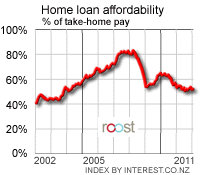
 Home loan affordability deteriorated sharply in October after house prices rose to record levels and fixed mortgage interest rates rose to their highest levels this year, the BNZ Home Loan Affordability measure shows. Affordability is now at its worst levels since November last year and has degraded faster in the last six months than at any time since the peak of the housing boom in early 2007, the monthly measure calculated by Interest.co.nz found. The BNZ Home Loan Affordability measure for all of New Zealand showed the proportion of a single median after tax income needed to service an 80% mortgage on a median house rose by 3.2 percentage point to 61.9%. This was the biggest deterioration in one month since March 2007, which was at the height of the boom that doubled house prices between 2002 and 2007.
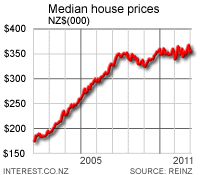 The median house price as measured by REINZ rose 1.4% in October to a record NZ$355,000 from NZ$350,000 in September and has now risen 11% from its January 2009 trough of NZ$325,000. The average 2 year fixed mortgage rate, which has been among the most popular with borrowers in recent years, rose 49 basis points to 7.07% over the month and has now risen from an average 5.92% in February. Variable mortgage rates, meanwhile, have fallen in the last month on average to 6.07% from 6.08%, meaning some borrowers may have chosen to go variable rather than fixed to improve their immediate affordability. Meanwhile, median incomes rose 0.7% in the last month, albeit under pressure from a flat employment market, less overtime and lower bonuses. "The last time New Zealand saw such a rapid deterioration in affordability was in 2007 before the market ran out of steam and started declining through 2008," Interest.co.nz Editor Bernard Hickey said.
 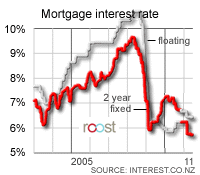 "Mortgage rates are continuing to rise as banks try to recover lost profit margins and they pay for higher deposit rates because of intense competition in the market," Hickey said. "Interest rates are widely expected to rise further next year while unemployment is rising over 6% in the wake of the recession. This combined pressure of higher interest rates and modest income growth will keep a lid on house prices through the summer and into next year, particularly given bank lending growth is well below 5%." Affordability hit its worst level of 83.4% in March 2008 just after house prices peaked and 2 year mortgage rates were close to 10%. Many home buyers jumped in March, April and May of this year to take advantage of lower interest rates and look for bargains, which improved the number of houses sold and boosted prices. But short term mortgage interest rates flattened out in late March and longer term mortgage rates began to rise in line with rises on wholesale markets and higher local term deposit rates.
 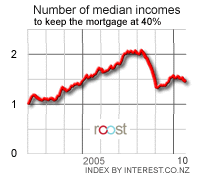 House sales volumes have flattened off in the last two months as first home buyers and rental investors stayed away, leaving most of the activity at the top end for owner-occupiers using equity stored up during the 2002-07 boom. Affordability is increasingly out of reach for most home buyers on a single income. The threshold proportion of after tax income considered prudent to sustainably own a house is around 40%. Anything above that is starting to become unaffordable. Affordability for the typical first-home-buyer also deteriorated in October. The proportion of a single after tax pay needed to buy a first quartile house rose to 52.8% from 50.8% in September. This is the highest level since November 2008. The first quartile house price was flat in October at NZ$250,000 with most of the house price action happening near the top of the market. This measure is for a median income earner aged 25-29 buying a first quartile home. Interest.co.nz thinks the "˜affordable' threshold is 40% for such a home buyer. Meanwhile, affordability for households with more than one income also deteriorated and are now back to levels seen at the end of 2008. This measure of a "˜standard typical household' found the proportion of after tax income needed to service the mortgage on a median house rose to 40.6% in October from 38.5% in September. This measure assumes one median male income, half a median female income aged 30-35 and a 5 year old child that receives Working for Families. This is the worst level of standard household affordability since November last year and significantly above the 35% trough seen in January, February and March when buyer demand returned to the housing market. Any level over 40% is considered unaffordable for a household. Our measure of a "˜standard first-home-buyer household' found the proportion of after tax income needed to service the mortgage on a first quartile home rose to 25% in October from 24% in August. This compares with the trough of 22% in January, February and March when some first-home-buyers returned to the market. This measure peaked at 35% in June 2007. This measure assumes a first home buyer household includes a median male income and a median female income aged 25-29 with no children. Any level over 30% is considered unaffordable in the longer term for such a household. Southland remains the most affordable region for home buyers with a standard affordability measure of 34.4%, while the Central Otago Lakes (Wanaka and Queenstown) is the least affordable on 90.9%. Auckland sits at 74.5%, Wellington at 67.1% and Christchurch at 55.9%. See more regional reports at the bottom of this page here Question and Answers about the report How does interest.co.nz work out these numbers? Interest.co.nz gathers data from Statistics New Zealand and IRD on wages in each region, data from the Real Estate Institute from each region each month, and data from banks and non-banks on interest rates. It has calculated home loan affordability going back to the beginning of 2002. How is this survey different from the Massey University survey of affordability? The Massey study is only done quarterly rather than monthly and uses an index of Home affordability rather than actually measuring home loan affordability. It uses an index rather than the actual measure of the proportion of after tax pay needed to service an 80% mortgage on a median home. The exact composition and meaning of the index is not detailed. Why use a single median income rather than household income? It's true that most homebuyers are using a combination of one or more full or part time incomes to service their mortgage. Each household is different and may be using incomes from different sources. The best measure of average national household income is calculated officially once in every three years by Statistics New Zealand. Interest.co.nz chose to use the median income data series from IRD and Statistics NZ because it can be measured monthly and can be drilled down by region and by age. We do include a chart showing how many median incomes are required to keep mortgage payments at 40% of take home pay. It is currently around 2 median incomes. We've also measured household affordability too for both first home buyers and a couple with a family. You can see that above. Why is home loan affordability important? It is a useful way to work out if a housing market is overvalued. It's clear house prices stopped rising when the national affordability ratio rose above 80% or 2 median incomes to service the average home loan. It's a way of comparing affordability of housing markets with a national average and comparing housing values from one year to the next. For example, the affordability ratio in 2002 before the housing boom really took off was around 41%.
We welcome your comments below. If you are not already registered, please register to comment
Remember we welcome robust, respectful and insightful debate. We don't welcome abusive or defamatory comments and will de-register those repeatedly making such comments. Our current comment policy is here.