
The comment stream

Join the Interest community to be a registered commenter so you can:
- Edit your comments
- Avoid the CAPTCHA
- Vote on comments
Register Here

Already registered? log back in here ..

Forgotten your password? No problem! Click here

Finance sector jobs

Senior Liability Underwriting Manager
Lead from the front utilising your strategic, technical and leadership qualities within th...more
New Zealand
Senior Liability Product Underwriter - Product Management
Lead from the front utilising your technical expertise in this highly attractive senior li...more
New Zealand
High Performing Senior Liability UnderwriterHigh Performing Senior Liability Underwriter
Customer focus, high performance, exceeding client expectations and achieving profitable g...more
New Zealand
Head of Retail Credit -Wellington, NZ
Key leadership position in the bank. Be a part of one of the fastest growing banks in New ...more
New Zealand
efinancialcareers.com

Reader poll

Should you fix your mortgage now or stay floating?

Choices

NZ GDP falls 1% in March quarter; 5th negative quarter in a row (Update 6)

Posted in News

New Zealand's economy contracted for the fifth consecutive quarter in the March quarter as Gross Domestic Product (GDP) fell 1% from December and was down 2.7% from the same quarter a year ago, figures released by Statistics New Zealand (Stats NZ) show. (Update 6 includes comments and Youtube video from Finance Minister Bill English). The data shows the economy mired in a deep recession that may not abate until late 2009 or early 2010. The construction and manufacturing sectors are still contracting (from the March quarter last year) and the only major contributors to growth are coming from government and financial services. The export sector is struggling with a resurgent NZ dollar and the retail sector's contribution is still negative. The figures suggest the Reserve Bank will be able to stick to its promise to keep the Official Cash Rate at or below 2.5% until late next year. The median economist expectation had been for a 0.7% contraction during the quarter and a 2.3% contraction over the year. The quarterly contraction was in line with the Reserve Bank of New Zealand's forecast. "The main contributor to the decline this quarter was manufacturing activity, which fell 7.2%," Government Statistician Geoff Bascand said.
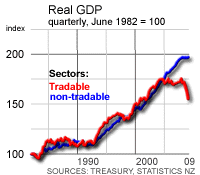
"Nearly all manufacturing sub-industries decreased this quarter, with the food, beverage, and tobacco; machinery and equipment; and metal product sub-industries recording the largest falls," Bascand said. "Construction activity was up 0.4% this quarter, following four quarters of contraction. Non-residential building activity fell, but this was offset by a rise in other construction activity. Other construction includes work on projects that are not buildings, such as roads, bridges, railway track maintenance, and power plants. Partly offsetting the decreases in GDP in the latest quarter was an increase in real estate and business services, which rose 3.2%," he said. The March quarter contraction followed a revised 1% fall in GDP in the December quarter (previously a 0.9% contraction); a revised 0.5% fall in September (from a 0.4% contraction); a 0.2% fall in June, and a 0.3% fall in the March quarter last year. In the full year to March 2009, GDP fell 1% compared to the full year to March 2008. This was the biggest decline in annual activity since the year ended March 1992, when the economy contracted by 1.3%, Bascand said. "For the year ended March 2009, activity in goods-producing industries decreased 5.6%. This is the largest annual decline in the goods-producing industries since the year ended December 1991." The expenditure measure of GDP showed a seasonally adjusted contraction of 2.2% in March from the same quarter a year ago (using 1995/96 prices). Actual figures (95/96 prices) show a 1.7% fall from the March 2008 quarter. Actual private consumption expenditure was down 1.8% to NZ$19.83 billion, its lowest quarterly figure since the June 2006 quarter. Actual general government final consumption expenditure was up 2.7% from March 2008. Following yesterday's Balance of Payment's figures, ANZ National said there was an upside risk to their forecast 1% quarterly contraction in GDP because net exports were stronger than expected. ASB had expected a 0.5% quarterly GDP contraction, with strength in agricultural production and processing masking "the underlying weakness in manufacturing production." BNZ had forecast a 0.7% contraction with upside risks following the net exports figure yesterday, and downside risks following the latest QSBO. Westpac had forecast a 0.9% contraction with upside risks. ASB economist Jane Turner said the key surprise for them was the weakness in manufacturing, "despite the surprisingly resilient Q1 manufacturing survey released earlier this month."

Indicators such as the manufacturing survey suggested the underlying momentum in GDP was weaker than our 0.5% forecast: we had expected some temporary strength in pastoral processing to hold Q1 up at the expense of a deeper contraction in Q2. Those factors didn't appear in the GDP accounts: as a result we will be revising our Q2 GDP forecast up from a 0.9% contraction. The 1% contraction was bang-on the RBNZ's MPS forecast. Nonetheless, today's GDP result lends us to think underlying momentum in GDP is weaker than previously thought, with the recession spreading through more sectors of the economy more aggressively than expected. The risks to the growth and inflation outlook definitely remain skewed to the downside. For the RBNZ this compounds the already-present risks to its own outlook that stem from its assumption the exchange rate will sit at a very low level for the next couple of years. Although green shoots may be appearing in the housing market, they are conspicuously absent in other sectors. At some stage down the track the RBNZ may want to deliver further monetary stimulus "“ or more correctly try and mitigate the lift in the NZD and long-term interest rates. We continue to have 25 basis point rate cuts penciled in for September and October.

Here are comments from JP Morgan economist Helen Kevans:

We forecast that the economy will contract again in the second and third quarters of 2009, before expanding modestly in 4Q. The significant monetary and fiscal policy easing that has been delivered should help New Zealand eventually recover from this prolonged recession, but growth will remain below trend for some time. Indeed, the forecast recovery will be milder than those experienced after previous recessions, where growth averaged 5%. This time, an extended period of weak investment and household deleveraging will delay to return to trend growth. The main risk to the recovery we forecast to commence later this year is the strengthening NZ dollar. RBNZ Government Bollard recently acknowledged that recent NZD appreciation had added to the broader tightening in financial market conditions. For this reason, it has become even more important that fiscal and monetary policy operate effectively. We believe that if monetary conditions continue to tighten, further monetary policy support will be delivered in 2H09. Indeed, the RBNZ has left the door open to further policy easing, and we maintain our call for a terminal cash rate of 2.25%. We acknowledge, though, the significant possibility that the RBNZ's easing cycle may already have ended.

Here's Bill English's take on the GDP figures in Youtube form below and in his statement.

"Budget 2009 has laid the solid foundations for our recovery, but we have plenty of work ahead of us to reverse these structural imbalances, which are clearly worse than we had envisaged. "That will be our focus over the coming year. We will be pressing ahead with our regulatory reforms, with our multi-billion dollar investment in productive infrastructure, and with providing better, smarter public services."

We welcome your help to improve our coverage of this issue. Any examples or experiences to relate? Any links to other news, data or research to shed more light on this? Any insight or views on what might happen next or what should happen next? Any errors to correct?

We welcome your comments below. If you are not already registered, please register to comment in the box on the right or click on the "'Register" link at the bottom of the comments. Remember we welcome robust, respectful and insightful debate. We don't welcome abusive or defamatory comments and will de-register those repeatedly making these comments.

I see in another article

I see in another article (NZPA) that the "experts" were taken by surprise by these figures. Why ? They must be living in a different world to me and most other ordinary folk.

Wait till June quarter comes.

Wait till June quarter comes. Worse than March. And what? some economists were surprised. Their employers should sack them.and do us all favor.

"They must be living in

"They must be living in a different world to me and most other ordinary folk."

Yep, all of them, the whole bloody lot- from all sides.

For the last two years its been a case of; forget the clowns, send in the economists.

i work for an unamed

i work for an unamed city council,and were steamlining due to financial constraints(no building permit revenue,rate shortfalls etc.).So how can these so called experts not see the writing on the wall!:(

“Our policy makers seem to

"Our policy makers seem to be promoting the attitude that this is an international problem, but the focus needs to shift to material local policy changes that will support the competitive position of our exporters."

"International markets are clearly a major problem, but we must focus on the things we can control. We need to encourage investment in the tradeable sector through lower and more broadly based taxation, investment incentives in the real economy and monetary policy measures to control credit volumes. We need to change to the shape of our economy." From:

Real economy continues to slow, 26th June 2009, here:

http://www.mea.org.nz/media/pressreleases.aspx

Anyway, no wurries, she'll be right, seems like David Carter's got a plan:

Wally Says: June 25th, 2009 at 3:08 pm

look at what Carter has had to say about the meat and wool indus: " "With land prices no longer buoyant, the days of low-margin sheep and beef farms getting by on capital gains from land values alone are over, for the time being," Note the four words at the end! Is he suggesting a capital gain culture could return? If so, is it a culture his govt is encouraging? From:

http://www.interest.co.nz/ratesblog/index.php/2009/06/25/nz-current-acco...

Funny old world eh?

We need a shakeup of

We need a shakeup of the whole system... I think someone should go around checking these so called Economist's certifications.. Most of them must be Self Proclaimed, After All !!!

You're on to it Les,

You're on to it Les, they'll be back to "capital gains from land values" just as soon as mate. What else would you expect when the National party rump is rural/city finance based and deeply into the 'capital gains from land values' culture. It's a no brainer. The trick is to realise the stupid behaviour will never change and plan your finances to avoid the worst of the bust periods while profiting from being in the right place before the rump get off their rumps.

Wally - yep. Where did

Wally - yep. Where did he say that. Got a link? Ta, Les.

It was in a Herald

It was in a Herald report Les. It's in that bit you posted above. The information we don't have is just what investments do the power brokers and policy makers have?
If they were all into land speculation activities, then why would they make any effort to restructure this disfunctional nuthouse?

Wally - sure, thanks, if

Wally - sure, thanks, if useful for others too, found it:

Change or lose out, meat industry told

http://www.nzherald.co.nz/business/news/article.cfm?c_id=3&objectid=1058...

but meat industry only industry

but meat industry only industry making money .100 dollar lamb compared to $4 milksolids more sheep less cows is the answer

Yep, lets keep chasing those

Yep, lets keep chasing those rainbows. Sheep are where its at,meet me at the pot of gold, anyone up for an equity partnership,guaranteed loss but you can write it off against your tax so it will be OK.
The meat industry has lurched from one crisis to the next all my life now we need a Fonterra model Genius bl**dy genius.

fonterra model ?

fonterra model ?

excellent piece by Gaynor in

excellent piece by Gaynor in the Herald:

http://www.nzherald.co.nz/business/news/article.cfm?c_id=3&objectid=1058...

He suggests that whilst NZ mightn't have been hit as hard as some countries in this recession, it may struggle more than most to return to boom times. I agree

Well worth a read

Australia is looking a better and better prospect

The apparently spectacular reversal in

The apparently spectacular reversal in the inventory levels of housing available for sale on realenz.co.nz continues. After falling continuously since February, the pace of decline slackened inearly/mid June and then there seems to have been a huge bounce this week. A low seems to have been hit at 42,156 but there has now been a big bounce up to 43,777 today (a jump of nearly 4% in a few days). Three possibilities - the data set is corrupted, there has been a flood of property onto the market or buyers have disappeared. One to watch VERY carefully.
The data is graphed here - interesting to see what happens to that graph on its next update:

http://www.interest.co.nz/charts/gallery12-60.asp

Forget GDP - Have a

Forget GDP - Have a look at our external debt.
GDP may be falling - but it sure hasn't stopped our borrowing.

Balance of Payments and International Investment Position: March 2009 quarter "“ Media Release - ex the NZ Govt Stats web site

Falling imports reduce current account deficit

[The good news machine by a Government Shrill - But dig deeper and read on ]

The seasonally adjusted current account deficit was $2,682 million in the March 2009 quarter, $1,042 million smaller than the December 2008 quarter deficit of $3,724 million, Statistics New Zealand said today. The smaller deficit came mainly from a fall in imports of goods, which was partly offset by a decrease in exports of goods."¨"¨

The seasonally adjusted goods balance surplus of $863 million in the March 2009 quarter was a $967 million turnaround from the December 2008 quarter deficit. Seasonally adjusted goods imports fell by $1,349 million, mainly caused by a decrease in the value of imports of petroleum and petroleum products, transport equipment and passenger motor cars.

Exports of goods fell by $383 million due to lower export prices, which more than offset an increase in the volumes of exported goods. "¨"¨The seasonally adjusted services deficit narrowed by $201 million from the December 2008 quarter to the March 2009 quarter. Exports of travel services increased, while imports of transportation services fell, mainly due to lower expenditure on freight, which is linked to the drop in volumes of imported goods."¨

The investment income deficit of $3,272 million in the March 2009 quarter was $35 million larger than the December 2008 quarter deficit. Foreign investors' earnings in New Zealand fell for the third consecutive quarter, but this was more than offset by a decrease in New Zealand investors' earnings from abroad."¨"¨

The current account deficit for the year ended March 2009 was $15,246 million (8.5 percent of GDP), compared with $16,108 million (9.0 percent of GDP) for the year ended December 2008, and $14,211 million (8.0 percent of GDP) for the year ended March 2008."¨"¨New Zealand's current account deficit was financed by a $2.0 billion net inflow of capital in the March 2009 quarter. This net inflow of capital combined with valuation changes of financial assets and liabilities of $7.2 billion, resulting in a $9.2 billion rise in New Zealand's net international debtor position from 31 December 2008.

Valuation changes arise from changes in exchange rates and market prices of assets and liabilities (eg shares). At 31 March 2009, New Zealand's net international debtor position was $176.6 billion (98.2 percent of GDP), compared with $167.4 billion (93.2 percent of GDP) at 31 December 2008.

Now turn to Page 11 after following the downloads "¦..

International investment position

This commentary discusses the presentation of New Zealand's international assets and liabilities as shown in tables 10 to 13 of this release.

At 31 March 2009, New Zealand's net debtor position was $176.6 billion (98.2 percent of GDP).

This position was made up of $138.2 billion in international assets and $314.8 billion in
international liabilities.

The 31 March 2009 position was 5.5 percent larger than the 31 December
2008 position of $167.4 billion (93.2 percent of GDP), and 14.8 percent larger than the 31 March 2008 net debtor position of $153.9 billion (86.4 percent of GDP).

The March 2009 quarter rise in New Zealand's net international liabilities was due to a $5.9 billion rise in net international debt and a $3.3 billion rise in the net international equity debtor position.

Net international debt has increased $21.4 billion (15.2 percent) from 31 March 2008 to 31 March 2009.

Compared with the 31 March 2008 level, overseas borrowing is up by $29.3 billion, partly offset by a rise in lending to abroad of $7.9 billion.

The banking sector held 78.1 percent of the total net international debt at 31 March 2009, compared with 79.4 percent at 31 March 2008. Net international debt held by the corporate sector was 25.5 percent of the total at 31 March 2009 compared with 27.8 percent a year earlier. The official sector (general government and the Reserve Bank of New Zealand) continues to be in a net overseas lending (asset) position, but this asset position is now falling. At 31 March 2009, official sector net lending abroad was $5.9 billion compared with $10.1 billion at 31 March 2008.

Overseas debt with a time to maturity of one year or less was 42.5 percent of total debt at 31 March 2009.

This compares with 47.3 percent at 31 December 2008, and 54.6 percent at March
2008. The December 2008 to March 2009 fall in debt due within one year is related to the increase in bank sector loans from abroad and the fall in the sector's debt security liabilities to abroad as discussed in the financial account commentary.

Next release ...

Real World Translation: NZ's External Accounts "¦.

"¢ Total Borrowings increased by $ 29 Billion during the 12 months to March 2009

"¢ Gross Debt is now $ 315 Billion "“ 175 % of GDP
Of this 43 % is due for rollover inside 12 months

"¢ Net Debt increased by $ 21 Billion "“ and is now 14.8 % larger than the previous year

"¢ Net Debt increased from 93.2 % of GDP to 98.2 % - and is thus very close to the magical 100 % when the world wakes up

"¢ Gross Debt is now 175 % of GDP !

Commentary:

The above levels of debt are truly alarming "“ which is why no one is prepared to discuss them. [ I suspect most are simply unaware of the situation "“ confusing this with Crown debt at ~ 20 % ]

Due to compound interest on the existing debt and ongoing current account deficits since 1971 this inexorable upwards trend will continue until it is reversed.

Something that cannot continue will come to an end. [ Try running a business on these ratios ]

The correction "“ and it will come, the only issue is when - will be precipitated by an "˜event' as Sir Anthony Eden once intimated.
When asked what precipitated change he replied - Events old boy "“ Events !

These "˜events' are likely to be very unpleasant and take place over a relatively short time frame.

The correction will involve a rapid exchange rate depreciation and high interest rates.
Both Iceland and Hungary have recently been down this route and it is not pleasant.

Quite simply - The winners will be exporters and foreign asset holders.
The losers will be importers and holders of New Zealand denominated assets.

Forget GDP - we can lower these ratios by building prisons and expanding GDP - this is unlikely to offer a solution !

Look at export earnings to external debt

A great post John B

A great post John B ( if the subject matter can be caller 'great'). I only hope that you are writing under a pseudonym, and that your surname actually starts with a K.

Sloop John B - that

Sloop John B - that is very very scary indeed
I am very worried for this country's future

JohnB Thanks for that,gives me

JohnB

Thanks for that,gives me something to think about....

John B Very succinct. Do

John B
Very succinct. Do you have an opinion on when these "events" might occur?