
The comment stream

Join the Interest community to be a registered commenter so you can:
- Edit your comments
- Avoid the CAPTCHA
- Vote on comments
Register Here

Already registered? log back in here ..

Forgotten your password? No problem! Click here

Finance sector jobs

Senior Liability Underwriting Manager
Lead from the front utilising your strategic, technical and leadership qualities within th...more
New Zealand
Senior Liability Product Underwriter - Product Management
Lead from the front utilising your technical expertise in this highly attractive senior li...more
New Zealand
High Performing Senior Liability UnderwriterHigh Performing Senior Liability Underwriter
Customer focus, high performance, exceeding client expectations and achieving profitable g...more
New Zealand
Head of Retail Credit -Wellington, NZ
Key leadership position in the bank. Be a part of one of the fastest growing banks in New ...more
New Zealand
efinancialcareers.com

Reader poll

Should you fix your mortgage now or stay floating?

Choices

Fonterra slashes 2009/10 payout forecast to NZ$4.55/kg; worse than expected (Update 2)

Posted in News

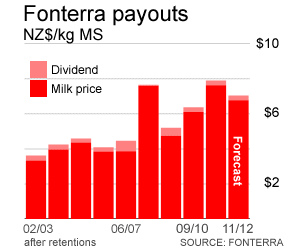
A higher than expected exchange rate and the announcement of US export subsidies for farmers this week have led Fonterra to announce a payout forecast for the 2009/10 dairy season that was well below expectations and could take NZ$1 billion out of the New Zealand economy.

Fonterra announced today its first payout forecast for the 2009/10 dairy season was NZ$4.55 per kg of milk solids.

This was made up of a milk price of NZ$4.10 and a value added component of 45 cents.

Economists were expecting a payout forecast of over NZ$5.00/kg. (Update 2 includes comments from Fonterra's Chairman and CEO in a news teleconference and comments from Federated Farmers)

This forecast was assuming an exchange rate of 59 US cents, Fonterra said.

Fonterra also left its forecast for the current dairy season unchanged at NZ$5.20, including a 45 cent value return component made in the final payout at the end of October.

"We were looking at a forecast over NZ$5 when the Kiwi was at 50 (US) cents but the rebound means we're now working with a dollar that's 10 cents higher," Fonterra Chairman Henry van der Heyden said about the 2009/10 forecast.

"And, just this week, at a time when we've been seeing some tentative signs of recovery in the global dairy market, the US Government has announced export subsidies for their farmers, which is bad news for our farmers," van der Hayden said.
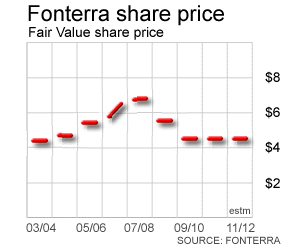
Fonterra also said it had set its fair value share price for 2009/10 at NZ$4.52.

This was down NZ$1.05 from the NZ$5.57 price for 2008/2009, and 5 NZcents below the previous forecast in December.

Van der Heyden said the fall in the share price was understandable given the external factors which have seen a dramatic drop in share values around the world. However, farmers holding excess shares have the option of selling them at this season's price, he said.

"This season farmers holding excess shares (above their current season's production) will be able to sell them at the current season's share price of NZ$5.57. Farmers will then have the opportunity to buy any additional Co-operative shares they need to cover their expected production in the new season at NZ$4.52 at the beginning of the 2009/10 season rather than the end," van der Heden said.

"We had expected dairy prices to be bouncing along the bottom at the moment, but the exchange rate has been a big negative. It has a huge influence on the Milk Price forecast when you go into the new season with a large chunk of your sales unhedged, which is always the case at this time of the year," van der Heyden said.

"Our hedging policy is designed to take out the volatility and provide as much certainty for our farmers as possible.

But as a rule of thumb a 1 cent movement in the exchange rate realised over a year has an impact of about +/- 10 cents per kgMS in the Milk Price, with everything else being equal," he said.

"We'd certainly like to see the exchange rate come down and stay lower. That would benefit our farmers and New Zealand's export returns. Our farmers are already under severe financial pressure and it's also bad news for the country as a whole. A payout at this level would take hundreds of millions of dollars out of the economy."

Earlier this week, most economists said their forecasts for the 2009/10 season were little different from the current one, and that the export subsidy announcement from the US had not affected forecasts.

Westpac said it forecast a final payout of NZ$4.90; ANZ National said slightly above NZ$5.00; BNZ between NZ$5.10 and NZ$5.20; and NZX-Agri-Fax said NZ$5.25.

Later in a news teleconference, Fonterra Chairman Henry Van der Heyden said the NZ$4.55/kg payout was below earlier indications given to farmers several months ago of a NZ$5/kg payout.

The difference between then and now was a move in the currency back over 60 USc from 50 USc. This reduction in the payout would take about NZ$1 billion out of the economy, he said. "This will put our farmers under significant cash-flow pressure," van der Heyden said.

"We've spent a lot of time anguishing over this but at the end of the day we can only return what the market has produced," he said.

Fonterra had decided to bring forward a payment of 20 cents/kg or around NZ$250 million to August from October for the current 2008/09 season to help ease some the cashflow pain.

The advance payment for 2009/10 from June would be NZ$2.90/kg, van der Heyden said.

Fonterra forecast production for 2008/09 rose 7.5% to 1,280 mln kgs.

Fonterra CEO Andrew Ferrier said commodity prices had bottomed out a couple of months ago and now "we're bouncing around the bottom."

"We're still wanting to see a demand recovery and that's keeping the market very uncertain," Ferrier said, adding US moves to reintroduce dairy export subsidies had further destabilised the market.

Ferrier said faster than expected sales of milk powder inventory and the benefit of extra share sales because of higher production meant Fonterra's balance sheet would look slightly better by the end of the financial year on July 31 than expected earlier. Fonterra's debt to debt plus equity ratio would improve to 53.5% by the end of July, "which was a little bit better than we expected a few months ago."

This ratio would below the 50% target within the next 12 months, Ferrier said, down from 61.5% at the end of January. Fonterra did not know how many farmers would take up the option to buy any extra shares needed to back their 2009/10 output early, which would improve the capital position. Van der Heyden said 60% of farmers had excess shares they needed to sell back to Fonterra for the 2008/09 season, while 40% needed to buy shares to back their extra production.

Meanwhile, Federated Farmers said forecast was "the day the recession hit home."

"These numbers are bleak," said Lachlan McKenzie, Federated Farmers dairy chairman. "So if you live in the city and think you're immune from this, think again. It's a hell of a lot of money that isn't coming through the front door of the economy," McKenzie said.

Federated Farmers said it was concerned about Fonterra's "ongoing fixation with its capital structure."

"Senior management and the board have to focus on servicing customers and shareholders to maximise revenue. Farmers cannot afford to have the eye of management and the board off the ball and on a shiny new capital structure that is a low priority for most shareholders."


We welcome your help to improve our coverage of this issue. Any examples or experiences to relate? Any links to other news, data or research to shed more light on this? Any insight or views on what might happen next or what should happen next? Any errors to correct?

We welcome your comments below. If you are not already registered, please register to comment in the box on the right or click on the "'Register" link at the bottom of the comments. Remember we welcome robust, respectful and insightful debate. We don't welcome abusive or defamatory comments and will de-register those repeatedly making these comments.

1 Comments

Well, I was telling my

Well, I was telling my dairy clients to expect $4.50, so I was on the money :) I think a forecast any higher than this level would have been irresponsible by Fonterra, and I don't know what the banks were placing their estimates on.

Mind you, according to those

Mind you, according to those same bank economists, the $NZ 'should' have been trading in a 40 to 50 cent range right now. A long way off this mornings 62 cents.

Again, it would great to have one Austrian school economist posting to this forum. There must be one stuffed away in a dark, deep closet in one of our tertiary institutions somewhere, or more likely, hopefully, our dwindling private sector.

(I used to think Infometrics came from that slant, but their postings all seem to assume the same 'huge' role of the State - as of right - as the Keynesians do.)

I'm free Mark!

I'm free Mark!

Fonterra is a virtual Monopoly.

Fonterra is a virtual Monopoly. This is a very optimist forecast. Export receipts are going down,is our spending dropping? I would have thought a payout with a 3 in front would have been more realistic next year maybe.
Dairy farming is going to Hell in a hand basket.Land prices will fall equity will disappear,make Kawarau look like small change. Maybe Mr Key should be investing if Fonterra,oh I forgot he already offered it to the Chinese.

http://www.ft.com/cms/s/0/f4020c0a-4956-11de-9e19-00144feabdc0.html

Mark, Just wait...the Kiwi's tits

Mark, Just wait...the Kiwi's tits are bulging, it will be strip milked soon....what else of value can be ripped from the Barren Islands (apart from F&P [Fools in Paradise..or is that the name for Kawarau])?

<i>I’m free Mark!</i> Then you

I'm free Mark!

Then you ain't no Austrian :)

What was the fair value

What was the fair value for shares announced?

Oh, answered now: cheers.

What will this do to

What will this do to the value of a dairy farm and LVR ratios - banks will be cruncing a few numbers right now.

At least some banks were

At least some banks were allowing clients to submit budgets at $4.90, so yes, the abacuses will be click clacking.

Well I suspect this payment

Well I suspect this payment is based on a successful bond issue in the spring. Any takers out there? Fonterra has major problems but never mind as Moody's pointed out they can always pay farmers less, so keep there credit rating. Oh and less and less in the future of course.

Here is a hot property for you,don't hang around opportunities like this don't come up every day!
http://www.trademe.co.nz/Trade-Me-Property/Rural-Property/auction-219844...

I expect they will be

I expect they will be crunching a few bank managers in due course!

By the way this farm

By the way this farm carries 900 cows and producers 300,000 kgs milk solids at $4.55.
Got to be a great investment 1.3 million income 1.8 million costs,bank should be able to offload this in a jiffy. Anyone bank with Nat,BNZ,ASB,SCF, they all have them much worse than this this is a good one!

I forgot stupid me, I see they are contract suppliers, no shares so you either by shares at $4.52 x 300,000 or get someone else to buy your milk,who????? This deal is getting better all the time

"(I used to think Infometrics

"(I used to think Infometrics came from that slant, but their postings all seem to assume the same "˜huge' role of the State - as of right - as the Keynesians do.)"

I'm not sure why we would want to be part of either school - Keynesian's ignore trade-offs and Austrians downplay market failures.

On the post - we were surprised with the bank's high forecasts for the milk payout as well. However, a milk price of $4.10 is pretty low - assuming that we don't end up with a full on trade war between the US and the EU in dairy products I think this value will probably increase by the time the season roles around.

Matt your assumption that the

Matt your assumption that the value will probably increase is based on?

Matt, interesting post. Then what

Matt, interesting post. Then what is Infometrics philosophic stance? Vis a vis, in this instance, the role of the State?

Looking at the currency charts

Looking at the currency charts now (its a shame I can't post up screenshots for the readers to see), the USD$ is looking weak against the NZD (as well as the other major crosses).

From a pure technical perspective the bullish count looks like we're on a strong wave up with target above 0.65 completing sometime in July / Aug.

The way I read this, is that unless Bollard (or the budget) can talk down the kiwi and keep it below a weakening USD$ then a strong export led recovery is not looking to hot right now.

"Matt your assumption that the

"Matt your assumption that the value will probably increase is based on?"

Well, a belief that the dollar won't stay over 59c US over the relevant period unless there is a significant appreciation in dairy prices. Also historically Fonterra is conservative with its initial announcements on milk price - as they believe that stating a price that is too high is more dangerous than stating one that is too low.

Put those assumptions together, combined with my earlier assumption that the US-EU spat doesn't worsen, and I reach the conclusion that the payout will rise from this low level.

Note to self - learn how to spell rolls :P

"Matt, interesting post. Then what

"Matt, interesting post. Then what is Infometrics philosophic stance? Vis a vis, in this instance, the role of the State?"

There is a gap between our what we may believe is appropriate, and what we think is pragmatically possible. This is one bias that may push some authors to write in a style that supports a larger state than they actually do.

Furthermore, "Infometrics" is a set of economists - we have a varying range of beliefs regarding the appropriate nature of the state. The main belief that ties us together will be a belief in "methodological individualism" - such that it is the actions of individuals that build society as a whole. Given this non-collectivist frame of reference I would say that none of us are really Keynesian in the strictest sense.

Perhaps the problem is that

Perhaps the problem is that most have been using an abacus whilst wearing rose tinted glasses instead of actually doing some proper true production economics analysis.
If this had been done, the dairy farm systems would be far less intensive and polluting than they are.
From proper analysis, at $4.55 and with "average" (I use the word even though it is a useless description due to the variation in farm production systems) cost of $4+/kgMS,
only about 20% of dairy farmers will be able to pay interest.
The more indebted will need to be sold and quickly -(so no, I will not partake of your opportunity Andrewj at this time) as they will rack up even more debt.
From a Bank point of view it is even worse, as not only does this spell even larger negative cash flows 2009/10 for dairy, the drop in share value has taken more from the balance sheet and if land values go where they should, any dairy farm above 40% debt will soon make their bank poorer when sold.
There will be better farms who will beat this prediction. Which is why "averages" are so inadequate - but that is what the dairy and sheep/beef industries have relied on for so long.
Austrian and Ag prodn economics where have you been??

Matt S, This could help

Matt S,

This could help

http://www.interest.co.nz/charts/gallery4-10.asp

Cheers

Alex

Matt Nolan If the Federal

Matt Nolan

If the Federal Reserve is forced to monetise explosive US Treasury issuance beyond that which they have already undertaken the NZD/USD pair may stay above 0.59 longer than sellers can remain solvent and sane.

Matt Nolan. Cheers for that.

Matt Nolan. Cheers for that.

"If the Federal Reserve is

"If the Federal Reserve is forced to monetise explosive US Treasury issuance beyond that which they have already undertaken the NZD/USD pair may stay above 0.59 longer than sellers can remain solvent and sane."

But then the $US will fall against everyone - and returns from our other markets will remain strong. Furthermore, we would only see the strong drop from monetization if it is expected to cause inflation in the US - which will increase the $US price of dairy as well. As a result - if the dollar movement is solely the result of "money being printed" it will not have a direct bad impact on $NZ returns from dairy.

On the farm I posted

On the farm I posted above you need to spend a million on cows,cost per milk solid over $4.50 before debt servicing ,tax anyone, no I dont think so,drawings, no none of that either(wife needs to get a job).This with shares,cows machinery should set you back just over the $20,000,000.

"Mr McKenzie said Federated Farmers

"Mr McKenzie said Federated Farmers was concerned about Fonterra's "ongoing fixation with its capital structure".

"Senior management and the board have to focus on servicing customers and shareholders to maximise revenue," he said.

"Farmers cannot afford to have the eye of management and the board off the ball and on a shiny new capital structure that is a low priority for most shareholders.""

With the debt mounting daily and the equity vanishing rapidly, Fonterra is right to be fixated with its capital structure.

When you are a monopoly

When you are a monopoly you get to do this,

'The company has also decided to continue its policy of refusing contract milk (third party or oversupplied milk that does not require the supplier to buy shares) into the 2009/2010 season to protect the company's books.'

this should be investigated,they have these suppliers over a barrel , it is not a proper/nice way to behave.

It's a pity that Fonterra

It's a pity that Fonterra is not a listed public company, I would love to have a few Put optins on their shares.

Andy Rodgers You should consult

Andy Rodgers

You should consult a friendly broker/dealer to borrow (Repo) a tranche of this issue and short it.

http://www.nzx.com/markets/NZDX/FCG010

By my reckoning @ the original issue terms of the higher of 7.75% or 6 year swap plus 340bps they should be trading at 8.635% as of last nights close.

I'm surprised at the effect

I'm surprised at the effect of the exchange rate on payout, I thought Fontera would have FX hedging in place to counter the fluctuations. Does this mean farmers should have been hedging themselves (personally I think they should as on the other side of the ledger there are other big ticket imported items such as fertilizer and machinery)?

Fonterra may not have had

Fonterra may not have had enough facility with their banks to take on more hedging.

How would farmers hedge the FX risk themselves? They get paid in NZD - or is there an option to receive the payments in another currency?

Similarly for the imports, the supplier of the machinery would have to agree to being paid in USD for example.

I guess they leave it

I guess they leave it to their Co-op fertiliser companies to do that (hedge).
The reaction of how much this is going to cost NZ seems to lack an understanding that the dairy industry's set of production and management factors interlink and do not rely on any single critical factor. There are opportunities to use resources in another manner and to substitute and adopt different options.
If dairy farmers react logically (i.e. do not let their banks insist on them increasing cows and production) the number of cows will be reduced as (most) supplementary feed is no longer economically viable. This may mean a varying drop in NZ dairy production. It will reduce world supplies (although a small producer in the world scale, it has already been shown that when a close balance for supply/demand applies, small quantities may be important).
This drop in numbers and feed bought will take costs off the import side too (farm and NZ).
Who knows, the reduction in MS may stabilise the world market perception of how much dairy product is available and improve this too. (It is what Co-operatives do??)
Individual farmers may actually make more cash surplus from reducing cows than the drop in payout suggests.
But that still leaves little hope for those with much debt - although selling cows will free up some capital and selling surplus shares at this seasons price will also help.
This reply is by necessity brief. There ARE actually very good analysts around who can provide in-depth advice for farmers and the wider industry. Suffice to say they are probably NOT those who have been in the press over the past few years though.

All sorted, no worries. The

All sorted, no worries. The banks own the farms as we know. They boot out the serfs and import some cheap labour from India where cows are it man. These new cheaper peasants with a thing for cows, mean the banks get to cream it and almost everyone is happy.

Its Ok, Fonterra have the

http://www.agprodecon.org/node/29

This link has appeared before

This link has appeared before on NZ dairy comments

http://www.agprodecon.org/node/29

It shows the rapidly rising debt, and increased marginal costs of production, on many NZ dairy farms in recent years. Conversion capital costs, expensive supplementary feed programs, and sale of low-debt properties to new highly leveraged owners have been major factors in shifting up NZ dairy's average cost of production.

Andrewj Under the verbal commitment

Andrewj

Under the verbal commitment basis I guess Mr English will be able to clear the national slate on Budget day as well.

I wonder if Fonterra's accountants will also join the year-end jubilation or will they be absent just as they were when the interim results were published?

Read more:

http://www.nzherald.co.nz/business/news/article.cfm?c_id=3&objectid=1057...

Fonterra's auditors will be running

Fonterra's auditors will be running for the door.

This piece from the NBR column is just great:
"No specific figures were provided to verify these claims, but the executives say the improvement has come through the rapid clearing of inventories as prices hit their bottom."

If this is the case they can ditch their marketing department and save even more money.

This debate would be better

This debate would be better informed if Fonterra met its obligations and posted the required statutory information on its website. Included would be projected milk solids supply for the 2009-2010 season. In that respect Fonterra still hasn't updated the 2008-2009 supply figures or the payout projection to $5.20.

What we are getting today From Fonterra is significant spin and the bare minimum of facts. A lot questions are left unanswered, and many have not even been asked. If we knew projected milk supply we might gain some idea of the level of redemptions Fonterra is facing. BJR has pointed out that high marginal cost milk production should be being cut. That may be a big story, but we are not being told.

Next is the so called fair value share price. That seems to be perverse at $4.52 given net tangible assets (unaudited) of 77 cents per share. The valuation process seems highly questionable being based on continuing expansion of milk supply through to 2018. It did interestingly reveal that Fonterra now has a WACC of 9.5%.

Then there is the actual payout projection which we have been given along with the informtion that it was based on a NZD:USD rate of 0.59. The $4.55 per kg MS is not supported by the sales Fonterra has already made into next season with the exchange rates at the time. The projection is a best case scenario that will almost certainly deteriorate, but not before production levels have been set and shares purchased. Note that in the current season the projected payout dropped by $1.80 per Kg MS.

A payout exceeding $4.00 is possible, but will require all of: A NZ dollar averaging below 60 cents US; Fonterra to keep costs to 2007 levels and; World dairy commodity prices not dropping below their present levels.

Yeah Wally, got it all

Yeah Wally, got it all sorted. Just the wrong country.
All past news I suppose as the Andrewj news for July 2010 no doubt will be:
"Banks wipe their farm losses off balance sheet through asset sales to China wealth fund."
and of course
"China buys large global milk processing facility to enhance vertical integration of world milk market".

Now that has to be good as PGGW were intending to do this with the NZ sheep market back in 2009 and everyone (?) thought that was a great idea too.
Oh, the cynics who just can't believe that even the truth is not some form of spin......

Matt Nolan said: "But then

Matt Nolan said:

"But then the $US will fall against everyone - and returns from our other markets will remain strong. Furthermore, we would only see the strong drop from monetization if it is expected to cause inflation in the US - which will increase the $US price of dairy as well. As a result - if the dollar movement is solely the result of "money being printed" it will not have a direct bad impact on $NZ returns from dairy."

I was assuming a falling level of employment and financial dislocation would make it increasingly untenable for those few left employed to service a parabolic increase in oustanding US Treasury debt. A consequent credit downgrade or talk of one might deter foreign investor's thus causing the USD to fall and the Fed to assume the status of buyer of last resort.

Inflating dairy product prices under these circumstances might prove difficult to achieve.

peterR said Next is the

peterR said

Next is the so called fair value share price. That seems to be perverse at $4.52 given net tangible assets (unaudited) of 77 cents per share. The valuation process seems highly questionable being based on continuing expansion of milk supply through to 2018. It did interestingly reveal that Fonterra now has a WACC of 9.5%.

PeterR, how would you feel as a contract supplier now having to pay $4.52 for a share with an asset backing of 77cents. Its a case of pay up or we wont pick up. This should not be allowed its a crime!

I mean to say, The

I mean to say, The farm I have posted for sale above is in the situation of having to buy$1.4 million of shares that PeterR thinks have a value of probably. 50 cents so they should be paying more like $150k. They have no choice in this area Fonterra are the only supplier. This share purchase or else is not acceptable behavior from a co-op with a Monopoly! How would other readers feel if they were in this situation?

I am sure the guys

I am sure the guys who bought shares 2 years ago and have now lost over $2 per kgMS are not that happy either?
As noted before, this is not helping their balance sheet at a time when banks are scrutinising the effect of known changes and still not wanting to acknowledge that share devaluation may be the tip of the iceberg. The big bit that some still want to hide is farm debt and the inability of many dairy farms to repay without at least $10 / kg MS payout.
And already pointed out, there is not the capacity for profitable growth on dairy farms now (as MC is almost always > MR) and conversions are no longer viable either.

Budget day tomorrow and if "Under the verbal commitment basis I guess Mr English will be able to clear the national slate on Budget day as well. " (thank-you Stephen Hulme) is true, I am sure continuing growth as per Fonterra and DairyNZ strategy can be swallowed as well.
I'd say you will need to have consumed ample quantities of NZ's finest wines to help disguise what you are actually swallowing though.
Wine industry sales will have to to rocket up? Hey. We need to get some growth somehow, somewhere, sometime.
Surely.........
Now THAT has to be possible - doesn't it?
PeterR? Andrewj? Stephen et al?

Andrewj. The fair value share

Andrewj.

The fair value share price is part of the reason the Fonterra model can't be fixed. As a contract supplier I would be extremely unhappy with a) the share price established, b) the lack of audited financial information available with which to make an assessment of the risks associated with purchasing Fonterra shares and c) the presumptions made, and lack of transparency, in the valuation process.

The total information available to shareholders on the valuation is here:
http://www.fonterra.com/wps/wcm/connect/4d79fd004e3fafd5aafcfa259d88aab5...
http://www.fonterra.com/wps/wcm/connect/eb4e58004e3f954fa991b95d5019cd93...

As a contract supplier I would have to consider ceasing supply as the least risk, and almost certainly the most profitable, medium term option in light of the forecast payout. If for some reason that is not an option then I should take legal advice on any options available to preserve capital.

bjr. There is good growth

bjr.

There is good growth and bad growth, but here are couple of fail safe ones to start with:

I see the current account deficit continuing to grow until serious numbers of borrowers start defaulting on their debts, and growth in government debt for the term of this government and the next.

The Fonterra shareholders have a

The Fonterra shareholders have a share in the company,if they loose money then that is their problem they have the representatives and the power to make changes. The contract suppliers are not share holders, they are farmers who supply milk daily and get less per kg than share holders. How they then get completely screwed by the shareholders who are forcing then to provide capital to the Co-op at price obviously well above market value, threaten them with not picking up their milk unless they go to the bank and borrow in many cases millions. The banks know the shares are overvalued and refuse to lend against them. This is almost corrupt and is to me unacceptable behavior from a company that was set up by govt legislation to avoid commerce commission rejection because both the Monopoly structure and the over charging on the local market where unacceptable.

http://www.interest.co.nz/ratesblog/index.php/2009/05/24/have-yo

http://www.interest.co.nz/ratesblog/index.php/2009/05/24/have-your-say-u...

How ask how pertinent the my last two posts of two days ago at the above thread now look with events unfolding with Fontera and a Chinese company moving in on Fisher & Paykel under debt stress.

And less than 12 months

And less than 12 months ago Fonterra was being hailed as the perfect model for the meat industry to follow.
It is positively frightening that our industry reps were out there pushing for sheep and beef meat producers to follow the model. Love to see a list of names published, and what they have to say now.

From the national bank http://www.nationalbank.co.nz/rural/infor

From the national bank
http://www.nationalbank.co.nz/rural/information/ruralreport/200903/repor...

The dairy sector does not split the payment of milk into a payment for milk and a bonus per se. Fonterra is on its fourth variation of trying to get to a milk price and a value-add return but the transparency of the calculations is lacking. The other companies declare an all-encompassing milk price.

Fonterra has a lower equity percentage than the other two dairy co-operatives, increasingly so in the past four years. The percentage equity for Westland and Tatua is sound but Fonterra at 29 percent is below an accepted minimum corporate manufacturing business norm of around 40 percent.

Fonterra's year end 2008 figure does include a net $600m withdrawal of equity by share redemptions.

While that may have met favour with the shareholders involved, was it a good business decision?
The simplistic measure suggests that the redemption risk for Fonterra is very high;

perhaps this is why they are unwilling to lend farmers money to buy shares

Got to buy more land.

Got to buy more land. Got to milk more cows. Got to buy a bigger tractor. Got to put up a new cowshed bigger than the neighbors of course, Got to put in big feed pads, Got to finance the boys into farms of their own, Got to go to more Fonterra meetings and sit there like a mummy listening to how big is best and lets give the head honchos more money because they are so clever and we are world leaders. $4,000,000 for head honcho no1 has to be cheap on the world scale, doesnt it? Look at me, I am clever. I can puff my chest out at the saleyards as being a BIG landowner. Mines bigger than yours! Seen all this crap for 50+ years. Farmers, start learning Mandarin now!!!!

When one considers that a

When one considers that a large chuck of Fonterra was once the "Dairy Board".. which was owned by ALL New Zealand and all farmers.... then the current Fonterra looks like it has lost its' way.....

I was amazed to read the above comments.... That Contract Milk suppliers are being Blackmailed.
That Fonterra is not at all transperent.
That Fonterra is behaving like a monolithic Monopoly.
That there is nothing magical about their growth... it is all debt based with aquisitions.

The Dairy board of old.... as well as being the global marketing and quality control for the dairy industry ... also smoothed the peaks and valleys of payout to farmers.???

Todays Fonterra is Amplifying the cyclical nature of the dairy industry.... They have been really negligent ... Considering the cyclical nature of Farming even a 50% gearing might be too much. ...???

Do they really operate in the best interests of the farmers.....???? of NZ..???

F&amp;P http://www.stuff.co.nz/business/2448937/F-P-Finance-on-b

F&P

http://www.stuff.co.nz/business/2448937/F-P-Finance-on-block

F&P Appliances said that earlier in the year it had engaged an international search consultant to identify potential new directors. "As a consequence of this engagement, several board candidates have been identified as potential replacement directors," the company said.

China's Haier Group has been offered two board seats in return for its up to $82 million investment and 20 percent cornerstone shareholding.

If China gets a shareholding in F&P its a bit sad and let face it , its going to be F&P in name only.
If China get a corner stone share holding in Fonterra they will be in virtual control of a monopoly. Its a frightening thought and yet one The National party appears to be supportive of. Debt is a frightening thing but even more so if it happens to be the weapon used against us.

William, how do you feel about the contract suppliers being forced to re-capitalise Fonterra?

Why China is coming to a town near you,
http://seekingalpha.com/article/139505-china-is-now-in-firm-control-of-u...

The ultimate rebuttal to the nonsense of the propagandists is to simply note what is happening in markets. Since the U.S. bond-bubble hit its peak late last year, U.S. Treasuries have already plunged a sickening 30% (see "U.S. Bond Bubble Bursts "“ bye-bye Equities Rally").

Meanwhile, the U.S. dollar just hit its lowest level of the year. A look at this horrific chart suggests that the plunge of the dollar is much closer to the beginning than the end.

It is not China which is "trapped". It is the U.S. government. Trapped by years of lies and statistical "padding" of its declining economy. Trapped by years of grossly over-spending. Trapped by the self-destructive machinations of the U.S. financial crime syndicate, which runs the U.S. government in all but name.

When China runs out of things to buy with its U.S. Treasuries, it will stop accumulating them "“ period! Instead, it will channel its huge budget surpluses into infrastructure development and other internal uses: for a huge economy which is still in the infancy of its development.

This is the story which the Financial Times should have written.

Andrewj.... Well said.... Bernard could

Andrewj.... Well said.... Bernard could not have written that any better....

A career in financial journalism looms.... :)

Sobering stuff

This out of the USADA

This out of the USADA regarding European stockpiles,

Milk production continues to increase seasonally throughout most European countries. Reports are mixed as to how output compares to last year. In Germany, output is running stronger than last season and is past peak levels. In France, output is also at or slightly past peak levels, but trails last year at this time. Last year, France experienced a very strong start to the season which did not occur this year. In Ireland, rainfall has been very prevalent in the country which is causing pastures to be soaked, thus not good for grazing and subsequently milk output.
Europeans are voicing various comments following the DEIP announcement out of the U.S. last week. Basically, comments indicate that this adds another dynamic to an already challenged international market. During the most recent Management Committee meeting last week and before the DEIP announcement, all export subsidy levels were unchanged. The Committee issues export refunds under the tendering system for 2,892 MT of butter, 485 MT of butteroil, and 9,650 MT of skim milk powder.

Intervention stock levels continue to grow and now stand at 77,360 MT of butter and 161,233 MT of skim milk powder. Both of these levels are well above the maximum levels (30,000 MT of butter and 109,000 MT of skim milk powder) that were allowable and received fully restitution. Subsequent offerings into intervention are being accepted but at reduced restitution levels. PSA totals for butter are over 83,000 MT.
Milk production in Eastern Europe continues to build seasonally and often lags Western counterparts by 4 - 6 weeks. Milk producers and handlers indicate that the season is developing quite well and currently project that the positive season will continue. At this point, traders and handlers are not reporting significant sales activity, but indicate that stocks are building and available for potential buyer interest

Europe has 20x our milk production, early in the season stockpiles of product are huge and growing fast. This dynamic is going to destroy the market, Fonterra must have been aware of this when they set the Milk price so optimistically high, looks to me like a 3 in front of the payout would be a good result!

The size of Europe's stockpile so early in the season should be setting of warning bells in Wellington.

Also the Kiwi is now

Also the Kiwi is now buying over 64c US,this must be turning into a worse case scenario in one hell of a hurry.

This article in the LA

This article in the LA Times:

http://www.latimes.com/business/la-fi-milk-crisis29-2009may29,0,6551352....

Dairy farmers in desperate straits

Falling prices are forcing many to sell their cows for meat. Some are threatening to dump milk into sewers. Two have committed suicide. In California, the No. 1 dairy state, the pain is felt keenly.

Thx, Paulg. I'm not in

Thx, Paulg. I'm not in dairy so I hadn't fully appreciated what you, and Fonterra, are up against in the export markets

"So far, the main (US) government action has been to buy up 238 million pounds of nonfat dry milk powder and 4.6 million pounds of butter since prices started to fall in October. Last week, the USDA said it would provide subsidies to export up to an additional 150 million pounds of nonfat dry milk, 46 million pounds of butterfat and 6 million pounds of cheese to help dry up the (US) surplus"

These are some of the

These are some of the comments emanating out of the US dairy industry.

As you can see, we have dealt with volatility for a
couple of decades, but the recent "peaks" and "valleys"
have gotten dramatically worse.
Also included in the report is this sobering chart to the
left showing what the Cornell University model
forecasts will happen to the U.S. all-milk price over the
next five years if we do nothing.
Baseline Projection is we do nothing
Cornell University's Program on Dairy Markets and Policy
May 2009

What does all this mean? This year is shaping up to be the worst year ever experienced by those currently in the
dairy business. There's no way to sugarcoat it "“ this year , dairy farmers will collective take billions of dollars in
equity built up over the decades they've been in business, and convert it into bank loans.
There will be some producers that decide to get out of the industry "“ either by choice or by force. And while that
is extremely unfortunate, the real question I'm asking today is aimed at those who are staying in: With the
massive boom/bust cycles that have become common in this industry, how do you plan to build your equity
back up? And with the banks feeling the pain in this wreck, are they going to be there for you the next time to
get you through that wreck?
Sure, there will be profitable times once we come out of this wreck, and Cornell's model predicts that as well.
But are the good times going to be long enough to make up for the massive hemorrhaging of equity that is
currently taking place? Are your pockets really deep enough to not only survive this wreck, but survive the next
one as well?

USDA's
announcement last week that the Dairy Export Incentive Program (DEIP) has been activated for the year ending
June 30th, at the time when little international demand is evident, only adds to the confusion.

It doesn't take a complex formula to understand why we have this volatility. Our industry is hard-wired to
overproduce. Not only do U.S. producers have some of the best genetics, the best technology, and the most
efficient operations in the world, but we've also got every incentive to maximize those resources and produce as
much milk as we can, particularly when dairy farming has any level of profitability. Simply put, individual
dairies in our industry have every ability "“ and every incentive "“ to exceed market demand for dairy
products, quickly turning any possible supply/demand balance (and profitable price) into a surplus (with a
plummeting price).
It doesn't have to be like this.

The U.S. dairy industry is a highly regulated industry,
and anyone who says something like "the markets will
fix this problem" are not living in reality. Some people
will tell you that this is the "market" getting rid of the
"less efficient dairymen." They will argue that the
industry is stronger coming out of these wrecks. To put
it bluntly, that logic is just plain wrong. The wreck we are currently going through has almost nothing to do with
"efficiency" on the farm. After going through the volatility we've seen in the past couple decades, the
"inefficient" dairymen are long gone. This wreck is about who can bleed equity the longest? Who has the massive amounts of family money behind him? And for those that don't, tough luck

I dont see sign here of Fonterra being able to met their projected payout.

Dairy producers are the same

Dairy producers are the same everywhere. NZ is no different except we are further into denial - this logic is prohibited thinking:

It doesn't take a complex formula to understand why we have this volatility. Our industry is hard-wired to overproduce. Not only do U.S. producers have some of the best genetics, the best technology, and the most efficient operations in the world, but we've also got every incentive to maximize those resources and produce as much milk as we can, particularly when dairy farming has any level of profitability. Simply put, individual dairies in our industry have every ability "“ and every incentive "“ to exceed market demand for dairy products, quickly turning any possible supply/demand balance (and profitable price) into a surplus (with a plummeting price).

Another point is that we do this with government research supporting over production and have banks happy to provide borrowed money.

Then claim to tourists that we are clean and green.

PeterR This year Fonterra was

PeterR
This year Fonterra was unable to move large amounts of milk powder,this resulted with a little help from the PM in a large sale to china(160,000 tonnes) at a discount price.
What about the coming season ,what has changed in the world to make us think they can successfully market this seasons products. All I can see is, this next season we have the EU subsidising exports as well as the USA Subsidising exports. This should have sounded alarm bells, the coming season is going to be a bloody nightmare for Fonterra.
A nightmare season for fonterra with 30% of the countries exports, on top of massive damage to much of this countries meat industry from drought (resulting in massive liquidation of capital stock throughout the East coast) and the need to rebuild herds, is going to blow out the trade deficit into kingdom come.
This will in turn impact on interest rates and our credit rating. Which will flow on to reduced Govt income and large Govt deficits. In time it has to kill our ability to provide entitlements and keep our wages at inflation levels. This is what could kill housing values. With a collapse in Farm values and house values our banks will start to look anemic, atrophy and eventual death will follow. so perhaps one should ask what the hell are they doing, continuing to lend vast amounts of money to the Ag sector

andrewj, assuming you are right,

andrewj,
assuming you are right, maybe they have chosen the "doubling down" gambling strategy.

Choices may well be to crystalize some losses now.

Or "double down", by upping the amount at stake, and hoping they can recoup most, if not all, the dosh that is at stake. If so, what information are they basing their decision on? Is it a likely scenario?

What should they be doing if they were rational? What does their behaviour suggest about their state of mind?

I'm following your posts on Fonterra with some interest. I have no idea if they are being rational or not.

which makes sense of this...

This all reminds me of

This all reminds me of the deer boom, goat boom, forestry boom, ostrich boom......,
The deer boom held for a while because their rate of replication is quite slow. Goats at 2 a year, up to 4, was over quick. Forestry was tax driven I think so relied on government policy. Ostriches were hilarious, $80,000 for a pair, that could deliver you 30 or more offspring in a season, well any fool could see the breeding stock value would keel over quickly there. This dairy thing had me fooled for a bit though. I fell for the feed the world, the world is starving, the population is growing, asia is rich.
Now I havent travelled much, but I happened to pick up a book of photos, satellite photos, before and after shots. I quickly realised we are just a pimple when it comes to farming, in 30 years the world has gotten hold of this farming thing, and they are as good as us. Marrying that with the old saying, milk production is 90% feeding and 10% breeding I realised if you pay someone enough, they will ramp up their feed supply, and those cows will pump out heaps more white gold. It only takes a couple of days of better nutrition to increase milk production.
I wasnt sure, but I was suspicious this $7.90 payout was going to create production problems of magnitude. And it did. Very quickly. Just as quickly as supply boomed, price dropped.
So, now we have an artificial suspension of price in the market. Subsidies. Back on the rollercoaster.
AndrewJ you asked what I thought of those farmers who dont have shares. What will happen. Damned if they do, damned if they dont. Some very hard numbers to crunch. Bankers tearing their hair out.
I dont know, they really do have to buy. If the bankers dont back them, they are cutting the tits of their cash cow.
Well maybe this will happen, it occurred in the mid to late 80s. Banks forgave loans.
They wrote money off. They had to keep farmers farming. Those farmers that crumbled under pressure, were sold up. Those that dug in eventually were "mortgaged down", not sure if that is they way to put it.
Realistically if the payout stays under $5.00, many of these large conversions will not perform. They built and conceived on buying in a large amount of feed, and at these prices it is not sustainable.
Those that are on contract supply and in a poor financial position, could be getting bad news shortly.
My Agribusiness manager doesnt say a hell of a lot, but he is a pretty grim dude when mentioning anything related to dairy. He acknowleded some months ago it was not a very nice occupation to be in these days, very distressed people, distressing decisions to make, advice to give.
I would say, and I have said this before, I think some of the first to keel over will be the equity partnerships. But lastly, $5.20 is not a bad payout. Many dairy farmers will do quite nicely at that. Its those that believed the hype and borrowed because of it who are in for a haircut.

That looks VERY grim. As

That looks VERY grim.

As the US and the EU withdraws from the purchase of the oversupply into their intervention inventories, the price of dairy will free fall. Cows will be killed, over supply of beef a result, and a colapse in meat prices. Grain prices will fall with no support from feedlot or dairy farmers.

I don't know why the Gov't and banks contine to fund this and fluff around the edges, they have been watching this come from a mile away, but continue to let the situation get worse....

The unfortnate result is that once this production bubble has worked through the system, there will be an over correction and we will end up in a global feed deficit situation in a decade or so. Poor peolpe will starve as the ag production cycle starts to crank up again.

NZFSU has got to be ill, as does PGW. Silverfern Farms is under massive pressure, and from what I hear on the factory floor, machinery is not being maintained or replaced, and just run to the death.

desperate doesn't even begin to describe it..........

I agree wholeheartedly Andrew with

I agree wholeheartedly Andrew with your posting on where our deficits are headed right now. It always amazes me how slow the economics experts are at picking up on how drought affects all of New Zealanders.
Just maybe New Zealand incorporated might start understanding in the next few years how crucial the nz farmer is to everybodies standard of living here in godzone.

PGGWrightson. Why would you want

PGGWrightson. Why would you want one sooooooo indebted company to ride to the rescue of Silver Fern Farms, another soooooooooooooo over indebted company. But that is history now, it all fell over, and PGGW became more indebted.
SFF just lost a major livestock supplier from central north island last month.
Any one got some good news about farming????????

The pigs are getting a

The pigs are getting a break, I hear.....

Do lambs put on more

Do lambs put on more meat, at a faster pace, if you feed them milk powder?

Andrewj, this piece from your

Andrewj,
this piece from your California Milk Producers:
"The U.S. dairy industry is a highly regulated industry,
and anyone who says something like "the markets will
fix this problem" are not living in reality." brought back the sense of futility felt over 2 years ago when a small group tried to present their concerns to Treasury about the future of the dairy industry. It was obvious then that much of the "model" was flawed and would be detrimental to dairy farmers, the environment and (because of the importance of the dairy industry) to the future of NZ.
We received a reasonable hearing until a more senior manager pretty much quashed our arguments and research by using the same "market" line. We felt at the time that most within the dairy industry had become "dislocated from reality" (a phrase now much used between the group) but were astounded at the same attitude at this level.
Despite repeated approaches to others in the industry (and even politicians) we have been forced to watch the "train wreck" (Andrewj ... again) unfold.
There are ways that some can be spared the worst effects of current problems, but unfortunately there is no evidence that anyone is yet prepared to listen. Just as in 2007.
Very FRUSTRATING when lives and not just money will now be at risk.
How will the problem likely be fixed? By employing the same people who caused the mess to provide wise counsel would seem the most likely answer......

Gentlemen: Not that I do

Gentlemen:

Not that I do not agree with the facts presented and maintain a similar outlook in respect of the NZ dairy industry, but it is apparent that inflationary forces beyond the borders of Europe and the US are leading to a sharp revival in fortunes in other markets. They may prove to be an unexpected saviour of ours.

Matters are moving fast and the dynamics of the post WW11 years no longer apply.

This extract from an article article published by Doug Noland at Prudentbear is illuminating.

http://www.prudentbear.com/index.php/creditbubblebulletinview?art_id=10234

The Core to Periphery Dynamic:
This week provided ample confirmation for the global reflation thesis. The dollar index dropped another 0.9%. Gold surged $22 to $979. Crude oil jumped $4.67 to a six-month high, posting the largest one-month percentage gain since 1999 (according to Bloomberg). The Goldman Sachs Commodities index rallied 5.5% to an almost 7-month high (up 27% y-t-d). Emerging markets remain on fire. And the Baltic Dry Index rose gain today, increasing its streak of consecutive gains to 19.

Leading the "bric" sweepstakes, Russian RTS equities index jumped 7.3% this week, while India's Sensex rose 5.3%. Russian stocks are now up 72% y-t-d, followed by India's 52%, China's 45%, and Brazil's 42%. Elsewhere, stocks in Taiwan are up 50%, South Korea 24%, Argentina 47%, and Hungary 22%. The "commodity" currencies led the charge again this week. The South African rand gained 4.1%,the New Zealand dollar rising 3.3%, the Brazilian real 3.0%, the Australian dollar 2.4%, and the Canadian dollar 2.7%.

It was quite a week in U.S. interest rate markets. Ten-year Treasury yields jumped 29 basis points during the shortened week's first two trading sessions (to 3.74%), before backing off to end the week up only 2 bps to 3.47%. The mortgage marketplace turned rather tumultuous, with benchmark Fannie MBS yields spiking 55 bps from last Friday's close before ending the week 19 bps higher at 4.33%. Some interest-rate hedging markets seemed in disarray, with the dollar swaps market demonstrating price discontinuity. After closing last week at 14.4 bps, the 10-year dollar swap spread traded as high as 38.25 before ending the week at 19.50.

Importantly, at least for the week, mortgage-related market tumult didn't broaden to other risk markets. Corporate Credit spreads were mostly narrower on the week, even as the company debt issuance boom ran unabated. The junk bond market enjoyed another week of strong fund inflows more than matched by huge issuance. It is also worth noting the resilience of the "emerging" debt markets. Brazilian benchmark dollar bond yields were down 14 bps to 5.86%. Mexican dollar bond yields fell 14 bps to 5.74%. Brazil's Credit default swap (CDS) prices declined to the lowest level since early October (197 bps, down from the October high of 600 bps). It is no longer the case that when the Treasury market catches a cold others get really sick.

At this point, the markets' sanguine attitude toward dollar and Treasury/MBS weakness is understandable. From a global perspective, a weaker dollar bolsters the inflationary bias that had prior to the Credit meltdown been driving robust economic performance throughout the energy and commodities-based economies. Dollar devaluation also works to reinforce already heady financial flows to "emerging" markets and non-dollar assets more generally. There are facets of inflation that seductively salve recovery.

The dramatic loosening of financial conditions globally is supporting an improvement in economic conditions. The optimists are looking for Asia and the developing world to lead a global recovery, and a sinking dollar on a short-term basis would seem to support such a scenario. Our weak currency also empowers the Global Government Finance Bubble. Amazingly, most countries today have unprecedented flexibility to issue debt without fear of negative market reaction or a run against their currencies.

I again want to emphasize the dramatic change in circumstances that is increasingly in view throughout global markets and economies. During the nineties "“ and stretching through the "King Dollar" period earlier this decade "“ there was an overarching inflationary bias that worked to direct flows to the "Core" (the U.S. Credit system and securities markets). Whether it was a crisis that initially erupted in Mexico, SE Asia, Russia, Argentine or Brazil, the immediate market response was an abrupt reversal of financial flows from the developing countries to U.S. dollar securities. While there was an ongoing acceleration in speculative flows meandering about the globe in search of big returns, the first sign of trouble would incite a panic immediately to the dollar.

The "Core" absolutely dominated the system, providing our policymakers (especially the Fed) extraordinary latitude. The Periphery to Core bias fostered financial crises, along with general Periphery financial and economic instability. This dynamic worked to keep global inflationary pressures in check. Or, better said, the nature of the inflationary flow of finance kept inflation pressures directed to U.S. dollar securities markets - as opposed to energy, commodities and more traditional inflation.

The global financial and economic backdrop has changed profoundly. Today, there exists a powerful inflationary bias working to direct flows away from the Core out to the Periphery. This dynamic helps to explain the dramatic change in the cost and availability of finance for the developed world over the past several years "“ the virtually unlimited cheap finance that funded historic booms in China and Asia.

Granted, this flow was abruptly interrupted by last year's global Credit crisis. It is, however, my view that the dynamic of powerful Core to Periphery flows has resumed. Moreover, it is the nature of this type of dynamic that if such a trend recovers it will likely resume stronger-than-ever (think tech stock post-LTCM reflation or mortgages post-tech Bubble reflation). This analysis is supported by the Periphery's recent dramatic economic and market outperformance relative to the Core.

So, is this bullish or bearish? Well, I believe The Core to Periphery Dynamic is supportive of a more rapid than expected global economic recovery. I definitely expect global inflation to surprise on the upside. Adherents to the global deflationary spiral thesis may be left wondering what the heck happened. The backdrop seems to be set for surprising revival in energy and commodities markets. And I would not be surprised if the global equities rally has some legs.

Yet I view The Core to Periphery Dynamic as profoundly bearish for the U.S. At its core, this historic redirection of global flows and inflationary pressures is the consequence of a breakdown in the dollar standard. Failed policies, a resulting deeply impaired economic structure, and massive ongoing devaluation have ended the dollar's reign as the globe's premier reserve currency and perceived stable store of value. There is today no sound currency to replace the dollar, so the global financial system operates rudderless and with great uncertainties.

It is more certain, however, that the great benefits commanded to our economy and markets over the decades from governing the world's reserve currency are drawing to an end. Our policymakers still believe they can inflate Credit and manipulate interest rates -and not have to pay a price for it. But the new global reality may be that currency markets protest massive U.S. fiscal deficits and activist monetary policy, while global markets come to dictate U.S. market yields. Over the past two weeks we have seen the dollar and U.S. Treasuries/MBS come under significant pressure. Is this the beginning of global markets disciplining Washington?

A robust Core to Periphery Dynamic and the re-emergence of dollar vulnerability are a potent combination. U.S. markets to this point remain sanguine with the prospect of an expanding Federal Reserve balance sheet rectifying any spike in interest rates. But currency markets are no doubt increasingly fixated on our propensity to monetize our massive debt. At some point, increasingly unwieldy flows out of our currency may force the Fed's hand. The scenario where the Fed is forced to choose between loose monetary policy and currency crisis could be a potential big negative surprise for U.S. markets.

Gibber. Excellent questions regards Fonterra

Gibber.

Excellent questions regards Fonterra who are definitely gambling, and almost certainly from a very poor financial position. That possibly means that from their perspective what now appears rational wouldn't in more normal circumstances. That may extend to ethical standards as well.

Fonterra has excessive debt from years of following an ill advised growth strategy. World demand for dairy products is contracting. Commodity prices are falling. Many dairy farmers are already under extreme financial pressure. A reduction in NZ milk production would reduce farm costs, in most cases improve farm profitability, reduce world dairy stockpiles and support dairy prices - it would be rational.

Rational except that Fonterra urgently requires capital. Not that capital will fix anything "“ just allow it to survive a little longer. Share redemption risk looms large, but new dairy production and shareholding are needed to provide capital. Fonterra are "doubling down" as you describe it. Hoping "“ irrationally "“ that something like the 2007 commodity bubble might save them.

So, to the information Fonterra is working from. Their projected payout is not supported by prevailing commodity prices. Those average USD 2,050 so far this year and look set to settle lower still at least in NZD terms. But Fonterra is projecting based on USD 2,750 and a 0.59 NZD:USD. Fonterra's interim accounts are missing a supporting accountant's report and previous information on accounting standards regards valuation of assets. Fonterra's share valuation is perverse. They have not made available the required statutory information on projected milk production volumes. Questions are not being answered.

What does their behaviour suggest about their state of mind?

Is desperation driving stupid, unethical or fraudulent activity or are we simply witnessing the arrogance of a distressed monopoly?

Stephen Which camp are we

Stephen
Which camp are we in. I would have thought more the indebted western model. My view would be more the, Clarke/Cullen/Bollard put a V8 in the corolla and put the foot to the floor. They took a gun out and blew the economies brains out.
The model we have used to run our productive sector be it forestry,fishing meat,wool,dairy has failed because our thinking was flawed. The arguments on this site about housing,interest rates,budgets are insignificant compared to the important issues raised in this thread. Our productive sector has been suffocated by regulation,taxes and other costs to the stage of failure. Add to that massive debts like Fonterras 14 billion of liabilities the nearly 50 billion of farm debt and its an explosive mix. The future of this country is going to be smaller.The Labour Govt increased spending by 14 billion and so far National have pared back 300 million, then spent 3 billion in the budget.
The economy is going to be in trouble because of the inability of our productive sector to continue to survive in this economy, the future may be less production a lot less. Lower inflation adjusted wages are coming our way,the days of rural councils paying employees over 200k have ended the future is going to be smaller,like the 1200cc standard corolla.
If we had better leadership and lower debts then yes we would be in a situation to take advantage of a world where the USA has a smaller role but as its economy is 6x that of China's Im doubtful and think the scenario in your post may be short lived.

Andrewj We certainly are in

Andrewj

We certainly are in the 'Core' camp. And yet if we were nimble we could leverage the collapse of the USD to our advantage.

The BRIC economies may be small in ecomonic terms when compared to the US but so is their level of indebtness.

They can only benefit (leverage) from an outflow of capital from the US and could well provide us with a market to sell our goods if we can quickly bankrupt our indebted operators and reorganise the existing infrastructure.

Equally a revaluation of our national worth (higher NZD versus only the US ) provides an opportunity to raise the capital to conduct such a re-organisation.

But we must come up with a tenable plan to achieve this quickly.

PeterR and Stephen What are

1) I hope the economy

1) I hope the economy academics working in the upper-floors with figures/ charts speculating what's going to happen next, start moving downstairs to the ground- level weak up and experience the real world for a while.

I think relatively small economies will be dictated/ ruled by worldwide power politics.
Upcoming major changes in world politics are not excluded.
http://en.wikipedia.org/wiki/Authoritarianism#Authoritarianism_and_democ...

Andrewj The solution to fixing

Andrewj

The solution to fixing the mess is contained within the articles you reference. Falling bond (Debt) valuations equate with declining asset prices.

Nevertheless, corrective governance structures need to be put in place immediately to halt renewed efforts by bankers to resurrect the compound interest treadmill and the contingent asset revaluation model guaranteeing productive assets evolve into loss making enterprises.

Never lose sight of the fact that halving the interest rate of perpetual debt doubles the value of that debt. Successful business requires the opposite.

Andrewj - "Our productive sector

Andrewj - "Our productive sector has been suffocated by regulation, taxes and other costs to the stage of failure."

Can you tell us specifically what regulation, taxes and other cost have impacted you in your sector?

What's the shelf life of

What's the shelf life of the Fonterra milk powder stockpile and how will Fonterra be looking if the dollar gets to and stays aound 70 cents for the next 9 to 12 months?

Les Before I sold my

Les
Before I sold my 1000 acre farm I had rates of $36,000.(+13,000 regional council rates)On top of this I had to provide details on such things as water use from my bores etc which I was charged the pleasure for. I had animal health board costs for possum control of $14,000. Every time a truck left my farm mileage tax was paid at nearly $1 a km(+existing taxes at pump). I had an accountants bill that often was as high as $10,000. My Fertiliser bill was around the $60,000 mark how much of this was costs that had a component of a Govt charge I would hate to think. My employees all had employment contracts,double time on Sundays 4 weeks holiday, I had to be careful as farmers in the area had been to the employment court and being fined over $20,000.
I think that the high cost of govt has filtered through to all parts of our cost structure. They must how else and the Govt continue to Rob Peter to Pay Paul. Even such piffle's like diesel tax on farm utes became a big cost. Putting down a new bore was horrendously expensive due to the cost of meeting regulation some of which admittedly was justified due to abuse by the dairy industry. Registration was getting to $380 for a diesel Ute, I paid over $20,000 a year in ACC. My insurance was around $10,000.
Everyone who came onto my farm,well drillers,plumbers,electricians,livestock carriers,stock agents must also have been suffering a similar assault by the state included in their costs. Its Sunday Night and Ive had a drink otherwise Im sure my brain would be smarter and I could remember more.
I had a visit from OSH, nothing happened just a friendly visit to remind me to spend a fortune on my cattle yards and tractors making them safer when any Idiot should know to keep his hand away from a rapidly spinning object and earmuffs had to be worn and so on and on.
Rates are a real killer on farms now I think in the future organised rate revolt will be a reality.

Wow Im living like 100

Wow
Im living like 100 feet above sea level in Hawkes bay and we have 2 inches of snow on the ground. Looks like the USA, we are white. My children have just made a 4 ft snowman in the garden.

ACC claiming 1 million for

ACC claiming 1 million for a Mob member who was shot in the car park of AFFCO,because it was work related is just one example of costs imposed off farm, that farmers get to pay in lower meat prices.

Andrewj - local government rates

Andrewj - local government rates are a real problem. Local government's involvement in roading is, in my opinion, is a big part of the problem. Many local Council's spend upwards of 60% of their overall budget on roading, I believe.

The present decentralised management of roads is inefficient - introducing private sector "competition" (as opposed to the government owned/controlled MoW) has seen costs escalate well beyond the rate of inflation. Much of these costs relate to the cost of capital - which for the private sector borrower is dearer than it is for the government borrower. Hence, the cost of building/maintaining roads reflects these higher interest rates as paid by the private sector.

Additionally, even though the government no longer BUILDS any roads - it has to plan (in conjunction with a myriad of other agencies of government: local, regional and central) and manage the distribution of monies - and so we still have a big bureaucracy who effectively just consult, shuffle papers and administer accounting systems.

It has never made any sense to me.

Andrewj - thanks for that.

Andrewj - thanks for that. Similar tone and shape of response I'd expect from other areas of the prod. sector. I guess while some folk may have view that ag. benefits from preferential policy, for instance the sector exclusive 'Primary Growth Partnerships' and ag. still has 'the subsidy that got away from '84', ie. nil-CGT, as individual operators you still have same and similar day-to-day crap to get through. Plus, I've seen various posts with misgivings and disappointments about the Fontera model, it's behaviour and there being more, possibly debilitating, toxic debt in ag. that we are seeing reported in other media. I read this last week on another thread contributed by jh:

"Capital gains tax to aid young farmers"

http://www.ruralnews.co.nz/Default.asp?task=article&subtask=show&item=14...

I get concerned enough when I hear similar sentiment from other areas of the prod. sector, and in particular the effect on 'Gen 'X & Y's in general*, but when I see that kind of thing coming from those operating the 'engine of the economy' it does start to jarr more somehow.

Would sorting this effective subsidy help sort ag. as a whole do you think?

* http://www.interest.co.nz/ratesblog/index.php/2009/05/28/opinion-this-bu...

PS - I trust you don't have a hangover this morning....if so, remember the Nurofen and Red Bull next time, cheers.

There's a bit of a

There's a bit of a worrying theme in a few of your threads, Andrewj. eg: expenditure on the scale of a war, but without a war etc.
Let's hope that Barak doesn't help us out with that one, with the help of The Beloved Leader.

Andrewj - you have clearly

Andrewj - you have clearly learned nothing about journalism from Bernard. If you are to hijack his 'Top 10 at 10' slot, and it's that depressing, there needs to be a counter-balancing Dilbert cartoon! I think you are right, we might have be on our heels and bleeding before appropriate change manages to filter through our electoral and legislative system and structure. Cheers, Les.

Sorry how about a holiday

Sorry
how about a holiday

http://www.youtube.com/watch?v=8ifqkhg0hZE

Looks nearly as risky as

Looks nearly as risky as being a New Zealand dairy farmer.!!

you may find this link

you may find this link better

www.mykiska.cz/typy%20na%20leto.pps

Good to see the "dislocation

Good to see the "dislocation from reality"mindset applies to your vacationers too Andrewj.
Bike helmets seem an obvious must-have accessory when having fun in the mountains?!
Just as relevant in the circumstances as OSH, or Central, District and Regional Councils aspirational plans for the well being of society at selected individuals expense.
Parachutes may seem more appropriate -- but the CEO's et al have golden ones already I guess.

http://agprodecon.org/node/29 the may 31st update

http://agprodecon.org/node/29 the may 31st update on rural debt.
Its shocking

William I had a read,

William
I had a read, did you read http://agprodecon.org/node/36 This concerns next years payout and raises a few questions.
Andrew

Andrewj - that youtube clip

Andrewj - that youtube clip was great. Was that the NZ bike trail??? Not for the fainthearted.

"Fonterra’s debt to debt plus

"Fonterra's debt to debt plus equity ratio would improve to 53.5% by the end of July, "which was a little bit better than we expected a few months ago.""

Can anyone tell me why Fonterra uses a debt to debt plus equity ratio, rather than just a debt to equity ratio?

Is it a little misleading ?

My accounting lecturer was bemused also....please enlighten....ta

AndrewJ, Yeah I read it,

AndrewJ, Yeah I read it, for those that havent, $4.00 is the realistic payout at 59US, the mind boggles. Anyone know if it is true that some Southland farms are already in the hands of banks, they have kicked the owners off, and put managers in? A radio announcer mentioned this, dunno if he was just reproducing gossip or really knew what was happening.

stevel, Fonterra uses various ratios.

stevel,

Fonterra uses various ratios. In reporting their interim accounts to NZX they used a debt to equity ratio (total liabilities divided by equity) which was 373.88%. They also claim $1.89 net tangible assets per security but I get 78 cents using their numbers - Equity $3.79 billion, Intangible assets $2.847 billion and 1.217 billion shares.

The debt to debt plus equity Fonterra uses is actually defined as net interest bearing debt to shareholders funds - possibly the number that looks smallest. That ratio is never part of the audited accounts.

Thanks for that PeterR, most

Thanks for that PeterR, most interesting (if a tad scary).

Ohh William, thats a scary post too....

.........Andrewj great posts too, very mind boggling stuff. It seems just amazing that the REAL threat of the compounding debt, and the way it will impact this nation continues to go unreported in mainstraem media.

And talking of compounding debt...

$4.00 per kg seems likely.

$4.00 per kg seems likely. It also seems likely we are watching the end of an era. The squeeze was applied to farmers ever since they turned down the Board's motion to go public and open the door to overseas shareholders. The small kiwi dairy farmer will soon be working for a European or Asian majority stockholder.

stevel. I can see why

stevel.

I can see why Andrewj is angry about the valuation of Fonterra's shares. Each Fonterra share purchased at $4.47 is backed by $0.78 of net tangible assets and carries $11.64 of liabilities.

Can anyone tell me why Fonterra uses a debt to debt plus equity ratio, rather than just a debt to equity ratio?

Is it a little misleading?

Quite.

Alex, bloody rough day

Alex, bloody rough day

"It's a long-established tradition among

"It's a long-established tradition among dairy farmers that they don't make a profit," said Prof Locke.

"The return on assets was a negligible 2 per cent, but the appreciation in land prices had been significant.

"Now we're getting to a point where land appreciation just isn't happening, and that, coupled with growing problems in servicing debt could lead to a real shakeout in the sector."

From:

Academic foresees shake-out in dairy sector

(or, The dismal effects of the subsidy that got away)

http://www.nzherald.co.nz/business/news/article.cfm?c_id=3&objectid=1057...

And some wonder why asset/property/land taxation and effective inflation control are so unpopular.

Subsidy created dependency cycles, How2 to fix em?

Hope we can, for the engine's sake.

Inflation is up http://www.scoop.co.nz/stories/BU0906/S00142.htm

Inflation is up

http://www.scoop.co.nz/stories/BU0906/S00142.htm

I think its time for the shock horror speech to the dairy industry, followed by a similar one to the banking sector.

Check out this advetorial from

Check out this advetorial from investment company MyFarm

"We forecast this supply and demand imbalance should see property prices return to levels last seen in 2007."

http://www.stuff.co.nz/national/farming/2480474/Time-to-invest-in-dairy

I don't think so..........

Warning warning warning http://blogs.telegraph.co.uk/ambrose_eva

Warning warning warning

http://blogs.telegraph.co.uk/ambrose_evans-pritchard/blog/2009/06/08/eur...

We depend on the EU for Quota access for dairy and lamb,the USA for quota access for beef. We are now on very thin ice. This may be where the unexpected black swan hits our economy. Lets see what happens to Fonterra with no access to Europe it would be insolvent overnight,our sheep industry would be in ruin.

As one dairy farmer said to his son

http://3.bp.blogspot.com/_9ZzZquaXrR8/SisMS0_WyOI/AAAAAAAAD4Y/jMXNN3Vczu...

"Toss in the concerning factor

"Toss in the concerning factor that the European Union is warning that its dairy export subsidies will not be eliminated before 2013 - and the expectation that the United States will soon signal its dairy subsidies will stay in place for a similar period - and there is the making of a full-blown crisis for New Zealand's dairy industry."

Fran O'Sullivan: Key's silence leaves dairy farmers in peril

http://www.nzherald.co.nz/business/news/article.cfm?c_id=3&objectid=1057...

"But so far, there has been diddly-squat from John Key's Government to suggest it even appreciates the economic danger this country's productive base faces."

Agreed, but as Don Nicholson says:

"Problem is nobody is listening."

Which is not a new problem, sadly.

but how can the government

but how can the government help fonterra when it has ignored other land based industries for 25 years.the problem is our best land is producing a product in competition with europe and america . dumb as

If Fonterra is predicting (have

If Fonterra is predicting (have we seen the last revision?) a payout below $5 today, imagine what next year's milk price will be? I won't be surprised when it cracks the $4 threshold in 2010. With bank borrowing costs on the rise at the same time farm revenues keep dropping it won't be long before the banks own more dairy units than the Federated Farmers. Short of using the Cullen Fund to subsidize farmers and underwrite their losses the only thing that will save the Kiwi dairy farmer is himself (or herself). It is time for a tractor hikoi that closes down Wellington.

I have little sympathy for F&P who planned to move manufacturing to Mexico, or for our agriculture giants investing in farms and production plants in Bolivia and China. New Zealand has been ill-served by the globalist dreams of those looking to move up in the world and away from here.

Good point Doug. If they

Good point Doug. If they had been focused on: developing products that yielded better returns; moving away from commodity based products; and fixing their capital structure.

Love the hikoi idea btw. They could hurl gumboots at the banks/parliament/RBNZ.

I dont see how you

I dont see how you can blame the present Govt or expect it to fix the problem. No one made Fonterra borrow billions to the point of having liabilities of over 14 billion. Who forced farmers to pay record prices for land based on record amounts of debt. Who complained every year Fonterra increased its share price and borrowed heavily to make high payouts. The banks may have added the fuel but they didnt hold anyone's arm behind their back.
This is an industry problem that belongs to the farmers and the farmer shareholders,if they wish to pay record salaries, go for it after all at the end of the day it comes of milk prices. The banks may not be innocent and they will pay a price for careless lending which they are well aware of. It will affect all kiwis but its a shareholder problem. The only concern to the Govt is the way they weld their virtual monopoly status to fleece consumers in NZ.

Much more of this and

Much more of this and people will have to listen, surely. And maybe think about disturbing the status quo:

http://www.nbr.co.nz/article/biggest-export-price-slump-1957-103548

Maybe?

Les : no doubt you

Les : no doubt you have followed the agriculture industry over some years. The boom and bust cycle is a recurring theme. After a small glimmer of promise in a particular product ( think apples/kiwi-fruit/blackcurrants/cashmere-angora goats/pine trees ) every man and his dog leaps in hollus bollus. Existing players expand to the max. And, inevitably, a day of reckoning occurs, and there is great wailing and lamentation as the market collapses, and the bankers circle in for their pound of flesh from the foolish.

Dairying is different, in that it supplies products that the world has increasing demand for. The fiscally prudent cockies ( read, not overly leveraged ) will weather the storm, and one day be back on top of the profit pile.

Its always different this time.

Its always different this time.

http://dairy.cornell.edu

http://www.odt.co.nz/news/business/59080/industry-threat-039a-no

http://www.odt.co.nz/news/business/59080/industry-threat-039a-nonsense039
--"You'll never see an empty farm in New Zealand because people always occupy land to produce something off it," he said.
--If debt drove a dairy farmer off the land, the land purchaser was more than likely another dairy farmer.

A CO-OPERATIVE should always ensure full information be supplied to shareholders to ensure the long term viability of all its shareholders.
A CORPORATE looks at short term gain with "churn" of supply and shareholders as part of the inevitable sacrifice required from some to achieve corporate success of others.

Both Fonterra and Californian Milk Producers are Co-operatives.
Californian Milk Producers and Cornell analysis (above) show every sign of Co-operative ethics.

but how do we reduce

but how do we reduce the amount of nz in dairy farms?

Roger - nope, have not

Roger - nope, have not followed ag. in that much detail, am a keen observer and very interested given ag. is our main sector and therefore I think tends to drive foundational policy thinking. Anyway thanks for going through the bubble stuff.

I guess I've also become more and more concerned about ag. given the kind of information shared by people on this site, eg toxic debt and all that, the fact that without capital gain some would not make a buck at all, it seems. So hardly any wonder no one is that keen talking about LVT, CGT and better inflation control, etc, albeit there are some exceptions as we've seen in other discussion threads, who see such as improving the strength and future of their sector, by removing the 'subsidy that got away'. A hard one eh?

Cheers, Les.

Les : there are still

Les : there are still many family farms, in the 3'rd or 4'th generation of ownership. So the profit motive may not be as paramount as is the desire for "life-style". And for them, your CGT would have no effect. I still think CGT is a "dog". But the LVT has merits I can see.

Roger - my CGT?! Please.....

Roger - my CGT?! Please.....

CGT/LVT, am not fussed really, whatever might be easiest to implement and so long as it enabled flat, across the board, lower rate down to mid, low 20's, thus allowing investment in wider productive activy to look more attractive than asset holding/PI - all good.

Cheers, Les.

robo28 - "but how do

robo28 - "but how do we reduce the amount of nz in dairy farms?"

Just wait, when dairy is at the bottom of its cycle, a whole bunch of farmers will change to sheep/deer/ or whatever else is at the top of its cycle.

bjr. You have linked the

bjr.

You have linked the Fonterra response, but I can't see anywhere on this thread the Macquarie article that forced it - something rare. Macquarie's analysis is here in the ODT:

http://www.odt.co.nz/news/business/59078/is-debt-doing-dairy-farmers

This will make a few

This will make a few bankers in Sydney choke on their sandwich,spit the latte across the room...

Farm sales have fallen, with 40 sales in the past three months compared with 159 for the corresponding period a year ago, and land prices were falling by up to 30%, in some reports.

Along with the sector's indebtedness and lack of profitability, Fonterra faced a redemption risk and it accused the co-operative of not providing credible leadership, according to the report.

The bank said the sector's credibility had also been damaged by the lack of acknowledgement by credit agencies and banks that Fonterra's future was dependent on the milk price it paid its suppliers, the company having added $4 billion in liabilities to its balance sheet from July 31, 2008, to January 31, 2009, without reporting it, and for raising bonds without publishing its interim financial results.

The sector's credibility had been further tarnished by rural servicing company PGG Wrightson "playing up its increased profitability from lending to agriculture at a time when banks are trying their best to reduce their exposure to the sector".

Fonterra was expecting to gain $400 million in equity, as farmers who previously supplied milk under contract were required to buy shares, but the bank asked where those farmers would get the money to buy the required shares.

http://www.odt.co.nz/news/business/59080/industry-threat-039a-no

http://www.odt.co.nz/news/business/59080/industry-threat-039a-nonsense039

This response from Fonterra is a joke. It is not funny, but it is a joke.

Just got PGG Wrightson's "Property

Just got PGG Wrightson's "Property Express". There is a splendid farm in Southland selling for $ 33 000 /ha. The place is 442 ha. ........... is it that some folks are in denial that the dairy boom is over ? Or maybe they think that a Michael Cullen type will stumble across their path and offer a "premium price" ( as you do when buying decrepit old trains and tracks ).....plus GST, of course !

http://www.nbr.co.nz/article/us-dairy-subsidies-begin-fonterra-b

http://www.nbr.co.nz/article/us-dairy-subsidies-begin-fonterra-benefit-1...

"Fonterra is Dairy America's export agent, handling the sale and transfer of goods on its behalf. The company's various US arrangements with DairyAmerica and Dairy Farmers of America (a US co-operative) account for around 80% of its non-NZ milk supply business."

Read em' and weep.... Fran

Read em' and weep....

Fran O'Sullivan: Why Govt needs to be bullish

http://www.nzherald.co.nz/business/news/article.cfm?c_id=3&objectid=1057...

"New Zealand should not - and will not - go down the subsidy path again."

So Fran, would now be a good time to remove 'the subsidy that got away' that helped contribute to this problem?

Like all susidies maintained beyond reason, they only add to the intensity of problem we see in ag. and residential property.

Capital gains tax to aid young farmers

http://www.ruralnews.co.nz/Default.asp?task=article&subtask=show&item=14...

<blockquote> In early May, the

In early May, the Prime Minister told the dairy sector his Government was "right behind" it as it charted a course for the future.

On the Key Government's programme was work to remove barriers to free trade, support for primary sector research and development, the reduction of red tape, developing critical infrastructure and supporting rural communities.

But right now other prime dairy exporting nations like Ireland and other parts of the European Union, and the United States are all pointing the finger at dairy monolith Fonterra claiming its auction system is driving prices down. Fonterra disputes their claims by saying their support mechanisms are the real cause of the diminishing prices.

The point is New Zealand is stuck in an international blame game which our farmers' competitors are playing for all it's worth. Do we continue to ignore this reality - or examine what - short of protectionism - can be done to salvage the industry's long-term future.

So now its time to reward stupidity,what a great idea. When has govt intervention resulted in a positive outcome.
Lower land prices are what we need to stem the flow of talented young farmers leaving for better opportunities due to lower capital costs in foreign fields.

"Lower land prices are what

"Lower land prices are what we need to stem the flow of talented young farmers leaving for better opportunities due to lower capital costs in foreign fields."

Ditto property prices in general, and we need to fix the inflationary dynamics that send them back up to 'unreasonable' levels.

If an CGT/LVT were phased in now and balanced by another subsidy to ag., which could be removed in more benign conditions, would that not benefit ag. in the long run, and other sectors that are negatively impacted by the investment imbalances caused by NZ's 'asset tax haven' effect, ie. absence of asset/property taxation?

Isn't now the time to look at this?

Just put this in another

Just put this in another thread but probably more relevant here:

Regarding farms - the market should be left to sort this out ie existing farmers who paid too much for their properties or did a diary conversion when the market was already oversuppllied should simply be left to fail - tough bikkie!

The quicker the banks pull the plug on these negative equity farms the better!

Then new owners can pick these properties up at realistic values so that they are actual businesses that are viable rather than the speculative property moves that farm purchases have been in the past.

It's a corporate problem and if Fonterra think these farms are worth the big bucks that were being paid for them pre 2008 then let Fonterra bail them out.

Could it be that dairy conversions will now be re-convereted to wheat - it's wheat that will be in demand in the immediate future.

Bank Manager - excellent post.

Bank Manager - excellent post. Much better thinking than Fran Sullivan in this piece:

http://www.nzherald.co.nz/business/news/article.cfm?c_id=3&objectid=1057...

Why should dairy farmers be baled out. The whole shift to dairy has compromised other agricultural sectors - will there be compensation for those farmers/processors/exporters?

Fonterra were quick to hail themselves as great marketers, let them take it on the chin.

Rather than "too big too

Rather than "too big too fail" I would call these over geared enterprises "not worth saving". Let a new owner snap up a bargain at a realistic level that provides a normal business ROFE - the milk will still be produced but the industry will be owned by a new wave of farmers.

Fonterra may become a 50% wheat 50% dairy company in the medium term.

I think for clarity we

I think for clarity we need to all realise that on a world scale we are tiny milk producers. The other producers consume their milk internally and therefore have a more stable selling platform. The unfortunate reality is that a small drop in consumption and a small increase in their production dwarfs our exports and floods the world market very quickly.
Our problem is that in much of the worlds diary production is rapidly expanding,take for instance the 90,000 extra cows that NZFSU are milking this year alone. The problem we face is that their costs of production are probably around the $1 a kg and ours are over $4. They will continue to increase production even at these low export prices and we will continue to be marginalised unless we can reduce costs. I see little hope of our escalating costs being held let alone reduced.
The debt problems are mostly in large dairy herds with Filipino workers, run buy managers and owned by speculators with a bent towards property speculation and world dominance, anyone wish to contribute towards a Key sponsored rescue?

There's always a group of

There's always a group of property speculators behind these farming problems, syndication, etc, etc - this is why the market has to sort this mess out so failure is simply the natural leveller in this environment.

As the USD$ falls through the floor the exporters will suffer more pain and an even lower payout could be the result.

Andrew J What's the use by date/shelf life on the huge milk powder mountain that is currently stockpiled throughout NZ?

I think our milk powder

I think our milk powder was sold to the Chinese on the cheap. However looks to be a new stockpile forming in the EU and Eastern Europe. Our stockpile will begin again in the spring I suspect.

I think there may be

I think there may be some lobbying behind Fran's article.

The dairy industry's problems pre-existed, but they have now become obvious to all as the recession-depression has reduced world demand. The Fonterra industry model was never going to work, and it hasn't.

The dairy industry has to change. Before it can change it has to work its way through the grieving process: Denial: Anger; Bargaining; Depression and; Acceptance. That process gives context to much of the current debate about the dairy industry, and probably wider economic debates. Lets just say many have a long way to go before they get to acceptance. Expect more articles in the media along the themes of denial, blame, and bargaining.

The dairy industry problem is one jointly created by government and industry over decades. It is not going to be fixed by government "leadership" - that has always been part of the problem, and this time will likely again make the long term situation worse.

What would help is for individuals to cease relying on the government and/or industry bodies doing the thinking. That is a dumbing down process that essentially defends the status quo. Instead: Start looking for other sources of information, share them around, discuss ideas and build their own solutions which will almost certainly be more practical, and smarter.

PeterR I bet there are

PeterR
I bet there are some dairy equity partners in Auckland having interesting debates with their investment managers today.I suspect this may include some powerful players with some influence in various political parties. Are equity partners included in farm debt figures,some dairy farmers around here have millions or dollars of equity investment such as the farm listed above. This weeks NBR supports your views.

Andrew J What! Are you

Andrew J

What! Are you saying that our milk powder stockpile has all been sold - so why have Fonterra been leasing tens of thousands of square metres of commercial space to store it in?

Do you have evidence of the stockplie being sold to China at a discount?

Bank Manager I posted an

Bank Manager

I posted an article from the NZ herald about Keys trip to China with Van de haden and they announced a massive 165,000 tonne sale of milk powder to China price was not mentioned.

Click on this link http://dairy.cornell.edu/ and then on top left where it says this,

We have recently analyzed a producer-inspired program to moderate milk price volatility. The research report, can be accessed here.

This gives a good background to the volatility in the market.
Andrew

Bernard. There are 140 comments

Bernard.

There are 140 comments on this post, and many of them are very relevant to the major discusssion going on around dairying, Fonterra and issues with agriculture's debt. Some comments are even informing the articles in the media.

Shouldn't you consider distilling the essence of this thread into a new post? Otherwise your site and its viewers are missing a major debate.

The only thing I can

The only thing I can take from Frans Herald piece is that she or someone she is involved with is a dire straits dairy farmer.
Most of those in trouble were greedy bastards. Do they care about the animals they own and farm. No. Ever seen a lame mob in one of these big herds. 200 yes 200 cows hobbling along. Ever seen how the bobbies are treated Fran, left on the ground in a heap to die. Ever seen the cows waiting to be calved. Heads handing out, but the workers and vets are too busy with other cows to get to them. How about the big "C " farmers. They wouldnt even employ vets, it was too expensive. I could go on and on and on and on. Its time these assholes get the uppercut from the market. They are in farming for greed. Just like Mike Kings pigs, horror stories that stay hidden. But they are there, they are real, and we avoid them so we get our cheap milk and pork.
Yes I hope these sods go down, they give good dairy farmers a bad name. Some of these big herds are shameful places.

Heard of a cockie today

Heard of a cockie today who dumped $300k of unpaid, overdue bills on his bank managers desk and said "your problem now" and walked off. They had him budgeted on 210k milk solids production for the year, but he had dried of in Feburary and only done 160k milk solids. No doubt lots more like this to come.

Heard of large farmers not

Heard of large farmers not paying huge fert bills. I mean huge amounts. There must be huge pressure on the support industries.(also not paying for irrigation installation) These big dairy developers have a lot to answer for. Like William I have witnessed horror animal welfare,I am to ashamed to talk about it, almost, as a taste, rubber rings on teats that have mastitis to stop workers being able to milk from teat and contaminate vat. I have zero compassion for many large scale farmers. Ive been exposed to the tough side of farming all my life and agree whole heartily with William, when animals just become a means to an end it a very sad day, let them burn.

I agree with what you're

I agree with what you're saying William. Up until the point where you say 'so we get our cheap milk...'. It ain't that cheap in N.Z.
But yeah, even some of my local runs around the rural roads, there's some awful skinny young animals around and about and winter's only just begun...

I took on some grazers

I took on some grazers a month ago. The dairy cocky was new to the job of rearing young stock. Didnt drench, didnt feed them. I got them and they were dying. Yip. Learning experience for dairy man. What makes me mad, his boss. Milking far too many cows on far too little acres. No money, so they keep the heifers on till May rather than get grazing and put the heifers behind the cows! Like milking cows are gona leave a skerrick of grass. The bossman should know better. Owns several farms. The story is just too familiar though. I called into my neighbours a few days ago. They had photographs of their grazers. Their lot were dying on the delivery truck.
Hamish I think our milk could be cheaper if us farmers didnt bid each other into the poor house over land.
Andrew, as farmers, seeing what we see going on, we have to do something. I phoned MAF on tuesday. Ironically, it was a sheep and beef farmer. A chronic case, starves his animals every year. He had an emaciated cow, with a starving calf beside the road. I have phoned the man in the past and told him he needed to buck up his ideas.
Its damn hard, we have to live with these people in our communities.
I agree let them burn.
I can imagine the size of those fertilizer bills, Ballance and Ravensdown will be struggling.

I am sure I saw

I am sure I saw on the front page of the NBR on the newstand earlier this week that the average dairy farm is carrying a $17m monkey - pretty horrific!

Sorry I think that should

Sorry I think that should have been 1.7

Bank Manager. The NBR said:

Bank Manager.

The NBR said: "358 most indebted dairy farms have debts around $17.3 million". I think that may be based on data that is a couple of years old.

Bernard/Alex/Bryan - ditto: PeterR @

Bernard/Alex/Bryan - ditto: PeterR @ June 17th, 2009 at 1:24 pm. PI is interesting, this is important.

Cheers, Les.

PeterR, Les Yes cheers. That

PeterR, Les

Yes cheers. That is a good idea, will try get something going (I'm off tomorrow, so may be Friday). Or there was a farm sales story a couple of days back - an info piece. Farm sales fell in May if you look at the month on its own.

http://www.interest.co.nz/ratesblog/index.php/2009/06/12/total-farm-sale...

We will also be getting sector credit data (inc. Agri credit) from RBNZ near the end of the month.

Cheers

Alex

I thought I was seeing

I thought I was seeing things! So was it saying there are 358 farms each with an average debt of $17.3m - how the hell do the farms stack up?

From an NBR article:

Once we add in mortgage finance costs, the situation becomes dire. On a $6 million farm, servicing $2 million worth of debt at 9% will cost you $180,000 a year which is a loss of $130,000."

Up to now, farmers have been willing to wear losses like these, he said.

"It's a long-established tradition among dairy farmers that they don't make a profit.

"The return on assets is a negligible 2%, but the appreciation in land price has been significant. Now we're getting to a point where land appreciation just isn't happening, and that coupled with growing problems in servicing debt could lead to a real shakeout in the sector."

The Bank Manager. <blockquote> I

The Bank Manager.

I thought I was seeing things! So was it saying there are 358 farms each with an average debt of $17.3m - how the hell do the farms stack up?

Yes. The story is that corporate dairy farms often do not stack up, and assets don't cover their $17 million debts.

"Yes. The story is that

"Yes. The story is that corporate dairy farms often do not stack up, and assets don't cover their $17 million debts."

Which is why the banks that funded these operations have got to make some good money out of depositers and homeowner with mortgages to pay for their reckless lending in these other sectors!

I wonder if Landcorp is

I wonder if Landcorp is one of the 358?

Alex, Bernard, SteveL - wot

Alex, Bernard, SteveL - wot more x-subbing:

"Which is why the banks that funded these operations have got to make some good money out of depositers and homeowner with mortgages to pay for their reckless lending in these other sectors!"

But??? I pay tax anyway, and their's....

PS - Alex - when you've had your skiving day off (with the hot chick in the wide shades) can you look into this, too.

and there predicting a nice

and there predicting a nice fat el nino to add the cherry on the top

Imbalances in economy must be

Imbalances in economy must be dealt with, says English

http://www.nzherald.co.nz/business/news/article.cfm?c_id=3&objectid=1057...

"Parts of it, especially the dairy sector, have quite large debt burdens and right now we are being bundled up with other 'commodity currencies'."

Well spotted Bill, your'e onto it.

"English outlined a range of regulatory reviews the Government has initiated into the Resource Management Act, the Building Act, the Overseas Investment Act, the electricity market and telecommunications regulation. Over the next two years it would expect to complete that work, speeding decision-making processes and reducing costs, especially in the job-rich construction sector."

Looks like reviews are the way to go, so I guess ag./dairy can expect a 'helpful' review anytime now.

I don't think ag./dairy sector

I don't think ag./dairy sector will get much help. Like the greens have been saying, the environmental degredation to the natural environment by dairy farmers is just starting to catch them up. Animal welfare problems are getting more publicity. Expect farmer to be told to cut the stocking rate and look after their animals properly, and their land. This will reduce the income, but will at least be enviromentaly sustainable. World wide food production is in decline, its not getting to much press because of the credit crunch, but the food crunch is coming to a TV screen near you soon (might be a year or two away).

Oh yeah, it starts with

Oh yeah, it starts with reviews and ends with a subsidy. Think you're wrong on this one Stevel. My bet is English is desperate for a way to prop up the Fonterra mess before the stack of cards collapses.

Regarding the animal welfare issues,

Regarding the animal welfare issues, is it time to get the tabloid television involved - Campbell live et al?

Following the sow crate story with another tale of woe would be good copy for them and it may stir MAF/NZFSA into action.

Trev The problem is a

Trev
The problem is a bit sensitive when we are so dependent on exports. It would have been a lot better if the banks hadn't funded these super dairy farms( they regret it, me thinks). they often get over %30 dry,i mean to say how do you get that number of dry's without some seriously stressed animals.

Denninger had this today. <blockquote>

Denninger had this today.

See, debt deflation cannot be avoided once you blow asset bubbles supported by debt - it simply can't. That cycle must end and when it does you wind up with the debt service sucking all the oxygen out of room and prohibiting growth. Once that condition asserts itself asset prices collapse and defaults go parabolic.

Put simply:
Once you start borrowing to pay current costs and interest - that is, you start "rolling forward" debt such that the amount outstanding increases as a percentage faster than GDP increases and this "rolling forward" shows up in asset prices, you are doomed to a deflationary credit collapse.

The longer you let it go on (or try to force it to go on) the worse the collapse will be.

This is mathematically certain - it is no more subject to avoidance than is the fact that you cannot "get" energy - you can store it, transform it or use it but each and every transformation will lose some of what you started with.

Likewise, once debt is taken on there are only two alternatives: PAY IT DOWN OR DEFAULT IT.

need I say more

Around here we have our equivalent to the USA's plunge protection team. National bank call it the 'debt management team' they are their to protect the banks capital not the farmers and they are busy chaps, can they stop the inevitable not a show but good luck trying. I wouldnt want to be one of their victims, i mean clients.

AndrewJ Thanks for your research.

AndrewJ
Thanks for your research. The price of milk solids, FX and debt are subtext to the real battle taking place for Fontera: Do we go public?

"Oh yeah, it starts with

"Oh yeah, it starts with reviews and ends with a subsidy. Think you're wrong on this one Stevel. My bet is English is desperate for a way to prop up the Fonterra mess before the stack of cards collapses."

Umm I don't think joe public, not me anyway is going to let my taxes go from hospitals and schools into debt riddled farm business and thier co-ops. The govt. is going to have a hard time justifying its landcorp prop ups, let alone "bail-out" 328 farmers and their AVERAGE of $17m of debt. (and they are just the "current" basket cases)

No way nadda, just not going to happen,
English will be desperate, but he is not that stupid!

I made an error in

I made an error in one of yesterdays posts. If farmers arent paying fertilizer bills, it will be RD1, PGG Wrightson and Farmlands wearing it. Had some trouble knocking my own fert bill on the head last season. Tripled in one year. Larger than my annual debt servicing cost now. Long term we are stuffed if fertilizer reaches these heights again, which is probable seeing a good whack of it is petroleum based.
Looking ahead the problems for profitable farming are frightening.

William Just out of a

William
Just out of a meeting. Its hit the fan, unpaid bills everywhere,wages unpaid, stories of some farms 30-40 k behind on wages.17 conversions in trouble in Southland this week. Major headaches in rural support industries no one is getting paid. Banks are trying to sell farms at price of land before conversion. Wheres Fonterra and your 4 million $ man when you need him?

No Trev, I agree with

No Trev, I agree with Andrew we dont want dickheads like John Campbell on the job. The likes of Campbell or the Sunday journalists wouldnt give a damn for the animals either. Another bunch of money (ratings) driven wallies. Overseas markets would overreact.
I dont really know what the answer is. Perhaps us farmers who give a shit should be hasselling those that dont. I am an AB Tech (artificial breeding technician, I get cows in calf) and on my travels I see a lot of ..... shady stuff. It is a difficult thing pointing out to somebody they are mistreating animals. So I tend not to, unless its over the top. I think we all, that is other farmers, need to be tougher, louder and more to the point. I do now refuse to work on farms where lots of cows have broken tails.
You have given me food for thought though. Perhaps we should be documenting what we see, with video. Passing it on to MAF. Clearly MAF need more animal welfare investigators.
Andrew, I regularly do herds where heifers are so poor, i just know I am wasting my time. I suggest putting them on once a day, I am looked at as if I am mad. Yet down the line I ask how pregnancy testing went. The answer, a large empty rate. One would think a couple of weeks of once a day, compared to dry 3yr olds. But nah it doesnt compute. Instead mega thousands are spent on cidrs. Inducing. Minerals....

Andrewj: what meeting was that?

Andrewj: what meeting was that?

Been reading everyones comments on

Been reading everyones comments on the state of the nation, and agree that things are not as they were. I sold out of farming 2 years ago because of the forseeable nightmare which seems to be coming true. Loved farming just could not see an end to the debt we had. Life is a journey

Shite. What can you say

Shite. What can you say really. Its gona get worse for the poor old girls, less staff. Do you think PGGW are mad advertising 12 months credit to all and sundry. Will they ever get paid?

I posted this on another

I posted this on another thread,I think he could be right on many points.
Andrew

http://theautomaticearth.blogspot.com/

Stoneleigh: People have been asking how we see the future unfold. In case you wonder what we stand for, much of our view of what's to come can be found in the primers on the right-hand side bar. Here is an additional brief summary (in no particular order and not meant to be exhaustive) of the ground we have consistently covered here at TAE over the last year and a half, and before that elsewhere.

1. Deflation is inevitable due to Ponzi dynamics (see From the Top of the Great Pyramid)
2. The collapse of credit will crash the money supply as credit is the vast majority of the effective money supply
3. Cash will be king for a long time
4. Printing one's way out of deflation is impossible as printing cannot keep pace with credit destruction (the net effect is contraction)
5. Debt will become a millstone around people's necks and bankruptcy will no longer be possible at some point
6. In the future the consequences of unpayable debt could include indentured servitude, debtor's prison or being drummed into the military
7. Early withdrawls from pension plans will be prevented and almost all pension plans will eventually default
8. We will see a systemic banking crisis that will result in bank runs and the loss of savings
9. Prices will fall across the board as purchasing power collapses
10. Real estate prices are likely to fall by at least 90% on average (with local variation)
11. The essentials will see relative price support as a much larger percentage of a much smaller money supply chases them
12. We are headed eventually for a bond market dislocation where nominal interest rates will shoot up into the double digits
13. Real interest rates will be even higher (the nominal rate minus negative inflation)
14. This will cause a tsunami of debt default which is highly deflationary
15. Government spending (all levels) will be slashed, with loss of entitlements and inability to maintain infrastructure
16. Finance rules will be changed at will and changes applied retroactively (eg short selling will be banned, loans will be called in at some point)
17. Centralized services (water, electricity, gas, education, garbage pick-up, snow-removal etc) will become unreliable and of much lower quality, or may be eliminated entirely
18. Suburbia is a trap due to its dependence on these services and cheap energy for transport
19. People with essentially no purchasing power will be living in a pay-as-you-go world
20. Modern healthcare will be largely unavailable and informal care will generally be very basic
21. Universities will go out of business as no one will be able to afford to attend
22. Cash hoarding will continue to reduce the velocity of money, amplifying the effect of deflation
23. The US dollar will continue to rise for quite a while on a flight to safety and as dollar-denominated debt deflates
24. Eventually the dollar will collapse, but that time is not now (and a falling dollar does not mean an expanding money supply, ie inflation)
25. Deflation and depression are mutually reinforcing in a positive feedback spiral, so both are likely to be protracted
26. There should be no lasting market bottom until at least the middle of the next decade, and even then the depression won't be over
27. Much capital will be revealed as having been converted to waste during the cheap energy/cheap credit years
28. Export markets will collapse with global trade and exporting countries will be hit very hard
29. Herding behaviour is the foundation of markets
30. The flip side of the manic optimism we saw in the bubble years will be persistent pessimism, risk aversion, anger, scapegoating, recrimination, violence and the election of dangerous populist extremists
31. A sense of common humanity will be lost as foreigners and those who are different are demonized
32. There will be war in the labour markets as unempoyment skyrockets and wages and benefits are slashed
33. We are headed for resource wars, which will result in much resource and infrastructure destruction
34. Energy prices are first affected by demand collapse, then supply collapse, so that prices first fall and then rise enormously
35. Ordinary people are unlikely to be able to afford oil products AT ALL within 5 years
36. Hard limits to capital and energy will greatly reduce socioeconomic complexity (see Tainter)
37. Political structures exist to concentrate wealth at the centre at the expense of the periphery, and this happens at all scales simultaneously
38. Taxation will rise substantially as the domestic population is squeezed in order for the elite to partially make up for the loss of the ability to pick the pockets of the whole world through globalization
39. Repressive political structures will arise, with much greater use of police state methods and a drastic reduction of freedom
40. The rule of law will replaced by the politics of the personal and an economy of favours (ie endemic corruption)

We all should read this
please note

Britain's unemployment rate is now 7.2 per cent, up 0.7 per cent from the previous three months.

Only the public sector was insulated - seeing an increase in overall employment by 15,000 to more than six million.

In stark contrast, private sector employment fell by 286,000 in the same period, to 23million.

http://www.dailymail.co.uk/news/article-1193646/100-000-people-month-red...

Mark, stock firm. May be

Mark, stock firm. May be all b*llsh*t. Id bet %90 right

This from denninger,

See, debt deflation cannot be avoided once you blow asset bubbles supported by debt - it simply can't. That cycle must end and when it does you wind up with the debt service sucking all the oxygen out of room and prohibiting growth. Once that condition asserts itself asset prices collapse and defaults go parabolic.

Put simply:

Once you start borrowing to pay current costs and interest - that is, you start "rolling forward" debt such that the amount outstanding increases as a percentage faster than GDP increases and this "rolling forward" shows up in asset prices, you are doomed to a deflationary credit collapse.

The longer you let it go on (or try to force it to go on) the worse the collapse will be.

This is mathematically certain - it is no more subject to avoidance than is the fact that you cannot "get" energy - you can store it, transform it or use it but each and every transformation will lose some of what you started with.

Likewise, once debt is taken on there are only two alternatives: PAY IT DOWN OR DEFAULT IT.

andrewj, thanks for the update.

andrewj,
thanks for the update.

Not the sort of updates to be seen in the Main Stream Media. You have been predicting events like this for a while now. I get the feeling you are not that happy that your predictions are panning out.....

"English will be desperate, but

"English will be desperate, but he is not that stupid!"
Agreed. But perhaps there are many politicians in National who are.
Bill English has been the only sensible voice heard (occasionally) since election .. and before that too.

Large dairy farms and economies of scale are a myth. Distance and time walked (and energy consumed doing this) time for milking, lack of appropriate management skills and an inability to sell such farms (except to Councils perhaps) due to their "value" have now all become a recurring nightmare for banks and rural support industries.

To take up on another comment, another misconception is that any reduction in production will decrease ability of farms to pay down debt. This ignores some basic production economics. The ONLY way many farmers have to survive is to actually bring management back to all pasture managed well. Unfortunately, the period from 1990 to now has been on the expanding use of bought in supplements (and it could be argued, the wrong genetics). The extensive use of supplements, many imported, have allowed farms to ignore real pasture management practices.

Overall, New Zealand will be better off with reduced dairy production (just read what real co-operatives do) as the imports of feed, machinery, fuel, drenches, sprays and vet products will markedly reduce along with a moderate decline in product sold.
This will allow the country to recover from the horror stories (that will be exposed soon??) of animal cruelty and environmental damage - all perpetrated in the name of increased production, and bring some logic, instead of greed, back into farming.

Well put BJR

Well put BJR

BJR Who the hell had

BJR
Who the hell had the bright idea to guarantee deposits out side the main trading banks. Lets give that guy a DB. Shet he must be a f**king genius we have been onto this for over 3 years, now we get to pay for it as well, via a taxpayer deposit guarantee.

My apologies everyone I have

My apologies everyone I have been so late to see this thread.
It is fascinating and will be a source for stories.
cheers
Bernard

Look at this crap from

Look at this crap from within the industry these guys dont have a clue.Well if you are going to be wrong you may as well be really wrong, who pays these guy's Fonterra? oh, I think they do work for Fonterra.

DAIRYNZ DAIRYING ECONOMICS COMMENTS

"While we agree with Colin Riden's calculation of average debt levels,
our analysis done last week [12th June] says that the distribution of
debt between farms is much more evenly spread than he claims. Allowing
for increase in debt levels between 07/08 and 08/09, we estimate that
5-10% of milksolids production (and farms) have debt levels over
$40/kg MS. Mr Riden is claiming that 33% of farms have a debt level
averaging $47/kg MS. Our data would suggest only 5% would have this
average today.

"These farms clearly face major financial pressures, but many of these
farms will be in development phases with ability to profitably lift
production and reduce debt per kg MS. In other cases farmers will be
looking to a mix of asset sales, reducing interest rates and cost
control to get them through the current downturn in the payout cycle "“
the 30 year trend in payout signals a $5.55 payout would be the
trendline payout for the 2009/10 season.

"Debt levels on farms have increased over the last decade as the
industry has expanded and capitalised gains in profit into land
values. The current downturn will certainly lead to some farmers
leaving the industry or down-sizing "“ but the debt tsunami scenario is
based on a overestimate of the numbers of farms under high debt
load."

"DairyNZ expects that over the next three to five years we will see
the cycle repeat the pattern of the late 1990s with farmers focusing
on profitability gains on farm to lift return on assets, followed by a
cyclical lift in payout adding to these profits and underpinning land
values.

Alex Fear

Senior Communications Advisor

Spin,spin,spin,spin,spin,spin. Im getting disorientated due for a holiday in Brazil lets take some kiwis along for the ride. Sh*t that was meant to be a secret.

Spin spin was obviously me

Spin spin was obviously me
but this?

Mmmmm.
If last year is anything to go by DairyBase had just over 1000 farms on record.
These were records from accountants and were a volountary sample.
Hardly a sample that one could give much weight to? (Except DairyNZ perhaps).

This is my first real

This is my first real foray into this thread. Reading all the comments here, I have been very confused, and have to say, I agree with Alex Fear quoted above. I have dairy farming clients throughout South Canterbury, some of them big (1000 plus cow herds), and I am in regular email contact with them - I'm trying to convert them all into Austrians. :). Yes, some have high levels of debt, but no one is being pressured by their bank, they are all paying their bills, as far as I know, and it is not as dire as one would think reading the above.

Perhaps it is different in Southland, where AndrewJ is, I have no clients down there, but from where I sit, it is not dire, banks are taking a reasoned approach to the situation, my clients are taking the actions needed to weather this, there is no panic.

The animal welfare issue is different, I'm an animal lover - indeed, am ex a farming family, but could not farm because I would become too attached to the stock - and would be distressed if some of what I read above is true regarding the large herds. I suspect there is truth in some of it, but again, I am sure on my client base this is not going on. My dairy clients, including the large herd guys, are not land speculators, they are dairy farmers and they love their industry, and their herds (including the welfare of).

But, thus far, and gained from talking to my dairy clients bank managers, we are nowhere near the financial armageddon that would be signified in some of the posts above. So, I keep a watching brief.

Information is king. I look forward to more analysls on this site.

Hi William If the wife

Hi William
If the wife had a smile on her face and the cows were content chewing there cud, Life was pretty good.
During our 30 odd years of farming and engineering(to pay farm expenses) my wife and I witnessed many aspects of animal welfare situations that annoyed us and many work practices in both industries that caused harm to good people that were only trying to do the right thing and provide for their families.
We are now both Warranted Inspectors working in the fields of workplaces and animal welfare . It is through public reporting that we can investigate the wrongs that are happening out there and try to correct them, most of the time this is achieved through communication so I do agree with you and Yes report these.Better to have said something than say nothing at all.

From Andrewj clip: Presumably the

From Andrewj clip:
Presumably the data referred to is sourced from DairyBase
http://www.dairybase.co.nz/index.php

Peruse where this data comes from, how it is arrived at and how current it is.
This applies to a small % of farms and data (based on financial records from previous season plus standardised physical figures) which is supplied by "rural professionals" on a voluntary basis. Not great for indicative sample so far.
Hopefully they merge this with more relevant data .
The "Colin Riden" referred to seems to gather his from both Reserve Bank figures and MAF monitor farms - with reservations about the latter in terms of which farm data are included. Also some logic applied to total debt vs. number of farms and production to repay it.

If the more indebted farms are as stated - "but many of these
farms will be in development phases with ability to profitably lift
production and reduce debt per kg MS. "
it would be of interest to elaborate on just how this lift in production will be achieved.
By more borrowing?
Presumably they attached the analysis done last week to this press release?
Dig it out please Andrewj - before you dash off overseas to some new dairying venture??

Mark, too many of the

Mark, too many of the larger land owners have taken a back seat and stayed out of the shed. They have employed young lads and lassies to work the farms with very little in the way of overseeing. These young people are expected to rise at 3.30am to bring herds in from miles away from the cowshed. Mobs of 500 or more. The tail enders will limp in with a motorbike up their backside. Milking may finish between 8 and 9, a short breakfast and back to work. Weed control, cleaning the vats etc. The whole process starts again at about 1 to 1.30, finishing between 5 and 6 at night if all goes ok.
3 days off a month.
Your clients may seem civilised, but personally I doubt it. What I see in October when the mating starts is absolutely exhausted people. Because guess what, those hours I just went through are the easy times. These people are up half the night calving cows, in all weather, mud, cold, from July to September, every day. Understaffed and undervalued.
So when nice mr farmer comes in, take another look at the books, how many staff does he employ? 5 per thousand cows?
Then ask how 5 staff can deal with the issues 1000 cows bring. Can all those cows been tended to when required. No. And I know because I see it day after day on my AB run. Large herd farms are chronically understaffed, because large herd owners are so indebted they cant afford the staff, so the animals come a poor second to interest payments.
Check your nice Mr Farmers books and ask why his calving percentage is 60 or 70 percent. Where did all those calves go, what happened to them. I will tell you, they died. Some dreadfully.
Because boys are left to bring in calves from the paddocks, 50 or 80 a day. Wet and not yet cleaned, dumped in a shed, to survive or die. Go and see it Mark. Go and see it.

Mark I talked to my

Mark
I talked to my accountant last year about what a terrible time we were having. He thought it was going ok , so far he could see no problems. Last month he was in shock horrible books massive losses. He was just doing the books over a year after the event. This year he is busy because the banks want to see the accounts asap to check on the financial state of their clients. I suspect many dairy conversions in north Canterbury are under financial stress. One of my friends has bolted in hiding with his wife while Rabo appoints a manager up to the auction, nice guy works hard just out of his depth in debt. The farmer Stevel talks about dropping 300k of bills on the bank mangers desk wasn't the farm i thought so that makes 2 i know in similar state. My father always said, a dairy farmers idea of cost cutting is to dig a hole and bury the cheque book till spring. Great for the farmer hard on the service sector. I also have a friend owed a heap for irrigation equipment from the Wairarapa so the problems I believe affect all new conversions and all existing farmers with high debt.

Andrew, the new conversion down

Andrew, the new conversion down the road have run out of money, they have 40k for 2 staff members. They intend to milk 1500 cows through a 54 rotary, with 1 staff member milking. Yes 1. They are due to start calving in 4 weeks, the shed is at least 8 weeks from finish. At least they havent run away, yet.
Your earlier posts this evening are too frightening to contemplate. So I will pretend I didnt read them.

Yep Mark I think that

Yep Mark I think that cockies can hide deficits for ages in their business. I talked to a independent stock agent a couple of days ago, one of his clients left him hanging on $275k worth of dairy stock (heifers). His terms of trade were 14 days, he got paid at 28 days. Was the longest 2 weeks of his life, but he was sooooo relived to get paid!

The slippery slide is getting more vertical by the week (day?).

I'm in the same boat as you Brownie, my wife gave me the ultimatum a couple of years ago "you choose; the fanny and the family or the f@rkin farm". So after 20 years of farming I'm back at school! (thanks for funding my higher education fonterra)

were u @ William?

were u @ William?

Andrewj, you predicted the breakdown

Andrewj, you predicted the breakdown so well ....now there are breakdowns within as reported above regarding herds of cows in strife not to mention human misery ....it is not just financial failure but systemic breakdown (disintegration?) ...put simply Chaos Theory has been set in motion with the destruction of virtual reality money, the dimensions are still incalculable as there is no tangible way to estimate of the magnitude of the world virtual reality currencie$ that have either evaporated or vanished.... Remember my posts last Oct/Nov regarding Chaos Theory?

Further to Andrew's comment to

Further to Andrew's comment to Mark, regarding:

banks are taking a reasoned approach to the situation, my clients are taking the actions needed to weather this, there is no panic.

And so it goes on until something / someone triggers the "panic". If just one of the banks starts taking a hard line it could potentially rip through the sector.

A little bit of info

A little bit of info at a time creeping into mainstream media,just a little, no PANIC yet.

http://www.stuff.co.nz/national/farming/2515409/Debt-forces-farmers-off-...

The banks had pulled back on their lending into the sector and been tougher with farmers not paying back on schedule.

So far there had been "quite a bit of denial" in terms of public acknowledgment by the banks that there was a problem.

But banks had decided they could not continue to pour money into farms that would not return the investment, Briden said.

"They've cut off so much credit that a lot of farmers are not paying their bills, that sort of stuff, forcing a few sales of holiday homes ... some farmers have been forced to sell [their farms]."

Still plenty of denial from affected parties out there.

NZ dairy industry tipped to

NZ dairy industry tipped to keep growing despite increased competition

http://www.nzherald.co.nz/business/news/article.cfm?c_id=3&objectid=1057...

"There will be increasing competition ... but as long as consumption and demand is there the increased supply from those competitors shouldn't pull down prices and the OECD's suggesting that real prices will actually be increasing even with that increased production."

"but so long as"

Anyone any comment on this?

<i>Anyone any comment on this?</I>

Anyone any comment on this?

Long term, the dairy industry is still a good one Les.

And, I've read the posts following my above one, but until I see the actual evidence of a large scale forced sale of dairy farmers, I will continue to go with the facts that I still have at the moment, which is that banks are not making hasty, or ill judged decisions, they will continue to see the majority of their dairy customers through this.

Yes, there will certainly be an increased incidence of those with the biggest debt loads forced off, no doubt about that - noting that a certain level of has always been happening, indeed, probably the biggest individual dairy farmer to 'go' in this manner in South Canterbury, did so well before this supposed crisis even started - but I still do not see this as the 'avalanche' or extreme crisis intimated above, or in Fran Sullivan's article (which I have to say did surprise me).

I might be wrong - it's happened before :) All we can all do is keep a watching brief.

The issue is that banks

The issue is that banks forcing the sale of the minority that do go will, at the same time, be tightening lending standards. This is particularly bad for farm prices, which will then affect the banks appetite for lending, etc etc.

Les Its called the Denial

Les
Its called the Denial stage. If you look at farm debt and farm incomes there is no way this debt can be serviced. Its maths. Banks are choosing denial over acceptance and admission of shoddy lending practices. Im hearing stories of farms needing a 20% increase in production to break even. No one is mentioning Fonterra's financial state, yet. The banks are going to suck the life out or Rural NZ one way or the other.

Les. The problem is that

Les.

The problem is that demand HAS contracted. That is why there are stockpiles of dairy commodities.

I suspect the OECD is still working to a scenario of a recession followed by a return to expanding credit. That is not going to happen - expect next years report to be more realistic.

Hi guys We've put up

Hi guys

We've put up a new thread here.

http://www.interest.co.nz/ratesblog/index.php/2009/06/19/big-problems-wi...

We're keen to get out'n'about to see what you've been talking about so we can get some photos and video footage etc. More on the other thread, including email addresses for you to get in touch if you wish.

All set to hop on a plane and come on down.

Great work

Cheers

Alex and Bernard

Alex at the moment the

Alex at the moment the dairy farms will be postcard pretty, cows heavy in calf being fed lots of silage and supplements. Its dry, so no mud to see them swimming in. A lot will be pretty thin though. But sit tight, spring is on its way and there the chaos begins.
However I am a little concerned. You sound a mite chirpy at the disgraceful mess. This is not something that needs tabloid journalism. I dont know the answers, but I do know what I have seen, and it is endemic.
I am terribly pessimistic about farming as a future. We so badly need oil to be cheap, and it wont be. Do the pollies understand what is coming? No one is really talking about it in farming circles so I wonder if it is only me. However a few posters above have similar ideas, so maybe I am not alone in my thinking.
New Zealand farming is petroleum based.
New Zealand farming is barely profitable.
New Zealand farming is highly indebted.
At $150US per barrel of oil we are out of business.
What product needs to be collected from farm every day? What is the cost of this collection? What will be the cost of this collection?
What chief fertilizer products are used in dairy production? Nitrogen quadrupled in price in 1 year. Super phosphate tripled.
Fertilizers used to be 10 to 25% of farm expenditure. Extrapolate that to last years price rises.
Thankfully we recently had price falls. Long may it last, unfortunately I doubt it. But look what happened in that 1 year. Hell broke loose. Farming couldnt take it for 1 year.
The dairy payout is still high in historical terms. But for many that has not been enough.
Drystock: currently understocked, underfertilised, over leveraged. Understocked because the stock were killed during drought. It will take time to build those numbers up again. But why would you when fertiliser is still twice what it was 18 months ago.
Weather extremes are becoming a problem. It is drier, it is wetter, it is colder, it is warmer. For the average Joe Blow, he takes his sweater off, he puts a jacket on. Take a gander around NZ at the moment, we have no grass. No grass, no weight gain, no weight gain, no money.
THIS is the story New Zealanders are unaware of. Our productive sector is facing a problematic present and an uncertain future.

In the interests of a

In the interests of a balanced approach to this debate, Im including a article from the USA. It gives a good view of the changing attitudes and problems we face for the foreseeable future.

EMPATHY, CONCERN, OR INDIFFERENCE ABOUT WORLD MILK PRICES: (By J. Kaczor) The
phrase "misery loves company" refers to a sense of consolation felt by someone who is facing problems from knowing others are in the same situation. The U.S. dairy industry is definitely facing problems, going through one of the worst financial crises in its history. However, the consolation referred to above may not apply to feelings about what's happening within the U.S. It's certainly no secret; the losses incurred and the sense of helplessness has touched every state in the Union and virtually every milk producer. Stories, local and national, about persistently low milk prices, high and rising costs, and monumental losses have been printed daily for some time. For various reasons, the feelings of some producers about what is happening elsewhere in the U.S. may
range from frustration to satisfaction, skipping right over consolation.
There are many examples that could be mentioned. Two touch California producers. California producers may rightly feel frustrated because they have, as a whole, been producing less milk in one way or another for ten straight months, while some producers in some states have been expanding over the same period. On the other
hand, satisfaction may be felt by producers in the East and Midwest that California producers are paying the price for their monumental growth over two decades that resulted from a combination of natural advantages and weak corporate leadership "“ and which did contribute to more milk being produced in California and the U.S. than could be readily marketed. Case in point: sales of California nonfat dry milk to the Commodity Credit Corporation since last October totals 258 million lbs; sales by plants in the other 47 lower states totals
zero.
But, over-riding the regional differences within this country, which are part of the industry fabric, are the hard questions all U.S. producers are facing: how much longer will this continue; what is keeping milk prices so low;
at what point does it no longer make sense to continue. These common questions, arising as they do from the collapse of milk prices late last year, leads to another question "why us?" And that leads to a look at what is happening elsewhere and perhaps, finally, at least a small sense of consolation.
At the heart of the collapse of domestic and international milk prices in the U.S., Western Europe, and Australia/New Zealand is the world-wide economic recession which was preceded by a record run-up of virtually all commodities, from field crops, to dairy, to oil and minerals. The recession (and the accompanying financial crisis) resulted in a significant reduction in international demand, including that small portion of world milk production that is traded internationally. Those countries who rely on exporting surplus dairy products suddenly found themselves with a huge problem: a surplus of dairy commodities, and few buyers with less available credit "“ and nowhere to go.
Here's a glimpse of what's happening in Western Europe, where milk production has, overall, not been increasing and milk prices vary by country and are negotiated between producers, milkplants, and wholesale customers. Milk prices began to fall last year, and have continued to fall through at least last month. Most reports say that producers are receiving prices that barely cover feed costs. A major cooperative in Great Britain, representing ten percent of the nation's milk supply, became insolvent early this month, closed several plants, and left many producers with nowhere to ship their milk. Since last August, producers in France, Belgium, and Germany have resorted to blocking traffic, dumping milk, sit ins, depositing manure in front of government
buildings, burning tires and hay, and otherwise protesting milk prices too low for them to exist. Is Western Europe the problem? Don't think so. Until early last year, milk production and domestic consumption there was well balanced "“ and then domestic consumption began to slip and their export volume also moved lower.
A different picture emerges from New Zealand and Australia. Their milk production is much lower than either the U.S. or Europe. Combined, these countries produce about 50% more than the amount of milk produced in California alone, and they consume only about 15% of their production. When their exports began to fall, prices
followed, and producers in both countries are now just about where U.S. producers have been since December. Recent stories by analysts in New Zealand paint a grim picture: Fonterra's forecast for prices for the next production year beginning in July will cover the costs of only those who have no debt; all others are facing severe cash flow shortages and their lenders are pulling back. They are at the mercy of the international
marketplace, and their leaders are placing much of the blame on the U.S. and Europe for the decline in dairy commodity prices (or more precisely, for the lack of price recovery once prices hit bottom at the beginning of the year).
Should U.S. producers care about what's happening to milk producers in other parts of the world? Empathy for those producers might be appropriate and, if it helps, some consolation that what you are enduring is shared by countless others who are doing nothing more than a very good job of producing one of nature's most nutritious
products. It should be easy to feel their pain because it's a lot like what you are dealing with right now. But let's take another look at those numbers. It appears that the industry leaders in Australia and New Zealand believe they are entitled to very much more than their fair share of the international dairy product market. They've been at it for a long time and they do a very good job in serving their extensive customer base, but entitlement? On the other hand, Western Europe's milk production is huge, but has been fairly well balanced with domestic consumption and regular exports. The same can be said for the U.S., although over response to record high prices in 2007 and early 2008, along with "windfall export volume" generated just under three percent more milk than was assured of a market "“ and that over-production is being remedied this year.
The facts show that New Zealand and Australia have been producing about 500% more milk every year than they use internally, and their projections of production this next year show further increases. They have the unique competitive means to channel their milk supply from plant to plant in order to take advantage of the most
profitable output at any particular time, including manufacture and sale of Milk Protein Concentrate to U.S. customers. Western Europe's supply this year is projected to be level to or lower than last year's output. The U.S. supply is projected to be lower this year as well as the next. Neither the U.S. or Europe have the means to control milk production or usage. That is why governments in Europe and the U.S. have taken actions that are compliant with World Trade Organization agreements to reduce existing surpluses by subsidizing exports.
That brings us to a few questions that may need answering. Should we care what happens to global dairy prices if domestic prices in the U.S. and Europe can be insulated from global prices? It's quite possible that when milk prices recover later this year in the U.S. because of the sacrifices being made by U.S. producers, global dairy commodity prices may remain much lower until global economic conditions substantially improve. If that happens, should we care, pretend to care, or derive just a bit of satisfaction that the piper must be paid by those
who call the tune?

"or derive just a bit

"or derive just a bit of satisfaction that the piper must be paid by those
who call the tune? "

As usual, filling the gaps that lazy journalism does not, Andrewj.
Not sure how Federated Farmer's unbalanced criticisms were being received by USA but this gives an indication of how the Californian producers feel.

The OECD report and most others fail to understand that the gap between income and costs is now so small that increases in production (which under current NZ farming practice involve more costs) are not actually profitable.
William expresses justifiable (from proper analysis) concerns.
Bill English (on another post) again makes sense. Perhaps though even he has not yet been appraised of the true extent of the NZ agriculture problem. Disguised in historical export meat receipts that are due to the depletion of drought-hit capital stock numbers and lost in dairy industry corporate rhetoric.
Sheep and beef farmers (if cash flow allows) will need to retain far more female stock in the next few years to restock.
This decreases exports.
Dairy just plain will find it difficult to compete in a world that can now transfer grass based technology cheaper than we can - or sees NZ as an increasingly expendable irritant if last post is heeded.
We need to quit this stupidity of buying production - the cost of which does not cover the return.
And so back to OECD and bank commentators who actually seem incapable of any analysis other than massaging historical data by averaging and extrapolating.
Thats where all these pronouncements fall through the reality cracks.

Andrewj. That is a US

Andrewj.

That is a US perspective, but I think they are a lot further along the path to acceptance (denial, anger, bargaining, depression, acceptance) than are NZ dairy producers. I translate four extracts from your post:

Oceania dairy industry leaders are blaming everyone but themselves for low world prices. Their arrogance is so profound that they intend increasing export production into falling world demand while the US and Europe take steps to reduce production. Domestic prices will imprive but international prices are going to stay low and seriously hurt producers dependent on exports. You dumb bastards (your industry's leaders at least) have cooked your own goose, and that provides us with some satisfaction given the damage you have done to world dairy markets.

They (Oceania) are at the mercy of the international marketplace, and their leaders are placing much of the blame on the U.S. and Europe for the decline in dairy commodity prices (or more precisely, for the lack of price recovery once prices hit bottom at the beginning of the year).

It appears that the industry leaders in Australia and New Zealand believe they are entitled to very much more than their fair share of the international dairy product market. They've been at it for a long time and they do a very good job in serving their extensive customer base, but entitlement?

The facts show that New Zealand and Australia have been producing about 500% more milk every year than they use internally, and their projections of production this next year show further increases.

It's quite possible that when milk prices recover later this year in the U.S. because of the sacrifices being made by U.S. producers, global dairy commodity prices may remain much lower until global economic conditions substantially improve. If that happens, should we care, pretend to care, or derive just a bit of satisfaction that the piper must be paid by those who call the tune?

The history of Fonterra is one of a series of marketing disasters.

Mark, Ian, Andrew, Peter -

Mark, Ian, Andrew, Peter - thanks for taking the time to respond to my request for comments. I'll respond on the new thread Bernard and Alex have set up here:

http://www.interest.co.nz/ratesblog/index.php/2009/06/19/big-problems-wi...

You, or people you know in the productive sector might want to take part in a survey NZMEA are running about how banks are treating their customers. If so it's linked from my name on this comment. (It'll only take 2 mins to complete.)

Cheers, Les.

andrewj: The article by J.

andrewj:

The article by J. Kazcor might provide "balance" in that it is "from the USA", but in the end it's just a misleading opinion piece.

For instance, the article states: "At the heart of the collapse of domestic and international milk prices in the U.S., Western Europe, and Australia/New Zealand is the world-wide economic recession..."

Really? Sure, the "global recession" is an easy scapegoat, and no doubt had an impact But global dairy prices started falling in the second half of 2007, well before any real economic impacts of the financial crisis were being felt.

I suggest anyone genuinely interested in the influence of US milk production on global markets to take a look at the USDA's data, compiled nicely at http://future.aae.wisc.edu/tab/prices.html.

The reality is that from early 2005, growth in US milk production lifted to nearly 3% pa, from its long-term historical average growth rate of around 1% pa (the latter being approx equal to US domestic demand growth). All this new excess ended up as exports, peaking at around 570k metric tonnes of powder/butter/cheese (not an insignificant quantity - about 1/3 of NZ's exports of powder/butter/cheese for the same period of about 1730k mt).

The result? After an initial period of absorption, international markets collapsed under the weight of excess supply. The global recession worsened the situation, but was not the heart of the problem, as suggested.

US dairy farmers, collectively, sowed the seeds for their own downfall, though my sympathies go to those that are clearly suffering at the individual farm level.

Briefly, the implications are fundamental to the outlook:
1. the collapse in global dairy prices was not so much due to a drop in demand as it was an increase in supply.
2. global supply growth is slowing dramatically and milk supply in the US is outright falling.

None of which absolves Fonterra of its responsibilities to its shareholders. It's done a terrible job in setting expectations, if nothing else. But neither do I think the outlook for global dairy prices is a dismal as many believe, or that NZ farmers (or their co-op) have any sense of "entitlement" to a greater share of the global market.

bob. Your link is a

bob.

Your link is a good source of data.

Increasing supply is definitely part of the problem. According to this article based on OECD work, "New Zealand was expected to record the strongest milk production growth in the OECD in percentage terms.":

http://www.nzherald.co.nz/business/news/article.cfm?c_id=3&objectid=1057...

The outlook for prices does become dismal if demand also falls.

A roommate recommended me to

A roommate recommended me to look at this site, brill post, fanstatic read... keep up the nice work!