
 By Bernard Hickey It is the biggest free kick in New Zealand's political and business scene right now. Everyone is kicking the big four Australian-owned banks because, it's assumed, they're profiteering on interest rates at the expense of farmers, homeowners, small businesses and big businesses. The big four are padding their profits by not passing on rate cuts, the argument goes. The other assumption is that the only 'good' bank is Kiwibank, which has sacrificed profits by cutting interest rates. The trouble is the free kickers are wrong on both counts. Our analysis of bank General Disclosure Statements (GDS) to the end of December show the net interest margins earned by the big four fell fast in the second half of 2008. Banks actually sacrificed NZ$396 million of profit from interest rates or 12 basis points on total assets of NZ$329.5 billion. Surprisingly, the big four's bank fees also fell, both in total and as a percentage of assets. The only reason bottom line profits didn't fall as much is the big four banks stripped out around 8 basis points or NZ$250 million of costs in the second half of 2008. Our analysis also shows Kiwibank had the highest net interest margin in the second half of 2008 and was the only bank not to see a contraction in its margin. The only thing making its net profit look less buoyant than the big four is that its operating costs (salaries, rents, advertising) are more than double those of its big four competitors as a proportion of total assets.
  These figures don't take into account what has happened in the last 3 months and it's possible the latest moves have reversed the falling profits, but it's unlikely given the sheer size of the bank balance sheets and the fact that the cost of the NZ$100 billion or so of foreign debt is just as high as it was late last year. So it's a little surprising that all and sundry are lining up to take the free kick. Federated Farmers has accused the banks of "profit gouging", Reserve Bank Governor Alan Bollard has called on banks to 'play their part' in passing on lower interest rates and Finance Minister Bill English has told banks to accept lower profits because they are guaranteed by the government. It turns out the big four have already done what Bollard and English asked of them. The assumption is that banks have not passed on cuts in the Official Cash Rate to borrowers and have cut term deposit rates much deeper than they needed to, thus widening their interest rate margins to more than offset expected increases in bad debts. Many customers, unions and consumer advocates are also angry at big fees to break fixed rate mortgages. Again, the kneejerk reaction is to say banks are gouging profits and turning down loan requests at a time when businesses and homeowners need lower interest costs and savers need higher term deposit rates. But are these assumption true?
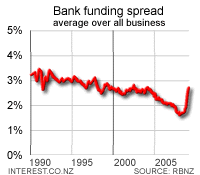
A quick look at some data collected from the Reserve Bank seemed to suggest they were. These first two charts were ominous. This Reserve Bank sourced 'Bank funding spread' chart (above left) going back to 1990 shows the average difference between the funding costs the banks pay and the interest they receive has spiked up in the last year. 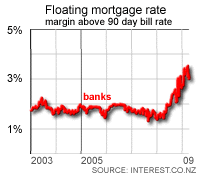 However, this data has a major flaw. It doesn't take into account the foreign funding costs faced by the banks. The Credit Crunch has increased these costs by anything from 150-250 basis points, say the banks. Cross checking these claims is difficult. Another way to look at what banks are paying versus what they are charging for interest rates is to look at the premium between the variable mortgage rate and the 90 day bill rate. That also shows margins apparently rising, but again it doesn't take into account the higher funding costs from around NZ$100 billion of foreign funding. Follow the money The best way to understand what is happening to interest margins and bank profits is to look at their General Disclosure Statements, which detail their net interest income, expenses, fee incomes, bad debt charges and ultimately, net profit. The key number is net interest income, which nets off all interest receipts and all interest payments. This effectively calculates the profit from interest on mortgages, credit cards, business loans and consumer loans minus the cost of everything in funding melting pot, including term deposits, long bonds, interbank funding locally and foreign short term funding. Simply looking at the bottom line net profit numbers is misleading because they include all sorts of factors, including non-interest fee income, trading gains, cost reductions, bad debt charges and tax changes. It's also best to compare Apples with Apples by measuring everything as a percentage of assets to make sure the numbers aren't skewed by size. It's worth going through the banks one by one so readers can understand where we got the numbers from and to see how your bank is doing.
 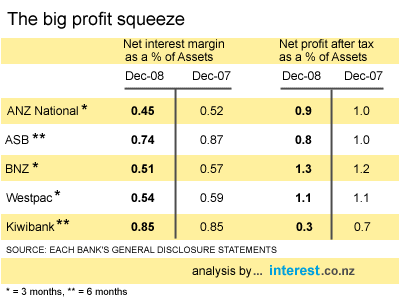 ASB's net interest margin down 15% (13 bps) ASB reported in its results for the six months to December 31 in its GDS, that its net interest income fell to NZ$483 million from NZ$494 million, which meant its net interest as a percentage of assets fell 15% to 74 basis points from 87.2 basis points in the same period a year ago. This is no doubt why CBA CEO Ralph Norris, who is very familiar with the mortgage market here, said in February that he saw more rational pricing soon in the New Zealand market. If ASB had maintained its 2007 net interest margins in 2008 on its NZ$65.343 billion of assets it would have booked a NZ$568 million profit, rather than the NZ$483 million profit it did book, implying a profit reduction for the six months of NZ$85 million because of those lower margins. This wasn't the end of the story for ASB. Its bad debt charges rose to NZ$67 million from NZ$5 million in the previous comparable half year. Operating expenses (salaries, rents, advertising) also rose to NZ$336 million from NZ$296 million, offsetting some of the increase in 'other income' (fees and trading gains) to NZ$244 million from NZ$189 million. The end result was that ASB's net profit fell to NZ$238 million from NZ$267 million. Hard to call that gouging. ASB's Key Information Summary (KIS) showed its net profit as a percentage of total assets fell to 0.8% in the year to December 31 from 1.0% the previous year. Westpac's net interest margin down 8% (4.7 bps) Westpac reported in its results for the three months to December 31 in its GDS that its net interest income rose to NZ$307 million from NZ$285 million in the same period a year ago, but its net interest margin as a percentage of total assets of NZ$55.951 billion fell 8% to 54 basis points from 58.7 basis points. If Westpac had maintained its 2007 margins in 2008 it would have made a NZ$328 million net interest margin, implying a profit reduction of NZ$21.4 million because of those lower margins. This isn't strictly comparable with the ASB profit sacrifice because it is for 3 months rather than 6 months. One crude measure would be to double Westpac's number to NZ$42.8 million. Westpac, however, managed to claw back some of the pain by keeping its costs under control and picking up some extra money from hedging gains. Income from fees and other trading gains rose to NZ$119 million from NZ$88 million. All of that came from hedging gains. Fees and commissions actually fell to NZ$88 million from NZ$89 million. Bad debt charges rose to NZ$91 million from NZ$22 million, while operating expenses fell to NZ$169 million or 30 basis points as a proportion of total assets from NZ$171 million or 35 basis points. The end result was that net profit fell to NZ$115 million from NZ$119 million. Doesn't look like gouging to me. The net profit as a percentage of assets in the year to December 31 was 1.1%, unchanged from the previous year, Westpac's KIS shows. ANZ National's net interest margin down 13% (7 bps) ANZ National reported in its results for the three months to December 31 in its GDS that its net interest income rose to NZ$601 million from NZ$570 million, but that its net interest to assets fell to 45 basis points from 52 basis points because of a jump in its assets over the period to NZ$132.127 billion from NZ$109.468 billion. If ANZ National had maintained its 2007 profit margin in 2008 then it would have made NZ$687 million, not the NZ$601 million it booked, implying a profit sacrifice of NZ$86 million. Again crudely, to make it comparative to the ASB 6 month result, this would imply NZ$172 million of lost profit in the second half of 2008. ANZ National's results actually got worse after it took into account bad debt charges tripled to NZ$94 million and other operating income, which includes fees, halved to NZ$93 million. Expenses also rose to NZ$380 million from NZ$350 million, although expenses as a percentage of assets dropped to 29 basis points from 32 basis points because of the 21% rise in assets. The net result was an after tax profit for the three months of NZ$210 million, down from NZ$310 million in the same period a year ago. Doesn't look like gouging to me. ANZ National's net profit as a percentage of assets for the 3 months to December 31 fell to 0.9% from 1.1% a year ago, ANZ National's KIS shows. BNZ net interest margin down 10% (6 bps) BNZ reported in its results for the three months to December 31 in its GDS that its net interest income rose to NZ$385 million from NZ$337 million a year ago. But once the 28% increase in its assets to NZ$76.086 billion is taken into account, that meant its net interest/assets fell 10% to 51 basis points from 57 basis points a year ago. Applying that 2007 margin to its assets at the end of December 2008 meant it would have made net interest income of NZ$433 million rather than the NZ$385 million it did make. Again using the crude method, this suggests profits sacrificed in the second half of 2008 was NZ$96 million. Like Westpac, BNZ managed to make up for the interest margin losses in other areas. Its other operating income, including fees, rose to NZ$100 million from NZ$96 million. Gains on financial trading produced the big bonus, increasing to NZ$111 million from NZ$28 million. Expenses were also virtually flat at NZ$192 million from NZ$189 million a year ago, meaning its expenses/assets fell to 25 basis points in the three months from 32 basis points a year ago. These helped offset a rise in bad debt charges to NZ$35 million from NZ$12 million a year ago. The end result of all of this was BNZ's net profit rose to NZ$260 million from NZ$171 million. This does look like gouging, but as I've shown, this was due to trading gains rather than expanding net interest margins. BNZ's net profit as a percentage of total assets rose to 1.29% for the year to December 31 from 1.21% the previous year, BNZ's KIS shows. Kiwibank net interest margin unchanged The great irony in this analysis is that the one bank that appeared to have 'gouged the most' through its net interest margin in the last 6 months was Kiwibank. Despite all its cut-rate mortgage offers, Kiwibank reported in its results for the six months to December 31 in its GDS that its net interest income rose to NZ$79.74 million from NZ$53.46 million the previous year. Taking into account the 50% rise in its assets to NZ$9.43 billion, Kiwibank's net interest margin was actually steady at 85 basis points. This meant Kiwibank's net interest margin was actually higher than ASB's for the half year. ASB was the only other bank to report its results as half year results. This relatively high net interest margin is due almost wholly to Kiwibank's near complete reliance on retail domestic savings for its funding rather than wholesale foreign funding. This meant Kiwibank has missed out on the higher foreign funding costs because of the credit crunch and has been able to take advantage of the big fall in term deposit rates in tandem with the slump in the Official Cash Rate over the last six months. The other thing worth noting from Kiwibank's results was its relatively high 'other income,' which included fees from customers and fees charged to New Zealand Post for running its payment services network. This other income rose to NZ$71.74 million from NZ$63.98 million. This meant Kiwibank's fees as a proportion of income fell to 80 basis points from 85 basis points the previous, but this is more than double the fees charged by ASB as a percentage of assets. ASB's much larger scale has no doubt created some economies of scale, but the large cross subsidy from NZ Post is evident here. It is Kiwibank's expenses line which transforms its healthy looking profit before expenses into something not so healthy. Expenses rose to NZ$110.3 million from NZ$88.51 million the previous year. This meant its expenses to assets percentage dropped to 118 basis points from 140 the previous year. But this ratio compares very unfavourably with the ASB's 51 basis points for a comparable period. This means Kiwibank is the one bank which hasn't seen margin contraction and is the bank with double the fees and double the cost base of the other banks. The end result disclosed in Kiwibank's Key Information Statement is that its net profit to asset ratio fell to 0.3% or 30 basis points in the 12 months to December 31 from 0.7% or 70 basis points the previous year. The conclusion? Politicians and business lobby groups are just plain wrong when they suggest the big four banks are gouging profits. They are also wrong when they suggest Kiwibank is sacrificing profits to help its customers more than the big Aussie banks. All this suggests that the big four banks will be very reluctant to pass on much of the expected cut in the Official Cash Rate later this month. It also means fixed mortgage interest rates have almost certainly bottomed out because the banks will be unable to tolerate much more margin contraction, particularly now they are having to fight very hard for local term deposits with retail rates that are now at least 100 basis points above wholesale rates. * This article was first published yesterday in our daily email subscription newsletter for the banking and finance industries. The email costs NZ$365 per annum and carries exclusive news and analysis for New Zealand banking and finance industry executives, regulators and investors. Sign up for a free trial here. Your thoughts? Comments below please.
We welcome your comments below. If you are not already registered, please register to comment
Remember we welcome robust, respectful and insightful debate. We don't welcome abusive or defamatory comments and will de-register those repeatedly making such comments. Our current comment policy is here.