
In this section
Offers for readers
The comment stream
Recent comments
- 1 of 19065
- ››
Editors choice
- 1 of 274
- ››
Finance sector jobs
An outstanding opportunity to become part of the extraordinary growth of this ASX 20 organ...more
Australia
Outstanding contract opportunity for experienced Cost Accountant with a household name in ...more
Australia
Great opportunity for a SME in Super to join this reputable financial services organisatio...more
Australia
Excellent opportunity to join a leading insurer as a Group Life Case Manager....more
Australia

The news stream
Latest news
Most commented
- Tuesday's Top 10 with NZ Mint 47
- Wednesday's Top 10 with NZ Mint 33
- A $72K losing position? 32
- Crafar Farms OIO approval justified 29
- Home loan affordability better in Dec 22
- 90 seconds at 9 am with BNZ 21
- Govt lifts minimum wage 50 cts to $13.50 an hour 12
- Amanda's Take Five for Tuesday 12
- NZ economic growth still underestimated 11
- Amanda's Take Five for Wednesday 8
Most viewed
Interest on Twitter
Opinion: 10 reasons why the March housing surge was an 'Indian Summer'
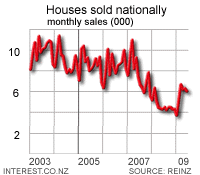
By Bernard Hickey The weather as I write this (driving hail here in Auckland) suggests winter has arrived with a vengeance, but an initial look at a closely watched indicator of house sales out today appears to show the sun returning to the market that drives the New Zealand economy. Real Estate Institute of New Zealand (REINZ) figures show housing sales volumes jumped 28% to 6,694 in March from February, which was the best monthly sales figure since the market peak for prices in November 2007. The median house price rose to NZ$335,000 from NZ$330,000. REINZ President Mike Elford struggled manfully to contain himself, saying the previous three months volumes had been light and the coming winter months would also be subdued, but the restraint didn't last. "I'm hearing that March was the best month for some time with properties available for sale and genuine buyers and sellers ready to meet market prices," Elford said.
"The indications are that there is renewed interest in the real estate market stimulated by the drop in interest rates and the affordability of properties," he said. "We're seeing investors back too, moving away from equities and returning to controlled investments such as real estate." So has the market bottomed and can all property investors and home owners breathe a sigh of relief that the worst is over? Here's 10 reasons why I think the worst is yet to come for prices and that this is an 'Indian Summer' of a recovery rather than the real thing. 1. Unemployment is expected to rise over 8%. The last set of jobs figures showed our unemployment rate at 4.6% and that employment actually rose in the December quarter. This won't last. Business confidence surveys of employment intentions show a wave of layoffs is approaching. Bankers and real estate agents know that the threat of job losses and actual job losses are what really deter home buyers and bank lending managers. 2. Credit criteria is tightening. The easy 90-95% loan to value ratios from the past are gone. For example, Kiwibank became the first bank today to cut its 2 year fixed mortgage rate since Alan Bollard's warning about long term rates last week. But the catch was that deposits had to be 20% or greater. A couple earning NZ$100,000 who have a NZ$40,000 deposit can now only buy a NZ$200,000 house with a 20% deposit, whereas the same couple could use that NZ$40,000 deposit a few years ago to buy an NZ$800,000 house with a 95% loan. That is the power of deleveraging.
3. The rush to buy in March may have been a one-off and the sales volumes figures were exaggerated. Agents say the market seemed to clear in March as exhausted vendors finally gave up on getting peak era prices and 'met the market' at the same time as buyers jumped off the sidelines. Mortgage brokers tell us that many of the buyers had been sitting on pre-approved mortgage approvals from their banks that were set to expire at the end of March. Some thought they would not get such good pre-approved deals if they had to apply again. Also, longer term fixed mortgage rates bottomed out around 6% in early March. Many buyers rushing to buy were also rushing to fix. That surge may not be repeated again this year. March's sales were much better than February and the same month a year ago, at least partly because there were full 5 weekends in the month this time, while February was short and had a long weekend, while March last year had Easter.
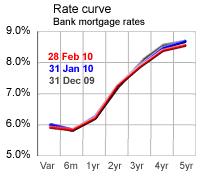
4. Interest rates are rising again. Despite Alan Bollard's attempts to calm down the long term interest rate markets last month, longer term fixed rate mortgages have risen by between 100 to 150 basis points since mid March. That is not going to be reversed. 5 year swap (wholesale) rates have now reversed their falls immediately after Bollard's comments last week. Bank funding costs are higher and rising because of the virtual cessation of longer term bank bond issues offshore. Banks are actually increasing their term deposit rates to attract savings from local investors because Mums and Dads have revolted at bank deposit rates under 5%. Regardless of what the Reserve Bank does with the Official Cash Rate on April 30 (a cut from 3% to 2.5% is widely tipped), banks will find it difficult to pass much more on to short mortgage rates and rising long term wholesale rates leave them little choice with long term mortgage rates. 5. The global economy is contracting fast. The OECD is projecting GDP in the most developed economies will fall 4% this year, which is the worst since World War II. Industrial production, exports and stock markets have fallen faster in the first year of this global recession than they did in the first year of the Great Depression of the 1930s, according to these two academics. This will hit us. Look at the woeful business confidence figures to find out how this hammer blow of lower global demand for our exports is hitting us. 6. New Zealand cannot side-step the immense power of global debt de-leveraging. I'm referring here to the global move by international financiers to pull back their lending on overseas assets as banks are nationalised and as shareholders and politicians demand less leveraging of precious equity, particularly outside of their own countries. Banks who have reported massive losses are pulling in loans whenever they can. New Zealand's banks have borrowed over NZ$100 billion from foreign institutions to fund their lending to New Zealand home owners. Since July last year there has been only one long term loan by a New Zealand bank offshore, which was ANZ National's US$1 billion issue last month. The IMF is set to announce that banks globally have US$4 trillion of toxic assets. The de-leveraging has only just begun and the global financial crisis will not be fixed until the big US and European banks have cleared toxic assets from their books. This has not been done yet. 7. The surge of cashed up expatriates returning home to buy houses is a myth. There is much speculation about New Zealanders returning home from weak employment markets in Britain, Australia and America with plenty of cash to buy houses. This was true from 2003 to 2006 when Kiwi expats returned with plenty of cash from Britain, in particular. The New Zealand dollar was weak against the pound in 2005 and 2006 and there was plenty of work here. Also, houses were easy to sell in the UK. Now, the NZ dollar is strong against the pound, jobs are not easy to find here and houses are hard to sell in the UK. The migration surge in the last couple of months actually came from India, the Philippines and South Africa. 8. The budget on May 28 is going to be tight. New Zealand's government is fighting to keep its AA+ credit rating and will have to show Standard and Poor's on May 28 how it can wrangle its budget deficit and debt issuance back under control. Government spending will have to contract and the promised tax cuts for next year and beyond are likely to be delayed or cancelled. 9. The New Zealand dollar has stopped falling. Many commentators say the fall in the New Zealand dollar will make New Zealand property more attractive to foreign property investors and returning expats. The New Zealand dollar fell sharply against the US dollar in late 2008 and early 2009, prompting some buying in February and March. The New Zealand dollar has strengthened significantly in recent weeks and is likely to stay strong while the US dollar is weak because of money printing fears. 10. Kiwibank cannot keep up the growth. Kiwibank wrote more than two thirds of all new mortgages in the December quarter before running out of steam in the March quarter because of a lack of capital. That has been rectified to an extent by a capital raising by NZ Post, but it cannot keep up the 50% plus growth it managed late last year without significant capital injections. Kiwibank's aggressively lower rates than the big banks have dried up in recent weeks. The government can't afford to pump more capital in either, meaning their will be less pressure on the Australian owned banks to compete for mortgage market share with lower rates. I am sticking to my forecast for a 30% fall in the REINZ median from its November 2007 peak of NZ$352,000 to around NZ$250,000 within the next couple of years. March was just an Indian Summer before a long winter.
2 Comments
Some solid reasoning in there,
Some solid reasoning in there, but the "crash" has been a long time coming (if it does actually come). Regarding #7, I am happily domiciled offshore with a steady but challenging professional job. If I were to NZ, I would have to prepare myself mentally for "kicking back" (which I'm personally loath to do at this stage of my life). I agree that many Kiwi expat "cruisers" would love to retun home for the lifestyle. OTOH, there are probably a fair number like me who would balk at blowing their hard-earned cash on NZ real estate. Even among the 03-06 expats, there is a probably a small army of suckers who blindly sold themselves into mortgage bliss.
Bernard - what you say
Bernard - what you say all makes sense but unreal estate seems to defy logic sometimes!
I've given up predicting, I think I'll just sit back and see what happens!
With a lower % of
With a lower % of transactions at the bottom end - it seems doubtful prices moved up at all.
The latest unemployment numbers out of Australia (refer The Australian) should sober us up here as well. Prof Steve Keen has a few things to say on that score on Debtwatch this evening.
I have no doubt the
I have no doubt the winter will be quiet, but prices will remain steady and then will start to increase in places with a high demand and not enough supply.
People will still buy real estate in spite of high interest rates and high unemployment. I remember my mother was absolutely determined to buy into the market in the late 70's when interest rates were 23%, you needed at least two mortgages, you needed a lengthy relationship with a bank to get any money and unemployment was around 10%. If it is the right time in their life to buy, people will do just about anything to get on the property ladder.
The only thing I thought might kill the market was trouble getting a mortgage. This is what has put the UK market into freefall. However- you can pretty easily still get a 90% mortgage here in NZ. To get a 90% mortgage you can pay a very small amount extra in interest or get a parent to provide a guarantee using their house equity or get a second mortgage. Easy. There was a huge amount of lending going on in NZ during March- there is no trouble getting mortgage money in NZ.
I think that the fall in property prices so far has been fairly media driven. Buyers have been told prices are going to keep falling so they won't buy. Vendors eventually gave in on price because the buyers are sitting on their hands. It will be interesting to see if vendors remain willing to take a loss or now stick resolutely to their price.
Re the surge in cashed-up
Re the surge in cashed-up expats and foreigners buying: if they were really looking for a deal, wouldn't they be looking at the numerous other countries which have already seen their real estate markets dive?
M, You're on the mark
M,
You're on the mark about expats buying wisely in other countries. Just the other day I was speaking with an Englishman who buys up foreclosures in the Kansai region of Japan. Without even a sniff of a capital gain, these properties pay themselves off in 4-5 years. In comparison, buying rental properties in NZ looks like the most retarded investment decision you could ever make.
JC, ask some hudred thousand
JC,
ask some hudred thousand Kiwis who invested in various finance institutions what they think about retarded investment.
And they don't really speak English in Japan
I don't quite agree with
I don't quite agree with you on point 2. Sure with the banks pulling back from 95% lending there will be have some impact but not as big an impact as you've suggested in that example. I would be surprized if a couple earning $100 k was ever able to obtain a loan of $760 k a few years ago. They would never have been able to service the repayments. $400k perhaps if they had a good broker but not $760.
I agree J.C. I bought
I agree J.C. I bought a rental 'investment' 18 months ago - one of the latter of the 100% mortgages. I got it at about 25% below market rate at the time, which I thought would be an ok buffer, and fixed on the best rate possible at the time - 30 months. I thought running at a small loss would be worth it in the long term. Now the market has fallen back to what I paid, I still am paying the high interest rate locked in for ANOTHER 12 months - drooling soberingly as I stare at those low rates that would turn a profit from my rental, and to top it off, the market rents have stayed the same! As long as I can service the mortgage, I am one of the lucky ones - but looking back, I would say that highly leveraged NZ rental property investment is looking like one of the most retarded investments I may have made. Still, its been a big learning curve. Wisdom - that which one gets, just after one needed it. At least I got me some metal when the dollar was at its peak. Very soberingly put Bernard. If only they taught that kind of economics at school...
Rob - you are right
Rob - you are right - I earn over 100K and there is no way I could service anything like a loan of 760K, I'd be lucky to get a loan of 400K even two years back
Bernard needs ot redo his sums
Dear Allen, Yes, the Englishman
Dear Allen,
Yes, the Englishman is fortunate that he speaks Japanese. Funny that you mention that the Japanese don't speak English because non-Japanese-speaking Aussies have singlehandedly created their own property bubble.... in the dying ski resorts of Japan! My bet is that the Kiwis and the Aussies will flog the property horse to death in their own indomitable style until all hope is gone. It's priceless if you think about it.
.. will be NZ's "winter
.. will be NZ's "winter of discontent" ..
Matt in Auck, Many thanks.
Matt in Auck,
Many thanks. Without giving too much about how much my wife and I were earning a few years ago, my bank was willing to lend me that much. You're right. I couldn't afford it. But that wasn't stopping the bank.
cheers
Bernard
10 Reasons Why Property in
10 Reasons Why Property in NZ wont crash but will be volatile
1/ Unemployment is due to rise to 8%, Those made unemployed with houses will taking boarders, get an accom supplement, but will not sell to rent as they wont be made to in NZ
2/ Credit Criteria is tightening, This affects supply as well as funds demand
3/ Agents can't at this point get listings so the supply is tight (had one visit me on the weekend B&T agent had no open homes on a Saturday)
4/ Any property built in the last 10 years is tainted with the leaky stigma
5/ Ex OE dependants are coming back home and moving in with their boomer parents who are now no longer able to quit their previously overlarge house
6/ As the world economy shrinks early retirement in the south pacific is attractive
7/ The NZ Dollar has stopped falling, This eases pressure on the cost of living so more funds are available to service the mortgage
8/ Interest Rates are going up, probably punitive for spec supply see point 2
9/ NZ exports have not suffered like the industrial nations, we can consume less with little impact on our quality of life, hence the relative standard of living compared to other countries will appear to improve.
10/ Our (Aussie) banks have not been bailed yet and our mortgage toxicity is not a fraction of that in the US/UK so it is in their best interest to stall wholesale carnage
I'm not saying its property boom time but we are a very fortunate to be in NZ now
Neven
Matt and Bernard - Am
Matt and Bernard - Am I reading what you appear to be saying - that Banks were lending as much as 7.6 gross annual household earnings a few years back?
How many times annual household earnings are they prepared to lend out now?
We need to see more discussion of these mortgage load to annual income trends.
"10/ Our (Aussie) banks have
"10/ Our (Aussie) banks have not been bailed yet and our mortgage toxicity..."
One of the silliest arguments yet (but held close to the heart of the nation). Where is NZ's Ron Paul? Are we capable of our revisiting our history where we had common sense?
JC is correct land prices
JC is correct land prices are falling in very desirable parts of the world. The numbers just don't stack up for investment in NZ's property market. Higher interest rates, much lower wages and very overvalued land prices with poor quality housing on top. I'm going for the size isn't everything argument here. I'd always choose a well-designed, well-located 100sqm house/apartment over a poorly designed 200sqm wheatabix McMansion any day. NZ might be nice for the retirement demographic - but that cannot be good for the nation. Look at Malta, Spain and Greece - the young/ambitious have to leave the country if they have any hope of prospering and the ones that remain become resigned to the politics of resentment as they are increasingly locked out of the local housing market.
This article is worth reading.
This article is worth reading. It shows that even with higher unemployment and some house price falls very few people will be forced to sell their homes.
http://www.nzherald.co.nz/business/news/article.cfm?c_id=3&objectid=1056...
Quite happy to be in
Quite happy to be in cash and able to wait for the real bottom to arrive.
The worst has yet to hit and when it does, the screaming demand for English to
subsidise the bloated mortgage debt of those who gambled in the boom, will ring loudly across the country. Fat chance of that thanks to Standard and Poors stranglegold on Bill's fiscal throat. Thank you to Standard and Poors. Don't let go that throat.
But we live in a poorly educated society, so banks continue to reel in their mortgage prey and agents do their best to grab any free money going.
Even the RBNZ is in on the madness, doing its best to destroy savings in the hope of porking some growth or at best holding the GDP slide as the country runs backwards.
Meanwhile Cullen escapes with a perk "do nothing but take the salary" position, is probably wishing he had invested the boom time revenue in a stash of gold locked up under the RBNZ. But no, he blew it.
Bernard, it would appear any
Bernard,
it would appear any green shoots in the US are likely going to wither
http://www.chrismartenson.com/blog/no-raise-fewer-jobs-less-dividends-le...
and boomers are stating to
and boomers are stating to retire and will need to unlock cash from property.
Fascinating piece from the UK
Fascinating piece from the UK - as recession bites number of 18-34 year olds living RENT FREE with parents TRIPLES:
http://www.telegraph.co.uk/finance/personalfinance/5125946/Number-of-gro...
Landlords in this country seem to be unable to grasp this reality - when recession really digs in/unemployment surges people try and avoid paying ANY rent/minimal rent by moving in with friends/family......
Bernard you're certainly stubborn I'll
Bernard you're certainly stubborn I'll give you that. You might think you are doing a favour pointing out worst case scenarios - but the problem is that some lemming type people believe you. I enjoy the various opinions on each article each day, and could probably save a lot of time by not turning on my PC to see what rubbish is being splattered through the media on an almost daily basis.
Just as there are people would would love for you to be right, I will continue with the knowledge you are wrong, but get the complete sh1ts that with a lack of financial education in this country people will line up to listen to the man with his own website woo hoo.....
Yes i do have property, so i have a vested interest in my opinion being correct. Perhaps the best thing to do is just buy more as there probably will not be a better time than within the next 6 months to further invest in something tangible, something i can drive past, something i can touch, something i actually own for as long as i decide to keep it
Neven - you however are correct, Mr Bernard Lemming Trainer Hickey could actually look at your comments and investigate deeply into those thoughts if he was neutral - just a shame he is so swirled up in his own ego that he wants to drag the economy down just to be right.... Like a little mini George Bush with a kiwi accent.
Its very interesting watching the
Its very interesting watching the jousting between Bernard who is telling it how it is and those who obviously have vested interests in property investment. Just one tip to those investors, you wont turn the market against the debt crisis tide by expending your energies on blog sites.
This debate is a kin to the Creation/Evolution debate, it is not whether we were created or evolved that is the most relevant facts to how we got to this point. The most relevant fact is the way we have behaved since the age of recorded human history.
The debate you/we should be having is what is the underlying cause of investment bubbles and that is the impact of the Debt Based Monetary System, until that changes volatility will continue be the common denominator in every human upheaval.
andy hamilton, similar article from
andy hamilton,
similar article from WSJ
http://online.wsj.com/article/SB123905105150794313.html?
"Homeward Rebound: Weathering the Storm With Kin "
President of Property you are
President of Property
you are some kind of comedian??
Andrewj - just someone with
Andrewj - just someone with my own opinion who doesn't get brainwashed by listening to the same verbal diarrhea spun out by Mr Hickey with his own website woo hoo...
I might have lost up to million since the market tanked, but have clawed back over 550k so far this year without having to do much more than think. Comedian... yeah right...
This graph shows why house
This graph shows why house prices are going to keep falling. It charts the NZ median house price against the consumer price index and household income from 1969. There is no doubt current prices are completely out of whack.
http://img509.imageshack.us/img509/3735/nzhousepricechart.jpg
This from Gibber at; http://www.interest.co.nz/ratesblog/index.p
This from Gibber at;
http://www.interest.co.nz/ratesblog/index.php/2009/04/09/opinion-how-nz-...
Supports my above post, you guys are stuck in a diversion to what is most relevant;
-Faced with an unprecedented explosion of debt obligations "“ many of them apparently fraudulent, and certainly in violation of traditional credit practice "“ Iceland has turned this inflationary solution inside out............ By indexing debt to the rate of inflation, it has guaranteed a unique windfall for banks that vastly increases what they receive in a "down market," at the expense of wage earners and industrial profits. Linking mortgage loans to the consumer price index (CPI) in the face of a depreciating currency and heavy balance-of-payments drain to foreigners can have only one result: destruction of Iceland's society and its traditional way of life.
Kieran- I think there is
Kieran- I think there is something wrong with those figures. Out there in the real world people seem to have the money to buy houses at current prices.
Rob - just incase you
Rob - just incase you missed my reply to your vitriolic attack, its here;
http://www.interest.co.nz/ratesblog/index.php/2009/04/08/bill-english-tr...
Housebuyer That graph is reality
Housebuyer
That graph is reality but probably not the reality you want so keep your head in the sand. People may very well be buying houses at current prices but that won't stop them from falling further its still a buyers market and bidders are offering as lower prices as possible which keeps driving prices down. There will always be people needing to sell for whatever reason. Mortgagee sales are still increasing, people are still getting divorced and dying, and moving to new jobs and or bigger houses.
Nice graph Kieran, I tend
Nice graph Kieran,
I tend to agree with your analysis, and Bernard makes some good points. What has changed in recent years is the determination to pay off the mortgage loan. That used to be the objective - pay off the mortgage. Any fool can borrow money.
The problem with high inflation (what else has the increase in house prices been?) is it destroys the incentive to save. This has to be restored before the current recession is over. Every well meaning attempt to ease the short term effects has to be paid back and so it also extends the period of difficulty.
When every street is a sea of for sale signs then we will have finally hit the bottom, until then it is a slow grind down with short bursts of euphoria.
This graph shows why median
This graph shows why median prices are being skewed upwards. The percentage of houses being sold under $400,000 has decreased dramaticaly while the percrntage of houses over $400,000 being sold has increased. Which is no suprise considering there aren't many first home buyers in the market because they haven't got the finances. Its mainly the wealthy who are still buying bigger and better houses in the top price bracket.
http://www.zoodle.co.nz/cms/wp-content/uploads/2009/01/sales-by-price-ra...
and:
http://www.zoodle.co.nz/cms/wp-content/uploads/2009/01/sales-by-price-ra...
I keep records of A
I keep records of A sth Auck suburb, fairly well rounded for high price home to rentals.
The Oct/ Nov 2007 period 108 sales
highest price $606.000
lowest $262,000
Ave $308,000
Feb/ March 2009 28 sales (which is a slight rise over previous periods
Highest $460,000
Lowest $203,000
Ave 325,000
The mean Ave has been greatly distorted by dramatic changes in distribution of types and price ranges of of the houses.... in the same way, the "ave income" doesnt mean that the majority of are actually within the band of the Ave.
It is very apparent that those houses that where selling well over the $400,000 mark, are now close or below that market around 15% discount and those that havnt sold (and would have in the heyday)are holding out or been withdrawn...
Those that where around the 300,000 are now selling some 15 to 18% below they would have in the heyday
But because a dramatic change in distribution the Ave doesnt reflect this.
So although I have agreed (for different reasons) with Bernard on
"I am sticking to my forecast for a 30% fall in the REINZ median from its November 2007 peak of NZ$352,000 to around NZ$250,000 within the next couple of years. "
I do not see the mean showing the 30% drop BH talks about, but still support the concept a 30% drop in REAL INDIVIDUAL VALUE of houses over the next couple yrs....with already somewhere in the ball park of a 15 to 20% drop...closer to the 20
And "March was just an Indian Summer before a long winter."
There also seems to be a marked drop off in new listings in the last couple months...thu repeat old listings still remain.
The land area (650700 as against 1000/1500) used to relate to price and this also seems now not to be a factor in advertised price...Which would indicate an exit of devalopers from the market.???
Roger Witherspoon - yeah, good
Roger Witherspoon - yeah, good idea, lets sell all the houses and live in cardboard boxes, or invest in some axes and blankets and go bush.
and when each street is a sea of for sale signs are you then going to pounce on all the bargains? no - because if each street is a sea of for sale signs then they really would be overpriced.
just because banks want to cover their arses and have more equity from the homeowners isn't a bad thing - in fact it will reduce mortgage payments significantly over the average 30 year loan - to the tune of 10's if not 100's of thousands in interest payments
if you are going to buy as an investment just be nice to your clients. if you are going to buy to live there - then it sure will beat going bush...
Keiran- I have no interest
Keiran- I have no interest in talking the market up- I currently own no property and soon will be buying into a market in which prices have suddenly jumped and listings are scarce. The zoodle graphs you linked to are old data- they don't give any information about Feb/March.
It just seems that people are looking at graphs and what they think should happen instead of looking at what is really happening out there. The most accurate information over the past few months has come from people currently buying or selling- people here seemed surprised at the jump in March sales but people trying to buy into the market recently have been saying that there is very little good stuff left unsold.
A friend of mine has just listed a property in Tauranga and had immediate interest from several pretty average kiwi families- this property will sell in the mid-$400,000s. There seems to be enough money out there to sustain the current prices in popular areas in NZ. Building consent numbers are improving too here.
we need to read this
we need to read this its relevant.
http://www.scoop.co.nz/stories/HL0904/S00068.htm
"Bad real estate debts also are pulling down banks in the two leading creditor nations, Britain and the United States Real estate prices, stock market prices and employment are going down in a straight line unprecedented even in the Great Depression of the 1930s. This has turned the neoliberal financial dream of "creating wealth" by inflating asset prices, by creating credit without actually increasing tangible capital formation (wages and living standards) into a nightmare. Just as individuals can't live off a credit card forever, neither can nations. As any classical economist knows, societies that only manufacture debt are unsustainable. Casinos may be fun places to visit (customers pay by losing their money), but no place to live. The same is true of casino economies.
that's sound familiar.
One needs to go back
One needs to go back to Bernards POINT 2 - CREDIT CRITERIA IS TIGHTENING - where he provides the example of the dramatic change in purchasing power when mortgage lenders hoist the deposits from the 5% to 20% mark - illustrating the purchasing power for a household income of $100,000 - drops dramatically from $800,000 to $200,000.
No doubt this stiffening of credit conditions is a major influence on Bernard predicting that prices will fall 30%.
But the reality is that this credit tightening is not as yet having this dramatic influence on house prices - and illustrates why we need to hear from those in the mortgage industry, exactly how people are financing their way in to inflated property.
So come on you mortgage guys - please participate in this forum as well.
It would appear to me that there are two major things happening -
1) With respect to first home buyers - parental asistance by way of a cash injection and / or the parental home being used as additional security. Tough for kids without parents already owning property.
2) A substantial amount of investment activity where the equity in existing properties is being used as additional security for further property purchases.
If the above is happening - the major reason why the market is remaining "propped up" is because of the artificially inflated equity out there.
Hugh Pavletich
JC <strong>One of the silliest
JC
One of the silliest arguments yet, I'd have to say one of the silliest posts yet, you rubbish the point (only 1 of 10 I must point out) and forward no reasoning.
If you understood the frac-reserve banking system you would realise that banks have a vested interest in maintaining property values as the constitute a large part of their business, The US/UK banks were simply throwing an increasing number of balls in the air to show how clever they were, when the mistake came...
AndrewJ
You should consider 2 things, 1) the US AND UK are fading Empires, (one pre the other post WWII), the UK was 'saved' by the now fading north sea in the 70's but have squandered the respite, The US have no-one left to invade/rape
2) NZ is on the fringe we did not have a huge financial industry, nor are we resource reprocessors (ala Japan & China), so we will hunker down on the sidelines
Bernard
My point was that some factors you state re reasons for crash can be equally applied as contra arguments, But you have made your prediction so you are wedded to Fraulein Schadenfreude
Steps
Interesting figures, we may not ever return to Hughs 50's wet dream of sprawling suburban houses for all, we may have to accept that housing will become more and more expensive as the net energy per capita falls. This will INCREASE the value of the installed base (though I don't think that effect will be seen for a few years yet)
Expat
and boomers are stating to retire and will need to unlock cash from property
You are assuming that they can retire, my mother, 74, is still earning an income from her horticulture property (and employing similarly aged friends part time), My Father in law (similar age) still works part time, how many older folk do you see working?. I'm afraid that every indicator is showing that we live longer and earn less so the modern (20th century) concept of retire at 65 may be a thing of the past for the following generations.
Neven
House buyer if you really
House buyer if you really are who you claim to be and think the market is picking up and the downward trend isn't really happening why don't you hurry up and buy a house then? You keep saying you have no interest in talking the market up, yeah right you haven't fooled me.
To all, Here's Rodney Dickens'
To all,
Here's Rodney Dickens' view on house building. He says it will recover this year, contrary to economists' forecasts, largely because developers will cut section prices. http://www.interest.co.nz/ratesblog/index.php/2009/04/10/opinion-why-hou...
An interesting angle, given predictions about massive shortages of supply driving up property + land prices.
cheers
Bernard
Neven, Can I point out
Neven,
Can I point out the "silliness" of the following:
"Our (Aussie) banks have not been bailed yet and our mortgage toxicity is not a fraction of that in the US/UK so it is in their best interest to stall wholesale carnage"
Apart from the fragility of the logic, I can guess you're saying we're in relatively better shape because our banks haven't collapsed. Barroom banter. A meaningless observation echoing throughout nation.
Yes, I read Rodney's comments,
Actually I don't think there is a contradiction between his view and yours. More supply leads to lower prices. Think of houses as a manufactured product, they should get cheaper to build as technology and processes improve.
We have no shortage of land in NZ, we are very wasteful with it. If, due to Resource Management Act changes it gets easier to build on it then we could have a dramatic decrease in section cost and new houses could get significantly cheaper.
The apparent shortage of land can be dealt with either as Hugh suggests by building efficient suburbs or Hong Kong style by efficient apartment building. Either way it ought to be possible to manufacture better accomodation for less.
Keiran- I stupidly listened to
Keiran- I stupidly listened to people like you (and Bernard and Gareth Morgan et al) and didn't buy during Feb/March ie I gambled that it was a dead cat bounce and it was safe not to buy. I was also unsure exactly where I wanted to buy so I thought I could put it off.
At the moment- given that the few new listings coming on the market have suddenly jumped tens of thousands in price compared to what has just sold- I would say that was a big mistake. I will buy as soon as something comes up that I want- I am not waiting any longer- I don't believe prices are going to go any further down.
BTW -I am not trying to "fool" you- I just think it is about time people like you took their blinkers off and looked around at what is really happening.
Hugh- here is a link
Hugh- here is a link to a mortgage broker website
http://www.squirrel.co.nz/?page_id=62
If you scroll down it gives advice on how to borrow over 80%- it sounds pretty straightforward.
Housebuyer it won't be proven
Housebuyer it won't be proven a dead cat bounce untill this time next year, besides its not really a bounce more of a plataue. Activity will probably keep going during April as well because there are people like you who mistakingly think we have hit the bottom of the decline. If that is what you think then you'd better hurry up and buy before its too late then, good luck to you thats your choice but Im not willing to risk losing my hard earned equity.
Andy Hamilton - thanks for
Andy Hamilton - thanks for the useful link re: young English people living with their parents. It backs up what I have said several times that many NZ expats returning will likely live with parents or friends, especially if they struggle to find work. Of course some will flat or even buy.
This all contributes to what I see as a bit of a myth about the impact of returning expats on property ie. Bernard's point 7.
I really do question how many will be flooding back. My neighbour's two adult daughters have just left for England for nannying and accounting work respectively. My brother came down here for 6 weeks after losing his restaurant management job in London to consider working here, but didn't like the look of the money here and has finally lined up another job back in London so he is back there again.
And as Bernard said many potential pom immigrants will struggle to sell over there at the moment without losing significant value in their property.
I guess time will tell....
Re: Boomers retiring - its not so much about boomers "retiring" as "ageing". Many will work into older age now, but that won't stop them from downsizing before they retire. For example, my parents are 66, both are still working but they downsized to a smaller townhouse about 5 years ago. Many of their friends have done the same.
Such a phenomenon is lilkely to free up the supply of larger suburban homes in the next 5-10 years.
I sold my dozen rentals
I sold my dozen rentals well before the 2007 peak. I couldn't believe what people were paying for them!
My properties were bought from 1989 onwards. With 30% deposits and always showing a positive return (even ignoring depreciation claims etc).
I sold a number to people who continued to keep them as rentals. They were making very negative returns on what they paid me for the houses.
I watched as the stupidity continued and couldn't believe what levels property went to.
I too am sitting on the sidelines waiting to see what will happen. I will only buy when the return from a rental is better than the bank (by at least 3%). Property is not a passive investment. Rental houses deteriorate very quickly and over a ten year period require a lot of time and expense. Tenant issues are quite frankly a pain in the backside.
I always bought on the fundamentals and on the understanding that capital gain was icing on the cake. Not the main reason to buy but nice if it happened come sale time.
Point number 2 is probably
Point number 2 is probably incorrect
"For example, Kiwibank became the first bank today to cut its 2 year fixed mortgage rate since Alan Bollard's warning about long term rates last week. But the catch was that deposits had to be 20% or greater."
Banks have *always* offered their best rates for the best security
Banks have *always* added extra interest and insurances for the higher LTV's
I am pretty sure that if i were to phone around the banks again as i did late last year in response to the internet mania of 'the new reality on 80% LTV' I would find that banks are still offering greater than 80% LTV for suitable customers for higher rates and fees as they were back then.
And i am not suggesting that people should be getting high LTV's in a time of great economic uncertainty either. But if you want them i think they are still there.
I am deeply depressed... The
I am deeply depressed...
The fundamentals just don't suggest prices should inflate..
this is a un-real estate.
Housebuyer - many thanks for
Housebuyer - many thanks for pointing out above the Squirrel website - which as you correctly say - spells out in very clear terms the actual criteria, which in reality is still very accommodating and liberal.
Particularly for those lucky enough to be born with parents who already own property. And of course for those wishing to continue stacking up with the inflated equity of their existing stock.
Readers are urged to read closely the Squirrel website.
Lets consider a young couple with an income of $100,000. It would appear that they can still borrow an extraordinarily high 5 times income or $500,000 - so that would leave them with a $120,000 deposit issue to deal with - giving them the capacity to get in to a $620,000 house.
So realistically - they could pony up with $40,000 in cash - with the daughter fluttering her eyebrows, with a few tears if need be at Dad (works nearly every time) for him to put the old family home up for $80,000 of security to the Bank (or some other financial institution) as the so called balance of the deposit.
I would imagine that in many cases the parents would be meeting the interest / principal obligations on the "deposit balance" (in this case $80,000) or pumping some addiitiional cash in to lighten the load. In many cases no doubt - and if the parents are old enough - they would meet this "deposit balance" with one of those silly reverse mortgages.
it would seem likely that property prices will not likely come down soon if there is a lot of this sort of mickey mouse financing going on.
The reality is that in the REAL WORLD in normal affordable North American markets where house prices do not exceed 3 times household incomes - the mortgage is 2.5 times annual household incomes.
New affordable starter housing is erected at a Median Multiple of 2.5 on the fringes - where the DEVELOPMENT RATIOS are 20% serviced lot / 80% actual house construction - not the nonsense 50 / 50 we are currently seeing in New Zealand.
In essense - Kiwis seem to delight in working for their Banks. How charitable!
I would suggest people closely read the Public Statement by the NZ Government's Housing Minister Hon Phil Heatley (available via www.PerformanceUrbanPlanning.org ) on the date of the release of this years Demographia Survey.
It is very clear that new fringe land must be openned up as quickly as possible.
Hugh Pavletich
Lets see what the March
Lets see what the March and April immigration stats show...
As you can see from the graph at this link below over the last few years there has always been a strong surge in Feb followed by dips from March through to spring:
http://www.stats.govt.nz/products-and-services/hot-off-the-press/interna...
HUGH - Heatley talked, is he going to walk the talk???
Kieran - my sincere apologies
Kieran - my sincere apologies for not getting back to you on another thread last Tuesday regarding further discussion on the SUBDIVISION COSTS BREAKDOWN issues - but alas - my Quantity Surveyor has alas "gone cold".
Your numbers are most helpful.
As you - and no doubt other readers will appreciate - I am not exactly on the Christmas Card List with many in the development and construction sectors because of my advocacy work these past four years. Something incidentally - I couldnt care less about - as I have no interest in having dealings with losers incapable of putting the wider public interest - first.
As Kieran has illustrated elsewhere - even with our lousy construction performance - new fringe sections should be selling on the fringes for in the range of $80,000 - $100,000 - and anything above that is "speculator profit" for the generally politically well connected at local level.
It will be a great day indeed in this country - when home buyers are no longer paying for welfare schemes for Banks and speculators!
Housebuyer don't buy until the
Housebuyer
don't buy until the end of next year- I think real estate will fall by 40% by then.
Matt - "Heatley talked -
Matt - "Heatley talked - but is he going to walk the walk". A very important question indeed.
Readers will be aware - that in my advocacy work these past few years - I have deliberately remained independent to date - so that as a former development practitioner and industry leader I was in a position to dish it up left, right and centre as need be.
Just to lighten things up - towards the end of 2006 I approached the National Party about coming on board with these issues - making it clear to them that I saw this as very much across political lines issue. I was told to go to hell.
I was so furious with them - I rewrote the National Partys Mission Statement to "The Mission of the NZ National Party is to tip toe through life - quietly - hoping to reach dealth safely" - and being the terrible person I am, made sure the Labour guys got copies.
At least the Labour guys thought it was funny.
Around 8 weeks prior to the last election I sent the National guys a little epistle - pointing out that there are 3 types of people in this world - phoenxis, sheep and donkeys - and asking whether the election was all about replacing the sheep with donkeys. Not everyone was amused and one of the Nats shot back with a "Sorry - donkeys dont send emails" to a perfectly reasonable question I asked.
In early 2007 the NZ Planning Institute came out supporting the Annual Demographia Surveys (I will always be eternally grateful to the planners for that). the Nationals then changed - and things have progressively got better and better.
The feedback Im getting currently Matt from many sources - is that there is extremely strong commitment right across the board within the Coalition Government - to deal head on, with these issues of housing, local government and infrastructure. I would have to say in fairness - that their performance to date has exceeded my best expectations and Im quietly confident the necessary changes will be put in place.
What I particularly like - is in how Prime Minister John Key is reaching out across the political spectrum - in a genuine endeavour to work with all New Zealanders in resolving these issues. The National / Greens Memorandum of Understanding signed yesterday is an illustration of this.
People need to be aware too I think - that these necessary changes cannot just happen in 5 minutes - as the issues being dealt with straddle so many areas of Government - at all levels.
I would suggest people making property decisions should follow political developments closely.
HUGH: "CREDIT CRITERIA IS TIGHTENING
HUGH:
"CREDIT CRITERIA IS TIGHTENING - where he provides the example of the dramatic change in purchasing power when mortgage lenders hoist the deposits from the 5% to 20% mark - illustrating the purchasing power for a household income of $100,000 - drops dramatically from $800,000 to $200,000.
No doubt this stiffening of credit conditions is a major influence on Bernard predicting that prices will fall 30%."
Get real, a lot of the boom was banks leaning on small no deposit, something that has only existed up to and during the over valued booms....and kieren graph apply reflects this. Old school good business always worked on a 33% equity for security...which could be easy achieved with a 20% deposit and slow increase in values as has happened for generations.
It is illogical to blame the cause of the overvalued market, for the correction that is happening and will be happening. The RB should never have lifted the min deposit and the banks have now done the sensible thing and voluntarily reinstated
Well I Suppose National want
Well I Suppose National want to remove RMA issues.. which will help free up costs...
Alos, with making councils huge like auckland.. that will help in freeing up land as well for development..
And in case people have
And in case people have concerns about our centre right Party performance here in New Zealand - may I suggest they check out the Conservative Party in the UK, Republicans in the US - and the worst of thev worst Liberal Party at Federal and States level in Australia.
Just look at the Liberal Nationals performance in Queensland a few weeks back - and how through sheer incompetence they lost a perfectly winnable election.
In my comsidered view - the Government we have here in New Zealand is way way ahead of the other Governments and centre right partys of the English speaking world. This country could turn around quicker than most realise, with a solid dose of sound political management.
Hi, time lag response re
Hi, time lag response re expats and foreigners buying. There are plenty of English speaking countries with tanking markets.... like the U.S. and Britain, Ireland, etc. Also, we know many expatriate friends who have bought houses and apartments in places like Singapore, Dubai, Manila to name but a few - English speaking, wonderful infrastructure, etc. Plus, language barriers are really not such a big issue anymore. Many many options. If the Kiwi markets do not correct, we don't foresee putting money into its real estate market. The fundamentals seem out of wack when taking into consideration the average GDP per capita and then looking at the cost of a house.
Hugh - thanks for your
Hugh - thanks for your response
the key question though is - how will National implement your idea to ban MUL limits so as to free up the supply of urban fringe land?
What sort of mechanism do you want?
Do you want the government to introduce a legal provision that bans Councils from setting urban limits?
I understand what you want but I want to know what the necessary mechanism is to implement what you want
M - where are you
M - where are you based out of interest?
Hugh keep putting the pressure
Hugh keep putting the pressure on politicians, I will be glad when this housing bubble is behind us so we can move on and learn from it. Hopefully that will only be 2-3 years away and not 10-15 years. I am not going to put my hard earned money into a deflating asset thats for sure, I would rather put it to productive use rather than flush it down the toilet.
Matt yes Its going to be interesting to see what the migration fugures are, they aren't due until the 21st.
For you hopeful property investors
For you hopeful property investors preying to get out with your shirts that have not yet realised what even Warren Buffet, supposedly the worlds most astute investor has, that the one thing he is not is a banker;
http://news.bbc.co.uk/2/hi/business/2817995.stm
The property investors need an insight into just what a "time bomb" you are sitting on and how it came about, check this out from Harvard;
http://blogs.harvardbusiness.org/hbreditors/2009/03/when_mortgage_backed...
Then take into account this;
http://www.multinationalmonitor.org/editorsblog/index.php?/archives/107-...
Then surely you seemingly intelligent folks might begin to get the importance of who controls the money/debt supply to inflation deflation;
http://mwhodges.home.att.net/debt.htm(US current account crisis)
http://www.rba.gov.au/PublicationsAndResearch/Bulletin/bu_oct07/Pdf/bu_1007_3.pdf(Australian current account crisis)
http://ips.ac.nz/events/downloads/2008/Bertram.pdf(NZ current account crisis)
-notice all have house price crisis
Matt - thank you for
Matt - thank you for the question above.
There is of course more than one way of doing anything - and you will be well aware that I have spoken more in conceptual terms - without getting in to the "nitty gritty" of the most appropriate mechanisms to deal with these issues.
My sense though is that we will see before too long a "performance based relationship" put in place between central and local government - with regional government thankfully shut down.
Now - what mechanisims and structures will be put in place to achieve this - I, like everyone else, simply dont know at this stage. I am sure however - that currently there is a massive amount of discussion going on, both within central government and outside of it, with respect to these issues.
The Coalition Government is acutely aware that its focus must be on local government, housing and infrastructure - if it wants to get a recovery underway in this country. The PM as we all know is very committed to raising productivity performance - and thankfully, he (and most other Ministers) has the necessary market understanding of what the "growth blockers" are in the New Zealand economy.
Lets just see whats announced in coming weeks.................
Hugh Pavletich
Hi Matt. We live in
Hi Matt. We live in Manila. My husband is Kiwi. I am American.
Kieran - thanks - Im
Kieran - thanks - Im enormously heartened with political progress in New Zealand.
M - thanks. Is your
M - thanks. Is your view on NZ property being a bad investment widely shared over there?
Hugh - "A solid dose
Hugh - "A solid dose of sound political management" do you mean something like this, the WorldBank and IMF have advanced from imposed Structural Adjustment Programs upon indebted nations to new rules of receivership, Private Sector Development Stratagies;
David Ellerman, economic adviser to the chief economist of the World Bank, suggests there might be cause for Alexander's concern. "Making the investment climate better for one group may well be at the cost of making it worse for another group," he writes in a memo. "The Bank tends to ignore these tradeoffs and to implicitly identify with one group (usually external or foreign investors)." ............
The PSDS solution to the equity problems of privatization is to provide subsidies to the lower-income groups. The World Bank's own Development Report 2000/2001, however, points out that subsidies often do not make it to their intended recipients because of "leakage" or capture of the subsidies by richer groups.........
The World Bank spokesperson agrees that "there is no doubt that companies will serve better off customers first," but holds that there are ways to make up the difference. "You can design a privatization that puts the focus on poor customers. ... [I]t is possible to do this equitably." ...........
"The evidence is now unequivocal: both cost recovery and the privatization of essential basic services inevitably lead to deeper inequity, and safety nets fail to prevent this," concludes Save the Children UK in a recent report.
The World Bank spokesperson agrees that "there is no doubt that companies will serve better off customers first," but holds that there are ways to make up the difference. "You can design a privatization that puts the focus on poor customers. ... [I]t is possible to do this equitably."........................
http://www.multinationalmonitor.org/mm2002/092002/tannenbaum.html
No doubt John Key the central bankers favourite son will be trained to deliver.
Hi again Matt. I just
Hi again Matt. I just don't think anyone else - not so many Kiwis here - has given it much thought. I do think that the odd Brit or South African is interested in moving south... but most are looking at Oz and not NZ. Most other expats are interested in either returning to their home countries or in staying overseas for life. Retirement places in Thailand, Singapore, Dubai etc.
M - sorry to interrogate
M - sorry to interrogate you!!!!
Why do the poms and africans have Oz as a preference? Climate? Bigger country? Combination?
Its interesting to get to the heart of these issues
are you guys looking to rush back to NZ because of the economy like some in the media over here, and pro-property punters, would suggest ?
Hi Matt. My own impression
Hi Matt. My own impression is that OZ has more sex appeal. It's bigger and glitzier. NZ is beautiful but not as much happening? No offense. I prefer NZ.
The media in NZ seems naive or maybe it's just complicit? So many articles with no facts but lots of quotes from real estate agents! We are in absolutely NO rush to go back to NZ. So far almost all of the expats that we know here, in Manila, have avoided the ax. This is not a financial/legal hub like HK, Singapore, etc. Also, it's not as export oriented. As for the rest of Asia, most of our friends have managed to keep their jobs as well. Anecdotally, some who've lost jobs in Asia are taking their chances to stay put and search in Asia, perhaps even looking at more local companies or downsizing on their packages. The footloose, i.e., those without kids, are even just taking the time to backpack on pilgrimages to places like India or doing some NGO type work to give back.
I have not personally or anecdotally heard of one instance wherein the expat/foreigner has suddenly decided to move to NZ to wait out the economic storm - excepting, of course in the NZ media articles quoting their real estate agents....
Writing from a hot pool
Writing from a hot pool on the Gold Coast. Which, according to the rellies in the building trades here, is DOA in terms of residential and CRE. Public infrastructure like the endless rebuilding of the M1 and the Brizzie tunnels is the safety valve, but the boom is goneburger. Mortgage holidays are the go, but most folk realise that the holiday just capitalises back onto principal, so a mixed blessing.
The intersting meme in the last few days is the notion of keeping lending to the US going, but denominated in SDR. The US has been the only country able to borrow abroad in its own currency. That, too, may now be DOA. Comments, Bernard?
M - very interesting indeed
Yes the NZ media are rubbish, really amateurish and trigger happy. As an American used to quality American newspapers you know what I mean
Yes the thing is unemployment is increasing around the world but even if unemployment hits 8% the majority still have jobs don't they?
Its interesting to hear your views because so many people here get brainwashed by the media, from what I'm hearing from you and other people overseas is that this much talked about flood of expats returning is a media and desperate bank economist's fantasy!!!
here's the latest crap from
here's the latest crap from tony Alexander in the Waikato Times
http://www.stuff.co.nz/business/analysis/2321195/Time-to-buy
this clown is either a simpleton or is clearly biased
There's no point in comparing the period June 01 - June 02 to now in terms of immigration - that mass flood was initiated by 9/11!!!!!! Thats was people fearing for their lives!!!!
my last post of the
my last post of the night before Tony's support club get in-
this is a guy who has been consistently wrong with predictions
Late last year he was firmly stating that the NZ dollar would be hitting 40 US cents and staying around there
Where is it now Tony?
Matt - put rather simply
Matt - put rather simply - the economics professionals should hold their heads in shame for their performance through these housing bubbles.
If these people had been trained properly (refer my article "Housing Bubbles & Market Sense" - it is likely we would not have had the housing bubbles today. Thanks to them - the planners dominated.
Senior Bank Executives also need to take a good look at themselves as well.
Matt I agree that article
Matt I agree that article is so bias and full of bad advise its not funny what he doesen't mention is all our gains only ever happen in spring/summer and we always get losses during autumn/winter even during boom years. The final total depends on how big the gains are during the summer period to offset the losses we get during winter. So far the total is 9600 which will be reduced over winter so it could only be 7000 in August way below the 15-30,000 he is predicting. His housing shortage theory is totally dependent on that also. The building consent numbers are 16,710 for the feb09 year not 12,500 he quoted.
I think its going to be a hard cold winter for the people who take his advise.
Matt, M's attitude relects the
Matt, M's attitude relects the many expats here in London that still have jobs (or business that is profitable). The idea of running home to NZ just doesn't seem worth the risk, grief and exposure to unscrupulous property merchants salivating at the chance to get their hands on your hard earned cash by pushing last century's dreams. I did that in the 90's recession - so have wisdom born of age (and mistakes). I am curious, have you lived overseas (cashed up) and returned back in search of....? You seem astute, yet you are grating against the edges of NZ's supposed immunity to the wider economic realities (amongst other things). It's a lonely place to be in and everyone that I know who has experienced that frustration usually leaves NZ again ... but for good. I hope you make it, I hope things finally change there so that you can realise a future - the country needs people like you to keep trying. However if it doesn't work out, leaving becomes so much easier the second time around and you will be in very good company.
JC <strong>Barroom banter. A meaningless
JC
Barroom banter. A meaningless observation echoing throughout nation, Interesting choice of venacular for this platitude, (the use of "barrooms"), which would suggest to me you are regurgitating international press verbatim.
I'd like you to consider how many of the major banks in NZ offer NINJA loans?, how many wrote ARMs?, Where is the market in CDO's? Had a look in the yellowpages for a "Trashout" company? Are there cul-de-sacs in your area where 5 out of the 6 houses are empty? Are 10% of the house sales mortagee? Where do I send my "jingle mail" keys for my negative equity non-recourse loan?
Maybe rather than using the demonym JC over Easter (with its haruspecial connotations) you should change it to CL (for Chicken Little)
Neven
PostDiaspora - thnaks for the
PostDiaspora - thnaks for the kind words. Yes I lived in Japan for two years in the 90s - much of my long standing skepticism about housing stems fro my time there and witnessing the destruction of their housing bubble
Yes this country drives me crazy at times but there are plenty of great things about the place too that (only just) keep me here
Hugh - I think you are spot on with your comment on economists
Im farming. Its very tough
Im farming. Its very tough with the climatic problems. From my side of the fence I dont see how we can pay our debts with our present levels of production. I dont see how we can increase production without it being canceled out by costs.
TO me housing arguments are a bit irrelevant as I dont see how we can sustain our present lifestyles. Inflation appears to be very high i suspect most workers are experiencing cost of living increases of over %10. Sorry Im agreeing more and more with Iain. I dont see a way out as we have way too much debt. I expect we will have our future dictated to us by overseas owned banks. I think we are in for a long period of falling living standards. If you want to spend your life paying of a house go for it. Personally Id try something else, anything else.
Andrew
http://www.independent.co.uk/opinion/commentators/johann-hari/the-dark-s...
Hugh - the economics profession
Hugh - the economics profession should be truly ashamed of themselves. That so few of them (with a few notable exceptions) saw the massively destructive property bubble inflating is quite astounding.
AndrewJ - Farmers talk a
AndrewJ - Farmers talk a lot of sense!
Good to hear a solid, wise view from the heartland!!!
I enjoyed this article by
I enjoyed this article by Micheal Hudson. Its very relevant to the predicament we find ourselves. Thanks whoever posted it.
http://www.scoop.co.nz/stories/HL0904/S00068.htm
In Britain much the same has occurred. Sitting in the lounge of Heathrow airport last month, I watched the hearings on BBC where members of Parliament expressed amazement that the most seriously affected banks were not led by bankers but by marketing men. Their job was not to calculate prudent loans, but to sell as much debt as possible, without regard for the debtor's ability to pay. The result is that the Bank of England "“ like the U.S. Treasury "“ is printing new bonds whose interest charges will have to be paid by taxes on labor and industry.
This problem was bound to arise, given Europe's postindustrial faith that whatever increases "wealth" "“ even by the trick of puffing up real estate and other asset prices "“ is as productive as building new industrial capacity and infrastructure. The result of this ideology was a set of bubble economies built on debt-financed real estate and stock market inflation. Such bubbles always burst at some point. Only belatedly are nations re-discovering the classical axiom that the only way to pay for imports on a sustainable basis is to produce exports.
In recent years financial managers have persuaded many countries to sell off public enterprises like their water or energy supplies, mainly to raise the money to pay debts or to cut taxes on the highest wealth brackets. This sale of the "commons" by naïve, myopic leaders (and the "useful idiots" promoted by financial lobbyists to be their economic advisors) turns debtor countries into "tollbooth economies" in which basic services become a vehicle to extract greater and greater portions of national income and wealth for the benefit of the few. This is the antithesis of "free markets" as classical economists understood the term. They are markets designed and controlled by the financial sector to appropriate for itself the surplus produced by labor and tangible capital investment.
To promote this siphoning off of surplus income, the rich have funded extensive disinformation (propaganda) campaigns around the world. Their tactic is to use familiar and revered ideological terms such as "free markets," "economic democracy" and "fairness" to win the hearts and minds of the population while actually imposing a set of policies in stark contrast to Enlightenment ideology, classical political economy, Progressive Era reform and 20th century social democracy "“ the ideals of freedom-loving peoples everywhere. Financial lobbyists have spent billions of dollars spent on public-relations think tanks to achieve this ideological con job. They have endowed business schools and gained control of government agencies to promote their creditor-oriented point of view, headed by central banks to serve as the ideological wedge for today's anti-democratic forces. This is the ideology that has pushed much of the Third World into poverty since the 1960s, as well as today's tragically debt-ridden post-Soviet economies.
This supremacy of the banks and the financial sector took thousands of years to achieve. It was not easy to overthrow traditional social values and to impoverish so many economies by subordinating customary property relations with legal priority for creditors. Iceland only recently has come under this kind of financial attack by creditors operating globally. Bankers managed to convince ambitious fortune-seekers that the way to wealth and economic growth lay in debt leveraging, not in staying free of debt. Selling debt as their product, banks and speculators at the world's financial core needed to prepare for what they must have known would lead to economic collapse and destroyed economies throughout history. They prepared the path to ruin by ideological engineering aimed at shaping how populations think about history, so as to accept debt pyramiding as a good economic strategy.
As an example of their warped thinking, consider an attractively priced home. Would you rather own 100% of a home free of all debt with a market value of 100,000 euros if free of debt "“ or, would you rather own 60% of the same home at an inflated market price valued at 250,000 euros? In the second scenario you would have 50,000 euros of "surplus wealth" (60% x 250,000 = 150,000 euros, compared to 100,000 in the first example). People across the globe have been convinced that the second scenario represents "wealth creation." What is overlooked is that the higher-priced home carries interest charges on its higher market price. This charge would amount to 6,000 euros a year, or 500 euros a month, at 6% interest. The same property is worth more, but includes a much larger debt overhead "“ income for the financial sector.
have a great Easter
andrewj
Just after 9/11 huge numbers
Just after 9/11 huge numbers of Kiwi's returned home to NZ. Is this going to happen yet again in the aftermath of the credit crunch? If so does anyone know how many came back after 9/11 as that's what seemed to set off the property boom in NZ. To Kiwis always come home in big volumes after recessionary events?
Is it likely to happen again now ie:
Influx of people (Kiwis returning plus fresh UK, USA Asian, Indian migrants)
Nobody leaving NZ
Population growing (40,000 per anum on births alone)
Interest rates down compared with early 2008
Not enough new homes being built
Existing house prices go up due to the immense pressure of population increase? Could this actually be the outcome?
I did listen Kieiran a
I did listen Kieiran a year ago when he asked me to sell some of my properties and to fix my mortgage for 5 years( I still keep all the emails Kieiran sent to me). Now I am in a much better position.
Iam glad you are sticking
Iam glad you are sticking with your forecast:
1.We've predicted a 30% fall in the average house price between November 2007 and the end of 2009. We're still on track for that. BH Sep 08
2.We forecast a 30% fall in the nominal median house price between November 2007 and November 2009. BH Dec 08
...
Lara, the world is facing
Lara, the world is facing a new kind of fear,destruction and there is no where safe to hide. The sand no longer works so don't put your head in there.
Matt in Auck Says: "AndrewJ
Matt in Auck Says:
"AndrewJ - Farmers talk a lot of sense!
Good to hear a solid, wise view from the heartland!!!"
I have to agree, espec after the big shakeup in the 80s.
Housing...well we dont have families living on the streets, sure every society from beginning of time have a had a few souls doing so..
Increase in forced auctions...sure % wise looks real bad but actual numbers are tiny in proportion of sales, or per head of population...
Like farmers, the REAL builder/tradesman hankers down and rides it out, sells his boat and rises again..the flighby nighters builders of leaky home disappear....sorts the chaff from the wheat, something builders have wanted for a long time.
For NZ to grow it is about exports...not houses, or shoes....farmers...
Guys like Andrew and some of our family members, have been thru it before, bite the bullet and if havnt done stupid business practises things like over borrow, ride it out and consolidate do a bit of infrastructure building to jump off when things get better.
The rest, who missed out on the boom, lost a heap regardless of the warning signs, those who impatient itching to re invest, and see their earning dropping off a little...wake up, its an economic winter, enjoy the rest and a nice glass of red wine in front of the fire, and stop being greedy and bitching.
Its not doom and gloom...hey I was very positive the proverbial was going to hit the fan, we are happy to go back to rissoles instead of eye steak...its time to look forward to to the light at the end of the tunnel.
These are positive times, not gloom....time to go fishing, enjoy a picnic.
Lara NO No jobs =
Lara
NO
No jobs = No Immigration.
Welfare and health education costs up= high cost on existing taxpayers of new migrants.
Real wages down ,real cost of living up =less income for repaying debt = more people squashed into houses falling rentals.
we are in a slight upturn phase of a long recession.Get used to it. we have woeful production and worse deficits are coming. Tax takes will be down Govt will borrow more, interest rates will climb,house values will fall.banks will have to source expensive funding. It all takes time but its coming.
Im surprised BNZ is still
Im surprised BNZ is still associating itself with Tony. hes a disaster. Gosh, people like him should be axed for such false propaganda. Doesnt he know the meaning of NZ housing being one of the most UNAFFORDABLE???
Tony, our advise is to go back to school.
Bernard, have you ever met that clown?
AndrewJ I'm similarly pessimistic in
AndrewJ
I'm similarly pessimistic in the long term, though I dont agree with Ian (ie monetary reform is not the solution). In essence we have lifestyles afforded to us by energy (particulaly oil) consumption, A house is a physical embodiment of the consumption of energy (energy to harvest the wood, mill it transport it, energy to make the cement etc) so as this energy availability per capita drops so correspondingly will our 'lifestyle'.
The corollary to this drop is efficiency, so if we increase efficiency we will keep the system at this level for a period yet.
The Chinese know this which is why they are investing in Brazil, Russia, Venezuela oil projects at the present time.
Debt is simply a call on the future, which is eroded by growth but without increasing energy you cannot grow, ie the burgeoning debt is a symptom (of the inability to endlessly grow) not the problem in itself.
My vision of a solution is a form of Green Economics where sustainability is valued as much as consumption. Though how this will happen I have no idea
Neven
Neven Then we should fight
Neven
Then we should fight against immigration. We have only a given amount of resources and with out an increase in production, dividing them amongst more and more people appears foolish.
I suspect that China will subsidise its exports and continue to destroy the West's manufacturing base, in doing so dominate world natural resource allocation and manufacturing for the foreseeable future. Like they started doing with steel last week.
JC looks like you took
JC looks like you took on the wrong man there and got yourself an intellectual arse whipping!!! Now that was entertainment!
With respect to the issue
With respect to the issue of "economists' - i would urge people to read my article "Housing Bubbles and Market Sense". This is just one of a number I have written over the years, pointing out the shortcomings of the economics profession.
Even Ben Bernanke, the current Federal Reserve Chairman told the Congress point blank back in 2005 - that the United States didnt have a housing bubble.
Most economists, planners and valuers still dont have a clue about the significance af housing / asset bubbles - and the destructiveness of them. And if one doesnt have a grasp of this - then one is simply all at sea.
Internationally (not yet in NZ regrettably) - the economics profession is in a state of "convulsion" - and it is a great credit to many of the leading economists, in how they are well aware of the problems.
We have yet to see this happening within the fields of planning and property valuation. Its about time these guys followed the lead of economists internationally.
It is very important the economics profession gets away from the Paul Samuelson inspired emphasis on "mathematical modelling" - and takes a more structural "nuts and bolts" approach to specific markets - in particular urban markets, which are the major growth engine of a modern economy.
Unfortunately - we dont have one competent urban economist in Australia and New Zealand. To illustrate - go ask any economist you know for a detailed breakdown of subdivision and construction costs on the fringes - and they wouldnt have a clue in hell what you are talking about.
Rather remarkably the same twits are mouthing off profound predictions about the housing market !!!!
One other remarkable thing about economists is in how they think they have the required knowledge to mouth off one minute about housing - then any other sector of the economy you care to imagine - 5 minutes later.
Again - the reality is that it takes years of hands on experience to ever get a reasonable understanding of any sector. Get me out of property development, infrastructure and housing - and I simply dont have the knowledge to comment on these other sectors.
Im having enough trouble understanding urban development - and the issues surrounding that after 30 years in the game !!!
And I have so much more to learn.
The great Oscar Wilde said "You should never let your schooling interfere with your education" - and to follow on from the great Oscars views on this issue - I think it would be fair to say that we have a lot of badly schooled economists, planners and valuers, causing unnecessary problems, because of their profound lack of understanding of the real market drivers.
Going forward - as the current Global Financial Crisis unfolds - increasingly I am sure that there will only be employment for those with the skills to "add value" - and as one surveys the performances of sadly too many within the professions of economics, planning and valuation - its extremely difficult to see at the moment how many of these people are actually "adding value".
Unless a lot of these guys start "re educating" themselves fast - I suspect a good number of them will be heading for the employment scrapyard. Former economists, planners and valuers as concrete placers on building sites - as well.
Well someone is going to
Well someone is going to have to eat humble pie within a year or so?
Will it be Alexander or Hickey?
And will whoever turns out to be wrong have the guts to say it and bear the consequences?
If Hickey is right and Alexander is wrong I would hope (but do not expect) that TA would resign from his position at BNZ
Somehow though I think the truth will fall somewhere between the two of them, so they'll kind of both be half right / half wrong!!!!
time will tell....(my latest favourite saying!)
Matt It depends who is
Matt
It depends who is paying you! Hickey has the freedom that bank economists dream of.
Exactly, Andrewj: " It's hard
Exactly, Andrewj:
" It's hard to get an honest view from a man when his income depends on it"
And, re our housing "shortage":
Don't we just have an uneven distribution of house ownership, rather than a shortage? My landlord has 10 "rentals",( must have gone to the "make 100k on each and become a millionaire' seminar!) but only lives in his one house.
With respect, people talking about
With respect, people talking about unaffordable housing in NZ, haven't seen much of the world. I live here for 5 yeras now, bougth brend new ap. in one of Wellington's top locations for just under 1 mil. which equates to some 400k E. You know how much would you pay for it in any other western capital? Well, figure will be the same, but in different currency. Spent most of my life in Europe, and NZ is one of very few countries that people actually live in the houses, there are small communities living at the railway stations, subways, parks... just wondering aimlessly.
This country also has good social and political policies, and public opinion actually means something to politicians.
Crime rate, unemployment are (still) low, and NZ is one of most desired location those days, that's my opinion at least.
Neven - you said; "My
Neven - you said;
"My vision of a solution is a form of Green Economics where sustainability is valued as much as consumption. Though how this will happen I have no idea"
How about spending our monetary base into circulation debt free to build sustainable energy projects. Thus, our own monetary base can be borrowed from no-one, owed to no-one and is backed by the free energy it provides throughout the lifetime of the assets created. The maintenance jobs created a further means of entering debt free money into circulation.
Cheaper energy down the food chain and cheaper credit down the food chain, win, win.
You know the first guy that suggested they only need to take a daily dose lemon juice on sailing ships to prevent scurvy was scoffed at because it was thought to be to simple. It was only adopted four years later and 10,000 sailors deaths later when someone of note by the name of James Cook tried it and it worked.
There are more than enough sustainable energy sources to power a reasonable standard of living for all, but what is produced as a prohibitor by those the central bankers who control most of the current technology, the cost! Remove the cost, make it a service to society with which to back our own debt free monetary base.
http://science.howstuffworks.com/maglev-train.htm(magnetic trains)
http://www.environmentalgraffiti.com/business/geothermal-energy-solution-to-the-worlds-energy-crisis/173(thermal energy)
http://en.wikipedia.org/wiki/Geothermal_energy(many sources of energy)
If you have broadband, a bit of time and interest, this doco movie;
http://www.youtube.com/watch?v=NT-2fenmLnc&feature=related (Zeitgeist Addendum)
not only gives a great insight into international monetary and commercial mechanisms, but also an insight into how multinational corporations have brought the patents to new technology in order to suppress its development because it would be less profitable to them than the current technologies they own. What about competition I hear you say? The inhibitive cost of borrowing at start up reduces competition in a world that presently nothing can now be done but for the motive of profit.
Good point Janet - when
Good point Janet - when you take into account the home residence of rental property owners they own around 65% of the approx 1.5 million residential dwellings in NZ.
Many of them are absentee foreign owners that take advantage of our lapsed foreign investment regulations, will not contribute hardly a thing to our economy and take their tax free gains off shore. I can hear them say now, "but we provide a service" has anyone actually taken a look at how many residential properties in NZ are on the verge of falling down, they have acted in typical corporate style and taken the tax free profits and reinvested next to nothing. Not for a minute saying their are not good landlords out their, but they would be the anomaly, not the norm.
There are two pillars of equality in my book, the right, that provided you work hard enough, to expect to be able to buy your freedom (freehold) by retirement age and the right to free education. Do we currently have either in this country?
Eneko - with all due
Eneko - with all due respect you are falling into the old trap of directly comparing the cost of a house here with houses internationally without factoring in the cost of that house relative to income HERE. Of course if someone comes from say Tokyo a house here would seem very very cheap
Its like if I go to Huntly from Auckland and see a great mansion for $250K - wow! But when most of the households there earn less 40K then that house seems pretty pricey
the key is the price of houses relative to income and as Hugh's studies show NZ is seriously unaffordable
this is another reason why we need to stop foreigners who don't live here permanently buying up our land and houses
they may give a very small boost to the economy when they build the house and for the 3-4 weeks they are here per year, but I think the costs outweigh the benefits
The trouble is, Ian, that
The trouble is, Ian, that we have forgotten to teach our children that wealth is something that you get 'from your day job', not from paper/asset trading. If house prices always go up, why work, if all you have to do is buy and hold? It's all too easy.
Hugh: It is very important
Hugh:
It is very important the economics profession gets away from the Paul Samuelson inspired emphasis on "mathematical modelling" - and takes a more structural "nuts and bolts" approach to specific markets -.......
I think it would be fair to say that we have a lot of badly schooled economists, planners and valuers, causing unnecessary problems, because of their profound lack of understanding of the real market drivers."
Wrong..its not just economists, its town planing, the deskjockeys in education, DoC...everywhere
All stare down at a column of statistics and formula and forget, or rather where never taught plan simple commonsense...They live in effect a dreamworld of 'statistical optical illusions' Then we have our old school academics, Jim Salanger (weather), Neville Economics, Middleton (Education) who are more common sense than statisical... a dieing breed.
Immigration: the general economic theory is we need population growth the grow economy, increase consumption and productivity.....Anyone checked that we have gone thru 2 huge baby boom periods since early 1990, and these will be coming into the economy now and in a few yrs...do we need immigration on the above premise..no.
Does anyone have links to
Does anyone have links to official figures that say what percentage of houses in NZ are owned by foreigners? I would like to see foreign ownership of our houses banned. Having those speculators - with their exchange rate advantage- driving up the prices of our houses really makes me see red. This issue has been bothering me for years- I have even thought about starting up a petition to get the issue some attention.
We are suckers in this
We are suckers in this country! Few countries are as liberal as us in letting foreigners buy our property.
I am not xenophobic one bit. I am all for balanced immigration from all parts of the world. I'm all for people coming here to live, contributing to our society, becoming permanent residents or citizens and buying property here.
What I object to is absentee foreign property owners who really contribute very little to the country other than minor benefits (maybe eating at a couple of local restaurants when they are down for their one month of the year), who are benefitting hugely as Housebuyer says from the exchange rate.
"I would like to see
"I would like to see foreign ownership of our houses banned."
"I am not xenophobic one bit"
:-)
Let us say that you dont want to prevent exporters from exporting also? The importer the other side of the deal gets say NZ lamb and the farmer gets NZ dollars. The farmer though is a bit trigger happy with his debt and decides to go visit his export market in Japan before flying on to europe. He sees some nice property on his travels and gets some good deals on farm equipment. Overall this country is now in debt because of an NZ person. The foreigners are now owed stuff from us. We owe them. We can send them NZ dollars and they can buy our lamb but they already buy our lamb and they get a bit worried we might devalue our currency so they want something concrete to protect their surplus until trade reverses and we buy less of their stuff than they feel like buying from us. Or are we going to go over their with guns and force them to buy more of our stuff they dont want??? Since NZ is not a bad place to invest in if you want a safe getaway appartment for troubled times Auckland is as good a place as any and has a vibrant overseas population and simple access to an international airport and pretty good weather....if a bit humid. So a few quality appartments and sea front houses for family holidays seems like a good idea.
Of course you can make it hard for foreigners to buy our stuff. And they can make it hard for us to buy their stuff. We can all play that game.
The solution is to buy less of their stuff and encourage them to buy more of our stuff.......but wait.......you dont want that to happen........
What you want is to see a collapse in NZ property so you can get good speculative deals on property........but those clever foreigners are in their first
Damn!
Readers - for a little
Readers - for a little light distraction from the weighty issues we are dealing with here.....may I suggest you flick over to "frogblog'" (Russel Norman / Green Party website) for an update on the "love in" going on between the Nats and the Greens.
peterquitote is making an enormous contribution bringing everyone together....with a warm but considerably less witty contribution by me.
All jokes aside - the Memorandum of Understanding entered in to between the National Party and the Greens last Thursday, is a very positive political development - and a great credit to John, Janette and Russel.
neven911 @10/04/09 11:21am<blockquote>Debt is simply
neven911 @10/04/09 11:21am
I agree. I am becoming increasingly convinced that we cannot have a discussion about the prospects for recovery of the housing market, the prospects for recovery of the NZ economy or the prospects for recovery of the global economy without at least addressing the issue of Peak Oil.
Most commentators agree that developed countries have accumulated unprecedented amounts of debt. Where opinions appear to differ is on just how difficult it will be to extinguish this debt. The optimistic view is that with enough stimuli, economies will kick start and continue to grow at the rates they used to and, over time, countries will pay back the debt. This assumes the ability to grow. Which in turn assumes that there will be sufficient energy to grow with.
So, what if these assumptions were wrong?
I thoroughly recommend this recent article by James Quinn:
http://www.marketoracle.co.uk/Article9913.html
To quote him:
.
Other commentators worth reading on this issue include Chris Martenson (see chapters 17a, 17b and 17c of the Crash Course)
http://www.chrismartenson.com/crashcourse
Matt Saviner
http://lifeaftertheoilcrash.net/
and Jim Kunstler
http://jameshowardkunstler.typepad.com/
The curse of living in interesting times, perhaps...
Housebuyer - statistics on the
Housebuyer - statistics on the level of foreign ownership do not exist because hardly an existing residential property in NZ breaks the threshold for investigation or record of in regard to value or size, it has been a free for all. The National Party central banker muppets are revising legislation surrounding foreign investment to make it even easier.
May the sake of reason come to the rescue.
It is often best to find an outside perspective in these matters to get the true picture;
Can overseas residents invest in New Zealand?
Yes, the New Zealand government actively promotes overseas investment. Non residents can buy property under $50 million and land under 5 hectares without requiring any specific consent firm the New Zealand government.
http://www.escapeartist.com/OREQ13/Real_Estate_In_New_Zealand.html (Australian property investment advisor)
http://theyworkforyou.co.nz/portfolios/finance/2007/aug/14/residential_property(government admission foreign ownership stats not available)
http://canterbury.cyberplace.org.nz/community/CAFCA/OIReview/OIReview.html (all the pertinent information)
Why are we doing it, because of this;
http://www.stuff.co.nz/business/771919(NZ adjust current account deficit or else)
http://www.multinationalmonitor.org/mm2002/092002/tannenbaum.html (Do this now or else)
http://ips.ac.nz/events/downloads/2008/Bertram.pdf (NZ debt charts, take special note pg 16 onward, take of rural lending to GDP of rural sector)
Nikki Pender - Your amicable
Nikki Pender - Your amicable debate on my previous post much appreciated. One of the forgotten compelling factors in the control of oil is probably the very first one, the fact that most mechanised military forces lose their mobility without it;
http://www.interest.co.nz/ratesblog/index.php/2009/04/09/opinion-10-reas...
"Most commentators agree that developed
"Most commentators agree that developed countries have accumulated unprecedented amounts of debt. Where opinions appear to differ is on just how difficult it will be to extinguish this debt."
If we go back to basic encomics and imagine one household called china and the other called NZ then China has savings 'in' NZ and is happy to have them there while it is happy to have them there. If it does not want the savings then it spends them and converts them to NZ assets or products. So it buys what NZ can offer. NZ gets less debt and owns/controls less of NZ and China has less savings and gets more of us.
So you then have a political problem. If you create debt then you reduce your ability to have domain over what you believe is yours that is mortgaged. the problem is easy to solve if we allow china to buy NZ farms and properties. But if we dont want that then we have to have a war.
We cant have it all ways and win win win.
Unfortunately some greedy bastard gets a country into these situations gets paid handsomly and then does not care at all. In the 30's faced with the same situation i think everybody just sat down realised they were all mutually screwed and just decided to take the gloves off and beat the crap out of each other until the weakest surrendered.
It is maybe different now because we have the more in your face mutual dependencies of globablisation. But often the people resent globalisation either thru ignorance or because of simple realities like cheap overseas labour devalues their own labour and they dont have the ability to demand higher money for the same work and it is the bosses who benefit from globalisation - while simultaneously the average person is busy feeding their face with exotic overseas products stereos travel and what not on debt. And these people say they were tempted by the evil banksters into debt. Partly true. Partly not true.
What will happen? Well we could just wind down the encomies of the world a decade or two and live more simply and spend less............but it will not solve anything because we still have to eat and find shelter and be amused somehow to avoid loitering street corners getting into trouble. Partly today people dont how to amuse themselves by playing cards, dancing gently and singing and they need a stereo to enjoy themselves or rave parties with drugs and partly corporations have brainwashed people into thinking that happiness comes from not singing and dancing talking and walking.
Even so we are here now. People dont know how to do it the old ways anymore. We can agree there are no magic solutions for today. Even if tomorrow they may come.
Can we spend our way out of this? we could delay problems today in the hope the debt can be managed down i suppose while the chinas support their economies while spending the money they got from us they saved to get us into debt while they did not feed their faces on products and goodies from us they did not want to buy.
I suppose we could go over their convince them they need to be like us and just spend more. And that is already happening
There are no easy solutions here.
Bernard- your opinion piece in
Bernard- your opinion piece in the Herald today is telling people it is the right time to buy a house. A few days ago you were writing that the median property price will fall to $250,000 and it is all doom and gloom.
I listened to you once because I thought you might know more than I did. As is turned out- you knew less than I did. You hadn't even researched your claims that deleveraging would require people to have a 20% deposit and therefore be a factor in the crash of the property market. That was a fairly basic error and inexcusable.
You need to be careful- having set yourself up as an "expert" people are inclined to listen to what you have to say. You had better stick to what you know, and if you are going to make big predictions, make sure you have your facts right.
A real estate agent posting
A real estate agent posting as "housebuyer" hahaha...
You guys have no interest in buyers other than the commission you get through the sellers.
There is no way one
There is no way one can call the performance of the NZ property market since it's peak in '07 a crash. Oil $145 to $35, DJIA 14,000 to 8,000 USA property, UK property and just about everything else qualify as a crash. Gold has done OK but definitely looking shaky lately.
NZ property would have to maintain it's current trend for another 18 months to even be called a bear market in the commonly accepted use of the word. Anything could happen, and sure, a crash is probably a better bet than a recovery, but it sure hasn't happened yet.
Hi Iain Parker Sorry for
Hi Iain Parker
Sorry for missing your earlier post.
The suppression of new ideas by big corporates demonstrates a breathtakingly myopic attitude. Where would General Motors be now if, instead of "killing" its own electric car, it had repositioned its business and aggressively marketed the EC as the way of the future? It could have had a 15-20 year lead on any other auto maker. Instead, GM is almost certainly facing bankruptcy, and China is poised to take the lead in EC manufacturing.
http://www.nakedcapitalism.com/search/label/Auto%20industry
I have no doubt that creativity can win out in the end and humankind will find exciting new ways to meet changing life conditions. Eventually. But we can't forget the old maxim "necessity is the mother of invention" which seems to mean that no matter how advanced the society, its people still need the immediacy of a crisis before they will answer a call to arms. However, by the time oil reaches crisis point (say $200 per gallon) there may not be enough time to organise a smooth switch to alternative sources of energy. (According to the US commentators linked to in my earlier post, at least a 20-year lead-in time is required before any combination of alternative sources of energy would be ready to replace oil fully.)
Which probably means that the world is about to go through a very grim transitional period.
Like you, I'd like to see some discussion about how NZ would fare if we could no longer rely on oil as a cheap source of energy. Is NZ uniquely placed to become more self-sufficient in less time than other countries? Or does our isolation mean that we'll be worse-off?
Your links show there are already some ideas that may provide some substitution if we were suddenly faced with oil shortages. Is any one of these ideas advanced enough to step up quickly? And/or to what extent are they themselves dependent on oil?
I don't know the answers to any of these questions, but would certainly like to hear from someone more expert in these areas.
housebuyer - the title of
housebuyer - the title of Bernard's article doesn't quite correlate with the content of the article
The title is "the Time is right to buy" but the content seems to be saying that relative to renting its getting better to buy, rather than "you have to buy now!!!"
but I agree, the tone of the article is a bit at odds with Bernard's 30% drop forecasts
Many young people reading the article would think that it could be worth buying now, yet if Bernard's forecasts come to fruition then they could be in negative equity within 2 years if they did buy now!!!!
Bernard - clarification please!!!!
The young people will miss
The young people will miss out to the cashed up ex pat Kiwis who are returning in droves and buying everything they can. Local investors also active - hard to compete with these people.
The property comments on page
The property comments on page 15 of this confidence survey are very interesting - sounds like boom times again. http://www.bnz.co.nz/binaries/cs060409.pdf
Anz's March property report, which
Anz's March property report, which is more based on reality
http://www.anz.co.nz/about/media/library/pf/pf20090320.pdf
I have been actively involved
I have been actively involved in the real estate industry in NZ since 1985 both in residential and commercial/industrial as an owner and as a real estate agent. I had the first hand experience of the 1987 crash and saw similarities to the pre 1987s as far back as 2006. The artificial hike in property values were very like those of pre 1987. Back then it was caused by deregulation of the finance industry and the removal of import licencing and import duties. Many of the finance companies that have gone bust lately were run by the same people that went bust back in the late 80s. They learned then that they could steal vast amounts of public money and get away with it just as they have today!
The deregulation of import licences and duties has allowed the importation of cheap goods from third world countries for the last 20 years and has largely contributed to the crash this time. This deregulation was following the rest of the west and has had the effect of shifting the wests manufacturing base and wealth to China and Asia.
Suddenly the boom is over and the effects of massive job losses are catching up.
The property values and rents in 1987 in some cases took 10 years to return to the same levels.
I saw a commercial real
I saw a commercial real estate site in Newmarket that sold for $8M in 1987 sold in 1989 by the bank for $2.5M.
An industrial rental struck at market rental in 1986 with a 12 year lease in place to a multinational company expired without ever being reviewed, the rent was prevented from decreasing during that term by a rachet clause.
I personally bought a house in Parnell in 1991 that the owner had paid $6000 more for it 5 years earlier. So not only had it not increased in value over the previous 5 years they also lost $6000 plus the agents commission.
Maybe this is of interest to someone looking at purchasing a property now?
It will not be all
It will not be all you self claimed intellectuals that get to decide if now is the time to buy or not. It will be the bargain hunters, first home buyers, speculators and new immigrants that will decide when was the best time to buy.
Being that there are a lot of idiots that made money when they sold does not eliminate the fact that you make the money when you buy - if you buy right.
We might just find out that time is now, with the next OCR around the corner, pre-approved purchasers, and contracts going unconditional when the new rates are established will most certainly be the winners.
Just as it is difficult to pick the top of the market it is equally difficult to choose the bottom. All that needs choosing is can the loan be serviced and is this what i really want/need/require etc.
As long as the loan can be serviced, which is more likely now than ever for most people of us, them now is the time to pounce.
If the market drops another 1-5% who cares it will surely rise again, better that than be pushed out to a grottier suburb or sh1ttier house every time you miss out at auction when it does experience the upturn
It is only the greedy that seem to forget how desperate buyers were that caused the property boom in the first place
and as for the 9/11 scenario, being a one off event, has any one read the paper about what they stopped happening in the UK Easter shopping malls?
we might be losing the clean green image, with violent crime on the rise, rapes, home invasions, drug rage etc - but so far not many with C4 strapped to their torsos.
I know where i feel safer
Lara - you really seem
Lara - you really seem to believe the hype about all these cashed up expats returning in droves????
There is no data to support that
January's net migration gain was only 700, February's was 1700. People like Tony Alexander who are heavily biased were talking up the 1700 figure, which is a load of cobwash because the main reasons for that increase was the foreign students returning for the 09 academic year. He says he is an independant bank economist but that is bullshit. If he was independant and un-biased he would acknowlege that March is always a big month for immigration because of students. He does acknowledge that in his bank report but not in his statements to the main newspapers ,which of course get the most coverage
Infometrics in today's sunday star times are talking about a net gain of 10k, compared to Alexander's 15-30K
It will be very interesting to see what the migration figures are for March - they come out on 21 April. I'm guessing they will come back to around the 1000 mark, then they'll lower over winter
I agree with Informetrics, I reckon we'll get a net gain of 10,000 this year
BNZ seem to be a
BNZ seem to be a bit out on a limb with their bullish comments about property.
ASB and ANZ for example are still pretty bearish, and are suggesting further falls in coming months
Any increase in property prices
Any increase in property prices or even an increase in activity implies an increase in debt.
You could be right we are in another period of increasing assets,however the increase in debt required to sustain this, means somewhere down the track we end up back where we are now, but with even more debt and bigger deficits as we borrow to pay interest.
The housing problem is a debt problem until this is sorted out the problem cannot go away,it can be put off by low interest rates and a increase debt but the problem has not gone away just been deferred.
To the above You are
To the above
You are right about the Herald on Sunday. That was not my headline. I say buying is now almost as affordable as renting now (before rates, insurance and maintenance) but that isn't the same as saying buy now. Buying now would make sense if prices were about to rebound and interest rates stay low. They're not, so I'm saying now is not the time to buy, unless, of course, you have other better reasons for homeownership, just as living in a stable home in an area you like close to schools you want.
cheers
Bernard
Thank you, Bernard for clarifying
Thank you, Bernard for clarifying your position. For a second even I thought that you were recommending people to buy, but your above statement clears up
Bernard - Thank goodness you
Bernard - Thank goodness you are starting to sound sensible, almost suggesting that if people want to live in a house they could consider buying one if for all the right reasons.
I was starting to think you were a lost cause and was quite concerned you would drag the economy and country down with the beat of your drum (30% fall etc) - you can stand tall again and i congratulate you on your hedging statement above (April 12th, 2009 at 1:48pm)
At least now it seems you are open to explore the possibilities outside of your media/ego driven stance of certain falls
Some properties have fallen 30% so you still got to be right, but it needs to be said those properties were probably purchased by the unwise or overly greedy. Most stock will recover reasonably unscathed from very low or just early double digit drops from their previous highs.
in years to come people will be think "why the heck didn't i buy more when i had the chance back in early to mid 2009. Gosh hindsight is a great thing"
Anyway, digs and banter aside, i acknowledge your statement and congratulate you for it.
we are just about to
we are just about to go out for dinner with a real estate agent so these comments are very timely for me to read right now! But, PLEASE stop quoting median house prices - quote average or mean prices, much more meaningful and realistic.
I cant believe that Bernard
I cant believe that Bernard had to actually explain.."its not time to buy"
Did anyone actually take the TIME to READ his article.?
Aparently NOT!!
It is very plainly self explainitary....
Some thing that Bernard is VERY good at.
Its well worth reading Mish's
Its well worth reading Mish's (mike Shedlock) Global Economic Trends article today - on the state of the commercial property market in the United States.
On that score - enclosed Malls are dionasaurs - with 400 of the 2000 of the major ones in the United States shutting down these past two years.
The same thing will happen here in New Zealand and Australia at some stage - simply because their total operating costs are not competitive.
The name of the game in retail development - is that only those with the lowest operating costs per square metre - and most importantly - the development configerations that can generate the highest dollar per square metre sales - will survive.
Interesting blog, some true the
Interesting blog, some true the rest crap, sure house prices may have fallen by 6-10% since the peak depending on who you listen to, I suggest that the fall rates differ depending on the circumstances, ie. whether you had to sell in a hurry or not for what ever reasons. But the most important thing is the supply of readily available houses on the market for sale appears to be dwindling, for example the realator in Ch. Ch. 6 months ago was 100 pages today it bearly gets over 55 pages, whilst driving around there is also a lack of For Sale signs around the city, the reason for this is that people who don't have to sell simply don't sell, it appears that only the desperate and those who would have sold irrespective of boom or bust bubble are attempting to sell. You have to remember that to most Kiwis that property is still a safe investment as someone said earlier you can drive past it every day, view it, touch it, sell it for money, thats because it is real. The Share market has already lost half its value(50%) that it gained in the last 6-7 years, but good old property has only lost 6-10% so far and appears to be stabilizing (easy to choose which is the best investment) and if you look back historically property increased in value even after the last great depression, so hello wake up Gareth Morgan and Bernard Hickey and all the other pessimists, you should be like the Housebuyer and get out there and find one and buy it now, I know that's hard because of the lack of stock but find something and grab it because say if they drop another 4-5%(which appears to be what the experts predict) at least you will now own because when the tide turns, which it will eventually the race for that property will force up the price to more than you previously paid, so you could be worse off. The other thing is that property in NZ is the cheapest for a modern western society, perhaps if previous Govts hadn't let foreign ownership of property it would have been considerably cheaper than it is, as I am sure this foriegn ownership has also contributed to the increase, it certainly increased the demand anyway.
You can also guaratee that house prices are affected by the basic supply/demand economic principal that favours all good and services, therefore happy house buying folks, get in now before its to late, back the historical data.
rod Says: Interesting blog, some
rod Says: Interesting blog, some true the rest crap
right on Rod.
Exponential growth in Debt has to end.
Nothing lasts forever, I suggest now is a good time to get a proper job.
Hello Rod, We cant generalise
Hello Rod, We cant generalise based on the small NZ housing market. Housing collapsed in most western countries. Many economies are facing crisis whose root cause is the housing bubble. NZ houses are poor quality stock and over valued because of the excessive debts taken. With little productivity increase in NZ, valuable capital is wasted on housing in the name of safe investment. What is "˜good' for an individual need not be good for the country. Hope the government introduces capital gains tax or stamp duty to correct the mob investment behaviour.
Sam this is NZ though
Sam this is NZ though and Kiwis are stubbon they won't sell if they don't want to even if long term they pay more for their house than its worth (ie the true cost), we have a great desire to own our own house at whatever cost. You cannot compare us with other nations, there are other things that make us differrent from the rest of the world, (ie Life style, culture, etc.)
The economy will rebound when housing affordability, driven by increased incomes, increase which is surely but slowly happening as we speak, which will remove the over valuation you talk about.
Therefore we can generalise with the NZ housing bubble, we have to because people will not sell and put that valuable capital into anything else. At the moment Capital Gains tax would create refunds for people as they take the CPI into account in countries that have CGT.
Andrew J. Hopefully expotenial debt
Andrew J. Hopefully expotenial debt has ended forever, it appears banks are not sales driven anymore like they used to be. Mind you that could change once the recession ends, or if it ends.
Rod - you need to
Rod - you need to read The Australian article of April 11 "Easy lending to hurt young housebuyers" - where the Aussie Banks are STLL lending an astronomical 5 to 7 times household earnings - with the FHOG thrown in for good measure.
Thanks Hugh that makes things
Thanks Hugh that makes things a little scary for them, I think its probably about time Govts here and abroad start regulating bank lending relative to a deposit for home buyers, this would have an impact to prevent future bubbles.
Rod %90 of our deficit
Rod
%90 of our deficit consists of dividends and interest payments leaving the country. If we continue to borrow this figure will increase. We will need to increase exports. I think we are heading to a decline in the sheep industry of over %30 because of drought and poor returns. Who is going to earn the money to pay these debts???
If the Aussie banks get away with creating more money to lend to house owners, even more of our earnings will end up in Australia. Exponential growth in debt has already reached an apex if thats possible,from here its all down hill.
the argument over housing should concentrate on debt, house prices are irrelevant as long as we can afford them. The arguments over supply and demand ,immigration and new building costs don't matter as much as our ability to pay our debts.
We depend on agriculture for most of our exports unfortunately, it to has experienced a bubble based on debt, the ability of agriculture just to pay its own way looks shaky, where does that leave the rest of you.
Hey Steptoe... Next time don't
Hey Steptoe...
Next time don't be too fast to scroll past what you think is irrelevant to get to your point as you may sound contradictory
You talk of reading the whole article, but before you slant people for not reading the article properly, how about actually casting your eyes over the entire article including the post article comments where you will find amongst them what Bernard Hickey stated.
" I'm saying now is not the time to buy, unless, of course, you have other better reasons for homeownership, just as living in a stable home in an area you like close to schools you want.
cheers
Bernard"
looks like a hedging statement to me...
Forgive me for copying and
Forgive me for copying and pasting some of my previous arguments on housing bubbles.
I am one of a few but growing number of people who believe that people like Hugh Pavletich, Wendell Cox, Oliver Marc Hartwich, and Alan Moran have the key to this problem and we are ignoring tham at our peril. For the benefit of those who haven't followed the argument, here is what I insist you should check out.
Wendell Cox and Ronald Utt: "Don't Regulate the Suburbs: America Needs a Housing Poliicy that Works".
http://www.heritage.org/Research/SmartGrowth/bg2247.cfm
Alan Moran: "The Tragedy of Planning: Losing the Great Australian Dream"
http://www.ipa.org.au/library/MORANPlanning2006.pdf
Those who insist that factors other than land use rationing, such as taxation treatment of housing, are responsible for housing bubbles, should look at page 54 onwards, (page 61 of the PDF) where Moran gives analysis charts of these factors accross a number of countries that have exerienced housing bubbles.
Oliver Marc Hartwich and Alan Evans: "Unaffordable Housing: Fables and Myths"
http://www.policyexchange.org.uk/images/publications/pdfs/pub_38_-_full_...
On page 17 is a graph of previous house price bubbles in the UK. The UK just happens to have had land use rationing decades ahead of everyone else. They have also had house price bubbles decades ahead of everyone else; they just never got the connection.
Oliver Marc Hartwich and Alan Evans: "Bigger Better Faster More: Why Some Countries Plan Better Than Others"
http://www.policyexchange.org.uk/publications/publication.cgi?id=47
Germany has policies of funding local government which are powerful incentives to development and construction. Consequently, Germany has not had a house price bubble other than in a few locales where local anti-development sentiment was strong enough to survive the cost impact of consequent loss of funding. They have had a nationwide 1990's construction boom and subsequent depressed property prices which are frequently misinterpreted as a "bubble". They do not, however, have huge increases in household debt backed by the "faery gold" of house price inflation, and subsequent wipeout of equity bringing the whole banking and finance system down. Germany can honestly say that the impact on their economy is spillover from outside their borders. Just about no other country can say that, including NZ and Australia.
I badly wish for more evidence than this, but this is pretty conclusive to my mind.
Why property price bubbles, nearly everywhere, at this time? There have been numerous periods of monetary looseness in the past which have led to bubbles in the share market. I would argue that every potential property bubble in the past was spiked in time by construction booms, other than in the UK, obviously. But the 1980's and 1990's were marked by the advancement of environmentalism and urban limits and planning and land use rationing. Just as environmentalist mismanagement of forestry policy has finally had to be blamed for unprecendentedly destructive forest fires in California and Australia, it is high time that the true blame for the housing bubble crises was directed that way also.
I also insist that a property price bubble will get underway against all other obstacles, because of land rationing policies alone. Alan Moran's comparisons are conclusive that CGT's and other taxation treatments made no difference. I would argue that land rationing policies could cause property price bubbles even under a gold standard. Think about this. All that is required is for prices to be unable to be relieved by supply, and mania to do the rest. The (temporary) gains for speculators in such a bubble will naturally be more attractive than virtually any other investment. The starving of productive capital of investment, as a result of the bubble, will indirectly contribute to the bubble's ultimate collapse. This is because of the effect on incomes, of productivity being affected adversely.
Did the famous tulip bubble not take place under a gold standard?
When a housing price bubble gets underway, Reserve Banks increasingly find themselves "holding a tiger by the tail". Raising the base interest rate will depress PRODUCTIVE activity which is already being depressed by the diversion of investment into real estate. But the demand for finance for the housing bubble will have been having an upward effect on interest rates anyway. Meanwhile, the cashing-out of increased house owner "equity" will have been driving consumption, which will not have been resulting in increased productivity either.
But a lower base interest rate, in the absence of other seriously depressing effects, will immediately have a highly volatile effect. NZ did not get this effect like the USA did, as our Reserve bank did not "do a Greenspan" any time there was a clamour for lower interest rates. In a way, we can thank them for that, but on the other hand, a housing bubble will inflate and blow up regardless, it will just blow up quicker under the low interest rate scenario. That is what we desperately need to avoid now; we desperately need to avoid tracking the US experience any further.
As I intimate above, NZ is thus far avoiding the highly volatile response to lower interest rates that was experienced in the USA, at least partly because we are already up to our eyeballs in debt even under the higher interest rate scenario, and partly because there are other depressive factors at work, like the rest of the world imploding around us"¦"¦"¦
But what would Bollard and Co hope to achieve by "stimulating the economy", Greenspan style, with lower interest rates? All we would be doing, is tracking the USA from 2001 onwards, only we would be starting from a very much worse position regarding our debt and the inflated prices of our houses.
The biggest favour the National government could do our economy now would be to just let the builders loose on whatever land anyone anywhere will sell them, and let low interest rates combine with LOW HOUSE PRICES and small mortgages, to leave as many income earners as possible with as much REAL discretionary income to spend, as possible.
One of the problems in trying to control a housing bubble by the base interest rate (Greenspan didn't even believe there WAS a housing bubble in the USA) is that not only is the housing bubble not based on the other fundamentals of the economy, it is de-linked from them. In some cases, the fundamentals are being driven by the housing bubble; like consumption being driven by people cashing out home "equity", rather than by incomes. As long as house prices cannot be brought down by the building trade and free availability of land, bubbles will occur and will blow up eventually. The OCR will seem to have played a role in so far as the bubble has been inflating more rapidly when the OCR is low, and possibly bursting at some point when the OCR is raised, but meanwhile everything else in the economy will have been pushed completely out of kilter. Incentives to save, what to invest in, productivity, wages"¦"¦.
The fundamentals should drive house prices and the fundamentals should also drive what the Reserve Bank does with the OCR.
The global crash problem in a nutshell; investment in productive capital was siphoned off into a speculative bubble in real estate.
Previous speculative bubbles have been mainly confined to financial markets. Why? There is a certain limitation on "supply" of business, in the shares of which speculation can take place. Such bubbles ultimately pop, and investors lose, in a matter of hours.
Speculative bubbles do not take place in commodities for which supply responds to demand. What Austrian economists call malinvestment can occur when production is boosted to meet demand that is not "real", but damaging as this is, it is nowhere near as damaging as speculative bubbles are in their own right. What some people call a "housing bubble", where a lot of cheap homes are built as in Texas recently, is really "malinvestment". In these conditions, prices of all real estate is actually kept low because of the over-supply; that is not a "bubble". Left to itself, these over-supply situations would be limited in their consequences as the suppliers would quickly adjust to the reality of lack of sales, and demographics and migration and economic reality (affordability) would ultimately take care of the empty homes. But price bubbles just carry on and on inflating until they reach the point where the economy cannot sustain them, by which time catastrophe is the unavoidable consequence.
Why did speculative price bubbles not take place in real estate before this particular time? The simple reality is that land supply was not restricted to the same extent or for as long as was required for bubbles to get underway. An interesting exception I can point you to, is the UK. The UK has been experiencing severe housing price bubbles since way back in the 1960's; the obvious consequence of their much earlier adoption of anti-development land use restriction policies.
Allowing these bubbles to occur in real estate is an economic error of an order of magnitude of difference to bubbles in financial markets which the small proportion of people with money to burn enter voluntarily, and the fortunes that are made on paper and wiped out do not leave huge economy-distorting amounts of debt behind them.
Not so housing. Housing affects everybody. The total sums of money are not only much larger than the sharemarket, the debt that remains when the values on paper collapse is an order of magnitude larger and affects a high proportion of the population. Nor does the bubble burst in a matter of hours, with values quickly resetting at realistic levels; denial and paralysis besets the whole economy for years.
Productive capital gets starved of investment both coming and going: both as the bubbles were inflating and as they deflate. This is grave in its implications.
Did ANYONE have the wisdom to see this coming? I'll tell you what, precious few have even got the wisdom today to see that this is "what happened" and what "is happening" still.
First, we need "domestic savings". It wasn't "domestic savings" that were going into buying houses, it was borrowing - debt - created by monetary inflation.
We need to be prepared to utilise resources, and utilise them efficiently. We need to make it less hassle and less risky and just plain less unpopular to be in business and make money. We need to reduce if not abolish corporate tax; we need to abolish the employment grievance shakedown industry and wind back the holiday and maternity leave and so on that we thought in the years 1999-2008, that our economy could afford. And we need to wind back the toxic combination of the RMA (Resource Management Act) and the anti-development powers bestowed on councils that are responsible for the double whammy of restricting productive investment and allowing house prices to bubble by interfering with supply, and also wind back the fee gouging by councils.
Our economy could NOT afford it in reality even then. THIS assessment, which I have just read, is exactly applicable to our situation; I have been looking for a long time for this sort of assessment:
http://www.dailyreckoning.co.uk/economic-forecasts/the-mystery-of-britai...
Fred Harrison: "The Mystery of Britain's Missing Recession"
EXCERPT:
(You could change "Gordon Brown" to "Michael Cullen" and it would still be true)
""¦..If the business cycle had played out in the way that we would have predicted on the basis of historical trends, the price of houses would have deflated in 2001-2. This would have been the outcome of a mid-cycle recession. Instead, under Gordon Brown's stewardship, the residential sector was allowed to bubble. This set new benchmarks for prices: the next housing bubble would have to inflate to stupendous levels before finally collapsing and driving the economy into the Depression of 2010.
But in the meantime, Britain's consumers were on a spending spree. They borrowed like there was no tomorrow to finance the purchase of luxury goods, holidays in exotic locations, new cars, and improvements to their homes. Following the election of New Labour in 1997, consumption grew faster than output, with retailers sucking in imported goods to make up the difference. Between 1999 and 2001, consumption grew exactly twice as fast as Gross Domestic Product (GDP). Unsecured consumer debt rose at an annual average rate of nearly 11% over the five years to 2004. While Gordon Brown preened himself with declarations about his virtuous "˜prudence' in handling the nation's public finances, he sanctioned private bingeing that undermined the culture of thrift"¦"¦"
PhilBest adds:
While Michael Cullen preened himself about fiscal prudence, NZ consumers went on a spending spree that artificially inflated our GDP and our business turnover and profits and the government's taxation revenue. We SHOULD in reality, going by what was happening to NZ's productive capital and productivity, have been in recession already and tightening our belts and the government should have been cutting wasteful spending, not embarking on new binges; and the government should also have been freeing up the productive sector, not imposing new burdens on it.
Interest rates need to be decided by the interaction between the willingness of people to save and the demand for productive capital.
The interference with this that results from housing bubbles (and any other speculative bubbles) is what is destroying modern economies today, even leaving aside the issue of whether the central banks can get the OCR's right.
A bubble develops through expectation of returns. Those expectations cannot be dampened by interest rates. Interest rates that would dampen a housing bubble, would kill productive business off in the process. That is why Reserve Banks are "pushing on a string" as long as housing issues are unresolved.
As Hugh has pointed out, the correct term for building lots and lots of houses, is a "boom" rather than a "bubble".
The effect of the two different things on the issues at hand, are quite different.
We definitely are in agreement about the need to get investment going in the direction of productive activity. But in the light of the huge "pluses" that result from affordable housing, I would be prepared to simply ignore the occasional building of "too many" new homes; in fact, the effects of prices being too high are so much more serious, that I think a little bit of oversupply would be the "best" sign to look for at all times; it would show that the market is not being interfered with in the direction of rationing.
A price "bubble" drives itself to the level at which it collapses, only through mechanisms that will ensure economy-wide destruction in its wake. But a construction "boom" rapidly undermines the reason for its own existence, it is self correcting.
Short story for casual onlookers:
Don't base your house buying decisions on any rationale other than that NZ will follow California and the UK into property wipeout just as soon as the same economic processes have played their way through our system and our central reserve bank has reached the bottom of the barrel on interest rate cuts too. And the productive part of our economy will have been dead long before that, I don't know what the property suckers will have thought was happening all the while house prices and unemployment were both going up.
NZ-ers would have to be certifiably insane to go down this road with the examples all over the rest of the world already on view for us. And we think we can scoff at the shortsightedness of greed on Wall Street? Derivatives would have done no harm whatsoever without a property and household debt bubble. And a property and household debt bubble will do most of the same damage as the USA (California mostly) in other countries, without a single derivative being invented in those countries.
PoP †I’m saying now
PoP
" I'm saying now is not the time to buy, unless, of course, you have other better reasons for homeownership, just as living in a stable home in an area you like close to schools you want.
cheers
Bernard"
looks like a hedging statement to me"¦"
No if we we where discussing some of the other commentators paid by real estate interests or banks, yes I would have to agree...But when it comes to independent commentators like BH, they dont "hedge" but will qualify when stats dont measure up to there opinion.
Or in other words...althu the stats say one thing, they state what the stats dont take into account.
There is an old saying "hear but dont listen, read but dont comprehend, look but dont see"
BH even states very plainly "They're not, so I'm saying now is not the time to buy,"
Or "Next time don't be too fast to scroll past what you think is irrelevant to get to your point as you may sound contradictory"
PhilBest: Could the shortage of
PhilBest:
Could the shortage of supply also be due to the growing trend over the past couple of decades towards fewer people living in each dwelling?
And, if "yes", might not the supply problem be corrected to some extent, at least during a depression/recessionary period, by a reversal of this trend towards more clustering (eg homeowners take in boarders, children make space for aging parents who have lost their pension funds, babyboomer parents take in grown-up kids who have lost their jobs etc)?
Again, if "yes", should the government wait a while to see how things pan out or free up supply restrictions now?
Iain As much as I
Iain
As much as I respect your posts on banking and monetary systems, you need to do a lot more research on energy economics, The US only produce a fraction (<10%?) of their energy renewably (cf 70+% in NZ) and some of their 'renewables' are suspect (Corn Ethanol for example). They do have 20% nukes but the rest is Coal and Natural gas
The other thing to consider is that the energy required to replace 100+ years of fossil fuel burning infrastructure is a huge and energy intensive task therefore with declining net energy it is unlikely to happen without disruption (this doesn't even take into account the fact the US grid is not up to the task).
The UK is in a similar pickle, aging Nukes, declining North Sea gas and coal being environmentally destructive, Dont be seduced by "clean coal" BS, coal is a low quality fuel by the time you remove the CO2 (its only waste gas) the net energy output would be pathetic.
The long squeeze has started
Neven
Steps... Aha... what is the
Steps...
Aha... what is the sound of one hand clapping, yeah yeah i know and it is obvious. All I clearly mention is BH might just be willing eventually to consider not all property will drop 30%, some has already, some has gone up, but most will just have a minor correction as opposed to an over-correction. BH now seems (at last) to be starting to seed his comments with mention of some reasons to buy, just as i would say now don't sell in less you have to.
Bernard, Point 2 is factually
Bernard,
Point 2 is factually wrong!
Kiwi Bank are still lending up to 95% [and more I hear but that may be more academic than real]. They are NOT requiring a twenty percent deposit on their standard 2 year fixed rate, but yes,they do require a 20% deposit if the customer wants the concessionary 2 year fixed rate.
John Buxton
Roost Mortgages - Auckland East
john.buxton@roostmortgages.co.nz
021 644838
Nikki Pender, thanks for the
Nikki Pender, thanks for the question. The whole point with having land supply for housing unhampered by regulatory rationing, is to keep prices low regardless of the level of demand and the reasons for it. High immigration, smaller households, young people leaving home earlier, whatever: if you don't have restrictions on land supply, prices will not go up, supply will go up.
I have had lengthy debates with Kieran on this; he and others insist that house prices could be kept low by higher base interest rates and capital gains taxes and ring-fencing investment property losses and so on.
I argue that according to the best research anyone has done so far, none of these things prevented a serious house price bubble forming eventually in a whole range of countries: Ireland, Spain, the UK, etc. The only areas that avoided housing price bubbles (so far, I only know of Germany and many States in the USA) did so by having land supply so free that low interest rates and easy credit resulted in a housing glut, too many new houses getting built. But prices stayed low. I argue that the occasional construction glut is a small price to pay for conditions that disallow destructive housing price bubbles to form.
I also argue that these price bubbles have not formed before simply because "Green" conservation politics had not yet interfered with thye land supply process. (Except that the UK has been having destructive bubbles since the 1960's, and they had introduced the whole green belt, urban limit thing in 1947 - that looks pretty good proof to me). Note that as recently as 1990, the median multiplier for NZ house prices was still 3.0 - i.e. affordable. It crept up to around 4.0 by 2001 and then went crazy, going up to 6.5 and more by 2006, where it lost momentum for all the obvious reasons (first home buyers dropping out of the market, etc).
As I argue at length above, the result of the land market being interfered with is so severe for the economy, that we should quit the interference "cold turkey". Governments are 100% wrong to attempt to prop house prices up, the high house prices are doing all sorts of damage to the whole economy as long as they persist.
Instead of bailing out the banks and trying to prop house prices up, the US government should have just made repayment of mortgage principal, tax deductable up to a certain level; (along with forcing California at least, to stop the land racket that is responsible for nearly half of the US's financial problems today).
Making repayment of mortgage principal tax deductible has several positive impacts compared to government bailouts of either home owners or banks.
It does not "freeze up" the whole financial system, with everyone waiting for their government handout and scared they will lose out if they act responsibly.
It results in the flow of capital to the banks, that they need for recapitalisation and deleveraging. However, it is earnt money, not money created or borrowed by the government.
The actual cost to the government and the negative impact on the economyof consequent government deficits, is smaller and more gradual.
It is a strong incentive for earners to earn as much as possible, and declare as much taxable income as possible against which to claim the mortgage repayment deduction; rather than to earn and declare as little as possible, which is the perverse consequence of many government handout and rebate policies.
It does not penalise responsible people who have not assumed excessive liabilities; I insist that anyone should be allowed to claim up to a certain limit - I suggest up to 50% of existing mortgages as at a certain date.
In tandem with this, governments should lay it on the line that they are going to ensure that new land and housing is going to be supplied at affordable prices from now on, no ifs, buts, or maybes; house prices will be expected to drop to historic affordability levels and the mortgage repayment rebate is to compensate for the loss of value to existing owners.
Lower house prices will make banks confident again; at the moment, of course they are reluctant to lend when it is obvious that prices have not gone anywhere near as low as they should. We should just get it over with.
Huge amounts of capital is freed up for productive purposes, by being released from being trapped within (and sucked into) housing bubbles.
I agree that these tax rebates will be expensive for government. However, it would fix the problem, unlike the same amount being spent directly by the government in "fiscal stimulus" and bailouts.
PhilBest, I note your comment
PhilBest,
I note your comment
"I also argue that these price bubbles have not formed before simply because "Green" conservation politics had not yet interfered with thye land supply process. (Except that the UK has been having destructive bubbles since the 1960's, and they had introduced the whole green belt, urban limit thing in 1947 - that looks pretty good proof to me)."
Have you looked at the bubble in Florida in the 1920's?
Or Homer Hoyt's book "One Hundred Years of Land Values in Chicago" detailing recurrent bubbles in an 18 year cycle from 1830 - 1833
I refer you to a couple of links
http://www.beardbooks.com/beardbooks/one_hundred_years_of_land_values_in...
and dr housing bubbles article on Florida's boom.
http://www.doctorhousingbubble.com/florida-housing-1920s-redux-history-r...
Both mention easy credit.
As far as I can tell the Florida article does not mention land planning regulations assisting the boom in that time and place.
Haven't read Homer Hoyt's book but struggle to believe Land Planning Regs would have contributed to the bubbles between 1830 and 1933....
Then there is Shanghai's recent bubble. Only regulation I was aware of was you had to get special permission to build less than 10 stories. (Note : I couldn't find a reference for this so it may be a myth. Anyone with knowledge of the issue - please contribute. But the essential issue is whether Land Planning in Shanghai contributed to the boom in Shanghai. Cannot see any evidence of it on the net. Lack of evidence does not mean that I can exclude Land Planning regs from contributing to Shanghai's bubble though).
I put the lack of regulation on the LVR the banks could lend to as the over-arching reason for the bubble. And to prevent this post being waaay too big, instead of just too big, I would suggest you read Steve Keen on Minsky to get the full background to why I believe that.
Plus it might be worth having a look at some empirical evidence on human behavior and bubble formation...
http://www.abc.net.au/catalyst/stories/2525497.htm
Another view on Florida and Chicago's bubble events can be seen at
http://www.dollarsandsense.org/blog/2009/02/great-real-estate-bubble-of-...
Gibber - intersting points. Its
Gibber - intersting points. Its most important however to refer to the Annual Demographia Surveys - and learn why so many of the mid North American urban markets remained affordable through the era of easy money.
You may like to explain to PlilBest and the rest of us - why Texas remained affordable at 2.5 times annual household earnings, while California blew out the top at 9 times - triggering the Global Financial Crisis. Noting too - that the highest growth markets of the developed world - Atlanta, Dallas Fort Worth and Houston remained affordable.
The reality is gibber - that we have made substantial progress since those earlier times - and particularly in our ability to get new housing stock in quickly if (a) the regulatory environment allows it and (b) if there is an adequate amount of ownership and rental stock in place as a "cushion" to allow the residential construction industry to ramp up production - so that supply shortages dont occur - triggering bubbles.
I refer to Bill Levitt as the "father of affordable housing" - and would suggest you read up on this guy - accessible via my website.
I go light on blaming the finance sector for these housing bubbles - as they only provide part of the fuel for them - the debt component. Also in the mix is equity and most importantly bubble equity - thats used to leverage further debt off.
May I suggest too - you go to the Houston Assn of Realtors website www.har.com click Homes for Sale and check out their latest February Monthly Report. Note with its population of 5.8 million and excess of 2 million housing stock - the churn rate compared with our approximartely 1.6 million residential units here In NZ. Our "churn" is far greater - as we have bubble housing markets. Transacting at these high volumes and bubble prices injects enormous excess liquidity in to the economy - something our whizz bang economists havent even bothered to research yet.
Phil Best, If it is
Phil Best,
If it is a true shortage of supply that has caused the bubble, why have rents not surged? Rents are the price of occupying/consuming housing, it is therefore rents that should respond the most strongly to shortages. But rental prices in NZ haven't increased much faster than the rate of inflation, let alone household income.
You refer to Germany as avoiding a bubble. It is worth remembering that Germany's population is expected to begin declining within in the near future. I am sure prospective German investors will have taken this into account. Germany has also suffered from sluggish economic growth, and has been through a period of adjustment in recent years.
It is predicted that the UK will overtake Germany as the most populous Western European nation with a couple of decades.
Spain and Ireland have suffered from massive over build, with huge numbers of dwellings standing empty.
I would like to see some figures of the urban land price per square metre in New Zealand compared to other countries. NZ has some of the lowest density urban areas anywhere in the world. Auckland is sprawled over a similar area to London!
Shortage of supply was a
Shortage of supply was a mere puff of wind when it came to inflating the bubble - easy supply of finance was the gale force wind that filled it to bursting point!
So better to blame the banks and the utter greed of the public - hungry for capital gains and fearful of missing out!
15 to 20 years ago
15 to 20 years ago a typical Kiwi was happy for his/her first home to be a basic 90m2 square Hardiplank box ie Keith Hay, Beazley or Reidbuilt style. Now first home buyers want all the mod cons, ensuites, heatpump, designer kitchen garage etc.
Imagine say somewhere near Albany or Botany Downs if developers started building streets full of this style of budget home again - would people actually buy them even if they were cheap?
Babk Manager - It would
Babk Manager - It would appear that you have yet to read the story of Bill Levitt "the father of affordable housing" - who in 1947 moved the horse and buggy housebuilding industry in to the production era. Go to my website and read up about the guy.
Of course the production housebuilding industry has moved on since 1947 in America and elsewhere.
On the fringes of affordable North American cities they are getting starter house / land packages in place for $US140,000 all up - $US30,000 for the section / lot and $US110,000 for the actual house construction. these 235 square metre starter homes complise a double garage, 4 bed one with ensuite, sep dining and ducted air conditioning.
You might like to point out to us where these sensibly priced starter homes are on the fringes of Christchurch, Auckland, Wellington, Hamilton and Tauranga?
I was in the United States mid last year for 9 weeks checking this stuff out. Take it from me - it is very hard looking at the overpriced mickey mouse designed subdivisions and housing going in here.
Prescriptive planning has done incalculable damage to the performance of our residential development sector in this country. Its going to take years to sort the current mess out.
The Bank Manager Says: "15
The Bank Manager Says:
"15 to 20 years ago a typical Kiwi was happy for his/her first home to be a basic 90m2 square Hardiplank box ie Keith Hay, Beazley or Reidbuilt style. Now first home buyers want all the mod cons, ensuites, heatpump, designer kitchen garage etc. ......"
Not just 15 /20 yrs ago 30/50 yrs ago..and .no paths, garage etc
Now these same houses have garages, paths, heat pumps, diswashers etc. Even built on extra rooms decks and swiming pools.
"Imagine say somewhere near Albany or Botany Downs if developers started building streets full of this style of budget home again - would people actually buy them even if they were cheap?"
I doubt it...the younger genetation doesnt know how to use a concret mixer or a hammer or a spade..and an attitude of "NEED it NOW"
Thanks, Gibber and Matthew. One
Thanks, Gibber and Matthew.
One of the problems analysing what the historical literature calls "housing bubbles", is that the term is also used for "supply" manias, where too many houses got built.
I am arguing that property PRICE bubbles, with home affordability deteriorating and prices increasing way out of proportion to incomes, have developed subsequent on "Green" land use restrictions.
"Bubbles" where house building occurred at too high a rate, had a positive effect on affordability. Hugh uses the term "building boom", to describe this. These "booms" contain their own safety valve; the economic fallout from them will always be limited to the comparatively small (percentagewise) "malinvestment" in building too many houses.
But the price bubbles that are a result of land rationing are a different beast altogether. They feed their own mania, and will only blow up when a range of economic factors have played out, by which time the whole economy is nearly destroyed. We can have years of declining productivity and declining real incomes (when the cashing out of property value increases is removed) along with property prices ramping up year after year?
I gather from Steve Keen's recent analysis of the Australian situation, that they have actually had both a boom and a bubble; driven by greed-crazed speculators who bought up overpriced new houses. We have the absurd situation that existing home owners use the increasing value of their own homes, as security to buy more overpriced homes. What eventually happens to first home buyers in this situation? Can anyone say "Ponzi"? The result will be interesting as it unwinds.
The same situation possibly applied in some of the other parts of the world such as Ireland and Spain where "enough" new homes have been built but prices remained severely unaffordable. This is an absurd defiance of all laws of supply and demand. Clearly there is serious interference occurring with the "supply" mechanism.
Of course rents remain low, when investors are buying properties in anticipation of capital gains. In this situation there will be a surplus of houses "to rent" that may well outstrip the supply of customers, who will of course primarily be young people priced out of actually owning a house. (The saddest situations are those of young people who mortgaged themselves over their heads in desperation to get on board the speeding train, and are wiped out when the crash comes).
The case is clear that only a completely free supply of land would prevent such a situation from starting in the first place.
I would argue that to periodically have an oversupply of housing, with low prices as a result, is of substantial net benefit to society and the economy. No "planners" are going to get it right; and avoiding PRICE bubbles is clearly of all importance to our economic future.
We avoided them up till the last decade or so, simply because we were not sucked in by Green conservation mania and "local community" "empowerment" policies, and we constantly had new homes being supplied on land at affordable prices.
The Bank Manager - you
The Bank Manager - you state "so better to blame the Banks" - and while that has a populist appeal to the ill informed - and I suppose can be seen as funny - it is sheer nonsense.
May I suggest you spend as long as you need to - until you figure it out - why California bubbled out to in excess of 9 times household earnings, while Texas stayed at 2.5 times.
Finance was just as readily available in Texas, as it was in California.
The reality was of course that the finance sector simply had no other alternative other than to design and sell mortgage product to meet the needs of propspective purchasers in strangled markets. In California it got so absurd that they were lending out 11 times annual household earnings - go check out "Herb Greenberg Mortgage Mess" on the web.
The reality is that households should not be paying any more than 3.0 times annual income for housing with 2.5 tiimes annual income of mortgage.
But here in NZ they are mortgage loading them to 4 and 5 times (refer Squirrel website) and in Australia 5 to 7 times according to a recent article in The Australian.
Where the Banks have failed - is in not acting socially responsibly in informing the public and politicians of the dangers of lending out at these higher multiples.
It is debatable, I suppose, whether it is too much to ask that the Banks play a more constructive role in this regard. It would at the very least, make a very pleasant change to the hillbilly marketing dressed up as economic analysis their Ecionomic Divisions dish up to us.
We live in hope!
I would further argue that
I would further argue that the inhabitants of particularly desirable areas should NOT be "entitled" to prevent further in-migration to their area through policies that make property unaffordable.
This is just as basically anti-human as the "Green" conservation policies are. It says in effect, that if these policies are the only right ones, that not only are humans not wanted here, they are not wanted anywhere. I am not joking or exaggerating. Sanctimonious Californians condemn Texas for its policies of cheap housing, growth, and high energy living (due to the heat and aridness).
If these sanctimonious and anti-human (essentially fascist) policies were in the trashcan of history where they belonged, California would be a lot more populated and the people living there would have smaller environmental footprints than if they were forced to live somewhere unpleasant like Texas. As usual, the sanctimonious policies have the exact opposite consequences than what they are alleged to be in the purpose of in the first place.
Greed and selfishness are clearly seriously destructive of humanity whether they occur on Wall Street or in green and pleasant neighborhoods.
New Zealand could, and should,
New Zealand could, and should, have ten times the population it does have.
Phil, it would be called
Phil, it would be called England then, not NZ
I am just constantly amazed
I am just constantly amazed in how PhilBest has made such a huge effort to absorb the mountains of research material out there. Its a great credit to him.
In my long experience as a development practitioner, industry leader and researcher of these issues - it was extremely important when I embarked on this "housing project" (yes - thats right guys - thats all it is - to get a job done) - that I did this work these past four plus years independently and on a voluntary basis.
I have been around long enough to know that it wasnt the "left" or the "enviros" as such who were the major "progress blockers" - but instead the bureacrats at central, regional and local level - and the protectionist right.
The reason for this - is that these two groups of progrese blockers had the FINANCIAL / CONTROL INCENTIVES to engage in the strangling of urban areas. The enviros and the left were pretty much ill informed pawns to these two major groups of progress blockers.
Most people should well know by now that with respect to the administration of our land use laws - "sham consultation" is rampant. The only ones the bureacracies are interested in fostering and listening to - are those that can further their aims to expand control.
And on the protectionist right - those who turn up to ACT and National Party meetings talking with great fervour about the joys of freedom, competition and personal responsibility (solo mothers are very naughty you know!) - before their next stop - their industry and other groups, where they then get down to the real work of shutting the competition out and scewing their customers?
Why dont a few of you go out and ask Shopping Mall tenants how much they enjoy paying exorbident rent to the planner protected Mall Owners? Go to the Mish website to check out a recent article on where enclosed Shopping Malls are heading in the United States?
If these people werre actually interested in the welfare of this country - and after 5 - I repeat 5 - Annual Demographia Surveys - it would be reasonable to assume that these people wouild have got the hint and said "Hell - I think we need to get ourselves over to North America to LEARN how to build this starter stuff at $140,000 on the fringes".
But no - they are not interested in that - much preferring to stay protected from competition by the land use regulatory system and their local political / planner mates.
Then the same business people wonder why people genertally distrust the business community and particularly the corporates.
Phil Best - In the
Phil Best - In the interest of transparity can I ask what you do for a living?
Your suggestion of tax relieve for principal paid off loans is about as humane as interest free student loans.
As for this,
"I argue that according to the best research anyone has done so far, none of these things prevented a serious house price bubble forming eventually in a whole range of countries: Ireland, Spain, the UK, etc. The only areas that avoided housing price bubbles (so far, I only know of Germany and many States in the USA) did so by having land supply so free that low interest rates and easy credit resulted in a housing glut, too many new houses getting built. But prices stayed low. I argue that the occasional construction glut is a small price to pay for conditions that disallow destructive housing price bubbles to form."
You are another who appear to perceive the resources of the world to be infinite, no limit to just how many citizens a nations environment can sustainably report, fill every space with houses for the house traders. There is overcrowding in the unsustainable sink-wells for credit called cities and under crowding in the regions. The bigger the buffer we can keep as a nation between becoming an unsustainable sink-well for central banker created credit the better. All bubbles of any kind are directly attributable to over supply of created credit;
http://blogs.harvardbusiness.org/hbreditors/2009/03/when_mortgage_backed...
http://www.optimumpopulation.org/opt.earth.html
http://www.bigcities.govt.nz/results.htm
http://www.multinationalmonitor.org/hyper/list.html
Iain Parker: If housing bubbles
Iain Parker:
If housing bubbles form in jurisdictions where officials have discretionary control over market entry (i.e. whether land can be used for housing) and do not form in jurisdictions where officials do not have such discretionary control, clearly the existence of such controls is a necessary condition for a housing bubble to form. Nothing surprising in this. If you restrain the ability for quantity responses to increased demand you get a greater price response to such demand. That then turns houses into apparently inflation-beating assets and people invest in them on that basis. Hence housing bubbles.
You are another who appear to perceive the resources of the world to be infinite, no limit to just how many citizens a nations environment can sustainably report, fill every space with houses for the house traders.
This is beyond stupid. Only a small % of land is used for housing. Allowing land use to respond to the demand makes little difference to that. It makes a big difference as to whether a median house is 2.5-3 times median household income or 6-10 times median household earnings.
Oh, so you are one
Oh, so you are one of THAT crowd, Iain Parker?
What do you think of the analyses I link to HERE:
http://www.interest.co.nz/ratesblog/index.php/2009/04/09/housing-special...
...that eliminate all other causes except land rationing? I think that most analysts are looking in the wrong place, like the guy in the joke who was looking for the wallet he had dropped, only he was looking for it where the light was better than in the place he actually dropped it.
I defy you to find that "expectation formation" regarding house prices, leading to a bubble, occurring anywhere other than where there are conditions of land use rationing.
One of the problems analysing what the historical literature calls "housing bubbles", is that the term is also used for "supply" manias, where too many houses got built.
I am arguing that property PRICE bubbles, with home affordability deteriorating and prices increasing way out of proportion to incomes, have developed subsequent on "Green" land use restrictions.
"Bubbles" where house building occurred at too high a rate, had a positive effect on affordability. Hugh uses the term "building boom", to describe this. These "booms" contain their own safety valve; the economic fallout from them will always be limited to the comparatively small (percentagewise) "malinvestment" in building too many houses.
But the price bubbles that are a result of land rationing are a different beast altogether. They feed their own mania, and will only blow up when a range of economic factors have played out, by which time the whole economy is nearly destroyed. We can have years of declining productivity and declining real incomes (when the cashing out of property value increases is removed) along with property prices ramping up year after year?
I gather from Steve Keen's recent analysis of the Australian situation, that they have actually had both a boom and a bubble; driven by greed-crazed speculators who bought up overpriced new houses. We have the absurd situation that existing home owners use the increasing value of their own homes, as security to buy more overpriced homes. What eventually happens to first home buyers in this situation? Can anyone say "Ponzi"? The result will be interesting as it unwinds.
The same situation possibly applied in some of the other parts of the world such as Ireland and Spain where "enough" new homes have been built but prices remained severely unaffordable. This is an absurd defiance of all laws of supply and demand. Clearly there is serious interference occurring with the "supply" mechanism.
The case is clear that only a completely free supply of land would prevent such a situation from starting in the first place.
I would argue that to periodically have an oversupply of housing, with low prices as a result, is of substantial net benefit to society and the economy. No "planners" are going to get it right; and avoiding PRICE bubbles is clearly of all importance to our economic future.
We avoided them up till the last decade or so, simply because we were not sucked in by Green conservation mania and "local community" "empowerment" policies, and we constantly had new homes being supplied on land at affordable prices.
I argue that the inhabitants of particularly desirable areas should NOT be "entitled" to prevent further in-migration to their area through policies that make property unaffordable. If greed and selfishness on Wall Street requires legal restriction to prevent damage to whole economies resulting, then so does greed and selfishness in green and pleasant local communities. People have to live somewhere, and these selfish policies at root are saying to people of the next generation and poorer people, ""¦do us a favour"¦"¦don't exist"¦.no, you can't live THERE"¦"¦.no, you can't build THAT"¦.yes, that is the cheapest accomodation you are allowed to live in"¦". The bottom 3 rungs have been knocked out of the social mobility ladder. But "combating inequality" is all about "transferring wealth" via taxes and government spending, isn't it"¦. not about ensuring that homes are affordable.
This is just as basically anti-human as many other "Green" policies are. It says in effect, that if these policies are the only right ones, that not only are humans not wanted here, they are not wanted anywhere. I am not joking or exaggerating. Sanctimonious Californians condemn Texas for its policies of cheap housing, growth, and high energy living (due to the heat and aridness).
If these sanctimonious and anti-human (essentially fascist) policies were in the trashcan of history where they belonged, California would be a lot more populated and the people living there would have smaller environmental footprints than if they were forced to live somewhere unpleasant like Texas. As usual, the sanctimonious policies have the exact opposite consequences than what they are alleged to be in the purpose of in the first place.
Greed and selfishness are clearly seriously destructive of humanity whether they occur on Wall Street or in green and pleasant neighborhoods.
New Zealand could, and should, have ten times the population it does have. The environmental footprint of those people would be lower in temperate NZ than in Texas or many other parts of the world.
Some commenters are pointing out that homes are for sale in Atlanta Georgia for US $20,000, and using that as evidence of a housing bubble crash in Georgia. But this is missing the point. Brand new homes on the urban edges of Atlanta were always available for as little as US$120,000. Oversupply and economic downturn has resulted in bankruptcy sales for a little less than this. But tumbledown old dumps in ghetto areas were also always available for $40,000 or less. Why would a first home buyer pay 7 or 8 times average annual income for a tumbledown old dump in a ghetto area, when there are brand new homes available for 3 times average annual income? This is the option that has been denied to the first home buyer in California - or NZ.
Or look at it this way. A subprime mortgage in Atlanta might be an unemployed solo mum with a mortgage of US $40,000 or $50,000. A subprime mortgage in California is a professional yuppie couple with a mortgage of US $500,000. Where do you think the problem of toxic CDO's has really originated? Some of the studies I link to in my essays on interest.co.nz point out that California is responsible for 45% of all the mortgage related losses of equity in the whole USA so far - and New York is responsible for another 10% and Florida for another 10%.
New Zealand is tracking California, not Georgia or Texas. A high proportion of our mortgages ARE what the USA would call "subprime" - we are just insensible to it. Our younger and poorer people are being screwed by having to pay hundreds of thousands of dollars for ANY home, whether on the outer limits of cities or for tumbledown old dumps in ghetto areas. Californians could emigrate to Texas much more easily than Kiwis can escape the property price trap. Are you aware that California spent years leaking population on net even as their house prices escalated, while Texas attracted large in-migration while houses remained well-supplied and cheap?
What do you think the flow-on effects are throughout NZ society, of unaffordable housing?
One of the things that makes me sick, is hearing the apologists for the land rationing status quo, accuse Hugh of having "vested interests"; as if Hugh's desire to bring sub-$200,000 new homes on the urban fringe to first home buyers is somehow a vested interest to be condemned, while the vested interests in maintaining the status quo of $400,000-plus new homes are somehow honourable. The difference is almost entirely in land prices. As recently as 1992, the relationship between land prices and incomes was closer to the first situation than the second.
One problem with freeing up
One problem with freeing up land for housing is that house-owners then start to complain about the activities which were already taking place in the area, in some cases forcing businesses to shut down.
If you add a rider that no-one buying a house can complain about noise, smells etc. or restrict the normal activities of businesses which were already there when they bought the house, then I'd have a lot more sympathy with the idea.
What would you prefer to
What would you prefer to do about "the people problem", Iain Parker? Make it too expensive for them to live; collapse their economies?
Why don't you just advocate the gas chambers now and be done with it?
I don't believe the earth is running out of resources at all, I think that is part of the next great fascist mass-murderer's movement's propaganda.
The best arguments I would point you to, are two books:
"The Ultimate Resource", by Julian Simon
"The Skeptical Environmentalist", by Bjorn Lomborg
And a magnificent intellectual essay; "Environmentalism Refuted", by George Reisman.
You are not going to convince me, or anyone who is familiar with the facts, with your propaganda.
BTW I just read something interesting in "The Australian" yesterday by Bjorn Lomborg (unlike the Fairfax machine, they actually print a lot of fair and balanced stuff like this). It was called "No, We Don't Need Five Planets", and it blew away the ridiculous myth that has been put about by the WWF to that effect.
Thanks for that sensible comment,
Thanks for that sensible comment, Lorenzo, I nearly missed it.
One of the things Lomborg points out in "The Skeptical Environmentalist" is that all 6.5 billion humans today could live on Tasmania at Hong Kong population densities.
GailM, I have no problem
GailM, I have no problem with that. I have been arguing at great length on other threads that economic recovery will require huge attitude shifts on gratitude for jobs and less ingratitude about workers conditions and environmental conditions that 90% of the world's population would kill to get.
Forgive me for copying and
Forgive me for copying and pasting some of my previous arguments on housing bubbles. (For Iain Parker's benefit).
I am one of a few but growing number of people who believe that people like Hugh Pavletich, Wendell Cox, Oliver Marc Hartwich, and Alan Moran have the key to this problem and we are ignoring tham at our peril. For the benefit of those who haven't followed the argument, here is what I insist you should check out.
Wendell Cox and Ronald Utt: "Don't Regulate the Suburbs: America Needs a Housing Poliicy that Works".
http://www.heritage.org/Research/SmartGrowth/bg2247.cfm
Alan Moran: "The Tragedy of Planning: Losing the Great Australian Dream"
http://www.ipa.org.au/library/MORANPlanning2006.pdf
Those who insist that factors other than land use rationing, such as taxation treatment of housing, are responsible for housing bubbles, should look at page 54 onwards, (page 61 of the PDF) where Moran gives analysis charts of these factors accross a number of countries that have exerienced housing bubbles.
Oliver Marc Hartwich and Alan Evans: "Unaffordable Housing: Fables and Myths"
http://www.policyexchange.org.uk/images/publications/pdfs/pub_38_-_full_...
On page 17 is a graph of previous house price bubbles in the UK. The UK just happens to have had land use rationing decades ahead of everyone else. They have also had house price bubbles decades ahead of everyone else; they just never got the connection.
Oliver Marc Hartwich and Alan Evans: "Bigger Better Faster More: Why Some Countries Plan Better Than Others"
http://www.policyexchange.org.uk/publications/publication.cgi?id=47
Germany has policies of funding local government which are powerful incentives to development and construction. Consequently, Germany has not had a house price bubble other than in a few locales where local anti-development sentiment was strong enough to survive the cost impact of consequent loss of funding. They have had a nationwide 1990's construction boom and subsequent depressed property prices which are frequently misinterpreted as a "bubble". They do not, however, have huge increases in household debt backed by the "faery gold" of house price inflation, and subsequent wipeout of equity bringing the whole banking and finance system down. Germany can honestly say that the impact on their economy is spillover from outside their borders. Just about no other country can say that, including NZ and Australia.
I badly wish for more evidence than this, but this is pretty conclusive to my mind.
Why property price bubbles, nearly everywhere, at this time? There have been numerous periods of monetary looseness in the past which have led to bubbles in the share market. I would argue that every potential property bubble in the past was spiked in time by construction booms, other than in the UK, obviously. But the 1980's and 1990's were marked by the advancement of environmentalism and urban limits and planning and land use rationing. Just as environmentalist mismanagement of forestry policy has finally had to be blamed for unprecendentedly destructive forest fires in California and Australia, it is high time that the true blame for the housing bubble crises was directed that way also.
I also insist that a
I also insist that a property price bubble will get underway against all other obstacles, because of land rationing policies alone. Alan Moran's comparisons are conclusive that CGT's and other taxation treatments made no difference. I would argue that land rationing policies could cause property price bubbles even under a gold standard. Think about this. All that is required is for prices to be unable to be relieved by supply, and mania to do the rest. The (temporary) gains for speculators in such a bubble will naturally be more attractive than virtually any other investment. The starving of productive capital of investment, as a result of the bubble, will indirectly contribute to the bubble's ultimate collapse. This is because of the effect on incomes, of productivity being affected adversely.
Did the famous tulip bubble not take place under a gold standard?
When a housing price bubble gets underway, Reserve Banks increasingly find themselves "holding a tiger by the tail". Raising the base interest rate will depress PRODUCTIVE activity which is already being depressed by the diversion of investment into real estate. But the demand for finance for the housing bubble will have been having an upward effect on interest rates anyway. Meanwhile, the cashing-out of increased house owner "equity" will have been driving consumption, which will not have been resulting in increased productivity either.
But a lower base interest rate, in the absence of other seriously depressing effects, will immediately have a highly volatile effect. NZ did not get this effect like the USA did, as our Reserve bank did not "do a Greenspan" any time there was a clamour for lower interest rates. In a way, we can thank them for that, but on the other hand, a housing bubble will inflate and blow up regardless, it will just blow up quicker under the low interest rate scenario. That is what we desperately need to avoid now; we desperately need to avoid tracking the US experience any further.
As I intimate above, NZ is thus far avoiding the highly volatile response to lower interest rates that was experienced in the USA, at least partly because we are already up to our eyeballs in debt even under the higher interest rate scenario, and partly because there are other depressive factors at work, like the rest of the world imploding around us"¦"¦"¦
But what would Bollard and Co hope to achieve by "stimulating the economy", Greenspan style, with lower interest rates? All we would be doing, is tracking the USA from 2001 onwards, only we would be starting from a very much worse position regarding our debt and the inflated prices of our houses.
The biggest favour the National government could do our economy now would be to just let the builders loose on whatever land anyone anywhere will sell them, and let low interest rates combine with LOW HOUSE PRICES and small mortgages, to leave as many income earners as possible with as much REAL discretionary income to spend, as possible.
One of the problems in
One of the problems in trying to control a housing bubble by the base interest rate (Greenspan didn't even believe there WAS a housing bubble in the USA) is that not only is the housing bubble not based on the other fundamentals of the economy, it is de-linked from them. In some cases, the fundamentals are being driven by the housing bubble; like consumption being driven by people cashing out home "equity", rather than by incomes. As long as house prices cannot be brought down by the building trade and free availability of land, bubbles will occur and will blow up eventually. The OCR will seem to have played a role in so far as the bubble has been inflating more rapidly when the OCR is low, and possibly bursting at some point when the OCR is raised, but meanwhile everything else in the economy will have been pushed completely out of kilter. Incentives to save, what to invest in, productivity, wages"¦"¦.
The fundamentals should drive house prices and the fundamentals should also drive what the Reserve Bank does with the OCR.
The global crash problem in a nutshell; investment in productive capital was siphoned off into a speculative bubble in real estate.
Previous speculative bubbles have been mainly confined to financial markets. Why? There is a certain limitation on "supply" of business, in the shares of which speculation can take place. Such bubbles ultimately pop, and investors lose, in a matter of hours.
Speculative bubbles do not take place in commodities for which supply responds to demand. What Austrian economists call malinvestment can occur when production is boosted to meet demand that is not "real", but damaging as this is, it is nowhere near as damaging as speculative bubbles are in their own right. What some people call a "housing bubble", where a lot of cheap homes are built as in Texas recently, is really "malinvestment". In these conditions, prices of all real estate is actually kept low because of the over-supply; that is not a "bubble". Left to itself, these over-supply situations would be limited in their consequences as the suppliers would quickly adjust to the reality of lack of sales, and demographics and migration and economic reality (affordability) would ultimately take care of the empty homes. But price bubbles just carry on and on inflating until they reach the point where the economy cannot sustain them, by which time catastrophe is the unavoidable consequence.
Why did speculative price bubbles not take place in real estate before this particular time? The simple reality is that land supply was not restricted to the same extent or for as long as was required for bubbles to get underway. An interesting exception I can point you to, is the UK. The UK has been experiencing severe housing price bubbles since way back in the 1960's; the obvious consequence of their much earlier adoption of anti-development land use restriction policies.
Allowing these bubbles to occur in real estate is an economic error of an order of magnitude of difference to bubbles in financial markets which the small proportion of people with money to burn enter voluntarily, and the fortunes that are made on paper and wiped out do not leave huge economy-distorting amounts of debt behind them.
Not so housing. Housing affects everybody. The total sums of money are not only much larger than the sharemarket, the debt that remains when the values on paper collapse is an order of magnitude larger and affects a high proportion of the population. Nor does the bubble burst in a matter of hours, with values quickly resetting at realistic levels; denial and paralysis besets the whole economy for years.
Productive capital gets starved of investment both coming and going: both as the bubbles were inflating and as they deflate. This is grave in its implications.
Did ANYONE have the wisdom to see this coming? I'll tell you what, precious few have even got the wisdom today to see that this is "what happened" and what "is happening" still.
We need to be prepared
We need to be prepared to utilise resources, and utilise them efficiently. We need to make it less hassle and less risky and just plain less unpopular to be in business and make money. We need to reduce if not abolish corporate tax; we need to abolish the employment grievance shakedown industry and wind back the holiday and maternity leave and so on that we thought in the years 1999-2008, that our economy could afford. And we need to wind back the toxic combination of the RMA (Resource Management Act) and the anti-development powers bestowed on councils that are responsible for the double whammy of restricting productive investment and allowing house prices to bubble by interfering with supply, and also wind back the fee gouging by councils.
Our economy could NOT afford it in reality even then. THIS assessment, which I have just read, is exactly applicable to our situation; I have been looking for a long time for this sort of assessment:
http://www.dailyreckoning.co.uk/economic-forecasts/the-mystery-of-britai...
Fred Harrison: "The Mystery of Britain's Missing Recession"
EXCERPT:
(You could change "Gordon Brown" to "Michael Cullen" and it would still be true)
""¦..If the business cycle had played out in the way that we would have predicted on the basis of historical trends, the price of houses would have deflated in 2001-2. This would have been the outcome of a mid-cycle recession. Instead, under Gordon Brown's stewardship, the residential sector was allowed to bubble. This set new benchmarks for prices: the next housing bubble would have to inflate to stupendous levels before finally collapsing and driving the economy into the Depression of 2010.
But in the meantime, Britain's consumers were on a spending spree. They borrowed like there was no tomorrow to finance the purchase of luxury goods, holidays in exotic locations, new cars, and improvements to their homes. Following the election of New Labour in 1997, consumption grew faster than output, with retailers sucking in imported goods to make up the difference. Between 1999 and 2001, consumption grew exactly twice as fast as Gross Domestic Product (GDP). Unsecured consumer debt rose at an annual average rate of nearly 11% over the five years to 2004. While Gordon Brown preened himself with declarations about his virtuous "˜prudence' in handling the nation's public finances, he sanctioned private bingeing that undermined the culture of thrift"¦"¦"
PhilBest adds:
While Michael Cullen preened himself about fiscal prudence, NZ consumers went on a spending spree that artificially inflated our GDP and our business turnover and profits and the government's taxation revenue. We SHOULD in reality, going by what was happening to NZ's productive capital and productivity, have been in recession already and tightening our belts and the government should have been cutting wasteful spending, not embarking on new binges; and the government should also have been freeing up the productive sector, not imposing new burdens on it.
Interest rates need to be decided by the interaction between the willingness of people to save and the demand for productive capital.
The interference with this that results from housing bubbles (and any other speculative bubbles) is what is destroying modern economies today, even leaving aside the issue of whether the central banks can get the OCR's right.
A bubble develops through expectation of returns. Those expectations cannot be dampened by interest rates. Interest rates that would dampen a housing bubble, would kill productive business off in the process. That is why Reserve Banks are "pushing on a string" as long as housing issues are unresolved.
As Hugh has pointed out, the correct term for building lots and lots of houses, is a "boom" rather than a "bubble".
The effect of the two different things on the issues at hand, are quite different.
We definitely are in agreement about the need to get investment going in the direction of productive activity. But in the light of the huge "pluses" that result from affordable housing, I would be prepared to simply ignore the occasional building of "too many" new homes; in fact, the effects of prices being too high are so much more serious, that I think a little bit of oversupply would be the "best" sign to look for at all times; it would show that the market is not being interfered with in the direction of rationing.
A price "bubble" drives itself to the level at which it collapses, only through mechanisms that will ensure economy-wide destruction in its wake. But a construction "boom" rapidly undermines the reason for its own existence, it is self correcting.
Oh, here is a goodie
Oh, here is a goodie that you musn't miss, Iain Parker:
"The tyranny of urban planning:
home truths about home affordability"
or
"Saving the world - a quarter acre at a time"
By Bob Day
".....Let me start by reading an extract from Karl Marx famous Communist Manifesto:
"In this sense, the theory of the Communists may be summed up in the single sentence: "˜Abolition of private property.' We Communists have been reproached with the desire of abolishing the right of personally acquiring property as the fruit of a man's own labour."
To Adam Smith of course the rights of property were sacred. Communism was the antithesis of what Adam Smith preached.
As the great British historian Paul Johnson says (and I will cite Paul Johnson frequently in this paper),
"The connection between political liberty and the individual ownership of property is one of the great certitudes of human society. It is carved in granite where the words "freedom" and "freehold" come from the same root and have interrelated with each other through many centuries."
What I would like to do tonight is:
1. Outline the historical connection between private property ownership and the development of western civilization.
2. Show that modern urban planning laws and their enforcers in the various planning bureaucracies, are destroying this central institution in key jurisdictions in Western society.
3. Trace the evolution of these laws and planning bureaucracies to demonstrate their origins in socialist theory and practice.
4. Establish a link between urban planning laws and the current financial turmoil gripping the world and
5. Show how individual home ownership - private property in its most basic form, still has the power to change the world.
In his famous speech in the House of Commons in 1763, William Pitt declared:
"The poorest man may in his cottage bid defiance to all the force of the Crown. His cottage may be frail; its roof may shake; the wind may blow through it; the storms may enter, the rain may enter"”but the King of England cannot enter. All his forces dare not cross the threshold of the ruined tenement."
Without property rights there can be no freedom.
The 19th Century British Prime Minister Benjamin Disraeli said that private property was to be defended, "with all vigour against the socialists."
The Peruvian economist Hernando de Soto observed:
"Legal property gave the West the tools to produce surplus value over and above its physical assets. Whether anyone intended it or not, the legal property system became the staircase that took these nations from the "˜universe of assets' in their natural state to the "˜universe of capital' where assets can be viewed in their full productive potential."
In other words, property rights, markets and prosperity go hand in hand.
It is impossible to exaggerate the importance of the ownership of freehold land to the progress of liberty throughout the English-speaking world.
Prior to 1832 the British Parliament consisted of a representative assembly of property owners. The suffrage was greatly extended with the 1832 Reform Act but it wasn't until after World War II that universal suffrage was adopted in the UK. In Australia, upper houses in some States had multiple votes for property owners and university graduates until WW II.
For centuries, the legitimacy of the British parliament was based on property rights, not citizenship. Nations in the 20th century that either adopted, or had democratic institutions imposed upon them, proceeded immediately to the one-person-one-vote method of election rather than going through the property ownership stage "“ which in England lasted over 800 years. Perhaps this is one of the reasons why such democracies have proven so fragile. Without property of their own, voters have limited interest in protecting the property of others. And if history teaches us anything, it teaches that when you take away property ownership rights, you take away a substantial chunk of personal freedom.
Perhaps instead of rushing to impose democracy in developing countries in more recent times, the West would have been better off establishing private property, embedded within the rule of law, first. Private property creates civic order. Civic order gives rise to civic representation "“ as it did in pre 18th Century Britain. Make everyone secure in their own quarter acre and many of the benefits of democracy will be achieved.
Historical experience shows that the possession of freehold land leads directly to democratic participation. As America expanded inland in the 18th, 19th and early 20th centuries, it adopted, and pursued on an enormous scale, "a cheap land" policy. Under this policy millions of immigrants arriving without property, were able in just one generation to acquire land. This process was accompanied by the extension of the vote to all citizens.
Australians have been home owners rather than tenants ever since European settlement began. Land was cheap and wages high and the culture of home ownership became strongly entrenched.
Home ownership became a symbol of our self-reliance, a part of our national ethos and culture, and this was particularly true for the hundreds of thousands of migrants who came to Australia from war-torn Europe. The dream of home ownership, so deeply entrenched in the Australian psyche, is founded on the idea that in a free and democratic society the security and stability that comes from having a home of your own should be within the reach of all citizens. And so it was that from the 1950s onwards the rates of home ownership in Australia increased significantly, passing 70% by the early 1980s. Home ownership was a constant ambition of the Menzies governments "“ much derided within left wing circles at the time whose regular refrain was, "We do not want little capitalists". Menzies response to this attitude can be found in his great "˜Forgotten People' address of 1942 in which he recognized the moral, social and emotional importance of the family home.
"The material home," said Menzies, "represents the concrete expression of saving 'for a home of our own.' Your advanced socialists may rage against private property (even whilst they acquire it); but one of the best instincts in us is that which induces us to have one little piece of earth with a house and a garden which is ours, to which we can withdraw, in which we can be among our friends, into which no stranger may come against our will."
Menzies understood that the human instinct to build and bequeath a home sent lasting ripples through every aspect of social and economic life.
"I do not believe that the real life of this nation is to be found in the great luxury hotels or so called fashionable suburbs". He said, "It is to be found in the homes of people who are nameless and unadvertised, and who, whatever their individual religious conviction, see in their children their greatest contribution to the immortality of the race. The home is the foundation of sanity and sobriety; it is the indispensable condition of continuity; its health determines the health of society."
And Menzies matched his words with deeds. He presided over an Australia with enviable levels of home ownership. It is no coincidence that this was an Australia with low levels of unemployment, low interest rates, high immigration, and a high degree of social cohesion. The fact that not just people on average incomes, but many on less than average incomes, could become home owners, was an important factor in Australia's political stability since federation. Australia was a property owning democracy, a nation of home owners.
Since World War II the average Australian was able to buy their first home on the average wage. Traditionally, the median house price was around three times the median household income. For example, when the median income was just 1,000 pounds per annum in the early 1960s, one could buy a basic house on a basic block of land for around 3,000 pounds. When the median income was $10,000 per annum in the 1970s the median house price was $30,000. And when the median income was $40,000 per annum in the early 1990s the median house price in most capital cities was $120,000. Young couples could get a start in the housing market, manage a home loan on one income, start a family, and work their way up from there.
Today, in Adelaide, Melbourne and Brisbane, the median house price is more than six times the median income and in Sydney and Perth it is more than eight times. The long-standing nexus between house prices and incomes has been broken.
So what went wrong? Consider if you will, these words by former Reserve Bank Governor Ian Macfarlane giving evidence to a Parliamentary Economic & Finance Committee in 2006.
"Why has the price of an entry-level new home gone up as much as it has? Why is it not like it was in 1951 when my parents moved to East Bentleigh, which was the fringe of Melbourne at that stage, and were able to buy a block of land very cheaply and put a house on it very cheaply? Why is that not the case now? I think it is pretty apparent now that reluctance to release new land plus the new approach whereby the purchaser has to pay for all the services up front "“ the sewerage, the roads, the footpaths and all that sort of stuff "“ has enormously increased the price of the new, entry-level home."
The regulatory seeds of the current housing affordability crisis were sown back in the 1970s. Up until then land was abundant, affordable and the development of new suburbs was largely left to the private sector. Our pre-1970s leafy suburbs of large allotments and wide streets are an enduring testimony to the private sector's ability and the traditional laissez-faire approach to urban development. It was into this environment of clearly successful urban growth that State and Territory Governments introduced land management agencies to establish and manage "˜land banks'.....
".......Since its inception in 1973, the South Australian State Government's land agency has seen land prices rise from $15,000 per block (in current dollars) to $160,000 per block, more than a ten fold increase. By comparison the cost of building a 135sqm house increased from $97,000 in current dollars to just $102,000 over the same period, virtually no increase at all. Think about that for a moment "“ a ten fold increase for a commodity (land) controlled by Government (with a so-called "˜price containment' policy), compared with virtually no increase at all for a commodity (the house) controlled by the private sector (with no price containment policy). One can only conclude that had the private sector been allowed to manage land supply like it has managed housing supply, we'd be enjoying land prices significantly lower than they are today.
This massive escalation in the price of land carries with it a multitude of detrimental impacts. Establishing affordable rental accommodation for those in greatest need becomes even more difficult for social and public housing authorities as they seek to purchase land and houses in a greatly inflated market. Road widening and major infrastructure projects experience cost blow-outs as land acquisition costs sky rocket, and the cost of establishing schools, community centres, health services and business facilities becomes difficult, and at times impossible. Inevitably the whole community suffers as a result of increased tax, transaction, finance and establishment costs.....
"......It is important to remember that the scarcity that drove land prices is wholly contrived. As anyone who flies into our major cities can observe by looking out the aeroplane window, this so-called "˜land shortage' is not real. It is the product of restrictions inposed through planning regulation and zoning. The so-called "˜land shortage' is a matter of political decision, not of geographical reality. Australia did not, and does not, have to suffer this housing affordability crisis.
But as well as the profit motive, State and Territory Governments have been spurred along by an ideologically driven, urban planning cabal obsessed with curbing the size of our cities and pushing a policy of urban consolidation or "˜urban infill'. Between them they have excluded more low and middle income earners from home ownership than at any other time in Australia's history.
The case for urban consolidation has been advanced on the back of a number of arguments "“ namely, that it is good for the environment; that it stems the loss of agricultural land; that it encourages people on to public transport; that it saves water and energy; that it leads to a reduction in motor vehicle use, and that it saves on infrastructure costs for government. All of these claims, I repeat, all of these claims are false. The facts and evidence from around the world refute each and every one of them.
Urban consolidation is not good for the environment; it doesn't stem the loss of agricultural land; it doesn't encourage people onto public transport; it doesn't save water or energy; it doesn't lead to a reduction in motor vehicle use, and it doesn't save on infrastructure costs. In fact building brand new infrastructure on the fringe is significantly cheaper than renewing or upgrading old infrastructure in the inner suburbs that was not designed for higher density living. Infrastructure developed to accommodate 1,000 to 2,000 people per square kilometre simply cannot withstand housing densities double that number.
It has also been suggested that the housing affordability crisis is all part of a world wide trend. Not true. An international housing affordability study by Hugh Pavletich and Wendell Cox of Demographia has confirmed that land rationing of the very kind we have seen in Australian cities is the principal cause of escalating land prices. The authors found that housing unaffordability was not the worldwide problem it was made out to be but was largely confined to Australian cities and cities on the East and West Coasts of America where constrictive land use polices are in place.
The situation in Australia is so severe that, according to the Demographia index which rates affordability by comparing median housing price as a multiple of median household income, all mainland Australian cities feature in the list of "seriously unaffordable" places in the world to live. If housing remains at its current level of unaffordability we can expect to see a serious decline in the levels of home ownership among future generations.
Urban planners, by promoting urban consolidation and at the same time demonizing urban spread have inflicted enormous damage on the economy and society. Billions of dollars have been wasted and enormous pain inflicted on the community as a result. And all they ever say in defence of their ideology is "it depends what you want our cities to look like." Well, if you ask me, they'd look a whole lot better without the traffic congestion, air pollution, destruction of biodiversity and high density infill projects which have destroyed the character of some of our most beautiful suburbs "“ delightful suburbs which pre-date urban planners and were constructed by people described by Adam Smith as advancing their own interests, rather than pursuing some social engineering agenda".
Ludwig von Mises, one of the most notable economists and social philosophers of the 20th Century observed:
"˜The planner is a potential dictator who wants to deprive all other people of the power to plan and act according to their own plans. He aims at one thing only: the exclusive absolute pre-eminence of his own plan.'
Politicians and public servants should stop listening to urban planners.
I used to run a newspaper advertisement with the headline, "If you do nothing else, make sure you own your home by the time you retire." I used this approach because I wanted to emphasise that the benefits of being a homeowner become most evident when people retire.
In human affairs there has been an imprecise, and at times neglected, moral contract between generations which dictates we should leave things better than we found them. In other words, we shouldn't arrange our lives simply to serve our own needs but we should consider those who are to follow.
When it comes to home ownership however, we are clearly breaking our contractual obligations. We are making home ownership much harder for the next generation. If we do not act to ensure that housing affordability is restored we will most certainly deny vast numbers of young people the opportunity to become home owners.
The social and economic consequence of large numbers of people reaching retirement as renters will not only effect the quality of their lives and the choices they are able to make but it will also create an enormous burden for government in funding housing and social services.
The economic consequences of all that has happened over these past few years have been as profound as they have been damaging. The capital structure of our economy has been distorted to the tune of many hundreds of billions of dollars and getting it back into alignment will take time. But it is a realignment that is necessary. We cannot deny the rising generation a home of their own merely to satisfy the ideological fantasies of town planners and the financial concerns of State and Territory Treasury officials. We cannot deny ourselves the joys of grandchildren because the young women of Australia have to work to pay mortgages instead of raising a family. The joke that high mortgages are the new contraceptive is becoming no laughing matter. Young women used to be afraid of getting pregnant, now, as they approach 40, they are afraid of not getting pregnant. We have to get back to the situation where a couple can pay off a mortgage on one income so they can start a family in their late 20s, not in their late 30s or early 40s.
One of the more pernicious aspects of high land prices ie high mortgages, is the forced misallocation of capital and family income into mortgage payments instead of higher standards of living, assets, goods, travel, children's education, appliances or even foregone income to spend more time at home. The most serious manifestation of this gross distortion in our capital structure, is the postponement of raising a family, and the impact on fertility rates which accompanies this trend.
The history of State and Territory land management and urban planning policies and the extraordinary escalation in house prices which has taken place in our capital cities, particularly Sydney and Perth, has many important lessons for us.
From my perspective, that of a builder who has been in the industry for more than 30 years and who has seen what has happened from the inside, it was obvious that the cause of rising house prices was the squeeze on the supply of land for new housing on the urban fringes of our major cities. It is the most basic law of economics that if supply is constrained for whatever reason, the price will rise. And in this instance supply was not just constrained, it was strangled almost to death.
But more disturbingly, all our important economic institutions, the Reserve Bank, the Productivity Commission , the Commonwealth Treasury and every economic commentator in the land, refused to acknowledge that lack of supply was the cause of rapidly escalating house prices. They seemed interested only in blaming demand factors such as capital gains tax, negative gearing, interest rates, first home buyers' grants, high immigration rates and so on. We need to ask, therefore, how did we get this unanimity of wrong advice? And how can we ensure that it doesn't happen again? While I have been banging on this drum for more than fifteen years, it has been pleasing to at least see the Reserve Bank now highlighting the way in which State and Territory Government restrictions on land supply have contributed to this crisis.
To fix the problem for good and ensure that future generations do not suffer the same fate we need to do five things:
1. Where they have been applied, we need to remove urban growth boundaries or zoning restrictions on the urban fringes of our cities. Residential development on the urban fringe needs to be made a "permitted use." In other words, there should be no zoning restrictions in turning rural fringe land into residential land.
It is only as adequate supply returns to the market that land prices will fall. Urban growth boundaries must be removed and the abandonment of the insane notion of "x" years supply of land available likewise. The home buying public will decide how many years' supply of land there is, not the government. The removal of urban growth boundaries and other restraints on land use is equally important for landowners. These boundaries and planning restraints effectively "˜nationalise' their land preventing those with land outside the boundaries from obtaining a fair value for it. It further inflates the value of land within the boundaries resulting in wasteful lobbying to have land rezoned. As we know, corruption of public officials in dealing with zoning changes is not uncommon. In NSW it has been a fact of political life for decades.
2. We need to encourage small players back into the market by abolishing compulsory "˜Master Planning.' If large developers wish to initiate Master Planned Communities, that's fine, but don't make them compulsory.
3. Allow the development of basic serviced allotments ie water, sewer, electricity, stormwater, bitumen road, street lighting and street signage. Additional services and amenities (ornamental lakes, entrance walls, childcare centres, bike trails, etc etc can be optional extras if the developer wishes to provide them and the buyers are willing to pay for them).
4. Privatise planning approvals. Any qualified Town Planner should be able to certify that a development application complies with a Local Government's Development Plan.
5. No up-front infrastructure charges. All services should be allowed to be paid for through the rates system ie pay "˜as' you use, not "˜before' you use. The inequity of up-front infrastructure charging is obscene. First home buyers on the urban fringe are subsidizing, through their electricity, water, sewer and council rates, the massive repair and upgrading of existing, older infrastructure in the inner suburbs in order to accommodate wealthy "˜in-fill' homebuyers.
Let me touch now on the financial problems which are spreading around the world as a result of the collapse of the sub-prime mortgage market in the United States.
California, the birthplace of the sub-prime mortgage industry, is paying the highest price of any State in America as the housing meltdown persists. California had nearly 500,000 foreclosures on properties last year and by far the biggest decline in house prices. By the end of 2008 property values in that State alone will have fallen by $600 billion.
Not surprisingly, almost half of the 25 biggest US subprime lenders were based in California.
California also happens to have one of the strictest urban planning regimes in the world. It, along with Florida, another highly regulated urban planning regime, account for around 70-80% of all sub-prime losses in the US.
Wall Street believes that investors will lose between $300 billion and $400 billion on sub-prime loans. And it's not over yet. The Chicago futures market for house prices suggests there could be another 8 to 9 per cent price decline during the next 12 months. Fourteen million people who purchased homes during 2006 and 2007 could end up with negative equity in their homes.
Foreclosure losses however are significantly lower in States like Texas and Georgia where planning and regulation were held at bay. Losses there are one tenth the losses in California and Florida.
Like most epidemics, the US sub-prime (and now "˜prime') mortgage housing crisis can be traced back to this one source "“ urban planning laws. The current credit crisis is the direct result of unprecedented house price inflation caused by the kind of urban planning policies I outlined earlier.
In Australia, the housing affordability problem, "˜mortgage stress' and the current rental crisis, are all caused by the same thing.
Again, none of this needed to happen. But it has happened and it now falls to the Government to fix it. Before that can happen, politicians and bureaucrats have to become not only much better informed about the causes of this appalling mess, but also much wiser in their attitude towards the bureaucrats who advise them."
http://erudito.livejournal.com/710656.html
There is more from Bob
There is more from Bob Day in the latest "Quadrant" magazine. This is not online, unfortunately, so I will wear my fingertips out now to give you all the benefit of his wisdom:
"Anthony Richards, Reserve Bank Economics Analysis Dept, recently said:
""¦..In principle, the price of housing should be close to its marginal cost, determined as the sum of the cost of new housing construction, land development costs, and the cost of raw land. In the absence of any restrictions on supply, the price of raw land on the fringes should be tied reasonably closely to its value in alternative uses, such as agriculture"¦"
(End of Anthony Richards quote).
""¦"¦.Home owners have better health, their children do better at school, they move less frequently, they are more involved in their communities"¦"¦.in communities where home ownership is higher, crime is lower, household incomes are higher"¦"¦divorce rates lower"¦"¦
""¦"¦.With changing demographics, IT IS IMPERATIVE THAT PEOPLE OWN THEIR OWN HOMES BY THE TIME THEY RETIRE. Future pensions will never be able to meet mortgage or rent payments"¦"¦..
""¦"¦.The escalation of house prices has led to A CONCENTRATION OF HOME OWNERSHIP IN THE HANDS OF THE OLD AT THE EXPENSE OF THE YOUNG. This has produced inequity between generations that will only be fully realised over time, and has diminished the tangible stake emerging generations have in the democracy of which we are so proudly a part"¦"¦"¦"
(My emphases).
More for Iain Parker to
More for Iain Parker to chew on:
The following are causes of increasing inequality and decreasing social mobility.
Breakdown in traditional marriage. The obvious thing is the disadvantage to children brought up without a father, or with a string of perverse male role models in their lives. But also, marriage across socio-economic groups, and subsequent "inheritance", were powerful reducers of inequality.
Provision of services, etc, with public money, that primarily benefit the wealthy, and the neglect of infrastructure that was a greater benefit, proportionally, to lower income earners. The neglect of roads, and time wasted in congestion, has a disparate impact on the poor, who tend to depend more on motor vehicle use than middle class people who can choose where they live and can organise their life around public transport. Public Transport routes converge closer to city centres, so that those who live in the higher-priced homes in those areas, find public transport convenient but those who live in lower-priced homes further out, do not.
The subsidy of cultural centres and art galleries benefits the wealthy at the expense of the poor. New Orleans was a classic illustration of the consequences of concentration on trendy cultural vibrancy and the like, by the local administration, at the expense of vital infrastructure that was fought tooth and nail by chardonnay greenies and NIMBY-ists.
Worth a specific mention, are "free" public goods like Water (in some jurisdictions). In so far as poorer people use a lot less and yet pay for the resource, and wealthier people use a lot more, the cost burden falls disproportionately on the poor in comparison to politically unfashionable "user pays" systems.
Background reading: "Back To Basics", by Joel Kotkin
http://www.joelkotkin.com/Urban_Affairs/NAF_GrowthStrategy.pdf
The "conservation" of land, and restrictive zoning, has a disparate impact on the poor, on the young and those who do not own properties, in favour of the more well-off who maintain their nice views and surroundings, while property values escalate out of reach of all who are not already property owners. An excellent article in this respect, is "Green Disparate Impact", by Thomas Sowell. (The "poor" population of California is actually being driven out of state by escalating property values).
http://www.townhall.com/columnists/ThomasSowell/2008/01/15/green_dispara...
Also, in "The Housing Bubble and the Boomer Generation", Robert Bruegmann argues that this phenomenon has resulted in "the greatest intergenerational wealth transfer in history", in favour of older, existing home owners, at the expense of young, first home buyers. The "boomer generation" benefitted from pro-development policies that enabled them to buy low-price first homes on the urban fringes, while at the same time the price of all houses was kept low. But now the boomer generation has gone along with land conservation policies that result in the prices of all homes being driven up, which benefits them but prices first home buyers out of the market. And when these property price "bubbles" burst, it is the people who bought more recently, mortgaged to the limit, who suffer the most from bankruptcies.
http://www.newgeography.com/content/00452-the-housing-bubble-and-boomer-...
One of the most absurd consequences of these policies, is that while the house prices go up faster than the young can save a deposit, the home owning generation can borrow against the appreciated value of their own home and use the money to buy further "investment properties", which they then rent out to those who are locked out of home ownership by the rising prices. Hopefully now that there has been a major financial crash stemming from these land price inflating policies, they will be reviewed. They were in any case, as this essay points out, probably the foremost cause of widening inequalities in society.
A further related factor, is the trend for developers of new housing, to be required to pay "infrastructure levies" and the like, which add tens of thousands of dollars to the price of every new home. The new homes bought by previous generations, had no such levies imposed and infrastructure was funded out of general public revenue. This gets worse, though, as "infill development" closer to the city centre requires expensive upgrades of old and inadequate infrastructure; while the beneficiaries of this development are invariably wealthier people, the political fashionability of infill development means that special levies are not made or are minimised, throwing a disproportionate burden onto the rates paid by young households closer to the urban fringes.
Increases in regulatory expense, like RMA costs, and the costs of obtaining licenses for commercial activity and the like, tend to inequality. A James Wattie could start up a food canning business in his garage. These "rags to riches" stories, are no longer possible, except perhaps in the entertainment industry.
This phenomenon is well covered in the book "The Mystery of Capital" by Hernando DeSoto. Interestingly, well-established larger businesses like this phenomenon, as it keeps competition to a minimum, hence the little-publicised support of many wealthy people for regulatory, socialist politics. Incidentally, that is not "Capitalism" although the cunning socialists "spin" the issues so it gets blamed on "Capitalism". (The correct term is Socialist Parasitism). More recommended reading: "Intellectual Class Wars", by David Horowitz, "Freedom of Opportunity, Not Equality of Opportunity" by George Reisman, and "Scratching By: How Government Creates Poverty as We Know it", By Charles Johnson:
http://www.fee.org/publications/the-freeman/article.asp?aid=8204
California is probably the outstanding illustration of all these effects of misguided policy of "Liberal Left" government on poorer people, which the same government and politicians claim to care about more deeply than "free market" politicians. A recent article made this comment:
"....As recently as the 1980s, Californians generally got richer faster than other Americans did. Now, median household income growth trails the national average while the already large divide between the social classes"”often bemoaned by the state's political left"”grows faster than in the rest of the country....."
http://www.american.com/archive/2008/november-december-magazine/sundown-...
The subsidy of tertiary education with public money. Tertiary education itself, tends to increase inequality, due to the higher incomes commanded by graduates. To use taxes, which must remain necessarily high on low income earners, to subsidise this, only worsens the situation. An outright free market situation with all students paying fees, and a broader use of direct student-based "scholarships", would actually produce less inequality than the system we have now, and would produce much better results in terms of relevant qualifications. I suggest that many of the poorer folk who do make it to Uni under the current system, could be tending to make poorer choices of qualification, which would be eliminated by better guidance under a scholarship-based system especially scholarships funded by private enterprise which best knows of its needs for people with certain qualifications.
Lastly, the trend for wealthier people to have children later in life, and have less of them, while poorer people still have larger families, tend to start earlier, and the worst of all are, sadly, early-starting solo mothers; this is a guaranteed recipe for cross-generational poverty.
Wow, yet another productive day
Wow, yet another productive day for founder of "First home buyers association"
Iain, it is with considerable
Iain, it is with considerable distaste that I advocate tax rebates for mortgage repayments. (I detest student loan subsidies). I mean it entirely in the context that the government needs to reduce house/land prices and there will be considerable opposition to that on the part of everyone who has a mortgage and who will be left "underwater" when their house drops in value. I would prefer to only advocate it for people who just bought their first home; they are the people most entitled to our sympathy.
By the way, I am 100% against bailouts of banks and financial institutions. The suggestion I have made would achieve the same long term result in deleveraging the banks, but it would bail out the right people in the process, as I said at greater length:
Instead of bailing out the banks and trying to prop house prices up, the US government should have just made repayment of mortgage principal, tax deductable up to a certain level; (along with forcing California at least, to stop the land racket that is responsible for nearly half of the US's financial problems today).
Making repayment of mortgage principal tax deductible has several positive impacts compared to government bailouts of either home owners or banks.
It does not "freeze up" the whole financial system, with everyone waiting for their government handout and scared they will lose out if they act responsibly.
It results in the flow of capital to the banks, that they need for recapitalisation and deleveraging. However, it is earnt money, not money created or borrowed by the government.
The actual cost to the government and the negative impact on the economyof consequent government deficits, is smaller and more gradual.
It is a strong incentive for earners to earn as much as possible, and declare as much taxable income as possible against which to claim the mortgage repayment deduction; rather than to earn and declare as little as possible, which is the perverse consequence of many government handout and rebate policies.
It does not penalise responsible people who have not assumed excessive liabilities; I insist that anyone should be allowed to claim up to a certain limit - I suggest up to 50% of existing mortgages as at a certain date.
In tandem with this, governments should lay it on the line that they are going to ensure that new land and housing is going to be supplied at affordable prices from now on, no ifs, buts, or maybes; house prices will be expected to drop to historic affordability levels and the mortgage repayment rebate is to compensate for the loss of value to existing owners.
Lower house prices will make banks confident again; at the moment, of course they are reluctant to lend when it is obvious that prices have not gone anywhere near as low as they should. We should just get it over with.
Huge amounts of capital is freed up for productive purposes, by being released from being trapped within (and sucked into) housing bubbles.
I agree that these tax rebates will be expensive for government. However, it would fix the problem, unlike the same amount being spent directly by the government in "fiscal stimulus" and bailouts.
BTW, the job I do
BTW, the job I do now is completely unrelated to my lifetime career, as a consequence of serious health problems for many years that have left me extremely skeptical about socialised health systems; I regard them as merely a much bigger and yet far more successful insurance scam than any clever capitalist crook could possibly hope to get away with. I have some time on my hands, along with having some strongly forged political opinions, as I am easing myself back into making a living, while having supported myself and obtained treatment entirely at my own cost. When I disappear completely from the blogosphere, it will be because I am spending all my time making a living again. As far as people who spend a lot of time on blogs are concerned, I am probably an anachronism.
Philbest You have been busy
Philbest
You have been busy however most of your links and arguments are futile because they are based on historic ideas and ignore the demographic time bomb about to hit us. Sure houses on the fringes have been in high demand by all the babyboomers with families going through the system but are they going to keep wanting the same in the future or are their needs going to be different in the future? We need to look at what their future needs are going to be and make sure we meet the demand.
You use Germany as an example of who we should be following however you fail to mention the majority of houses are owned and supplied by the Government and the ownwership rate is only 45%. If you want NZ to be like that in the future then yes we should take a look at Germany and Russia.
Kieran - you will be
Kieran - you will be interested to know that the OECD in a report released today said NZ needs to introduce a Capital Gains Tax to redirect investment towards more productive areas
I heard the news on National radio, but I haven't been able to source the report yet
OECD report: http://www.oecd.org/dataoecd/62/41/42564695.pdf
OECD report:
http://www.oecd.org/dataoecd/62/41/42564695.pdf
"Households’ indebtedness reached 160% of
"Households' indebtedness reached 160% of disposable income "“ and, in aggregate they cut their saving, possibly in the mistaken expectation that ever appreciating house prices would fulfil their future savings needs, notably for retirement."
"Weakness in labour-market outcomes and in household incomes could further aggravate the housing correction"
(above quotes from OECD report)
Tony Alexander seems to be downplaying unemployment's effect on housing, even though last year he said property might only correct 30% if unemployment went over 6%!!!! (which it will do soon)
Of course things change, economists' forecasts change, we have such an undersupply of housing now don't we???
Good to get a truly impartial, international view
Postcard from America for Tony
Postcard from America for Tony Alexander.
http://www.youtube.com/user/george4title?gl=NZ&hl=en-GB
Well, well I go on
Well, well I go on holiday to the lovely Taupo for a couple of days and Phil goes off the a maniac. I am back at the hamster wheel at 3am in the morn, so will not have time to read the small book you have written or copied. But will attempt out of diplomacy, if time allows, to reveiw as much as pos.
I did happen to spot this somewhere way back at the start;
"I have been arguing at great length on other threads that economic recovery will require huge attitude shifts on gratitude for jobs and less ingratitude about workers conditions and environmental conditions that 90% of the world's population would kill to get."
This has slavery conservative written all over it. The word conservative refers to someone wanting to preserve or conserve ways of the past. It can be applied to many things over many periods of time, but the original term is associated with the great battle to abolish slavery. The original conservatives were those who sought the continuance of the practice of slavery, the minimum input for maximum profit to slave owner.
You once again head down the path of trying to label me a Communist who does not believe in Private Property rights. Like many before you, You once again are barking up the wrong tree. I have no problem with a person who works twice as hard, or produces twice as much from accumulating more of the means of exchange as someone who doesn't, then spending that money to buy more property than those who don't. What I have a problem with is fraud and slavery, where a select bunch of slavery conservatives have monopolised the worlds money supply, which they create out of nothing and rent out at interest, then use the proceeds of crime to monopolise what is advancing toward the entire means of production of the world.
Phil Best- I waded through
Phil Best- I waded through two thirds of above, skimmed the rest. You very much remind me of Mike Moore, from reading a number of his books and email contact, a very conflicted contradictory person. You claim to support freedom, but come across more slaveminded than not. You claim we need to use resources wisely, yet claim we have no resource issues and the world is free to be covered with housing.
The examples you give of England and Australia are very poor. England is already overcrowded beyond sustainability and Australia during the last drought was going to have to cut water to its agricultural food growing areas to ensure the cities did not die of thirst. I am afraid you will have a hard time convincing me to convert NZ to either of those to create low cost housing due to oversupply created by covering productive fertile land to the point we are further dependent upon imports, whilst further eroding our means of repayment of those imports as is supposed to occur in the surplus-deficit self regulating market model you are trying to convince me/us to retain?
I do not have time tonight for an in depth reply. I ask of you this until I do, Phil, Do you believe that growth can be perpetual and that increased population will not see resources pushed to a point of maximum utilisation?
"The global crash problem in a nutshell; investment in productive capital was siphoned off into a speculative bubble in real estate."
"Why did speculative price bubbles not take place in real estate before this particular time? The simple reality is that land supply was not restricted to the same extent or for as long as was required for bubbles to get underway. An interesting exception I can point you to, is the UK. The UK has been experiencing severe housing price bubbles since way back in the 1960's; the obvious consequence of their much earlier adoption of anti-development land use restriction policies."
"We need to be prepared to utilise resources, and utilise them efficiently. We need to make it less hassle and less risky and just plain less unpopular to be in business and make money. We need to reduce if not abolish corporate tax; we need to abolish the employment grievance shakedown industry and wind back the holiday and maternity leave and so on that we thought in the years 1999-2008, that our economy could afford. And we need to wind back the toxic combination of the RMA (Resource Management Act) and the anti-development powers bestowed on councils that are responsible for the double whammy of restricting productive investment and allowing house prices to bubble by interfering with supply, and also wind back the fee gouging by councils."
"In other words, property rights, markets and prosperity go hand in hand.
It is impossible to exaggerate the importance of the ownership of freehold land to the progress of liberty throughout the English-speaking world."
""¦"¦It is important to remember that the scarcity that drove land prices is wholly contrived. As anyone who flies into our major cities can observe by looking out the aeroplane window, this so-called "˜land shortage' is not real. It is the product of restrictions inposed through planning regulation and zoning. The so-called "˜land shortage' is a matter of political decision, not of geographical reality. Australia did not, and does not, have to suffer this housing affordability crisis."
There are heaps of buyers
There are heaps of buyers looking at property in central Auckland a good mix of bargain hunters, people moving city, UK returnees and immigrants, serious local propery investors, middle class people gearing a first or second rental, chinese investors and good numbers of first home buyers and people looking to upgrade suburbs.
The 30% crash in house prices has not occured, however there has been a 40% crash in mortgage repayment costs. Last year when interest rates were approaching 10%, a property with an income stream of $50,000 ought to have been valued at $500,000 but was overpriced and selling for $850,000 requiring capital gain for positive returns. Now with interest rates available at 6% the same house can be valued and sold at $833,000 and provide positive returns for investors. Seems that interest rates have been brought into line with rents, peoples incomes and ability to service their mortgage.
BH's bet on a 30% house price fall was a bet on who blinks first vendors or banks. We wait to see who blinks most and longest.
Quality of housing stock. During the housing boom the quality of the housing stock increased. Deferred maintenance carried out, new kitchens and bathrooms, house extensions, more bedrooms, new garageing, insulation, old villas turned into modern homes, leaking buildings reclad etc. One can assume this increases the housing stocks effiency in turing out properly rested, leisured, bathed and fed human capital every week day morning. Some commentators foreget that better housing is a good reason for higher prices
Quantity of housing stock. When the government provides decent broad band coast to coast then modern batches will be let year round to teleworkers. The exisiting housing stock will be used more efficiently.
The "new zealand disease" (crazily
The "new zealand disease" (crazily inflating house prices) is set to return I fear. This country more than any other in the developed world urgently needs to legislate to mitigate increases, capital gains tax being just one of a raft of measures needed. Prices in some parts of nz are still at ratio ave earnings/ave house price of x6.5 plus! Prices in the UK, Ireland and Spain have fallen drastically and they "need to" (for a whole raft of reasons already adequately explained elsewhere) here as well ! no question.
For any market to function properly and to the advantage of all involved, there needs to be an optimal flow of information to both potential buyer and seller. In the UK there are many internet sites that will offer reasonably accurate estimated values for houses, in Nz there none! QV's internet site is cumbersome and expensive to use and they hold a virtual monopoly on the flow of market data). Net result: real estate agents hold too much power, distort the market and act very effectively to stem the flow of market intelligence.
<a href="http://www.ugggo.com/ugg-classic-tall-c-52.html" rel="n
ugg boots classic tall
classic tall boots
ugg classic cardy sale
**
Wonderful blog, i recently come
Wonderful blog, i recently come to your blog through Google excellent knowledge keep on posting you guys.