
Offers for readers

The comment stream

Recent comments

Join the Interest community to be a registered commenter so you can:
- Edit your comments
- Avoid the CAPTCHA
- Vote on comments
Register Here

Already registered? log back in here ..

Forgotten your password? No problem! Click here

Finance sector jobs

Senior Legal Counsel
At NAB, it's all about our people reaching their full potential. And that means we drive t...more
Australia
Senior Financial Planner (Business) - Bondi - NSW - NAB
Senior Financial Planning professional to join our Business Banking team in Bondi....more
Australia
Senior Manager, Operational Risk & Monitoring
At NAB, it's all about our people reaching their full potential. And in MLC and NAB Wealth...more
Australia
Corporate Recovery Senior – Australia, Audit experience welcomed
Successful applicants will have the opportunity to work with this leading Australian Advis...more
Australia
efinancialcareers.com

Reader poll

Who do you think should be appointed Reserve Bank Governor to replace Alan Bollard when he retires in September?

Choices

Opinion: Think more than twice before subsidising electrification of rail

Posted in News

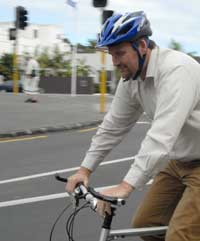
Bernard Hickey Riding His Bike Down Kelmarna RoadBy Bernard Hickey It seems, according to the NZHerald, that the National government is considering subsidising the Auckland Regional Council's  NZ$1 billion plan to electrify the Auckland passenger rail lines. In theory, National would buy the electric trains as a type of compensation for canning the 9.5 cent per litre regional petrol levy, the newspaper said. Here's a taste of this slightly speculative piece.

The Herald has obtained a letter from Transport Minister Stephen Joyce to Auckland Regional Council chairman Mike Lee in which Mr Joyce said it "makes sense" to consider whether Government-owned KiwiRail, rather than the regional councils, should buy and own all new passenger trains planned for Auckland and Wellington. An announcement is expected this week, when the Government is also likely to confirm it will drop a regional fuel levy which would have added 9.5c a litre to petrol and diesel prices in Auckland. The letter follows concern from Mr Lee about how the council would pay for the rail electrification if the Government got rid of the regional fuel tax.

The devil will be in the detail, but I think the government should think more than twice before subsidising the electrification of rail in Auckland at least. Wellington may make sense given heavier rail usage, but I'm also doubtful. I have yet to see a proper economic justification for the electrification of rail. Currently each rail passenger current receives at least NZ$3.50 of public subsidy for each trip in Auckland. Prices would basically double if the passenger had to pay the real price. Auckland does not have the concentration of population or the concentration of workplaces in the CBD to justify a heavy rail system. Even rail systems in concentrated cities like London require massive subsidies. Buses work because they don't require massive investment in rail lines and are very flexible. They work for a dispersed city like Auckland. Rail doesn't. You could argue that the public benefits and the greenhouse benefits of rail justify the subsidies. But I have yet to see this analysis, particularly when the congestion and greenhouse benefits can be found much more readily in buses. Or cycling. Can the government really afford NZ$496 million on infrastructure that does not wash it's own face? Your views? Comments below please.

We welcome your help to improve our coverage of this issue. Any examples or experiences to relate? Any links to other news, data or research to shed more light on this? Any insight or views on what might happen next or what should happen next? Any errors to correct?

We welcome your comments below. If you are not already registered, please register to comment in the box on the right or click on the "'Register" link at the bottom of the comments. Remember we welcome robust, respectful and insightful debate. We don't welcome abusive or defamatory comments and will de-register those repeatedly making these comments.

1 Comments

Bernard Who said buses work?

Bernard

Who said buses work? What is the subsidy per bus ride? Public transport is not about energy efficiency it is a social service and it frankly p%%es me off how the bureaucrats (and green politicians) keep trying to spin it into an environmentally friendly 'solution' whilst carefully hiding the facts from us all.

Hugh wants to built great tranches of cheap houses on the fringe, how is that going to be serviced, basically his 'solutions' to the housing price crisis requires cheap oil and that may well be at risk.

Electrifying the rail network in Auckland is a stopgap measure which will reduce demand on the motorway system so we can continue BAU for a few more years (exactly as the northern busway was about extending the life of the harbour bridge) and at $500 million costs half of Helens looney plan to tunnel thru waterview

Its not the money that annoys me its the lack of transparency.

Neven

Bernard I disagree completely. I

Bernard
I disagree completely.
I take the train in Auckland, its patronage has increased greatly over the last 2 years as petrol prices have surged.
It can be rather unreliable, and I have thought twice about using it given its unreliability.
Improve the system and its reliability and people like me will definitely stick with it. You'll probably even see significant further increases in patronage.
I train from Greenlane. If I bus I am faced with a 35 minute plus trip at rush hour. The train is 15 mins.
Buses are always faced with the problem of being stuck in amongst car traffic. Bus lanes help to a limited extent.
Subsidising trains will limit the need for expenditure on motorways and new roads, so although there is a cost, there are also longer term savings. And as the auckland Councils have a mandate to intensify around town centres and public transport corridors, patronage of trains should grow.
Not to mention the green house gas reducing benefits of train transport over buses and cars.

Matt, How much does that

Matt,

How much does that train trip cost you? Or more accurately, how much does it cost me and other taxpayers?
You might find it's cheaper to take a taxi if you had to pay yourself.
I have a better suggestion. Cycle.
I often cycle from the edge of Greenlane/Epsom to Herne Bay for work and it takes 25 minutes. Cycle with me and you can ride in my slipstream. I have a very large slipstream....
That costs the taxpayer nothing, costs me nothing in petrol, and generates little greenhouse gases, apart from my coughing, wheezing and burping.

Neven911
I agree on the lack of transparency. Who knows how much it really costs? Or what the benefits are? Especially when we have no idea yet what our greenhouse gas costs will be.

cheers
Bernard

Bernard : We may be

Bernard : We may be facing the same sad scenario that the USA is. Namely, we've had a change of government, much heralded and applauded ; but now the dust and hoopla has subsided we see they have the same inherent faults as the vanquished : They let their hearts rule over their heads. Some grand new ideas, a sop to the Greens ( country long cycleways & rail electification ), but in reality another monumental waste of tax-payers money.

Bernard But how much does

Bernard
But how much does congested motorways cost the economy in terms of business (congestion related time delays), the environment (green house gases), and our health (air quality)?? Hugely I would suggest.
I agree that cycling should be encouraged too.
thanks for the slipstream offer!!!!

Governments are always gonna waste

Governments are always gonna waste taxpayer money. It's what they do just accept it

Look at it this way - electric trains must be one of the best ways to waste money on. Nice roomy trains will actually improve the lives of many people

Would you rather they dump a billion on prisons or military stuff?

Steve, I don't mind governments

Steve,
I don't mind governments spending on infrastructure. But we should do a proper cost benefit analysis first. This has never been done for electrification.

Matt in Auckland,
You may be right on time delays and greenhouse gases. But I haven't seen any proper studies on the impact.
My bet is more money on broadband, allowing more people to work from home, would deliver more bang for our buck. But again, until we have an analysis, we shouldn't be spending money on either.

cheers
Bernard

My opinion as a Wellingtonian

My opinion as a Wellingtonian and a cycling commuter:
Cycling lanes (with infostructure) make much more sense than buses or trains.
-Can't speak for Auckland but it would work here.
I noticed in Europe (France I think) that they have a cycle system similar to the way they use supermarket trolleys (coin operated). Seemed to be working too.

Biggest problem inhibiting cycling in Wellington is the personal danger.

Bernard Nice to hear that

Bernard

Nice to hear that you are not flatulent (for those who cycle behind you). Certainly Matt has rose tinted glasses as far public transport is concerned, its a faith based "build it and they will come", unfortunately it is a mirage, the more services you put on the lower your utilization, and without a regular service they won't come at all. utilization is the key to efficiency, the most perverse thing is that to majorly increase the efficiency of public transport you have to carry people further, which is why it is cheaper per k to fly to Sydney than take a bus into Auckland CBD. So you end up with this Kafkaesque situation that public transport is efficient as long as we move people a long way, somewhat self defeating on the environmental front wouldn't you say?

I have a copy of a report from the ARTA called "TRANSPORT COST ANALYSIS: a case study of the total costs of private and public transport in Auckland" which is an interesting read, basically a justification of public transport based on dragging in every cost they can think of (including the Humanitarain cost of car accidents) and as bus users don't generally die (though we have had a spate of buses killing pedestrians lately) you guessed it, that public transport is actually subsidized less that private transport

What is also in this report is public transport is actually a small part of Auckland transport (and therefore doesn't carry the burden of costs) and therefore if you scaled it up to the point where is significantly contributes (by spending billions of taxpayer dollars) the scales would probably tip, so that t was the largest polluter, it did the most environmental damage and people still required a car.

What we need is a vision of a city where you can function with neither a bus/train or car

Neven

The cycle hire system in

The cycle hire system in Paris was brilliant the week the RWC final was on - the city kept moving in spite of the metro strike. London is about to copy the Parisians.

The only time I have

The only time I have agreed with Marcus Lush was when he suggested that the motorways in Auckland be changed to cycleways. No significant hills, lots of room, a good surface - hitting a pothole while on your bike is not pleasant at all - and no drivers opening their doors just as you approach their car.

I don't want government involved

I don't want government involved in any of these issues: bureaucrats are lousy at running business.

Regarding transportation, have a look at the US situation in this Stossel doco:

http://www.youtube.com/watch?v=dtwdVInR1Gw

Then slightly related :), does anybody else see the irony in these two quotes from today's media:

From government press releases, via NZX: http://www.nzx.com/news/economy/4876702

Quote: "The Government is set to embark on an overhaul of the rules surrounding overseas investment, as it looks to attract more foreign investors to New Zealand."

And then the below from: http://www.stuff.co.nz/timaru-herald/business/2264120/BNZ-to-fight-big-t...

"Bank of New Zealand will square off against the Inland Revenue Department in the High Court in Wellington today in a case that could eventually cost the big banks about $2 billion in unpaid taxes and interest. ...

If the Inland Revenue wins its case, it would affect foreign investors' perception of New Zealand, he said."

Just noticed in passing.

this public transport spend up

this public transport spend up is going to send the country broke if it isnt allready.Rail is allways fantastically expensive ,especially for our tiny population and running trains and buses 24/7 when they only full a small part of the time is crazy.Read Sir Rog Douglas speech over the weekend,he's onto it.Slaves on wages like me cannot afford whopping rates increases to subsidise the train lobby- make it full user pays I say !

Trains are already electric in

Trains are already electric in Wellington.

I disagree with you regarding

I disagree with you regarding the railway upgrade. Railway is an essential public infrastructure which is a lot more utilized in other developed countries. If you only look at carrying people, it might look uneconomical, but because New Zealand (not just Auckland, but also inter-regional connection as well) don't have a well-functioning railway system, industries are heavily relying on motor vehicles for transporting goods and people. Inadequate railway system in NZ certainly discouraged development of manufacturing sector, and also wrongly facilitated building badly designed motorway junctions which soon became chronic bottlenecks of the traffic. Buses are used in a lot lower population density areas, and relying on buses on congested road is so unreliable. Auckland certainly has enough mass to have railway reasonably utilized; there are a number of cities about the same size as Auckland but have better railway system. I should also note that poor infrastructure really disappoints foreign investors too.

Mitch O Quite right about

Mitch O
Quite right about Wellington being electric already. But the Herald is reporting that the government might buy new electric trains for the line. This may make more sense given the lines etc are already there and Wellington is more 'train friendly', particularly for that Hutt-CBD line.
cheers
Bernard

The nearest city to Auckland

The nearest city to Auckland with a 'real' metro rail network is Sydney. The train lines were largely built many years ago, but development tends to run alongside the lines. For example areas like Hornsby and Waitara (20km or so from the CBD) are packed with hi-rise apartment buildings only two or three minutes from the railway station.

Building a decent rail network in Auckland, then letting developers create good, affordable home near the stations would solve more than just simple traffic problems.

Simply put Auckland cannot continue

Simply put Auckland cannot continue the way it has been going for that last 20 years and expanding into endless green fields both North and South. When we stop this madness and start to concentrate development on urban centers close to public transport then the use of rail will make total sense. The thing is that we have a chicken and egg situation, people don't want to live in high density housing without public transport and until we have the population to support public transport it will make no financial sense. Decent public transport is a no brainer for any growing city, now is our chance to build a commuter rails system fit for our times and electrification is just one step on the road to this goal. If we can get the city planners to support a proper development plan that harnesses this transport system then we should end up with a great city.

It's one of those tricky

It's one of those tricky things! I went for a 'round the world trip a few years ago and quickly learned to categorise cities into those where public transport sucked or it didn't. Where it didn't suck they invariably had rail, which could get you where you were going faster than a car.

Where it did suck you were stuck with buses, which were by definition slower, generally wound around circuitous routes rather than going direct, and were a pain in the ass to figure out routing for.

If done properly rail is a great solution from a citizen productivity point of view. Rail should provide very high speed transport between major hubs, with buses and private transport filling in the gaps. An interesting thought experiment would be to imagine a massive park 'n ride combined with a free high speed express trip into the city. Why sit in your car for 30 minutes when you could be there in 10 and not have to find or pay for a parking spot in the city? What effect could this have on the congested motorways? What effect could it have for the thousands of people who suddenly have an extra hour in every day?

Of course it all costs money, and rail is expensive. Bernard may well be right and it might be too expensive for us ... but with a proper solution it could have tremendous benefits. I'm probably in the minority but I have no problem with my taxpayer dollars being spent on a decent rail system for Auckland ... this despite the fact I live in Christchurch!!

The Wellington regional council has

The Wellington regional council has already ordered trains for the Wellington line, so Wellington ratepayers are paying for them. The Auckland ratepayers should really be paying for their own rail improvements

Bernard Well isn't this thread

Bernard

Well isn't this thread the antithesis to Hugh "Whack em up on the fringes for 200K and we'll all be sweet" Pavlitich?.

Actually I think rail is old and passe they should be looking at a monorail, quiet, automated and could probably be self funding.

Neven

The rail investment would be

The rail investment would be a one off set up cost, followed by routine maintenance and possible expansion later if need be. This coupled with a decent road system must be good for Auckland. Rail technology is and will move up a notch, i.e. lighter, safer and quicker which will equate to a more efficient rail service. This business of the cost of subsidized rail fails to take into account the unseen factors like air quality, stress, noise, time and space (1 person per car, 10 minutes to go half a km) whats all that worth health wise, do we know? Electric rail could future proof us against oil shortages it could or might be a way of getting fiber optical cabling to the suburbs of Auckland. To me there is more to it than money but in the long run it could be that's exactly what it will be about, only saving money right across the board.

<a href="http://www.linkwhore.co.nz/?p=558" rel="nofollow"> Link

Link to the article referred to by Neven above: TRANSPORT COST ANALYSIS: a case study of the total costs of private and public transport in Auckland.

On one hand , improve

On one hand , improve the motorways and acesss to /from them
On the other get train and public transport convenient enough to use...

Even if the 2nd happens/ exist the Aucklander is still going to use 1 of their 2 cars....
And since congestion is a slow growing issue, the Aucklander tends to grow with the incovience...at what piont of inconvenience will the will the Aucklander swap inconvenience of traffic for public transport , regardless of how good it happens to be?
Put simply, the planners are caught between the ocean and deep blue sea.

Our daughter and husband was having their 1st baby, visiting to middlemore was a hassle, and parking expensive, so we thought what the hell...drive to the station, catch the train....faster, more relaxing, and 1/4 of the cost !!!!!!
Then we went for a day out into the CBD...again great day.
Have we used the train since?...no Auckland mentality....and the lack of security parking the car at the train station.... we could catch the circuit bus to the station 50m up the road....the time taken for the circuit bus to get to the train station...may was well drive into the CBD.

As to electrifying, my thoughts are the same as BH.. is it justified...
AND what about the supply of the electricity? is it reliable enough, is there enough...
Damns, upgrades of the national grid has to be sorted out 1st, and RMA sorted...

So the logistics would be spend on building 'damns' up grade the national grid planning for the next 40yrs, Auckland traffic left get to a point where the Aucklander (JAFA), starts using public transport THEN upgrade....
But than commonsense doesnt get votes for the politicians, so the politicians would not consider it even as a feasible plan.

BH
"Can the government really afford NZ$496 million on infrastructure that does not wash it's own face?" a polite way of putting it, but spot on.

Bryan Thanks for adding the

Bryan

Thanks for adding the link! on page 4
This has been calculated via the average bus (26.29 passengers) and car (1.3 passengers) occupancy and total annual vehicle kilometres travelled for buses (26 million km) and cars (6,968 million km) in 2001

This is blatantly twisted and downright wrong, no bus service in Auckland averages 26.29 pax, it is closer to 5, This they actually do not know because bus companies do not report their repositioning K's to the ARTA. If they used the figure of 26 for the rest of the report then the case for buses is overstated by a mere 500%

Neven

Steps We actually have so

Steps

We actually have so much electricity in NZ we export it (via the Ali Smelter), I can't see your plan of letting traffic degrade and then upgrading working, It simply is to short sighted, this is how Auckland sprawled in the first place, as we got wealthier we all got our own cars and built roads. Mind you I don't see electric rail as a panacea either

Neven

Hi Neven Where do you

Hi Neven

Where do you get your number of 5 passengers average from ? As a regular bus user I tend to agree but would interested if you can point to some research.

Bryan

"An interesting thought experiment would

"An interesting thought experiment would be to imagine a massive park "˜n ride combined with a free high speed express trip into the city. Why sit in your car for 30 minutes when you could be there in 10 and not have to find or pay for a parking spot in the city? What effect could this have on the congested motorways? What effect could it have for the thousands of people who suddenly have an extra hour in every day?"

That is a great idea. The Northern Busway (North Shore to Britomart) has been a huge success and could be improved further - more parking, faster cleaner buses etc.

Matt Nolan argues that the

Matt Nolan argues that the regional fuel tax much better tax policy here.

I agree with Steptoe -

I agree with Steptoe - the whole system needs to be integrated. Vancouver is a good example to follow I am told.

How to get Aucklanders to use public transport - set the petrol price over $2.00, that worked. But there has to be a system to use, not one or two trains per hour and not buses that fill up at the first few stops and then leave passengers waiting at subsequent stops.

The longer Auckland leaves this problem, the harder it is to resolve it - and more expensive.

Bryan From Richard Scott (TRANSPORT

Bryan

From Richard Scott (TRANSPORT NETWORK ANALYST) at the ARTA,
From emails I exchanged with him
The total bus patronage for the year ending June 2007 was 42.7 million boardings and the total service Km 42.9 [million k]which equates to .99 passengers per bus km. and
Passenger kilometres is a different measure and the annual passenger Km
for 2007 was 259,899,000.
Giving an average journey of 6.08km.

Which gives an overall average load of 6.02 which I reduced to 5 because the 42.9 million k does not include repositions (all those buses saying 'sorry - out of service')

The reason I asked him this question was that I was sitting at a bus stop trying to get into the CBD on a Friday afternoon and 4 buses came past displaying 'sorry - out of service', repositioning for the out of town rushhour, I then did a little "thought experiment" and realized to my horror that a rushhour bus can never be more than 50% full and one that stops on its run 25%, that is the ideal, so was not surprised when it came back at 6.02

I then queried Richard on how many of these K's were empty repositioning, the answer was a classic, they don't know because it is a cost to the bus co and therefore "commercially sensitive", so these guys are preaching environmental benefits to us and they cant quantify if there are any!

Neven

Thanks Neven I'm looking forward

Thanks Neven

I'm looking forward to reading through the document in detail.

Bryan

Look, every half truthful study

Look, every half truthful study on this issue comes up with the following realities.

The true cost of running public transport is so high that if fares were "user pays", nobody would use it.

The true cost can be calculated simply by dividing total running costs of public transport by total fare revenue: then just multiply every fare by that factor.

If it is cheaper for a given traveller to run a given car rather than pay true-cost reflecting public transport fares, then that car uses less resources than public transport; not even counting the energy used to get to and from bus stops.

The cost benefit ratio of getting a shift like 10% of car users, to public transport, is exponentially worse than the cost benefit ratio of simply providing new roads and lanes; if there is even a benefit at all. Because most travel is done only at certain times of day, huge "investments" in rolling stock would be necessary to cope with such a shift. Roughly ten times as many people use cars as what use public transport. This means that a 10% decline in car use, shifting to public transport, requires nearly a 100% increase in public transport subsidies. It is a myth that increased patronage will bring efficiencies sufficient to negate this need.

If we attempted to run a public transport based, car-free transport system, the cost would be greater than our entire current GDP and/or the lost flexibilities of individual motor vehicles would lead to massive economic contraction. Look at the former USSR. Do you think that their public transport was more efficient than our car use? Did you know that they were far worse wreckers of the environment on every measure, and used more resources per unit value of GDP, than capitalist countries?

Car-free societies absent totalitarian planning, were (Victorian England) and are (Slumdog Millionaire) mixed-use land use societies with people and animals living above and around factories and offices. We will only reach the stated aim of resource conservation and emmissions reductions to the extent we return to such a society. Long distances are the main problem, not modes of transport.

Limiting sprawl does not achieve the desired result because of the effect on land prices. Alain Bertaud's work on urban density profiles show that average commute lengths have increased in cities like Portland precisely because of this effect. The cost of land closer to the urban center becomes prohibitive, and most of the infill development takes place closer to the more affordable fringes. Seriously, take a look at his graphs.

Cities that have been allowed to develop closer to Lassez-Faire principles actually end up with lots of mixed use land use and multiple nodes and much lower average commute distances, and urban density profiles that slope evenly from the highest at the centre, to the lowest at the fringes. The low density at the fringes means that the commuting done by these people is of minimal effect, while the affordability of land is retained over the whole urban area, meaning that many people who could not have afforded to live closer to work under the controlled scenario, can do so under the "free" one.

Trains initially served the use of getting wealthy people over longer distances faster and in more comfort than horse drawn carriage. Trains have had their day long since.

We are doing ourselves serious economic and environmental harm with our mistaken assumptions about all public transport.

I heartily recommend the online

I heartily recommend the online essays:

David S. Lawyer "Does Mass Transit Save Energy?"

Brad Templeton "Is Green US Mass Transit a Myth?"

Ali Modarres "Commuting Patterns in Multi-Centered Urban Settings"

Ari Vatanen and Malcolm Harbour: "European Transport Policy: Strangling or Liberating Europe's Potential?"

Alain Bertaud:
"The Costs of Utopia"
"Clearing the Air in Atlanta"
"Sprawl and Urban Spatial Structures"
"Urban Transport and Cities Spatial Structures"
"Efficiency in Land Use and Infrastructure Design"

Owen McShane:
"The End of Cheap Oil and Urban Form"
"Why Urban Planners Love Global Warming, and, as usual, have got it all wrong"
"Alternatives to Smart Growth"
"Back to the Future"
"Why Planned integration of Land Use and Transport will not achieve its goals"
"Petrol Prices, Driving Habits, and Public Transport"
"Double-Bubble, and Oil, and Trouble"
"Applying Systems Intelligence to Transport"

Randal O'Toole:
"Real Global Warming Fix"
"Debunking Portland"
"Roadmap to Gridlock"
"Does Rail Transit Save Energy or Reduce Greenhouse Gas Emissions?"

Joel Kotkin:
"Opportunity Urbanism"
"Back To Basics"
"The New Suburbanism"

Wendell Cox: "The Illusion of Transit Choice"

David J. C. McKay "Sustainable Energy - Without the Hot Air"

Steve Polzin: "Energy Crisis Solved"

Ted Balaker and Sam Staley: "How Traffic Jams are made in City Hall"

William Eager: "Population Density and Reduced Road Congestion"

People run their own cars

People run their own cars by choice. The taxes they pay for petrol alone, covers the cost of roads and externalities. It is public transport that does not pay its way even for running costs let alone externalities.

No-one would use public transport by choice if they had to pay the true cost.

The worst thing here is that people are being lied to about what their hard-earned rates and tax money being spent on public transport, actually achieves. It has never achieved cost-benefit justifiable reductions in road congestion and it has never achieved real reductions in resource use or emissions, let alone cost-benefit-justifiable reductions. We would have been better off in every way to have never spent a cent on public transport subsidies, and simply built more roads and lanes and had lower congestion.

If there were no public transport subsidies, and no government interference in transport, entrepreneurs would identify opportunities to run appropriate vehicles on appropriate routes at appropriate times of day, and make a profit on it.

If you understand economics, you will understand that if people buy product A because it is cheaper than product B, it is simply because the making of product A is a more efficient use of scarce resources than the making of product B. It is not necessary to attempt to trace the whole process from one end to the other: (refer to the essay "I, Pencil" by Leonard Read: to see how complicated it is to calculate all the inputs into making a pencil) the price is the quick answer.

If public transport fares absent subsidies would have to be more than people would pay, then it is not an efficient user of scarce resources. Actually, you do not have to look very far into the way Public Transport is run, to get a gut confirmation of this.

It is NOT a question of running 30 people from A to B by bus, compared with 30 people running their cars from A to B, and it never has been.

The 30 people get from 30 different "A"'s to 30 different "B's". To get the bus to pick them all up and drop them all off, would take so long that nobody would use it. The only people that use the bus today, are the small minority who it really suits.

The bus has to start somewhere empty and finish somewhere empty. Its average loading for the 1 trip is more like 15 people. Then it has to go back to the start mostly empty; average loading drops to below 10. That is just for the peak times of the day, which are the only times when running these services might make any sense at all. But then we have the lunacy of running that same bus around all day, with average loadings not exceeding 3 people.

Why is it so freakin' HARD for ratepayers and taxpayers to see this? You are being fleeced for no good reason. The environment is not being saved and there are stuff all less cars on the road; if public transport use increases 10% there are only 1% less people on the road. It is exponentially cheaper to build new roads for the 10% odd people who do not yet use cars for their travel, than it would be to provide buses and trains for the 90% of people who do not use public transport: in fact the latter has been calculated to cost more than our entire GDP.

As for the social objectives of running buses and trains for poor people to use during the day, this is so expensive that we could provide hired stretch-limos for them at a lower cost, to pick them up at their door and drop them off where they want to go.

Philbest - lots to read

Philbest - lots to read there, thanks for that.

You say " The true cost can be calculated simply by dividing total running costs of public transport by total fare revenue: then just multiply every fare by that factor."

How do you factor in the cost of railway tracks for instance - only the maintenance is a running cost. The cost can be amortised/depreciated - is this what you mean?

This might be a dumb

This might be a dumb question - but isn't it already electrified? What are those wires slung over the tracks? If all we are talking is new locomotives then there is no difference - a diesel locomotive is just an electric locomotive with a giant diesel generator bolted on. Sure locomotives cost 25 times the cost of a bus, but they haul at least ten times as many people and last 4 times longer. Trains can shift huge numbers at peak times, unlike busses that still largely sit in traffic. We need buses, but they won't form the backbone of a city of 2m people, which Auckland should be planning for. Long term the choice is really between European style dense cities or American style sprawl with inner city decay. There are some lovely American cities - Boston, San Francisco and New York, but they all have great public transport unlike the hell-holes of Detroit and LA that have relied on the "free market" or should I say corporate sponsored private motor vehicle solution.

Neven . " I can’t

Neven .
" I can't see your plan of letting traffic degrade and then upgrading working, It simply is to short sighted "

I think u miss the piont...people like cars, get them out by congestion...they start using Public transport and then upgrade as they do..the objective is long term use of more effective transport...or put another way, more leisure time coaching the children's soccer team.

Steps This is all predicated

Steps

This is all predicated on cheap oil, despite Phils ravings he doesn't seem to understand "the" fundamental of economic growth and that is incremental production or a substitute has to be cheaper than the current production. This has been the case for the past 100 years because its has been underwritten by cheap energy, it didn't matter that the quality of copper ore declined, we had bigger and more powerful machines to extract it.

The whole energy ponzi scheme may be coming to an abrupt halt, this puts the kybosh on Hughs suburbs and what we may have to realise is that we can no longer 'afford' the dream that was on offer.

Yes we love our cars but if they cost 4 times what they cost now to run would we love them as much? Unfortunately if public transport offers no respite (ie it is as energy inefficient as private transport) then it is not a solution, it is a false deity. The only way to avoid this is Bernards bike (I also bike a lot and work from home)

Neven

Yes. Quite right. More lanes

Yes. Quite right. More lanes on more roads is the only sane answer. The market, free of regulationm, is CLEARLY so superior...
Of course they should knock down your house, not mine, to build the new road. Actually you had better keep that motorway just a little further away from my house - the noise is so irksome.
And if only Keys would sort out the RMA we could put dams on every river in the South Island, drown anything resembling a unique ecosystem, and cover the growth in electricity demand for at least a couple of months.
And as for biking... really Bernard, I am surprised at you. So dirty and sweaty... almost as much effort as walking to the bus stop... but at least you do not have to share germs with all those poor people on public transport (if only they would get themselves finance for a car).

...now if only I could find some sucker to buy my house, so that I can buy a nice house-boat (sea level rise is such a drag when you live in a coastal city...)

Chicken and egg. If there

Chicken and egg. If there is good public transport that goes to somewhere people want to go, then people build houses near that public transport, and companies open offices near that public transport.

For Auckland, I have no problem with using the existing railway lines. They're already in, the corridor exists. I suspect that with a good service and zoning rules that allowed infill housing, that people would start living closer to the stations.

The problem is probably where it terminates - how many people's jobs are close to the end of the railway? How do you get from the station to work?

That would be a start, but it won't fix all the problems - too many places in Akld are nowhere near a train station. There could be park and ride to help with that (maybe with apartments built above it), or we need another option. I doubt new rail lines would ever pay for themselves (they certainly don't in Sydney), another alternative is buses for those areas that don't have rail. Problem is, now we're multimode - ride the train till you're close, shift to bus. It's enormously more efficient on a single mode.

Over 30 years, Auckland might change to locate along the railway line, if it were there and useable. Maybe we need some vision now to start the changes.

neven911 Says: "Yes we love

neven911 Says:
"Yes we love our cars but if they cost 4 times what they cost now to run would we love them as much?"

Well maybe Im an exception to the rule...so it is a denfinate YES..
I dont think there is much that could convince me each day not to drive the early Camaro or the Bradford...Both appreciate and maintance is less than 1/2 of the toyota, and insurance/registration 1/2 or less...on the other hand im one of those fortunates that can choose what time I drive.

Just a thought..I have had a therory for many yrs now...the whizz kids who design our motorways have no commonsence.
Congestion is caused by too many cars on a partular road/motorway at one time...so instead of coming off a motorway, go 1 or 200 ms then have a major interesction, banking cars way back...
The off ramps should have roads dividing up in different directions each for a km or so THEN a smaller intersection.

If all the money (millions) milked from the taxpayers over the last 50yrs by over paid 'consultants' for the repeated studies on transport in Auckland, which all piont to similar rapid rail systems, had been spent building such a system it would be built and paid for by now.
A matter of "too many cooks......"?
The Auckland transport sytem is very profitable to some, so long as nothing that is proposed is actually done.

Careful Mr English, you're starting

Careful Mr English, you're starting to look like Mr Mag00 on roller skates.
Here a billion there a Billion,
old MacEnglish had a Vault
it was empty not his fault
so he borrowed billions to stimulate
but the end result was not that great
the soverign rating took a hit
and from that point on,
we were in the sh

I'm loving the poetry. Only

I'm loving the poetry. Only on interest.co.nz
cheers Wally

Bernard

Steps I'm not talking about

Steps

I'm not talking about cars like ours (my current list 1973 911E, 1970 914/6, 1985 Golf GTI), I'm talking utilitarian commuter cars, When its costing you $100's to commute from your Hugh McMansion in Kaukapakapa 100k's everyday, suddenly your cheap house isn't so cheap no more

Actually Camaro & Bradford? What strange bedfellows (couldn't find a Jupiter?)

The problem with Auckland is not the consultants, it is its whole genesis, a car designed conurbation of the 20th century, like its ugly friends, LA, Houston, Brisbane, Sydney, Melbourne...

Neven

You could GIVE em all

You could GIVE em all a moped...or redevelop the old push bike bike with the little motorised rear wheel that was around in the 50s. Very economical. no need for more of ANYTHING....road or rail.

Chinese and Asian cities in general work better than over thought AUCKLAND.

Stop thinking and start doing, we cannot afford any more CONSULTANTS.

Then the rest of us who don't live in AUCKLAND can get a little peace. Enuff already.

<a href="http://www.linkwhore.co.nz/?p=569" rel="nofollow">Video

Video here of an interview on TVNZ Breakfast with a spokesman for the Campaign for Better Transport discussing the proposed national fuel tax.

Neven911, would you agree with

Neven911, would you agree with me that the free market will sort out all the unknowns far more effectively than 10 year plans?

The reality is that if peak oil is real and AGW is real, public transport is no fix. I have actually read every one of those articles, essays, and reports I have listed above; that is how I came to make the list.

Public transport in its current subsidised, "social objectives" form, is actually doing more harm than good. It is a pretty good economic rule of thumb that if it needs subsidising at all, it is not an efficient use of resources.

We can make huge gains in average vehicle efficiency yet; there are still people who buy V8's by choice. Price rises will accompany resource depletion, and average vehicle efficiency will rise. Even with today's technology, we could gain 70 or 80%. But of course there will be further technological advances. Heck, Greenies themselves talk about this out of one side of their mouths, when it comes to energy SOURCES, but they talk out the other side when it comes to energy CONSUMPTION by private vehicles using roads. I believe that new technology, electric cars and so on, will be very quickly supplied at affordable prices through manufacture in Chindia; at the moment they are made in small quantities in the USA or Europe and are just unaffordable. Think of the first one-piece carbon fibre bicycle frames and what they cost (Kestrel; $10,000?).

Internet-based car pooling/ride sharing alone, is an answer that public transport is not. ANY full car is already more efficient than even the fullest bus or train, and any car with two people in it is already more efficient than the current public transport average. I think if the authorities want to get serious about this issue, taxi licensing regulations should be abolished to allow anyone to carry a passenger for a fee. That would incentivise participation by all those drivers with spare seats.

Then we must return to more flexible uses of land. It makes no sense to force lengthy commutes through rigid zoning that was based on a previously popular ideology; society has taken one step forwards and two backwards. Along with dispersion of sources of jobs, we need interconnectedness to minimise trip distances and times by road. It is an economic impossibility to provide this interconnectedness by public transport.

The model being pursued by our planning classes now is just so wrong-headed that one suspects that they are driven by ideologies other than genuine concern for humanity and its environment. Their model will only work under conditions of such population density, that totalitarian rule would be necessary to achieve it. Alain Bertaud's study on Atlanta concluded that Atlanta would need to abandon two thirds of its existing housing and retract back into the remaining one third, if public transport was to be viable. But of course the reconstruction that would be necessary, would consume so much resources that it would be doubtful whether recouping them would be possible through the alleged efficiencies of the higher density.

William Eager's study in my above list, shows that increased population densities result in more road congestion, not less, for the simple reason that greater majority of the increased population moving into an area still opt for car use. The exceptions may be downtown Hong Kong and Manhattan.

Such high densities bring their own environmental and quality of life problems. It is far from certain that the resource efficiency and emissions of high density living are superior to urban sprawl. Urban sprawl is partly the result of choice and partly the result of zoning fashions of the past. Free market choice is actually a very good allocater of resources. I believe that those zoning fashions of the past have given us the longer commute distances that are our main problem today: under a freer market in land use, we might have had more urban sprawl but we would also have lower average travel distances.

We don't have a "school zone" that we all pack our kids off to 30 km's away by train; I fail to see why we have to have "workplace zones", if we really do have such a "crisis" of resources and emissions to confront.

Isn't it funny how the political classes favoured "solutions" to any problem invariably involve reductions in human freedom, even when an increase in human freedom would be a better solution, knowledge of which needs to be suppressed accordingly?

Phil <strong>Neven911, would you agree

Phil

Neven911, would you agree with me that the free market will sort out all the unknowns far more effectively than 10 year plans?

Not in the case of falling net energy, the 'free' market is based on endless growth. We have falling net energy per capita currently and neither TPTB or the economists can appreciate the effects. And if you think efficiency increases, electric vehicles or car pooling will make any difference then you don't appreciate Jevons paradox

All the essays and studys you pointed to were composed in this growth environment, where the philosophy of public transport was more important than the energy efficiency, but now the rules have changed.

I fully expect in the next 5 years this will become self evident as the 30 Billion barrels of oil we burn a year drop by a gross of a few percent the net drop will be far faster and it will not be commuting we worry about, but food supply

Neven

Here's my latest views on

Here's my latest views on this here.

http://www.interest.co.nz/ratesblog/index.php/2009/03/17/opinion-this-au...

cheers
Bernard

neven911 "Actually Camaro &amp; Bradford?

neven911
"Actually Camaro & Bradford? What strange bedfellows (couldn't find a Jupiter?)"
Where u are concourse? had both there..the Camaro was the tow vechlie lol
Megiures made a nice job on the camaro.
Email me jowettnz.sytes.net web master lower left bar link

Can't complete the city loop

Can't complete the city loop tunnel until the line is electrified. Once the city loop tunnel is completed and Britomart is no longer a terminus with a one way in and out choke-point, the capacity and efficiency of the rail system increases immensely.

To Mark Hubbard: "And then

To Mark Hubbard:
"And then the below from: http://www.stuff.co.nz/timaru-herald/business/2264120/BNZ-to-fight-big-t...

"Bank of New Zealand will square off against the Inland Revenue Department in the High Court in Wellington today in a case that could eventually cost the big banks about $2 billion in unpaid taxes and interest. "¦"

Yeah, we wouldn't want the banks to actually pay their taxes, would we.

$191M of tax on $2.87B profit is disgraceful. Go the IRD!!!

My opinion on this matter

My opinion on this matter is that, the project is heavily expensive and not that flexible unlike the normal transport system in Wellington. Thus the government should think more than twice before subsidizing the electrification of rail in Auckland at least.

interesting article

interesting article