
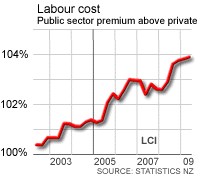
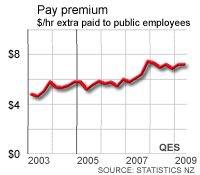
 University of Waikato School of Management Economist John Gibson has published a study of public sector pay versus pay in the private sector and found public servants are on average paid 17-21% more than their counterparts in business.
The study used 2005 data and adjusted for various components including the level of stress, the amount of physical work and levels of educations. It therefore is an apples for apples comparison.
Gibson said the differential is likely to have widened since 2005 because of faster pay rises in the public sector.
University of Waikato School of Management Economist John Gibson has published a study of public sector pay versus pay in the private sector and found public servants are on average paid 17-21% more than their counterparts in business.
The study used 2005 data and adjusted for various components including the level of stress, the amount of physical work and levels of educations. It therefore is an apples for apples comparison.
Gibson said the differential is likely to have widened since 2005 because of faster pay rises in the public sector.
 "The findings should be a valid estimate of what a given worker would gain when moving from the private to the public sector and doing an otherwise similar job," Gibson said.
"Interestingly, because this study only compares like with like, it appears that higher pay levels in the public sector have little to do with needing to pay more to attract more skilled workers," he said.
Have your say on the issue of public sector pay versus private sector pay.
Are public servants overpaid?
"The findings should be a valid estimate of what a given worker would gain when moving from the private to the public sector and doing an otherwise similar job," Gibson said.
"Interestingly, because this study only compares like with like, it appears that higher pay levels in the public sector have little to do with needing to pay more to attract more skilled workers," he said.
Have your say on the issue of public sector pay versus private sector pay.
Are public servants overpaid?
 Are you having problems with staff being poached by the public sector?
Are public servants more productive than their equivalents in the private sector and therefore justify the extra pay?
Does this drag on New Zealand's productivity and cap our growth rate? Is this a problem for the Reserve Bank in its battle to fight inflation? Does it therefore keep interest rates higher than they otherwise would be?
Here is the full press release relating to the paper from Gibson.
Are you having problems with staff being poached by the public sector?
Are public servants more productive than their equivalents in the private sector and therefore justify the extra pay?
Does this drag on New Zealand's productivity and cap our growth rate? Is this a problem for the Reserve Bank in its battle to fight inflation? Does it therefore keep interest rates higher than they otherwise would be?
Here is the full press release relating to the paper from Gibson.
With one eye on the upcoming election, public sector unions are pushing for big pay increases to lock in gains for their members before a possible change of government. But public servants can hardly claim they're currently underpaid, according to research by a University of Waikato Management School economist. The study, published in the New Zealand Journal of Employment Relations, shows that public sector employees already enjoy a substantial pay premium compared to workers in the private sector. "The average pay differential between the public and private sector was between 17% and 21%," says Professor John Gibson. "The study was based on 2005 data, so given the faster rate of public sector pay rises recently, the premium is likely to be even higher now." Prof Gibson's study compared workers in the public and private sectors using data from the New Zealand component of the International Social Survey Program Work Orientations Survey "“ data that's used for international labour market studies.An important feature of the survey was that it also captured information on the characteristics of jobs, such as stress and whether hard physical work is involved, and the attitudes of workers to their jobs. No other New Zealand survey captures these details. "The findings should be a valid estimate of what a given worker would gain when moving from the private to the public sector and doing an otherwise similar job," says Prof Gibson. "Interestingly, because this study only compares like with like, it appears that higher pay levels in the public sector have little to do with needing to pay more to attract more skilled workers." Prof Gibson said he could find no justification for the premium in terms of job conditions in the public sector. "Some job factors - like stress - may be worse in the public sector, but others - like the work not being physically demanding and not being viewed by the worker as boring - are better than for private sector workers. In addition, public sector workers appear to benefit much more from a 'warm glow' belief that in their job they can help others and that their job is useful to society.
"In competitive labour markets people would be willing to work for less to feel so good about themselves and their jobs. So the fact that public sector workers actually get paid 20% more is evidence of how out of line wage setting has been in the public sector." Overview of findings from "The Public Sector Pay Premium and Compensating Differentials in the New Zealand Labour Market": Public sector workers are:
Premium for public sector work:
- More highly educated (1.3 years more on average)
- More likely to be female (70% vs 46%)
- More likely to reside in the Wellington region
- More likely to believe a job should be useful to society
- More likely to find their job interesting and useful to society
- Less likely to do hard physical work
- Less able to work independently
- More likely to find their job stressful
- More likely to find work interferes with family life
- Raw premium (based on pay alone): 11%
- Including age, education, gender, ethnicity, martial status, location: 13%
- Including job attributes: 21%
We welcome your comments below. If you are not already registered, please register to comment
Remember we welcome robust, respectful and insightful debate. We don't welcome abusive or defamatory comments and will de-register those repeatedly making such comments. Our current comment policy is here.