The comment stream

Join the Interest community to be a registered commenter so you can:
- Edit your comments
- Avoid the CAPTCHA
- Vote on comments
Register Here

Already registered? log back in here ..

Forgotten your password? No problem! Click here

Finance sector jobs

Senior Liability Underwriting Manager
Lead from the front utilising your strategic, technical and leadership qualities within th...more
New Zealand
Senior Liability Product Underwriter - Product Management
Lead from the front utilising your technical expertise in this highly attractive senior li...more
New Zealand
High Performing Senior Liability UnderwriterHigh Performing Senior Liability Underwriter
Customer focus, high performance, exceeding client expectations and achieving profitable g...more
New Zealand
Head of Retail Credit -Wellington, NZ
Key leadership position in the bank. Be a part of one of the fastest growing banks in New ...more
New Zealand
efinancialcareers.com

Reader poll

Should you fix your mortgage now or stay floating?

Choices

Property values have flattened in the last few months, QV says

Posted in News

QV, the government valuation agency, released their February indices today on residential property showing the rate of property value growth in urban areas has begun to slow, even more in rural residential areas where house values have actually decreased over the last 3 months.
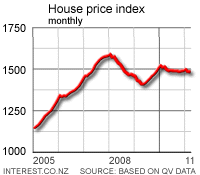
QV said figures looking at a year on year change for February show a change of a 5.5% increase, but values in the last few months have flattened in many areas and values at a national level are 3.9% below the peak of the market in late 2007.

“The annual change in values across New Zealand has continued to increase from last month, but this is masking what has happened in the most recent months. In the main urban areas, values have grown since mid 2009, but that rate of growth has recently begun to slow. In the provincial areas, this growth has slowed even more, and across the rural residential areas house values decreased slightly over the last month," Glenda Whitehead of QV Valuations said

The figures for the national average sales prices show an increase of $416,074 in February, up from $409, 807 in January, QV said.

The national average of sales prices is less reliable than the QV index as averages, they said, as it depends which part of the market is active.

High end of the market properties are continuing to sell quickly but 'less desirable' attributes are proving hard to shift and banks are cautious in lending with properties where the borrower has a 'relatively' low deposit, Whitehead said.

Fewer property investors are buying at present prior to announcement of the May budget and the decision over property tax, QV said.

“We expect values to stabilise over the coming months reflecting the ongoing uncertainty around economic factors such as employment, pending interest rate rises and continued tight lending criteria. We may see more certainty in the market after the May budget announcement when personal tax cuts are known, changes to property taxation are specified, and interest rate changes are clearer” said Whitehead.

Values in the Auckland Region have continued to increase in recent months and are now 8.7 percent up on the same time last year. The Wellington Area is 6.7 percent up, and Christchurch 6.9 percent up. Values in the other main centres have been stable in recent months, but still remain above last year by 4.3 percent in Hamilton, 1.0 percent in Tauranga, and 6.2 percent in Dunedin.

Unlike the main centres, values in the provincial centres have been more variable over recent months, although values are still above the same time last year in almost all areas. Rotorua is 2.5 percent up, Gisborne 2.6, Napier 5.9, New Plymouth 7.9, Wanganui 1.1, Palmerston North 6.1, Nelson 5.5, Queenstown Lakes 0.8, and Invercargill 4.3 percent. Whangarei is the only centre still below last year at 1.8 percent although this has improved since last month.

We welcome your help to improve our coverage of this issue. Any examples or experiences to relate? Any links to other news, data or research to shed more light on this? Any insight or views on what might happen next or what should happen next? Any errors to correct?

We welcome your comments below. If you are not already registered, please register to comment in the box on the right or click on the "'Register" link at the bottom of the comments. Remember we welcome robust, respectful and insightful debate. We don't welcome abusive or defamatory comments and will de-register those repeatedly making these comments.

46 Comments

Great time for first home

Great time for first home buyers to get their deposit they have been saving for the past 2.5 years and get into an entry level home. Some great bargains out there in the suburbs, alot of speculators are flicking off the rental before the May budget.

Assuming they've kept their jobs

Assuming they've kept their jobs and haven't been paying down debt, how much do you reckon they've saved in the last 2.5 years ? And why do you think those speculators, who's job it is to know what's happening in the market, are selling? Because prices are going back up after the Budget?

Not sure whether realestate.co.nz Feb

Not sure whether realestate.co.nz Feb report was linked here yet;

http://unconditional.co.nz/blog/nz-property-report-february-2010/

Illustrates the build up in inventory.

I would go further... From

I would go further...
From looking at individual sales it also appears many of the 400K plus sales could be where mum dad speculators have upgraded the family home, keeping the old home as a rental...and now selling the 'upgrade'
The selling..and sales are going thru in greater numbers also of these could be holding the overall mean up.
If we go back to old posts/discussions over the last 2 yrs....the growth of a whole new industry of 'advisers' in the boom on speculation based on tax rorts, capital gains, and bending beyond breaking point IRD rules .. there are a lot of these mum/dad speculators seeing the errors of their way are/will be catching up with them.

Talking around, I dont see any long term rental investors who base their operations on sound business practises being effected, rather the opposite..buying up bargains.

"Great time for first home buyers to get their deposit they have been saving for the past 2.5 years and get into an entry level home"

Are there any stats showing how many 1st home buyers who qualify now for cashing in Kiwi Saver to buy their 1st home?
A point I made 1to 2 yrs ago several times

28 (now 29) yr old

28 (now 29) yr old
Bargains they may be right now, but will they still appear to be bargains a year hence?
If you cannot answer that question then I don't want to know.
Add another year or two's savings to a flat or soft market and you may not even have to trouble your bank.

Note, from QV, which does

Note , from QV, which does put a different spin on this article:

The monthly statistics provide an indication of how property values around New Zealand have changed over the previous 12 months. Residential sales compiled for the previous 3 months are compared to the same period of the previous year to identify the annual percentage change in property value. QV’s House Price Index methodology is used to generate a residential index for each area by recognising the sales price of each property sold compared to its capital value. This ensures the index provides a measure of change in property values, without fluctuations caused by higher sales volumes in one or more property sectors (e.g. high volumes of apartment sales or investment properties). The Average Sales Prices calculated in the Property ValueMap are based on residential sales compiled by QV for the previous 3 month period. The residential sales included are for residential houses, apartments, flats, home and income properties, and houses converted to flats.

Logical Dave Says: "28 (now

Logical Dave Says:
"28 (now 29) yr old
Bargains they may be right now, but will they still appear to be bargains a year hence?
If you cannot answer that question then I don’t want to know."

Well going off my DB of sales and addresses since 2006 lower end homes and 'rentals' where selling in the low to mid 300K...these same and similar houses are selling in the mid 200K range..Thats a 15 to 18% drop
End 2007 when comparing to long term ave these houses where approx 30% over valued, a couple yrs have rolled over since then and the long term ave has now increase around 8 to 10%
The doomsayers (including me) predicted a market rectification to the long term ave of 30% over 5 or 6 yrs....it seems well over 20% has already happened with another 2 or 3 yrs to go. If the market remains basically static or small increase or decrease over the next few yrs, it will rectify the balance to the long term ave .
I cannot see another drop but rather a static market till definite recovery in another 3 yrs.
So at this point in time BH and other doomsayers predictions back 2007/early 2008 are damn near right on the mark.

We cannot compare the boom stats with those of post boom...the market has changed dramatically along with the type of buyer and seller several times..Its like comparing bread with weetbix..yet they are both made out of grain.

Steps And this is what

Steps
And this is what Rodney Dickens seems to be forecasting.
No great nominal price drops, but significant real price drops over an extended period of time.
And he says in the latest Listener that rental property won't be a good investment for "a long, long time"
Difficult to argue with that when yeilds generally remain poor, and some of the tax beneifts will disappear

Steps, It sounds like you

Steps,

It sounds like you are right onto it.

The only thing that really makes sense to me is to compare like for like prices (in other words, when the same property is sold twice).

Talking about averages (no matter what average), is meaningless if, for example, new houses are generally larger / more expensive than existing ones.

If that is true, then of course the average price will rise, but it could simultaneously be true that prices of all existing properties are actually falling - that is quite (mathematically) possible.

More likely, the reported drop in prices (10%) is made up of larger properties and a greater drop in existing prices just as you indicate.

Alan.

Logical Dave: "Add another year

Logical Dave:
"Add another year or two’s savings to a flat or soft market and you may not even have to trouble your bank."

Whoa! You mean as in buying a house cash? That's basically assuming you can put away at least 300k over 24 months (104 weeks), assuming you have a small deposit to start off with. I don't think a lot of people can save $3,000+ per week on a regular basis...

Yea i would have liked

Yea i would have liked to have seen someone good at number crunching do 'OCR adjusted' house prices throughout the post 2007 period.

Have read different takes on it but a 1% drop in cost of finance can lead to 8%+ growth in house prices as more people can afford higher prices and people generally borrow as much as they can afford...

So say 8% price increase per 1% rate drop is accurate (someone with more time than me could get a better number than this..), mortgages from 8.5% to 5.5%, say 3%, leading to 24% increase in house prices. We have seen around 5-6% from the lows, so in 'OCR adjusted' terms prices have been dropping and still are, but will only been seen nominally once interest rates return to neutral.

Exact same thing happened around 1998, where big OCR cut lead to a temporary price increase, promptly followed by further price falls.

Property cycles are long, ignore 28 year old and wait a while to buy your first home, you're in no danger of missing any decent cap gains, but in real danger of seeing your 20% dep rapidly eaten up by further price falls.

"The results show that an

"The results show that an increase of one percentage point in the long (15 year) spot real interest rate reduces the annual growth rate in residential land prices with outline planning permission by ten percentage points."

-http://www.gwilympryce.co.uk/housing/Levin_&_Pryce_Real_r_&_PES_Working_Paper_28feb07.pdf

-
Heres some results from a UK study. 10% price change per 1% change in interest rates. Good luck for those bargin hunters out there....

So if we accept the

So if we accept the "Low/No return" scenario what would the effect be of a significant blip in one or more of the influencing factors?
IMHO there will be sudden drops and if they occur within the natural seasonal periods those drops will not result in even minor recoveries.
So the market will not be a smooth one.
Going on to the other markets (shares, commodities etc) the drops always are much faster than rises and they also tend to overshoot. Possibly the best recent example is the March 2009 equities market which has already proven to be a buyer opportunity and may even now be in overshoot in the upward direction.

Based on what im seeing

Based on what im seeing and hearing im starting to wonder whether an OCR rise in June is such a foregone conclusion ?

Sarah...you have nailed it.."people generally

Sarah...you have nailed it.."people generally borrow as much as they can afford"..and they think their ability to afford will always remain as good and the cost will never rise. This in a nutshell is the judgement on stupid Kiwi. Throw in dumb Kiwi believing the spin about prices always rising and the govt BS about recovery being underway...hey presto you arrive at idiotville. All it needed then was for the govt of the day to give the banks a wink and a nod...then it's off to the races and bubble here we come.
Now the knives are out to carve the Turkey. The new Beehive fools are rushing to prop up the ponzi scheme. What will they use as props?...immigration and inflation of course.

Wally, the notion of borrowing

Wally, the notion of borrowing to the max is not just a kiwi, but a human thing. You don't have to look very closely to see this behaviour all across the globe. In essence, it's a cocktail of fine human traits like short sightedness, herd mentality, with a good splash of greed (oooh capital gains).

Right now the OCR has

Right now the OCR has no effect on interest rates..
1/For the 1st time in decades the floating is lower than the fixed
2/traditionally the floating has about a 1/3 'mark up' on the OCR
3/the RB is very unlikely to increase the OCR to bring it up even close to the 2/3 of the floating.....
4/ Controlling interest rates in the last decade was a joke, because most of the mortgages where on fixed...and it was a tool to control inflation

What controls the credit supply and interest rates is the RB reinstated tool of deposit to leading ratio...which to have stable markets is about 1/3 desposits...
It was this tool removed by Governments world wide that caused the sub prime crisis in the 1st place...along with Governments requiring banks to have around a 20% deposit on high value assets....this way normal inflationary values of markets would soon bring the home owner stretched to the limit at time of purchase into the secure owning 1/3 of the home in 2 to 3 yrs.

Steps do you not think

Steps do you not think the banks will use an increase in the OCR to justify lifting short term rates ?

But Steps...there is a doorway

But Steps...there is a doorway to porking the property bubble that has been left open...wide open....the marketing and sale of property directly to foreigners with the borrowing taking place overseas...this is the way the banks will sidestep Bollard!

Has anyone else noticed how

Has anyone else noticed how thick the property pres is currently. There appears to a huge number of houses being dumped onto the market. These sellers only have a limited number of buyers to attract, so prices are going to drop. Huge supply, and not a huge demand, especially as interest rates are going up soon. You may say, that the sellers don't have to sell, but the agents will want their cut, and will put pressure on the sellers to drop their prices to meet the market. Is now a good time to buy...I personally don't think so, perhaps in 6 months will be a far better time.

Think about it...bank is aussie

Think about it...bank is aussie owned....sets up a ghost company overseas and markets property in NZ with morts at low low rates in that local currency...this explains the flood of asian buyers...Bollard on the Terrace thinking he has plugged the hole...haaaaaahahaha. None of the lending is on the bank books in NZ. The flow of loot enters like a tsunami and the bubble is kept going. Bolly having a we dream about controlling inflation with the core funding rate, finds himself at a loss to explain the rampant inflation. He tightens the CFR and stuff all happens.

Rob - its a buyer's

Rob - its a buyer's market again.
Now is only a good time to buy if sellers drop their asking price significantly
So there could be the odd good deal out there I suspect, especially if you lock in a decent longer term interest rate

So the scene is set for falls in the next 3 months as:

- building consents have improved. increasing supply
- supply of properties to the market has increased substantially
- migration is starting to turn
- investment properties won't sell without decent drops as yields are still poor and tax changes are coming
- unemployment creeps slightly higher or remians at current levels

whats everyone's picks?
I'm thinking 3-5% drop over 2010

It's known as the back

It's known as the back passage! Do the deal here but have the mortgage registered over there.......

Horses for courses - stuff

Horses for courses - stuff is still selling like hot cakes in the Eastern Beaches. A few places we looked at in 2008 have been bought and sold again. 2 have sold for $100K more then they were sold for 2 years ago.

Steps - "So at this

Steps - "So at this point in time BH and other doomsayers predictions back 2007/early 2008 are damn near right on the mark"

If he had predicted a 30% drop in "real" prices, maybe. But the prediction was a 30% fall in the median REINZ price to $246,000 - later revised to a 15% drop ($299,000).
I would say at this point in time a long way off the mark....

People on here talk about

People on here talk about "Real House Pirices" - just how does one go about working this figure out ? (laymans version please)

@G We have not done

@G We have not done this recently but we update the site every 1/4 with fresh inflation stats from QV.

Cheers,
Emma

I'm looking for a freehold

I'm looking for a freehold 2-4 brm apartment in Auckland City. One I'm looking at is in a retrofitted older building. Crappy refit and has been used as short term accommodation so it is run down. It is also a mortgagee sale. Its been passed in by the bank at auction several times because no one wants to pay the price PLUS the $30,000 arrears on the body corp. Bank won't take a haircut and the body corp can't afford to take a haircut. A couple of agents have said that banks are passing properties in rather than writing down the loan. Investors don't want them because the numbers don't stack up. There are hundreds of empty apartments in central Auckland just waiting for someone to blink (many of them are leasehold with imminent big jumps coming in the ground rent) Who is going to blink first. The banks or the buyers?

Sorry Emma, i meant in

Sorry Emma, i meant in general how does one work this sort of figure out.

@G: "Real price" is the

@G:
"Real price" is the exchange ratio between real goods regardless of money.It is the Nominal price adjusted for the price change ( 'inflation') of other goods.
eg: a house that costs $500k that is worth $525k in 12 months time hasn't changed in Real Value if the CPI has changed by +5%.

The question is...how many of

The question is...how many of these deals are sales to foreigners borrowing in their country and sliding the currency into Kiwi to close the deal. So much for Bollies Core funny Rate!. The RBNZ has almost zero control over the flood of cheap and easy loot.

@G - in "laymans" terms,

@G - in "laymans" terms, the "real" price increase of something is the percentage it has increased minus the inflation rate.

Couldn't find any current graphs, but here's an older one that illustrates it:
http://www.rbnz.govt.nz/publications/0092983.html#P419_29665

As you can see, "real" house prices have gone negative more often than actual "nominal" prices....

cheers

Exactly, Wally! My landlord is

Exactly, Wally! My landlord is Singaporean, and hasn't even been to New Zealand ! ( so the property manager tells me). They borrowed at 3.5% and don't give a proverbial what Dr. B does. In fact the lower rates go, the more they are likely to reap on the exchange rate gain ( vesus current) when it rises with an uptick in our OCR. Doing rough sums that's a gross yeild of 5.75% p.a. for them when they would only get 0.5% p.a. for funds on deposit back home.
This type of carry trade is the 'inflation salvation' that the Americans/Europeans are exporting to the rest of the world.

@G This might be a

@G

This might be a helpful calculator
http://www.rbnz.govt.nz/statistics/0135595.html

@ G, here is a

@ G, here is a link to the RBNZ inflation calculator http://www.rbnz.govt.nz/statistics/0135595.html

Cheers,
Emma

>>The question is…how many of

>>The question is…how many of these deals are sales to foreigners borrowing in their country and sliding the currency into Kiwi to close the deal.

If the mortgage is held offshore they would have no way of forcing a mortgagee sale without going through the courts. I can't see any banks going for this unless they can get a guarantee in their home country.

Murray: <i>Couldn’t find any current

Murray: Couldn’t find any current graphs, but here’s an older one that illustrates it:
http://www.rbnz.govt.nz/publications/0092983.html#P419_29665

Its interesting how Tony Alexander has more or less changed his tune (the Tony writing that article would be horrified if shown today's debt levels). Times change, and so I guess does economic theory.

Thx for the link, Andrewj.

Thx for the link, Andrewj.
A tsunami of carry funds headed our way if that article plays out. Who needs the immigrants if we just get their money. We haven't got long to get the productive ecomony/regulations/taxation on an even keel if we don't want our asset markets swamping.

Murray Says: "Steps – “So

Murray Says:
"Steps – “So at this point in time BH and other doomsayers predictions back 2007/early 2008 are damn near right on the mark”

If he had predicted a 30% drop in “real” prices, maybe. But the prediction was a 30% fall in the median REINZ price to $246,000 – later revised to a 15% drop ($299,000).
I would say at this point in time a long way off the mark…."

Lets keep things in proportion the prediction BH made was purely on fundimemtals AT THAT PIONT in time...since then the OCR dropped around the world to historial lows, the type and nature of the buyers and sellers and type of properties changed dramatically in '08, and have again now
Some of the mean sales prices have been changed in how calcuated since 2008

The fundimentals of BH and others doomster predictions have and are still correct, the variables above have thrown them off a little.....BUT the essence is on the mark.

Studies have shown over the last decade or so people who use cell phones no longer think thru or plan as far ahead as they used to...I dont have or know how to use one.

Andrew T Says:
"Steps do you not think the banks will use an increase in the OCR to justify lifting short term rates ?"
Look Im just an amater hobbist who plays on paper markets and stuff for the last 40 yrs, other than nearly owning our home I have no finacial interest. So what the hell would I know lol
Banks..they have shareholders right?
There is a legal obligation of directors of any company anywhere in the world to maximise returns to shareholders...there is NO moral obligation..in fact moral obligation doesnt enter into the equation at all...only legal obligation.
So lets take Macdonalds finacincing a hospital..unless there is a market gain and profit to be made from it..it is technically illegal for them to do so.
So ....."do you not think the banks will use an increase in the OCR to justify lifting short term rates ?"
What the hell do you think..banks going to sit back and not put their proganda (sry marketing) machine into play and not increase returns to shareholder?

Step, you are playing devil's

Step, you are playing devil's attorney here.

Steps I agree....which is why

Steps I agree....which is why I dont get your comment that "the OCR has no effect on interest rates.."

alen Says: "Step, you are

alen Says:
"Step, you are playing devil’s attorney here."
No m8 I say what I think, doesnt matter if one day I think someone is talking rubbish and the next commonsence.

"which is why I dont get your comment that “the OCR has no effect on interest rates..”

right now the OCR is so damn low it doesnt effect the markup banks have on wholesale rates.....and I cant see the RB bumping up the OCR all in one go to meet 2/3s or more of the current floating rates.
And keep in mind the long term floating rate ave is somewhere around the 8.5%

IanC - yes, economists (&amp;

IanC - yes, economists (& journalists!) are great at changing their forecasts & opinions from one year to the next.
I love the quotes at the beginning of the "REAL Story", Don Brash in 1998 saying "In reality, the inflation-driven capital gains of the past have come to an end."...
... and "People can be confident that price stability is now a fact of life."
Hilarious. Mary Holm was sure he was right too....
I remember thinking at the time that claiming to have inflation and cycles under control meant also claiming to have human nature under control....

"I love the quotes at

"I love the quotes at the beginning of the “REAL Story”, Don Brash in 1998 saying “In reality, the inflation-driven capital gains of the past have come to an end.”…

Well he was right..the property boom was not inflation driven, it was uncontrolled market driven.

"… and “People can be confident that price stability is now a fact of life.”
Hilarious. Mary Holm was sure he was right too….
I remember thinking at the time that claiming to have inflation and cycles under control meant also claiming to have human nature under control…."

Now that was a load of crap...A RB that had all its tools removed...history shows that is the basic formula for an excessive boom....and bust.
"stable" that doesnt mean stable stable, it means stable cycles, not boom and bust cycles.
Ian C "Times change, and so I guess does economic theory."
yeah and thats what causes the booms and busts...the new fashionable theory is always considered the modern answer..then it all falls apart...because the traditional proven rules just keep on over ruling them.
Dumb economists with PhDs...except Neville of coarse, and hes retired.

Murray - the key that

Murray - the key that they weren't expecting was the introduction of financial innovation (its just a euphemism for "more debt").

You can understand why they didn't see it coming. What I can't understand is why anyone would expect increases like the last decade in the next decade, without new financial innovation (I just don't think there is appetite for it).