
The comment stream

Join the Interest community to be a registered commenter so you can:
- Edit your comments
- Avoid the CAPTCHA
- Vote on comments
Register Here

Already registered? log back in here ..

Forgotten your password? No problem! Click here

Finance sector jobs

Manager Operational Effectiveness and Assurance IT
Reporting to the Senior Manager Operational Risk Effectiveness and Assurance, the key focu...more
New Zealand
Financial Controller
Reporting to the Head of Finance - Retail and Business Bank the key focus of this role is ...more
New Zealand
Manager Finance Corporate Core - 12 Month Contract role
This role in consultation with the Financial Controller provides financial, strategic and ...more
New Zealand
IT Audit Manager - Internal Audit - Auckland
If you are motivated by the prospect of seeing the big picture, developing your team and m...more
New Zealand
efinancialcareers.com

Reader poll

Should you fix your mortgage now or stay floating?

Choices

Have your say: RBNZ's Bollard says it's time to remove the stimulus of low interest rates (Update 7)

Posted in News

By Bernard Hickey

Reserve Bank of New Zealand Governor Alan Bollard has argued in a speech that New Zealand's economic recovery is now in a new, less fragile phase and it was time to remove the 'very stimulative' setting of the Official Cash Rate being at 2.5%.

(Updates with more details, quotes, chart, link to full speech, currency jump, jobless drop, my view, JP Morgan Chase economist Helen Kevans' view, details and chart on household saving, details and chart on lending growth, Chris Slane cartoon)

Bollard told a Local Government of New Zealand Conference in Dunedin that he was comfortable with financial market expectations of a mid-year rise in the Official Cash Rate and small increases after that for some time.

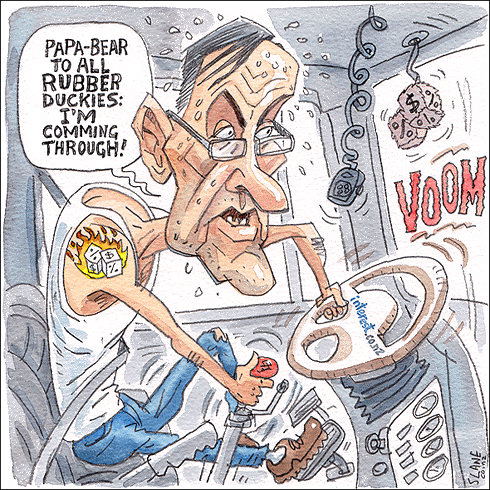
“Using a truck driver analogy, our foot is strongly on the accelerator. Over coming months we expect to reduce the pressure on this pedal, but in effect to keep some throttle going," Bollard said in the speech.

"Truck drivers know they must reduce acceleration long before the corner. We are not talking about tightening policy yet. We do not expect to have to touch the brake pedal for the some time," he said.

Bollard said it was time for conventional monetary policy to play its part. The New Zealand dollar jumped to 72.7 USc from 71.6 USc in morning trade as traders viewed it as increasingly hawkish and confirmed a likely interest rate increase on June 10 with the next Monetary Policy statements. The 90 day bill rate futures indicated higher interest rates. News of lower-than-expected unemployment at 6.0% also boosted the currency.
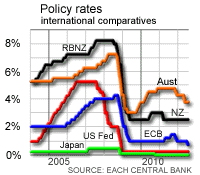
Economists said after the speech and the jobless figure that a June 10 hike in the Official Cash Rate was now a near certainty and that the official cash rate was likely to rise to 5% by later in 2011. Assuming bank margins on floating mortgage rates and term deposits don't change, floating mortgage rates would rise to around 8.3% and one year term deposit rates would rise to around 7.5% by the end of 2011. Two year fixed mortgage rates are currently around 7.3%.

"New Zealand has been fortunate in some respects, allowing most of our crisis liquidity and guarantee measures to be terminated. Conventional monetary policy will now guide the stages of recovery," Bollard said.

Bank credit growth continued to be "extraordinarily restrained," he said. "Whatever the explanation, we certainly wish to see credit available for all sound business ventures."

Bollard said there had only been a soft pick-up in house prices, new building and sales as householders were building up savings and reducing debt.

"In our Official Cash Rate Review last week we noted: '...we expect to begin removing policy stimulus over the coming months, provided the economy continues to evolve as projected," Bollard said.

"We used the words 'begin removing stimulus' deliberately. With an official cash rate at an historically low level of 2.5 percent we are clearly in a very stimulative position," he said.

Households saving

Bollard pointed out that households were saving through a variety of means, keeping the consumer economy from rebounding quickly.
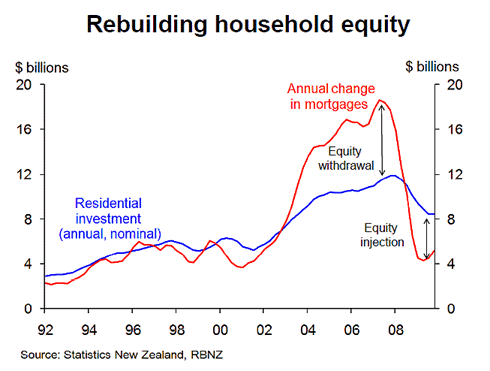
House prices and activity contracted markedly through the recession, although they ended up a little more robust than we had feared. However, as we now record positive growth again, we have seen only a very soft pick-up in house prices, new building and sales, despite moderate demographic growth.

Despite this, rather than building up housing assets, so far in this recovery, householders are concentrating on reducing their mortgage borrowing sharply, and hence building up housing equity. Another way to see this is as householders building up savings and reducing debt.

This is happening through borrowers not taking on new mortgages as in the past, and using lower interest rates with constant repayments to reduce the size of outstanding loans.

Bollard also pointed to signs that business sector credit was very constrained.
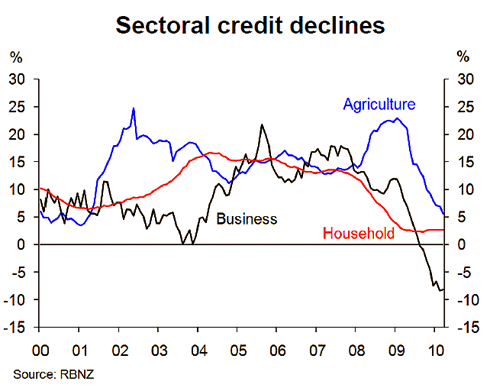
The business sector has emerged from the crisis bruised but not permanently scarred. In general, businesses went into the period with healthy balance sheets, in contrast to the 1990-92 recession. However they are now behaving very cautiously and as a generalisation, are still not looking to invest in plant and equipment or re-employ staff.

Together with the deleveraging taking place, that means they are not undertaking new borrowing. Indeed the banking sector credit data continues to be extraordinarily restrained. This is probably an unusual combination of demand weakness and supply constraint. Whatever the explanation we certainly wish to see credit available for all sound business ventures. In the meantime business credit growth continues to contract by 8%, a most unusual situation and one that contributes to our monetary aggregates showing no growth over the past year.

JP Morgan Chase economist Helen Kevans said the key to the speech was the truck driver analogy, although she still saw a July hike rather than a June hike.

Indeed, this implies that the RBNZ is readying to remove the policy stimulus, but exactly when the truck driver will decide to “reduce acceleration” will depend on how the economic data evolves. If the economic data continues to evolve in the remarkably positive fashion of today’s employment numbers, a June rate hike will be delivered.

Financial markets interpreted the speech as being a little hawkish, with market pricing shortly after the speech suggesting a 72% chance of a rate hike at the next official cash rate (OCR) announcement in June, compared to 68% previously. We believe, though, that the speech simply was an expansion on the bank’s statement on April 29, when the RBNZ left the cash rate at a record low 2.5% and signaled that the policy stimulus may be removed “in coming months.”

We acknowledge the risk on a June move, particularly following this morning’s very strong employment report (which showed the largest drop in the unemployment rate since 1986), should the economic data prints firmly ahead of the decision. The June OCR announcement will be accompanied by the Monetary Policy Statement, which will allow the RBNZ move ability to convey its outlook on the economy and inflation.

That said, we still think that a July move is more likely. By then, the RBNZ should have another healthy GDP print in hand (we are forecasting 1Q GDP growth of 0.8%q/q, matching the solid increase in 4Q), and the case for keeping the cash rate at historic lows should have weakened substantially.

My view

Congratulations Alan. It is great to see you growing a beak and darkening your wings. New Zealand's monetary policy needs a hawkish approach to respond to the rebound in the economy and the risk of inflation.

This is tough news for exporters and home owners, but we have to remember that 2.5% is unusually low. The Australian official rate is now 4.5% and its Reserve Bank has been moving rates higher since October. Our biggest trading partner is experiencing its biggest mining boom in a century. Our terms of trade are near record highs and our commodity prices are nudging record highs.

Our banks need to raise more money from term deposits to reduce their dependence on 'hot' wholesale money markets, as directed by the Reserve Bank. Higher interest rates will help this and help send a signal to both consumers and rental property investors that these low interest rates are not normal. Unfortunately for housing investors, they face a rough few months with rising interest rates and the end of some of their tax breaks in the May 20 budget.

Cheers Alan. We're looking for a cartoonist to show you as you see yourself: a truck driver reaching for the gear lever to change down. I can almost hear the sound of the engine brake kicking in with a growl. Excellent.

Your view? We welcome your comments and insights below.

The full release referring to the speech is below:

Handling Our Economic Recovery

New Zealand's recovery from the Global Financial Crisis is entering a new, less fragile stage, which will allow monetary policy stimulus to be removed, Reserve Bank Governor Alan Bollard said today.

"New Zealand has been fortunate in some respects, allowing most of our crisis liquidity and guarantee measures to be terminated. Conventional monetary policy will now guide the stages of recovery," Dr Bollard said in a speech to the Otago and Southland Zones of Local Government New Zealand in Dunedin.

"Overall, we are emerging from the crisis with some reconstruction of our external deficit, as a result of strong exports, weaker import growth, suppressed domestic profits, and some consolidation of balance sheets."

On the other hand, the domestic sector is seeing a more fragile recovery, with business bruised but not permanently scarred. It is behaving very cautiously, still not looking to invest in plant and equipment or re-employ staff.

"Banking sector credit data continues to be extraordinarily restrained. Whatever the explanation, we certainly wish to see credit available for all sound business ventures."

In the household sector, there has been only a soft pick-up in house prices, new building and sales. Householders are building up savings and reducing debt.

Dr Bollard said the stage is set for the Bank to influence the pace of recovery through more conventional discretionary monetary policy.

"In our Official Cash Rate Review last week we noted: '...we expect to begin removing policy stimulus over the coming months, provided the economy continues to evolve as projected.'

"We used the words 'begin removing stimulus' deliberately. With an official cash rate at an historically low level of 2.5 percent we are clearly in a very stimulative position.

"Using a truck driver analogy, our foot is strongly on the accelerator. Over coming months we expect to reduce the pressure on this pedal, but in effect to keep some throttle going. Truck drivers know they must reduce acceleration long before the corner. We are not talking about tightening policy yet. We do not expect to have to touch the brake pedal for the some time.

"Financial markets currently expect the Reserve Bank to begin raising the official cash rate around the middle of the year and continue to do this in small steps for some time. This is broadly in line with our current views as outlined at last week's OCR Review.

"However, the timing and pace of returning the OCR to more normal levels will ultimately depend on economic developments. Both markets and ourselves foresee that the official cash rate will not need to rise as far in this cycle as it did in the last one.

"But a final caution: recovery so far has been full of surprises. There will be more to come."

We welcome your help to improve our coverage of this issue. Any examples or experiences to relate? Any links to other news, data or research to shed more light on this? Any insight or views on what might happen next or what should happen next? Any errors to correct?

We welcome your comments below. If you are not already registered, please register to comment in the box on the right or click on the "'Register" link at the bottom of the comments. Remember we welcome robust, respectful and insightful debate. We don't welcome abusive or defamatory comments and will de-register those repeatedly making these comments.

66 Comments

Stay floating they say, you

Stay floating they say, you will be right.....We will see about that.

"The New Zealand dollar surged

"The New Zealand dollar surged to a new 33-month high against the euro overnight amid fears that a euro-zone debt crisis may spread beyond Greece, and after Greeks rioted over harsh austerity measures, leaving three people dead in a torched Athens bank."(herald) ....and for NZ exports to the euro zone it means what?....a lower NZ$ return....oooops....that's not in the RBNZ plan!
So what happens when the RBNZ finally gives in and starts to chase the RBA with higher ocr rates in an effort to keep the truck on the road as it goes round the corner!...oh I know this one...the Kiwi dollar goes goes goes up...bugger...won't that screw the export sector?....bugger.

@JT: You pay a premium

@JT: You pay a premium for a fixed term. I think banks have set a rate based on historic maxims that dont seem appropriate moving forward. So Bollard seems to be saying dont expect floating rates to be 10% anytime soon...even 8% seems unlikely that makes a fixed of 7~8% seem too high....Ive stayed floating for 18 months now, Ive saved $100+ a month which Ive used to pay off the sum....for me to end up paying more over 5 years it would have to be past 10% in the last year for me to lose money....that seems unlikely.

"you will be right" whos the fool? rely on yourself and accept the wins and losses....

regards

.. starts slow clap

.. starts slow clap

Maybe I am just getting

Maybe I am just getting long in the tooth, but I vividly remember the 25% interest rates of the 80s. For 90% of my borrowings I have fixed years ahead, at an extroadinarily good rate historically speaking. It is affordable. It stops me worrying. Thanks Bernard, took your advice a year ago. Fixed. Not keen on your current advice. I call it the float n hope.

hedge your risk of a

hedge your risk of a high mortgage - sell your expensive Auckland (or wellington) property, then go and live in the west coast or Southland. Somewhere like Haast..

I'm glad I fixed a

I'm glad I fixed a year ago at 6%. Now i'd be looking at around 8% for the same term. My biggest worry would be the people who can afford it at the current floating but once that starts to go up and the fixed rates move up too, how quickly do they start to have difficulty paying the mortgage? Not looking too good to offload the property now, the real estate magazines are stuffed full and not a lot seems to be moving.

What about those that Fixed

What about those that Fixed and want to sell to get out of a dropping market?

Swap rates increased dramatically today

Swap rates increased dramatically today on this news, and on the positive employment data. The two-year (and to a lesser extent three-year) fixed rates now look better value than floating rates over the period.

I was fully floating until yesterday, but after extensive consultation with my spreadsheet, have just fixed most of my mortgage for two years at 7.1%.

[...] Blogging On Interest Rates,

[...] Blogging On Interest Rates, Economics & Business in New Zealand [...]

well it sure is still

well it sure is still below the 8.95% i gotta pay for another couple of months yet...

[...] Blogging On Interest Rates,

[...] Blogging On Interest Rates, Economics & Business in New Zealand [...]

Wally - the problem is

Wally - the problem is that all countries are racing their currencies down to the bottom (i.e. towards being worthless). Why should we follow the others off the cliff? I know that it will affect our exports for a while, but without sound and stable money the whole country is screwed. And without interest rates that are reflective of risk and return, then there is no incentive to save and build real capital.
Either way, we will get smacked, but devaluing our currency is like a heroin addict asking for another shot "just this one time". It just leads downhill, and if your currency is worth nothing then so are you.

Why in the world would

Why in the world would he want to divert funds away from repaying capital on mortgages and business loans?

Why would he want to pressure landlords into demanding higher rates of return from property whether that be through increased rents or property prices?

Alan Bollard might feel his foots strongly on the accelerator because he dropped the OCR 69% (8.25 - 2.5) but out in the real world interest rates are 6% only 20% below the cycle average of 7.5%. Haven't felt any stimulus here. How about a full employment policy that might turn the crank handle!

I can just see Bernard

I can just see Bernard dancing on the sofa! (Although it's certainly no revelation that interest rates will go up, but remember Alan is great at backtracking and getting his timing wrong - he has already managed to screw up the property market TWICE - rates too low in 2003, rates too high in 2008).

RobW, why fix 2 years at 7.1% when you can probably get 18months at 6.6%. You would have to assumed that in 18months time the six month rate will be above 8.6% to be better off. Chances of that being the case are negligible unless the economy starts to really boom. You could have reduced your current interest payments by about 7% (50bps).

POP, so you fixed for 3 years in 2007? I can't understand why people didn't break late 08 when Lehmans collapsed and the reserve banks started to act. I think we paid a total of about $6,000 to break $6,800,000 in fixed loans in September 2008 - and then fixing for 5 years in March last year potentially saved $1,000,000 in interest payments. Do people not pay attention to the news??

Remember Alan, just use 'the

Remember Alan, just use 'the force':

http://www.interest.co.nz/ratesblog/index.php/2010/04/22/top-10-at-10-wh...

I mean, just use the ratios!!!!!!!!!!!

Who could possibly complain about that? Certainly not savers and exporters, if you are keeping your foot of the OCR brake, and throttling the 'fuel' supply.

http://en.wikipedia.org/wiki/Governor_(device)

From one truck driver to another Alan - try to use a governor, nevermind all the whinging from the 'fuel' suppliers:

http://www.interest.co.nz/ratesblog/index.php/2010/04/30/anzs-fagg-says-...

Don't be a wally, get on with it.

Cheers, Les.

[...] Blogging On Interest Rates,

[...] Blogging On Interest Rates, Economics & Business in New Zealand [...]

@clare: everyone's case is different,

@clare: everyone's case is different, I stayed floating but Ive continued to pay the same amount as before....actually some more about 12% so my household budget isnt impacted until 12%+..in the mean time im paying off more of the capital... so if we went above 12+ that's less interest as there is less capital to charge on.

If you are at the financial limit at say 7% then fixing at <7% makes sense. However the floating rate is cyclical ie ideally you pick the start date on rising rates and the end date on dropping so you miss the peak, too short and you come off onto the full high rate which is a shock...and an issue. Its hard if not impossible to judge that....and Im sure the banks have that sussed better then the likes of you and I. In the mean time you could end up paying more than you need or you could save....bit of a gamble...I know today I couldnt tell you where the rate will be in a year or 2 or 3....frankly its range is 4~14% with 5~8% the most likely....and Ive not seen anyone who Id trust to be any more accurate...

regards

Les you are a tad

Les you are a tad confused...Bolly's big ocr boot is on the Accelerator..not the brake...and do have a word with that fool of a cousin of yours across the ditch please.

"RobW, why fix 2 years

"RobW, why fix 2 years at 7.1% when you can probably get 18months at 6.6%. "

Totally agree...needs something that finds the sweet spots....I wonder if BH or someone could write such a web page...plug numbers in and look at the results....

or maybe www.sorted or something

regards

Steven...re the Krugman thinking...sure he

Steven...re the Krugman thinking...sure he has it right but leaves out one thing the Greeks could export...islands. The Tsar flogged off Alaska and Napoleon sold most of the current USA. What price the islands. Who would buy. Would China like to own a naval base in the eastern Med? Or maybe Washington! That would provide the ideal missile defence base.

It's more than the interest

It's more than the interest rate, steven 3.58pm. It's about access to money, as well. Now while 6 months may not be long, what happens if in 18 months time the banks won't relend to you? That 6 months for a small interest rate premium might be just what keeps the wolf from the mortgagee sale door. Chrisj got rate and security with their strategy. Their business is property investment and one would expect them, of all people, to get the timing about right. But for most people? RobW has their money for 2 years, and that makes them happy.

@Steven John Bolton's blog at

@Steven

John Bolton's blog at Squirrel.co.nz has really good info for comparing floating v fixing - and the timing etc.

At the risk of promoting someone elses website ......

Anyone betting on static or

Anyone betting on static or lower interest rates ahead need only read this:
http://www.zerohedge.com/article/cds-traders-verdict-uk-deep-shit-are-fr...

Ludwig...so when she blows does

Ludwig...so when she blows does that mean a flight to the USD ?

Wally - methinks 'tis you

Wally - methinks 'tis you who is confused:

“Truck drivers know they must reduce acceleration long before the corner. We are not talking about tightening policy yet. We do not expect to have to touch the brake pedal for the some time,” he said.

Meaning, maybe, reducing acceleration is cranking OCR to 'neutral' and hitting the brake equates to cranking the OCR over 'neutral'. Whereas I'd agree with the comment of yours I referred to, instead crank up the ratios, that is, the CFR, maybe change the shape of it and also tighten capital adequacy ratios for specific asset classes, and because RBNZ didn't actually turn into pumpkins at midnight by messing with money volume flow, albeit indirectly, why not reintroduce a specified reserve ratio and use that too?

Or is he gaming before the budget - do something on property tax, or I'll start cranking OCR and stuff tourism and your export led recovery? Because we know that's the only way monetary policy works in NZ, with so many hedged on fixed rates. Even with less folk on fixed rates, the general degree of hedging, still means AB might well have to stand on the brakes, when in fact all he need do is throttle the fuel (money) supply with the ratios.

Or what? This and the employment figures will certainly have wiped some tourism/export earnings today, do we need that?

Uncle Kev is nowt to do with me. Different clan.

Cheers, Les.

NA, Quite to the point…

NA,

Quite to the point… And steven, if you are unsure what he meant with that, read this…

http://www.leap2020.eu/GEAB-N-43-is-available-Global-systemic-crisis-USA...

Andrew T - I wish

Andrew T - I wish I knew the all the answers. My guess is maybe temporarily, but the USA's finances are not much better than Greece's, and they are hellbent on destroying the USD as well. USD could implode within 5yrs the way they're going.

The analysis on the squirrel

The analysis on the squirrel site is good, but I think he's wrong on banks lending margin decreasing back to anywhere near historical levels. Its high because banks are competing for deposits because the RBNZ is making them do so.

Either way, cliff notes and reminder for this post ---> low interest rates - economy bad. Economy improves, interest rates rise. Economy good, high interest rates.

Those are your choices (and based on what Bollard's been saying in the past several months "interest rates" is looking more and more like "mortgage rates") - don't do your budgeting on the basis we have a good economy and low interest rates. Its not impossible, but its unlikely...

Asia Times (always a good

Asia Times (always a good alternative view) has this gem from Francesco Sisci - just let Germany run the show. A century of trying to stop it has been - well - pointless.

And we're spoilt for choice, 'cos there's a new Spengler piece, too

Disagree. Think its all a

Disagree. Think its all a bit premature. Only a clumsy, inexperienced truck driver will brake too early and excessively. Wage inflation is low suggesting that inflation expectations are low, 6% unemployment is indicates that there is significant capacity left in the economy (high employment does not neccessarily result in high inflation anyways), business capital investments are low, the public sector is supposedly shrinking, the May budget may increase the tax burden on housing investors, increase in GST will reduce consumption (less demand in the economy), at least 3 of our major trading partners are struggling with the recession, the euro zone is becoming a big maybe. And with more people supposedly on floating interest rates, changes to the OCR will have a more immediate impact. There is still time to wait and see before pulling the trigger.

Reserve Bank Governor Alan Bollard

Reserve Bank Governor Alan Bollard says the New Zealand economy is now ready for higher interest rates as the recovery moves into a "less fragile stage."

LOL, I want everyone to remember those words. 'less fragile stage'. Some how while the rest of the world is slowly going down the tube Mr Bollard thinks a few "trumped up" employment figures are indicating NZ is stemming the flow.

I hear WINZ is handing

I hear WINZ is handing out free tickets to Aussie! ;-)

“less fragile stage"....I don't know

“less fragile stage"....I don't know whether to laugh or cry. I think Bollard means to say we are in deep shite but if we take a deep breath and hold on for several years...we just might not sink any deeper.

Get real folks...the 200 billion in household debt is not going to go poooof and be gone. Some poor bugger has to pay for the credit over and over and over again. Bill English is busting a gut to grow the govt debts bigger and bigger and bigger. We are living in an insane asylum. But we are not alone...the management is there with us doing its best to farm us all like a flock of sheep.

It's a good news day!

It's a good news day! So we are heading back to normal and closer to that day we won't have to keep bailing out the obsessed mortgaged/propertied crowd. It's a good news day.

Alex agree regards squirrel (sorry

Alex

agree regards squirrel (sorry BH) http://www.squirrel.co.nz/april-ocr-unchanged/

John from squirrel stated in FEB 2008 that any 5 year rate below 6% was great value....for a new kid on the block I glad I locked in

As chrisJ says above 18months is best for value at the moment

I'm going to wait 2 weeks for the banks to battle before fixing my last floating mortgage

What an amusing blog! Keep

What an amusing blog! Keep going guys (if only you knew...)

"Congratulations Alan. It is great to see you growing a beak and darkening your wings." "Cheers Alan. “We’re looking for a cartoonist to show you as you see yourself..." - And who is speaking here? Do I know you? Hmm, quite an improper familiarity in your tone...

Low interest rates – economy

Low interest rates – economy bad. Economy improves, interest rates rise. Economy good, high interest rates.

If you think the recession is over you are sadly mistaken fellow Noddylanders.

I agree with you Justice - "remember those words. ‘less fragile stage’" Noddyland is not going to miss out on the shit that is going on in the rest of the world and even Wally would agree. A wise person would be better to sit floating because the game has changed in Noddyland and the only people who want you to fix are the banks and Bollie who thinks he is a clever dick right because he did nothing for a year but as soon as he starts raising that will change. Fixed interest rates are not going to be less than floating in the future guys adn girls - it is unnatural and was a NZ aberration over the last 20-30 yrs that is not normal. Bollie is a fool if he thinks we are immune and all of you in this blog saying now is the time to fix are so very, very wrong. Ride the wave for the next 12months because there is no improvement in the economy coming to a place near you soon.

is he taking the piss

is he taking the piss or what?
"Banking sector credit data continues to be extraordinarily restrained. Whatever the explanation, we certainly wish to see credit available for all sound business ventures."
http://www.odt.co.nz/news/business/104839/nz-economy-trucking-again-boll...

Surprised unemployments going down, the

Surprised unemployments going down, the way so many companies are hell bent on outsourcing jobs to India at the moment.

My work is getting right into it.
Some of the mistakes they make are monumental, but apparently they save us money.....somehow.

Bernard, and why are you

Bernard, and why are you so keen on interest rates hiked?

63% drop in house prices

63% drop in house prices over 4 years

[...] Blogging On Interest Rates,

[...] Blogging On Interest Rates, Economics & Business in New Zealand [...]

[...] Blogging On Interest Rates,

[...] Blogging On Interest Rates, Economics & Business in New Zealand [...]

[...] Blogging On Interest Rates,

[...] Blogging On Interest Rates, Economics & Business in New Zealand [...]

@Ludwig: "Anyone betting on static

@Ludwig: "Anyone betting on static or lower interest rates ahead"

Given "normal" circumstances is anyone? Is this normal however? The EU looks like its about to implode, it seems highly likely Greece will default and exit the EU at which point the EU banks do a "Lehman" and we are not talking just one...there could be a dozen or more. Even if Greece does not it looks like just a matter of time and that seems to apply to Portugal and probably Spain. To me it looks like the hedge funds/speculators are looking for targets to take out aka George Soros and the UK. If one private entity can bring the UK Govn to its Knees several acting in a disconnected but "rational" manner on weaker nations I cant see as failing to many players too many weak targets. Way too much money is there to be made, 100s millions upon 100s millions at the expense of the tax payer.....

So if they succeed we get a depression and deflation....and thats the good news after we see 3~6months of chaos from the EU banks collapsing........at that point where would the OCR be? 0.5%?

I really wonder if this extreme scenario is that far fetched....such a risk is with us for two to three years...

Now throw in Peak Oil, a lot of ppl are assuming countries with huge debt can crawl out by recovering and growing their economy....growing an economy only happens if the oil supply can grow....if the oil supply declines which it will, so will economies and Greece in particular needs tourists and that means affordable air fares which wont happen with jet fuel above $120US.......let alone the extra tax burdens from covering the bailout costs....

So if the "peak Oilers" like me are right then once oil supply declines the bond ppl and other lenders will realize that there is no way the debt will ever be re-paid.......

Bollard says above that ppl are paying down debt, that's good news for them and us as a nation, raising the OCR means they pay down less debt....not so good...

regards

@OS: "why are you so

@OS: "why are you so keen on interest rates hiked" because low interest rates leads to property speculation....and that's bad news, just look at the mess the US housing market is in, and they are now talking about yet another dip in US house values....

regards

@Jimmy: "63%" ouch.....the norm is

@Jimmy: "63%" ouch.....the norm is a 3:1 or 3.5:1 ratio, that points to a 40% drop....63% seems high...

What's your logic?

regards

No logic there, steven. Jimmy's

No logic there, steven. Jimmy's just sleep blogging again during one of his psychedelic dreams.....

http://www.ft.com/cms/s/0/a93abcea-1fe7-11df-8deb-00144feab49a.h

http://www.ft.com/cms/s/0/a93abcea-1fe7-11df-8deb-00144feab49a.html

".........the house they bought for $582,000 in May 2006 – at the peak of the US housing boom – is now not likely to be worth more than $315,000.
“We plan to retire in four years and will not be able to afford the mortgage payments then,” he explains. “The loss if we sell will be so large that, after doing a lot of research, we have made a business decision to walk away.”

So as more and more ppl do the "sensible" thing losses will mount, then there is the Arm resets....where ppl will have no choice....hello jingle mail.....

regards

@steven The US housing market

@steven
The US housing market "mess" as you call it did not come around as a result of low interest rates: Americans have had low interest rates (and deductible mortgage payments, etc.) for a long time.
On the other had, higher interest rates will lead to even lower "afordability" for potential house buyers...

Jimmy's logic could be a

Jimmy's logic could be a rounding of the Golden Ratio? That gives a market fall of 61.8%. I guess Bernard's ( or was the Steve Keen's?!) original projection was along the lines of the second ratio - 38.2%
http://en.wikipedia.org/wiki/Golden_ratio

@OS: Exactly, the low interest

@OS: Exactly, the low interest for a long time seem to clearly point to over "investment" in housing....ppl came to believe that extremely low interest rates were here to stay so could afford massive mortgages on low interest...this is a 20~30 year bubble...

regards

steven, are you talking about

steven, are you talking about the US or NZ? If you're talking about NZ there's no point mentioning Arm resets and jingle mail, we don't have either....

NA - the Golden Ratio to predict house prices?!! Are you sleep blogging also?....

OS - good point. Bernard

OS - good point.

Bernard - why are you so keen to see interest rates hiked? While some might eventually benefit from better accommodation pricing, (in theory) how will this help Gen X&Y, who also need a profitable real economy if they are not to continue going west? More questions:

Why not call for RBNZ to ignore the 'fuel' suppliers and to increase the core funding ratio sooner? Why not for RBNZ to change the shape of the core funding ratio to further bias away from offshore funding and toward onshore savings?

http://www.interest.co.nz/ratesblog/index.php/2010/04/30/anzs-fagg-says-...

Why not call for RBNZ, not, to delay tighter capital adequacy rules for specific asset classes, and also focus same on residential property investment:

http://www.interest.co.nz/ratesblog/index.php/2010/04/15/rbnz-delays-int...

Why not call for RBNZ to use a supplementary instrument of some sort that addresses the monetary policy hedging afforded by our (still) high proportion of fixed rate mortgages? Maybe using something like Tony Alexander's mortgage levy idea, or my 'principal repayment rate' (not a tax) approach:

http://www.interest.co.nz/ratesblog/index.php/2010/04/22/top-10-at-10-wh...

Why not also call for RBNZ to specify and vary a fractional reserve ratio to help control the 'fuel' supply?

Why support an approach to monetary policy that only works by primarily throttling the the real economy and therefore future opportunities for Gen X&Y and NZ as a whole?

Cheers, Les.

It doesn't predit house prices

It doesn't predit house prices per se, Murray. It indicates behavioural patterns.
Look for any asset market to move in extremes of 23.6%; 38.2%; 50%; 61.8%; 76.4% and 100%.
How much have house prices risen though, in this extreme; 100% ? Why not another ratio in the reverse?

And here's a great illustration

And here's a great illustration of how it works, Murray! The Stock Market in NY at 2.30pm their time today. What caused all that? Mathematically calculated trading models. All those models based on some foundation; many of them started with..... the Finonacci numbers I mentioned above.

NA - "How much have

NA - "How much have house prices risen though, in this extreme; 100% ? Why not another ratio in the reverse?"

We also had around 50% in the 60s, 200% in the 70s, 300% in the 80s and 50% in the 90s. Why not reverse them all? !!

$6,000 houses here we come!!.......

Doesn't sound possible, does it

Doesn't sound possible, does it Murray? $6k for a house again. But who would have thought AIG would plunge to near zero; or the biggest banks in the world be humbled? Or European countries go bust? One just never knows.... But what caused most, if not all, of those? Debt.

Re all the talk on

Re all the talk on how far things have dropped property wise:

We have just had a chap from QV value our property (we get the actual report next week). He was quite hesitant at the begninning as we were wandering around measuring, taking notes and photos etc as to what our expectations were. Once he realised that we were wanting a relaistic valuation (ie what it would actually sell for on the open market) he was quite chatty. In a nutshell, we are looking at a 30-40% drop in value from the council rateable valuation (they all get redone here in Dunedin in July - so its an old one done at the peak). We are actually quite glad that we have no mortgage, have never had a mortgage (we have bought/built through savings - never borrowed anything, or had an inhereitance), and will come out all cashed up if we decide to sell (we have no debt at all which isn't a hard place to be in if your disciplined wihti money), though from the sounds of it finding a buyer might be difficult as no one (in his opinion) is buying at the moment.

From his comments I got the impression that from the few valuations they have done recently people are upset as to how much things have dropped, and are not liking the fact they have a massive mortgage and can't sell (hence they are holding out for a muggins to save them with a chequebook).

So a 60-odd% drop is not far off what has happened - though as I said the actual report we get next week after he's done some more analysing.

[...] Down the Road of

[...] Down the Road of LifeDiscover The Best Way To Get Non Profit Debt Management | My Trading BlogBlogging On Interest Rates, Economics & Business in New ZealandMassive Credit Card Debt? How to Reduce Credit Card Debt Through a Settlement Program | Good [...]

Well Murray, on an inflation

Well Murray, on an inflation adjusted basis they did all revert to mean.

Kirsty? Really? Move the house to an average Auckland suburb and there'll be no problem. Price inflation there is, quite frankly, rampant.

Updated with Chris Slane cartoon

Updated with Chris Slane cartoon

cheers
Bernard

[...] Info and MaterialsBEST CREDIT

[...] Info and MaterialsBEST CREDIT REPAIR COMPANY >> How To Repair Your Bad Credit | isdaryanto.comBlogging On Interest Rates, Economics & Business in New ZealandCan You Refinance Your Home With a Credit Score of 500? « Your Credit Your LifeGuides to [...]

[...] Blogging On Interest Rates,

[...] Blogging On Interest Rates, Economics & Business in New Zealand [...]