
Offers for readers

The comment stream

Recent comments

Join the Interest community to be a registered commenter so you can:
- Edit your comments
- Avoid the CAPTCHA
- Vote on comments
Register Here

Already registered? log back in here ..

Forgotten your password? No problem! Click here

Finance sector jobs

Audit Senior - Australia
Sought after opportunity to move to one of the most beautiful westernised countries in the...more
Australia
Portfolio Manager New Team Perth Investment Bank
You will be reporting into the head of Corporate Finance and work in liaison with the gene...more
Australia
Tradebook Sales Representative
Bloomberg Tradebook is a global agency broker offering innovative trading algorithms and s...more
Australia
Corporate Finance Reporter
Bloomberg News seeks an experienced Corporate Finance Reporter in our Sydney office to cov...more
Australia
efinancialcareers.com

Reader poll

Who do you think should be appointed Reserve Bank Governor to replace Alan Bollard when he retires in September?

Choices

Fonterra lifts total milk payout forecast for 2010/11 to around NZ$7/kg

Posted in News
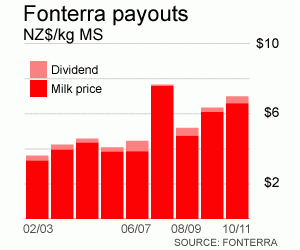
Fonterra payout and forecasts

Fonterra has set its first payout forecast for the 2010/11 season, lifting its outlook for the milk price by around 50 cents per kilo to around NZ$6.60/kg.

Once dividends from profits are added, Fonterra could produce a payout of around NZ$7/kg. This would be the second highest payout in Fonterra's history after the record NZ$7.62/kg paid out in 2007/08. Fonterra chairman Henry van der Heyden said it was possible the final payout could be over NZ$8/kg if the exchange rate and commodity prices stayed at their current levels. This would add up to NZ$2 billion to the economy from the NZ$2009/10 season, assuming the drought of the last few months does not hurt output too much.

Each extra dollar of payout adds around NZ$1.2 billion to the New Zealand economy and the forecast of a higher payout will boost the outlook for the economy overall and provincial economies such as Southland, Canterbury, Taranaki, Waikato, Manawatu, Bay of Plenty and Northland.

Fonterra also held its value of its shares at NZ$4.52 per share. Fonterra requires its farmer/shareholders to hold one share for each kilogram of milk solids it produces each season.

Here is the detail below in Fonterra's release:

Fonterra today announced an opening forecast payout before retentions for the 2010/11 season of $6.90-$7.10. This payout combines a forecast Milk Price of $6.60 per kilogram of milksolids (kgMS) and forecast Distributable Profit of 30-50 cents per share.

Fonterra Chairman Sir Henry van der Heyden said the opening Milk Price forecast represented an increase of 50 cents on the forecast Milk Price for the current (2009/10) season. Sir Henry said the Board was forecasting a Distributable Profit for 2010/11 of 30-50 cents a share, although an updated forecast will follow the Group’s annual budgeting process in late July.

He said that the Board currently intends to make retentions from this Distributable Profit, in line with Fonterra’s dividend policy which is to retain 25-35% of total Distributable Profit in the Co-operative. Based on these forecasts and targets, Fonterra farmer-shareholders on average would receive a total payout before retentions of $6.90-$7.10 for each kilogram of milksolids backed by a Fonterra share.

Sir Henry said if international dairy prices and foreign exchange rates were to hold to current levels for most of the coming year, then it is possible that the 2010/11 payout could be well over $8.00. However, the forecast payout has been set at $6.90-7.10 reflecting a more cautious outlook given the high degree of volatility in the market.

“That’s what the market looks like right now, but we know that there is substantial volatility in the market. The reality is that we are seeing big swings in foreign currencies and turmoil in some economies. These factors could have a big impact on demand for dairy products and the prices we ultimately realise.

“With this in mind, we believe a payout forecast in the range of $6.90-$7.10 is appropriate. “Accordingly, farmers doing their budgets for the coming season should base their planning around a payout broadly in line with this year. “If prices hold up throughout next season, we could be looking at a significant improvement during the course of the year. But at this stage, in the current volatile environment, it would not be sensible to count on this.”

The Co-operative has also set the Fair Value Share (FVS) price for 2010/11 at $4.52 per share.

In November last year, shareholders voted to move to a Restricted Market Value Range – reflecting that Fonterra shares can only be held by supplying farmers.

The Independent Valuer, Grant Samuel, has determined a Restricted Market Value Range of $3.95-$4.58 per share with a mid-point of $4.27 per share. This represents an 11.5% increase on the Restricted Market Value Range mid-point of $3.83 estimated in December.

As Fonterra is transitioning to a Restricted Market Value approach, the share price is being effectively held at $4.52 per share until the Restricted Market Value mid-point reaches this level.

During this transition period, the Independent Valuer is continuing to also provide a view of an unrestricted Fair Value Share price. The Valuer has determined a Fair Value Range for the 2010/11 season of $5.26-$6.11 per share, with a mid-point of $5.69 per share (up from an estimate of $5.10 in December 2009). Sir Henry said the increase in the Restricted Market and Fair Value Ranges since the estimate in December was largely due to an increased value for Fonterra’s regional consumer businesses, which have been performing very strongly over the last several years, as well as the positive impact of retentions on the share price.

2010/11 Payout Forecast

Fonterra CEO Andrew Ferrier said the opening forecast Milk Price of $6.60 per kgMS was based on a favourable outlook for dairy pricing.

“There continues to be strong growth in dairy consumption and demand from China, the rest of Asia, the Middle East and North Africa. “Meanwhile, global supply remains constrained, with production down because of adverse weather in Europe and Australia, while tight credit conditions are constraining dairy growth in the United States,” he said.

However, Mr Ferrier said there was considerable volatility in the market. Unfavourable movements in foreign exchange rates or economic conditions in major markets could have an adverse impact on global dairy demand and pricing. Mr Ferrier said: “The forecast Distributable Profit range of 30-50 cents per share is an early indication that we believe there will be a rebound in operating profits in our FTO and Ingredients businesses. Current year operating profits are under pressure due to poor stream returns.

In other words, the returns on cheese and casein are lagging the returns on whole milk powder. Under Fonterra’s new Milk Price, if non-powder returns lag the returns on powders, there is a reduction in profit. For next year, unless there are significant further increases in powder prices, it is expected that stream returns will improve from 2009-10. “In addition, we expect another solid year of profit growth in our consumer businesses in 2011,” Mr Ferrier added.

Fair Value Share

The Independent Valuer, Grant Samuel, said the major driver of increases in the Restricted Market and Fair Value Ranges was a higher value of the consumer businesses, consistent with share price movements for large listed FMCG (fast moving consumer goods) companies. Mr Ferrier said it was heartening to see that the continued strong performance of the consumer businesses had given the Valuer the confidence to increase their value.

Grant Samuel assessed the Restricted Market Value mid-point for 2010/11 to be $4.27 per share, up from the $3.83 per share estimated in December. This implies a discount of 25% on the Fair Value Share Range. “It’s pleasing to see that the Valuer now assesses the restricted value at $4.27 per share which is now only slightly below our approved price of $4.52 per share,” said Sir Henry. “It is encouraging to see this gap is closing.”

2009/10 Payout Forecast

Sir Henry said the Board had also reviewed the forecast for the current 2009/10 season.

“We remain on track to achieve a forecast payout before retentions of $6.50-$6.60,” said Sir Henry. This payout combines a forecast Milk Price of $6.10 per kgMS and forecast Distributable Profit of 40-50 cents per share. The Distributable Profit forecast remains unchanged as a strong performance by the consumer businesses and a number of one-off gains have offset the negative impact of stream returns on non-powder products.

Fonterra’s target dividend range is unchanged at 20-30 cents per share. This means Fonterra farmer shareholders would on average receive a total payout after retentions of $6.30 to $6.40 for each share backed by milk production and a dividend of 20-30 cents for each dry share they hold.

We welcome your help to improve our coverage of this issue. Any examples or experiences to relate? Any links to other news, data or research to shed more light on this? Any insight or views on what might happen next or what should happen next? Any errors to correct?

We welcome your comments below. If you are not already registered, please register to comment in the box on the right or click on the "'Register" link at the bottom of the comments. Remember we welcome robust, respectful and insightful debate. We don't welcome abusive or defamatory comments and will de-register those repeatedly making these comments.

27 Comments

Oh wont Crafar be cussing his

Oh wont Crafar be cussing his timing.

What and see!!!

What and see!!!

Hooray !! Looks like next

Hooray !! Looks like next quarter's GDP figures are going to be another good one. This is truly the land of milk and honey !!

Note the "headline" payouts

Note the "headline" payouts of $6.50 - $6.60 (09/10) and $6.90 to $7.10 (10/11) are before retentions (i.e. take 20 cents off the figures and you'll get the "actual" payout expected).

Signs are that European and US production will likely increase (US 1.7% ahead of last year month of April). A good corn harvest in the US is also likely to supply feed at reduced costs allowing US farmers to ramp up production. Low Euro will make dairy exporting more attractive to EU countries. Current season supply constraints were mainly driven by dry weather in Australia (-5% production) and NZ (down 2-3% on original estimates).

So hopefully dairy farmers will take the chance they have to reduce debt levels as much as possible before dairy commodities return to more long run average prices. If not, they haven't learnt anything from the past 2 years.

looks like the dollar is

looks like the dollar is still dropping too,field days could be a big success.

Great some good

Great some good news....

:D

regards

Some good news on a wet, cold

Some good news on a wet, cold day. Ü

my understanding is that milk

my understanding is that milk powder prices are over $1500 above alternative products ie palm oil, soya.at these levels they will be used instead of dairy. as been said above us,eu will be producing more this year.cant see this level of commodity prices staying.

How much good news is it

How much good news is it really? Are they really earning that much more from selling milk powder, and why aren't they paying down debt, rather than paying out farmers?

Well the current WMP price is

Well the current WMP price is around $4000 / tonne up from a low of $1800 in July 09, so I guess they are earning a little bit more for it now than they were previously.

There is retentions coming from this season's payout of approx $0.20 / kg MS, current season production will be around 1.28 billion kg MS, I am guessing that a little bit of that will go towards debt reduction. Also would anticipate an inflow of money into the co-op from increased milk production in the South Island, these guys will share up, those in the NI who are down in production will now likely hold their shares given they recieve the dividend payment on these 'dry' shares.

As to the first line, how much good news is it? I tend to think that this provides some of those over-leveraged farmers out there the opportunity to reduce debt if they haven't already from the current season. I don't believe that the bank vault will be opened up for these guys and that debt reduction will be a requirement, this is very good news as it will start bringing some stability to the industry.

We need Andrew J to make some

We need Andrew J to make some comments on the current state of the cow industry

@Ploughboy, re: using soy,

@Ploughboy, re: using soy, yes that seems to be an outcome that has been observed and if you are lactose intolerent thats a good thing! However America is using more and more land for bio-fuel production, so America 'might' produce more soy but the net available as a food stock might be less in which case soy etc will rise in price also....

EU im not sure on as Ive not been following their bio-fuel industry at all as its no where as advanced/subsidised....however the USA seems to be heading for no grain/bean exports...so that means the EU spare capacity is used to fill the USA export hole.

So lets see what happens...

regards

Expect to see a surge in the

Expect to see a surge in the number of farms for sale on the back of this. There are a number of farmers for whom this will offer them an opportunity to leave the industry with some dignity, as they are so over extended. I see already today, a farm 'suitable for conversion' has been put up on trade me for $29,000/ha. At potentially 1000kg/ms/ha that farm would cost $29/kg/ms and it has yet to be converted. Only an idiot would pay that. A friend was recently at a bank sponsored seminar and the Ozzie whizz banker warned that though we might get $8kg/ms,after taking account of global financial factors, that level of payout is simply unsustainable.

As to the $8 payout - read Sir Henry's lips: IF prices stay as they are, IF currency stays as it is, IF etc etc

I would imagine that this announcement will not be pleasing Open Country Dairies, who contract with their suppliers to pay 'x' cents less than Fonterra. My understanding is they haven't been making profit, and now will have to stump up more $ to their suppliers.

Prices are high at the moment but as bloggers above have said - that could change. It will be interesting to see what if any changes bankers make to their current tight lending criteria for farmers. I hope it will be 'steady as she goes' and not a return to 'easy credit'.

so a decent price is

so a decent price is converted at $5000 / ha.....looks a big price drop is out there..........

If you have no idea what you

If you have no idea what you are talking about it is best to keep your fingers off the keyboard.
$5000 per ha for a dairy farm????

Assuming 1000 kg MS / ha gives income of:
1000 @ $6.60 = $6,600
Stock Sales = $280

Less Costs at 50% leaves $3,440 per ha surplus.

Yes your right the price of dairy farms needs to come down at this price you cannot pay it off in one season.

Farmer Bob A friend working

Farmer Bob A friend working in one of the major banks said that 80% of their dairy farming clients need $5.30 just to break even and that was back in March before they knew they were in for a prolonged drought.

I would only believe that of

I would only believe that of one bank in the rural market at the moment, they seem to be one step ahead of the others when it comes to debt loading on farmers.

I am not sure what the avg debt loading is per kg MS but I believe it is somewhere between $18-$22 / kg MS, so at a SQ int rate of 8.5% this gives annual int cost of $1.53 - $1.87 / kg MS That would leave $3.43 - $3.77 / kg MS for Farm Working Expenses assuming a $5.30 payout. In my view you should be able to operate on $3.00 cost structure including management (unless they are chucking in truck loads of PKE). So getting around to your point I don't think 80% of farmers need $5.30 to breakeven. Also noting that average farmer will generate $0.28 / kg MS for stock sales.

I didn't say 80% of farmers

I didn't say 80% of farmers need $5.30 to break even. I said one lender said 80% of their clients needed $5.30 (this included stock sales). There is a big variation in debt levels between farms.
"7500 dairy farms only carry 10% of dairy's $30b debt, or $400,000 each. However, only 350 farms also carry 10% of that debt. Some of these properties, fully leveraged have debt up to $80/kgMS."
http://www.nzfarmersweekly.co.nz/article/7645.html

A friend who has been looking to buy a 2nd farm for quite some time, was told this week by his banker, not to panic 'as there will be quite a few farms coming on to the market in the next few months due to crippling debt levels.'

"Farm working expenses rose again in 2008-09 to an average of $3.86 per kg, driven by increased feed and fertiliser expenses."
http://www.nzherald.co.nz/business/news/article.cfm?c_id=3&objectid=1058...
I agree with you and your comments re $3/kg/ms costs, unfortunately many dairy farmers lost their way on operating low cost systems years ago.

It's all looking good -

It's all looking good - Higher payout, falling dollar, Allan's keeping a lid on interest rates and Bill has come through with tax cuts.

All in all a great recipe for some solid economic growth in the years ahead......

So we will see our milk and

So we will see our milk and cheese, and other products that use NZ milk increase in prices again, which will increase inflation. We may end up doing better if we import our milk products from china in the future...

Do we consume more milk and

Do we consume more milk and cheese in NZ than we export??

No, but it is a case where

No, but it is a case where the price that NZ farmers will be selling it for, will be more than supermarket companies can buy it in at from other countries. The same applies with other things that we import, when we also export them. Eg. NZers won't be able to afford our our premium products, and will have to buy in cheaper inferior products.

Don't panic. There's yet

Don't panic. There's yet another load of NZ dairy animals on its way to China right now. And there's no way this will turn into a repeat of the kiwifruit debacle. Right?

http://www.stuff.co.nz/timaru-herald/news/3696029/Kiwi-dairy-cows-head-t...

You'd thing the greedy idiots

You'd thing the greedy idiots would learn.

shipping costs to rise--no

shipping costs to rise--no mention of this in the fonterra release--surely this has some sort of impact on payout
http://www.stuff.co.nz/business/blogs/nick-smith/3723570/Exporters-miss-...

milk to be dearer than

milk to be dearer than petrol--$1.81 litre--exc of gst rise
http://www.odt.co.nz/news/business/107897/litre-milk-could-rise-20c

Does that mean I can run the

Does that mean I can run the heap on milk?