

Here's my Top 10 links from around the Internet at 6pm in association with NZ Mint.
I welcome your additions in the comments below or via email to bernard.hickey@interest.co.nz.
I'll pop the extras into the comment stream. See all previous Top 10s here.
Juan Carsalesman at number 10 made me laugh very hard.

1. Stress in European and US money markets - Ambrose Evans Pritchard writes at The Telegraph that central banks and official funds have parked record sums of US dollars at the US Federal Reserve because they don't trust their own banks.
The level of this 'distrust' is getting back to Lehman Bros collapse type levels from late 2008.
We need to keep a close eye on this.
All of this could continue to get worse over the next three months as we go through the Rugby World Cup and election campaign.
It's beginning to feel very similar to what we saw during the last election campaign in September and October 2008.
Here's my coffee bet for anyone who wants to take it. Whoever wins government, and that's likely to be National given the polls, will announce a black budget in either 2012 or 2013 as growth slows and the deficit stubbornly refuses to get back towards surplus by the forecast 2014/15.
Here's Ambrose and a cracking chart:
Data from the St Louis Fed shows that reserve funds from "official foreign accounts" have doubled since the start of the year, with a dramatic surge since the end of July when the eurozone debt crisis spread to Italy and Spain.
"This shows a pervasive loss of confidence in the European banking system," said Simon Ward from Henderson Global Investors. "Central banks are worried about the security of their deposits so they are placing the money with the Fed."
Lars Tranberg from Danske Bank said European banks are reduced to borrowing dollar funds for "a week at a time" rather than the usual six to 12 months. "This closely resembles what happened in late 2008, though the difference this time is that the major central banks have dollar swap lines in place. If the dollar funding markets completely freeze up, the European Central Bank can act as a backstop."

2. Bettting on Las Vegas land - Leith van Onselen at Macrobusiness does a wonderful job of looking at Las Vegas house prices and how land restrictions played a major role in the boom and then the 59% price bust that followed.
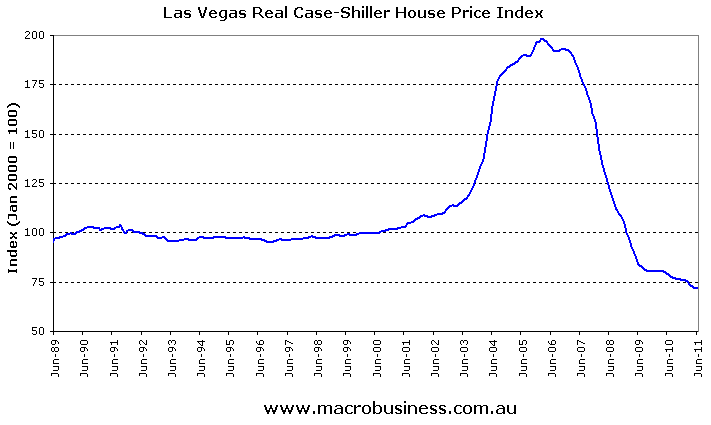
He concludes:
It’s hard to deny that if land had been freely available for development, developers would not have paid such high prices for the land sold by the federal government and Las Vegas home prices would never have risen to such dizzying heights or crashed as violently.
Las Vegas is yet another case study whereby excessive government interference in the supply of land (and/or the provision of housing) has mixed with easy credit to create a speculative bubble followed by a disorderly bust.

3. Going after the big guns - America's regulators may finally be getting serious about prosecuting the big banks.
The New York Times reports that the Federal Housing Agency is about to sue a dozen big banks, including Bank of America, JPMorgan Chase, Goldman Sachs and Deutsche Bank, for misrepresenting the toxicity of the loans they bundled up and sliced up into sub-prime dreck that blew up the world.
Finally.
The suits will argue the banks, which assembled the mortgages and marketed them as securities to investors, failed to perform the due diligence required under securities law and missed evidence that borrowers’ incomes were inflated or falsified. When many borrowers were unable to pay their mortgages, the securities backed by the mortgages quickly lost value.
Fannie and Freddie lost more than $30 billion, in part as a result of the deals, losses that were borne mostly by taxpayers.
And here's Reuters on a Federal Reserve order to Goldman Sachs over wrongful mortgage foreclosures.
4. Extend and Pretend - Reuters analyses the maturity of US government debt and finds it needs to be extended...otherwise it's not sustainable...
Insatiable demand for safe haven U.S. government bonds is helping mask a potentially huge financial problem -- the need to extend the maturity of debt issued by the United States.
The United States has the least balanced maturity schedule of any major nation. Over 70 percent of its bonds mature within 5 years, compared with an average 49 percent for the 34 member countries in the OECD. This leaves the country extremely vulnerable to any shift in investor sentiment at a time when its debt load has almost doubled in four years.
Marketable U.S. debt has risen to over $9 trillion, from around $5 trillion in late 2007, before the government increased spending to bail out struggling financial companies.
"There has never been a single example in the history of finance where financing long-term liabilities, which we are, with short-term debt, ends well," said Mitch Stapley, chief fixed income officer at Fifth Third Asset Management in Grand Rapids, Michigan.
5. Home from US$99 - The Daily Mail reports a company in America (Tumbleweed Tiny House Company) has started making portable houses (well more like sheds with beds and buckets) to house the poor.

6. 'Stupid and Arrogant' - Former US UK Chancellor of the Exchequer Alistair Darling has written about the financial crisis and the attitudes of various bankers, including Royal Bank of Scotland's 'Fred the Shred' Goodwin.
The former chancellor says in his memoirs that Britain’s bankers were “stupid and arrogant” and says Sir Fred behaved as if he was “off to play a game of golf” while officials struggled to prevent a meltdown.
Mr Darling describes the secret discussions which led to the Labour government effectively nationalising RBS and Sir Fred being heavily criticised for his management style and conduct.
7. Not enough subsidies - American solar tech company Solyndra fell over this week, despite huge US government loan guarantees. Basically, the state subsidy it was getting wasn't as big as the ones its Chinese competitors were getting from their government.
Sigh. I get beaten up for saying 'free' trade is a scam. But it is. No one plays fair except us. The Chinese are the biggest culprits, followed by the Americans and the Europeans.
Here's Todd Woody at Forbes on how a bunch of US green tech firms are now hitting the wall:
Founded by veterans of the Valley’s chip and hard-drive industries, these companies attracted billions of dollars in venture capital investment on the hope that their advanced “thin film” technology would make them the Intels and Apples of the global solar industry
But as the companies finally begin mass production — Solyndra just flipped the switch on a US$733 million factory here last month — they are finding that the economics of the industry have already been transformed, by the Chinese.
Chinese manufacturers, heavily subsidized by their own government and relying on vast economies of scale, have helped send the price of conventional solar panels plunging and grabbed market share far more quickly than anyone anticipated.

8. Today's must read - Michael Pettis is a closely watched academic economist who is based in China and tells it without varnish or an interest to protect.
Someone should put him in touch with John Key and cure our Prime Minister of his perenially sunny disposition about Chinese growth.
- BRICS and other developing countries have not decoupled in any meaningful sense, and once the current liquidity-driven investment boom subsides the developing world will be hit hard by the global crisis.
- Over the next two years Chinese household consumption will continue declining as a share of GDP. Chinese debt levels will continue to rise quickly over the rest of this year and next. Chinese growth will begin to slow sharply by 2013-14 and will hit an average of 3% well before the end of the decade. Any decline in GDP growth will disproportionately affect investment and so the demand for non-food commodities.
- If the PBoC resists interest rate cuts as inflation declines, China may even begin slowing in 2012. Much slower growth in China will not lead to social unrest if China meaningfully rebalances. Within three years Beijing will be seriously examining large-scale privatization as part of its adjustment policy.
- European politics will continue to deteriorate rapidly and the major political parties will either become increasingly radicalized or marginalized.
- Spain and several countries, perhaps even Italy (but probably not France) will be forced to leave the euro and restructure their debt with significant debt forgiveness. Germany will stubbornly (and foolishly) refuse to bear its share of the burden of the European adjustment, and the subsequent retaliation by the deficit countries will cause German growth to drop to zero or negative for many years.
- Trade protection sentiment in the US will rise inexorably and unemployment stays high for a few more years.
9. Totally irrelevant video from US comedian Rob Parovonian. I needed a laugh at the end of a long week.
10. Totally Clarke and Dawe - A used car salesman (Juan Previousowner) talks about the Australian economy.
64 Comments
Oh come on you guys...you're not supposed to hit the bottle before 6pm..spot the ERROR
'Stupid and Arrogant' - Former US Chancellor of the Exchequer Alistair Darling has written about the financial crisis and the attitudes of various bankers, including Royal Bank of Scotland's 'Fred the Shred' Goodwin.
Thanks for spotting Wolly
Corrected now.
cheers
Bernard
Hey no worries Bernard...
Chinese government backed investment funds are looking to buy the decidely dodgy LA Dodgers, the LA Times reports.
http://www.latimes.com/sports/la-sp-dodgers-mccourt-sale-20110902,0,3026247.story
The WSJ wonders if this is China's Rockefeller Centre moment.
The possibility of the sale also reminds us of the height of panic in the U.S. over Japan’s then-rising global power in the 1980s. Back then, Japanese investors bought U.S. landmarks such as New York’s Rockefeller Center and the Pebble Beach golf course in California. And Japan’s economy promptly fell off a cliff and has never recovered.
Could the Dodgers be China’s equivalent of the Rockefeller Center deal? We can call it the trophy purchase top.
Here's the problem with choosing to export your way to freedom by subsidising everything and controlling your currency.
It only works when there's someone on the other side to buy it.
When the whole world slows down then there's a problem. Demand from Mars is not going to eventuate.
Here's the WSJ on the global slowdown in factory output that came this week:
The end game, of course, is to protect jobs. But any escalation in trade barriers or attempts to manage currencies are bad for global growth since the efforts impede the free flow of goods and money.
The risk is that the revival in demand that everyone wants will be delayed by the very moves taken to protect market share.
When the pie is shrinking, every nation will scramble to protect its slice.
Think how bad it will be when they decide Peak oil is here and they'd better panic about "now".
regards
When the pie is shrinking, every nation will scramble to protect its slice.
bing.. bong NZ
What’s going on in Auckland – no protest – amazing !!!
A $500 million $ 500’000’000.- deal between Government and council is set to bring a fleet of new electric trains to Auckland. Transport minister Steven Joyce and Auckland Mayor Len Brown this afternoon signed an agreement to buy 57 electric multiple units (EMUs), each with three carriages.
http://www.nzherald.co.nz/nz/news/article.cfm?c_id=1&objectid=10748778
PM – where are the 170’000 new jobs coming from, when you are constantly importing things in the billions ?
PM – in what industries are Kiwis, particularly, NZyouths going to be employed, when your government constantly taking away interesting, skilful jobs to overseas workforces ?
PM – why do we have in this country youth education programs costing taxpayers money millions, when there are no decent jobs and our youngsters are forced to move overseas ?
PM – how can we have a solid, more complex, better coordinated production sector, covering our needs, when you import them in the billions ?
..and PM why are you wondering – why we need more money for unemployment, prisons, and the police force ?
..and PM, by importing most everything and not producing in NZ – why are you wondering, why NZwages of the wider population remain low, families are financially struggling and our account deficit is going up ?
..and PM when you aren’t able to answer these questions to the nation satisfactory – why not start thinking building up a new economic philosophy – not running for growth, stop megalomania, competing in the worldwide race – but modesty, an economy dictated from inside out, a balanced NZsociety with quality of life under an average standard of living and not much debts ?
We do have railway workshops which could build these electric trains if allowed. But 'tis better to export the jobs. See Gordon Campbell on this http://werewolf.co.nz/2011/08/train-wreck-at-kiwirail/
Such major operations worth (b)millions have a massive, valuable impact (logistics) on other sectors of our industries - research, development, exporters, agriculture, etc.
I’m wondering, what the NZMEA Les or/ and John W. have to say ?
I recommend Andrew's link - great !
Good to see NZjournalists (in that case BH), who describe the worldwide situation,
independently, honestly, straight in a few plain English words – thanks Bernard.
I think that is the only way to help the NZpopulation to make the right decisions, planning their daily life’s.
Useful post here from Ed Harrison on Hoover's Great Depression speech of 1932
http://www.creditwritedowns.com/2011/09/hoovers-great-depression.html
cheers
Bernard
Dunno know about $99 but hey anything with a roof that has an engine, wheels, a stove, freezer, cooker, dunny and a bed...it's gotta be good. Follow the trail of pubs and the Whitebait right....!
Here..find yourself one in the adverts..... http://www.nzmca.org.nz/........go
Here's the NYTimes' preview of Obama's speech next Thursday, which some think will unveil a depression-avoiding plan for job creation and mortgage forgiveness. The initial signs look tepid.
http://www.nytimes.com/2011/09/02/us/politics/02assess.html?_r=1&smid=tw-nytimes&seid=auto
Expected among those stimulus proposals is an extension for another year of the payroll tax cut for workers that Mr. Obama and Republicans agreed to last December, which has meant $1,000 more this year for the average family. Mr. Obama has been considering whether to seek an expansion of the payroll tax cut for employers. And he is expected to propose a separate tax credit for employers who increase their payrolls.
The total cost could reach several hundred billion dollars. But the White House figures that tax cuts have the best chance of Republican support.
Borrowing (Sorry Bernard, is that an extension to my personal debt profile) from a poster on Zero hedge earlier today, this sums up how I feel.
"I'm having a difficult time prioritizing what I should be depressed about first"
I listened to John Key last Friday lunchtime at North Harbour Business group meeting. While he carefully acknowledged there were international problems, he failed of course to identify them as significant elephants in the room and had the "trust us we are going to be alright" message was centre stage. Should I worry about this clown?
The rightful decision on Nathans Finance directors today re culpibility and sentence pales into insignificance (if only because they have ceased to be players) if the Wall Street banks get pinged with $US30-40 Billion charges that Fannie/Freddie Mae/Mac are likley to seek and the impact on already dodgy bank balance sheets. Should I worry about this?
Against this background, Fonterra must have some big brass ones to say that future payouts will be right up there against foecasts!! I think I have already decised to worry about this!!
Iain,
Can you please limit your comments to a just a couple of links at most and a much shorter comment than what you have here. It would be much more effective and widely read. It also stresses our spam filter.
cheers
Bernard
Hey Parky, I don't think Berno has ever made any kind of resoned response to any of your points ever, for that matter nor has Wolly.
Its interesting, pretty much all content discussed on this site (excluding the music video clips) is within the context of the concept of money, and yet that monetary concept that we all live is flawed, but accepted by so many people who should know better.
Some people just cant seem to be capable of seeing the big picture.
Fred Dagg is in fine form, best one for quite some time.
Cherry picking Hugh.....you mean you want economists that can back up your views.
The problem again and again is your work is written to support your views and not to look for the truth IMHO. This is the difference between a peer reviewed academic paper and typical bloggers and magazines / web sites with a bone to pick....
If you actually read the article one thing stands out immediately,
"like all housing bubbles it was only a matter of time before the debt-fuelled party turned into one giant hangover"
The city went up by 59% but the state went up by 53%, so on the face of it at best you could say the city limits were responsible for 6% of the bubble...(assuming no other factors).
To be a meaningful study (and one not by a pro-business right wing magazine that does its best to blame govn at every opportunity) we need to see a base case. This is one where the variables can be accounted for and removed, or, are not present leaving just the land restrictions as the "final" and most importantly the main cause. If you can do that then you have a ver strong case. Otherwise with no land restrictions we still get the bubble just its slower to build but the pop can be large or larger....
So what we need to see to validate this and your "crowing" is a state where there was no easy lending or land restrictions or any other impacting variable so these factors can be taken out...we dont really have that? though texas shows some promise as that...
So if we see a state that had just one difference that of no land restrictions that would give a huge confidence that land restriction was the main cause, otherwise is just a contributing factor....where in actual fact cheap and easy credit would seem to be the main causes....take away those two and in effect the land restriction does not matter....
So rather than a business site claim, please point me at several reputable academic studies, then I can believe you, otherwise you are simply in the "wrong" bucket....as thats the safest place to put you.
And I mean real studies via Universities and not (so much) via "independant" economists....not unless they can be shown to be truly agnostic....so say a von-mises supporters piece doesnt count. I want to see peer reviewed papers in academic journals....and the critique of them.
regards
Hugh obviously has a life outside of interest.co.nz, unlike certain trolls who are obviously paid to do it (by the Green party or a well-heeled supporter) or who are welfare beneficiaries.
The obvious comeback to that pig ignorant criticism regarding "proper academic research", was THIS:
http://www.performanceurbanplanning.org/academics.html
On Hugh's site, not hard to find.
Let's try an experiment. Let's try to list as many of the quoted apparent causes of this problem, in the NZ context. I'll kick off, in no particular order:
1) Cullen hiking the top rate to 39% - I recall some Westpac work associating 17% of house price inflation between 2002 to 2008 (?) with this change.
2) Immigration - RBNZ take this view, see recent submission to Productivty Commission.
3) Constrained landsupply and all that - Hugh, Leith and RBNZ as well, at least.
4) Taxation - various.
5) Ineffective inflation control - nuff said!
6) Credit supply - same people as in 5 above, and if you look at Leith's work you will see he cites this as a factor but secondary to constrained land supply.
Any more?
Next phase of experiment. Rank the influence of each causes, in some way, to determine the most effective area to apply the fairly obvious solutions.
Next phase of experiment. Rank each solution in terms of ease of implementation.
Doh, game over. None of the solutions can be implemented.
Oh well, back to the status quo.
I share your pessimism. Sickeningly, the ignorant masses see "lassez faire" as "one of our biggest problems".
The simple facts are that the only part of the world NOT deep in crap today, are the low tax, small government, low regulation States of the USA. So much for the "mainstream" narrative. If these States seceded from the rest of the idiot "liberal" States, they would be the world's strongest economy by a long shot. As it is, they are propping up California and the other liberal coastal States.
Sure, "Wall Street did it" - but if you want to immunise your economy to "Wall Street", you do it by having LESS distortions in it for the fat cats to exploit. The housing bubble issue is riddled with rent seekers, starting with the urban fringe development rent seekers. The finance sector just happens to be the biggest rent seeker of the lot, riding the distortions created by "Smart Growth".
Rick Perry has a powerful platform on which to run for President. The first thing he should aim to do as President, is outlaw urban growth boundaries, period. That would 90% fix the USA's problems, and it would 90% fix our problems too if we had any politicians with the gift to sell this to the public. Lange could have done it if he needed to, and if he wanted to. Key is not Lange.
I would add irrational exuberance to the list. I suspect that and the loosening of credit were the biggest factors. Even houses in towns and cities with no obvious barriers to growth seemed to double in sale price over that 2004-2007 period.
My point Hugh and Phil is that if you solved the housing issue(which would be a good thing) then the bubble fueled by easy credit would show up somewhere else.
scarfie - just curious, given risk-weightings lenders use, where else might a bubble show up?
Les - there's the rub. Folk live in houses, and spend either on the houses, or on stuff to fill 'em with. What other bulk soak of consumables is there? Someone doing housing somewhere else? There has to be an end buyer for every exported commodity.
Hugh and PB just get a bad time here because they take a very narrow view - one that suits their purpose - then call it 'immutable gospel'. Median multiples, unlimited exponential expansion capability, slanging off anyone who fetters them, and I think that's about it.
Their 'history' is referenced to decades only - some of us see it in millions, even billions, of years. Ultimately, we ain't going to change them, and having tried once but failed, we have to bypass those folk. There simply isn't time to wait for the usual generation-dies-out change thing with this one.
Note Wally's post about it being a global recession, and remember that Steven and I were predicting that confidently, years ago. Maybe, just maybe, we know what we're talking about.
Never let the facts get in the way of a good story eh:)
The truth is we can't speculate on where the money would have gone if not housing, but a good guess there PDK.
But surely the parallel boom in commodoties fuels by institutional investors is the proof in the pudding and gives an insight into human behaviour when easy credit is available. I say this because surely the leverage used is just another form of credit. I can only hope the gold is going to follow a different path when the commodity bubble collapses, I am not so sure on that as I would like to be.
I had the term used to me last week in relation to engineering about getting back to first principles.
Thanks Hugh. I think you get unfairly criticised for seemingly focusing on just one aspect, the scarcity "trigger". While you do tend to speak more about it, you've not denied the influence of the "fuel" factor.
If we were to distil the list of causes to "trigger" (controlled land scarcity) and "fuel" (finance), it might help with an extension to our thought experiment. That is, I wonder which factor can be changed more readily to ensure demand does not lead to a bubble? I wonder what RBNZ would think about this? Would it be the case, that if we had completely unfettered access to land supply we would not have the problem anyway and so action from RBNZ, say, would no be so critical in avoiding bubbles?
A little more "trigger" here perhaps:
In the US some states gave unfettered access to land....yet still had a bubble...while I can accept land scarcity played a part what I dont accept is it was an or the over-riding factor......Throw in that there is an assumption that if the concil relaxed the city boundaries there is the huge and un-substantiated assumption that land prices would collapse....this is ludicrious.....all we would see is artificial scarcity moved from the hands of the council to the hands of the land owners.....all they would do is sell it off gradually in expensive lots at the same old premium.....
What Ive never seen from Hugh is how he see's the guarantee of cheap land being made available....knowing NZers that wont happen voluntarily, they will milk it for every penny. So unless the Govn or council purchases the land at its present agricultural price and then releases it sectioned off for residential with say a 4% margin Hugh is wasting his breadth......IMHO....
regards
"the Govn or council purchases the land at its present agricultural price and then releases it sectioned off for residential ..."
Now there's a useful idea. Get y'self down to CERA HQ, Steven.
Cheers, Les.
The ppoint is all we do with Hugh's "plan" is remove the artifical restriction of the council to the artifical restriction of the owners, the house buyer still gets screwed over....ie who really thinks they will sell the land at its present price plus a small margin? I certianly dont....
Given the liquid areas of Chch are stuffed then new suburbs need to be constructed and built on.....but I suspect for some reaon taht isnt so simple....some dicating needs to happen.....but I suppose its the usual reason(s) someone(s) wants to make a lot of money on the misery of others.....
regards
There is a bit more with Hugh's plan -- transfer the infrastructure costs of new subdivisions to ratepayers and taxpayers and away from developers; don't worry about energy efficiency, public transport, accessibility (unless you have a car) ....
Simon - indeed another factor, let's call it the 'Greenspan Doh!'. I recall this was his observation, or surprise, given he believed in the rationality(?) of self-interest - big mistake. Just curious, what towns and cities are you thinking of?
Rotorua is an example; static population and surrounded by farmland which is opened up as required to development. There is no housing pressure but prices went up though nothing like Auckland. There was a ludicrious article in the Herald yesterday about how KiwiSaver has taught people to save so now they can afford a deposit using their KiwiSaver money. In it the head of the Rotorua Property Investors Association said that "PIs no longer have the market to themselves", i.e. the only people buying and selling were PIs. http://www.nzherald.co.nz/residential-property/news/article.cfm?c_id=76&objectid=10749272
Thanks Simon. Your response, I think, helps answer my question posed above, pitched against this as a duo-causal problem - "which factor can be changed more readily to ensure demand does not lead to a bubble?"
I've always thought of this problem as multi-causal and that applying time-effective partial solutions in some areas is better than applying none to one area that can seem the most influencial. Or one that fits well with a particular ideology, or whatever.
So, RBNZ could have done a better job pushing back against debt growth into housing than they did in the up-swing of the property boom. The aggregate level of debt was and is not prudent and so they would have been well within the Act to use prudential tools to arrest the problem, given the OCR, and their operation of it, was proving to be less effective than absence of any other supplementary approaches implied.
Why didn't RBNZ take more effective action against this problem?
Would they make the same mistake again?
Makes y' wonder, huh ...
Cheers, Les
lol Clarke and Dawe brilliant again.
Yes I showed my wife a few last night, she then spent a happy hour laughing her head off via youtube.
regards
Interesting...Gerry B was right in 2010 to toss out the Smart Meter red tape...seems every household in the UK now has to pay more for the useless toys.see google uk bus.
And the number of new jpbs created in the whole USA in August....is...wait for it......ZERO.
No, not useless...first rule of manageing a resource know how much and how fast....the smart meters give NZers the ability to manage their power.....Frisges for instance can be switched off en-mass in peak periods, even rolling delyas of 1/2 or 1 hour when its thousands helps.....
google uk bus.? cant find a link that substantiates your comments...
regards
Ok are we there yet...? Has the debasement of the currency washed away the debts yet...well has it...has it?....bugger no.
"Keep it going Alan...don't you dare raise the ocr...let the beast roam free cos it's our only hope Alan...we gotta steal the capital from somewhere...and anyway how many New Zealanders with savings will understand what we are doing to them....hahaha...oh this is the way to go...
Three more years Alan...another ten percent knocked off the mountain of debt and by gum the property speculation game is still going in places.....the stupid media really have supported us".
Meanwhile down in suburbia the peasants are slowly but surely cutting away the wasteful splurge on shite they don't need and the veg gardens are popping up now that spring has arrived. Great to see the road kill council gangs are no longer needed. Those recipes made all the difference.
The poor banks....demand for credit still falling...bet the advertising sector will have heaps of work though...all the new fangled shite adverts to churn out encouraging Mr&Mrs peasant to rush on in for some cheap once in a lifetime mortgage credit.
Humbug.
FYI no jobs growth in America in August.
http://www.bloomberg.com/news/2011-09-02/employment-in-u-s-unexpectedly…
Employment in the U.S. unexpectedly stagnated in August, increasing pressure on Federal Reserve Chairman Ben S. Bernanke and President Barack Obama to spur an economy that’s barely growing two years into the recovery.
Payrolls were unchanged, the weakest reading since September 2010, the Labor Department said today in Washington. The median forecast in a Bloomberg News survey called for a gain of 68,000. The figures included a 48,000 drop in the information industry, mostly reflecting a strike at Verizon Communications Inc. (VZ) The jobless rate held at 9.1 percent.
“This is further evidence that the economy is very close to stalling if not having stalled,” said Nariman Behravesh, chief economist at IHS in Lexington, Massachusetts, who forecast a gain of 15,000. Mohamed El-Erian, chief executive officer of Pacific Investment Management Co., called the report “grim and scary” in an interview on Bloomberg Television’s “In the Loop” with Betty Liu.
Stocks slumped and Treasuries rallied on bets the data raise the odds of another recession. Earnings and hours worked both declined, today’s report showed, reducing the purchasing power of consumers whose spending accounts for 70 percent of the world’s largest economy.
I wonder what I'll be sitting and thinking a year from now.....Interesting stuff...it looks so bad yet seems to defy gravity.....like the wild coyote...if we look down is there solid ground or fresh air....dare we look?
I wonder how xmas spending will go...if its bad and its looking bad, more closures in January seem likely....empty malls.....commercial property diving again, state taxes down, yet again.....
regards...
The gold grab is not far away now....no way will Obama allow the rich to slip the net...hand it over all you American citizens...he will hunt you down where ever you hide...you will be sent to the Rock if you're caught hiding any...Uncle Sam wants all your wealth......haha.
Na...months or years away.......its likely to be a 5 year ish slide to the bottom.....Obama wont be in power then.....we'll have some fruit cake republican probably and they'll be bombing Iran because....er......they can...........the panic of peak oil should be in front of everyones noses by that stage......so Palin or Buchanan or which ever half wit they elect will be busy invading......
regards
"The facts show the entire global economy is in recession"
End of lies – reality increasingly visible
“As modern macroeconomics developed over the last half-century, most people either ignored or finessed the issue of debt. Yet, as the mainstream was building and embracing the New Keynesian orthodoxy, there was a nagging concern that something had been missing. On the fringe were theoretical papers in which debt plays a key role.
B*ll*cks....this was not Keynesianism for the last 30 years, this was voodoo economics based on some sort of moneterism with a twist of libertarian screw up by Greenspan...we were rolled and thw world should wake up to that......Minsky fringe? nope, ignored....yes....
This is a keynesian commenting on how the disaster is going....
http://krugman.blogs.nytimes.com/2011/09/02/fatal-distraction/
Ambrose is I think quoting someone else but isnt saying how un-fortunately....
regards
I cant fathom why chartists...um chart.....somehow they seem to convince themselves there are patterns......strikes me its like a mathematician thinking he can bet on the horses and win....
regards
I think it is more akin to psychology Steven. A certain amount of speculation for sure, but human behaviour can be predicted with high rates of probability in some circumstances. The trouble today is the massive manipulation going on as attempts are made to hide the problems.
The charts are looking very similar to 1929 & 1987, so this will be an interesting couple of weeks.
"human behaviour can be predicted with high rates of probability in some circumstances"
Yes Ive seen this commented on before. Lemming like behaviour when there are enough ppl, some interesting software I saw predicted how ppl would act in the event of a fire....some would leave, some would stay and finished their food, some would "blindly" follow others, some thought.....it was these who were most likely to survive if something unusual happened....the ones who satyed to finish their food perished.....fasinating software, it seemed to predict very well.
regards
Poor old Obama, can't even push through new smog rules that he promised. What was his campaign pledge again? Yes we can??? Seems corporate America and the lobbyists have had there way again, probably on the back it would have cost jobs of course (don't worry about the planet felas, everything is going to be fine!)
The poor man was well intentioned, but i don't think he really knew what he was getting into, you almost feel sorry for him as he realised he is infact powerless. He's starting to make George W look good!
So its a great thing that the GOP extremists are crippling America in their pursuit of un-seating Obama? totally immoral.....IMHO, but then they are fruity loops...
regards
Anybody else noticed that Italian bond yields are creeping up again? The ECB was supposedly going to cap them at around 5%
"A small town in central Italy has declared its independence and started to print its own banknotes.
The authorities in Filettino, 100km (70 miles) east of Rome, are protesting against austerity measures.
It has only 550 inhabitants and under new rules aimed at cutting local administration costs it will be forced to merge with neighbouring Trevi.
Town mayor Luca Sellari, who stands to lose his job because of the eurozone crisis, came up with the idea.
He created his own currency, called the Fiorito. Banknotes have his head on the back, and they are already being used in local shops and being bought as souvenirs by tourists who have started to throng the normally quiet streets"
http://www.bbc.co.uk/news/world-asia-pacific-14774526
550 and they need a mayor...and a local council......no bloody wonder they are broke....what a joke.
Are you ready for the Sept RWC economic BS...hope so cos they are planning a mighty season ahead to convince punters that Bill knows best.
It will of course be switched off like a light bulb on the night of the election. No need to waste money once the deed is done. Then we can get back to the steady stream of banking blather about growth and why idiots should borrow money from them. Xmas spending season looks set to be a real fizzer with post xmas sales already being planned. No need for new led lcd 3d woppa screens that make beer after the RWC is there. Heaps of sets going cheap as man.
Sky repackaging its reruns of shite to make a new channel to extract new money...fat chance of that being a winner.
Summer beckons...the heat...the flies....the little biting bloody black ones....the fishing...the picnics with the wasps...sand in the ice cream....warm beer...it's almost here.
Sod it...several hundred bloody lambs to tail and castrate and dose and chase....hope the dogs know what to do.
"No need for new led lcd 3d woppa screens that make beer"
Cool! I'm off to Hardly Normal asap.
Re: #3 It's taken them a long time to grow the balls to go after the big banks, I doubt they will get anything. These are awesomly corrupt institutions, with bucketloads of cash (and the ability to create more). The law has never, and never will care about right and wrong, or the truth. It's all about linguistics, and the ability to argue. These companies specialise in exploiting (and creating) loopholes.
Tssk tsk. It's the evolution of battle by combat. The better funded can afford the better champion.
September prize for best BS goes to:
"Kiwisaver is giving New Zealand's provincial property market a boost. For the past nine months, first-home buyers have been able to withdraw their savings to help them buy a property.
Regional centres in particular have noticed an influx of people at entry level.
Kiwibank spokesman Bruce Thompson said he had been surprised at the number of people wanting to use their KiwiSaver funds to buy property."
Congratulations to Brooseee!
"Kiwibank spokesman Bruce Thompson said he had been surprised at the number of people wanting to use their KiwiSaver funds to buy property"
Duh! People want to feel their savings are in something tangible and of real future benefit to them. As opposed to vague promises of some vague future value.
Pity, they probably are better leaving it in Kiwisaver for 2/3/4 years more, but maybe I'm wrong. If it's cheaper to buy than rent then you should probably buy.
"Master builders are delighted with a Labour Party election proposal to pay employers the equivalent of the dole for every new apprentice they take on - subject to conditions - in the next three years.
The proposal would give employers $8727 for every new apprentice aged 18 or 19 who has been on a benefit for at least three months or is at risk of long-term benefit dependency.
The payment, equivalent to one year on the dole, would be a one-off subsidy for the first year of an apprenticeship only.
Labour has budgeted to pay it for 3000 new apprentices a year until 2014, then cut back to 1000 in 2015.
Part of the cost would be recovered by scrapping an existing $5000 subsidy for training and in-work support for 1000 young people a year. herald
.........
How will those with no basic Math or English reading skills cope with the qualifications demands about to be dropped on builders.?
psssst...wanna have a gork at how the US govt has made tax fraud easier for non US citizens....costing $4.5billion last year alone.....! gobsmacking insane...no wonder they are in a hole.
http://globaleconomicanalysis.blogspot.com/
Scroll down to the second part.
Is this the next black swan.
Remember that unpronounceable Icelandic volcano, Eyjafjallajokull, that disrupted Europe and how the volcano next to it has a history of erupting a few years latter. Well look at the seismic activity around Myrdalsjokull now. Is it winding up to blow?
http://en.vedur.is/earthquakes-and-volcanism/earthquakes/myrdalsjokull/
We welcome your comments below. If you are not already registered, please register to comment
Remember we welcome robust, respectful and insightful debate. We don't welcome abusive or defamatory comments and will de-register those repeatedly making such comments. Our current comment policy is here.