

Here's my Top 10 links from around the Internet at 10:00 am today. We now have a new Monday-Wednesday-Friday schedule for Top 10.
Bernard is on vacation this week, and will be back Wednesday week with his new weekly edition.
As always, we welcome your additions in the comments below or via email to david.chaston@interest.co.nz.
See all previous Top 10s here.

1. The internet of things
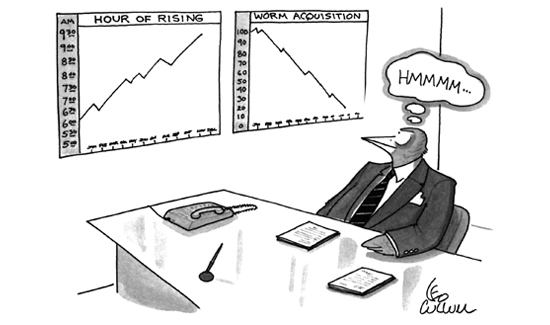
Last week we looked at where the next big gains in productivity would come from. (#3. which featured a McKinsey study about the next big waves of tech progress.) One was 'the internet of things'. What is that?
Well, it is where the things we use in life are all hooked up to the internet, and smart decisions are made from the information collected. Your rubbish bin for example: an intelligent bin would alert the collectors and help them plan a more effective pick-up schedule and route. Sensors in everything should give a much better utilisation of our assets, and help to all but eliminate unexpected downtime.
From all these improvements supposedly will boost GDP by 2% to 5%. Michael Mandel is a fan. He is the chief economic strategist at the Progressive Policy Institute and a senior fellow at the Wharton Business School. He is also a regular columnist at the NY Times. He has written a recent paper on how it will bring back high-growth.
More broadly, the Internet of Everything is essential for broadening the economic impact of the Information Revolution. Computers, routers, and smartphones are in every sector of the economy, of course.
Nevertheless, up to this point, the Internet has had its biggest impact on data-intensive industries such as media, entertainment, and finance. David Kirkpatrick, CEO of Techonomy, makes the case that today’s Internet is so far mostly serving as a “soupedup communications and information tool for individuals — a sort of phone/telegraph/library catalog on steroids.” Or as the venture capital firm run by entrepreneur and investor Peter Thiel has said, “We wanted flying cars, instead we got 140 characters.”
By comparison, the Internet of Everything potentially has the capability of transforming “physical” activities such as manufacturing, energy, transportation, healthcare, and public sector services such as waste collection. As we show later in this paper, many of these industries have not shown much productivity acceleration in the Internet era. But a network of sensors in a factory, for example, hooked to powerful data analysis capacity, could greatly improve the productivity and flexibility of production, and perhaps lead to a rebirth of manufacturing in the U.S.
2. An earlier peak
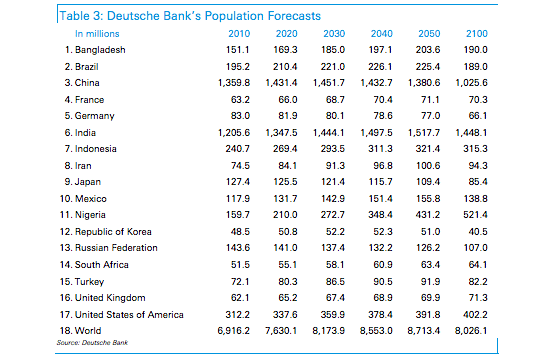
Demographers are suggesting there may be a 'supply shock' hitting the world's population. The UN thinks there will be almost 11 billion of us in 2100. But other professional demographers are not so sure (sorry, one key story is behind a paywall, but the chart below summarises the conclusions). They say the game is over on population growth because the world's fertility rate will fall to replacement levels in about 10 years, and decrease from there. The smart money is on an 8 billion world population by 2100, and that is a huge difference.
One consequence is that 'per person' output will be very much higher, giving the potential for continued growth in living standards.
In our view, global fertility will fall to the replacement rate in less than fifteen years. Population may keep growing for a few more decades from rising longevity but, reproductively speaking, our species will no longer be expanding. We forecast that world population will peak at around 8.7 bln in 2055 and will then decline to 8bn by 2100. Thus, world population could peak half a century sooner and, by 2100, stand 2.8bn below what the UN currently predicts.
Developed countries have long had low birth rates but the largest declines in fertility are in developing countries with the Chinese, Russians, Koreans and Brazilians no longer replacing themselves. A large decline in the Chinese workforce is now unavoidable irrespective of the removal of the one-child policy. Due to a skewed gender ratio, we found that China no longer has enough child-bearing age women to stabilize its population.
3. Widening responsibilities
The £14 million fine for Deloitte imposed by British regulators is worth a read - and a think. What is clear is that Deloitte's audit was not in question. It was the consulting advice that drew the sanction - and for a 'novel' reason.
Deloitte was engage to represent the seller - but the British regulators have fined them because they did that, rather than represent the 'public interest'.
That would seem to close off any accounting firm in that country acting as a consultant to a seller or a buyer. Your client may engage you, and pay you, but you can't get caught advising what's best for them. Exit accountants from consulting in Britain, I think. Countries that have followed the British model (eg NZ) may be studying this precedent.
One transaction that outraged investigators later was a deal that transferred the benefit of MG Rover tax losses to another company owned by the Phoenix partners without MG Rover receiving any compensation. Mr. Einollahi told the Financial Reporting Council that he was aware of that fact but not very interested in it. “It was of no concern to me ultimately where the benefit sat, in which company,” he said. “What was of concern to me here is my client is asking me to help turn some losses into value.”
The tribunal concluded that the transaction was not in the interest of MG Rover and that “in those circumstances, the respondents should have considered the public interest in relation to the transaction.”

4. Today's raw market data ...
A quick new-week update:
| as at 11:10am |
Today 9:00 am |
Friday |
Four weeks ago |
One year ago |
| NZ$1 = US$ | 0.8121 | 0.8130 | 0.8120 | 0.8297 |
| NZ$1 = AU$ | 0.8806 | 0.8777 | 0.8843 | 0.7921 |
| TWI | 76.42 | 76.43 | 76.28 | 73.46 |
| Gold, US$/oz | 1,319 | 1,328 | 1,365 | 1,770 |
| Dow | 15,380 | 15,311 | 15,018 | 13,541 |
| Copper, US$/tonne | 7,029 | 7,044 | 7,286 | 8,293 |
| Volatility Index | 14.77 | 14.29 | 15.10 | 14.59 |
5. New 'systemic risk' in re-insurance
We think of the GFC as a 'banking crisis' but it was broader than that. Remember AIG's bailout. It was a broad financial system crisis that included insurance companies.
Now the chairman of Lloyds in London is warning of a new capital crisis in the insurance industry - because unsuitable investors are rushing to grab the perceived returns from re-insurance.
We should worry about this. Re-insurers are paying a big portion of the Christchurch quake rebuild. They may be chaffing under the load (and the primary insurers may be getting much closer to having to pay out of their own reserves), but the last thing New Zealand needs (Wellington needs?) is for the re-insurance market to become unstable. Here is the FT:
The chairman of Lloyd’s of London has warned of the danger that a rush of capital into the insurance industry will cause “systemic problems” akin to those of the banking sector during the financial crisis.
Tens of billions of pounds of fresh funding from investors such as pension funds – especially into reinsurance, or insurance for insurers – has helped keep premiums for consumers and businesses low.
However, some insurers fear the industry may not be pricing risks appropriately which could leave inexperienced investors at risk of big losses. Insurance “can be a dangerous business for those who do not understand it”, said Mr Nelson on Wednesday.
Meanwhile, some capital providers – notably US billionaire investor Warren Buffett’s Berkshire Hathaway – have begun passively following the decisions taken by other insurers – a contrast to the traditional model under which underwriting syndicates take an active decision on whether or not to take on a policy.
The non-traditional sources of capital are a source of competition for traditional underwriters at Lloyd’s and put pressure on the prices they can charge policyholders.

6. Beyond Homo Economicus
All sorts of academics are saying economics-as-we-know-it is dead, and proposing alternatives. Tania Singer is one of them. She thinks there are devastating consequences implied by a failure to address global challenges like climate change, poverty, and food insecurity, and humanity has not risen to the occasion. She also thinks our future leaders should only be selected from people 'properly trained'.
Economies, both crisis-stricken and thriving, are failing to eliminate poverty, improve the provision of public services like education, and maintain and allocate collective goods, such as fish stocks and rain forests, effectively and equitably. At the same time, societies are increasingly fragmented, with perceived loneliness and stress-related illnesses on the rise. And existing governance structures are inadequate to improve the situation.
Clearly, a new approach is needed. But developing effective mechanisms for addressing large-scale shared challenges must begin with a fundamental shift in the way human motivation and cognition are understood.
Mental-training programs make participants more efficient and more focused, while improving their capacity to cope with stress. At the same time, they promote pro-social behavior and a broader, less self-centered perspective that accounts for humans’ interdependence. Such findings have started to inspire fields like experimental microeconomics and neuroeconomics, which, in turn, have begun to incorporate pro-social preferences into their decision-making frameworks.
These promising findings should now be incorporated into new economic models and concrete policy proposals. Given that brains are at their most malleable during childhood, beginning mental training in school would help to create a solid foundation for the kind of secular ethics that would contribute to the development of a more compassionate society. But mental training also has benefits for adults, so businesses, political authorities, and research institutions should collaborate in establishing “mental gymnasiums.”
7. Why there's gold in vintage cars
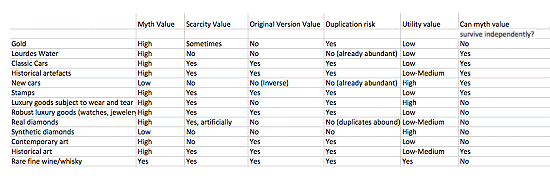
Izabella Kaminska at the FT has been thinking about scarcity, and what 'creates' scarcity value. She thinks there is a growing scarcity of scarce markets. She identifies three attributes: uniqueness, utility, and 'the story'.
Why are vintage car rising in value, she wonders, when gold is not. It's a lot to do with 'the story' she reckons. Her Morgan car example is instructive. Scarcity value looks a lot like the greater-fool-theory; 'the story' is probably the biggest component. Which may be why luxury brands advertise so much.
8. The Porridge List
If you didn't check in on this website over the weekend, you would have missed the release of our Porridge List - a summary of the legal punishments handed out for the financial industry failures over the past eight years.
It is somewhat surprising to see that sentences of more than 100 years (mostly jail time) have been imposed for wrongdoing.
Our story is here, and the full list is here. Note it is a work-in-progress; there are still trials going on, and even some that have yet to get underway. We will update the list as new punishment is recorded.
So far ...
| Total jail time ... | 86 years & 1 month |
| Total home detention ... | 15 years & 1 month |
| Total community service time ... | 158.5 days (0.43 years) |
| Total $ reparation and fines ... | $3.3 million |
9. A new low benchmark
Here's something you don't read every day - "The actual repayment period for the households with loan-to-value ratios of less than 75 per cent that actually amortise their mortgages is 140 years." WTF?! 140 years?!
It's not from some third-world economy, its from Sweden, as revealed in a 2013 report by the Swedish central bank on their mortgage market. (See page 10.) Now that's real unaffordability; buyers relying on the greater-fool-theory to escape the trap.
The analysis of the sample of new loans shows that 40 per cent of the households with a loan-to-value ratio of less than 75 per cent amortise. This is a slightly larger percentage than in the mortgage stock as a whole. The sample shows that the households that have unamortised loans have approximately as strong a repayment ability as the sample as a whole. The sample also shows that many of the unamortised loans are in the 51–75 per cent loan-to-value interval. The actual repayment period for the households with loan-to-value ratios of less than 75 per cent that actually amortise their mortgages is 140 years. This is in line with the total actual repayment period for the bottom loans in the mortgage stock, which is 148 years according to the banks' calculations.

10. Today's quote
"A father is someone who carries pictures in his wallet where his money used to be." unknown
11. This YouTube clip
is a little old, but a goodie. No visuals, its all in the audio. (HT Craig S.)

We welcome your comments below. If you are not already registered, please register to comment
Remember we welcome robust, respectful and insightful debate. We don't welcome abusive or defamatory comments and will de-register those repeatedly making such comments. Our current comment policy is here.