
By Amanda Morrall
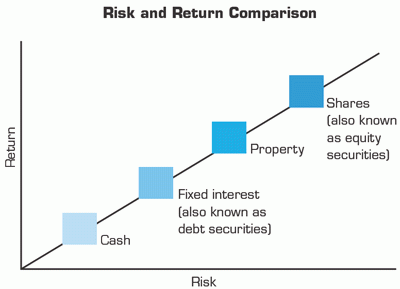
1) Risk and return
The higher the risk, the greater the reward but seldom do investors really appreciate this warning until it's too late. To help with the education process financial commentator Mary Holm has published a new book Upside, downside: A guide to risk for savers and investors. The book, commissioned by the Reserve Bank of New Zealand, is an updated version of an earlier book by Holm called Snakes and Ladders. Her latest also explains investment risk as it applies to KiwiSaver.
Free copies of Upside, downside: A guide to risk for savers and investors can be obtained from The Knowledge Centre, the Reserve Bank of New Zealand, PO Box 2498, Wellington, 6140, by phoning 04 471 3660 or by emailing rbnz-info@rbnz.govt.nz
2) The banking quiz
When it comes to banks, house rules apply. So how well do you know the rules? The office of the New Zealand's Banking Ombudsman prepared this five minute quiz to test your knowledge.
Have a go here.
3) Hunger Games
Don't blame rising food prices on Mother Nature. Blame it instead on the banks. The World Development Movement is. Aljazeera reports that Barclays Bank alone made US$800 million alone speculating on food markets over the past two years. Not so sure we can hang it all on the bank but nor do I believe Mother Nature is exclusively driving it.
FACTS ABOUT RISING FOOD PRICES:
- The World Bank says global food prices rose by 10 per cent from June to July
- According to the World Bank corn and wheat prices have gone up by 25 per cent
- Food prices are now one per cent higher than they were at their previous peak in February 2011
- The US heat wave and drought in eastern Europe has been blamed for the rising costs
- The last 12 months in the US were the warmest on record
- The US provides up to 60 per cent of the world's food aid
- Seventy per cent of the US' corn growing region is in drought
- High corn prices also affect meat and livestock prices
- The World Bank says that countries that import grains are particularly vulnerable
- Haiti, Sudan, Somalia and Chad are among the countries most at risk of food shortage
- A UN official says the US should suspend its bio-fuel programme
- The US has diverted about 40 million tonnes of maize to produce ethanol
Have a look at our interactive food price index for NZ below.
4) Time scarcity
Hate your job but don't have time to look for a new one? Fortunately, job seeking isn't quite the sycophantic experience it once was, pounding the pavement handing out CVs.This blog from the Wall Street Journal explains how it can be done discretely in 15 minutes, thanks in large part to the social media. I'm a convert. Linkedin is a goldmine of contacts. Go for it. What do you have to lose? A jerk boss and a lousy job?
5) Fast tracking the mortgage
The faster you pay off the mortgage, the quicker you'll achieve financial freedom. Anneli Knight from the Age talks to one couple about how they did it.
Create some good karma for yourself today by helping a good cause. You'll also restore my faith in humanity.
Thanks kindly.
20 Comments
Correct, risk reward is a conceptual theory to explain how interest rates are set as opposed to a fact.
There is no direct relationship as the real risks are not known, but estimated and this estimation is put forward as a factual representation and the lowest interest rates are offerred, and if there are no takers they increase until there is uptake.
Its supply and demand not risk reward at play. i.e. retuns on investments are falling not because risk is reduced but because there is an excess demand, i.e. too much money looking for a home drives down yields.
I get 1% less on my term deposits this year than last year, has the bank risk fallen over this time, definitely not as the government guarantee has gone and I get less interest.
The point I was trying to make was understanding the relationship.
Straight off the mortgage has the highest reward and the lowest risk.
Yes. You might decide to accept greater risk if the reward was greater. But No. the 'relationship' is not always so clear.
The risk is the risk. And must be evaluated alone. To assume that a low interest rate indicates low risk is just not true. You can't evaluate risk that way at all.
A classic example was a finance company who offered a very high interest rate. And could get very few takers. People thought this indicated they were risky. So they lowered the interest rate markedly and found that public assumed that they were low risk. So 'invested' many more dollars than before.
They were of course very dodgy and high risk all the time to the end. Whatever interest rate they offered.
and if you invested in a NZ finance company - "no matter what the risk, the greater the chance the reward will be about 1 cent in the dollar, at some undefined point in the future"
"But it's got that lovely man from the weather, it must be OK..."
Well there were warnings, one Bernard Hickey's column (The Press in 2006 I think). I tried (unsuccesfully) to get my Dad the hell out in '06 after listening to a clued up finance guy. He pretty much lost the lot, just shy of $1m.
Perhaps the best thing is to try and learn as much as you can yourself. The finance "industry" is constantly on the hunt for new prey.
@Ivan you should probably work on your spelling and grammar a bit, but if I understand you correctly you are saying that getting a 10% return from 1990 to 2006 and then losing all your money in 2007 is a good investment?
I would like to dispute your comment "people who invested with the finance companies did very well out of them" because in actual fact the returns from Hanover etc were not actually that much better than the returns offered by the Big 4 banks but with (obviously in hindsight) much greater risk.
It's kind of difficult for the so-called experts to predict an impending collapse of a finance company when the accounts are being carefully prepared to show a profit or hide some risky investment strategy by those running the Company. Hence the risk is even worse - the experts can't tell what's going on inside the finance company due to some rather opaque accounting and auditing, and you can never tell until afterwards that your hard-earned wealth was actually being squandered by some cowboy.
I suspect those that had money with one of the myriad dodgy NZ finance companies and got their money before it went belly-up are probably breathing a big sigh of relief that they got away with their funds, rather than kidding themselves that they made an astute investment choice.
From the same World Bank report; from July 2011 to July 2012
Sugar went down 19%
Soybean Oil went down 7%
Crude Oil went down 10%
Rice went up 7%
US Wheat went up 14% (but they are in drought so hardly unexpected)
Maize went up 11% (but the US drought has an impact here too).
Also worth noting the survey is in nominal USD. So if your dollar appreciated against the USD in the same time frame your country did not have these increases in nominal terms. And if you believe some of the alternate inflation measures US inflation is running at over 9%, in which case a nominal increase in food pricing of 15% would not be out of order.
Amanda, Re your second item on banks.
I had a strange experience yesterday when i asked Westpac to transfer some funds that had been on call with them, to a competitor, ASB.
The manager said he couldn't do it, and that i would have to take it in the form of a bank cheque, and deposit it with ASB myself. Which i did.
But now i have 3 day clearence delay.
Westpac IT systems were running OK, but they refused to process the transfer electronicly
Have you ever heard of this before? I have certainly never experienced it.
Weird. No I haven't heard of that. No problem approving $10m overdraughts tho.:) Maybe they have a new system in place. I'll inquire.
what's an "overdraught"?
.... an extra strength beer ..... or a very windy day ?
Drink alotta strong beer , and create your own windy day !
Mmmmm, beer. Might improve my spelling.
do you have internet banking? makes inter-bank transfers dead easy. no hassle.
Yeah, have internet banking, but never really use it.
It was a reasonable sum, and not sure I/B would have processed it anyway. Thats why i went in in person.
Yep, no trouble at all. I had a reasonable sum with St George Bank (a Westpac subsidiary) in an internet-banking-only iSaver account receiving honeymoon interest rates for several years, then one day they refused to roll it over, so at the click of a mouse it disappeared out of their hands into an ANZ iSaver account who have been most accomodating (so far).
Really...? well just try moving it from there at the click of a mouse, the ANZ can be the most anal, unfriendly , organisation when their the ones losing the funds .
Their standard cap rate of transfer is 5K a day without special notice, then if you wanna move say 250k they become downright obtuse.
So the dude up top was correct in saying he was asked to collect a bank cheque, that is the old "give you time to think it through routine, or the f*%k me around ,if your the recipient (as in the one wanting to transfer the funds) from their greasy mitts.
Yeah, I'm aware of the cap. Happy to trickle it out at $5k per day, with the odd arranged transfer. Have IB accounts with ANZ and NAB plus the Westpac one which is now closed. Haven't tried CBA (yet). Waiting to transfer funds back to NZ in which case it is a BPay transaction up to $100k without prior notice out of ANZ. Hoping you could give me a heads up next time you spot a baby with some candy in its hands. Before or after doesn't matter so long as its within a short timeframe of the baby losing its candy.
The RBA ain't just whisling dixie there iconolast....the potential to print alone (for more than one reason ),is....extreme....your a smart guy, you figure it out ...,but keep this in mind , they can't afford to risk Barry's return putting a spanner in the downhill run...good luck Stay happy..
I had a strange experience yesterday when i asked Westpac to transfer some funds that had been on call with them, to a competitor, ASB.
Moa man , no your ok on that , it's standard practice to become as obtuse as possible when transfering to competitors.......they will give you some proceedure drivel that just won't hold water , but really it's all about ....not helping you become someone elses customer...
Corporate spite I think is the term......
We welcome your comments below. If you are not already registered, please register to comment
Remember we welcome robust, respectful and insightful debate. We don't welcome abusive or defamatory comments and will de-register those repeatedly making such comments. Our current comment policy is here.