
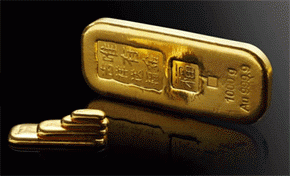
The IRD says all gold gains are taxable for holders of bullion, bars, investment coins and 'paper gold'.
They are not 'capital gains' as some believe.
The position applies to all other precious metals too.
'Intent' is the key issue.
The IRD says that, no matter what the time horizon, because precious metals never return an 'income', the only reason to buy them is for the gain in value they will produce.
And that is enough to qualify that gain to be taxable, no matter how long you have held it.
It has published an "exposure draft - for consultation and comment" on the matter. You can read it here.
In it, IRD says: “The Commissioner considers that the very nature of the asset leads to the conclusion that it was acquired for the purpose of ultimately disposing of it.
“Such a commodity does not provide annual returns or income while being held and has use or value only in its ability to be realised.
“The onus is on the taxpayer to show that they did not acquire the property with the dominant purpose of disposal."
Only investors who could prove they purchased gold (or any asset) with “no clear purpose” may not be subject to tax, according to the IRD.
“The Commissioner considers it unlikely that a taxpayer could satisfactorily show that they purchased gold bullion with no clear purpose in mind,” the exposure draft says.
Gold bugs often contend that 'gold is money', but these days that is a hard position to sustain.
The claim that gold is held as an 'inflation hedge' or as 'disaster insurance' doesn't seem to sway the IRD. Neither of these reasons qualify if for tax-free status, they say.
What the tax authority is targeting is 'investment gold' and not jewellery.
The IRD exposure draft says its tax proposal applies to “gold bullion, or gold units or certificates that do not pay interest or dividends” as well as other precious metal investments.
The purchase of gold and other precious metals for business purposes (such as jewellery or a bullion trading exchange) would not be subject to the same investment tax treatment. They are taxable in the normal way business assets are.
Gold purchased in the form of “jewellery, antiques, ornaments, collectables” may also be exempt from tax on sale as long as the items were not bought for “the dominant purpose of disposal”.
The IRD says taxpayers must consider the “totality of the circumstances” when such an exemption may be valid.
“These include: the nature of the asset, the taxpayer’s occupation, the circumstances of the purchase, the number of similar transactions, the length of time the property was held, and the circumstances of the use and disposal of the asset,” the IRD paper says.
The public have until April 7 to make a submission or comment on the Exposure Draft.
An issue that Inland Revenue and taxpayers encounter from time to time is whether or when there will be tax consequences from the sale of gold bullion investments. It is sometimes suggested that because gold is often held as a long-term investment or hedge against inflation, there are no tax implications. However, others have taken the view that investments in gold will give rise to tax implications.
Comparative pricing
You can find our independent comparative pricing for bullion, coins, and used 'scrap' in both US dollars and New Zealand dollars which are updated on a daily basis here »
Precious metals
Select chart tabs
We welcome your comments below. If you are not already registered, please register to comment
Remember we welcome robust, respectful and insightful debate. We don't welcome abusive or defamatory comments and will de-register those repeatedly making such comments. Our current comment policy is here.