
By Sharon Zollner*
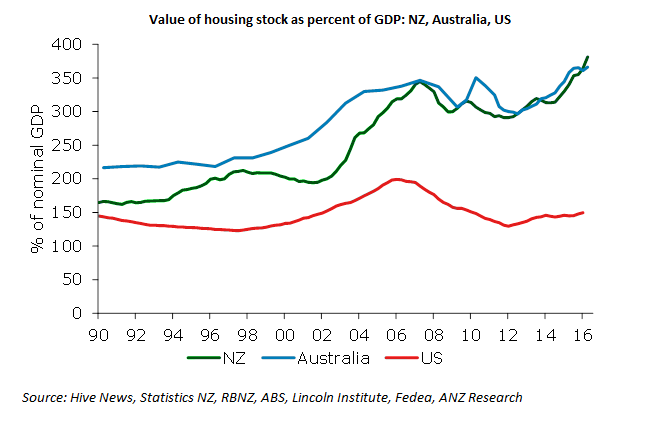
The Reserve Bank of New Zealand’s most recent M10 housing report shows the value of New Zealand’s housing stock (capturing changes in both the price and the number – and quality – of houses) increased in the June quarter to $NZ 959,850 million, or 381% of nominal GDP. Australia has followed a very similar trajectory.
An unusually high ratio does not in itself imply a nasty correction is imminent but it can certainly be a warning light, as it indicates either house prices are very elevated and/or there is housing oversupply.
Typically, oversupply leads to a sharper price correction when the market turns. Housing oversupply is certainly not an issue in New Zealand which has experienced very strong population growth. But there is broad agreement house price to income ratios are unsustainably high, particularly in Auckland.
In Australia, house prices have also risen strongly in the past 15 years or so, while oversupply is generally considered to be limited to pockets such as Melbourne apartments.
The US housing stock peaked at around 200% of nominal GDP before the global financial crisis (oversupply was a widespread problem and house prices then dropped 30%), while in Spain it was around 460% before the GFC – house prices subsequently dropped almost 40%.
Spain has a large number of holiday homes owned by foreigners, so would be expected to have a higher ratio on average over time, but oversupply was clearly a significant issue there too. The current UK ratio is around 240%.
Feeling bulletproof
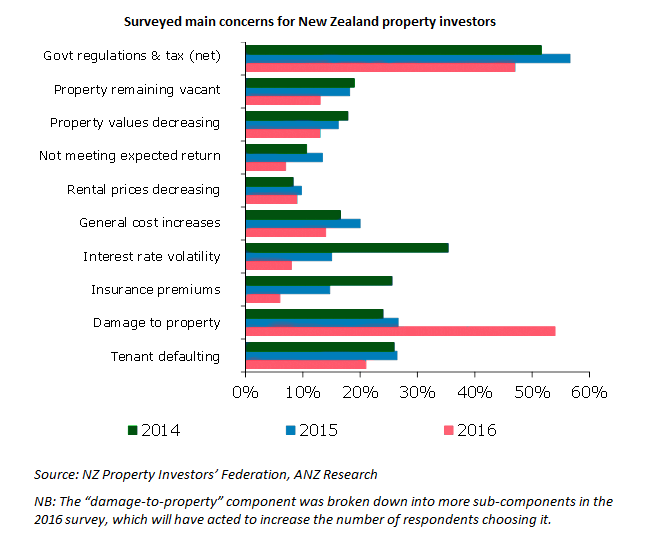
Despite the highly stretched state of housing affordability, the latest ANZ-Property Investors’ Federation Survey suggests not many investors are worried about cyclical risks to their property portfolio.
Concerns such as tenants not paying, difficulty finding tenants, rents falling, property prices falling, or not meeting expected returns are not rising. No wonder nearly 70% cent are intending to buy again.
The recent tightening of the restrictions on high loan-to-value-ratio (LVR) lending has certainly been noticed by investors, with nearly a third saying LVR restrictions had already impacted their investment strategy and many expressing concern that the restrictions would further cramp their style going forward.
But few seem to be extrapolating from impacts on their own purchase decisions to the broader market, with expected capital gains still very strong – and as shown in the chart only 15% of investors contemplating house price falls as a significant risk.
(Updated to insert missing 'not' in third paragraph from bottom)
------------------------------
*Sharon Zollner is an Associate Director & Senior Economist, ANZ NZ. This article first appeared on the ANZ BlueNotes website here, and is used with permission.
We welcome your comments below. If you are not already registered, please register to comment
Remember we welcome robust, respectful and insightful debate. We don't welcome abusive or defamatory comments and will de-register those repeatedly making such comments. Our current comment policy is here.