
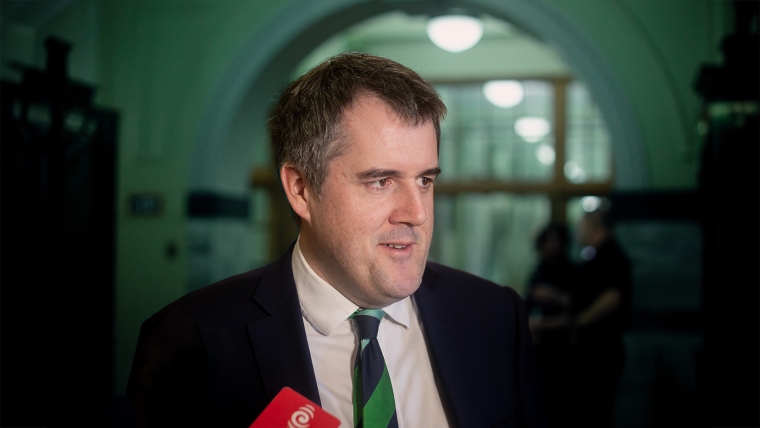
Housing Minister Chris Bishop says New Zealand has to decouple its economic growth from house price increases, even if it is difficult in the short-term.
Speaking to reporters on Tuesday, he said the economic recovery needed to be driven by broad-based productivity gains and not increases in property prices.
“We've got to decouple the idea that the economy is linked to house price growth. It's not.”
“Destroying the idea that the New Zealand economy should just be based on house price growth is a fundamental formula this government is trying to embed into the New Zealand psyche and also into the arteries of the economy. It will take some time but I'm pleased with the process we're making,” he said.
Data released by the Real Estate Institute of NZ on Tuesday found house prices declined for the fourth consecutive month in June and were up just 0.3% from the same time last year.
Economists have pointed to weak asset price growth as one reason the Reserve Bank’s interest rate cuts have had a muted effect. Normally, falling interest rates lift the present value of assets like property, making households feel wealthier and more likely to spend.
But buyers remain nervous about their own job security and a big backlog of unsold houses means sellers have little leverage to push for higher prices. Real estate agents say an “oversupply” of housing has replaced the shortage seen in previous years.
Policymakers are also working to prevent the housing market from heating up again. The RBNZ now has additional tools to cap borrowing relative to property values and incomes, while the Government’s housing agenda is explicitly aimed at reducing prices in real terms.
Stephen Toplis, head of research at BNZ, said lower interest rates had stopped house prices from falling further but hadn’t put them on an upward trend.
“Household net wealth has flatlined since mid-2021. House value is the key component of this… With asset prices going nowhere fast it shouldn’t be a great surprise that household spending is doing likewise,” he wrote in a recent note.
Jarrod Kerr, chief economist at Kiwibank, said more cuts to the Official Cash Rate were needed to entice investors back into the housing market and kick start broader growth.
“More rate cuts are needed to stimulate demand in housing. Much of our optimistic forecasts for growth in the Kiwi economy into 2026 is predicated on a bounce in housing demand — It’s the Kiwi way,” he said in a note on Tuesday.
The bank forecasts house prices to rise between 5% and 7% during 2026 as investors become more confident and re-enter the market.
“Although we said the exact same thing coming into 2025. Unfortunately, the housing market has underperformed for longer, much longer, than we expected.”
Property and asset prices are just one channel through which monetary policy is transmitted.
More significant are the direct incentives to save or spend, and the effect on disposable incomes as interest rates change. Monetary policy also influences the exchange rate, the availability of credit, and expectations about future inflation and interest rates.
But the residential property market, which is worth roughly $1.6 trillion, has an outsized influence on how households perceive their wealth and financial security. If prices don’t rise, consumers are less likely to spend and invest.
Old habits die hard
Bishop wants to break this link. He said reforms were still underway but he was heartened by early signs of stabilization in housing costs.
“Rents I would characterise as flat to falling. There's now quite a bit of evidence coming through … that new rents are falling in some markets. House prices you could broadly characterise as stable, and that's a good thing,” he said.
“It frustrates me that, every time you open up some of the media outlets , there's a huge interest in things like, housing market yet to take off, and everything's characterized as: we need house prices to rise.”
The flipside of stagnant house prices was that it would be easier for first time buyers to get into the housing market. This should be “celebrated rather than bemoaned” he said.
Roger J Kerr, a currency expert, said too many economic commentators were talking down the economy.
“The local doomsayers just appear to be overly impatient and not understanding the transmission/timing mechanisms in the NZ economy from when the RBNZ cut interest rates until domestic spending picks up as a result,” he wrote on Monday.
“It takes over 12 months to have an impact from the time monetary easing is commenced. The RBNZ started easing policy last August, so from next month it is highly likely we will see an improvement in the retail and residential property sectors.”
The export sector was already booming, due to high commodity prices, and business confidence levels had climbed close to record highs. Kerr was still forecasting annual economic activity to reach 3% by the end of 2025, whereas RBNZ most recently forecast just 1.8% annual growth.
“It does seem that if house prices are not rising, the majority of the local economic commentators do not think the economy is performing. These are jaundiced and ill-informed attitudes that do not serve the public well,” he said.
We welcome your comments below. If you are not already registered, please register to comment
Remember we welcome robust, respectful and insightful debate. We don't welcome abusive or defamatory comments and will de-register those repeatedly making such comments. Our current comment policy is here.