The comment stream

Join the Interest community to be a registered commenter so you can:
- Edit your comments
- Avoid the CAPTCHA
- Vote on comments
Register Here

Already registered? log back in here ..

Forgotten your password? No problem! Click here

Finance sector jobs

Senior Liability Underwriting Manager
Lead from the front utilising your strategic, technical and leadership qualities within th...more
New Zealand
Senior Liability Product Underwriter - Product Management
Lead from the front utilising your technical expertise in this highly attractive senior li...more
New Zealand
High Performing Senior Liability UnderwriterHigh Performing Senior Liability Underwriter
Customer focus, high performance, exceeding client expectations and achieving profitable g...more
New Zealand
Head of Retail Credit -Wellington, NZ
Key leadership position in the bank. Be a part of one of the fastest growing banks in New ...more
New Zealand
efinancialcareers.com

Reader poll

Should you fix your mortgage now or stay floating?

Choices

Expected increase in housing market appears to be absent, QV says

Posted in News

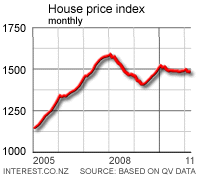
The government valuation agency (QV) indices released today on residential property show a national increase in property values in the three months to January from December. Values in January were 4.4% above the same time last year, but remained 4.3% below the market peak of late 2007. This is compared to 4.9% below the peak in the three months to December. QV said the house prices average sales increase across New Zealand of $409,807 in January, up from the $404,671 in December is a less reliable measure of value change than the QV index because the average is dependable on which part of the market is active at the time. The QV indices show an increase in some sectors of the housing market but overall activity was lower than expected in January, QV Valuations Glenda Whitehead said.

This could be due to the recently announced tax working group recommendations, uncertainty in the market over interest rates, employment  and which direction property prices are likely to move, Whitehead said. "There is increasing debate around the likely impact of the options put forward by the tax working group, but movements in property market are driven by a combination of factors, and while any tax changes implemented will impact, that change will be alongside other market factors such as interest rates, employment security, and bank lending policies prevalent at the time any of those tax changes come into effect," White head said. Frantic market activity of 2009 where multiple buyers were competing for property appears to have eased, with the majority of market activity, especially in the main centres, being driven by existing homeowners and first home buyers rather than investors, she said. The main centres have led the way in improving house values in recent months with values in Auckland Region, Wellington and Christchurch all up:

Values in the Auckland Region are now 7.3 percent up, the Wellington Area is 5.7 percent up, and Christchurch 6.3 percent up. Values in the other main centres have fluctuated in recent months, but still remain above last year by 3.5 percent in Hamilton, 0.6 percent in Tauranga, and 5.0 percent in Dunedin. In the provincial centres values have been more variable over recent months. However, values in nearly all areas are now above the same time last year. Rotorua is 3.3 percent up, Napier 5.1, New Plymouth 7.1, Wanganui 0.1, Palmerston North 5.6, Nelson 3.6, and Invercargill 4.6 percent. Whangarei is the only centre still below last year at -3.9 percent. Queenstown Lakes is 0.5 percent above last year and this is the first time it has shown year on year growth since May 2008. This is due to an increase in values in the last few months after a relatively flat 2009.

Here are the regional reports from QV:

Auckland Property values in the Auckland region increased by 7.3% over the past year (calculated over the three months ending January 2010 in comparison to the same period last year), an improvement on the 5.1% annual growth reported in December. The average sale price for the region increased from $535,197 to $549,028. Glenda Whitehead of QV Valuations said; "Auckland's residential property scene in January, like December, was a relatively quiet month, as can be typical of this time of year. Roads around the Auckland region have been free-flowing, perhaps reflecting the absence of its usual population, many of whom may be using up accumulated leave. This laid-back or absent part of the population has probably not sought to make any major life decisions recently and has therefore taken heat out of the property market for the moment. At present values appear to be holding and there is a general feel of stability". "Of those who have been active in the market, homeowners appear more prevalent than investors, with some refinancing while others are preparing to make those buy or sell decisions.  Buyers remain cautious and are taking their time to get a feel for what is going on. With the likelihood of sustained capital growth through this year uncertain, investors continue to focus on cash flows. Adding to their angst are also looming interest rate hikes and potential new taxes, which could simply compound uncertainty" Ms. Whitehead said. "Value increases are patchy and localised to areas where buyers outnumber sellers. In all the region's cities and districts, the market continues to show positive growth when compared to a year ago. When we consider the rise from the lowest period in the market, the cities (North Shore, Waitakere, Auckland and Manukau) have shown the strongest recovery of 6-10%, while the districts (Rodney, Papakura and Franklin) have risen 1-3% from their low points" Ms. Whitehead said. "With schools now back and many returning from extended annual leave, we expect activity over February, March and April to pick up, as these are typically the most active months of the year for Auckland's property market. It remains to be seen what impact this activity will have on values" Ms. Whitehead said. Hamilton Property values in Hamilton increased by 3.5% over the past year (calculated over the three months ending January 2010 in comparison to the same period last year), an improvement on the 1.8% annual growth reported in December. The average sale price for the city increased from $343,310 to $350,722. Mairi MacDonald of QV Valuations said; "Residential property values in Hamilton City improved slightly in January 2010 after remaining reasonably steady over the past three months. Value changes were however quite varied across the City. The largest improvement was in Hamilton South East and Hamilton South West areas, with minor increases in the Hamilton North East and Central CBD/ North West areas". "Over the past four months property values in the city have fluctuated within a very narrow range. However, these latest figures indicate that we may be starting to see a gradual increase in values, as has been the trend in the major cities. This is also supported by the average sales price which has increased after remaining relatively constant over the past four months. The market has seemingly absorbed a number of potential setbacks which appeared likely because of poor regional economic factors, but it now appears that we are headed towards a sustained period of stability" Ms MacDonald said. Tauranga Property values in Tauranga increased by 0.6% over the past year (calculated over the three months ending January 2010 in comparison to the same period last year), a slight improvement on the 0.1% annual growth reported in December. The average sale price for the region decreased slightly from $424,241 to $422,226. Shayne Donovan-Grammer of QV Valuations said; "Tauranga's residential property market remains fickle and is still tracking behind the other main centres. The last few months have seen most activity in the $200k - $400k price brackets, and this continues but at lower levels overall. This is a traditionally quiet and undecided time of the year, so we may not get a solid grasp of the market's sentiment for another month or two". "There has been a lot of talk lately of land tax and other measures which could adversely affect property owners. There is no clear indication on what will be implemented, which has made some sectors of the market understandably indecisive. Having had two years of a declining market, further uncertainty is not going to do much for value increases" Mr. Donovan-Grammer said. Wellington Property values in the Wellington region increased by 5.7% over the past year (calculated over the three months ending January 2010 in comparison to the same period last year), an improvement on the 4.6% annual growth reported in December. The average sale price for the region increased from $448,652 to $460,638. Mr. Pieter Geill of QV Valuations said; "Apart from being quite slow over the holiday season, the residential property market in and around Wellington has been fairly contradictory. Some properties are selling quite fast, while others seem to linger on the market for a long time, usually as a result of overpricing. Buyer attitudes also seem to have hardened somewhat and people are generally making property decisions more cautiously than in October and November last year, despite the shortage of listings over this period". "We have been saying for the last couple of months that we expect more properties to come to market in the near future. Anecdotally, this seems to have started occurring in the Wellington region from late January and continues presently. We are seeing more vendors taking time to seek valuation advice prior to sale, and we are still seeing forced and mortgagee sales trickle through. If a flush of housing does come to market without an equal number of buyers to balance, we may well see values ease. Prices are generally holding well for now though" Mr. Geill said. Christchurch Property values in Christchurch increased by 6.3% over the past year (calculated over the three months ending January 2010 in comparison to the same period last year), an improvement on the 4.6% annual growth reported in December. The average sale price for the city increased from $371,034 to $380,268. Melanie Swallow of QV Valuations said; "Property values in Christchurch continued to show a very gentle recovery throughout December and January. Suburban Christchurch has held well with the South West suburbs showing the greatest recovery, up 7.6% on last year, followed by the central and northern suburbs at 6.1%. These results appear to be encouraging, but should still be treated with caution as activity is quite segmented". "In the entry-level market bracket, many properties are still achieving strong sales results and this is where the majority of the activity is occurring. Following close behind is the $400,000 to $500,000 price range.  However, the market is a bit hard to read and is possibly being influenced by seasonal factors such as people using up leave and taking longer holidays than normal. Also, buyers are generally exercising more caution, with first home buyers outweighing investors in the entry level part of the market. Investors are no doubt considering the future increase of long term interest rates" Mrs. Swallow said. "We recommend purchasers continue to exercise caution with their buying decisions.  Uncertainty continues to harass the market place, although overall sentiment is upbeat. We anticipate that our statistics over the next few months will provide a clearer indication of the direction of different market segments" Mrs. Swallow said. Dunedin Property values in Dunedin increased by 5.0% over the past year (calculated over the three months ending January 2010 in comparison to the same period last year), up slightly on the 4.9% annual growth reported in December. The average sale price in Dunedin increased from $276,875 to $279,101. Mr. Tim Gibson of QV Valuations said; "Our January figures for Dunedin are starting to show a slowdown in the growth of residential house values experienced during late 2009. The annual growth in Dunedin city has increased by 0.1% from December to January, the smallest improvement in our year-on-year figures for a while. The QV index is showing the first negative movement since March 2009. January values are still 2.9% below July 2007 levels which was when the residential market peaked in Dunedin". "South Dunedin has shown the most growth, now showing a 9.6% annual increase in values, whilst the peninsular region has slowed substantially. There appears to be a more cautious, wait-and-see approach occurring in the market at present which could be put down to increasing long-term interest rates and uncertainty surrounding taxation changes. Some Real Estate agents have also reported difficulty shifting lower valued properties over January. This price bracket was usually the domain of investors during the latter part of 2009" Mr. Gibson said.

We welcome your help to improve our coverage of this issue. Any examples or experiences to relate? Any links to other news, data or research to shed more light on this? Any insight or views on what might happen next or what should happen next? Any errors to correct?

We welcome your comments below. If you are not already registered, please register to comment in the box on the right or click on the "'Register" link at the bottom of the comments. Remember we welcome robust, respectful and insightful debate. We don't welcome abusive or defamatory comments and will de-register those repeatedly making these comments.

98 Comments

Gosh I'm confused.... why are

Gosh I'm confused.... why are house prices still climbing if evil property investors aren't buying at the moment? Hmmm...

I wonder what QV is

I wonder what QV is costing tax payers. Anyone know how much we 'pay' for this drivel?

Aaaah - the "trusted source",

Aaaah - the "trusted source", QV says property prices are on the rise.

It has been pointed out here in the past QV data is out of date and for January is only for sales where the properties changed hands in January. The actual sales most probably took place in the last quarter of 2009 which is why REINZ statistics tend to be more up to the minute and in Tony Alexander's words "the most reliable source"

These REINZ figures should be out later in the week.

Wally - QV is a very profitable organisation!

Wally I suspect we don't

Wally I suspect we don't pay as much for QV as we do on benefits and working for family bribes.

Team at interest.co.nz do any of you know how much we spent on WFF last year??

to Dave Smyth easy -

to Dave Smyth
easy - if you take away a great slice at the bottom of the market (who would be investing in residential property reight now?), then both mean and median prices rise

Good theory Mark. But investors

Good theory Mark. But investors are selling now, so if all the anti-investors were right about landlords pricing people out of the market, then the private buyers would be swooping in, surely?

4.3% off the 2007 peak

4.3% off the 2007 peak PLUS inflation PLUS the cost of paying twice as much to pay a mortgage as rent times 2 years for the privilage of living in a house that you own nothing of, there goes that 10 - 20% deposit. Good luck paying another 25% on mortgage payments when your mortgage repayments start kicking in at 9% and houses prices effectively going sideways for the next few years

to Dave Smyth Investors are

to Dave Smyth
Investors are trying to sell right now, hence the plentiful listings but few sales. Private buyers know that they only have to bide their time for bottom end prices to fall sharply.

OO good time to invest!

OO good time to invest!

But come on, don't buy the house you live in! That's silliness.

Perspective.... again....the lead headline video

Perspective.... again....the lead headline video on the http://nz.finance.yahoo.com/ website is:
"Statistics show House Price Boom"
Yet the written article state" Property market slow to pick up"

i think you'll find if

i think you'll find if you watch the video between corrinne dann of tv1 breakfast/biz news and glenda whitehead of QV this morning that the " statistics show house price boom" is very balanced and informative.

the only mistake is they forgot to put a question mark at the end of the headline as the perspective of the vid.clip reflects that it was a query re a boom...the general tenor of the i/view is that 2010 will see a settling of the prop. market and that the only activity at the moment is mainly first home owners at last being able to get into the market as investors list their lower end rental properties and bale out.

@David Smyth: If house prices

@David Smyth: If house prices are too high for people to buy, it doesn't matter who they are (be they investors or people wanting to occupy), its not like the money gets generated out of thin air.

If the vendors selling want high prices and are not under pressure to reduce prices, then they won't. It will just mean that the volumes of sales will be lower. There is always a lag between demand dropping and prices dropping. House prices in NZ seem to be very "sticky" which I would guess is the people owning homes freehold and not being willing to take a loss from the paper value of their house.

Auckland house prices increase by

Auckland house prices increase by 7.3% QVNZ report http://tinyurl.com/osf2pw
So why not buy below July 2008 council valuation R.V.$500k http://tinyurl.com/ygs92ls

Auckland market is really resilient.

Auckland market is really resilient. Why is that?

to 28_yr_old (now 29) good

to 28_yr_old (now 29) good question. I had have attached a link for ird, it should be in their annual report. But best of luck looking through it. I will also try and have a look later too. http://www.ird.govt.nz/aboutir/reports/annual-report/annual-report-2009/

"Auckland market is really resilient.

"Auckland market is really resilient. Why is that?"

It's where most of the migrant population goes and so has the most inherent demand and supply is restricted by urban boundaries.

2008 figures: The Government spent

2008 figures:

The Government spent about $2.2 billion on Working for Families tax credits in the year ending in March and more than 370,000 families are claiming the benefits.

Families were mostly getting $125 to $150 a week under Working for Families.

Brodie Davis <i>"If house prices

Brodie Davis "If house prices are too high for people to buy, it doesn't matter who they are (be they investors or people wanting to occupy), its not like the money gets generated out of thin air."

Actually it sort of was generated out of thin air for much of the past decade. The debate should be over whether it can and should continue to do so...

Andy- Thank you citizen journalism!

Andy- Thank you citizen journalism!

If we scrap WFF ,

If we scrap WFF , and give the $ 2.2 Billion as a tax reduction to ALL PAYE tax payers , how much can the tax rates be cut by ? Top rate back to 33 % , that'd be nice , back to where it was before Cullen started all this nonsense !

@ Mark - Listing numbers

@ Mark
- Listing numbers are considerably lower than they were at the peak of the boom in early 2007. Our local property guide is probably 50% smaller than at that point and I know agents who are struggling for listings.

@ Brodie Davis
- Money *does* get generated out of thin air. It's called fractional reserve banking. Every time you put something on your credit card, money is created.

New Zealand had a huge

New Zealand had a huge property price boom in the 1970's - what caused this as LAQC was not in play? WFF is in play as we have a huge growing class of working poor thanks to both major political parties

@ Dave Smyth I understand

@ Dave Smyth

I understand how the fractional reserve system works, the issue is that banks want people to have 20% deposit these days, so if a average house is $500k-$600K, then they need $100k-$120K, and if they don't have it, then they don't get the loan. No matter how much they want or need the house.

As prices rise, the pool of people with the resources to purchase is reduced, until the prices go down, that pool is still the same and will likely be depleted of the people who are willing to purchase. Hence lower sales numbers.

Thanks Andy M and welcome

Thanks Andy M and welcome Emma

I doubt Jonkey is going to change WFF at all

"New Zealand had a huge

"New Zealand had a huge property price boom in the 1970's "“ what caused this as LAQC was not in play?"

Look at the net migration figures.

@ Brodie - Banks will

@ Brodie
- Banks will still lend up to 95%. It just depends on the case.
- An average house in AKL might be $500k but an average house here in Whangarei is under $300k and you can still get into a unit for under $200k
- I've seen a couple of amazingly high sales go through recently. I suspect that sales numbers are lower in no small part because people are just taking a "wait and see" approach.

So the investors are selling?

So the investors are selling?
Who are the buyers?
Presumably as the market finds a new position owner occupiers will come from current renters. This could well lower prices right up to the $600k range over time.
If the RB keeps the pressure on the banks lending the only way is to reinforce the downward trend.
I also noted in the NZH on Saturday that the "esteemed" Dean Leftus suggests:
"The end result is a slam dunk:chronic housing shortage and massive rental increases"
Rental increases? Where from?

Whangarei prices don't help explain

Whangarei prices don't help explain AKL prices. I'm not sure banks should be lending 95%, but I agree they are.

I've just realised that I've been reading comments from those "pro-property" (or is that long property??) about how a whole lot of factors either lead to house price increases, or don't cause decreases.

So... what does actually cause a decrease?

Ah yes, Dean Leftus' comments

Ah yes, Dean Leftus' comments - by his logic, rents will probably fall when interest rates rise...

The NZH seems to have

The NZH seems to have taken an editorial stance against tax reform.

Saturday's paper had one sided lament for landlords right beside Brian Fallow's piece on the benefits of tax reform.

Fallow's piece was far more intelligent and relevant, but the landlord piece was given a large picture and headline.

Maybe NZH is supporting their advertising revenue.

2 factors to decrease prices

2 factors to decrease prices
increase supply, decrease demand.

Examples of decreases in demand:
Slam property investors with tax changes.
Lower net migration.

Examples of increases in supply:
Expand city boundaries.
Decrease compliance costs to build

but the landlord piece was

but the landlord piece was given a large picture and headline. Maybe NZH is supporting their advertising revenue.

Yes, landlords are a noisy bunch when it comes their rights to make tax free gains subsidised by the taxpayer.

"QV said the house prices

"QV said the house prices average sales increase across New Zealand of $409,807 in January, up from the $404,671 in December is a less reliable measure of value change than the QV index because the average is dependable on which part of the market is active at the time."

What a Revelation!!!!!!
Who is the bright spark who after all these months has suddenly realised that?
Nup I doubt that they could have figured that out on their own otherwise they would have done so long ago...
I know..they have been reading someones posts here for the last yr or so and decided "Im bored Im going to look into that" and presto...

Actually the other thing I

Actually the other thing I noticed in the Herald was the comment from the "Baron of Bond St", who complained it was expensive to own all those old villas and he generally didn't end up paying any tax due to expenses etc, with the final straw (yes, I am paraphrasing) coming once he's spent $5k on each property p.a. on maintenance.

In almost the same breath, he was bemoaning that losing the depreciation deduction would affect his earnings.

Seems to me he wants to have his cake (depreciation deduction reducing tax to pay) and eat it too (expense, and thus claim back tax, on maintenance - ie not capex).

@ IanC - I've been

@ IanC
- I've been surprised at the recovery in 2009. Perhaps 2010 will see a dip again.

@ Andy M
- If you go and add up the number of articles about property taxes, you'll see a huge majority are pro-tax.
- Are you not a property owner, who also made tax-free gains?
- These taxpayer subsidies? I assume that you're referring to depreciation? It's not that big a deal... on a $300k rental, the amount of tax you'd save might be about $30 a week. Since I bought when the market was lower, it's more like $15 a week.

@ Andy_M Incidentally, I didn't

@ Andy_M

Incidentally, I didn't get into property investment because of a childhood desire for world domination. I subdivided a big section that my first home was on and moved into the new house. This was in 2002 and the market hadn't moved much in the previous 4 years. I was going to sell it but rather than sell and make bugger all out of it, I kept it as a rental. Rents climbed from $180 a week to $300 a week within a few years. Not many people realise that while yield on market value did drop dramatically, rents were increasing quickly too.

Are you not a property

Are you not a property owner, who also made tax-free gains?
Yes, but I'd rather have not, because it illusory. For me to make such a gain someone else ultimately loses.

- These taxpayer subsidies? I assume that you're referring to depreciation?
no, that's a valid expense. I'm referring to
offsetting losses against your tax bill so the rest of us have to pay more.
Getting WFF through using rental properties or trusts to shelter income from tax so the rest of us have to pay more.

No real business would survive years of losing money and that is where its at for most people entering the property investment market today.

I am achieving eye-popping rent

I am achieving eye-popping rent increases at the moment. My last four tenant changes had the new tenant moving in on the day the old tenant moved out. Quality tenants, great references, all income proven and credit checked. There is already a shortage of quality rentals in desirable areas and plenty of evidence of investors bailing.

Tenants are always the losers when authorities, however well intentioned, interfere with the market. Eventually the entire rental stock will be held by high-equity cash-flow positive professional investors usually with considerable income coming from other business besides property. The Jimmies of this world will pine for the days of the over-leveraged amateur dance of the desparates we have seen when they realise (too late) that the current "tax-breaks" have effectively been a subsidy to tenants.

We need and will continue to need more houses both to rent and buy. The villianisation of the dreaded landlord prevailing is doing nothing for the supply side which is where the solution to affordability lies.

@ Andy M - Offsetting

@ Andy M

- Offsetting losses against our personal tax bill is part of the reason rental yields are so low. Granted, there was an insane preoccupation with tax deductibility for a while there but without being able to offset losses, the rent required to invest will rise. If you assume that there will always be people who can't afford to buy (reasonable, I think), they will be the ones to suffer.
- WFF does sound like a debacle... blame Labour.

"No real business would survive years of losing money..."
You mean like... mining, forestry, farming, large scale property development, commercial property... Amazon.com? It depends on the ability of the investor to service the losses.

@ Pete - Stop with

@ Pete
- Stop with the logic! :)

@ Pete: "Eventually the entire

@ Pete: "Eventually the entire rental stock will be held by high-equity cash-flow positive professional investors". That's how it's supposed to be, Pete! Get rid of the amateur capital gain driven gamblers, and return the property rental market to a sensible, business based model, run by business people, just like any other. That's the bit about 'level playing field' that most of us post on this site about. Renting any asset, be it a car, a house or a hotel room, is supposed to be more expensive that ownership. But once the threshold of affordabilty is reached, ie: the renter can pay no more, there is only one way to balance the equation.

Supply of rental properties isn't

Supply of rental properties isn't improved by a property investor buying a house from an existing owner-occupier or another investor - supply is improved by construction. The issue, until its not an issue any more, is that the price of land makes new construction uneconomic (for an investor or an owner-occupier).

If you think its because a whole lot of houses will be sold by investors as its uneconomic, its only a temporary supply issue - its while they sit empty and for sale. House sells, house is occupied.

Roger, according to the treasury

Roger, according to the treasury booklet, to drop the top rate 1% cost the country 101 million. To drop the middle upper rate 1% costs 92 million and the bottom middle rate would cost 390 million and the bottom rate dropping by 1% would cost 331 million.

Well, can anyone see this

Well, can anyone see this coming: From July 2010 thousands of kiwisaver potential first home buyers come off the 3 year waiting period for the first home deposit subsidy.

They are required to buy a house in the lower 25 percentile. At the same time landlords of these houses are most likely selling after the May budget tax reform while interest rates are still expected to be well below longterm average. So now what part of the market will be very active and what will that do to the median sell price that has been so conveniently bandied about by the RE mob? Will that trigger a spiral?

Would be interesting if the first home subsidy was to include building too as this would increase housing supply - I guess who ever made the rule just wants the subsidy passed on to the vendors.

Dave - my opinion is

Dave - my opinion is that WFF and accommodation supplements are the supporting factor for rents.

Commercial property doesn't make losses - banks only lend 60% and yields are usually 7-10%. Its a totally different (and rational) game. Farming has spent a decade being a combination of a marginally (or not) profitable enterprise plus land speculation, and the chickens have come home to roost in the last 12 months. It's become apparent the actual income generation potential of the land is important - who'd have thought?

Mining, forestry and large scale property development have a return profile consistent with the risk being undertaken - again, different game to residential property investment. Interestingly, I recall forestry went through a few phases of being popular for its tax minimisation potential (clamped down on).

Josh - any first home

Josh - any first home susbidy should only be on new builds - that would be really effective.

@ Nicholas Arrand "Renting any

@ Nicholas Arrand
"Renting any asset, be it a car, a house or a hotel room, is supposed to be more expensive that ownership."
- Why would renting a house long term *ever* be more expensive than owning it? Cars and hotel rooms are more expensive because it's short term.

@ IanC
Hrmm... new home builders rely on someone buying their old home. If they can't sell, it becomes a rental. That's how I started and it's a big part of the reason there has been a rental glut. That and emmigration to Oz.

It's an Oz/Kiwi thing, Dave

It's an Oz/Kiwi thing, Dave Smyth. Go just about anywhere else and it's the reverse. In London I paid £450 p/w to rent a house that I could ( and did) buy for £350 versus an after tax cash investment return. But that was because I could afford to buy it. If others could have, they would have, if you get my drift. As I posted above, it finally gets down to affordability on both the purchase and rent sides, and at that stage the music in property game stops.

@ IanC "Commercial property doesn’t

@ IanC
"Commercial property doesn't make losses"
- Tell that to all the owners of empty commercial properties right now.
- Lending is based on overall collateral that can include the owners home and rental properties of course!
- Agreed, mining etc are different... um... so? The approach is the same... chuck all your money in and try to hang on long enough to make some money!
- Forestry is why LAQC's came into being.

@ Nicholas - I rented

@ Nicholas

- I rented in the UK for 7 years and don't recall it being cheaper to buy than rent. Hey I'm not complaining, it it goes that way here I'll be happy :)

OK you got me -

OK you got me - "when rented" commercial property doesn't make losses.

Lending is based on overall collateral, I agree. IMHO, tax deduction of interest payments should only be on the portion of interest the collateral in the tax "paying" (I use that term loosely) represents of the total collateral offered. Would certainly change behaviour.

I assume you're also talking about the small commercial properties which, based on what I can see, exhibit evidence of tax driven purchasing decision (5% yields). It doesn't stack up without a tax subsidy, and that's misallocation of investment capital, again IMHO.

I'll conceed that this was

I'll conceed that this was after the property realignment of 15 odd years ago, Dave Smythe. Many people will not forget, emotionally or financially, that time of negative equity, and now there is a new, current generation of similaly affected house owners in the UK! Had the rent vs purchase equation remained positive, then perhaps today's UK property turmoil could have been avoided. But, again, as I said on another thread, all countries are different. Time will tell if Australia and New Zealand remain so.

@ IanC - And that

@ IanC

- And that is why property investment can be very profitable. The potential downsides are HUGE, so the investment requires a good upside. I've had...

- long term vacancies
- house fire from cannabis oil
- drug addict tenant (not the one above)
- 250 people having a party and trashing my rental
- several runaway tenants
- floods
- carpets ruined by unauthorised pets
- burst water heaters
- roof leaks
- burst water mains
- burst plumbing inside the wall (Mmmm... Xmas Eve 2009)
- mountains of tenant rubbish and general filth

Sure some of these happen to your own home but multiply it by several houses and include a tenant's personal problems and you'll figure out why there's so many people bailing from rental property.

Re the commercial properties... you'd have to be crazy to buy at a 5% yield. Commercial can go horribly wrong and lose cash too. I know one property where the tenant stripped the place bare of chattels and did a runner. Vacancy is probably the biggest risk. Lots empty locally right now.

@ Nicholas "Many people will

@ Nicholas

"Many people will not forget, emotionally or financially, that time of negative equity..."
- Funny you should mention that. I left the UK in 1994 and my brother in law was below the water line. I bumped into him last week in Whangarei and he's now pretty much retired from the sale of the same house.

@ Dave Smyth: I hadn't

@ Dave Smyth:
I hadn't realised that it was so common! My sister was summonsed by the agents letting her house in Mlebourne , and was greeted with a shell! No toilet, shower, wardrobes, kitchen, garden plants...nothing! And, well done your brother in law. But that's proabably because he got out! That's the secret, Dave. Don't be left without a chair when the music stops

Yeah, but they don’t deduct

Yeah, but they don't deduct their losses against PAYE income to increase cashflow. Investors have to take the losses directly to maintain working capital.

I guess it's a matter of principal. Housing's principal function should be homes and shelter not being used as a vehicle to make money at the expense of those who might like to own their own house. Trying to explain this to those who have the housing equivalent of gold fever is a lost cause though.

The only reason rents have risen so strongly since 2002/2003 on the original purchase price is lack of supply & too much demand for the housing stock.

I have to laugh at those who so they are trying to secure their financial future so as not to be a burden on the government.
Does this mean you'll pass up your NZ super cheque when it comes your way in lieu of the tax deductions from your investment.

Roll on John Key's speech

Roll on John Key's speech tomorrow and let the flaming begin.

Andy M by 2030 there

Andy M by 2030 there wont be an NZ Super cheque, I hope you have a superannuation plan sorted

@ Andy M "I have

@ Andy M

"I have to laugh at those who so they are trying to secure their financial future so as not to be a burden on the government. Does this mean you'll pass up your NZ super cheque when it comes your way in lieu of the tax deductions from your investment."
- If there is a super to receive, I hope to have that option.
- I doubt many are considering the burden on the Govt, they're more concerned about what Super there will be at all.
- The burden is on the taxpayer... the Govt just redirects the money.

NZ Super for someone single and living alone is currently (in the hand) $310.95/week or $478.38/week for a married couple. This will be very difficult to sustain with our aging population and it doesn't go that far now. I don't want to be 70, fit and have a grand total of $16k a year to survive on.

@dave Smyth: You say you

@dave Smyth:
You say you left the UK in '94, and rented for 7 years there. So you would have been there in the teeth of the property collapse of that time. Don't you remember the horror of that experience for many people? It was the first time that average people, coerced into the property game, found that there was a hidden risk. It was the first time that the man in the street saw that property prices could actually fall. Time does indeed heal, Dave. But not for all. Ask your brother in law how he felt as his equity evaporated, and if in those dark days he could see the light that he has now experienced.

IanC mentioed this in his

IanC mentioed this in his post, regarding the Baron from....

Seems to me he wants to have his cake (depreciation deduction reducing tax to pay) and eat it too (expense, and thus claim back tax, on maintenance "“ ie not capex).

my comments

I wonder how much in the way of maintenance is really capex.

@ Nicholas - As a

@ Nicholas
- As a renter, I didn't have the same sense of it as I squandered my money instead of saving for a deposit but yes, I remember the headlines in the tabloids and the resignation of those affected.

@ wairarapa perspective
"I wonder how much in the way of maintenance is really capex."
- For that particular guy... probably all maintenance as they are old villas and I imagine the upkeep would be atrocious. Look at it this way... If a new carpet costs $5k and needs to be replaced every 10 years (damn good for a rental!), then it costs about $500 a year... add in repairs and maintenance to wiring, painting, kitchens, bathrooms, plumbing, the roof, gardens, cladding and anything else I can't remember and $5k a year in Central Auckland is not unrealistic.

Yes but if you're claiming

Yes but if you're claiming it as maintenance, and the result is that (on a nominal basis) he suffers no depreciation, then he is, in effect, getting the tax back twice (and will have to pay depreciation recovered, eventually). I'm not saying its not legitimate, I'm saying both together is a subsidy that shouldn't be there, and he shouldn't really complain about losing a depreciation deduction.

Dave - you highlight why it is that rental property should give a higher return than it does! Without (the unprecedented) price appreciation of the last decade, I suspect you wouldn't feel so good about your current portfolio, eg if you'd acquired it 10 years earlier (and the boom hadn't occured yet).

If (when!) NZ Super becomes a problem, they'll start extending the age of entitlement (as we live longer anyway), aggressively means testing it (I suspect with a look-through to family trusts etc) and cutting back health entitlements across the board. Not pretty.

And think of the depreciation

And think of the depreciation clawback to benefit the government coffers should landlord/investors sell up residential property en masse as a result of the changes.

@ IanC - Depreciation doesn't

@ IanC
- Depreciation doesn't make a lot of sense to me either. I recall someone on here saying it was introduced to encourage property investment during a housing shortage some years ago?
- I didn't say it should be higher. I was just indicating why it is, or can be high. The price appreciation was an unprecedented as the lending! I wouldn't have my current portfolio without that growth as the growth in equity provided the collateral for further purchases.

"If (when!) NZ Super becomes a problem..."
- It will be a massive shake up for sure. I'll make a prediction and say that immigration will be massive as the Govt tries to increase the taxable population and that many wealthier retired people will shift to countries where tax laws are kinder to them.

@ Kate "And think of

@ Kate
"And think of the depreciation clawback to benefit the government coffers should landlord/investors sell up residential property en masse as a result of the changes."
- Maybe. Although I think most of the people selling won't have much if any depreciation recovered to pay tax on.

Nothing is going to change.

Nothing is going to change.
Those tax rules might get touched here and there, but at the end of the day things will work out the same.

you gotta luv dat small

you gotta luv dat small kev, don'tcha!

Pete, "The Jimmies of this

Pete,

"The Jimmies of this world will pine for the days of the over-leveraged amateur dance of the desparates we have seen when they realise (too late) that the current "tax-breaks" have effectively been a subsidy to tenants.
"

hmm dont think so becasue 1) i will be getting a reduction in my personal tax rate and
2) there is no evidence tax breaks subsidise rents, they subsidise a bad cash flow which occurs independantly of income generation. Remove the break, prices over time will fall to reflect the poorer post cash yield. Quite simple really.

@ Jimmy " i will

@ Jimmy

" i will be getting a reduction in my personal tax rate "
- perhaps but not everyone will.

"...there is no evidence tax breaks subsidise rents..."
Dude... please.... lame response. Obviously if the current tax rules improve cash flow, it allows an investor to invest at lower rents than they otherwise would.

"...prices over time will fall to reflect the poorer post cash yield. Quite simple really."
- You don't seem to get that older house prices are directly related to the cost of a new build and have far less to do with property investors than you think.

"Obviously if the current tax

"Obviously if the current tax rules improve cash flow, it allows an investor to invest at lower rents than they otherwise would."

I don't really buy this argument. Surely investors will always try and get the best price they can. Tenants don't care what the tax situation is for landlords - they will just pay what they can pay. The market (renters) will dictate how much rent can be asked for.
Do you really think tenants are just going to bow over and accept significant rent increases just like that?
Especially once emmigration starts up again there will be less pressure on rentals.

Plus some of us have secured two year rental contracts which protects us against any possible rises.
so like Jimmy I'm looking forward to much more cash in my pocket through reduced income tax, and no change to my rent over the next couple of years

@dave S wouldn’t have my

@dave S
wouldn't have my current portfolio without that growth as the growth in equity provided the collateral for further purchases.

Do you wonder at all who is paying for your growth in equity and why the money that in paying for it is really bad for the country?

Dude"¦ please"¦. lame response. Obviously if the current tax rules improve cash flow, it allows an investor to invest at lower rents than they otherwise would.

Rents are decided by the supply and demand, if they go skyhigh people will decrease their demand. Simple. Landlords charge as much as the market will bear.

There will be nothing solid

There will be nothing solid announced by Key tomorrow, just waffle, drivel and conjecture that will keep us all guessing and many putting any plans on hold until the May budget.

Things are going to drag

Things are going to drag , drag and drag on until people are tired of all these talk and nothing being done, and by then, there will be something else new to talk about...

Doesn't bother me either way cos we've never claimed any depreciation on our properties. We were taught not to claim depreciation if you don't have to right from the first day.

market rent is not always

market rent is not always what is charged, it is what the market rent plus or minus certain factors - ie MR + x amount because someone appears dodgy (hedging for damage) or because you can wait out for max $$$, or MR - x amount for good tenant already in place, or if you need it rented in a rush etc...

however it may become if you want a home buy one or pay the amount asked to rent - and provide max bond, references etc...

I'm guessing the renters market will switch to a landlords market, just as we saw a vendors market turn into a buyers market (and back again)...

@ Matt in Auck "I

@ Matt in Auck
"I don't really buy this argument. Surely investors will always try and get the best price they can. Tenants don't care what the tax situation is for landlords "“ they will just pay what they can pay."
- Look at it this way... a tenant will not pay the maximum rent they can afford if they don't have to any more than a landlord will buy a property if they don't think the cashflow is good enough.

"Plus some of us have secured two year rental contracts which protects us against any possible rises."
- If your tenancy agreement states it, a landlord can still increase rent 6-monthly.

@ Andy M
"Do you wonder at all who is paying for your growth in equity and why the money that in paying for it is really bad for the country?"
- It was people borrowing and spending too much. Mostly home buyers.

"Rents are decided by the supply and demand, if they go skyhigh people will decrease their demand. Simple. Landlords charge as much as the market will bear."
- Agreed... as supply decreases, rents will rise.

Hi Guys, Don't wast your

Hi Guys, Don't wast your time here any more and all you need to do is to talk to your landlord to fix your rent for as long as you can before the rent skyrocketed.
The rent in my area has gone up for about $30 for last two weeks and I have fixed the rent for next two years with my landlord.

"- Agreed… as supply decreases,

"- Agreed"¦ as supply decreases, rents will rise."

Supply will not decrease it will always increase except in exceptional circumstances. I think you mean supply relative to demand will decrease.

Longer term you may be right, short term I am not so sure as I think demand will be flat for a while.

Houses and flats are still getting built, immigration dropped in 2009, net migration increased but that was mainly due to fewer younger people going overseas (many of them would have stayed at home or crammed in with other flatmates).
More will start emmigrating this year, and I think the so called shortage is much hyped
(Tony Alexander says there is a shortage but that it is "immeasurable" - in other words he is guessing, in a direciotn that suits his pro-housing arguments). Remember there was a high build rate over a couple of years of low net migration (2006-2007).

I DO think however that there could be greater pressure on rents through 2011 and beyond. The low build rate will catch up eventually, and immigration will pick up eventually as the job market etc gets better. Notwithstanding that, rents will have to go up a long way (something I can't see happening in the next 2-3 years) and prices will have to drop further before residential property becomes a good investment again

and lo and behold what happens if the RMA taskforce recommends urban limits be abolished and that is acted on?

Jo Blog Good work lad,

Jo Blog
Good work lad, thats the way. My rent is fixed for 2 years from last December
Hey its a win win - sure the landlord can't raise their rent but they have security (don't forget two or three changes in tenancy in 2 years can cost a landlord quite a lot)

@Joe blog One of you

@Joe blog
One of you is, wrong...

This is great stuff, the

This is great stuff, the housing bulls thoughts the bears were knocked out, and so did some of the bears
but the bears have climbed off the canvas fighting, as 2009 is looking like the dead cat bounce
Its going to be a fascinating scrap in 2010

As discussed here and on

As discussed here and on other welated threads, I can't see any sound weasoning for tenants to be concerned about went hikes. It's just blather from wandords. I'd not be surprised if you are one, Joe Blog! Your windustry association hasn't got you rorking some kind of cartel have whey? Maybe not, but I can't welieve there isn't a woordinated communication (wopaganda) campaign pushing hard against TWG's work, especially with all this went hike hooley booley wooley. Phat utter wonsense.

@ Matt in Auck -

@ Matt in Auck

- Agree with you about relative supply.
- There was certainly a rental glut until recently and I think the high built rate had a lot to do with it. From what I hear, available rentals are back to normal levels and rents are going up.

"...prices will have to drop further before residential property becomes a good investment again"
- Yields have actually improved a lot to the point that there are some reasonable deals around.

@ AndrewJ LMHO

@ AndrewJ

LMHO

@ Mr Bean - It

@ Mr Bean
- It would be pretty naive to think that there won't be upward pressure on rents if cashflow is adversely affected by tax changes.

@ Dave Yep... i think

@ Dave

Yep... i think a good amount of the accidental landlords our now safely out of the game ( in their own opinion), hence the predicted shortage of rentals on the horizon....

Mr Smyth, but won't wandlords

Mr Smyth, but won't wandlords also sell, won't other wandlords buy at a discount, won't they be content to warge lower wents and still make wield and waish-flow, won't some wenters also buy what some wandlords can't waish-flow and so weduce raggregate wental demand, whence a wequilbrium situation? Are wots of wemails being sent weft light and centre orchestrating the wesistance? Surely you can't all walk wollocks so consistenetly.

Its been said, but surely

Its been said, but surely tax treatment subsidising rents only changes what the landlord will pay for the property, based on (the landlord's, potentially misguided, view of) achieving an acceptable return. The same as interest rates up and down changes the economics for the landlord.

If you believe otherwise, how do you explain the lack of increase in rents during the periods of higher interest rates (pre GFC)? And why haven't rents come down with lower rates?

“Plus some of us have

"Plus some of us have secured two year rental contracts which protects us against any possible rises."

Landlords love this, I m always willing to accept lower rent if i can secure a longer contract.

@ Bean - can't be

@ Bean - can't be bothered translating your post.

@ IanC
"...surely tax treatment subsidising rents only changes what the landlord will pay for the property..."
- true but we have far more existing landlords than we will have new purchases for some time.
- I think the only thing we can say for sure is that it's a balancing act and landlords won't be the only ones affected.

"If you believe otherwise, how do you explain the lack of increase in rents during the periods of higher interest rates (pre GFC)? And why haven't rents come down with lower rates?"
- My rents increased around 70% from 2002 to 2007
- I have had to decrease some rents due to oversupply in the last two years.
- It's late and I can't figure out what you mean by GFC?

When talking about housing shortage,

When talking about housing shortage, we don't count eveny single house built in New Zealand.
There is a shortage of houses where most people want to be, main centers and where the jobs are.

I see the landlords were

I see the landlords were up late at night. Worried about something?

@ Josh we are up

@ Josh

we are up late and early birds - worms are out 24/7...

Yummy worms POP Bernherd are

Yummy worms POP

Bernherd are you going down to Wellington to get us landlords the scoop today?

http://www.nzherald.co.nz/business/news/article.cfm?c_id=3&objectid=1062...

Its cloudy here in Nelson

Its cloudy here in Nelson but I reckon by about 2pm the sun will be out shining brightly.

Well done to Bernard and others for successfully campaigning to end the various housing associated rorts - by late afternoon it seems that at least some of them will be on the road to temination.

Spwlendid Mr Hamilton! Top show

Spwlendid Mr Hamilton! Top show inbweed. No more walking wollocks for Mr Smyth and co., webermind.

GFC = global financial crisis

GFC = global financial crisis

"- true but we have far more existing landlords than we will have new purchases for some time."

I don't think you'll get where I am coming from. If adverse tax changes impact the post tax returns from a property, the price to an investor will fall. A new investor buying the property, at the new lower price, will receive a return commensurate with the new post tax returns.

Mr C, yes, and also

Mr C, yes, and also agweed ..... Ok, so my point is that once they sell they either return to the rental pool or are bought by an owner-occupier reducing the # of renters........ wexactly my point at February 8th, 2010 at 9:57 pm, that Mr Smyth, Mr King et al, all wefuse to acknowledge. Wenters have no wurries, weally.

What have you to say Mr Worsie?