
In this section
Offers for readers
Follow the news from interest
The comment stream
Recent comments
- 1 of 20819
- ››
Editors choice
- 1 of 295
- ››
Finance sector jobs
Lead from the front utilising your strategic, technical and leadership qualities within th...more
New Zealand
Lead from the front utilising your technical expertise in this highly attractive senior li...more
New Zealand
Customer focus, high performance, exceeding client expectations and achieving profitable g...more
New Zealand
Key leadership position in the bank. Be a part of one of the fastest growing banks in New ...more
New Zealand

The news stream
Latest news
Most commented
- Fonterra to tighten TAF rules 67
- Govt eyes NZ$1.4b revenue grab 58
- English defends current account blowout 57
- 90 seconds at 9 am 51
- 90 seconds at 9 am 43
- Thursday's Top 10 with NZ Mint 38
- Budget 2012 reactions 36
- Budget tax moves to target high income NZers 29
- Friday's Top 10 with NZ Mint 24
- Wednesday's Top 10 with NZ Mint 24
Most viewed
Opinion: Are we out of the woods yet?
By Neville Bennett New Zealand is casting about for direction. There is an air of confidence, bolstered by news that GDP increased into positive territory in the last quarter, albeit at a rate of 0.1%. Can a strong recovery now be expected? One newspaper headline last week: "Recession done and dusted" prompted this response. While the economy is strengthening over previous quarters, there is no evidence of a recovery towards strong growth. Several commentators are picking 3.5% growth next year though 2011 and onwards. This optimism is misplaced. It worries me because it assumes that New Zealand is a closed economy, capable of prosperity based on better house and some retail data (like lipstick and fast foods) indicating we can get rich by taking in others people's washing.
Actually, we live in an international economy where many markets are subdued, capital is tight, and debt bedeviling budgets. The stimulus is wearing down and now must be paid for. Our growth is limited by that of our customers, and the USA, the EU (including the UK) and Japan foresee very low growth. My main argument, however, is that the past crisis has been minimised. It is not a mere blip, and it may not be over. A point I will stress is that the latest research by the IMF into 88 banking crises over the last four decades, shows that after a crisis, on average, "the output level is still around 10 percent below its pre-crisis trend seven years after the crisis". In other words, our output may still be 10% below that of 2007 in 2014. I am not saying this is certain, but Japan's experience of no growth over nearly 20 years is a reality. Moreover, some indicators are consistent with poor performance. As Michael Coote wrote income growth in the US cannot be expected to grow for 4 to 5 years, wealth loss will crimp consumer spending, credit is tight (the Bank of England is considering negative interest rates to force banks to lend rather than deposit money with it) and most economies with be subject to fierce fiscal drag from 2010. There are strong headwinds in the medium term. New Zealand Basically, growth can only come from more activity than is presently occurring. Some extra activity is always necessary because economies are in a state of creative destruction. Some parts are growing very quickly but others are in decline or have gone out of business. The slowing element is obvious in growing unemployment and falling investment. Many firms are stable, with negligible profitability. Where can extra income come from? Exports are the main hope, but most markets are fragile and exports dived in August. The outlook is diminished by a high dollar. The trade balance is quite good only because imports have dropped 21% for the month, and the downward trend is the worst since the statistical series began in 1988. Imports of goods for consumption are much stronger than investment goods - which bodes ill for future growth. Other external sources of growth include tourism but that is also down and not certain to recover strongly. Fortunately immigration is very positive. Growth can also come from internal demand, either from the public or private sector. Greatly expanded government expenditure is impossible owing to National's ideology and the scrutiny of the credit raters. There is, however, significant stimulus in road construction. But, business is not investing significantly. As incomes are not rising strongly, stimulus from household expenditure must come from savings or credit. Retail spending will not be sufficient to power a growth surge. The outlook in the next 2-3 years is little better, with growth perhaps occurring in the 1%-2% range, according to BERL. IMF Viewpoint The IMF's World Economic Outlook, October 2009 argues that banking crises have a long-lasting impact on the level of output, although growth eventually recovers. Lower employment, investment and productivity all contribute to sustained output losses. Obviously, there is variation across countries and with the nature of the crisis. But this recession is much greater than the other 88 which the IMF studied, and presumably did more damage and will be harder to recover from. For the average country, the output level is "still around 10 percent below its pre-crisis trend seven years after the crisis". This is applicable for both developed and undeveloped countries.
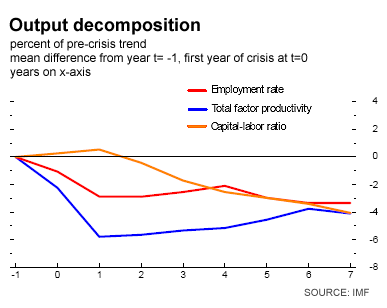
Depressed output comes roughly equally from three sources: reductions in employment, the capital-to-labour ratio and productivity. Initially, the greatest loss in output comes from a loss in total factor productivity, but this recovers in the medium term. But capital and employment suffer enduring losses because the crisis depresses investment as the supply of credit is more limited. Moreover, unemployment tends to endure for a long time which erodes working skills. Many workers have to change their type of work. Less credit, persistent unemployment and a weaker capital-to-labour ratio weaken productivity. The most surprising finding is that a high pre-crisis investment-share is a good predictor of large medium"“term output losses. Normally one associates high investment with productivity and innovative products. Nevertheless, it was noticeable that manufacturers, especially in motors cars, have suffered inordinately in this crisis. The Asian Crisis also impacted adversely on societies which devoted a high proportion of their national income to investment. The good news for Australia and New Zealand is that initial conditions have a strong influence on output loss: their loss of GDP is much less than the average country, which facilitates a revival. Some counties avoid an output loss and achieve growth subsequent to the crisis. The key appears to be timely stimulus and a readiness to reform. This research is rather sobering. Most counties will suffer an output loss in the medium term. Stimulus measures may mitigate this, but the IMF sees merit also in reforms to help to raise output and facilitate the shift of resources across sectors. This is not music to my ears, readers may recall an earlier column in which I lamented the drive to de-industrialise and rely on services.
____________ * Neville Bennett was a long-time Senior Lecturer in History at the University of Canterbury, where he taught since 1971. His focus is economic history and markets. He is also a columnist for the NBR where a version of this item first appeared. neville@bennetteconomics.com www.bennetteconomics.com
35 Comments
The mix tourists is changing
The mix tourists is changing with tourists from China is increasing as is the proportion of Chinese bus drivers. Migration is keeping house prices up. The other good news is that leaky homes are providing lots of work for builders.
"Fortunately immigration is very positive"....and
"Fortunately immigration is very positive"....and that Neville, about sums up Noddyland and why we are a boom bust boom bust nuthouse run by idiots. Once again the cry has gone out in the Beehive...."bring in the migrants"...."rich ones pleeeease".
Forget about a balanced economy and the spin from Bill about.."strategy"...to hell with encouraging investment in productive export areas....we're into another property booooom...stuff the debt and on with splurging again....oh yeah it's back to chasing each other round the suburbs to see who can be the most stupid dork in paying tooo much for crap property. Give it away Neville....this place is not worth the candle.
I think even the dimmest
I think even the dimmest economist understands that without a recovery in the US economy there can be no meaningful global recoverey.
Yet the US economy is very largely being kept out of intensive care by government stimuli, which by their nature, are transient.
To understand this one need only look at the 'cash for clunkers' program which was designed to boost demand for new US vehicles. During its short lifetime you could make the case that it succeeded as sales rose rapidly from the depression level values of 9 million or so units (Feb, March, April) to 14 million units in August.
Now its ended - and guess what - estimates are that sales crashed right back down to 9 million units for September (see graph here: http://www.calculatedriskblog.com/2009/10/light-vehicle-sales-92-million...)
Worse - the program will have taken some future demand out (from succeeding years).
So the US car industry is right back where it was in Q1.
Now the US has a similar program to get first time buyers to buy homes which runs out in November.........and so forth.
If you can get where this is all going - ring the bell, claim the prize. Yep, your cognitive powers are far superior to a mainstream economist.
Get ready for the US govt to roll out STIMULUS PROGRAM NUMBER TWO - at which point the parallels to a certain island economy due East of the Asian mainland start to become uncanny.
Neville: <blockquote> It worries me
Neville:
Well put. But your positives for growth: Internal demand, either from the public or private sector; Greatly expanded government expenditure and; Immigration - are all effectively only 'taking in other people's washing'. Certainly on a per capita basis.
NB wrote "Greatly expanded government
NB wrote "Greatly expanded government expenditure is impossible owing to National's ideology". I would suggest that borrowing $40 billion over the next four years contradicts this statement.
Yes it would appear that
Yes it would appear that the stimulus packages have failed.
NZ is likely to be heading for a double dip recesssion:
1) Strong kiwi dollar means very bad future for our exporters
2) Strong kiwi dollar means people will import more cheap goods
3) Low floating interest rates prop up housing market
4) Strong kiwi dollar means very few Kiwis return from overseas and certainly don't want to repatriate money from UK and USA at current exchange rate
5) Net migration gain only because nobody is leaving NZ
6) Unemployment here will continue to rise throughout 2010
7) Impact of a failing dairy industry and a govt guaranteed potential failure of SCF will be massive
8) Government borrowing $400m a week
Anyone else able to add to the list?
and of course we have
and of course we have a government that is basically doing nothing and a Prime Minister that should know better!
Thank you for the article
Thank you for the article Neville.
A request for an article from me :)
I would like an article on previous crashes and the resulting scrips, or community money systems, that were created, and what effect they had on the local economies.
For example:
http://www.absoluteastronomy.com/topics/WIR_Bank
The number of such systems appears to have been growing over the past decades, and it seems to me this should be an important aspect of economic history.
I would especially like to hear about complementary money systems in New Zealand history, and how and why they flourished or withered.
My understanding is that they tend to flourish at times like this because they enable local trade to continue when there is a lack of money.
This is what I've collected so far:
Sustainability, Community & Our Future Money System
http://neuralnetwriter.cylo42.com/forum/22
Neville I find it interesting
Neville
I find it interesting that terms like "Wealth" and "Recovery" are bandied about without any debated agreement to what they mean, Are we sure that we want a quick return to the prior state? a return to accelerating toward a resource constrained, overpopulated brick wall?
The world economy is fundamentally unbalanced, the US (6% of the world pop) consumes 25% of the worlds oil and 'economists' have no answer for the fundamental truth, that is that we all cannot live like that.
Most of the oil resides in Russia and the ME so if there is any return to "Growth" the almost immediate result will be geopolitical pressure and possibly instability, is this what we yearn for?
Any comparisons with historical economic events are fundamentally flawed because of the basic fact, "We have never been here before!"
Neven
Good article, I totally agree
Good article, I totally agree that we will see only minimal growth in the next 2-3 years.
Those who are expecting a return to boom times (there seem to be plenty out there) are going to be disappointed
The only boom we're gonna
The only boom we're gonna witness is the Gumnut debt , as they go cap in hand to our foreign creditors , pleading for more dosh , to bail us out of the debt spiral we are in . ............. Hmmmmmmmmm , how to get out of a hole ? Keep digging !
Yes things have fundamentally changed,
Yes things have fundamentally changed, the USA can not bounce back and the comparisons with the Japanese economic experience are not justified. Japan over the last two decades was an export oriented nation selling to the rest of the world experiencing unprecedented growth. That is not the back drop for any economy with their trading partners at this time.
Wally, re your comment about
Wally,
re your comment about bringing in rich migrants, would that also price out locals here and cause more imbalance? and would net migration continue to be positive? what if a reverse migration occur? I think we are going to be in deep trouble again, right?
The unemployment in the US
The unemployment in the US is getting worse by the month. Latest report shows a 9.8 percent unemployment. Are we not affected by the aftermath, are we always so resilient or optimistic in nature?
The latest G20 murmering mentions
The latest G20 murmering mentions "More Balanced" about 20 times.
so the west wages and credit addition must slow as the east starts to domestically spend and floats its currency. This will take a decade to achieve. expect start/stop www style recovery until the asian domestic demand kicks in.... biggest unknown , who is going to fund the deficiets of the us and uk and eurozone....
the world has excess capacity and excess labour.... scary lets hope the traditional route is not being considered.
Grandy, you are in a
Grandy, you are in a leaking rotting lifeboat with the crew from the rusting coastal steamer that is now on the seabed. There is no water, no food and not one of the fathead crew can read, let alone navigate. The nearest land....twenty years of rowing distant. Storms are on their way. Oh....and the crew are hungry, so stop looking like a lamb chop.
To The Bank Manager-re rich
To The Bank Manager-re rich migrants-overheard this in a TGA bar before the boxing.Indian migrant Trust accounts having large deposits put into new arrivals accounts ,from trusts-then transfering back once qualifing period over!!
To Wally,was going to buy a house,but now a sailboat looks good-Waterworld here we come,(someone always wants soill!!!!!).
wally - while you hold
wally - while you hold little hope for humanity, I would not want to fight the printing press.... printed money can inflate ... everything.
NZ GOVT debt 13 bil
corp debt 230 bil
the nz gov owes so little that everyone else wants to hold NZD as part of their reserves...
interesting, i think your views may be too negitive, anyway you have made your bets and anyone who has purchased assets in the last dip have made theirs. good luck.
@ Bank Manager "and of
@ Bank Manager
"and of course we have a government that is basically doing nothing and a Prime Minister that should know better!"
That is a good thing - the only way forward is to purge the toxins from the body - detox is never easy. The more we try to stop the revaluation happening, the worse it will be. It will be bad which ever way it happens. You cant unwind 20+ years of rash spending without pain.
If the Govt stands aside and lets the economy crash, things will be really rough for a couple of years and then there will be a chance of a meaningful recovery. If they step in and try to prop things up - we only have to look at how that worked in japan - 1990 to 2009 - 19 years of pain...
It will cost them the election but will be better for us in the long run - so it wont happen.
@ The Bank Manager To
@ The Bank Manager
To add to your list;
(8) Strong Kiwi Dollar - less tourists would visit NZ (ie. would affect tourism and hospitality industry)
(9) Strong Kiwi Dollar - less foreign students to come here (ie. would affect rental of housing)
Do you agree?
interested - Dont get to
interested - Dont get to carried away now the central bankers have encumbered the private sector up to the gunnels, they are now once again turning their attention to the public sector debt to complete, again, their coup'etat by debt entrapment, check out what the Auditor General thinks we have coming, and remember the figures stated are only "on book" debt, it is common knowledge that the privately owned network International Financial Institutes(IFIs) are prone to dealing anonymously with government officials under the premise of "consensus".
This chart from Audit NZ re Government Sovereign Issued Debt( GSID):
http://www.auditnz.govt.nz/publications/central-government/treasurys-dec...
All sectors of NZ debt and interest costs to economy here:
http://www.johnpemberton.co.nz/html/debt_graph_info.htm
The increasing govt debt and still increasing private debt are going to continue to be issued as non-backed created credit money supplied with compounding interest attached:
"The IMF may have catapulted to a more exalted status than that. According to Jim Rickards, director of market intelligence for scientific consulting firm Omnis, the unannounced purpose of last week's G20 Summit in Pittsburgh was that "the IMF is being anointed as the global central bank." In a CNBC interview on September 25, Rickards said, "They've issued debt for the first time in history. They're issuing SDRs. The last SDRs came out around 1980 or '81, $30 billion. Now they're issuing $300 billion. When I say issuing, it's printing money; there's nothing behind these SDRs."
http://www.webofdebt.com/articles/imf.php
NZ have once again began dipping into the IMF SDR trough, not that the House of Representatives, let alone the citizenship would have a clue:
http://www.imf.org/external/np/fin/tad/exporta.aspx?memberkey1=710&date1...
This is the best I have seen in a decade of research, describing the voting structures and secrecy surrounding the IFIs, all very interesting, but for the apathetic, especially from pg 33 down, for the 5 min folks pg 39 down:
"For example at the IMF, Executive Board documents are published after five years, Executive Board minutes are released after ten years, and other archived material is available after twenty years. The time lag means no decisions can be scrutinised until well-after they have been implemented. Even when documents are released, they are only available at the IMF's offices in Washington DC.88 This effectively makes even the
archives inaccessible to most politicians, groups and individuals outside of the United States; an appalling situation for a global institution."
http://siteresources.worldbank.org/INTPRS1/Resources/PRSP-Review/WDMPRSP...
The above fits with when I asked National Archives why documents surrounding our entry into IMF in 1961 were not digitally available like most, was told they are, but you have to come to Wellington to veiw, and they are not allowed to be taken from the building. What average PAYE slave has the time to do it.
How much more irrefutable information from the hoses mouths do I need to put to supposedly intelligent people before I have the right to call them blinded luddites.
You might as well go and sell your children into slavery now to assist with the ever increasing impact of debt upon your day to day living. The IFIs know the benefit of interest free credit, their subsidiary International Financial Corporation give interest free loans to corporations for Private Public Partnerships all the time. The credit money loaned comes from the monetization of debt via government bonds, thus transfers the profits from the use to corporations and the cost to the future taxpayers vis future taxes.
Sorry should read from page
Sorry should read from page 32 not 33
"Critical elements to facilitate democratic decision-making in this international context are therefore: fair representation on the Boards of the IFIs for those countries affected by IFI decisions; transparent decision-making so that the citizens of affected countries can know how their government has acted (and how other governments have acted) so that politicians can be held to account; and transparent ways of working so that the bureaucracy functions in the public interest and legal accountability so that citizens have some form of recourse if the actions of IFIs infringe their rights. Sadly, as this Chapter explains, both the World Bank and IMF largely fail on all of these issues."
http://siteresources.worldbank.org/INTPRS1/Resources/PRSP-Review/WDMPRSP...
Just go to the Mall
Just go to the Mall and you'll find it hard to believe that we are not "out of the woods".
Iain Dont fight the printing
Iain
Dont fight the printing press... just go where all the liquidity is going...
@interested: Yes, given many other
@interested: Yes, given many other countries are printing money in order to de-value and get a competitive advantage, we have to consider doing the same, (or the equiv) or we cannot get a decent recovery (when/if it happens)....ie knock our exchange rate down to <0.50....to do that we need a credit downgrade and I suspect drop the OCR to <2% I suspect....
@william we are not....I think those who think we are are living in noddyland....mostly economists and Pollies who have a vested interest. Lets face it their entire "wealth generating" system and their promises are broken you cannot grow your way to riches....which is what is promised. So ordinary ppl have been putting up with not doing that well while the rich grew richer because they were promised it would happen for them to. In the mean time take on debt, I mean you will be rich soon, so can pay it all off.....so what happens when ppl finally get it....
regards
@Neville: Agree....we are not out
@Neville: Agree....we are not out of the woods yet...
regards
"In other words, our output
"In other words, our output may still be 10% below that of 2007 in 2014."
Just one slight correction. The IMF article says that GDP is 10% below pre-crisis trend 7 years following a crisis, not 10% below pre-crisis levels. Assuming trend growth of ~3% per annum, the research is consistent with output being 11% above 2007 levels in 2014.
This would be consistent with most forecasts of below trend growth over the next year, and a return to trend growth thereafter
Grandy - yes good points
Grandy - yes good points and of course strong Kiwi $ also means more Kiwis travel to take advantage of lower costs and more $ leaves our shores.
Ian - re Indians - traditionally 3 or 4 Indian families would all live together and put everything into the pot and help one family into a business (usually a corner dairy) then once that family were gone another one bought in at the bottom and the next one moved up the ladder - it was a very successful strategy.
So I would not be at all surprised if the trust fund money is used and put into the recent migrants account until the qualifying period is over. There is a flood of Chinese and Indian families moving here - perhaps interest.co.nz should investigate how they are managing to beat the system in order to get into NZ.
Grandy - the foreign students
Grandy - the foreign students tend to be in homestays rather than renting houses.
Another area where IRD could
Another area where IRD could clean up is where say a couple own a home and then they go overeseas for a few years and rent their house out. Or move to another city and keep the old house but rent it out. Not all have moved them into a LAQC. Most would not be declaring the rental income so a great tax opportunity is lost.
Also developers who cannot sell properties but end up renting them out. At the time they are rented out they should be returning 1/9th of the total property value as GST but suspect this is not happening. ie a developer who ends up renting out a $450,000 property would immediately in his next GST period have to return $45,000 GST. You can guarantee this GST payment is not happening as that's almost 2 years worth of rent.
@Chris: previous growth rate isnt
@Chris: previous growth rate isnt coming back until the world picks up and buys our goods...so the 3% GDP growth per annum is pie-in-the-sky I think, until the world is growing anyway. But by 2014, it will be obvious that what we will be seeing is -3%...peak oil will be clearly with us by then....so oil isnt going to be cheap unless we are already into a serious recession...hopefully I will have been able to buy a 3kw electric scooter by then...
:)
regards
@ Bank Manager Why would
@ Bank Manager
Why would there be any gst to pay? Developer pays gst on eventual sale of property. Residential tenancy is exempt of gst. In your scenario no gst has been collected. ???
Yes Joe, change in use
Yes Joe, change in use provisions apply, however there iis a pro-rata provision allowing GST to be spread.
u nvr fail to impress
u nvr fail to impress me. this is another good write up!!! ;)
You Made Interesting Topics. I
You Made Interesting Topics. I like it very much. You bring me so much fun of it. thank you