
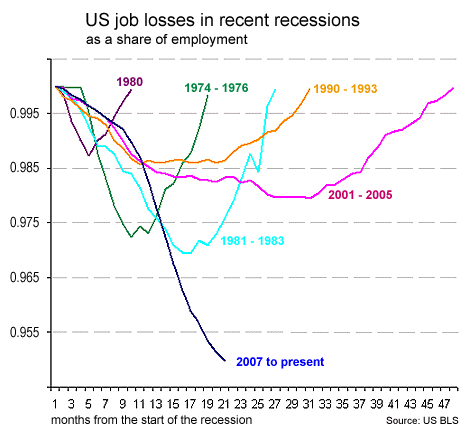
 By Neville Bennett The number of the jobless is at a record level in Japan and close to it in the US, UK and the EU. The two previous recessions had prolonged recoveries. The mild 2001-2005 recession lasted for four years in employment terms in the US. Recent recessions had jobless recoveries although GDP and industrial production rose. I wonder if joblessness is a feature of structural change. Perhaps my fears are unwarranted, but these are the confessions of a Neanderthal who thinks globalisation is not always an unmixed blessing: the evidence is mixed. Most US administrations are defensive about jobs. There are explicit denials that unemployment is structural and will remain as persistently high in the US as it is in the EU. Normally in the US about 65% of unemployed are in the "temporary lay-off" category, but that has become 50%. This could be because these workers were in firms with broken business models which are difficult to revive. It is widely conceded that future growth will be muted which will not readily reduce the army of unemployed. Senior US Fed officials have offered warnings: Dallas's Fed Chief suggests preparing for a savings-driven society, while the President of Philadelphia's Fed wonders if the US economy has sustained a "permanent" shock". A Nobel Laureate, and as a class they are very garrulous at present, has lent his name to research suggesting the US could plunge into third world status.
 Employment: Change I found Guillermo de la Dehesa's "Winners and Losers in Globalisation" (Blackwell 2006) a useful foil for my thoughts. Globalisation distributes economic activity around the world according (generally) to comparative advantage. This redistribution leads to changes in employment as well as remuneration. Globalisation has driven developed countries to supply goods and services intensive in capital, technology and skilled labour. They have no comparative advantage in unskilled labour, so less-qualified workers' remuneration falls. Some are unemployed as structures change. Firms locate activity where labour costs are competitive. But as everyone knows, low wage workers in Asia compete indirectly, through cheaper imports, with workers in higher wage countries like the US or New Zealand. Higher wage workers are vulnerable to firms locating the labour-intensive part of their activity in developing countries. Disintegration The notable change in recent history is the disintegration of production: it is now located in many places to take advantage of costs and perks. The Barbie Doll is an example: in 1996 its plastic and hair came from Taiwan and Japan, it was assembled in Indonesia, Malaysia and China, the moulds and paint came from the US, and cotton material came from China. The dolls were gathered in Hong Kong and exported at US$2 per unit. The Chinese got 0.35c for labour and the materials cost 0.65 cents. Mattel sold them for $10 in the US market. Despite delocalisation and disintegration of production, the US reaped the most valued-added rewards. As a result of this process, industrial activity in the OECD countries fell from 30% of GDP in 1960, to 20% in 2000. Industrial employment continues to fall rapidly in the OECD. I personally feel uncomfortable about this trend as it reduces employment opportunities, creates rust-belts, de-skills much of the population, and closes avenues of development. A point is reached where a country loses autonomous capability. Many New Zealand furniture jobs have gone of-shore, for example, I would rather that the industry produced good design and become a net exporter like Sweden, perhaps establishing a comparative advantage through design and indigenous materials. Nevertheless, most economists applaud the trend and insist that it is inevitable. Dehesa, for example, would find my attitude Neanderthal; he thinks producing goods is less important than "inventing them, controlling their advertising and brand name, or financing and transporting them". My question for him is: "what can a country do when it has few internationally powerful brands? Does it de-industrialise completely and engage only in agriculture and tourism? Dehesa emphatically denies that industry provides better growth and jobs, more export earnings and greater technological progress than other activities. It is "atavistic' to lament a car-plant closure while not applauding an opening of a mall, which creates a multitude of jobs. He adds that as wealth rises, households spend an increasing amount of money on education, health, insurance, leisure etc and these provides higher paid jobs. Less-developed countries have most of the population engaged in agriculture, but advanced economies like the UK have only about 2% of the population in agriculture. Dehesa thinks industry will be only 10% of OECD GDP in the near future. He welcomes it as deindustrialisation is a characteristic of development and is "closely related to improvements in the standard of living". I think that is fine: as long as people can move into services. Many cannot because of lack of education. More importantly, I believe there is no rule that as industry fades; the demand for services will keep pace. We are entering a new era in which the consumer is burdened by debt and more careful in expenditure. I think there is a structural shift taking place which is lowering private demand. The shift is obscured by short-term enormous state stimulus and cheap interest rates. Some trends are ominous. Since 1973 real wages in the US have been falling by an average of 0.4% p.a. Lower paid workers have lost 20%, while higher-paid have prospered, especially managers and executives. Residual inequality, which measures differences between groups according to gender, race, education and experience has also increased. Unemployment is structural in Europe and may become so in the US, especially as importing goods from developing countries is, Dehesa says, "the equivalent of importing the labor used in their production". Labour is the element of production that takes much of the risk in a globalised economy. I believe there will be growing wage instability in the face of external shocks, especially those caused by the abrupt movement of capital from one country to another. ____________ * Neville Bennett was a long-time Senior Lecturer in History at the University of Canterbury, where he taught since 1971. His focus is economic history and markets. He is also a columnist for the NBR where a version of this item first appeared. neville@bennetteconomics.com www.bennetteconomics.com
1 Comments
Hello Neville Bennett! Write now can't explained about your article has gotten me shocked. Truly did not think in the starting time when was about to begin reading above subject. But in the middle my interest developed and when reached till end feeling that today have been collected most useful information of "Without design skills and international brands, can we survive globalisation?". Cheap Web Design Pakistan. Thanks for superlative archive shared with us.
We welcome your comments below. If you are not already registered, please register to comment
Remember we welcome robust, respectful and insightful debate. We don't welcome abusive or defamatory comments and will de-register those repeatedly making such comments. Our current comment policy is here.