
Offers for readers

The comment stream

Recent comments

Join the Interest community to be a registered commenter so you can:
- Edit your comments
- Avoid the CAPTCHA
- Vote on comments
Register Here

Already registered? log back in here ..

Forgotten your password? No problem! Click here

Finance sector jobs

Corporate Recovery Senior – Australia, Audit experience welcomed
Successful applicants will have the opportunity to work with this leading Australian Advis...more
Australia
Transaction Services Assistant Manager/ Manager – Melbourne
Think Global Recruitment is working with this exceptionally respected Australian Boutique ...more
Australia
Audit Senior - Australia
Sought after opportunity to move to one of the most beautiful westernised countries in the...more
Australia
Research & Master Trust Relationship Manager
Strategic and Senior Appointment...more
Australia
efinancialcareers.com

Reader poll

Who do you think should be appointed Reserve Bank Governor to replace Alan Bollard when he retires in September?

Choices

REINZ median house sale price and volumes steady in July from June (Update 4)

Posted in News

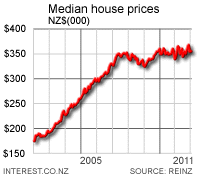
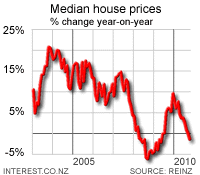
New Zealand's median house sale price in July was NZ$340,000, the same as in June 2009 and July 2008, the Real Estate Institute of New Zealand (REINZ) said. (Update 4 with new stratified house price inflation measure.) The level of nationwide residential property sales was also similar to June 2009 with 6,014 sales during July, down slightly from 6,040 in June and up from the 4,489 a year ago. "The market has certainly recovered well from the lows of mid-2008," REINZ President Mike Elford said. "You wouldn't call it brilliant, but there are positive signs such as more listing stock," Elford said. The median sale price of NZ$340,000 was still below the NZ$345,000 in July 2007, but was double the median price in July 2001, when there were 6,078 sales nationwide. The REINZ's median days to sell figure was 37 in July, from 41 in June 2009 and 58 a year ago. Main centresIn Auckland, the median sale price was up NZ$5,000 from June to NZ$440,000 and sales were steady at 2,024 (from 2,032). This compared to a median price of NZ$421,000 and 1,411 sales in July 2008. Elford said the 4.5% rise in the Auckland median price over the year was a sign of an improving market. The median price in Wellington fell NZ$5,000 over the month to NZ$370,000 while sales fell 8.3% to 618. This compared to a median price of NZ$371,000 and 503 sales in July 2008. In Canterbury/Westland, the median sale price was up NZ$2,000 to NZ$297,000 over the month, with 905 sales, up from 889 in June. This compared to a median price of NZ$300,000 and 675 sales a year ago. Reaction ASB economist Jane Turner said the July data confirmed the recent recovery in the housing market remained firm and that declines in house prices had come to an end. "Nonetheless, the absolute level of demand remains below average. While population growth and low interest rates are supportive for the housing market, rising unemployment and ongoing economic uncertainty continues to dampen the degree of optimism," Turner said. "Houses remain relatively expensive compared to incomes and rents, and future house price increases are likely to be moderate "“ particularly compared to the previous boom," she said. New house price inflation index The REINZ is now publishing a new stratified house price inflation index (see interactive chart below) that was created with the help of the Reserve Bank. The new index rose 1% in July from June, and was up 0.9% from July 2008, which was the first annual increase since March 2008, REINZ said. The new national stratified median house price in July was NZ$353,055. This compared to the non-stratified median price of NZ$340,000. In July, the index was down 7.3% from its peak of NZ$380,900 in November 2007. However this was up from the index's trough in January this year, when it was down 11.4%. November 2007 also saw the peak in the REINZ median house price. The REINZ said that monthly movements in the index could be volatile and so also provide a three month average figure, similar to what Quotable Value does with its house value index. The index rose 2.2% in the three months to July from the three month to June. This compared to QV's figures showing house values rose 0.7% in the same period.
We welcome your help to improve our coverage of this issue. Any examples or experiences to relate? Any links to other news, data or research to shed more light on this? Any insight or views on what might happen next or what should happen next? Any errors to correct?

We welcome your comments below. If you are not already registered, please register to comment in the box on the right or click on the "'Register" link at the bottom of the comments. Remember we welcome robust, respectful and insightful debate. We don't welcome abusive or defamatory comments and will de-register those repeatedly making these comments.

1 Comments

darn....i was hoping for the

darn....i was hoping for the "boomlet" to run a bit longer so as to flush out more listings so the real escape agents could talk the poor punters down with soothing words like "we'll have to let the market decide the price" etc and the steady decline in real estate prices would continue until reality was met.

o.k...time to sit back now and watch the real escape artists come online and rationalise that this was a correction ( burp) that we had to have.

rock on , elves!
( and stay lucky!)

“The market has certainly recovered

"The market has certainly recovered well from the lows of mid-2008," REINZ President Mike Elford said. "You wouldn't call it brilliant, but there are positive signs such as more listing stock," This bloke should be on as a comedy show. Reminds me of comments made some time back "The Titanic certainly recovered well from that blow, you wouldn't call it brilliant, but there are positive signs such as less distance for the lifeboats to drop"

I have had a search

I have had a search but could not find on the internet data on number of property listings in USA during there price falls. I would love to see a comparison with NZ.

As i see it, NZ has dramatically dropped the number of houses for sale as soon as prices started weakening. This of course means temporary lack of supply as people hold there houses in hope of better prices in the near future. Demand-supply imbalance leads to upward pressure on prices during the 2008-2009 period which partially counters the downward pressure from the world wide credit crisis.

What I want to see is whether a return to normal levels of listings would take away this artificial limit on supply and lead to further prices falls in the near future. Is this what has happened in USA for example?

I'd be interested in any

I'd be interested in any surveys / data on the question of "Will you list your house once markets improve". I'm guessing we have a huge overhang of supply which is just waiting for a few green shoots before the owners will put it up for sale.

However a bunch of these owners won't be able to wait indefinitely, and when they list it could get painful

Looks to me that kitties

Looks to me that kitties coming down!!!!!!!!>)Wait for the 3mth data lag to come!

It is interesting to follow

It is interesting to follow the graphs. QV are showing there has been a total drop since the end of 2007 of 9.9%
http://www.interest.co.nz/ratesblog/index.php/2009/08/10/property-values...

Over the last few months there has been a small up-blip, which is causing a fair bit of breathless excitement in the RE community. Green shoots yadda yadda.

However, look at the longer term picture, and the decline has in no way removed the excesses created by the 2002 - 2007 housing bubble:
http://www.rbnz.govt.nz/keygraphs/fig4.html

I'm going to stay a bit longer in the rental we are in. If NZers want to keep property at the present nose-bleed level & keep their heads in the sand about the real state of the economy, they can get stuffed. I'm blowed if I can see the national wealth that justifies this obsession.

Also I would love to

Also I would love to see mortgagee listings expressed as a percentage of all listings.

I imagine in times like these this percentage would sky rocket, highlighting the fact that people are only selling if they really have to. Again this can't last. Its a bit like people holding there breaths as they are held under water hoping to be let up. Eventually they'll need to take a breath and we'll finally see this price bubble die.

Dang right there Philly. It's

Dang right there Philly. It's an obsession cultivated by those morons in the Labour govt and now being nursed along under National. The way I see it, Noddyland is just a bigger version of SCF and all the other overleveraged finance crowd with their related party loans and so forth. Sooner or later the axe will fall and the later it is the sharper the blade. Bet you the national rumpers in the loop are pulling their loot out faster than an mp can grab an extra perk.

Flemming - i've been search

Flemming - i've been search trademe for mortgagee sales and numbers were going up..but have flattened at the moment.

Have I missed something as there is no report here or in the Heralds report about number of listings 08 to 09 June to july as this is the measure of "Supply" change..

Did they report on this or are media burring this under the carpet?

Well well, seems like all

Well well, seems like all the SPI's (Smart Property Investors) and Agents (Re) are starting to run out of steam !

They are ''desperate to reignite the property market for the spring/summer season''.

Going by there track record in blowing NZ property out of insane proportions to date....

I FEAR WE WILL END UP WITH A
"FIRE SALE''

no one on the 23%

no one on the 23% prediction blog took up my wager to to bet the ASX would go up 23% first - the ASX or the NZ median price. (Come on Chris_J, Murray etc)

Since Tuesday (the wager date) I am up about 5%, seems property is static so 5% ahead in 3 days - 18% to go. I have 3 years to get there according to Infometrices. And guess what, I dont have to pay huge transaction costs, get a lawyer, pay rates, maintenance, insurance AND the yields are about 2% better than the median house. Come on guys!! the share market has had its crash, property has not. I'm not saying its plain sailing form here on in, but its not difficult to see what represents better value.

Jimmy: will I feel be

Jimmy: will I feel be a roller coaster ride on shares. I think the crash is going to turn into a "W" shaped one. Overall I feel there are risks for all investment classes - eg inflation taking off, exchange rate effects. My order in terms of attractiveness at present is:
1) Selected commodities & metals: gold, copper, oil
2) Equities
3) Bank deposits
4) Investment grade bonds
5) Commercial property
6) Housing / rentals
7) Junk grade bonds etc

Of course one would create a balanced portfolio reflecting degrees of risk etc.

I would be interested in others' rankings - eg Wally.

Philly - good points. Which

Philly - good points. Which is why I like index funds, minimum fees and good exposure across all asset classes (except cash and residential property - happy to avoid property, cash I have some stored away in an Aus First Home Saver at low tax rates)

It would be interesting to

It would be interesting to see the after seasonal adjusted data. I am definitly in same camp with you guys, but the seasonal adjusted data may be much better then what we thought. Have you huys checked how many weekends in JUly? school holiday or public holiday in July?

Jimmy, unless you have cash

Jimmy, unless you have cash to burn as most young people dont who start out then I can't see how shares are a better return, lets say joe avearge has $10k saved and he puts it into shares, when he gets his 23% return he has made $2,300 so all in all pretty good for not too much effort, now if the same joe average puts his $10k into a house for arguments sake that's worth $100,000 and gets 23% on that he has now made $23,000 or 10 times what the growth would have been on his shares, sure he has had some hoops to jump through to get there but his return is greater and his decision to buy a home puts a roof over his head (something shares dont do), he could have bought shares but then he would have had to rent and pay someone elses mortgage.
It seems to me that too many people get hung up on how much their property goes up or down in value I believe the measure is in how much of your own money do you have to put in versus what you get out, deals can be done in property where you dont have to put a cent in so your return is then infinite-if this can be done in the sharemarket then please tell me how as Id love to give it a go.
prehaps you should rethink your wager as in set a limit of how much money you invest and then focus on the cash that money has generated over the three years and not just on the percentage of the return, 100% of nothing is still nothing

Can anyone here provide a

Can anyone here provide a formular regarding the housing data adjustment?

Nick: Looks like the sort

Nick: Looks like the sort of argument that those who "invested" in Blue Chip may have been sold! Remember that leveraging doesnt' just magnify profits, it magnifies losses the same way. So your $23k of gain could just as easily be $23k of loss.

Brian Gaynor is pretty good on the sorts of traps that await the unwary when they dabble in property without understanding the effects of leverage, liability etc:

http://www.nzherald.co.nz/business/news/article.cfm?c_id=3&objectid=1057...

Philly, fair point but you

Philly, fair point but you would agree that you could just as easily lose in shares, if a company collapses you generally have no shot of getting your money back and yes you can take a hiding in property but atleast it will always be there in the end and will come back up eventually there are plenty of ways to help and buffer yourself with property, adding value,vendor loans with price increase guarantees e.t.c. all of which will help provide some form of insulation if/when the s**t hits the fan to atleast ride the storm, on the other side if you are heavily leveraged then its your own fault if things go pear shaped.

Nick, on the topic of

Nick, on the topic of leveraging property; you're forgetting that all the 'other peoples money' that you make your capital gains on costs your around 6-8% per annum. So the 23% increase over 3 years, gives you 7% per annum, leaving you with effectively ZERO GAIN, as interest payments over the 3 years takes out your 23k profit and then some.

And as for having a place to live, a single person can rent a single room relatively cheaply, and if they put all the money they were going to have to pay on mortgage payments (mainly interest) into shares then history shows over the long run you are likely to be better off

nick, leverage has traditionally been

nick,

leverage has traditionally been the main advantage of property. The problem nowadays is that allowing for long term interest rates (8-9%) a property that someone would actually want to live in costs about 2.5 * as much to buy as it does to rent. In this regard leverage works the other way and the cash flow loss eat into the capital gain - at the same time as cash flow losss are occurring, the capital gain in the long term will most likely be poor at best to account for the fact that yields will eventually revert to something more sustainable.

Philly, yes to copper, NO

Philly, yes to copper, NO to property. Trouble with the predictions of a W shaped event is the FED will open the vaults to keep this U shaped event chugging along. You might well see the W take place in some sectors and the U in others, while seeing the China India Brazil Asia (CIBA) crowd surge forward and the western debtors stuck in the mud. I think Russia is out of it now.

Liam Flemming, wait until you

Liam Flemming, wait until you start to see how many cram into those slum tower apartments in Auckland! If you put in some extra bunks, could be a winner.

Liam, ok assuming this property

Liam, ok assuming this property is an investment property(after all thats what your shares are) and the rent recieved is enough to cover the outgoings e.t.c. then you now have your return back again? or am I missing something?
please note-I'm not having a crack at any one or their opinions I enjoy reading here on this site there are clearly alot of people who I can learn a thing or two from.
I enjoy dealing with property but thats because I don't know much about shares so ill keep reading up from people who do.

cheers

Nick, "Liam, ok assuming this

Nick,

"Liam, ok assuming this property is an investment property(after all thats what your shares are) and the rent recieved is enough to cover the outgoings e.t.c. "

Thats a huge assumption, and for the most part positive cash flow is not possible - certainly not when rates are back up from their deflated lows.

Nick You could have lost

Nick
You could have lost all your money if you invested your 10K in to a 100K property 2 years ago. Leverage is a double edge sword.

Nick, for positive cash flow

Nick, for positive cash flow you need your rental yeild to be above mortgage rates. Thats why rate rises scare property investors more than falling house prices, because once they become negatively geared they have to either find the extra money themselves or sell. Same is true when they can't find tennants. (9% vacancy rate in aucks currently).

House prices fundamentally should not beat inflation by much, and betting that they will in the future is a big risk. Fundamentally, good companies exist to make profits and expand. They are productive enterprises. A small amount of research leads to much better gains with shares in these companies. Dividends (approx. 4% ave) are comparable to the rent from property over and above any capital gains.

Some managed funds are a good place to get started, let them do the risky stock picking, follow individual companies in there portfolio's and learn what makes a company a good investment. This sort of knowledge has a much bigger impact on returns than anything else you can do in property. Property is alright if your alternative is to spend it on a weekend on the piss, but you sound smart enough to be able to learn about investing in shares and get much greater returns

jimmy <i>no one on the

jimmy

no one on the 23% prediction blog took up my wager to to bet the ASX would go up 23% first - the ASX or the NZ median price. (Come on Chris_J, Murray etc)

I've decided I'd like to find someone prepared to sell me a house at any price they choose, with a guaranteed buyback at 10% higher than that price at 3 years. I'm not greedy. I don't need 26%.

Philly, no finance cos? new

Philly, no finance cos?

new money, I would be pretty much all cash for the short term, then see what equities, commodities do over the next couple of months. They need a breather, it could be a collapse again is all.

Nick, absolutely you can leverage into shares. For example levergae $10k 70% into Telecom at its april low of 2.19... its now woth $42k, using the same logic as you have.

And according to the Q.v stats of a 9.9% drop in house prices your $10k is now worth nothing. I steer clear of property currently as I fear our nationwide obsession is going to bankrupt us all.

But I am not a hater, good on you for giving it a crack and I hope you do well.

The difference between a good investment and a bad investment is the investor.

Fairfax: I never ever would

Fairfax: I never ever would have touched any of them thar finance company toxic waste ripoffs. They never came within a million light years of being on my investment radar. & that includes the Money Managers & Blue Chips of this world. I don't think anyone who read Chris Lee or Brian Gaynor would have.

In my list above, you could put them in with 7) Junk grade bonds. Especially since 2 of the 3 remaining big finance companies have just been officially put there (about time the rating agencies got wise).

Jimmy, ASX in with both

Jimmy, ASX in with both feet, sweet return with great profits today ,thinking seriously of selling and buying with my profit SCF Bonds Repayment 2011 second hand..20%.. And Philly. Chris Lee was selling and buying SCF ....I know...

chris lee, huh? he's got

chris lee, huh?

he's got plenty of skeletons in his cupboard.... like all the investors he advised into provincial finance and others who "fell over" back a few years?
at least , he doesn't deny it but i wouldn't drive my investments on his advice.

wouldn't take too much notice of his self promotion either.

rob of the north, C.Lee

rob of the north, C.Lee got his fingers burnt with some finance but sized up Money Manager...How Somers Edgar still is around is amazing....this shonky company should have been routed at the fall of First Steps., clip, clip ......Has taken down many retired people .....Amazing and disgusting...

Philly, that was very tongue

Philly, that was very tongue in cheek...

Chris lee promotes finance companies more than any other financial advisor in NZ, he has just put a better spin on it, ask any mum and dad in strategic, st laurence, provincial, dominion.

But you are right , there seems to be nowhere near the return offered for the obvious risks in those investments.

house sales increased 7.1% (after

house sales increased 7.1% (after seasonal adjusted) on June 2009 from Infometrix web site.

Thanks Liam, Im in the

Thanks Liam, Im in the deep south so its alittle easier to get cashflow here I guess, I haven't looked in other areas as then I'd have higher costs e.c.t. a few deals I have done are with interest free vendor loans for 30% of p/price 5 year term and the right to extend the term if x level of growth isnt reached within the term so hopefully I have a big enough buffer incase of further price drops aslo have a small business with a few staff so Im doing my part to be productive, and help provide the govt with tax $$ for their living allowances.
Good points there Fairfax, cheers

Liam Flemming In answer to

Liam Flemming

In answer to your request for data on listings in general and mortgagee listings, let me direct you to the Unconditional blog on realestate.co.nz where you will find firstly a comprehensive monthly report on new listings coming onto the market as well as inventory and asking price expectations.

Here is the link for the NZ Property Report

In the case of mortgagee listings the data on that is presented on this blog under the housing data charts that Bernard keeps updated courtesy of realestate.co.nz. I have not posted an article on mortgagee listings for quite a while.

Here is the most recent post on mortgagee listings

Until the unemployment numbers decrease,

Until the unemployment numbers decrease, there won't be any considerable increase in property prices. New Zealand property market is being turned into a ponzi scheme by the banks. They know that if they tighten the lending criteria too much, there would be a lot of bad debts in their books.

John Well, according to the

John

Well, according to the Herald today property is running hot again:

http://www.nzherald.co.nz/nz/news/article.cfm?c_id=1&objectid=10591107

I throw my hands up in the air! It is clear that logic has no place in housing, the herd mentality reigns supreme!!!

I'll look at the pros of the coming boom - more architectural work!

(PS is this the first time in the world that house prices have gone up in a time of growing unemployment and low inflation???)

It is becoming obvious to

It is becoming obvious to all, the NZ govt cannot be looked to for the sort of action needed to prevent the borrowing bubble to continue. It seems as though English and Key are passing the buck to the ratings agencies and the overseas lenders. There is little chance of the country avoiding a ratings downgrade and a serious hike in the cost of credit. This will result in all those families that have been sucked into the banking mortgage property rort over the last few years, in being slammed with rates in the high teens. Forget the 2 to 3% rise predicted by the RBA being copied over here.
Expect the increased cost to run close to 10% above current rates. Enough to rip the guts out of the property sector and tens of thousands of families. All thanks to a gutless govt failing to do the right thing months ago.

Why is everyone getting so

Why is everyone getting so excited over a small blip in the market?

Those figures released by the RE Institute ( see http://tinyurl.com/oasxra )
show that there were only just over 6,000 homes sold and that's the second worst July sales volume since July 2001.

Sure sales volume is well up on July 2008 but hard to see the rest of 2009 being very positive as people lose their jobs and interest rates climb towards 10%.

But isn't it amazing how the media have got in behind and hyped this release and also incredible how quickly people believe it when Infometrics state prices will increase 25% yet scorn Bernard when he and others stated homes were over valued by 30%.

A buyer paying $500,000 and taking 3 years fixed at 7.5% with a 20% deposit would be paying interest of $721 per week plus rates and insurance yet the same $500,000 property would only rent for $500 per week.

Why would you bother buying if there is little capital growth prospect in the future?

Rusell, "A buyer paying $500,000

Rusell,

"A buyer paying $500,000 and taking 3 years fixed at 7.5% with a 20% deposit would be paying interest of $721 per week plus rates and insurance yet the same $500,000 property would only rent for $500 per week."

And dont forget the 100,000 would also be providing some return depending on where you invest it. And dont forget up front purchase costs, building inspections and many many wasted weekends. There is also maintenance (allow 1% of purchase price - more if the roof needs redoing). Another thing to consider if you are a long term homeowner is that on average you will upgrade in 8 years - so add 20,000 for sale costs and divide by 8. So the equation per week is:

Rent = 500
returns on deposit = 80
Net cost = 420

House
interest = 721
maintenance = 100
rates = 30
insurance = 20
transaction costs over 8 year period (25,000) = 60
Net cost = 931 per week.

So there you have it - it is more than twice as expensive to own a 500,000 house (which does not get you much these days anyway, the ratio gets worse the more expensive the house). I'm waiting for the property bulls to say we should not be fussy and use our 100,000+ incomes to buy a house in a low socio economic area. Is that why we work hard? So we can afford what a low skilled worker could afford only 10 years ago???

Just think what you could do with the extra 510?? It really does illustrate what a rort housing is, and when you see the bulk of the disparity is taken up by interest payments you can see how much the leech banks are laughing from their overseas boardrooms at us peasants bidding each other up to get into an asset that can only have a serious detrimental impact on quality of life (not to mention the nations financial position).

actually - just had a

actually - just had a look at the above calculation. The 400,000 loan would "only" have about 600 per week interest. So we are comparing 420 with 820 - still a pretty crappy comparison. And imagine what it will look like when we get back to 9%???????

I'm sure it's been mentioned

I'm sure it's been mentioned on the site somewhere, but what's chance of us harmonising our property laws with Oz, now that they are contemplating reforms? Possible, CGT on all (?) property-with mortgage interest tax decuctible for all ( equalises all owners, not just LAQC ones) and Stamp Duty on all transactions.
Make sense to get all our trans Tasman regulations in line, not just Open Skies....and the Ozzies think their changes will drop their property prices.

jimmy - "So there you

jimmy - "So there you have it - it is more than twice as expensive to own a 500,000 house"

I agree that the house price to rent ratios have got a bit out sync. However, even with your example above of owning the same house costing $500 per week more, it would only take a 5% capital gain to cancel that out. Given that house prices are already up 5% so far this year and the long term average is between 7 - 10%, it seems a fair assumption. I'm not a fan of relying on capital gains, but I can see why people do it.

The Shares vs Property argument has been going on for centuries, and the reality is that long term they both provide similar capital growth & similar yields. The advantages with property are being able to leverage up to 80% or more of the purchase price, much less volatility in price movements, and the ability to add value by making improvements (paint etc). The fact remains that the majority of people on the Rich List in any country have either made their wealth or hold their wealth in property.

Murray, I doubt many on

Murray, I doubt many on the rich list would hold any where near as much of there wealth in property as most kiwi's do.

Balance is the key, and being realistic.

I'm waiting to see where rates go and what changes to tax system happen before I get more rentals. Capital gains above inflation aren't going to be significant in the near future, i do my sums on zero capital gain relative inflation and just work on cashflow by careful selection of properties. Much much harder these days to find property with decent yeilds. Property is definately behind most other investment assets classes at the moment.

Murray said: "I agree that

Murray said:

"I agree that the house price to rent ratios have got a bit out sync"

Murray - that is the understatement of the century!!!!!

Its going to be very interesting times. If property has another mini boom, which Infometrics are predicting and anecdotally seems to be happening, I think things could get very ugly for the NZ economy over the next 2-3 years, as we get more and more indebted, and as exporters continue to struggle on the back of a strong NZ currency

It could all come tumbling down quite badly.

I've given up on predictions (my own and those of "experts") however all I will say is that I wouldn't be surprised if this rising mini-boom results in a more severe crash 1-2 years down the track

If this does happen then its not like the govt hasn't been warned....

"5% capital gain to cancel

"5% capital gain to cancel that out. Given that house prices are already up 5% so far this year and the long term average is between 7 - 10%, it seems a fair assumption"

Facts are wrong here mate, assume this and you'l be up sh*t creek

Craig : Good point, about

Craig : Good point, about our rich. If you follow their portfolios , a picture emerges of diverse assets across industry and country : Think Todd family , Stephen Jennings , Mr Hart : and we have NZ energy/ Russian financing/ food / paper & packaging.......and these guys may be buffeted by larger market forces at times , but they re-emerge richer eventually , long after the speculators and mom&pop have been washed out of the markets. There may be a lesson there...............oops , hang on guys.......gotta take this call from my agent , there's a nice little condo in the city that I simply must make a bid on...................!

Murray, long term the gains

Murray,

long term the gains are NOT 7-10% - this has only been the case over the last 30 years and you need to remember

1) this has included some periods of very high inflation and
2) these gains are why we now have a bubble and why we got the GFC in the first place. They have come on the back of a massive increase in debt. That can not happen forever and as you can see overseas, reductions in debt are resulting in massive drops in asset prices. I still see no good reason why NZ will not go through the same rebalance despite the tired argument in favour of the bubble. Even under a best case scenario, I cant see prices rising more than the rate of inflation in the long term. So you would still lose out here relative to renting.

The recent resurgence is nothing more than a combination of absurdly low short term rates coupled with an entirely false belief that property is now safe again. It is simply not sustainable.

Matt,line. "It could all come

Matt,line.

"It could all come tumbling down quite badly.". I think we have passed the point of "could". Its now pretty much a bankable certainty. WHY? The only way to keep houses at existing highs is for new entrants to the market to take on 3* the level of debt relative to inflation that those finishing their mortgages were required to take on 20 years prior. This means that every year, even if houses stagnate, about an additional 200,000 extra in debt per new FHB is being taken on than is being paid off further up the line. This is why our debt has increased hugely over the last 2 years even though prices have dropped a bit. Every year prices remain high, then a new batch of high debt is taken on and on current calculations adds over 10% a year to our debt to gdp ratio. THERE IS NO ESCAPE FROM THIS INCREASING DEBT OTHER THAN
1) Massive increase in productivity (good luck here)
2) Massive decrease in house prices (this will not reduce debt immediately, just stop the increase)
3) An immediate freeze of debt from our creditors.

Simply put - there is no escape, get your money out of NZ. And whatever you do, dont buy property.

and if you think 8.5%

and if you think 8.5% current accoutn deficit is bad - what will it look like when interest rates are high again?????????

I see the Greens are

I see the Greens are calling for a CGT....
IMHO they would be far better served calling for a relaxation of planning rules within metropolitan areas. Unless this occurs, not only will house prices go up, but there will be overhwelming pressure for development to sprawl beyond present city limits, increasing greenhouse gas emissions, surely something the Greens wouldn't want to see???

Actually I'd go further and

Actually I'd go further and say that a CGT may be counter productive to a green philosophy...
why?
Because as it would make housing investment less appealing, there would be less imperative to build higher density within cities. This would then, at least theoretically, push development pressures out to the urban margins

Jimmy said: "Its now pretty

Jimmy said:

"Its now pretty much a bankable certainty"

thats a bold call!

I can entirely see the logic in everything you are saying, but as I posted earlier logic seems to have gone out the window

And the experts, trained in economics, seem to be saying that either houses are going to rise by about 10% in the next year (Infometrics and Alexander) or at worse be flat / rise very slightly (ASB, ANZ, etc)

no expert as far as I can tell is calling any further significant falls, or a crash

I'm not saying we won't still see a crash its just that the experts are not picking it.

Mind you, most economists didn't pick the crash in the US did they?

I guess if it does happen then we should call for the immediate resignation of the economists

I've been looking and am

I've been looking and am unable to find properties with yeilds above 8% (what i am using for interest payments, could be more than this, unlikely to stay below this though).

Some student flats may come close but they are not 52 weeks of the year, more like 35, so can cut the yeild calculated there down by 30% or so.

There is no point buying rentals when you have negative cash flow with capital gains at or around inflation at best (i.e zero in real terms). Adding to this the maintenence costs when you rent a place to strangers, and it simple does not stack up.

Prices have grown faster than rents and incomes. Rents are already pushed as high as they can go, they simple can not grow faster than incomes or else people will have zero disposable income and our economy will collapse.

The reason prices are staying a float at the moment is because of low variable, 1 year rates, which can buy people renting there house out some time. Also the large portion of people who brought there houses at 20-80% less than they are now worth thanks to the boom, so there yeilds based on historical cost will still stack up nicely.

Again its a case of things are fine so long as large capital gains continue at 10%+ levels thanks to new people buying into the market, just as a ponzi scheme is fine so long as new investors outweight the old.

Jimmy - as you live

Jimmy - as you live in Aus, whats your view on house prices over there?
immigration seems to have continued unabated, and young Aussies never seem to have permanently left their country in as great numbers as kiwis
Surely its supply and demand, and demand from all their immigration will push up prices?
have they had a similar thing to NZ with tonnes of finance companies going under, or have most of theirs remained intact?
A problem in Nz is that with the finance company sector crumbling many developers are struggling to get finance, that is not helping the supply side of the equation

Once the large capital gains

Once the large capital gains stop (as we are seeing) then none of the figures stack up. And it doesn't matter than most home owners do not know how to calculate these figures, because you can be sure the guys at the bank can.

The drastic drop in OCR has only brought the market some time, its a temporary band aid to slow the blood loss for a while, and give people a chance to talk the market back up so the ponzi scheme can continue on its merry little way.

The income-house price ratio can be inflated only when prices are going up at 10%+ per annum, when this stops the ratio will always drop back to historical levels before another true boom cycle can start

Matt, the main diff i

Matt, the main diff i can see between between aussy and nz is aussy actually have a shortage of houses. Vacancy rates of 2% or less in all major cities. Auckland is 9%+, similar to USA

Are we ready for another

Are we ready for another week of Beehive BS? They haven't trotted out the 'strategy' crap for at least two weeks, so that could be due for a re run. Must be about time for Brash to show off his lineup of selected 'experts'! Yes yet more bloody experts. My money's on Minty the monkey as the only national caucus member likely to shift the lard and come up with some action. Oh and the funny farm starts up again at 2pm Tuesday.

Craig : There's an advert

Craig : There's an advert running on the radio today ( Radio Live ) about a property syndicate with Fairfax & other publishers as tenants, and it's paying 9% + , guaranteed , over 3 or 5 years. You need a minimum $ 50 000 stake.

Wally : Watch out for the CGT. These bozos are daft enough to think that its a goer. Still no talk of reining in their expenditure. Seems a grand idea , in the depths of a mega-recession , to screw the system of more tax...........rather than just spend less.............hands up who voted for these boof-heads !

Matt, When I was talking

Matt,

When I was talking about bankable certainty, the main point I am making is that NZ either faces bankruptcy OR a massive deleverage of its debt position (only possible via house price falls). I can not see any other way. as i pointed out every year houses stay high another 10% is added to our debt position. Remember also that consumers are the biggest driver of the NZ (and any) economy. its one thing to have an economy where only those who bought in the last 5 years had to ake on massive debt. At least the boomers and some of Gen X can spend up. What will our consumption be like if house prices stay high and MOST households had to take on massive debt?? I'm not sying we will see a crash this year or next - merely that it will happen OR we become another Iceland, in which case we will see a crash anyway. No way out.

"Surely its supply and demand, and demand from all their immigration will push up prices?
"
Discgracefully our govt is using immigrants to keep prices high. But the major demand factor built into existing prices is speculative demand fuelled by easy credit.
Remove this, and the housing market follows. You would need a million immigrants to fill the demand gap. Ditto for Aus - they are actually worse than us, yes immigration is high but why are rents not throught the roof?? why are yields low?? Mining only makes up 4% of Aus GDP and employs 1% of teh workforce. So its not a get out clause the for Aus economy. They have a high CA deficit as well.

Lets see how the Aus and NZ markets hold up once interest rates return to normal levels.

Wow, this is all makes

Wow, this is all makes me GLAD I didn't buy. I came close in the last few weeks but renting and saving the difference is just so much more attractive, and easy too! Common sense says that house prices must come down, sooner or later. I can't for the life of me understand why anyone would want to fork out $820 a week when they could fork out $420, have no stress, and save the difference (or invest it). What kind of qualty of life is there to be had forking out $820 a week, just on housing??? And just wait till interest rates take off! No thanks.

And did anyone read that

And did anyone read that Colonial Bank in the US has just gone bankrupt? Apparently they were the biggest Real Estate Development lender over there........yuck. And it was all underwritten by the US Govt too, better crank that money printing machine up!

Craig - "Facts are wrong

Craig - "Facts are wrong here mate" - do you have some stats that show the median house price isn't up 5% so far this year and the long term average isn't around 7%?

Matt in Auck - "that is the understatement of the century!!!!!" - given that the current median rent/median house price yields 4.75% and that the long term average is around 6%, it's not that much of an understatement.

jimmy "long term the gains are NOT 7-10% - this has only been the case over the last 30 years" - 30 years ago (1979) the average Auckland house price was $40,600. 14 years earlier (1965) it was $10,980 which equates to 9.8% per annum from 1965 to 1979. Are you sure it's only been the last 30 years?

Veedub - I wish we

Veedub - I wish we could see more evidence of common sense in the housing market!
Unfortunately it seems like a common sense free zone!
tell me where the common sense lies in dunger houses selling in the middle of state housing areas for 500K plus???
Madness, absolute madness
but the beauty of it is, Veedub, we can choose not to participate in the madness
thats freedom for you :)

veedub - "better crank that

veedub - "better crank that money printing machine up!" - and with all that printing money comes more inflation, and with more inflation how do you suppose building a new house gets cheaper??

Printing money and creating inflation has been going on for centuries and is unlikely to change. These days it's not even printed, just more zero's created at the touch of a button. Back in the middle ages it was done by debasing the currency, a process that involved reducing the amount of precious metal in coinage without changing the legal value of the coins.

Murray - I don't think

Murray - I don't think inflation would make building a new house cheaper at all. Unless salaries start ramping up in a big way, it will just reach a point where people, in particular FHBs (Gen X/Gen Y) just will not buy houses. Sooner or later, some of those BBs will need/want to offload their properties - but to whom? Who could afford to buy them? I won't buy them now because $420 a week is better than $820 a week and I'm pretty confident that one way or the other house prices WILL come down. They can't just keep increasing indefinitely because so few people will be able to afford them. If for whatever reason they don't, I'd rather live out the last 20 years of my life in retirement renting, than paying exhorbitant amounts on mortgage/interest etc for the 30 years between now and then, stressing out each time interest rates go up or the roof needs doing etc. My plan B is my inheritance, and my plan C is perpetual travel with no fixed abode (recently did this and it was actually cheaper than living in NZ!).

veedub - "it will just

veedub - "it will just reach a point where people, in particular FHBs (Gen X/Gen Y) just will not buy houses. Sooner or later, some of those BBs will need/want to offload their properties - but to whom?" - possibly their kids will just inherit them, so your plan B of inheriting could work depending on your parents assets ;)

"I'm pretty confident that one way or the other house prices WILL come down" - only if developing sections gets cheaper, building materials get cheaper, and tradesmans labour gets cheaper. None of it is likely. If people can't sell for what it costs to build, they won't build, and sooner or later a housing shortage develops. This has been happening in the last 12 months.

"my plan C is perpetual travel with no fixed abode" - I travelled around NZ for a year in a caravan and loved it! Much more enjoyable than my travels through Europe & America. Minimal stuff, minimal costs, move on whenever you feel like it, and stayed on some beautiful beachfronts for $20 or $30 a night. Better than owning a beach-house I reckon!....

To be honest, like Matt

To be honest, like Matt in Auckland, I've given up trying to predict what house prices will do. To hell with it - let the craziness continue unabated for all I care. If people want to pay $500,000 for a dump then good luck to them. For me, and for now, $420 p/w beat $820 p/w hands down. So I'm liking both my Plan B and Plan C.

I completely concur with your third paragraph Murray - and yes, that sounds WAY better than owning a beach house. That's exactly the sort of thing I'd be more than happy to do in retirement (would be happy to do it now come to think of it!). Hubby and I existed very happily in a 2 bedroom apartment in the South of Goa (India) for about $300 p/w (including food, beer and a motorbike) - didn't want to leave. I'd go back tomorrow and do it all again for as long as each 6 month visa would allow. There is life outside NZ!

veedub - "For me, and

veedub - "For me, and for now, $420 p/w beat $820 p/w hands down" - I'm glad you said "for now", 'cos the only trouble with that plan long term is that in 25 years that $420 p/w rent might be $820 p/w or more, but the person that was paying $820 p/w on their mortgage would now be paying $0 (assuming a 25 year P&I mortgage).
I'd prefer my accomodation costs to go down over time instead of up. This is how owning property works very well in the long term :)

Murray, "do you have some

Murray,

"do you have some stats that show the median house price isn't up 5% so far this year and the long term average isn't around 7%?" Make up your mind. 7% or 10%, the difference is huge.

Murray, why not try this

Murray,

why not try this graph. It show zero net growth for 20 years accounting for inflation between 79 and 2000. Then it takes off. Hmm wonder what it will take to get the blue line back to the pink. If history is a guide this is inevitable.

james - "7% or 10%"

james - "7% or 10%" - depends what time frame your looking at. The last 40 years in NZ has been around 10%, and records before that are sketchy. I've seen examples from the UK on individual London properties from the late 1800s to early 2000s that worked out to around 7%.

What graph?

What graph?

if its around 10% Murray

if its around 10% Murray since 1965 - based on your figure of 10980 teh average price would be 727529. And gues what, it will hit 1.2 million some time in 2012 - LOL. There is a good article on the jenman site. If proeprty in Sydney doubled every 7 years (10% per year) the average house in Sydney would be worth 180 million, and 27 million if only 7% per year. You are right, the growth has been excellent since 1965 - but not as much as you think and clearly the growth rates are unsustainable, simple math would indicate it absurd for prices to reach 2 million by 2012. You can only stretch so far.

sorry - here is the graph.

http://www.eastonbh.ac.nz/wp-content/uploads/2007/04/house_to_cpi_79-06.gif

"I’ve seen examples from the

"I've seen examples from the UK on individual London properties from the late 1800s to early 2000s that worked out to around 7%.
"
Would those studies have been selectively picked out by some real estate spruiker hoping to sell some proerpties?????? ie back up the "property doubles every 7 years" crap they like to dish out.
The best study I have seen is on property in Holland since the 1600s which shows a real decliine in value.

james - "It show zero

james - "It show zero net growth for 20 years accounting for inflation between 79 and 2000" - I don't see much point in "accounting for inflation", the whole point of owning property is that it is an "inflation-proof" asset. If we have zero inflation for a century then the price of everything will theoretically be the same in 100 years, but given that inflation has been around since Adam was a boy I'd say it's here to stay.

I don't see a link to your graph but if there was zero growth in "real" (inflation adjusted) prices from 1979 to 2000 it just shows how cheap houses were in 2000. I thought they were cheap at the time, but more enticing was the 10% yields everywhere I looked, so I was getting stuck in like a pig in mud while all the doomsters told me I was crazy and that inflation was dead..........

Murray and Veedub, "I’m glad

Murray and Veedub,

"I'm glad you said "for now", "˜cos the only trouble with that plan long term is that in 25 years that $420 p/w rent might be $820 p/w or more, but the person that was paying $820 p/w on their mortgage would now be paying $0 (assuming a 25 year P&I mortgage).
"

1) the 820 per week did not include the premium JUST the interest. Include premium might bring it to 900. The 820 was also not just interest. You will always be paying the rates, maintenance, insurance, transaction costs. These do go up with inflation. In fact thats what old people with overpriced houses struggle with the most. Price rises mean rates rises.
2) The 100,000 deposit will also be growing
3) The 400 per week savings will be added to the deposit and continue to grow.
4) most importantly, the house value is likely to drop/stagnate over the long term given the rent / cost discrepency.

Murray, accounting for inflation is

Murray,

accounting for inflation is extremely important because it guages how well an asset performs relative to other costs and especially compared to incomes. the graph shows quite vividly that property has raced away from incomes - every time it has done that over the last 30 years it has readjusted back down. We can expect the same to occur again. As for properties being cheeap in 2000? Looking at the graph they seemed to be no more cheap than normal. 10% yield actually used to be the benchmark up until the last bubble.

Murray - do you think

Murray - do you think it possible for average houses to reach 1.2 million by 2012??

"10% yield actually used to

"10% yield actually used to be the benchmark up until the last bubble" - you must be talking commercial. Residential long term has averaged around 6%. There have been other periods over the last 45 years where residential yields have been below this.

"do you think it possible

"do you think it possible for average houses to reach 1.2 million by 2012??"

In 3 years time? No.

Are you talking averages or medians? Current NZ median is $340,000. It's possible for it to reach $700k in the next decade or two.

This is a must read

This is a must read paper on "Arithmetic, Population and Energy"

http://www.globalpublicmedia.com/node/461

It exposes completely the lack of basic mathematical understanding in our general projections for growth in all areas: energy use, population, prices etc.

It is quite possible that house prices could double in the next decade:

Between 1998-2006 they rose 143%.

The money supply rose 100%

But "Inflation" (as measured by the CPI) rose only 20.7%.

How people will pay for these houses is the unknown quantity........when wage rates have been rising in line with CPI.....

ah yes......more bank created debt.

leverage is a wonderful thing.....but in the end the maths always catches up with you.

Oh goody, average houses heading

Oh goody, average houses heading for one million dollars.

The major flaw in most

The major flaw in most peoples thinking about house prices is the idea that they have a right to compound, and so grow exponentially.

Fundamentally, compounding occurs when the added value of something increases the potential for even more value in the future. A business growing is like this, as it grows (capital increases) it's ability to profit grows, compounding it's size/profits.

With houses the price increases are on paper only. The only fundamentals that are growing are rent (reward for ability to provide shelter), and as this only grows with inflation, so must the price of houses.

Murry have a look at this before you base your lifes savings on the last 40 years of NZ prices:

http://www.youtube.com/watch?v=kCM7zNuQkm8

Inflation is the only aspect

Inflation is the only aspect of a houses prices that can compound. So when house prices exceed inflation over a period, watch out!

Murray, "It’s possible for it

Murray,

"It's possible for it to reach $700k in the next decade or two.
"

But according to your 10% growth rate since the 60s, the average price should already be 700,000 +. And the next decade or 2??? Make up your mind. double in 1 decade is 7% growth. Double in 2 decades is 4% growth.

jimmy - if you want

jimmy - if you want to be pedantic about it Auckland average house price for 44 years from 1965 to 2009 = 9.23% per annum. I was talking approximately. As always it depends on what area you're talking about, what type of house etc. A well maintained house close to the CBD will achieve better growth than a poorly maintained house out on the fringe. Being pedantic again, doubling in 10 years = 7.18% pa, 20 years = 3.53% pa. If I had to pick a time frame I would go for 10 years, but I said 10 to 20 to cover by butt! It's never taken 20 years in NZ since records began, but I'm not going to say it can't happen. People forget it's not just house prices that grow exponentially, the minimum wage for example has tripled in 20 years from around $4/hr to $12.50/hr, during 2 decades that the RBNZ supposedly had inflation under control. If it happens again in the next 20 years, the minimum wage will be $37.50/hr or $75,000 pa.

Craig - Robert Shiller's graphs are another example of the indexes I've mentioned before, that contain a lot of adjustments, assumptions and fundamental flaws - the main problem looking back at the 17th & 18th centuries is that there was so much debasing of the coinage going on no-one really knows what that money would be worth in todays dollars.

I see that the leaky

I see that the leaky home disaster just keeps getting worse, I think I have posted here several times that we have just touched the tip of the iceberg:

http://www.nzherald.co.nz/nz/news/article.cfm?c_id=1&objectid=10591520

the very poor quality of a large % of NZ homes just reinforces to me how much of a rip off housing is. If the quality of the housing was high then I could ALMOST accept the prices

Matt - look at older

Matt - look at older homes, they built em well back then - and no leaky building syndrome!

Interested... I'm not too sure

Interested...
I'm not too sure about that. I know what you mean, some of the older state houses and villas etc were of solid construction, however they were often orientated in the wrong direction, and often are poorly insulated
Sure you can fix the insulation and open up the house to get more northern aspect, but that all costs money!!!!!

"the minimum wage for example

"the minimum wage for example has tripled in 20 years from around $4/hr to $12.50/hr"

Thats 5.6% per annum, not keeping pace with house prices at all.

Robert Shiller's graphs showed that over long periods of time, its not unlikely to see 50 years of gains as we have seen in past, followed by 50 years of falls. Put whatever spin on it you like the facts are house prices do not grow sustainably at rates anywhere greater than 1% over inflation

That's not all Matt, whatever

That's not all Matt, whatever you spend to do up the heap of borer ridden rimu costs you 12.5% to the thieving govt so they can pay for the mps perks and Parliaments annual bash through Europe. Then when it's all done, along comes the thieving council to up your rates because your dump is now worth more.

The only way to beat

The only way to beat the buggers is to be content with living in a dump with old wrecked holdens in the weeds out front. Have yourself a cracking good tunnelhouse garden out the back, a dozen chooks with helpful neighbours who get cheap eggs and know to keep their gobs shut when the council police cruise by. Get down to WINZ and make their day by becoming a 'client'. They love an increase in workload since every boss on the ladder then gets a pay rise and a year end bonus for doing such a grand job. Feed the spare loot into the lotto shop. Work the garden during the bad weather and take the boat out when it's calm. Even with sticking to the rules and putting up with the entire coastal fish stock having been decimated by thieving foreign factory trawlers let in by stupid govts, you can still get a good feed.

Hi, I found your blog

Hi, I found your blog on Yahoo. I thought your readers might be interested in a free debt analysis with a tool that I use myself. Thanks..