The comment stream

Join the Interest community to be a registered commenter so you can:
- Edit your comments
- Avoid the CAPTCHA
- Vote on comments
Register Here

Already registered? log back in here ..

Forgotten your password? No problem! Click here

Finance sector jobs

Senior Liability Underwriting Manager
Lead from the front utilising your strategic, technical and leadership qualities within th...more
New Zealand
Senior Liability Product Underwriter - Product Management
Lead from the front utilising your technical expertise in this highly attractive senior li...more
New Zealand
High Performing Senior Liability UnderwriterHigh Performing Senior Liability Underwriter
Customer focus, high performance, exceeding client expectations and achieving profitable g...more
New Zealand
Head of Retail Credit -Wellington, NZ
Key leadership position in the bank. Be a part of one of the fastest growing banks in New ...more
New Zealand
efinancialcareers.com

Reader poll

Should you fix your mortgage now or stay floating?

Choices

Cutting OCR further may lift NZ$, not lower it, Westpac economists say

Posted in News
Some export groups have been clamouring for a cut in the cash rate in the belief that it would result in a lower currency. In the most recent Official Cash Rate (OCR) Review the Reserve Bank gave some comfort to those hopes, intimating that the level of the exchange rate may put the economic recovery at risk and, if the currency were to stay elevated, lower interest rates may be the response. In this article, we take a look at the relationship between the OCR and the exchange rate. We caution that lowering the OCR may not reduce the exchange rate at all, and could in fact make New Zealand's structural imbalances worse, not better. Currency drivers There are numerous potential drivers of the exchange rate, including (but not restricted to): interest rate differentials; risk appetite; commodity prices; momentum; relative inflation, economic growth and productivity; migration; external balances; and market participants expectations of the future path of all of the above. Which interest rate differentials matter? Higher interest rates in NZ relative to those available overseas tend to lead to a higher currency, holding all else constant. This is the nub of the "˜carry trade'. Foreign investors are encouraged to park some of their funds in New Zealand if our yield is relatively high. However, those investors tend not to invest overnight. Historically, it is the two year interest rate differential "“ rather than the cash rate differential "“ that tends to drive their behaviour. There have been numerous episodes in NZ's recent history where the exchange rate and interest rate differentials (both OCR and 2 year) have moved in opposite directions. Figure 1 highlights a few particularly large divergences. There are two avenues where cutting (or raising) the cash rate may not lower (or raise) the currency: longer term interest rate differentials may move differently from the cash differential, and all else may not be constant.
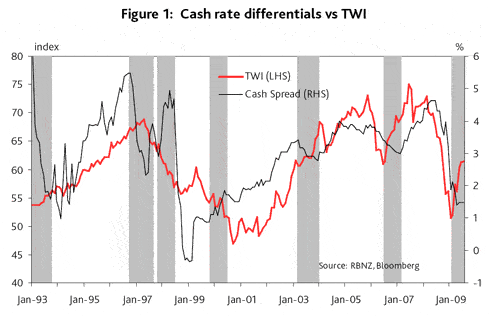
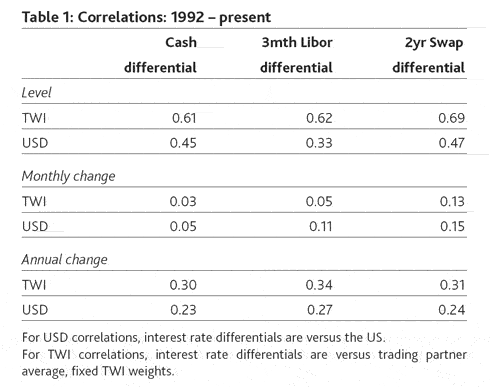
For example, if global risk appetite changes dramatically (e.g., during the Asian crisis, the bursting of the tech bubble, the sub-prime crisis), then the currency will tend to drop almost regardless of where interest rates are set. Equally when appetite for risk is back on the table, commodity prices tend to rise (as is occurring now) and so too does the currency. In a similar vein, NZ's 2 year interest rate differential tends to move in advance of the cash differential as markets anticipate future monetary policy. Occasionally, the differentials can move in opposite directions if the markets take a different view to the central bank, which will ultimately be reconciled. Correlations The correlation between the level of interest rate differentials and the currency is high (refer Table 1) reflecting that they tend to move in a similar direction over a number of years, in tune with the broad economic cycle. However, the correlation of the monthly change in both is only very weakly positive. The correlation is weakest for the cash rate differential, and gets stronger as the interest term lengthens. The correlation on an annual basis is far stronger. But as highlighted in Figure 1, there are significant episodes where the correlations turn negative. Regardless, it is necessary to note that correlation does not mean causation. For example, if commodity prices (or migration, or economic activity etc) are stronger, the currency is likely to be headed higher. Inflation pressures are also likely to be rising, encouraging higher interest rates. Interest rates and the currency may be moving in the same direction, but not directly causing each other to do so. Equally, causation does not mean correlation. Interest rate differentials could be pushing the currency in a particular direction, but being swamped by movements in other variables.
The currency is where it is It is useful to keep in mind that the currency is always where it is for a reason. We struggle to say whether the NZ currency is either under or overvalued at present. On a trade weighted basis (TWI) the currency is currently 62.2. Its average since 1985 has been 60.8 (and 61.6 since 1995). It is very close to its average level even though NZ's terms of trade (pre the big August Fonterra auction) are 14% above their post-1995 average, and New Zealand's economy has come through the global downturn better than most. Against the AUD, the NZD is virtually bang on our estimate of fair value. If the global financial crisis entered a second phase, then the NZD would undoubtedly be sold aggressively. This in itself would be bad for exporters. The currency may well be telling us something. If the expected conditions that it is based on prove to be false, it will unwind of its own accord. Imbalances A big part of the desire for a lower currency is to correct New Zealand's structural imbalances (i.e., heavy reliance on foreigners' savings, and growth dominated by leveraged consumption at the expense of exports). However, currencies are two-way streets. Not every country in the world can simultaneously devalue their way to competitiveness. As we note above, NZ has come through this financial crisis in better shape than many. And the markets are currently judging that NZ's challenges are less than those of the US. On the imbalances issue, we have strong affinity with comments made by Dr Alan Bollard in his recent speech simply titled "Economic Recovery". We repeat some of those below: "Sustainable recovery, with rebalancing in demand and the economy's productive base, is mostly a microeconomic matter. This means households, firms, banks and investors making the right decisions about where to allocate land, labour, capital and funding. The Reserve Bank's role in this is essentially facilitative." "Our status as a deficit country with a particularly large net foreign liability position means that, more than for most other countries, our recovery depends on a sustained pickup in net exports." "A clear risk beyond near-term recovery is that households resume their "˜borrow and spend' habits before bringing their debt levels back to more prudent levels. A premature resumption of strong growth in household spending could be triggered, for example, by renewed moderate house price inflation. This needs to be avoided." "The onus on us is even greater to shift domestic savings behaviour in the right direction." Cashing in To us, lower interest rates would most likely exacerbate imbalances in the economy "“ not ameliorate them. New Zealand's current account deficit reflects a dearth of domestic saving, "˜excessive' housing investment, and a less than spectacular net export position. Lower interest rates would likely lower domestic savings, lift consumption, and raise investment (at least in the short term) and increase imports. The effect on exports is ambiguous. Given the low starting point for the OCR (2.5%) and the nature of the economic recovery unfolding (higher net migration, increased residential construction, higher house prices, and consequently a potentially reinvigorated consumer), we think lower interest rates would fuel those sources of economic growth and potentially lead to a higher "“ not lower "“ currency. To the extent that monetary policy can affect imbalances, it should focus on those aspects (i.e., domestic spending) that it can most influence. The lessons of 2003 are fresh in our mind.

We welcome your help to improve our coverage of this issue. Any examples or experiences to relate? Any links to other news, data or research to shed more light on this? Any insight or views on what might happen next or what should happen next? Any errors to correct?

We welcome your comments below. If you are not already registered, please register to comment in the box on the right or click on the "'Register" link at the bottom of the comments. Remember we welcome robust, respectful and insightful debate. We don't welcome abusive or defamatory comments and will de-register those repeatedly making these comments.

An interesting article, and one

An interesting article, and one that suggests that interest rates are not the best tool to correct the imbalances in NZ's economy. Policy measures to reduce 'investment' in housing (such as the proposed capital gains tax) would be more effective.

Yes, interesting isn't it. How

Yes, interesting isn't it. How can we possibly have high savings rates without high interest rates as an incentive?

House prices are high because of low real interest rates over long periods.

A well intentioned policy producing the opposite result to that intended.

The article is correct in

The article is correct in that interest rate (esp OCR) is not the driver of exchange rate outcome, esp for Kiwis. We are just too small in the total currency market to have much impact or even be noticed.

Carry trades operators don't look at OCR in their financing, as the article said, it more of the medium term that determine carry trade outlook. Right now we are cash short and debt long and it seems we are heading more that way than the reverse. A lower OCR may just encourage borrowers to feel even more confident that interest rate may remain lower for longer and thus borrow even more. That's like drinking another bottle of scotch because the bar is not closing for another two hours...maybe even open 24/7?

I have always said we need Higher interest rate not lower to discourage unproductive investment and consumption. The tool to overcome our present predicament with our debt bingeing is to devalue our currency by market intervention by RBNZ.
Just because other central bankers are doing it doesn't mean we should not (is it ideological purity?) in fact the point that everybody is doing it shows we are the "dummy" left standing ?

I have a nagging suspicion that there is something else holding back the hand of RBNZ in the devalueation strategy...is it because a large number of our companies are so loaded in foreign currency debts that a devalueation will prove terminal for them?
Anyone still remember the F&P foreign loan debacle ??

A few weeks ago I

A few weeks ago I made an offhand suggestion that Interest should be neither taxable as income nor deductable for expenses.
There was very little comment about the idea but it got me thinking about the idea.
The problem is that under the current tax system, tax deductable interest can be converted in to tax free capital gains. This gives advantages in to high gearing and investing in non productive areas.
There are advocates on this blog that a CGT is the solution. I think CGT has problems with administration which becomes gravy train for lawyers and accountants and may not result in the desired effects (see OZ).

My suggestion is to turn the problem around, don't tax gains but increase the costs.
Make all interest expenses non tax deductable.

Some of the advantages as I see it:
Decreased borrowings will result because the benefits of gearing up will reduce. A rental property will make a taxable income regardless to whether it is funded by equity or debt. LEQC's will have no tax benefits. There will still be capital gains but it will be from equity funding not from converting tax deductable interest in to tax free capital gains
Easy to administer: It's like GST, the receivers will effectively audit the payers. It will be easy to track if tax free income has become tax deductable expense.
Increase equity in business.
Increase savings.
Shouldn't affect tax revenue. Losses from interest income will be made up from reduced deductions ie higher taxable profits. Tax will be paid each year, not at some time in the future as under CGT. It will put a stop to some the "˜funding' that goes on with subsidiaries of non NZ companies, where there is very little equity (or even negative equity) and lots of debt funding which makes the subsidiary not make a taxable profit in NZ.
It effectively increases the capital hurdle rate which means only the better projects will be funded. Equity and Debt will have similar after tax cost.
It should unwind some of the more exotic structure that have put in place to convert interest to capital gains. Ie what the banks have been up to with their fees on low interest loans.
I would welcome some discussion over this idea. Is it a goer? What problems have I missed?

Would it not deter start

Would it not deter start up businesses? Cost of capital in the embrionic years being a major cost that can be stored and offset against future revenue?

What an excellent idea NevilleWC,

What an excellent idea NevilleWC, get in touch with Bill English!
Cheers!

George If a start up

George
If a start up business is only viable using the benefit of the tax deduction of on interest but isn't viable using equity, is it worth starting it up?
The other side is that there is a bias under the present system to use debt rather than equity which greatly increases the risk of failure. Paying that interest kills the cashflow but equity investors (should) look for longer term benefits.

Well, NevilleWC, so long as

Well, NevilleWC, so long as you want live in a country where the biggest business is the corner dairy, fine.

In the meantime, I'll put the notion of non-deductibilty of interest where it belongs: the loony bin. Seriously, think of our biggest businesses, what one is left if you don't allow the deductibility of interest? Or to rephrase, which one wouldn't be broke after paying what in some instances be 100% tax rates.

Next time you drive through your towns industrial park, look around you, probably 99% of those businesses wouldn't be there anymore.

Why don't we just slash the size of the State so we can reduce all taxes, rather than ideas such as this, or equally offensive, CGT's.

I know, I know, I'm just preaching to the free of mind, which is possibly two of us on here.

Um, Bryan, I can't edit

Um, Bryan, I can't edit any of my typos in the above post, there doesn't seem to be an edit function anymore at all?

Mark Your assumption is that

Mark
Your assumption is that without interest being tax deductable no borrowing would take place. So why do companies raise equity as dividends aren't deductable?
Most large companies work on Income before Interest and Tax and see debt as a different form of (usually cheaper) funding.
Small business use debt to expand because it retains shareholder control not just for the tax benefit.
At the moment because debt is 'cheaper' after tax than equity, companies load up on debt. An expanding company would bias to financing the expansion by equity. My suggestion would, after a period of time, change the balance. Savings supply would increase. Debt demand would decrease. Interest rates would decrease because both the supply would increase and as companies increased the equity ratio the risk premium in the interest rate would decrease. As savings increased more would be directed towards equity raisings rather than finance companies.
Debt has to non deductable to all borrowers or it will just be channelled thru deductable vehicles (like LEQC's).

This wouldn't wipe out all the profits. It would increase the taxable profit by the amount of the interest and decrease the after tax profit by 30% of the interest paid. What would happen is that the higher the gearing (and risk) the lower the profit after tax.

You mean LAQC's, I'm assuming..

You mean LAQC's, I'm assuming..

Okay, lets get away from big business. I have a set of financial statements on my desk, a medium sized business, not a dairy farm (and not my own): it has a tax loss from 2009 of $500,000, after deducting interest payments of $1 million: worryingly negative operational cashflows. It's called the recession, the debt was from buying expensive capital equipment.

You're saying we add the interest back and make them pay tax on $500,000, that is, give them a tax bill (Company) for $150,000.

So, they made a loss, they're bleeding cash, and you want them to pay $150,000 tax so Bill English can upgrade the mansion. They're either going to have to, ironically in this instance, borrow more, yes, more debt, or go bust.

So, what has been achieved?

I will look into this,

I will look into this, there is supposed to be an edit function. I will be reviewing the feedback (mostly negative at this stage) tomorrow and making a decision on whether this style stays or goes.

“The onus on us is

"The onus on us is even greater to shift domestic savings behaviour in the right direction."

This is a quote from the article by the RB Governor. So why does he have the OCR and hence savings rates at record low levels and promise to keep them low until the end of 2010. Does Bollard really believe that low interest rates encourage saving?

I actually quite like it,

I actually quite like it, as it allows a 'theme' within a thread to be consistently held together.

But no edit, no good.

By the way, Neville, this

By the way, Neville, this is an example of the law of unexpected consequences. Government intrudes into the market to change investor/business behaviour away from borrowing debt, the result of which is that business has to take on more debt in order to pay the greater tax bills.

The better solution is to get the government out of the damned business: stop creating a mountain of procedure and red tape for business to stumble through, stop taxing business, just leave business, and all of us, alone.

If that was at 10%

If that was at 10% interest, that would be a $10m of debt.
If it had been funded by equity the profit would be $350,000 ($0.5m less tax)(a 3.5% return but almost as good as you get at the bank) and the co would be on going.
Not great for the shareholders but still solvent.
I don't know what the gearing is (or its cashflow) but to survive someone needs to put in $500k. Will the shareholders, will it be the bank? Will the shareholders equity survive?
I don't think the deferred tax loss is going to save it!

How many have been sucked in by being told "just borrow it, the interest tax deductable"

NevilleWC Really interesting idea cheers

NevilleWC
Really interesting idea
cheers
Bernard

You are missing one further

You are missing one further thing, Neville.

A small to medium szied business is a hell of a hard to fund for start up, especially via outside equity (and costly, given the securities legislation).

Debt/Banks allow many businesses to get off the ground, that simply would not, otherwise, were they to have to go to the public to get 'Unknown Widget' co off the ground. While a bank can easily take security over the equity such a new business owner has built up, pre-setup, in private or other assets, the process of issuing prospectuses, etc is complicated and, again, I suggest most new businesses would never get off the ground.

The problem is because the

The problem is because the tax system makes saving and borrowing asymetrical.
Savers lose up to 39% of the value while borrowers can get full value as a deduction.
What would happen if buyer and a seller of a good agreed on a price of $10 as a fair trade but then the seller found they would only get $6.10. Would the seller be in a rush to produce more?
See my post above for a possible solution.

Preview then edit. Can edit

Preview then edit.
Can edit after posting (say it!)

B** Should read 'Can't edit

B**
Should read 'Can't edit after posting'

How many boxes within a

How many boxes within a box can we get ? This is like those Russian dolls that you open up, and keep finding another, smaller one inside. Anyone care to comment ?

I am aware of these

I am aware of these problems but some of them are because NZers and their advisers seem to have no grasp on evaluating risk.
Bank debt is an easy way to get off the ground but has a high risk of disappearing. Bankers are so friendly until they want 'their' money back.
Equity is harder to obtain but gives a better risk of survival.
Shares are thought of as risky but lending to 'Property companys' are low risk!
There is also the founder problem, where the founder would prefer 100% of nothing than 50% of something, so no new shareholders are allowed in (or the terms are so onerous that no funds can be raised)

Why were financial advisers pushing money in to Bridgecorp rather than startups? The investors would have got more money back.

Do we need short form prospectuses or standard prospectuses like standard real estate agreements?

I think there are two

I think there are two important factors missing from the report:

1. "Quantative easing" - one would expect currencies undergoing "printing" to devalue against those that are not.

2. The Forex market is very large, and is mainly speculative. Currency movements are not necessarily rational.

I am by nature against interference in a free market, but it seems to me that some influence which encourages productive investment and deters non-productive 'investment' might be a good idea.

I wonder for instance whether borrowing by exporters should be subsidised by a tax on borrowing for mortgages, making the mortgage rate higher, and the cost for exporters lower.

This will no doubt bring howls from house 'owners' and cheers from the manufacturers.

I say this knowing that the only real solution is a money system free of the "money masters".

Hot off the press from

Hot off the press from NZMEA.

Westpac economists well off the mark

Westpac economists have claimed that lowering the Official Cash Rate (OCR) could cause the dollar to rise further. The New Zealand Manufacturers and Exporters Association (NZMEA) say that this is unlikely as it is the differential between official interest rates here and those of Europe and the United States that are behind the strength of the dollar. Therefore, if this margin got smaller the pressure on our currency would fall.

NZMEA Chief Executive John Walley says, "The other affects mentioned, such as an increase in house prices, are longer term issues of a low OCR, they are likely to have little impact on the dollar in the short-term and of course they demonstrate the need for credit volume controls to supplement the OCR."

"The key issue is the spread between our base rate and those of the other major western economies. This makes New Zealand rates really attractive. While a lower OCR may not cause a significant fall in the currency, it would at least provide downward pressure. Equally, a demonstration that the Reserve Bank is ready to do more than talk would be another step in the right direction," says Mr. Walley.

"As the economists noted, the necessary rebalancing of the economy has been inhibited by the high dollar and an export led recovery is unlikely while it persists at these levels."

"It is a statement of the obvious to say "˜the currency is always where it is for a reason', what matters is whether the reasons are good ones, whether the consequences are acceptable, and whether we going to try to change it."

"Our tradeable sector has now been in a recession for well over five years. We need to be doing more to put this right."

The tax rate would be

The tax rate would be dynamic.
As the assessable income would be higher, a lower rate would bring in the same amount of tax. Lower geared would gain, high geared lose.

It's of no consequence what

It's of no consequence what Wooly Bully Bolly does, the banks aren't listening. they can't access funds any cheaper than they currently are. And Uncle Sam is struggling to unload bond issuances. buying them back themselves, it seems.........A-hem , yessssssssssssss !

I quite like the way

I quite like the way 'themes' are held together.
Some sites allow you to expand / condense the themes.
Can this be allowed with this software?
Edit a problem, just have to take more time over the preview!

Mark H I'm on your

Mark H
I'm on your side, less Govt, less distortions.
I was proposing a different solution to a CGT.
No income tax and no deductions for interest will change traditional relationships but that is the point. We can't go on using our sparse savings on generating tax free capital gains. Borrowing overseas for non productive investments in NZ.
Some of the problems you point out wouldn't be directly affected by my proposal but if less saving were directed to housing and more to productive investment, would that offset the costs? Interest rates could stay lower and that could stablise the exchange rate.
It needs an economist and other technics to analyse the gains and losses and I haven't got all the skills.