
The comment stream

Join the Interest community to be a registered commenter so you can:
- Edit your comments
- Avoid the CAPTCHA
- Vote on comments
Register Here

Already registered? log back in here ..

Forgotten your password? No problem! Click here

Finance sector jobs

Senior Liability Underwriting Manager
Lead from the front utilising your strategic, technical and leadership qualities within th...more
New Zealand
Senior Liability Product Underwriter - Product Management
Lead from the front utilising your technical expertise in this highly attractive senior li...more
New Zealand
High Performing Senior Liability UnderwriterHigh Performing Senior Liability Underwriter
Customer focus, high performance, exceeding client expectations and achieving profitable g...more
New Zealand
Head of Retail Credit -Wellington, NZ
Key leadership position in the bank. Be a part of one of the fastest growing banks in New ...more
New Zealand
efinancialcareers.com

Reader poll

Should you fix your mortgage now or stay floating?

Choices

Bill English points to massive structural deficits; says 'time for searching questions'

Posted in News

By Bernard Hickey Finance Minister Bill English has pointed to a massive structural deficit in the government's finances and has called for a debate that asks some 'searching questions' about how to reform the government and the economy to improve New Zealand's growth rates. English told interest.co.nz in an interview that Treasury and the government were now coming to grips with the depth of the challenge in the decade ahead, given slow global economic growth, New Zealand's structural problems and the prospect of years of borrowing and deficits. The 2009 budget had been written in a short period and had been designed to deal with the short term problems caused by the global financial crisis. Coming budgets would have to deal with the structural issues facing the economy, English said. "The harder we look at the way the world has changed, it's becoming increasingly clear that we won't have the same benign conditions we've had in recent years, and we won't have them for a long time," Finance Minister Bill English told interest.co.nz in a phone interview. "When you look at New Zealand's imbalances, they are larger and more embedded than we realised. We are going to have to ask some searching questions about what's required to achieve our ambitions of closing the gap with Australia," English said.
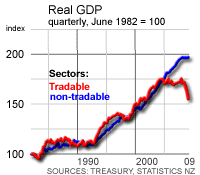
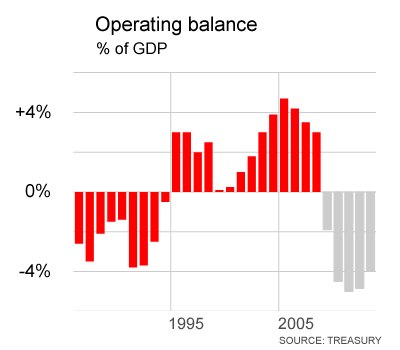
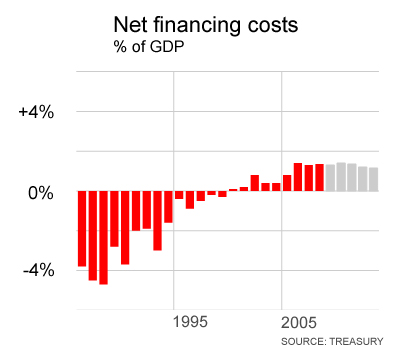
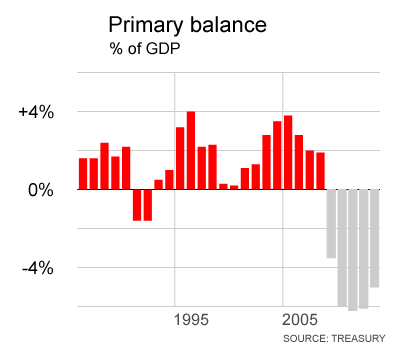
English referred to a measure of the government's structural position called the 'Primary Balance' , which extracted financing costs of debt and income from state owned assets and funds from the budget position to get a clearer picture of the government's core spending and revenues. English presented the measure to the Finance and Expenditure Committee (FEC) this week along with an analysis showing that output from the traded sector of the economy (exporters and companies competing with importers) stalled around 2004 and was now falling. Meanwhile, the non-tradeable sector of the economy (health, education, social services, electricity, construction, housing, communications and government) had continued growing output strongly. This raised questions about whether the non-competitive and state-owned parts of the economy had grown at the expense of the export earning sectors, meaning the current account deficit had deteriorated sharply. The combination of the two analyses presented a sobering and unsustainable outlook with the non-tradeable sector continuing to 'monster' the tradeable sector, creating twin current account and budget deficits that would suppress growth for years to come. Essentially, the wealth redistribution and consumption parts of the economy were overwhelming the wealth creation and the production parts of the economy. The Primary Balance analysis showed the budget had been in deficit for only two years in the early 1990s once debt servicing costs were extracted. Since then the budget had been a structural surplus position up until 2009. The outlook was for structural deficits of 5% or more of GDP from 2010 onwards, which was far bigger than the deficits in 1991 and 1992 that prompted the 'Mother of all Budgets' and significant government reform. This analysis suggested that the scale of the budget deficit problem confronting the government is twice as big as that facing Ruth Richardson when she took drastic action in the "mother of all budgets" in 1991 to reduce entitlements and bring in asset sales to rectify the problem. However, once the tough medicine was taken, the economy and the government's fiscal position improved fast and significantly. This time the economy also faces the tradeables and non-tradeables imbalance that is making it very difficult to reduce New Zealand's chronic current account deficits. English pointed to the comments in a speech by Treasury Secretary John Whitehead as the beginning for a debate about structural reform that needed to be had. Here's what Whitehead said in the speech.
Without changes to the tax system, there is a real risk that the government's revenue base will be unsustainable in the medium term, given growing competition for production factors and an aging population. More broadly, the tax system as it is currently structured does not seem fit for growth. The mobility of production factors "“ especially skills and capital "“ is of particular relevance to New Zealand's tax system and economy. New Zealand has one of the most internationally mobile labour forces in the OECD, and we have very high demand for inward investment. Our tax system should be encouraging investment to keep coming here and skilled people to keep staying here. Unfortunately that doesn't appear to be the case at the moment. A key priority has to be reducing effective marginal tax rates and increasing the rewards for effort. There is a growing view that the high mobility of our skills base means high personal income taxes are especially harmful for New Zealand's growth and productivity. There is also growing evidence that productivity is being held back by high corporate tax rates. New Zealand's company tax rates are at the upper end of the scale by the standards of the OECD and other open, small economies. With average OECD rates trending down, keeping our corporate tax rates competitive will be a priority. The pressure on us will be even stronger if the review of Australia's tax system currently underway leads to further company tax cuts across the Tasman. Another major component of a tax reform strategy should be shifting investment incentives, by taxing returns to capital in a more even-handed way. And at the risk of being chased down by an angry crowd with pitchforks and flaming torches, yes this should include consideration of moving the boundaries to tax more capital gains "“ for example on investment property - and shifting more of the tax base towards consumption. I know there is a lot of passionate debate on this matter, but capital gains or property taxes would be beneficial for encouraging investment in productive activity. A more complete capital income tax base reduces the impact of tax distortions on investment decisions, thereby improving the allocation of capital in the economy. It also improves fairness, and provides revenues that can be used to reduce overall income tax rates. Greater reliance on consumption tax "“ aligned with reduced income and corporate tax rates "“ should help strengthen incentives for savings. If we look at this at a high level, shifting from a system that relies heavily on income and corporate tax towards one that is weighted more towards taxing consumption "“ and bringing untaxed, or under-taxed, income-earning activity into the tax net "“ such a shift would better support higher productivity and growth. It would help address the sustainability challenges and tensions, where governments will increasingly grapple with competitive pressures to reduce taxes and demographic spending pressures to increase them. It would also help reduce our vulnerability to overseas events by reducing the pressure on the current account and thus external indebtedness. To be sure, such a shift would involve imposing challenges. But now, when hopefully we are at the bottom of the business cycle, is the most propitious time to make these changes.

Whitehead said earlier in the speech the economy needed to rebalance with less dependence on government spending.
A critical part of New Zealand's recovery programme will be bringing public accounts back into surplus as a matter of urgency. What is equally important is to ensure that over the coming years, our economy undergoes the adjustment and rebalancing it needs, with a strong focus on productivity and competitiveness. Now is the time to drive changes that will position New Zealand to come out of the recession stronger and better able to generate higher living standards.

Overcoming the hurdle of geography and lifting productivity are not impossible tasks. They can be done. But they require New Zealand to set and achieve some high standards. In short, if we are to improve our economic performance and living standards significantly, we need to have institutions and policies in place across a wide range of areas that are not just good, but up with the best in the world. Our judgement is that many of New Zealand's current policy settings will not deliver the performance we need. I don't have time today to discuss them all, but one area I should touch on very briefly is the public sector and its role in a growth strategy. Taking resources out of the private sector to fund public services can create value "“ it may come as a shock that not everybody in the Treasury believes in leaving everything to the market! But it does come at a cost, and this cost rises the more you take out. This means we should set a very high threshold for additional public spending, if we want to provide both social benefits and sustainable economic performance. Otherwise, poor value and excessive spending acts as a tax on the competitiveness of the tradeables sector. The first salient point from this work is that we have underestimated the importance of people flows for growth. New Zealand relies heavily on these flows, not just to meet our labour needs but also for the exchange of ideas and innovation. All of our population growth, and half of our employment growth, between 1996 and 2006 was due to inward migration. And we have one of the highest rates of foreign-born residents in the OECD "“ almost one in four people living in New Zealand. The Treasury thinks there is scope to make much more of the advantages that can come from the movement of people both in and out of New Zealand. We could look at ways of shifting incentives, so that people sometimes study overseas and then come home, rather than the other way around. We could also enhance knowledge flows and innovation through stronger student and researcher exchanges. And we could do more to better integrate migrants, so that we can make the most of the skills, knowledge and connections they bring with them. The other pertinent finding from our work reinforces the point I made earlier: we think of New Zealand as an open country, but in some indicators we still lag other countries. Effective changes that could be put on the table include reducing the costs of Customs processes, removing all remaining tariffs, and lowering or even removing investment screening on all but the most sensitive of items. None of these on its own is a big hit, but they would add to the perception abroad that New Zealand is open for business. Never underestimate the importance of the signals we give.

Neville Bennett's article on the merits of a land tax, as used in Hong Kong, is also worth a read and generated significant comments when it was published on May 22 before the budget.

We welcome your help to improve our coverage of this issue. Any examples or experiences to relate? Any links to other news, data or research to shed more light on this? Any insight or views on what might happen next or what should happen next? Any errors to correct?

We welcome your comments below. If you are not already registered, please register to comment in the box on the right or click on the "'Register" link at the bottom of the comments. Remember we welcome robust, respectful and insightful debate. We don't welcome abusive or defamatory comments and will de-register those repeatedly making these comments.

That's all well and good,

That's all well and good, but people outside Treasury and Government have been saying this for quite some time. The searching questions should call to account all Government spending. What should the Government be doing, and what should it not be doing? Define the basic premise and start from there, perhaps. I can think of a whole range of useless policy advice bodies and departments that could just be axed and nobody would notice. The other facet is "How much of GDP should be taken up by the Government?". Define the basic level beyond which we will not allow Government to grow (and for a growing economy, it should be about half the level we have now) and make sure Government can't get beyond that. Put it in the Constitution. Oh, wait...

On the other hand, that might be too much to take on all at once. That being the case, I would take a hard second look at the obvious targets for existing spending - working for families, for example, should just be scrapped. There are a whole range of other things where "entitlements" have become entrenched and grown way beyond their original intentions to become an endless money sink. Welfare should be a safety net, not a chosen, desired way of life. We need another Ruth Richardson.

<i>working for families, for example,

working for families, for example, should just be scrapped. There are a whole range of other things where "entitlements" have become entrenched and grown way beyond their original intentions to become an endless money sink. Welfare should be a safety net, not a chosen, desired way of life. We need another Ruth Richardson.

YES YES YES.

Every time I think on the rort that is Working for Familes, it just makes me furious. And for the record, Richardson and Douglas went nowhere near far enough.

Well English, like Treasury, and

Well English, like Treasury, and lots of others including yourself have had a long time to finally figure out there is a problem. Had you all been running a manufacturing, farming or similar business you would have been up with the rest of us years ago.
And just in case you need reminding of the lousy performance of previous govt.'s and to remove any excuse English has,(after all he was opposition spokesman for finance for how long and he goes into to Govt. and hasn't a clue what needs doing and how to do it.), here is something to think about.
Now i know lots are going to put up all sorts of bullshit arguments but the truth is here and its the reason we are so mediocre. We have mediocre politicians who make mediocre policy.

No Second Class Citizens
Friday, 19 June 2009, 12:33 pm
Speech: ACT New Zealand

No Second Class Citizens

Speech to Window and Glass Industry Conference, Rotorua

by Hon Sir Roger Douglas, ACT New Zealand

Friday, 19 June 2009

Many think that ACT New Zealand is a party for big business. It is a real tragedy that ACT suffers from this stereotype. It is a tragedy because the profile is so out of whack with the reality.

I have spent most of my adult life in the Labour Party. For 21 years I represented one of the poorest electorates in New Zealand.

My brother was a Labour Member of Parliament.
My father was a Labour Member of Parliament.
My grandfather was a Labour Member of Parliament.

The goals I have today are the same as those I had when I was in Labour. I am just as concerned today as I was then about poverty. I am just as concerned today as I was then about opportunity. I am just as concerned today as I was then about second class citizens.

But where I have changed is what I see as the cause of second class citizenship.

Let's look at the facts.

For almost 80 years, New Zealanders have experimented with the welfare state. What have the consequences been?
Do all children receive decent education? No.

Do most people retire with enough money to live in comfort? No.

Does everyone receive health treatment when they need it? No.

Have we eradicated poverty? No.

On the very goals that the welfare state has sought to achieve, no one could genuinely argue that it has succeeded. Even the modern day proponents of the welfare state, be they in National, the Greens, or Labour, all know it has failed.

But they think they have the solution. They think the solution is more money. I have never heard a politician from those parties come across a problem that they believe could not be solved with just more money.

That is why, regardless of who has been in power, the budgets for welfare, education, and health have all shown an almost inexorable growth.

Two Classes of Citizenship

New Zealand has two classes of citizens. And we have two classes not because the Government isn't doing enough for the poor, but because what the Government does for the poor denies them choices, destroys the incentives they have to get ahead, and subjects them to political abuse.

In New Zealand, we have the haves and the have nots.

The haves are the people who do not live from payday to payday, but earn enough to set some aside "“ to save, or buy healthcare when they need it, or buy education for their kids. The have nots are those who scrape by, and rely on the state for all their social services.

In New Zealand, we have the privileged and the unprivileged.

The privileged are those who get others to pay for their whims and fancies. The unprivileged are those who face the vicissitudes of the market economy, while being taxed to pay, for example, for the tertiary education of the children of the affluent.

In New Zealand, we have the fortunate and the unfortunate.

The fortunate are those born in a school zone which happens to have a good school. The unfortunate are those born in an area with a poor local school. Zoning locks them in, and if they want to escape, they need to pay twice. They either need to move house, or they need to go private. Only the wealthy can afford to do that.

We have those who receive handouts, and those who pay for the handouts.

And the tragedy is that handouts are often not delivered to those who need them. Working for Families delivers money to many who are comparatively well off. Government subsidies for business force relatively poorer taxpayers to pay for those lucky enough to get a Government grant.

I hold the same ideals I always have. In fact, every party in Parliament claims to share essentially the same goals when it comes to welfare. National, Labour, and the Greens are all wedded to the current system. Only ACT has an alternative to the failing status quo.

The problem with the status quo is that it all about power. Politicians control who gets an operation, where kids get educated, and how much superannuation you receive.

I can share the goal of equal opportunity for all, and have a different way of achieving it.

There are few things we have got as backward as we have with the way we try to help Maori.

There is no doubt that Maori suffer disproportionately from poverty. But if we continue to encourage Maori to look to the past, we will continue to create the system that locks them into poverty. Only if we are willing to look forward and devolve control of the money to individuals, will we deliver solutions to the problems they face.

It is a great irony that the same kind of paternalism that once stripped Maori of individual autonomy and self-determination is today seen as the solution to the problem of poverty.

We have become a nation rife with bureaucracy, recklessly determined to re-use the ideas that have failed to solve poverty for over 80 years.

But if we always do what we've always done, then we'll always get what we've always got. What 80 years of political control has achieved is a larger welfare budget, more people on welfare, and barriers for those at the bottom to actually get ahead.

Health

55 percent of your and every one else's personal tax goes towards healthcare. Saying 55 percent can hide what this means. If you earn minimum wage, you will pay about $2500 every year for healthcare. If you earn the average wage, you will pay over $6000 for healthcare.

People say that we have a free healthcare system. To me, it seems that free healthcare has never been so expensive!
Healthcare is not free. It costs you.

And when healthcare costs the average person $6,000 every year, you'd hope that it really delivered.

And yet it doesn't. Despite the enormous cost, we ration healthcare. People who are sick get placed on waiting list. On that waiting list people get worse, not better. Some die.

And the suffering that takes place on health waiting lists are rationalised away, as if the goal of equality justifies denying healthcare to people who desperately need it.

If the health system treated every one like this, then at least it would treat us all equally. But the most pernicious effect of socialised medicine is how it creates second class citizens.

The first way it does this is through a bizarre mixture of subsidies. Some medicines are fully subsidised, some are partially subsidised, and others are not subsidised at all. Decisions over what medicines you can take are actually determined not by the patient, not by the doctor, but by a bureaucrat in Wellington.

The second way it creates second class citizens is through the way pressure can be applied to get treatments performed. Doctors, patients, politicians, can all pressure the system to get certain operations performed at the expense of others.
If you can get your story on Campbell Live you can be sure you'll get your treatment.

If you can form a pressure group to get Herceptin subsidised, you'll get your treatment. But in socialised health, your treatment comes at the expense of someone else's. And because the affluent tend to be the more politically connected, the more influential, the more organised, treatments for the rich come at the expense of the poor.

The third way it creates second class citizens is the fact that wealthy people can afford to pay twice. They can afford to pay tax for healthcare, and then buy health insurance on top.

The very people who are denied this opportunity are the very people that universal healthcare was meant to help. While the poor die on waiting lists, the rich pop down to the private hospital. No one would seriously contend that the system treats people equally.

And the solution to this problem is the same kind of pathetic snake oil we hear from all the other parties in Parliament. All the problems could be solved if only there was more money.

When will we wake up to the lie?

Under Labour, health spending increased in real terms by 50 percent. We still have waiting lists. We still have a system that creates second class citizens.

Despite the huge increases of resources at their disposal, the productivity of doctors actually reduced by 15 percent. Nurse productivity dropped 11 percent. Overall, the drop was only eight percent.

Why eight percent? Because the productivity of cleaning and orderly staff surged. And those services were outsourced to the private market. This just gives a hint of the kind of benefits that could be achieved if we dropped the pretence and lived up the reality: socialised healthcare has failed.

If we simply gave the person on the average wage the $6,000 back they currently pay, this would enable them to buy catastrophic insurance, put money aside for their healthcare in retirement, and pay for their day to day healthcare needs such as doctor visits.

Superannuation

Superannuation today locks you into poverty in your retirement. And the low levels of superannuation occur despite the high cost to taxpayers.

Superannuation costs you one third of your personal tax. If you earn the average wage, that's $4000 a year.
Superannuation is not free. It costs you.

But, of course, our super scheme is designed so that people pay today for the retirement of their parents. If we simply adjusted the system so that that money went to pay for your own retirement, most would have a cushy retirement.

If that money was put in the bank, earning seven percent nominal interest (five percent real), then the average worker would retire with $1,804,300 in the bank.

It would be like you'd just won lotto and then retired.

And let's say you put that money in the bank at one percent interest "“ a pathetic one percent. The interest on that money would return more to you than current superannuation does.

A single pensioner currently gets $311 a week, while a married pensioner gets $239.

With just one percent interest on the capital, they'd earn $34

So the cost of Government superannuation, in old age, is around $1000 a week.

It's costing you.

The present system creates second class citizens.

Some go through their lives, scraping by, paying tax, but not having enough left to save. When they retire, they'll get whatever the politicians of the day decide they deserve.

But the wealthy, well, they will have saved for their retirement. They'll be able to live in comfort, doing the things that most want to use their retirement for.

The raw deal most get from Superannuation is only going to get worse. The flight of New Zealand's most skilled, combined with the baby boom, will see increasing burdens shifted to the working poor. They will pay high taxes and receive a stingy pension.

But while changing the system would help us all, it would harm some politicians in Labour and National who rely on promises they cannot deliver to win votes. By making people self-reliant, they would have to change strategy from making increasing numbers of people recipients of welfare.

The power that gives them is something they will be unwilling to give up, unless we force their hand.

Education

Apparently we have a free education system.

It is not free.

GST receipts cover the cost of education. In other words, 12.5 percent of everything you and every one else buys only just covers the cost of education.

Most people know ACT's education policy. We call it school vouchers, or tax credits that effectively ensure education money follows the child.

The problem with our education system is a lack of choice. But there is one group of people who have choice in New Zealand.
If you want to send your child to the school of your choice, you have to move house, or pay twice "“ once through taxes, and once through private tuition fees.

The very people who have choice are the wealthy. They're the people who can move house for the school zone, or can pay twice to privately education their child.

The very people who are ripped off are the poor. News reports recently indicated that police were now stationed in 10 South Auckland schools, and that this program was being expanded to the Bay of Plenty.

The real tragedy is that there will be kids in those schools whose parents desperately want them to escape, but they are not allowed. The Government won't let them.

The Government continues to force the least well off into the worst schools, and they have managed to convince most that they do it in the name of equality.

They express concern that 30 percent of kids leave schools with poor educations, unable to read or write adequately. But when you look at schools in poor areas, this percentage is much higher. They get the rawest deal.

When it comes to enabling people to improve their lot, education is one of the best ways they can do so. And yet the very people who most need this opportunity are denied it by the Government.

But on the tertiary level, the current system creates second class citizens in an even more concerning way. At least, when it comes to most education, the rich are forced to pay twice for quality.

When it comes to tertiary education, the poor are forced to pay for the education of the wealthy. Most people receiving the costly tertiary education courses are those from the middle and upper classes.

Those who leave school and get a job pay to educate those who leave school and get a degree. The poor subsidise the wealthy.
And then many of the wealthy use their human capital in jobs overseas, leaving others to pick up the bill for all the other failing aspects of the welfare state.

25 percent of skilled workers have now fled the high taxes of New Zealand for better prospects off shore. We will not attract them back with larger welfare budgets and higher taxation.

Conclusion

When you look not at the goals of the welfare state, but its actual performance, the results are depressing.
In the last 80 years we have grown far wealthier than we once were. Yet today, there are more who receive welfare than ever before.

I consider it a great misfortune that Michael Joseph Savage did not live to see the effects of his vision.
If he did, I am sure that he, like me, would realise the error of our ways.

We have created a system that gives options to those who can afford them, while denying choices to those who most desperately need them.

We have created a system that taxes and regulates opportunities for the poor out of existence, and destines them to poverty.
We have created a system that creates two classes of citizens.

And at the very same time, the solutions put forth by the other parties in Parliament are more of the same. More health spending, more education spending, higher taxes on the wealthy. Only the ACT Party stands against the philosophy that is creating two classes of citizens.

When will we wake up? On its own terms, the welfare state has failed.

Well, time will tell if

Well, time will tell if this govt has the balls to make the necessary calls.
I agree Working for Families has to go, but somehow I doubt National has the balls to remove it. Politically it would cost them quite significantly I would imagine.
But it will cost the country a lot more if they don't.

So, Bernard, did Bill ring

So, Bernard, did Bill ring you?

15% GST here we come.

I agree about Working for

I agree about Working for Families. The problem is, Labour cunningly made middle class welfare a central policy plank, & it has now of course become ingrained in our thinking. Tens of thousands of middle NZ families will now rely on it to supplement their income. The big dare that Labour handed to National was to remove this clearly centrist benefit, & be tainted with the brush of Ruth Richardson etc. Well, the chop will have to come sooner or later, & National should really have seized it early in its honeymoon period, with the hope it might be forgotten by the next election.

PS to Robert, if you

PS to Robert, if you have long speeches by Douglas etc, how about just putting a link in, & have a concise narrative around it? Clutters things up otherwise, & takes away the flow of the thread.....

Philly - exactly. Maybe Big

Philly - exactly.
Maybe Big Bill is reading in here, wanting to see what Bernard published after his interview? (I'm guessing politicians don't read their press but who knows)
Bill - cut the crap and make some cuts before this country really goes to the dogs
As Philly says do it early in your term

Philly - is it MMP,

Philly - is it MMP, system etc? Is it the three years? Or what?

Have changed my name's website link - an interesting quizz for, well you'll see. Flick the link to people who you think might care.

Cheers, Les.

Just one, but important example.

Just one, but important example.
For years we have a monstrous Real Estate industry, which inflated prices and made young talented, educated and skilful Kiwis leaving the country.
We urgently need actions to bring them home.
With the help of the government/ private industries we must develop/ encourage quality industries/ businesses, which create real wealth and make NZ in general and housing affordable.

We need to find a

We need to find a way to tax property more, as we have to find this tax from somewhere. It is becuase property has been such a good investment, due to the lack of taxes on it, that has pushed property prices to unsustainable levels.

You guys are still thinking

You guys are still thinking inside the square, fairly and squarely where they want you.
This retoric is softening us up for the "we said we wouldn't do it, but we have no choice. We will have to sell strategic assets to address our hopeless Current Account Deficit or we will face sanctions. We are sorry but its all the other mobs fault. We are really sorry"
Come on guys, should be used to it by now, its almost Kiwi culture. Global culture actually.
I was going to make a fleeting comment but ended up doing a background on every advisor appointed by National and quess what, most of them were the very same people involved in the last firesale liquidation of assets to pay down debt in 1984 or belong to other organisations that want to throw the gates open and put the draw bridge down. I know some here think we could fit the entire population of the world in our space, but where are we going to get the fresh water, what are we going to import it with?
Full picture here;
http://socialcreditorbust.blog.co.nz/john%20key%20brings%20back%20roger%20douglas's%20band%20of%20merry%20asset%20salesmen/

Mark - You claim Douglas and Richardson didn't go far enough last time, well you might just get your wish as all the very same people that mentored them are back in town and planning the very same game. Only I don't see you wanting to hang around with the social upheaval it will bring. Mind you, you sound like a Wild West type of guy.

Tomorrow's world is going to

Tomorrow's world is going to be very different from yesterday's. The nations that emerge from the recession first - and grow faster, will be the BRIC economies. Asia and South America are our future trading partners. The economies of tomorrow will become more regionally interconnected, so planning for an ANZAC dollar (or a goal of parity with the AUD) and a common market in Equities and Futures trading makes sense. The New Zealand and Australian banking sector's are one anyway, so that's a good start. The National Party should make balanced budgets an immediate goal.

Now for the difficult part.

Treaty Settlements
New Zealand Maori will become more predominent in the population growth. FAIR redress of grievances will be cheaper today than it will tomorrow; the time to settle is now. This includes a new constitution that entrenches the Treaty O Waitangi as a founding document. An investment in Maori will pay huge dividends because they will not break their ties with Aotearoa the same way pakeha do.

Dismantle the Welfare State
Government cannot afford to support those who choose not to work. For too many people, dependency on handouts has become a career choice that passes from generation to generation. Only those immigrants who choose citizenship should be eligible for superannuation or benefits.

Invest in Education
Instead of building new sports stadiums we should be building universities. Provide tax incentives to those companies that invest in education. Eliminate the government funding for courses that allows WINZ to fudge their numbers by transferring the unemployed off their rolls on to student benefits (this is a larger number than most realise). Students need to spend more time in the classroom; that means longer days and less holidays. Teachers should be paid on a par with policemen, but be restricted from collective bargaining.

Tax Reform
Is there any reason New Zealand cannot have a flat personal tax rate?

Are you lot serious? Do

Are you lot serious? Do you really expect English to sweap away the effluent of decades of govt splurging waste and stupid brainless thoughtless short term vote buying policy? Go back to sleep. As soon as 2011 arrives it will be "same again Bill" more dumb promises, more bullshit for the peasants another three years of waste and more bloody waste.

Wally: about the only sensible

Wally: about the only sensible and truth full post Ive seen. ie BE et al will want to be re-elected....

Matt in Auck: Key has a platform not to decimate....Im sure he recognises that dumping on the voter ie doing something he said he wouldnt do is a quick way to loosing 2011....so getting into power on one agenda but acting on a "secret" one is a quick way to political death IMHO.

To the ACT and Libertanz in here, you seem to dominate these discusions but dont forget that in the real world you are 3.4% of the voting population....

"The harder we look at the way the world has changed, it's becoming increasingly clear that we won't have the same benign conditions we've had in recent years, and we won't have them for a long time," Finance Minister Bill English told interest.co.nz

Never was a truer word spoken IMHO....

"an analysis showing that output from the traded sector of the economy (exporters and companies competing with importers) stalled around 2004 and was now falling.
Meanwhile, the non-tradeable sector of the economy (health, education, social services, electricity, construction, housing, communications and government) had continued growing output strongly."

1) What makes a country and its people rich are the exporters....what makes it poor are the importers....

2) The rich dont make a country rich unless its in exporter terms or productivity terms, many of the rich's endevours can be classed as just another tax scheme, this time a private one on other NZers....ie they make themselves rich but its just churn....

So, this quote is nonsense by itself,

"Unfortunately that doesn't appear to be the case at the moment. A key priority has to be reducing effective marginal tax rates and increasing the rewards for effort."

Reducing marginal tax rates on the churners achieves nothing, it just makes those few a bit richer at the expense of other NZers....what needs to be done is to make exporting easy and profitable...preferably noticably profitable...so tax breaks for the exporters, or some such action....

Yes the Govn looses a round of tax on these guys, but they will get more tax as its churned through the NZ economy as they get to multiple tax dip anyway....the important point is there is more real money here....

Stevel: 15% GST I see as hard to go through, however if GST a rise but tax cuts elsewhere is a good way to stimulate exporters (on the face of it I think it is?) then Im for it, So on the face of it rising GST is a tax on churn and importers, but exporters wouldnt pay GST on goods leaving NZ? if thats the case this strikes me as a good way to suppress one side of the balance in trade while stimualting the other...

GTG....

(got to go), will finish later

regards

But wait can't we get

But wait can't we get rich by creating a consumption based economy just like the USA.

Remember current account deficits don't matter I mean you guys are starting to sound like Winston Peters he was always going on about the current account deficit.

Working for Families. I have

Working for Families. I have a daughter-in-law who has been an at-home mum with young children. They are now all at school. I asked her last year if she was thinking about going back to the workforce now, & she said "no, I've worked it out & its financially not worth it, I would lose too much from Working for Families to make it at all attractive."

So there you have it. Encouraged to stay on middle class welfare. Using up non-existent taxpayer money. Not contributing to the workforce. Not building new skills or seniority that would help build a better future for her & her family. Talents wasted. Self-esteeem atrophying.

D'oh!!

I have the link sorted

I have the link sorted out now. For those who want an insight into how we got here and where we are once again being taken;
http://socialcreditorbust.blog.co.nz/john_key_brings_back_roger_douglas's_band_of_merry_asset_salesmen/

Theres no doubting dumping Working

Theres no doubting dumping Working for Families would cause short term pain.
It would have negative consequences for the housing market.

Unemployment may rise as people like Philly's daughter in law will have to find work, there will be more competition for a limited pool of jobs

Short term cost savings may therefore be fairly limited, as people may essentially transfer from working for families benefit to the dole

but as they say "No pain no gain"

I still think National have got too much to lose politically though to do it

(PS Doug brilliant ideas. I especially liked your thoughts on Maori. Its often forgotten that due to higher birthrates Maori and Pacific Islanders will grow significantly as a % of the population. Again, we forget demographics at our peril)

MattinAuck: Working for Families. Yes,

MattinAuck: Working for Families. Yes, I agree. But is National going to be just a "go with the flow" government, afraid to rock the boat, & refuse to ask the "searching questions" that English talks about so boldly?

I have argued elsewhere that National will never bring in the Capital Gains Tax that creates such structural changes, the farming lobby would never stand for it. However, Working for Families would have been a more doable change, I would have thought. It seems insane to ration spending on hospitals & education, when you are "investing" in middle class welfare.

BTW, did anyone else read

BTW, did anyone else read TOny Alexander's latest report?
As many of you will know I'm not his biggest fan, but he does sometimes make good points.
I was interested in his views on petrol prices, see page 1 of his latest report here:

http://www.bnz.co.nz/binaries/w180609.pdf

If petrol prices bump way up again thats going to have interesting implications for our economies and our personal lives
Also property ramifications? Eg. outer suburban prices stagnate / drop further, inner suburban areas rise?

Philly - I guess National

Philly - I guess National have been quite bold on some things like the RMA changes, but politically that was quite an easy one because other than some fringe environmental groups it wasn't going to hit hard

A point is being missed

A point is being missed here. Two thirds or more of the voting pop are living on the backs of the rest. That is why this govt will play a 'middle of the road' game. They will do no more than tinker with the clapped out economy, relying on a lick of paint over the bog before flogging it to the electorate as a job well done,using those big fat party donations rolling from the banks to fund the tv advertising fluff. Chuck in the much planned for wave of wealthy migrants and hey presto you get happy lala land data showing jobs being created and the votes are in the bag. I am more likely to witness a pink pig flyby than I am to see the mob vote for pain.

Tax reform , working for

Tax reform , working for families etc yes..
But thats just putting the cart before the horse.
1st reform what is grossly wasted on spending, otherwise and tax reform etc may bring in more cash, only to be wasted
Education...do we need every few months some ' new' patch up in the system instigated by some deskjocky to justify their position...taking teachers out of classrooms.
We need to get back to basics, rather than reduce teacher student time by 20% for their weekly day off "professional development" BS
Just look at Primary school accepted Aves of achievement...the stds are running averages that over the last 30 yrs have resulted in very low expectations of teachers and students
Why do we have Uni classes start off with 140 students, then by the 2nd yr down to 40? what a waste of money on Admin, lecturer quality etc etc

DoC..They ask for volunteers to plant trees etc..fine, but why not use disabled , and elderly who cant do so, to privately breed species of endangered birds etc ..who would admin blood lines and provide stock for free....yet DoC doesnt have a budget to do its self...Give me 5 people in the North Island and in 5 to 10 yrs we could damn near repopulate the Nth Island with kakariki...at no expense to tax payers

Building industry..A builder has several std plans, yet every time he has to build one, spends 10s of 1000s of dollars to get engineers to photocopy the previous reports for the new building

A car Wof fitness now has to purchase an expensive fancy machine to measure headlight direction, when the string board does the same job just as well....And lets face it , it only ends up being used when the WoF inspector is getting audited...All because some desk jockey sees an advert or is approached by some sales person who makes these machines overseas ...similar parallel situation to education above.

The list just goes on and on.

1st we need to simplify Gov spending, get rid of the empire building bureaucrats within the system.....just get back to good old fashioned common sense.

MattinAuck. RMA. This intrigues me

MattinAuck. RMA. This intrigues me a bit. National has been bolshy on reforming this to remove the "needless time wasting and road blocks". However, I ask myself who are the main complainants at resource hearings? Take as an example the power line that is to be put thru the Waikato. Those unhappy & trying to block it are farmers & the like - key National supporters. I know a farmer near here who has been trying to put in a coastal subdivision, but has been held up endlessly by farmers & lifestylers litigating left and right. The biggest Nimbyists are those wanting to protect their views, quiet access roads etc. All natural National voters. Perhaps they should be careful what they wish for. So may make the reforms a bit of a political hot potato when it comes down to it ........

The first figure tells it

The first figure tells it all. Not hard to figure out what happened: inflation goes up = OCR goes up = NZD goes up = tradable sector gets knee-capped, non-tradable sector (operating in a captive market place) chugs along. Monetary policy that focuses on inflation targeting (oops, I mean cpi targeting "“ if they were concerned about inflation they would be looking at money supply) produces an unbalanced economy. Sure it will rebalance sooner or later, but that ain't gonna be pretty: the longer it takes the bigger the crash.

And meanwhile the NZD steams along despite an economy in critical need of rebalancing. Why? Because overseas speculators know that as soon as there is a whiff of inflation, up goes the OCR.

It's all a house of cards Bill "“ unless we get monetary policy that addresses the needs of the "wealth creation and the production parts of the economy" we're never going to prosper as a nation.

“…massive structural deficit in the

""¦massive structural deficit in the government's finances"¦"

So why didn't S+P notice this when they upgraded our sovereign credit rating after the budget? Well they did of course, but they know that we still have some assets left and a government with the propensity to flog them off (why else the govt-S+P courtship ritual before budget release?). And we all know which one will go first.

Philly - good point about

Philly - good point about the RMA. Being an architect and working under the RMA a lot, a lot of the NIMBYists and moaners are wealthy people who will oppose anything that represents change or which is not their idea of "good taste". It is very ironic because many so called pro-business and anti-bureaucracy types actually are the first to squeal if a new development is happening in their neck of the woods. Very hypocritical indeed.
Some (unnamed) local body politicians in Auckland are the worst offenders - self proclaimed right wingers, but bad mouth any development that might be slightly pushing the boundaries in their neck of the woods.

Bill - you and David

Bill - you and David Carter ought to get yourself a good bottle of scotch and have read through these threads:

http://www.interest.co.nz/ratesblog/index.php/2009/05/27/fonterra-slashe...

http://www.interest.co.nz/ratesblog/index.php/2009/06/19/big-problems-wi...

Also, given 'swine flu' is likley to have a negative impact on our GDP, there are some lessons about the dangers of excessive animal husbandry that could be learnt from here:

http://www.nzherald.co.nz/entertainment/news/article.cfm?c_id=1501119&ob...

We should send him the bill!

Finally, people in the productive sector might want to take part in a survey NZMEA are running about how banks are treating their customers. If so it's linked from my name on this comment. (It'll only take 2 mins to complete.)

Cheers, Les.

Steptoe,"taking teachers out of classrooms."

Steptoe,"taking teachers out of classrooms." what's wrong with that?

Matt in Auck: Its not

Matt in Auck: Its not if petrol goes up, its when and how high and how long for.....There is an interesting graph from a Prof Deffeyes on youtube, basically when energy costs get to 6~7% GDP a huge recession results.... The BNZ's comment is interesting, they dont say "peak oil" but they do say "soon we will once again be asking ourselves where the oil will come from to feed China and other fast developing countries." same thing really, a recognition that our economy and the world's is about to become energy constrained by passing peak oil (2005~2008)....wonder if thats why the banks are putting up 5 year rates....(amongst other things)....

Wally: funny thing, classrooms need teachers......

NeilC: "when they upgraded our sovereign credit rating" they didnt upgrade....they canceled the downgrade....

Short answer to this structural porblem is of course tax is going to go up....either its going to via the front door which voters wont stand or backdoor....ie get the SOE's to pay bigger dividends....forcing them to put up prices....or break them making them ripe for sale as "basket cases" (yeah right)....asset sale income, Ruth Richardson round 2.....driving licence renewals $200, road tax $500 etc etc....

regards

Steven - yes I wondered

Steven - yes I wondered if those petrol forecasts are a factor in the higher 5 year rates. Inflation could well start jumping to 3% plus in a couple of year's time, wouldn't be surpised if the OCR is back above 5% by 2012

Matt: 5% is diddly but

Matt: 5% is diddly but there is a big spread ie anything from a lost decade like Japan where the OCR stays at 2~3% or looking at it more like a 1% rise per annum so yes 5% in three years is quite doable....my worry is 8% (or more)....which could be == 12% mortgage rate, which would also cripple business recovery...then Govn tax take does not rebound...at which point not only a high OCR but rising taxes....or massive servies cuts...which means effectively voters pay for their needs privately (or go without)...just as crippling......Its interesting, what happens if say the Govn decides that there is no public education (California is interesting to watch as an example of the right wing policies and voter stupidity destroying the state) ....right now I think the bill per child is about $6~7k...so kids dont go to school? whats the Govn going to do send the parents to jail? damn big jails and lots of foster parents then....

OK, so education stays....dump public healthcare? we all go private? in effect we have to pay a cost to the Govn for a public health service or pay it to a private provider...its a "tax" on an individuals income which ever way.......no one wins...

So put up taxes....oh thats a sure fired vote winner......

One to watch is California, right now instead of putting up taxes they are selling bonds but thats just taxing the future for operating/running costs today thats plain nuts....bonds make sense for funding a capital project not for funding operating deficits....oh we can grow our way out....like here's peak oil....hello $4 and higher gas guys.....its going to come back and bite them....maybe they have 2 years before they default.....

Anyway, personally I think the option to hope for NZ is Japan's lost decade....no huge deflation and no hyper-inflation, either of those is going to kill joe public.....keep the dollar below $0.60 so our exporters can cope....we need the money, raise GST or find someway to curb imports...probably frighten ppl into saving and not spending...would do it...

Non-tradeables inflation - a roadblock

Non-tradeables inflation - a roadblock to the recovery

Opening vital sectors of the economy and the use of the corporate model (SOE) has led to high end user costs, reduced the nations international competitiveness, created a loss of public/government control, and in many circumstances (foreign ownership) capital flight.

Bernard talks of roadblocks; well, the corporate model has effectively become a roadblock to the overall production led recovery.

Insurance costs - New Zealand's home insurance market is largely dominated by State, Tower and AMI.

Electricity costs, airfreight costs - are related to the corporate model.

Telecommunications and banking charges "“ another largely dominated market with the government competing rival also run under the corporate model.

The success of an open economy totally relies on a competitive market. However, New Zealand's small local market has trouble sustaining a truly competitive environment, which is all the more reason why we need to reconsider how effective our open economy has become.

Can we really maximise our potential under the current structure?

Clearly, when it comes to vital sectors, an efficiently run public service model would be far more capable of achieving a superior end result. (Lower end user costs boosting our international competitiveness)

We can't let failed and embedded ideology become another roadblock to our success.
Telecommunications costs, electricity costs, airfreight costs, banking charges, insurance costs, local rate increases, are all roadblocks created by the opening of vital sectors and the incorporation of the corporate model.

The debate on the effectiveness of the corporate model needs to be revisited.

"Clearly, when it comes to

"Clearly, when it comes to vital sectors, an efficiently run public service model would be far more capable of achieving a superior end result." I don't think so!
The trouble with The Chairman's conclusion is how quickly it skips across the concept of 'efficiently'.
Past performance of the public service model (govt) has been poor at best and an utter failure in many cases. What's starts out with a hiss and a roar soon decays into waste and failure propped up by poltical pork slicing corruption at all levels. The final stage being the complete refusal to accept the concept of change. Had we kept the state run monopoly in telecommunications, we would still have the old dial up phone technology and party lines to enjoy with our black and white NZBC rubbish being presented by white middle aged men speaking with two plumbs in their gobs.
The last bloody thing we need is a return to that sort of crap.

"unless we get monetary policy

"unless we get monetary policy that addresses the needs of the "wealth creation and the production parts of the economy" we're never going to prosper as a nation."

Totally agree. Monetary policy should be focused on making NZ wealthy. Not as it is now focused on the RB Governors bonus which is linked to the theoretical measure of inflation control. These two are diametrically opposed when the prospect of higher inflation causes high interest rates which in turn causes high exchange rates and therefore condemns our export earning capability to the bin.
Re write the Reserve Bank Act to make the Gov.s bonus dependent on the increased wealth of NZer's.
And while we are about it stop beating up people who own property for those issues are symptoms of the problem,not the problem. We need to fix the problem and that is failure to earn sufficient income for NZ INc and failure to live within that income because of too high Govt. expenditure taking too much from the income producers. (and passing it on to those without real need.)

Hickey today is trying once again to make the news (as oppossed to reporting the news, which is a reporters task), by finding another measure that suggests houses are over priced. Unfortunately he picks on rents as a measure. Rents have been notoriously under priced for a number of years, which almost anybody with any investment experience can tell you. Unless rents rise their will be no new rentals and the Govt. will have to do for all those that won't have a house.
Bernaud, your argument is pointless for I could more legitimately argue that in fact the low wages in NZ are the reason that rents are low and therefore house affordablility so bad.
We don't see people with high incomes having trouble buying a house, we only see Joe average or lower with that problem. The answer lies in making NZer's much more wealthy by increasing their incomes and lowering their expenses.

Here is a link worth reading, not for anything to do with interest rates nor housing but about education. In particular why education struggles from lack of leadership and a bureaucratic imposition of wealth standards to business of education. It is an example of all of Govt. spending which everyone acknowledges is at the core of NZ's problem.
There are also some solutions put forward, including better leadership.

http://www.nzcpr.com/forum/viewtopic.php?f=3&t=759&p=22429#p22429

Robert - you are way

Robert - you are way off the mark:

"We don't see people with high incomes having trouble buying a house, we only see Joe average or lower with that problem"

What planet are you on mate? I earn a 6 figure income, I am categorised as high income, yet I am struggling to buy a median priced house in Auckland. Of course I could go and buy a three bedroom dump in Glen Innes for 400K-ish, like one of my friends did, and who has been burgled 5 times in a year and a half. No thanks.

Let me guess you are a property owning Baby boomer with no appreciation of the struggles young New Zealanders face

Wally: "Past performance of the

Wally: "Past performance of the public service model (govt) has been poor at best and an utter failure in many cases. What's starts out with a hiss and a roar soon decays into waste and failure propped up by poltical pork slicing corruption at all levels. The final stage being the complete refusal to accept the concept of change."

You only have to look at the American health system to see what a failure it is...your comments are far more apt being applied to a privitised health care system than public.....

regards

Steven, my comment was aimed

Steven, my comment was aimed at what has gone on in NZ to date. Government is useless in most areas but especially in business. I suspect you will find a good deal of the problems in the US health system come from govt involvement. The one thing we do not want to see is a return to the govt business model because it was a mess. Granted, the private model has serious flaws, especially in a country with poor regulation of markets due to hopeless govt. Why make it worse by handing more power to the Beehive and the flunkies in the state sector. Better to fix the flaws.

"Government is useless in most

"Government is useless in most areas but especially in business."

Here's a great example:

"However, now that $40 million of public money has been spent acquiring the wharf, both Key and McCully are silent on what should happen to it."

http://www.stuff.co.nz/business/industries/infrastructure/2517504/Queens...

Bring on the "searching questions" Bill, we've had enough of these silly sideshows.

The wharf debacle - so

The wharf debacle - so mickey mouse its not even funny.
Fran Sullivan wrote a great piece in yesterdays herald about how we could just close streets and stuff like that and have big tV screens like they did in Berlin for the scocer world cup
why are we so fixated on the wharf and waterfront?
we've got plenty of great spots in the city where the world cup can be enjoyed

Wally: I dont find the

Wally: I dont find the Govn useless at least in terms of services...The Govn itself ie the Pollies, well yes...bunch of hoons and RD's case, loons. US Govn plays no role in the US private healthcare system....sorry but check your facts before making such a statement. You can look up a lot of info and I dont think you will find anybody creditable claiming the US private healthcare mess is the US Govns fault.......NZ SOEs seem to be doing quite a good job actually, ditto Kiwibank....lots of ppl signing up.

regards

Matt: a 10k bet on

Matt: a 10k bet on the average price of oil in 2010...

http://en.wikipedia.org/wiki/The_Simmons-Tierney_Bet

One wins if its over $200 one wins if it isnt....

Personally although I agree with Matt Simmons I dont think it will go to $200 because the global economy would collapse first....if its the 7% of GDP mark I guess that's circa $130~140 a barrel...ie lower this time as GDP has shrunk...

regards

@ Wally Past performance has

@ Wally

Past performance has shown the public service model can work and if managed correctly can be maintained. However, as you rightly identified, just like the corporate model, it's also susceptible to management failure.

The public service model hasn't let us down; it was the public servants who were in control. We needed to reform the management not do away with the model.

With the correct management and incentives set in place, an efficient public service model is clearly the way to go. It also keeps vital public services under public control.

The alternative is expanding the corporate model, which sees the public lose control and will not deliver the desired end results. The more we maximise profits onshore (the corporate model) the harder we make it to maximise profits offshore.

yeah its logical to think

yeah its logical to think at some point petrol prcies will be self limitting, people will heavily reduce car use, demand will drop, prices will self correct
yeah and your collapse theory makes sense too
still circa $140 a barrel is still pretty high

I must say the joke

I must say the joke of the week was the sale by the ports of Auckland of a wharf for $84 million . I thought Auckland owned the ports of Auckland did we sell ourselves the wharf.

Bill Sure did. They had

Bill
Sure did. They had 130 mill of debt after being stripped by ARA, Key got them together and purchased the wharf as a means of recapitalising Ports of AK. They should investigate how it came to be in such a sorry state.

on the subject of middle

on the subject of middle class welfare - I am in aus and i think its great. I think for the first time in my life I am getting a fair chunk of my taxes back despite a 6 figure salary as follows:

baby bonus 5000
child allowance (special needs) 60 per week
chile care rebate (7000)
kiwi saver govt contributions (1000 each for wife and I) - can still do this from Aus
kevin rudd stimulus package (900 each)
PLUS - if my wife did not work we would get another 60 per week regardless of what I earn.
free health care (baby care, doctors etc)

Its sure nice to know my taxes are being used for something other than someone elses pension, health, prison, policing costs, govt junkets, stupid departments like "Womens affairs", land claims, lawyers fees for land claims Comment edited for defamatory content

if it could be proved

if it could be proved that we were paying the same amount of tax overall, I'd be happy to see GST and capital gains tax go up and income and company tax go down.

It's ridiculous that we tax hard work heavily but you can keep the benefits of good fortune if the housing market rises. The other thing to remember is that if we tax capital gains we should be able to off set capital losses?

Lots of heat but the

Lots of heat but the original points still have the most light, along with Wally.

The sad facts are:

- the voters, having been well bribed with their own money, have discovered they rilly, rilly like this. So weaning them off each others' money ain't gonna happen without a crisis of some sort.

- there is a lot of magical thinking out there, such as the firm belief in a Magic Money Tree. Rational discussions, such as the one that Dipton Bill would no doubt love to have, and rightly so, are not going to dent this thinking one iota.

- As to why the S+P's etc rate us relatively well - it's an Ugly contest. Least ugly wins. Compared to the rest of the world, we are a paragon of virtue and reason. Hence our sovereign debt ratings. See Mish (globaleconomicanalysis.blogspot.com) on Key, f'rinstance.

- Structural changes such as those being mooted by earnest common taters and other more-or-less deep thinkers don't happen by voting for them. They occur with one hand forced up behind the back, face to the wall, heel on the back of the neck, and other brutal cliches.

There is a long and rich literature about human nature and the grooves it wears for itself, and the one lesson is clear: getting out of these comfortable routines is not a pretty process. Just look at the public sevtor for a workinmg example. No creative destruction thereabouts.

So in urging Deep Structural Change, one has to be wary, because to any Establishment, it can sound awfully like a Revolution if not a War. Complete with tumbrils, knitters, a long line of deserving recipients for the chop and of course a baying mob with pitchforks and torches.

Consider the reformation: 95 bullet points in 1517, the fighting died down in just a few short centuries with the end of the Thirty Years War in 1648 and the rise of Westphalian policy.

So, be careful what you wish for. (sidles quietly off, stage right, head intact).

Waymad Great points as always.

Waymad

Great points as always.
But something has got to change. Otherwise we'll suffer a slow grinding descent into a country where the kids have left and all we have is a few farmers, tourist operators and pensioners. Sounds a lot like Tasmania.
Personally, I'd like to get my hands on a pitchfork
cheers
Bernard

Nothing wrong with Tassie, Bernard!

Nothing wrong with Tassie, Bernard! But am I hearing that the Aussie are starting to chat about dropping stamp duty on housing? I suppose that would be an immediate drop in prices as it's about 4% (?) that doesn't go the the States. But I wouldn't have just wanted to have bought a house and paid it! Part of their structural change....

"Finance Minister Bill English spelt

"Finance Minister Bill English spelt out the problem in Parliament on Wednesday saying, "the tradeable sector of the economy, including manufacturing, the primary sector, and export of services such as tourism, has been in recession for the last five years, while the non-tradeable sector, which has been about consumption, housing, and Government spending, has grown remarkably fast over those five years."

Mr Walley says, "Bill English clearly sees what is happening; talk is easy though, we need action."

"The reason house prices and consumption have grown at the expense of the tradeable sector is because our economic policy settings offer distorted incentives. Land and housing investments are tax havens that fuel the appetite for debt on these assets driving currency speculation that overvalues our dollar, further encouraging the consumption of imported goods."

"Consequently the lack of investment in activity and R&D combined with an overvalued currency discourages investment in the tradeable sector."

From, 'R&D funding not working' 19th June, here:

http://www.mea.org.nz/media/pressreleases.aspx

Bill - stacks of good ideas here. Am looking forward to 23%....

http://www.interest.co.nz/ratesblog/index.php/2009/05/08/have-your-say-w...

(Bernard even got IRD to do the 23% calcs for you. It's easy arithmetic, but a difficult equation - that needs to be solved. I hope you have what it takes.)

PS - If you would like to complete a 2 minute survey NZMEA are running about how banks are treating their customers it's linked from my name on this comment. The survey will close on 25th June.

Please forward the link to others in tradeables that may be interested.

Cheers, Les.