
In this section
Offers for readers
Follow the news from interest
The comment stream
Recent comments
- 1 of 20817
- ››
Editors choice
- 1 of 295
- ››
Finance sector jobs
Lead from the front utilising your strategic, technical and leadership qualities within th...more
New Zealand
Lead from the front utilising your technical expertise in this highly attractive senior li...more
New Zealand
Customer focus, high performance, exceeding client expectations and achieving profitable g...more
New Zealand
Key leadership position in the bank. Be a part of one of the fastest growing banks in New ...more
New Zealand

The news stream
Latest news
Most commented
- Fonterra to tighten TAF rules 67
- Govt eyes NZ$1.4b revenue grab 58
- English defends current account blowout 55
- 90 seconds at 9 am 51
- BNZ cuts most fixed mortgage rates 48
- 90 seconds at 9 am 43
- Thursday's Top 10 with NZ Mint 38
- Budget 2012 reactions 36
- Budget tax moves to target high income NZers 29
- Wednesday's Top 10 with NZ Mint 24
Most viewed
Home loan affordability worsens in April by the most in a year
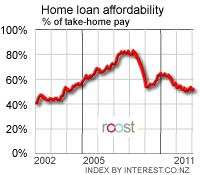
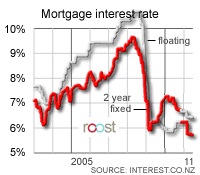
The New Zealand Housing Affordability measure from interest.co.nz worsened the most in over a year in April as a higher median house price and higher interest rates increased the amount needed to service a home loan. After a year of almost unbroken improvement in affordability the trend has reversed in March and April. "This is a spanner in the works for many first home buyers and rental property investors who were getting back into the market," said Interest .co.nz Editor Bernard Hickey. "The improvement in affordability helped fire up the market again in March and April, but this reversal is likely to cause many to think again before diving back into housing," Hickey said. The REINZ median house price rose to NZ$340,000 in April from NZ$335,000 in March, while the average 2 year mortgage rate rose back to 6.24% from 6.07%. These two factors increased the proportion of a single median income needed to service an 80% mortgage on a median priced house to 56.2% in April from 54.6% in March. This was the biggest deterioration in the home loan affordability series since March 2008 and came despite an improvement in after tax incomes because of tax cuts on April 1.
This measure of housing affordability had improved to its best level in 5 years in February because of a sharp fall in interest rates and falls in the median house price. Affordability hit its worst level of 82.9% in November 2007 when house prices peaked and 2 year mortgage rates were close to 10%.
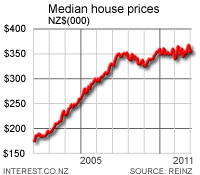
Many home buyers jumped in March and April to take advantage of lower interest rates and look for bargains, which improved the number of houses sold and had stabilised prices. But interest rates started rising again in late March and the April 30 cut in the OCR has largely not been passed on to most fixed rates and variable rates by the major banks. "The housing market usually cools off in winter and this worsening of affordability is likely to add an extra chill," Hickey said. "The budget on May 28 is expected to confirm the delay or cancellation of further tax cuts in 2010 and 2011, so affordability is unlikely to improve again unless mortgage rates fall and house prices fall," he said. Interest rates have stopped falling despite the Reserve Bank's OCR cut and some longer term mortgage rates have actually risen as heavy government borrowing globally forces rates higher and bank margins are squeezed. "The only realistic hope therefore for home loan affordability is further falls in house prices." Affordability remains slightly out of reach for most individual home buyers. The threshold proportion of after tax income considered prudent to sustainably own a house is around 40%. Anything above that is starting to become unaffordable. Affordability also worsened for a typical first home buyer. The Housing Affordability report's measure shows the mortgage servicing proportion worsened to 48.8% in April from 47.4% in March. This measure is for a median income earner aged 25-29 buying a first quartile home. Interest.co.nz thinks the "˜affordable' threshold is 40% for such a home buyer.
The report's measure of affordability for a "˜typical' household shows that proportion rose to 36.7% in March from 35.9% the previous month. This "˜typical' household includes one 30-34 year old male earning a median income, one 30-34 year old female earning 50% of a medium income and one child over five. Interest.co.nz thinks the "˜affordable' threshold is 30% for such a household. The report's measure of a "˜typical' first home buying household shows the proportion required to buy the first quartile home worsened slightly to 23% in April from 22.5% in February. It has, however, improved from 34% a year ago and 34.9% at its peak in November 2007. This measure is for one full time male aged 25-29 and one full time female aged 25-29 with no kids. Interest.co.nz considers the affordability threshold for this group as 30%, although that doesn't leave room for children. Southland continued to be the cheapest region in the nation with the typical home buyer having to pay 34.5% of take-home pay to afford the mortgage on a median house. The most expensive region was the Central Otago Lakes region on 71.3%, although this is down from 115.4% a year ago. Home loan affordability for typical buyers Links to individual reports for regions can be found here Home loan affordability for first-home buyers Links to individual reports for regions can be found here
Logically house prices have to
Logically house prices have to fall further given the conditions of the economy. Baby boomers are finally in trouble according to latest Veda Advntage report on credit defaults.
Unfortunately the RBNZ is using the wrong OCR tool to control inflation and stimulate economy. This tool wont be effective given our excessive overseas debt, speculative house buying, tax-free profits on housing investment etc.
basing "affordability" on interest rates
basing "affordability" on interest rates is a crap measure anyway, we would naturally expect this to fluctuate as interest rates go up and down. True affordability is purely a measure of income v prices - maybe throw in LONG TERM average interest rates but certainly not interest rates at a point in time.
Bernard: In relation to housing
Bernard: In relation to housing prices, I was interested in this section of the Financial Stability Report:
"Another significant credit exposure for New Zealand's banks is the residential mortgage market, which accounts for around half of total bank lending in New Zealand. The major banks experienced a significant rise in past-due mortgages during
the latter part of 2008 (figure 4.3), with rental property investors understood to account for much of the increase. Most of these exposures appear to be soundly collateralised, however, with the major banks reporting that less than a
tenth of all residential mortgages have a current loan-tovalue (LVR ) ratio in excess of 90 percent, with some variation across institutions (figure 4.5)."
So far, so nonchalant. But look at the next sentence:
"These LVR measures are based on the value of the property at the time the mortgage was arranged, rather than the current market price."
EEEeeekkk!! Now, we know there was a huge uptick in the number of housing loans during the boom, & of course values had skyrocketed at that time - so the "value at the time the mortgage was arranged" was probably inflated & will often have gone down about 9% (based on QV data). Now looking at the graph on P.29, one notes that a bigger tranch the loans has a loan-to-value ratio of over 80% - in fact, now more than 20% of the total. It seems likely that perhaps a much bigger chunk of house loans than they are letting on are close to under water.
Am I reading this right do you think?
It doesn't seem to ring true with the very soothing RBNZ report of Mizuho Kida on housing debt that Neville Bennett reported on 4 May, which I think Neville wondered about a bit.....
It seems clear that RBNZ wants housing values to gently decline in a stately & orderly fashion - not precipitously, nor (heaven forbid) take off again. But, reading between the lines.......
Philly, You raise a good
Philly,
You raise a good question. The numbers would all look very different if the banks were forced to mark to market the assets underneath their lending to rental investors.
But they don't and they're not going to unleash mass mortgagee sales because they don't have to. They're hoping any decline will be slow.
There is also plenty of 'fat' in the system for many investors who bought before 2005, 2006 and 2007. Also, lower interest rates will probably save them.
cheers
Bernard
Hi Bernard I was driving
Hi Bernard
I was driving aroung central Auckland yesterday I found there is hardly to find any open homes. So I can see the the housing market (sales volumes) will be be cooling down in next three months. According the rule the price is lagging three months of sales volumes so I can see the house price will drop in three to six months time.
If we all just wait and see, we will see the reality.
Second James. Really, all this
Second James. Really, all this blather shows is that incessant ticker-watching does not advance the body of knowledge much.
As J notes (but it is worth pounding the drum yet again) if the hoary old house price-household income multiple is consulted, it hasn't moved down much if at all.
Now yes, this here blawg is about interest. But the tunnel vision on this one factor cannot but obscure the bigger pixture - that housing is still hopelessly unaffordable for a great proportion of the potential market. And particularly for new entrants.
Hugh P, yer turn at the barricades...
"....if the banks were forced
"....if the banks were forced to mark to market the assets underneath their lending...."
Looks a little like what they might be going to do to rural lending...
"To address these concerns the Reserve Bank proposes to
amend the relevant bank capital adequacy framework in the
following respects."
http://www.interest.co.nz/ratesblog/index.php/2009/05/14/farm-sales-weak...
The best thing protecting the
The best thing protecting the wealth of everyday Kiwis are bloated home prices and high interest rates and terms. The only people buying homes presently, are speculators and real estate agencies playing 'hot potato' with each other's properties in an attempt to re-inflate the marketplace. Hopefully they will be the ones with their pants around their ankles when the smoke clears.
Keeping mortgage and interest rates at common sense levels will encourage smart people to keep their money in cash. The only thing governments can do is borrow, spend and tax. And make no mistake about it; higher taxes, a watered-down safety net, and superannuation at age 70 is just around the corner.
"The report’s measure of a
"The report's measure of a "˜typical' first home buying household shows...."
"This measure is for a median income earner aged 25-29 buying a first quartile home. "
Is the "first quartile home" in the stats taken off the overall ave inflated due to high numbers and well above ave value....
Maybe the "˜typical' first home buying household, should be taken from an 'Ave' area that is typical of what the 1st home buyer purchases.
Crunching numbers on this basis from QV, with our children in mind, avordabilty is far better than represented by interest.co.nz formula.
Here we go down the
Here we go down the property speculation gurgla. As Buffet said, standing there in the buff, you don't know who's swimming without togs until the tide goes out. Should be fun to see the RBNZ fiddle the rules so the banks can pretend the loot they loaned out is backed by assets and not smoke. What's a place really worth?
But hold the tide there Canute, we can see the next wave of immigrants on their way loaded with loot and dead keen to pork the property bubble once again. Look, they have "save the real estate agents" T shirts on. So an end to the dream that savings will be our way to wealth, hell no we're all for speculation and stupidity again, the great kiwi property madness. Let the credit flow. Give us more debt they screamed.
Doug "only people buying homes
Doug
"only people buying homes presently, are speculators and real estate agencies playing "˜hot potato' with each other's properties in an attempt to re-inflate the marketplace", I have been wondering who's buying, so now I know they are all speculators.
And Canute's not even going
And Canute's not even going to let the waves of taxation reinvigoration sweep over the shores of Godzone this budget season, Wally!
We're going to organise another public chat-group to talk about it.
King John is going to watch his cakes smoulder a little longer whilst trying to figure out what to do about Christine's clothes.....
http://business.theage.com.au/business/end-of-the-age-of-plentif
http://business.theage.com.au/business/end-of-the-age-of-plentiful-debt-...
The present debate misses the point that it may not be feasible to reach again the growth levels in the global economy of the past 20 or so years. Recent global prosperity was founded on a series of elegant Ponzi schemes.
Consumption rather than investment drove growth, especially in the developed world. A deregulated financial system supplied the borrowing to finance the consumption. In the new economy, to borrow from Earl Wilson, there were three kinds of people "” "the haves", "the have-nots" and "the have-not-paid-for-what-they-haves".
Like consumption, growth in global trade was also fuelled by debt. Since the 1990s, there has been a substantial build-up of foreign reserves in the central banks of emerging markets and developing countries that became the foundation for a trade-financing arrangement.
Doug I see your comment.
Doug
I see your comment. "The only people buying homes presently, are speculators and real estate agencies playing "˜hot potato' with each other's properties in an attempt to re-inflate the marketplace."
Do you have any evidence of this?
Does anyone else have evidence of this?
cheers
Bernard
Bernard - oh my gosh
Bernard - oh my gosh you are clutching at straws again... and I thought you were finally getting over that...
You say "The housing market usually cools off in winter and this worsening of affordability is likely to add an extra chill,"
You could say " Despite usual cooling off of properties at this time of year, the property market is really starting to heat up again despite my previously claims of a pending 30% drop, whoops I was wrong, sorry to all those who missed the boat"
Hey, what's this nonsense - Affordability remains slightly out of reach for most individual home buyers - WTF? Since when have we had individual home buyers, individuals go flatting with their mates, or go looking for the other kind of mate for mating... mostly single home owners are divorcees, and they only own half..
You also say "This is a spanner in the works for many first home buyers and rental property investors who were getting back into the market,"
You could say " Goes to show there's no spanner in the works for many home buyers and rental property investors, the ones who did not take everything I said as gospel and actually got back into the market"
You also say - "The improvement in affordability helped fire up the market again in March and April, but this reversal is likely to cause many to think again before diving back into housing,"
You could say - "The improvement in affordability helped fire up the market again in March and April, and this reversal is likely to cause many to look at housing once more, before it's too late for them to do so"
Jeepers, I could go on and on, but I'm sure you'll just keep spinning your double headed coin, the one with your face on it. Somewhere out there is a whole other side to the story and you seem totally unprepared to report it as it conflicts with your ego/media driven 30% drop in property price claims.
How about this angle - owning a home is expensive, and we will just need to learn how to manage our money and our debts if we ever want one, as we can no longer bank on them getting cheaper, we need to invest in ourselves, in our financial literacy... and wow build up the courage to ask for a pay rise, that 5 minute conversation is worth more to everyone than any tax break, and sure makes things more affordable.
To others who got to reading this far - ask for a pay rise some time this week, Tuesday mid morning, and Thursday mid afternoon are good times, also there is no time like the present... like right NOW...
Naah, I don't accept Doug's
Naah, I don't accept Doug's comment. I have been going to open homes, & there are genuine buyers there keen to buy. When u see the impressive price drops on some places, its understandable. People are believing the green shoots, & responding to those lower prices, believing that is the bottom of the market. Even I find it hard to keep my wallet shut when you see hefty drops! But, I say, "stay disciplined Philly!"
On a similar issue, interesting to note the Manawatu Standard's (print) headline today, "Region's housing market soaring". This is because house sales in P.Nth were 421 in the April quarter, compared with 307 for the same quarter in 2008. They quietly ignore the 522 sales in 2007 & 550 in 2006! The interesting point is the commentary "The latest house sales figures reveal Manawatu is leading the charge as the country fights its way out of the recession." - based on comments from the Chamber of Commerce. The City Council back this up, commenting that "other figures, such as building consents and electronic transactions, were also looking promising".
So this shows the ongoing Kiwi mentality that the secret to wealth and growth is housing and consumption. I can understand the REINZ etc promoting this, but scary when you see Chambers of Commerce etc following the same belief system. Only the productive sector, particularly exports, can do this, & thats a big ask in this environment.
Hey, Prez of Property, I
Hey, Prez of Property, I love your chutzpah!
Very like Napolean esconsed in Moscow in 1812.....
It would be interesting to
It would be interesting to get some solid data on this, but I'll bet a high proportion of properties sold in March and April were to investors, or people who fortuitously sold up towards the end of November 2007 and have been waiting for the right time to buy.
Anecdotaly, I've heard that a lot of first-time buyers in Auckland (who have just started sniffing around the market again) are being beaten to the punch by investors snapping up 2 and 3 bedroom homes in cheaper areas.
Why? I think people who have cash sitting in their banks just want to put it into something tangible. Banks aren't paying huge amounts of interest anymore and there's still a lot of nervousness about what to do with any "nest-egg". House prices go up and down, but at least the house won't disappear - you can always rent it if you buy sensibly. That's bound to be the "mass perception", anyway.
However, there is a limited pool of these people and they're buying NOW. I think over the next 3 to 6 months we're going to see a steady decline again. I don't think property prices will ever get back to 3.8 times NZ income (what's that, $150K-odd?), because there are too many people out there who earn more than us. Pretty much everyone, in fact.
However, we've got a way further to drop yet - and just wait until interest rates start going back up. There'll be a quick frenzy, then prices will drop away again.
It's an interesting and slightly scary future - nobody really knows what's going to happen, so if you're borrowing - BE CONSERVATIVE! I just can't believe that we're going to avoid the impact of trillions of dollars of global deleveraging with just a gentle 10% property drop and 5% unemployment. It's going to hurt more than that, we just don't understand yet how badly.
I really cannot see an
I really cannot see an end to this financial crisis. The world has been borrowing more than the savers have deposited for too long now.
Short term the Governments of the world are going to deleverage as much debt as they can by robbing off the savers. I reckon deleveraging is just finding ways to make the savers forgive the debt. In NZ a lot of deleveraging was done when finance companies failed. The savers lost billions there.
Then the borrowers started stealing off savers further when RBNZ lowered the interest rates the borrowers pay. Every dollar less interest borrowers have to pay is more money stolen off the savers.
The final theft will be massive inflation caused as a result of printing money.
The last theft from the savers will be when we have hyper inflation causing assets (flat screens, holidays, cars and I suppose houses) to rocket in cost. Then the savers money in the bank won't be worth anything.
The problem is the total world debt is higher than the total the savers have invested. So long term we are all shafted. The savers will end up broke and the borrowers will still crash and burn.
President of Property Many thanks.
President of Property
Many thanks. Yep. I'm sticking to my view. Markets never go down in a straight line.
I'm happy to buy you a coffee in a couple of years time if house prices are above where they are now. You'll be a winner both ways...
I enjoy the debate and your views represent the views of many if not most in the market. Many thanks too for your congratulations on our Qantas win. You are quite right. "wow - i didn't know my audience was so large, no wonder it won"¦"
cheers
Bernard
Bernard
Prez de Property "You could
Prez de Property
"You could say - "The improvement in affordability helped fire up the market again in March and April, and this reversal is likely to cause many to look at housing once more, before it's too late for them to do so""
Now why would he want to say that? If you truely believe that affordability drives demand, then what can possibly improve it more from where we are, with rates (by the banks own admission) now about as low as they can go.
The only way for affordability is up or sideways, unless we magically find some way of growing income (as unemployment rises).
Ooops - affordability "worse" or
Ooops - affordability "worse" or sideways.
Those three Barfoot agents who
Those three Barfoot agents who lost their licences in a 'pass the parcel' scheme last December was proof it exists. The Real Estate Agents Act, passed last fall, may help, but it doesn't even come into effect until November 17th. Bernard: do you believe these are the only ones at it? The SFO doesn't think so. http://www.sfo.govt.nz/HousingFraud.pdf
Ian C - yep, i
Ian C - yep, i agree, affordability can only get worse or sideways, they sure aint getting cheaper...
ps: i believe supply also plays a part in demand...
Speculators and real estate agents
Speculators and real estate agents purchased over 6000 properties(See Doug's comment), so let us play wait and see game. Speculators cannot play sale and buy games for too long time so the price will eventually drop and speculators and then real estates agents would out of market.
Long time reader, first time
Long time reader, first time commentator. I've avidly been following all sentiments posted on here regarding property prices/home affordability and the ensuing speculation. We're in a situation where we have a minimum of 20% sitting in the bank so are ready to buy in that respect. Our problem is we're renting a very nice house for much less than what it would cost in mortgage repayments on a substantially lesser house than what we rent (factoring in rates, insurance and a bit of maintenance as well, let alone improvements, we're about $200-$300 a week better off renting). So we save at least that amount every week, adding it to our deposit, and go out looking at open homes at the weekend (incidentally, there were a LOT of people out looking this weekend, in spite of the foul weather). But most of the houses we look at in our price range are too small or in undesirable areas. The ones we would consider are at the very upper limit of what we are prepared to pay. We both earn good incomes, but I'm struggling to be "OK" with spending an extra $300 a week, even $400 a week for a place that we'd really like to live in, more than what we currently spend in rent. And this is before interest rates start really taking off again! Why would I do that while there is a risk that the value of any house we buy may still deteriorate yet? Am I missing something here? Should we be rushing out, like a lot of other people seem to be either doing or advocate doing, to buy a home right now?
exactly veedub. in a similiar
exactly veedub. in a similiar position to you. we have a large amount of cash and are in a position to buy now but our expenses are wayyy lower renting than owning a house. in a declining market we will wait for at least a year or two more, maybe longer before seriously looking at buying.
here's a great online tool for running the numbers re renting versus buying.
http://www.nytimes.com/2007/04/10/business/2007_BUYRENT_GRAPHIC.html
and bernard is right that asset bubbles don't decline in a straight line. they pretty much always go down in steps as people prematurely jump in having seen a discount on bubble prices or they wrongly try to time the market. and asset markets never bounce back up again, they splat and stay mooching along a price floor often for years. so calling the bottom of the market finally becomes a not so difficult thing to do. a v shaped recovery? to my knowledge it's never happened.
President of Property, what do
President of Property, what do you have to say to Olly Newland's latest article
http://www.empowereducation.com/Olly_column_17May09.bz?connect=true&refi...
"The days when any property investment would automatically make money are over. We are in a new age where the old rules are changing and no-one is yet sure of the new rules. "
What new rules would you recommend, considering the world has changed.
I find it funny you suggesting people to ask for a raise, when the government and unions are telling everyone to take a paycut to let their companies survive in these economic conditions. Seems like you are talking to people living in 2007.
Wow - thanks for that
Wow - thanks for that link culver. According to the graph that I ended up with (after entering the CURRENT scenario, which obviously won't stay the same but we can only use current facts) I would NEVER be better off owning rather than renting. Again, at some point house prices WILL lift and that will alter the result drastically. So based on that, and the sentiment that you offered which is in line with Bernard's, I'll happily sit on the sideline for a bit longer and see what pans out over winter. In that time I'll be adding to my deposit to the tune of $400 a week minimum, confident that any house I would've bought right now probably won't be appreciating to the tune of $400 a week, plus a measly amount of interest! I'm really not missing anything in this am I?
veedub - if you are
veedub - if you are renting and actively saving, you are also in a good position, as every bit of savings will dramatically reduce the life span of a mortgage when you get one. The main problem with renters, is they become resigned to the situation and 'blow' all the other money, and lock themselves into that situation for a lifetime, removing choice from the matter. Given your savings, when the banks raise the deposit rate (which they put off as it costs them years of potential interest repayments) you will still be okay. If you are out all the time looking at houses, then you will educate yourself and learn what is too much and eventually will be able to spot one worthy of further investigation, and perhaps buying.
It's all down to what you want in life, you choose then you do. As you are buying by the sounds of it a family home, then it might be worth renting in a less desirable home than you are currently in, and saving that extra money for your deposit too. Your first home need not be a palace, nor the home you rent while you wait, but as the market continues to look like it is improving, stay in pace with it, save save save, and even without a drop in prices you will save up to hundreds of thousands of dollars in interest repayments if you can increase the percentage of your deposit. Good luck
PS: example, i have paid less than 20k off a floating 440k mortgage, and the statement arrived today saying, i did not need to pay it down, with minimum repayments scheduled to be going for another 24 years and 6 months. it now says it will be paid off in 11 years and 3 months, saving $239,000 in interest repayments if i keep throwing extra money at it. That to me is what makes property affordable, not just the price of the property, put also the price of the mortgage...
So where will asset prices
So where will asset prices be if H1N1 mutates, and, say, 50mio people are wipped off the planet (an occurrence like that is WAY overdue)? Or BSE sneaks into NZ?
On the other hand, what about the WAY overdue BigOne that could remove thousands of houses from NZ?
Asset prices ALWAYS go up over the long term? You just never really know.....
POP - there's no way
POP - there's no way in a million years I'd ever "blow" my nest egg, I've worked and invested way too hard for that. I understand what you're saying though. For us to rent a "lesser" place than we're currently in would only save us about $50 a week (we have lovely landlords that aren't greedy) so not really worth the disappointment/extra commute time etc in my opinion. Indeed, house prices will either need to come down a bit more yet, or stay stable while we add to our deposit, to entice me into buying. Because once we're in, we won't have the extra $300-$400 a week to pay down the mortgage quicker. I realise I'm taking a gamble - relying on prices to come down a bit more yet or at least stay the same, but the gamble I'd be taking if the opposite happened would annoy me immensely!
Looking back on the open homes we saw last weekend, none of them could be described as "palaces" or anything remotely like it, just everyday abodes in everyday suburbs that need a bit of work done to them. That doesn't appeal to me, not for the prices they're asking, and in turn the weekly repayments versus what I currently pay in rent.
POP "Ian C - yep,
POP
"Ian C - yep, i agree, affordability can only get worse or sideways, they sure aint getting cheaper"¦
ps: i believe supply also plays a part in demand"¦"
I think you misunderstand where I am coming from. If you think the lift in demand in the market was affordability driven, and that this has now (already) finished, then the heat will go out of the market. If interest rates rise, prices must fall to maintain the current affordability.
Whatever happens, there is no further scope to see affordability improve **by interest rates alone**. Since this is the case, you have to choose between either:
(1) a return to weak demand (mini boom over); or
(2) house price go down in value to maintain affordability if / when interest rates rise.
If its the former, and house prices go sideways, buying properties at current prices is uneconomic compared to renting. The attraction of a rental property for an investor without fairly constant evidence of capital gains is basically nil. A lot of work, hassle and (often) topping up negative equity for no benefit.
Veedub, you are on to
Veedub, you are on to it. Keep your powder dry and don't jump in until the numbers make sense for you.
Problem is where is your money going to be safe over this period?
If you lot want to
If you lot want to see and read about real living, go to
http://www.mrsharkey.com/busbarn/glen/glen.htm
Good question Dazza - currently
Good question Dazza - currently a quarter of it is in Bonus Bonds (we've had a couple of small wins so far), quarter of it is on Term Deposit (which matures this week) and the other half is just sitting in a current account. I want it to be "at the ready" so we can pounce when/if we find the right place for the right price. Sure, the interest on the current account is a bit sad, but no point having it tied up if we're actively looking for a property to buy (though that's leaning more and more towards inactively looking as we see what's on offer). I don't know what other options there are really.
End tax breaks on property
End tax breaks on property investment, increase capital gains tax on property (and make it work properly), basically do whatever is necessary to end nzers destructive fixation with property speculation and do it now!
Eastie: Forget about capital gains.
Eastie: Forget about capital gains. There is absolutely no way that is going to happen. It wouldn't just catch the landlords, but would snare farmers cashing up. That would be totally politically impossible. Think about the stink over the "fart tax" (no pun intended), which was going to be puny in comparison, & multiply the hysteria by a trillion.
Eastie: What are these mythical
Eastie: What are these mythical 'tax breaks' that only apply to property investment? You mean the ability to deduct expenses from income like every other business can? The ability to treat depreciation as an expense like every other business does? Being able to deduct a loss from one income stream against profit from another like every other business does?
Name a single 'tax break' that only aplies to property investment.
Here's the problem, ak. Most
Here's the problem, ak.
Most NZ houseowner Do run their property as a business. So you're right! Allow all the 'normal' tax deductions (ie: your comments) and tax ALL property gains or losses on property as if it were a business. That way there are no disadvantages for anyone, and no loopholes ( ie: own home etc) for anyone to crawl through. After all, even a CG on an 'own home' is income, isn't it?
Bernard - nothing like housing
Bernard - nothing like housing to get the debate going!
I've fallen into a bit of money in the last week, means I now have a 20% deposit for the kind of house in the kind of location I am looking for
However I am not rushing in at all.
I will keep eyes open and if the right property comes up and I can get a good price then I will consider. But I certainly won't panic. I still think prices are likely to drop at least another 5%, at best I think they'll go sideways in the next 12 months so as far as I'm concerned there is no rush at all.
So Veedub - its up to you but if you are like me keep your eyes open, if you see a place you like and can afford have a look, but go in with a lower offer. It will still be a buyer's market these next 12 months.
ak - you are right
ak - you are right in principle re equal tax treatment but I think you miss the point
1) name one other investment where it is as easy for the average punter to get a 95% loan despite the asset being almost guaranteed to make a loss for 10 years thus producing a HUGE RELIANCE ON TAX CREDITS to offset the loss?????????? Rents only move up with inflation, businesses that borrow generally do so to produce a lot MORE INCOME, not to SPECULATE.
2) name one other investment where the investor competes with another class of purchaser (homeowner) who buys a place to live in and does not have the opportunity to offset the greater costs of owning versus renting.
3) Savings are taxed at full earnings (although it is only interest), whereas property (and some classes of shares) only get taxed on dividends. This certainly puts property at a tax advantage compared with savings. Why should income be treated differently to capital gains??
I agree with Bernard Hickey
I agree with Bernard Hickey that housing is overinflated. I note the following:
(1) Auckland is even more over inflated with the average house price at 6 times the average income (and probably worse once you remove the exodus of small apartments at the bottom of the market being disposed at less than half their original sales value - deduct them from the equation and housing is even more unaffordable);
(2) despite enormous rises in the market, there has been a minimal increase in incomes - barely above CPI - this doesn't promote much gain in servicability for debt;
(3) Lower interest today doesn't mean property is more affordable. The average cost of borrowings is more important (the average interest rate over time) because interest rates do not remain the same - the fluctuate up and down - the interest rate this month is almost irrelevant within the time frame of a 25 year mortgage. To suggest a cheap interest rate today matters is absolute rubbish;
(4) Housing needs to be affordable to the masses to exist as a sustainable market. It needs average people to be actively part of that market and when they can no longer afford to purchase the average house - then the market is in risk of cataclysmic drops to arrive at a level where it is affordable to the masses. It is simply not enough to rely on wealthier people or investors to fill the gap as they too are subject the same fundamentals of affordability - borrowing against the same assets (homes).
(5) rental yields are too low to make rental investments work. If anything is a signal of how much one can afford to pay to live in a house - it is how much they will pay for rent;
(6) Bank deposit rates are too expensive - 20%. If the average house in Auckland is $480,000 then it requires a $96,000 deposit at 20% to enter. A single average income earner would take approximately 12 years to save that deposit, or 6 years for a couple. (An interesting side note - if banks really beleived their own hype they would be relaxed and okay with lending at higher amounts or does the 20% deposit expectation really signal that they anticipate values to drop?);
(7) compared to other countries which have average house prices at 3 times the average income NZ is scarily too expensive (which when considered with point (8) below makes it worse;
(8) NZ interest rates are more expensive than other countries which fundamentally means that servicing a mortgage costs more money from the average income. A higher cost of debt servicing inhibits the amount one can borrow. Hence - it isn't rocket science to note that if servicing a mortgage is more expensive in NZ - the average house price should be much cheaper - and this has historically been the case.
There are plenty of other reasons to consider however the fundamentals are there - that property in NZ is way over inflated and has to correct itself. Whether this is fast or slow remains to be seen.
It is interesting that both the IMF and the World Bank have clearly communicated their concern with the value of NZ property and for the reasons above. NZ'ers have over traded in property - choosing it as the preferred method to make a buck and the chickens will come home to roost soon enough.
I suggest that we need to stop and think about what and who is communicating the message that property is stabilising and or okay. Banks and Real Estate firms make money from property and its fair to say that they will spin any positive communique they can. The reality is that without activity their businesses faulter. Don't beleive the hype.
BRN - very well said
BRN - very well said and easy to follow.
Just goes to show, if a house is too expesnsive compared to your income, it just is plainly too expensive
Janet, there is a common
Janet, there is a common misconception that property investment confers some sort of 'tax break' in addition to the remote possibilty of capital gains. All an LAQC does is give individuals the same tax treatment as any companys gets.
Capital gains tax is a different issue (and is already paid by those who's business is speculating and dealing in property)
BRN - good points. Its
BRN - good points.
Its hard to say who is an objective commentator mind you.
You could say the Reserve Bank are objective (and predicting further price drops)
however cynics might say they are not so objective as they have a vested interest in limitting inflation (and therefore property deflation is "good")
However putting such cynicism aside I think the reserve bank are about as independant as we will get. The Bank Economists claim "independance" but lets get real
It would be interesting to hear a viewpoint from an academic or someone like Brian Easton, someone who is divorced from the commercial benefits / disbenefits of price gains or losses in property.
Bernard - any chance of getting someone like Brian to write a piece on housing?
Veedub, I'm in a similar
Veedub,
I'm in a similar position to you and i'm sitting on my hands for the time-being. I'm concerned that if I buy a house that it will effectively dissapear. A 25% drop means goodbye equity.
I've just come back from my OE and watched house prices in London drop 20% plus. They are still falling. Month by month. Drip. Drip. Drip. Some people are still buying though in the belief that since they have fallen they must be cheap and about to go up.
The excuses as to why house prices wouldn't fall in London are spookily similar to those given as to why house prices won't fall too much here: 'immigrants will always want to come and live here' 'limited supply of land and housing stock, increasing demand' 'strong economy' 'low interest rates' 'low unemployment' 'demographic changes causing increased number of households'. None of these things saved London or California and things are still dropping.
Why should Auckland be immune to a global economic collapse?
ak - while an LAQC
ak - while an LAQC confers no special benefit, the whole premise of buying a rental property no the basis of "negative equity" (ie loss making), in particular if there is a cash loss involved, is that capital gains are an integral part of the investment decision.
If I was the IRD, my starting point would be that all landlords claiming a tax deduction in relation to a rental property (or properties) are subject to capital gains.
I bought house some 15
I bought house some 15 years ago, and during that period my repayments including insurance and taxes were higher then my rent would be. I worked hard over that period to pay off my mortage, and now 15 years later Iam mortage free, and better off by around $400 p/w, till rest of my life. In meanwhile average rent has doubled and value of my property tripled. If I ever decide to move on and sell it, will ended up with cca $300k cash. How anything else can be beter investment for retirement?
Iam now in process of subdividing and renting/selling second dwelling, as have bigish section...
Johan, "How anything else can
Johan,
"How anything else can be beter investment for retirement?".
The last 15 years have been fantastic for housing and there have been few better investments, no one is denying that. What you need to realise is that past performance is no guarantee of future returns. In fact, if past performance is too good, you most likely have a bubble in which case the future returns are likely to be the opposite of past performance ( eg US, UK, Ireland, Spain, and now NZ and Aus).
property has only been a fantastic investment because households have gone further and further into debt. That process has stopped and gone into reverse - so will house prices.
That's good for you Johan,
That's good for you Johan, but you have to recognise that the conditions for the same change in house price / rent no longer exist.
House prices have tripled in 3 years, but incomes have grown by less than 2x (same as rent, as it happens). If you think that will happen again, the house price to rent ratio will go from 6x to 10x. In 15 more years from 10x to 16x. You must agree that this is not possible - even if you think there can be a widening gap between income and house price... there has to be a limit.
The houses price will drop
The houses price will drop in next year because what people are saying here is exactly what people were saying in year 2000 and the house price dropped in 2001. Property market is 100% OF PEOPLE'S CONFIDENCE. I remember very clearly people told me property price will never be back because if..,if...,if... So the conclution is the property price will drop.
Don't enter the market until
Don't enter the market until the "fundermentals" are done buying at ridiculous prices.
Until then watch prices fall.
i meant fund der mentals.
Johan and 10 years back...
i love your work - goes to show that remembering you're in the movie is worth the ticket price. some people just get so caught up in the moment they forget what's really going on.
anyone that thinks property will continue to fall, get in now, i will offer you a blanket and an axe for whatever you have, before it drops even lower.
and before everyone jumps on the fu wagon, i do have a drop or two of that blood in my veins, like most of us, so i am not having a dig a Maori land ownership, i am talking about perception.
land values will continue to rise, property will continue to rise, and of day, we can do without the petrol, but we still will need somewhere to stand/live on, as we have not yet learnt to hover without getting wet.
we need houses, people will always need homes...
wot A lot of bull.
wot A lot of bull. POP
These first home buyers will lose their shirts if they listen to you.
VeeDub, whack that deposit into a safe Rabo bank PIE on call cash fund. Only pay tax at 30% and sit back and enjoy the fall.
No point trying to catch a falling knife.
You will have plenty of warning when prices have bottomed. The process is going to take years so dont be in any hurry.
we are stuffed - the
we are stuffed - the secret is to catch the falling knife with a magnet so you don't get cut in the process, or to spend years learning the art of 'catch falling knife'...
by the way... we are
by the way... we are not stuffed... slight attitude adjustment required one would suggest...
:) let others get cut.
:)
let others get cut.
Pick it up when it has clearly hit the floor.
Nope, we are clearly stuffed.
Nope, we are clearly stuffed. Some more than others but we are all stuffed non the less.
it will never reach the
it will never reach the floor
Back to Johan. In 2007
Back to Johan. In 2007 we sold our properties, at the top of the market. We are now sitting in a rental waiting. Our rent, minus rates, insurance & maintenance is about $12k. Over the last year, housing values went down nearly 10% (QV figures). The house we would most likely buy has therefore gone down from $400k, close to $40k reduction. So we made nearly $30k. Tax free. Try to match that return over the last year.
We are not simply making the most of our particular situation. Au contraire. It is totally strategic. I saw the bubble reaching its peak & sold up to make the most of the peak. I am now very deliberately waiting. I have been rewarded so far, but expect richer pickings yet. I must admit with the proviso that runaway inflation would ruin our party - that is the only real fear I have.
I did the same thing in 1987, selling all my shares about 6 months b4 the crash. A bubble isn't hard to spot. If it looks like a duck, walks like a duck, & sounds like a duck, then it most probably is a duck. This one has been quacking frantically for years, but its now duck-shooting season.
And its like evolution, global warming & peak oil - you can deny it all you like, but its still a-happening.
POP "land values will continue
POP
"land values will continue to rise".
Real Values will continue to rise. Prices however will drop a further 20% to align with real values ... and they may even undershoot further!!
Veedub, Welcome to the site.
Veedub,
Welcome to the site. We're glad we can be useful.
BRN - Great contribution. Thankyou for the effort.
President of Property - Good luck with that magnet (and we love your comments) I still chuckling over your comment on the Qantas award
cheers
Home affordability has lot to
Home affordability has lot to do with Government policies. Land controls and Monetary policies (Taxation, Inflation control etc), productivity growth are the long term drivers of housing development. Bank interest rates etc may have some short term effect. Home ownership improved during Labour mainly because of cheap credit and excessive risk taking by banks and individuals. I don't think home ownership will ever jump up as happened in the last 6 years, and it will stay at about 50%. Depending on what happens at the employment front, low value houses may retain their value because of their affordability but not the high end or the beach property type of houses. Low bank interest on cash deposits, which is below the inflation rate, will sustain properties whose rental return is about 7%. I expect a skewed fall in house prices at the high end in the next 2-3 years.
Sam. I don't think you
Sam. I don't think you are correct on home ownership rates under Labour. From memory, over the last 10 years home ownership rates went down from about 75% to about 67%. It appeared to me that 1st home buyers were unable to compete against resource-rich baby-boomers who were able to take advantage of the IRD subsidy (to the tune of nearly $1 billlion pa) to crowd them out of the market. That is, able to claim the mortgage costs against their income, unlike the poor homeowner. So much for the socialist Labour govt, tho of course the regime wasn't their contribution - theirs was the 39% top tax rate that made the subsidy so attractive. Hopefully the new tax think tank considers the inequity of this, but history suggests there will be no change.
Bernard ... Nice to see
Bernard ...
Nice to see i can make you chuckle, and good to see actually take note of what is being said. i was surprised though when you made no mention of the comments that followed this one story you quickly ran and outdated, when i took note of what you said... and agreed...
http://www.interest.co.nz/ratesblog/index.php/2009/05/06/whats-happening...
So, POP ... what house
So, POP ... what house price to income level do you think is unsustainable (you obviously think its not an issue at the moment)?
IanC - well that depends
IanC - well that depends on if you drink coffee and beer, and throw unused vegetables away at the end of the week because you had takeout. It also depends on if you need a shiny stainless steel patio warmer in your outdoor entertainment area, or if indeed you entertain. What a stupid question. If people try harder they get luckier didn't you know. It is okay to shoot for the stars as long as you don't have your head in the clouds, or the dark side of the moon - if you know what i mean...
POP - you have missed
POP - you have missed your calling. You really should be a poet.
I sort of know what
I sort of know what you mean, but you're missing the point.
As I discussed in the middle of the page somewhere, strong price growth requires an increasing (and necessarily debt funded) relationship between prices and income. This isn't possible forever - eventually there isn't enough income to pay for the interest (even if you don't eat).
Once you accept there is an upper limit on house prices vs income (and lets assume that incomes won't grow any faster than the past), you have put a cap on house price appreciation at the sorts of rates you appear to expect (let me guess - double every 7 years?).
So, do you see a cap?
A related question - rents have tracked incomes (funny that). If rents keep tracking incomes ... what drives capital appreciation (beyond wage inflation) for rental properties? What justification can there be for a decreasing rental yield if there is no particular reason to expect rents to increase materially in the future?
Fundamentals are important. The housing market is just really unusual in that there are so many factors which can disconnect pricing from fundamental values for a long period of time.
@POP - enjoy the debate's
@POP - enjoy the debate's but don't mention financial literacy and housing in the same sentence. In NZ they bear no co-relation.
And please less of the 'if we didn't have a coffee a day, that house would be with us next week' attitude. House's as a rule are so far out of kilter that for many people they could not eat, use no utilities and still not get close to the payments for a property.
And as to fundamentals...
I bought a property on the North Shore in 1994 for $145,000 (3 bed, 1 bathroom with carport, full section). Rented it for $250 a week. Now that same place is $400k and rent just under $350. Yield has gone from 9% to 4.5%.
House price has gone up 168%, rent up 40%, and wages up probably 30% (if that). Anyone seeing the problem??
(And I did buy it on one income (was earning just on $40k) at just over 3 times salary).
Now today, assuming a 20% deposit and $320k mortgage at 6% interest alone it needs $20k per annum, excluding principle. At 8% that's $25.6 k....without rates, maintenance, principle and of course that magical $80k which just appeared from nowhere.
Realist. I agree with all
Realist. I agree with all you have said. But the probelm that "we" have created is that we have taught our children that it's easy, and certain, that to get ahead, you don't need to work, but just buy property! It worked for their parents, and grandparents, so why wouldn't it work for them? Except that it will be "us" selling to them, as we all cash up; and then they can sell to ....? Looks like immigration and inflation will be their salvation.
Realist - it's good to
Realist - it's good to see the numbers crunched for a real life situation. What you've just laid out is exactly what's making me scratch my head and question the whole exercise of buying a home. The obvious points for me are that I only pay about $20k a year in rent right now, and I have my weekends to myself - not trying to fix up some dump of a house to make it inhabitable, or at least to my liking! Thanks for doing the exercise and sharing it with us.
POP - perhaps you should
POP - perhaps you should eat some PIE 's! Cheap money + inflation + silly tax rules have created a genuine bubble. Immigrants require jobs.. are they still flowing in?
There must be pent up demand from families who NEED to move, perhaps it is them behind this latest little push - volumes are THIN = volatile market prices. I wouldn't read much into 'price' until volumes get back to normal.
I would buy if after tax YILEDS are more or less = LONG TERM MORTGAGE RATES as I expect my loans to be DEFLATED away over the life of the mortgage making me better off. But hej, is wage inflation/rising rents a sure thing??
Philly - "LVR ratio's at time Mortgage was arranged" - scary indeed! what happened to Mark to Market??
Another spin for you; Housing Affordability may NOT GO DOWN to where 'it should be' if our productivity/incomes in real terms has declined and we already have so much DEBT to service - we're in a hole and it's a slow climb out, I'm buying XRO shares :)
say no more http://www.financialsense.com/editorials/quinn/2009/
say no more
http://www.financialsense.com/editorials/quinn/2009/0518.html
sorry here is a taste,
sorry here is a taste, well worth reading.
After reaching peak values, Japanese home prices declined by an average of 40%. In the country's largest cities, the declines were worse, averaging 65%. Homes in Tokyo lost 80% of their value and are still on the downward slide to this day. National home prices in Japan were $125,000 in 1985. Twenty years later home prices are again at or near the $125,000 level. If the U.S. follows this path, median home prices will be $143,600 in 2020, the same level as 2000. You won't hear any "experts" making this prediction, because the economic implications would be too dire. A nice dose of runaway inflation could solve this dilemma. Are you up for it?
Thx, Andrewj. My boss is
Thx, Andrewj.
My boss is just back from a visit to his parents in Osaka, and he confirms two things to me:
1) Big cities in Japan have become unsafe after dark ( unheard of 10 years ago),and as you say
2) Homes in Tokyo have lost 80% of their value from peak and are still on the downward slide.
Actually he tells me they pasued for about the 6 recent months, now they are off again.
Japan has little relevance to
Japan has little relevance to NZ beyond the fact that it illustrated before our property bubble burst that property does crash.
When people said to me two years ago that property never crashes I always mentioned Japan, as well as Germany.
Their population has been shrinking for some time and they have very little immigration. Result is that demand for housing has been on a downward slide.
I doubt very much that we will see the same sort of long term decline here that we have seen there.
Also an important difference is that property is not viewed as an investment there anywhere near the same level it is here.
Matt, its not about Japan
Matt, its not about Japan , immigration comes with the assumption of growth????
Americans have accumulated so much stuff that their McMansions can't contain it all. At year-end 1984 there were 6,601 self storage facilities with 290 million square feet of rentable self storage in the U.S. At year end 2008, there were 51,250 "primary" self storage facilities representing 2.35 billion square feet -- an increase of more than 2.0 billion square feet. There is 7.4 square feet of self storage space for every man, woman and child in the nation; thus, it is physically possible that every American could stand "“ all at the same time "“ under the total canopy of self storage roofing. It took the self storage industry more than 25 years to build its first billion square feet of space; it added the second billion square feet in just 8 years (1998-2005). Boomer materialism was taken to whole new dimension in the last decade. Boomers would be bursting with pride if they had the room.
How can anyone in their right mind say that housing has bottomed when the months supply of new homes is at an all-time high of 13 months, the months supply of existing homes is 10 months, there will be 2.1 million foreclosures in 2009 versus 1.7 million in 2008, and 7 to 8 million more people will lose their jobs in 2009? Neither foreclosure counseling, foreclosure moratoriums or magic pixie dust will keep housing prices from completing their roundtrip back to 2000 levels. Bubbles never burst halfway. They burst completely and the mess spreads everywhere.
The entire suburban existence of the last twenty years has been a fraud, built on a foundation of debt, with bankers lying to investors and homeowners deceiving themselves. Fraud is the intentional perversion of truth in order to induce another to part with something of value. The CEO's of major financial institutions intentionally created and marketed fraudulent mortgage products in order to enrich themselves. Why would someone create NINJA loans (No Income, No Job or Assets) unless you wanted to induce borrowers to commit fraud? What good business reason would a professional financial manager have for not wanting to know whether the person has a job or income when you are loaning them $400,000? The reason is simple. They knew the loans they were making were frauds, but they didn't care. They were bribing Moody's and S&P with huge payoffs to buy a AAA rating for their packages of fraudulent loans, so they could sell them to unsuspecting investors throughout the world. Former banking regulator William Black described the process:
Matt: "Also an important difference
Matt: "Also an important difference is that property is not viewed as an investment there anywhere near the same level it is here."
I think you'll find it was considered an investment in Japan as the boom rocked on up to unsustainable levels. If anything, it is precisely because we see housing as an investment that we're potentially in trouble.
Ian - my wife is
Ian - my wife is Japanese and I lived there for a while.
Yes there was an element of housing being viewed by some as an investment in the 80s there, but it never permeated society the way it has here ie. there was never anywhere near the number of mum and dad investors we see here.
Culturally the Japanese view housing very differently. My mother in law has just sold the family house of 20 years - the new owner will knock down and build again. This is very common.
They assign very little value to the buildings, its all in the land.
I agree with you that the fact so much weight is given to property here as an investment could be problematic.
I think the savings culture of Japan is a great strength for them.
Hi, We have just added
Hi,
We have just added your latest post "Blogging On Interest Rates, Economics & Business in New Zealand" to our Directory of Home Loan . You can check the inclusion of the post here . We are delighted to invite you to submit all your future posts to the directory and get a huge base of visitors to your website.
Warm Regards
Homeloa-n.info Team
http://www.homeloa-n.info
hey all you housing buffs,
hey all you housing buffs, check out Treasury's latest forecasts for house prices - not good:
http://www.nzherald.co.nz/nz/news/article.cfm?c_id=1&objectid=10575157
Good to see something without the bull@#$% spin of bank economists and unreal estate guys
looks like us prospective first home buyers should be able to pick up good deals in the middle of next year
Ray - if only????