
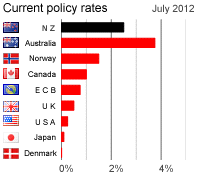
 The Reserve Bank of Australia cut its official interest rate by 25 bps to 3%. This latest move has brought it in line with New Zealand's Official Cash Rate and was in line with market expectations, although Australian economists were split with many expecting rates to be left on hold, while others saw a 50 bps cut.
The Australian move will have been closely watched by Reserve Bank of New Zealand Governor Alan Bollard as he decides what to do with the OCR on April 30. Earlier today, Bollard was faced with the worst NZIER Business Opinion survey since 1970 and Treasury has said that the economy is in a worse position than its downside scenario in December. Treasury also said the outlook for 2009 and 2010 was worse than its previous downside forecasts.
The next RBA rate announcement will be on May 5.
Here is the statement by RBA Governor Glenn Stevens accompanying the move:
The Reserve Bank of Australia cut its official interest rate by 25 bps to 3%. This latest move has brought it in line with New Zealand's Official Cash Rate and was in line with market expectations, although Australian economists were split with many expecting rates to be left on hold, while others saw a 50 bps cut.
The Australian move will have been closely watched by Reserve Bank of New Zealand Governor Alan Bollard as he decides what to do with the OCR on April 30. Earlier today, Bollard was faced with the worst NZIER Business Opinion survey since 1970 and Treasury has said that the economy is in a worse position than its downside scenario in December. Treasury also said the outlook for 2009 and 2010 was worse than its previous downside forecasts.
The next RBA rate announcement will be on May 5.
Here is the statement by RBA Governor Glenn Stevens accompanying the move:
Recent information from abroad indicates that the contraction in the global economy continued during the first few months of this year, and most assessments of the near"‘term outlook have been further marked down. Considerable economic policy stimulus is in train in most countries, the full effects of which are not yet discernible, but which should help contain the downturn over the rest of the year. There are tentative signs of stabilisation in several countries, including China, though it is too early yet to judge how durable these will prove to be. Conditions in global financial markets have continued to improve gradually, helped by progress towards a resolution of banking system difficulties in the United States and other major countries. Sentiment remains fragile, however, and the contraction in economic activity is affecting asset quality of financial institutions.
The Australian economy is contracting, though by less than those of its trading partners. Capacity utilisation has fallen from its peak, and will decline further over the rest of the year. With demand for labour weakening, growth in labour costs will probably also fall. Hence inflation over the medium term is likely to be lower than it has been over the past two years. Demand for credit is weak overall, though credit for owner"‘occupied housing is picking up. There has already been a major change in both monetary and fiscal policy in Australia. Market and mortgage rates are at very low levels by historical standards and business loan rates are below recent averages, reducing debt"‘servicing burdens considerably. Nonetheless, the Board judged that there was scope for a further modest adjustment to the cash rate. The stance of monetary policy, together with the substantial fiscal initiatives, will provide significant support to domestic demand over the period ahead.
We welcome your comments below. If you are not already registered, please register to comment
Remember we welcome robust, respectful and insightful debate. We don't welcome abusive or defamatory comments and will de-register those repeatedly making such comments. Our current comment policy is here.