
The comment stream

Recent comments

Join the Interest community to be a registered commenter so you can:
- Edit your comments
- Avoid the CAPTCHA
- Vote on comments
Register Here

Already registered? log back in here ..

Forgotten your password? No problem! Click here

Finance sector jobs

Senior Liability Underwriting Manager
Lead from the front utilising your strategic, technical and leadership qualities within th...more
New Zealand
Senior Liability Product Underwriter - Product Management
Lead from the front utilising your technical expertise in this highly attractive senior li...more
New Zealand
High Performing Senior Liability UnderwriterHigh Performing Senior Liability Underwriter
Customer focus, high performance, exceeding client expectations and achieving profitable g...more
New Zealand
Head of Retail Credit -Wellington, NZ
Key leadership position in the bank. Be a part of one of the fastest growing banks in New ...more
New Zealand
efinancialcareers.com

Reader poll

Should you fix your mortgage now or stay floating?

Choices

Have your say: Bill English says banks should accept lower profits

Posted in News

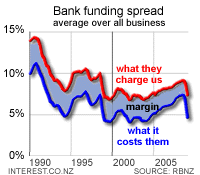
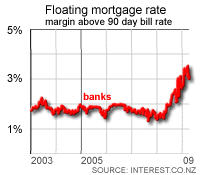
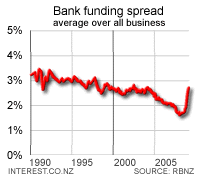
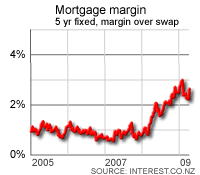
Reserve Bank Governor Alan Bollard was much more careful to question the rise in wholesale interest rates on Wednesday. Unlike some of the newspaper headlines, he did not take the extra step of criticising the banks directly. Now Bill English has gone that extra mile. Comments by a business lobby group and Federated Farmers late on Wednesday that banks were price gouging and misleading farmers have also opened up the debate. Bank workers union has also jumped on the bandwagon, calling for the banks to drop profit expectations. "It is time for banks to think not just about shareholders' dividends but about a social dividend. That means fairer interest rates and job security for New Zealand workers," said Finsec Campaigns Director Andrew Campbell. "Banks now enjoy significant support from taxpayers and reduced risk to shareholders, with few strings attached. A commitment to New Zealand jobs and a fair deal for customers should be conditions of the schemes," said Campbell. But is it true? Are the banks profiteering? My short answer is yes, but not to a huge degree. They are protecting their profits and trying to grow them, but the growth is in the low single digit area percentage wise, which is not strong enough to use the profiteering tag. The latest round of mortgage rate hikes followed a spike in wholesale interest rates directly, which implies they were not 'profiteering hikes'. However, the banks are also now charging a higher margin over wholesale mortgage rates, but that can be partly justified by the extra costs they now face when borrowing offshore. Our research of all 3 and 5 year debt issues by our Australian owned banks and their parents show this funding margin over interbank swap (wholesale) rates has increased from around 10-15 basis points in March 2007 to around 150-170 basis points. That tallies with the jump shown left in the chart for floating vs 90 day bill rates. The average bank 5 year mortgage rate is around 7.5% right now, which is about 250 basis points over the 5 year swap rate. So there seems to be around 50-100 basis points of 'fat' in there over the 150-170 basis point increase in cost. But figuring out what is the true profit margin is difficult, given the banks have a huge mix of funding costs and interest rates. There are apples and oranges and grapefruit all over the place. The Reserve Bank has a crack here (C10) and finds that the 'spread' between funding costs and claims (what they charge customers) has widened to 272 basis points by February from 175 basis points in July last year. However this measure does not include the cost of foreign currency funding, which makes up about 40% of funding, so it doesn't give the whole picture. Overall bank profits, which includes profits from fees as well as net interest margins, have been solid to slightly higher in the last year. We'll do some more research on the latest bank results later today. However, should their profits be lower? This would bring them into line with profits for other businesses, which are mostly sharply lower. And does English have a point in saying the government is guaranteeing them so should expect some leniency and profit sacrifice? I think the banks will have to cop this question. Once they took the guarantee, the must have known it would eventually come to this. It was never a gift. The banks are paying for the privilege with a 10 basis point fee, but some would say that's not nearly enough to cover the risks. Everyone who goes into debt to someone knows they eventually have some control over you. In a sense, Bill English became the bank manager to the banks when they took the government guarantee. If the banks want to avoid this sort of political pain they should give up the guarantee. My overall feeling is our banks should share some more of the huge profit pain that other businesses are feeling, but taxpayers and customers shouldn't be baying for blood. We shouldn't forget our banks are very strong and are still growing lending at a time when banks in other countries are basket cases. Look at the carnage in the UK, US and European economies where their banks are essentially insolvent in the face of massive toxic debts. Here's my more detailed thoughts on that here in: 5 reasons to thank the banks and 5 reasons to spank the banks. Your thoughts? Comments below please
We welcome your help to improve our coverage of this issue. Any examples or experiences to relate? Any links to other news, data or research to shed more light on this? Any insight or views on what might happen next or what should happen next? Any errors to correct?

We welcome your comments below. If you are not already registered, please register to comment in the box on the right or click on the "'Register" link at the bottom of the comments. Remember we welcome robust, respectful and insightful debate. We don't welcome abusive or defamatory comments and will de-register those repeatedly making these comments.

Mr English faces nothing but

Mr English faces nothing but higher term interest rates, now FASB reinforces the farce of mark to model over mark to market accounting rules. Read more:

http://www.bloomberg.com/apps/news?pid=20601103&sid=auSutnW4GSyw&refer=us

Who in their right mind would lend money to any corporate body in this type of lunatic asylum environment without excessive credit risk protection?

Our banks, upon adoption of similar rules , will mark their profits to suit the current agenda.

It's not rational to expect

It's not rational to expect a business to accept lower profits when their risk has been reduced. If my risk were reduced, I'd be making hay while the sun shines - just like the banks are. Without legislation (which would be a bad idea) to restrain banks using the guarantee, this is all just hot air and bluster.

Wow ! Now it's English

Wow ! Now it's English turn.Hey if the Banks don't play by reducing the interest margins, why don't you revoke the guarantee??? Ha Ha Ha....go ahead make my day...(so say the banker to the politician) This is what you get when politicians try to play God of the Market....they try to intefere with what the market wants...like giving them guarantees instead of letting them sweat for their deposits....It's call the law of unintended consequences.

Which brings me to my two cents reason why interest rates (both wholesale and retail) went up...

1. didn't Alan Bollard says "I am seeing signs that the economy is recovering"
2. Didn't John Key say "The economy will recover to 4% growth by 2010' ?
3. Didn't Bernard Hickey say "It's time to fix because long term rates are going up"?
4. Didn't our Deficit just went up to 9% of GDP (meaning we have to borrow more, meaning higher cost) ?

With all those bullish views from Great and Important people don't you think we meer mortals should take heed and fix our mortgage rates to kingdom come before it hits 20% or more like in the 70's ?

OR maybe the banks knows more than we do...after all they are in this business more than us....Is the economy going to be much worse than those Great and Important people thinks...that they are going to get more NPL's and losses going into the year and next and so need to provide more margins now for new loand to make up for future losses ?

Surreal - everything from politicians

Surreal - everything from politicians acting as if in charge of something, to the total irrelevence of market and accounting fundamentals, to the CNN interview of Sir Boomtown Rat Bob representing the interests of the third world at the G20 summit.

The news is a sort of tragic comedy (or comic tragedy!) in which we are all glued to our seats because the shape of things to come is so impossible to predict.

It is weird. A cynical

It is weird. A cynical person would say that the statements by Bollard and English were merely to garner public affection when they know damn well that they will have no impact.

That is a very good

That is a very good point, David S. But I still think that the banks would be out to make as much margin as possible even if they didn't have the government guarantees they've got, as their risk of loss of equity is so high at the moment with values not really having dropped as far as the fundamentals would indicate they should (i.e. wide disparity from the historical relationship between earnings and asset values). In fact if they didn't have the guarantees, their rate of deposit-taking and their willingness to lend would require much bigger margins still.

It really isn't about the base interest rate set by the Reserve Bank, any more. The banks know that using that to inflate credit would only come back to bite them even worse in time. It is about the wisest course we can hope for at the current time, one which will stand NZ in good stead as and if other countries banks succumb to the lure of credit inflation.

I think the rates should

I think the rates should rise. Anything to drive down the insane property prices.
Only when families can afford a home will their disposable income rise, savings increase and spending too.
The root of our national problem is the massive household debt and the unaffordable housing costs.

Right on, Wally. Have you

Right on, Wally. Have you just read my comments on the Philip O'Connor thread? Or is it just great minds thinking alike?

Wally and Kin are onto

Wally and Kin are onto it.
Also forget what the OCR does now as the banks are in a position where they dictate, not Bollard or English, it amazes me they think that they can!!!
As Wally said the only way to cause deflation of the housing market is to increase interest rates not lower them as lowering them effectively has the potential to create another bubble by people getting in now before the bottom is reached and also with inflationary pressures pushing up interest rates and then more mortgage defaults. We are in for some interesting times.

English might have a point,

English might have a point, to the extent that the government is guaranteeing the banks. But they are not. They are guaranteeing the creditors (depositors and lenders) in the event that a bank defaults. Note that last bit: WHEN A BANK DEFAULTS. The guarantee does not imply support in any form for the banks themselves.

The obvious response here will be that "banks benefit from the guarantee because otherwise there would be a run on their deposits". Maybe, but there is no real evidence from other countries that deposit guarantees/insurance have prevented bank runs. Getting paid back in full if a bank falls over is not really compensation for the loss of access to your money and to banking services in the meantime (the delay could be months, especially with the lack of systems in place here).

Bernard, here's some more flavour

Bernard, here's some more flavour on your numbers:

"Our research of all 3 and 5 year debt issues by our Australian owned banks and their parents show this funding margin over interbank swap (wholesale) rates has increased from around 10-15 basis points in March 2007 to around 150-170 basis points. That tallies with the jump shown left in the chart for floating vs 90 day bill rates."

If Australian banks are paying 150 basis points over swap then NZ banks are certainly paying more than that. Ditto for the second point - if the 90-day risk premium has risen by 150bp then the 5-year premium will have risen by much more.

"The Reserve Bank has a crack here (C10) and finds that the 'spread' between funding costs and claims (what they charge customers) has widened to 272 basis points by February from 175 basis points in July last year. However this measure does not include the cost of foreign currency funding, which makes up about 40% of funding, so it doesn't give the whole picture."

There's a bigger problem than that. Banks raise a lot of funding at the 90-day rate, then switch it to fixed rates using interest rate swaps, to match the terms on their lending. The C10 data only captures the fall in the 90-day rate, leaving out the fact that - like so many homeowners - the banks are still locked into fixed rates. However it does show up on their balance sheets (the SSR tables) as a revaluation liability, which has grown immensely in the last few months and is now over $50bn off the top of my head.

"Overall bank profits, which includes profits from fees as well as net interest margins, have been solid to slightly higher in the last year. We'll do some more research on the latest bank results later today."

I've had a look at the disclosure statements of the big 4 banks - net interest margins in the second half of 2008 were 2.15%, compared with 2.27% in the first half of 2008 and 2.33% in the second half of 2007. Overall profits are increasingly coming from the trading side of the business, which will tend to do better when markets are volatile. Any suggestion that banks should use trading profits to cross-subsidise home loans would probably get short shrift.

There is a simple answer

There is a simple answer Bill English - Government regulation, stop resorting to pathetic public comment to get your way use legislation and make sure you tighten property investment lending criteria and loosen business lending criteria.

How to cut the cost

How to cut the cost of a new home but not compromise on quality.
What would happen if a Chinese manufacturer set up shop here and
imported high quality timber homes in kit set form. The Germans do this all over Europe.
The FTA agreement would allow it. They could even bring out their own labour which would help with the instructions. Clay tile roof, solid timber walls and floors, driven piles,
Double glazed timber window units. You might even get a free gong.

English's arguments are populist and

English's arguments are populist and contain little logic....at least he's smart enough not to try to dictate to them who to lend to which was the situation in the US that lead to the subprime crisis. If his argument is that the banks need to accept less margin when times are tough for its customers, then why does that only apply to bankers....what about oil companies (popularist), trucking companies, accountants, lawyers, super markets etc etc etc...you name it, everyone that incurs costs to others in the course of their buisiness.

Truth is competition determines prices, and banking during the past 5 years has been ultra competitive as the economy has done well resulting in a great squeeze on bank margins as borrowers dictated to banks ....e.g mortgages with 50 point margins, and strong farmers with 80 points. The world has now turned, and so has risk, and margins have moved to where competition now warrants them to be...that will change again in the future, but the market place will determine that, not policiticans

Miguel, You make some great

Miguel,
You make some great points.
I'll dig into the GDSes too.

cheers
Bernard

Miguel Sanchez, - Getting paid

Miguel Sanchez,
- Getting paid back in full if a bank falls over is not really compensation for the loss of access to your money and to banking services in the meantime (the delay could be months, especially with the lack of systems in place here). -

Great point. This of course why Kiwi bank is the lifeline of New Zealand that must be defended at all cost. If we were to by need or deed implement our own alternative money supply Kiwi bank is our only means of distribution of it.

It is no coincidence that John Key, the central bankers favourite son, turned up here and all sorts of doors began opening for him at the same time Kiwibank was launched.
We are one of few nations with a national bank, I believe his main mission is to see that, that changes in case the potential advantages become to obvious to to many.
Notice how under Labour the relentless march of the banks was arrested a little by KiwiBank competition, now National are in they are not competing quite so hard.

Iain said, "It is no

Iain said, "It is no coincidence that John Key, the central bankers favourite son, turned up here and all sorts of doors began opening for him at the same time Kiwibank was launched."

Interesting point - so I checked it out - and yes, Kiwibank started in 2002;
http://www.beehive.govt.nz/release/kiwibank+runaway+success

And Key returned to NZ the same year;
http://www.nzherald.co.nz/john-key-the-unauthorised-biography/news/artic...

"By the time he returned to New Zealand in 2002, he was worth more than $50 million."

Not one for conspiracy theories... but you do make one think Iain, that's for sure!

Dont think to hard Kate,

Dont think to hard Kate, it will oneday probably be designated as a crime by our central banker overlords under the Anti-terrorism Act 2002 or is that Patriot Act;

http://www.nzherald.co.nz/nz/news/article.cfm?c_id=1&objectid=10389009

http://www.stuff.co.nz/national/2305431/NZ-faces-security-threats-SIS-says

http://www.nzsis.govt.nz/work/subversion.aspx

http://www.legislation.govt.nz/act/public/2002/0034/latest/DLM151491.html

And they staged a nice big terrorism raid on a bunch of bewildered Tuhoe individuals in the week leading up to the final reading of the bill. The classic fear tactic. They need not have worried. Nobody seemed to give a stuff that rights that had taken 800 years of precedence in blood, sweat and tears were being removed with the strokes on a keypad.