
 By Bernard Hickey Reserve Bank Governor Alan Bollard railed yesterday morning against a pesky increase in longer term wholesale interest rates, saying they were "unwarranted and inconsistent with the monetary policy outlook." His obvious but unstated concern was that the associated rise in mortgage rates might derail the economic recovery he was banking on for later this year. "As indicated in our March Statement, we are projecting interest rates to remain at relatively low levels for an extended period," he added. He appeared to be directing the markets to move their rates into line with his forecasts before someone gets sent to the naughty chair. I'm being a bit rude, but that appeared to be the tone of the statement. It was an exasperated and almost plaintive statement. And a tad pointless. There is no naughty chair for long term interest rates. His only obvious tool to move interest rates is the Official Cash Rate and that can only influence short term rates directly. His comments and the direction of the OCR can influence sentiment in the long term, but that is as much because of the Reserve Bank's forecasts for the economy rather than the OCR itself. He has another nuclear powered tool he hasn't used before that I'll talk about later.
Supply and demand The sharp jump in wholesale interest rates started on March 12 because Bollard, rightly, indicated he couldn't cut the OCR too much further because international investors wouldn't let us. Back then he also pointed out the Reserve Bank had forecast a relatively quick economic rebound in late 2009 and early 2010 that would push GDP growth over 4%. I think the Reserve Bank is being too optimistic for economic growth, but the markets took the bank at its word and priced in the risks by starting to put up longer term wholesale rates, and therefore longer term mortgage rates. 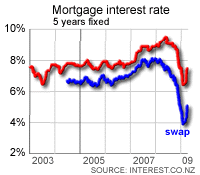 Another big reason for the big jump in wholesale rates was a rush by many home owners who were floating to fix their mortgages long, believing that long term fixed would start rising after almost a year of falling. I said in my Brother in Law's guide on March 13 that floating borrowers should go short for the cheapest rate now, but those who want to fix should look to fix soon. I have since firmed that up to say borrowers who want fixed rates should fix now. There was about NZ$15 billion of mortgages that switched from fixed to floating between September last year and March, according to Westpac in a research note, meaning the wall of borrowing that has to be financed in the wholesale market by banks is enormous if everyone raced for the fixed door at the same time. The effect on interest rates was magnified by there being a lack of supply on the other side of the door. During the global credit boom from 2003 to early 2008 there would have been plenty of foreign banks and investors willing to lend our banks the money through the swaps market. But that easy money has gone, as well as some of the 'market maker' intermediaries who helped build volume in the market from their bases in Sydney. The exit of the some of the foreign owned banks from this market has had a substantial impact. This partly explained why the 5 year swap rate rose from 4% to over 5% in the last three weeks. Full interactive charts are below and here (for bookmarking). The point of this detail about why long term interest rates rose is to reiterate that they are determined by supply and demand, not by Reserve Bank edict. Although to be fair to Bollard in his statement, he wasn't issuing an edict, more of a frustrated waft of advice. Embrace high interest rates Sometimes it's worth standing back and asking why the market is sending such price signals. New Zealand has a very effective set of automatic stabilisers that have served us reasonably well over the last couple of years. The rise in the New Zealand dollar from 2005 to 2008 helped soften the inflationary impact of a fast growing economy and a commodity price boom. The fall in the New Zealand dollar through late 2008 has softened the impact of a commodity price slump on export returns and increased the cost of imports at a time when we need to reduce our current account deficit. Long term interest rates are another one of these automatic stabilisers. When demand for capital and funds to spend or invest is high those rates tend to rise. When supply of those funds from overseas investors is weak then the fixed interest yields or rates rise (fixed interest price falls) to make it more attractive for foreigners to invest. This price signal is a crucial one for the economy. Essentially the price signals from two of our main automatic stabilisers, long term interest rates and the exchange rate, are telling us what we all need to know. Most of us know we need to know it. Some guess we need to know and others are in denial. But there is nothing so definite and motivating as a price signal. International investors, Mum and Dad depositors, financial institutions and the big soup of influencers that make up a market are telling New Zealanders to rebalance away from borrowing and consuming and towards saving and investing in productive assets. The pressures of a current account deficit running at 9% of GDP and a net foreign debt close to 95% of GDP are pushing up long term interest rates. The global shortage of easy lending across borders and the prospect of higher inflation in years to come because of heavy money printing and government bond issuance is also driving the market. Higher deposit rates will encourage Mums and Dads to spend less and save more. This means there is more money around to lend to business and others wanting to invest in productive assets. A lower currency is discouraging the importing of consumer goods and encouraging exports. It's also encouraging investing in assets that produce both exports, and goods that are import substitutes. Twin deficits The twin effect of high interest rates and a low currency is to encourage more foreign lending to New Zealand, to encourage more local saving, to discourage local spending and to encourage investing in export production. The end result, we should hope, is a lower current account deficit and a lower net foreign debt. Higher long term interest rates also discourage governments from running very big budget deficits. The problem with automatic stabilisers is that they can often be painful in the short term. Politicians hate them. The process of rebalancing our economy will be painful. Some people in consumer-focused and debt-driven industries, like retailing and residential property, will lose their jobs. GDP will fall for a time. That is already happening. My main point then is to say this adjustment must be allowed to happen. Alan Bollard may not like the impact on the economy in the short term and how it makes his optimistic forecasts look, but this is the signal the market is sending. We have a savings and debt problem. We need a long recession to fix it. There is no easy way out and the market is not wrong. The nuclear powered option I mentioned above is for Bollard to print money by buying back government and other bonds, therefore forcing down long term mortgage rates. This is exactly what the Bank of England and the US Federal Reserve are doing right now. Bollard himself was sceptical about either the need for such a 'quantitative easing' or the potential success of it when he spoke at length in the MPS press conference on March 12 about it. He even warned MPs in his session at the Finance and Expenditure Select Committee on March 12 of the 'very nasty' inflation problem likely to come from the money printing globally. He was right to be sceptical about quantitative easing and I doubt he would resort to it. If he did, all bets are off. I believe it would collapse the currency and actually not reduce long term interest rates that much as foreign investors rushed to the exits guided by a credit rating downgrade, and Mum and Dad depositors demanded higher interest rates. Here's a great interactive chart on wholesale interest rates.
We welcome your comments below. If you are not already registered, please register to comment
Remember we welcome robust, respectful and insightful debate. We don't welcome abusive or defamatory comments and will de-register those repeatedly making such comments. Our current comment policy is here.