
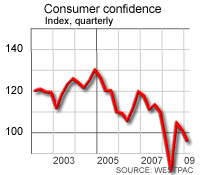
 The Westpac McDermott-Miller consumer confidence index fell to 96.0 in the March quarter, its second lowest level since 1998. The March result was down from 101.3 in the December quarter, with the lowest level since 1998 being in the June quarter last year (81.7), after Reserve bank Governor Alan Bollard had held the Official Cash Rate at 8.25% for 12 months.
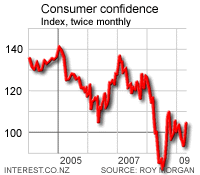
The latest Westpac McDermott-Miller consumer confidence index follows a similar line to an earlier Roy Morgan consumer confidence survey, which is released twice a month.
"The balance of economic news has been overwhelmingly negative since our last survey was conducted in early December 2008," Westpac Chief Economist Brendan O'Donovan said.
"Top of the list has been the rapid deterioration in global economic conditions. It has been almost impossible for consumers to escape the bad news from offshore, with nearly every day bringing another tale of woe from one of our major trading partners," O'Donovan said.
"Indeed for many of us it is hard to fathom job losses of 650,000 in one month, as was the case in the US in February. Nor is it easy to comprehend a 46% decline in exports in the space of a year, as experienced in Japan. Yet, at present it is these news stories we have to digest on an all too regular basis," he said.
"Back home, the economic news has been far less sensational, albeit still disturbing. Businesses are deeply pessimistic and expect to cut back sharply on investment and employment over the coming year; unemployment is on the rise; house prices continue to fall albeit at a slower rate; and lower NZD is putting upward pressure on the price of imported goods, including petrol where prices have risen around 14% since the survey was last taken in December 2008."
The Westpac McDermott-Miller consumer confidence index fell to 96.0 in the March quarter, its second lowest level since 1998. The March result was down from 101.3 in the December quarter, with the lowest level since 1998 being in the June quarter last year (81.7), after Reserve bank Governor Alan Bollard had held the Official Cash Rate at 8.25% for 12 months.
The latest Westpac McDermott-Miller consumer confidence index follows a similar line to an earlier Roy Morgan consumer confidence survey, which is released twice a month.
"The balance of economic news has been overwhelmingly negative since our last survey was conducted in early December 2008," Westpac Chief Economist Brendan O'Donovan said.
"Top of the list has been the rapid deterioration in global economic conditions. It has been almost impossible for consumers to escape the bad news from offshore, with nearly every day bringing another tale of woe from one of our major trading partners," O'Donovan said.
"Indeed for many of us it is hard to fathom job losses of 650,000 in one month, as was the case in the US in February. Nor is it easy to comprehend a 46% decline in exports in the space of a year, as experienced in Japan. Yet, at present it is these news stories we have to digest on an all too regular basis," he said.
"Back home, the economic news has been far less sensational, albeit still disturbing. Businesses are deeply pessimistic and expect to cut back sharply on investment and employment over the coming year; unemployment is on the rise; house prices continue to fall albeit at a slower rate; and lower NZD is putting upward pressure on the price of imported goods, including petrol where prices have risen around 14% since the survey was last taken in December 2008."
 However, O'Donovan said New Zealand consumers were less pessimistic than most.
"For example, confidence amongst US consumers is at a mind-bogglingly low 56.6 on their Index. In Australia, the consumer confidence Index is at 85.6. The divergence in confidence raises the questions as to whether NZ consumers are being staunch or whether they are in denial," he said.
"There are a number of plausible explanations as to why NZ consumers are not suffering such a bad case of depression. A key factor is the substantial stimulus coming to consumers via monetary and fiscal policy."
JP Morgan economist Helen Kevans said that "on the employment front, the outlook has deteriorated rapidly."
"Firms increasingly are shedding human capital to cut costs as the recession deepens. In the most recent NBNZ survey of business confidence, 87% of respondents expected the unemployment rate to rise and 29% expected to shed workers in the coming year, reaffirming our expectation that the unemployment rate will to rise to 7% by year-end, from a five-year high of 4.6% at present," Kevans said.
"Meanwhile, falling house prices, along with other asset price declines, have continued to cause massive wealth destruction in the highly leveraged household sector, where the debt to income ratio is 162%. In our view, house prices will continue to decline under still elevated (although lower) market interest rates and slowing net migration. The RBNZ forecasts house prices will fall around 20% by early 2010 from their 2007 peak, much in line with the 15% fall J.P.Morgan forecasts by end-2009, which will continue to dampen sentiment," she said.
However, O'Donovan said New Zealand consumers were less pessimistic than most.
"For example, confidence amongst US consumers is at a mind-bogglingly low 56.6 on their Index. In Australia, the consumer confidence Index is at 85.6. The divergence in confidence raises the questions as to whether NZ consumers are being staunch or whether they are in denial," he said.
"There are a number of plausible explanations as to why NZ consumers are not suffering such a bad case of depression. A key factor is the substantial stimulus coming to consumers via monetary and fiscal policy."
JP Morgan economist Helen Kevans said that "on the employment front, the outlook has deteriorated rapidly."
"Firms increasingly are shedding human capital to cut costs as the recession deepens. In the most recent NBNZ survey of business confidence, 87% of respondents expected the unemployment rate to rise and 29% expected to shed workers in the coming year, reaffirming our expectation that the unemployment rate will to rise to 7% by year-end, from a five-year high of 4.6% at present," Kevans said.
"Meanwhile, falling house prices, along with other asset price declines, have continued to cause massive wealth destruction in the highly leveraged household sector, where the debt to income ratio is 162%. In our view, house prices will continue to decline under still elevated (although lower) market interest rates and slowing net migration. The RBNZ forecasts house prices will fall around 20% by early 2010 from their 2007 peak, much in line with the 15% fall J.P.Morgan forecasts by end-2009, which will continue to dampen sentiment," she said.
We welcome your comments below. If you are not already registered, please register to comment
Remember we welcome robust, respectful and insightful debate. We don't welcome abusive or defamatory comments and will de-register those repeatedly making such comments. Our current comment policy is here.