
 On the face of it, the British government's second desperate attempt to bolster the UK banking system and jump start lending doesn't mean much for New Zealand's banks. Now that Lloyds TSB no longer owns National Bank, there aren't many direct or large connections between our banks and the British banks. Royal Bank of Scotland owns ABN Amro (the source of many of its problems), but ABN Amro is a relatively small investment banking and wholesale brokerage operation here, and part-owned retail broker ABN Amro Craigs should be relatively immune from the gyrations in London. The only bank of any significant size here with UK connections is HSBC. It was not involved in the announcements overnight and the UK makes up a relatively small part of its global footprint. There are some claims from a dissident shareholder that HSBC needs to raise capital because of its exposures to the sub prime and housing markets in the United States through its HFC division. But HSBC says it has plenty of capital and I haven't seen any independent observers questioning that.
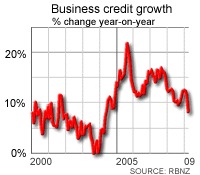
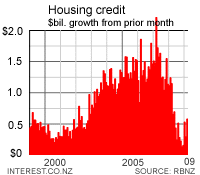 Unlike Britain's banks, New Zealand's banks are still lending, albeit at a much reduced rate. One of the reasons cited for the urgent measures announced overnight in Britain was that British banks have stopped lending to each other and to businesses and consumers, despite the various government guarantees and capital injections announced in October. New Zealand banks are still growing lending. Reserve Bank figures show bank and non-bank housing lending grew NZ$136 million in November, while business lending grew NZ$924 million in the month and farm lending rose NZ$372 million. We won't get the figures for December until the end of this month, but the anecdotal signs and the indications from home loan approvals numbers show activity was relatively robust after the 150 basis point cut in the Official Cash Rate to 5% on December 4. Mortgage, business and farm Lending growth in November from October was around 0.5% overall. Figures from the British Bankers Association show that corporate lending in particular has collapsed. Mortgage, personal and corporate lending in Britain grew just 0.29% in November from October. Corporate lending growth fell to 1.3 billion pounds in November from 50.7 billion pounds in October and a six month average of 18.7 billion pounds a month.
  British corporate lending has collapsed largely because the wholesale markets remain virtually closed. Prime Minister Gordon Brown also pointed ominously to the new problem of "financial isolationism" where foreign (often US) banks have sharply reduced lending across borders as they pull in their horns and scramble for survival rather than lending growth. British banks depended on foreign lenders for about 40% of its funding. This is where the connections between New Zealand's and Britain's situations become stronger. New Zealand's banks also rely on foreign wholesale funding for around 30% of lending, depending on how its measured. There have been signs in the last month or two that these markets were beginning to reopen to New Zealand and Australian banks. Our wholesale markets have been less affected by the Credit Crunch than those in London and New York, although our banks were still unable to raise longer term funds (anything more than a month or two). The Australian bank parents of our banks have been successful in recent weeks in raising tens of billions of Australian dollars through government guaranteed bond issues. This takes some of the pressure off our banks, who have also been taking advantage of the Reserve Bank of New Zealand's Term Auction Facility (TAF). This facility is designed to help tide the banks over for the next six to 12 months in case they struggle to refinance some of the short term foreign debt. The Reserve Bank has lent the banks NZ$6.1 billion through the TAF since it was launched on November 12. This includes lending against Residential Mortgage Backed Securities (RMBS) created by the banks from their mortgage books. This is the Reserve Bank's main tool to help the banks cope with the virtual closure of international markets to raise funding.
  This issue of "financial isolationism" is the most significant implication from last night's announcements in Britain. Gordon Brown's words on this are chilling. "The greatest risk after the events of the last few months is a retreat into what I would call financial isolationism," Brown told the Financial Times over the weekend in the lead-up to the announcements. Isolationism on trade, driven by politicians enacting tariffs and restrictions, was a significant contributor to the severity of the Depression in the 1930s. Now we are seeing a "financial isolationism" driven by bankers frozen in the headlights of trucks bearing down on them with tonnes of toxic debt. The final implication of the second British bailout is that there had to be a second one. Gordon Brown was lauded back in October for coming up with the 'solution' to the Credit Crunch when he pledged to spend 250 billion pounds providing various deposit and whole issuance guarantees along with capital injections, rather than insuring or quarantining toxic debt. The Brown approach was widely aped in Europe and the United States. Many thought it would be enough to stabilise the situation.
  But the scale of the second bailout and the sense of frustration evident in Brown's comments about banks not lending show that the Credit Crunch is entering a worrying new phase. Now the global recession and growing unemployment is creating a new swathe of toxic debt that has to be quarantined to create some transparency and rebuild the confidence of lenders. Most of the measures announced last night are unlikely to be needed here, or have already been put in place. The first and biggest one is an insurance scheme for toxic assets, rather than a 'bad bank' where the government or someone else takes over the asset and quarantines them. Essentially the banks are taking out a credit default swap with the British Government over these assets for a fee that has yet to be determined. There's no need that I can see for that here. Secondly, the British government is setting up a guarantee scheme for banks to issue asset backed securities over mortgage, consumer and corporate debt. This is an extended version of the wholesale guarantee scheme already in place in New Zealand, although it has yet to be used. Australia's wholesale guarantee is being heavily used. Thirdly, Britain is also setting up a 50 billion pound facility for the Bank of England to lend directly to corporates, effectively short circuiting the financial system to get around the British bankers frozen in the headlights. New Zealand doesn't have this yet and there appears little need for it while business lending is still growing. The Reserve Bank has said it will accept commercial paper as security, but only when lending to banks. It has yet to decide to lend directly to corporates. Finally, the British government is converting its preference shares in Royal Bank of Scotland (RBS) into shares, increasing its stake to 70%. In return, RBS has promised to keep lending to small businesses and households at 2007 levels, while increasing lending to businesses by 6 billion pounds. New Zealand is nowhere near having to do anything like this. Our banks did not go on the sort of wholesale debt funded acquisition sprees of investment banks that RBS embarked on over a period of years before the Credit Crunch destroyed investment banks and the sort of wholesale debt funding used heavily by RBS. Ultimately, the implications for New Zealand are indirect, but important. The British measures show the global financial system remains volatile and unstable. Our dependence on foreign wholesale funding means we remain vulnerable. The impending decision by Standard and Poor's about whether to downgrade New Zealand's credit rating (it is on review for downgrade) has increased our vulnerability. Our Reserve Bank still has some weapons up its sleeve, including slashing interest rates, quantitative easing (money printing), lending directly to corporates, and massively increasing the size of the TAF if the situation deteriorates further. We can only hope Gordon Brown's latest attempt at stabilising the core of Britain's banking system is successful. If the bankers in London remain frozen in the headlights and their counterparts in New York continue to shy away from lending across borders then we have not seen the last of the turmoil that is now hammering the real economy.
We welcome your comments below. If you are not already registered, please register to comment
Remember we welcome robust, respectful and insightful debate. We don't welcome abusive or defamatory comments and will de-register those repeatedly making such comments. Our current comment policy is here.