
The comment stream

Join the Interest community to be a registered commenter so you can:
- Edit your comments
- Avoid the CAPTCHA
- Vote on comments
Register Here

Already registered? log back in here ..

Forgotten your password? No problem! Click here

Finance sector jobs

Senior Liability Underwriting Manager
Lead from the front utilising your strategic, technical and leadership qualities within th...more
New Zealand
Senior Liability Product Underwriter - Product Management
Lead from the front utilising your technical expertise in this highly attractive senior li...more
New Zealand
High Performing Senior Liability UnderwriterHigh Performing Senior Liability Underwriter
Customer focus, high performance, exceeding client expectations and achieving profitable g...more
New Zealand
Manager Operational Effectiveness and Assurance IT
Reporting to the Senior Manager Operational Risk Effectiveness and Assurance, the key focu...more
New Zealand
efinancialcareers.com

Reader poll

Should you fix your mortgage now or stay floating?

Choices

Butter price drops 12% in fortnight as payout below NZ$5/kg possible

Posted in News

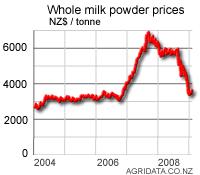
Fonterra's dairy payout for the current 2008/09 looks set to drop below NZ$5/kg from NZ$7.66/kg last season and well below the current official forecast of NZ$6/kg as dairy commodity prices have collapsed in recent weeks at the same time as the currency has firmed from 52 USc to 60 USc. Prices announced last night by the US Department of Agriculture show Butter prices fell 12% to US$2,150 a tonne from US$2,450 two weeks earlier, and are down from US$4,050 a tonne just 5 months ago. The fall in skim milk powder prices to US$1,950 a tonne from US$2,150 a fortnight ago reinforces the trend. New Zealand dollar prices have fallen even more because of the New Zealand dollar's recent rise. Weak demand from China and India, and strong supplies from the United States and Australia are helping to drive prices down.
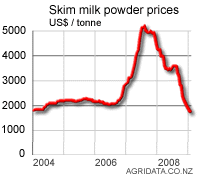
Using the latest prices and a NZ dollar at 60 US cents, the Agrifax Fonterra payout calculator suggests a payout range of NZ$4.99 to NZ$5.09. * This article was first published earlier today in our daily subscription newsletter for the banking and finance industries. The email costs NZ$365 per annum and carries exclusive news and analysis for New Zealand banking and finance industry executives, regulators and investors. Sign up for a free trial here.

We welcome your help to improve our coverage of this issue. Any examples or experiences to relate? Any links to other news, data or research to shed more light on this? Any insight or views on what might happen next or what should happen next? Any errors to correct?

We welcome your comments below. If you are not already registered, please register to comment in the box on the right or click on the "'Register" link at the bottom of the comments. Remember we welcome robust, respectful and insightful debate. We don't welcome abusive or defamatory comments and will de-register those repeatedly making these comments.

52 Comments

Bernard - very timely. Do

Bernard - very timely. Do you happen to know how much a $5 payout removes from the rural economy as compared to a $7.60 payout in absolute terms? I would estimate in total that would be several billion NZ$ less into the rural economy in 2009 as opposed to last year? (barring an almighty resurrection)

I am betting that there is not a single dairy farmer in NZ who will have budgeted on recieving anything remotely as low as $5/kg in the next payout (or 30% less than in the previous year). I wonder what is going through the typical Rural loans managers head at the moment, particularly as land values have stalled and farm sales volume has plunged. Another hat tip to Andrewj on this developing story.

Andy, Fonterra farmers are likely

Andy,

Fonterra farmers are likely to produce around 1.25 billion (corrected from million) kgs this season, assuming we don't have another drought. A NZ$2.60/kg reduction would suck about NZ$3.25 billion out of the New Zealand economy on the first go around. That's about 1.8% of GDP. There would be multiplier effects. Not good.
cheers
Bernard

This from a contact in

This from a contact in Australia

Dear Folk,

Keeping you informed.

Yesterday the major Milk Companies 'Murray Goulburn' and 'Fonterra'
announced amended Milk Prices effective as of 1st Jan '09, ie. 40-60% cuts.

Some Dairy Farmer clients have faxed in the newly amended Cash Flows, and
milk price has dropped from earlier forecasted prices of 40-50 c/L down to
27-28 c/L for Jan/Feb '09, climbing back to 30-34 c/L for March-June '09.

Market prices for Dairy Cows has reportedly dropped overnight.

In my view Milk Companies will need to close marginal factories and reduce
operating costs, and not place all of the financial pressure on Dairy
Farmers.
And, unless Milk Prices can be clawed back up, there would not be a Dairy
Farmer in Australia that could currently operate viably at these amended
Milk Prices.

Ho Hum!!!

Cheers for now,

Leon A. Martin BAgSc(Hons) MD Grosvenor Range Pty Ltd
International Agronomy, Research, Agricultural, Environmental And Livestock
Consultancy

Long term average prices are $4.70 we are going way below this!
Andrew
A friend purchased a dairy farm in Aust this year at$6k an acre their dairy farm debt is minimal, we are in deep trouble. Our debt level wont work at these returns. Its all about debt and we have too much to put it nicely.

This a loss of around

This a loss of around $250k per average 500 cow herd.Working on $5kg ms (actual payout) vs $6.9kg ms (Financial Budget Manual 2008. budget payout). This is only a $1.9 drop as anything greater ie Bernards $2.6, fonterra will have to fund out of borrowings to support its suppliers. Hence issue of bonds. We can only hope that things rapidly improve. I would guess that fonterra are "exploring the option" of captalising some of this debt. If things don't improve) The do have a model that they put on this that has been put under the farmers noses and delicined. Maybe it needs a dust off and given it to Bill as a vechicle for the govt. to by shares in fonterra and support the farmers. Land corp. can assist with management. Or is it subsidation.?

Land corp. can assist with

Land corp. can assist with management.

Steve I take it you are Joking?

Im laughing.

Well, I am assuming that

Well, I am assuming that most dairy operations will have enough equity to burn 12-18mths at these levels of income. If things do not come right I guesstimate about 20% of NZ Dairy farms will have an unviable bussiness model - too much debt. New conversions, farmers starting into their farming bussiness or expanding, and bold corprate dairy investors will feel it worst. Earlier in the year the rumor mill ran riot with talk of a $10 payout if the dollar was to fall. I know of a farm sold for $5m with one fly by of the helicopter. I talked to bankers who said "we don't need to worry about doing bugdets - these guys equity position is so strong, its all about capital gain. Cashflow is secondary."

I bet they are looking a little harder at budgets and cashflow now.

These are going to be very tough times, I would expect some farmers to walk away from their operations. Someone has to run the farms. Would you buy a farming operation with a negative ebit in the hundreds of thousands of dollars? Worst case is that landcorp may end up managing these properties that the government will own by default.

NOT FUNNY

Steve L Landcorp's dairy investment

Steve L

Landcorp's dairy investment must be looking pretty sick. I dont see any need for a govt corporation to become involved in this problem, the market will fix it ,debt needs to be repudiated. New farmers are waiting for the chance to purchase land, Landcorp is just as guilty as any dairy farmer for the crazy prices paid for land. Landcorp will nationalise NZ. National has admitted that it intends to sell Landcorp pity it wasn't done sooner.The only money Landcorp makes is Capital gain ,its farm management is excellent but at a board and corporate level its appalling, a place political favor's end up.
Why should the Govt own by default, its not the taxpayers responsibility to stand behind shoddy lending practices by the likes of W-PGG and National. The banks have already had a handout in the form of a taxpayer deposit guarantee you are talking way beyond this.
Dairy debt at $22 a milk fat solid means many large scale indebted farms are history. Debt is going to be a major. You are talking of a 500 cow herd losing 250k a year, this before debt servicing?

Govt. deposit gurarantees allow banks

Govt. deposit gurarantees allow banks to swap securities (mortgages) for cash, (correct me if I am wrong). So the banks may swap mortgages on these operations that are over indebted with the govt. to sort out and get paid for it? Kind of like the US toxic loan buyout, but nastier because its here in NZ, and its 25% of the NZ's earings - gone.

It cost $4-5 dollars for a dairy farm to produce a kg of milk solid, old school way of low input, pasture based system. High equity, low debt.

High production systems using latest intensive, high input methods push this up by another dollar or so (urea,palm kernel, tapioca, feed pads, in shed feeding systems, maize bla bla bla). Highly geared, high debt.

New farmers are not wiating for the chance to get into farming, its like looking for new house buyers in the residential maket, cheap loans have sucked future potential purchasers into the market early (last few years).

At current pricing levels for dairy there is no ebit for debt servicing, so the bussiness cannot suppot any debt. If you were given a farm, with stock and plant for free, no debt, the farm working expenses will be more than the gross farm income, you will still lose money. Sheep and beef farmers have had this problem for years and have only been able to exit the industy, or borrow more debt because of high dairy prices holding up the land market.

$250k loss of earnings, about $500 per cow, projected figures around 2m cow getting milked in the next few years, NZ Dairy income down about $10b, p.a. (check my figures please)

Steve You are wrong about

Steve
You are wrong about deposit guarantee its a straight govt guarantee of deposits( for what its worth) In accepted institutions.
this from the market ticker.

Yesterday we closed at a historic low, and early indications today are even worse, at 21.20 The IRX, or yield on the 13 week T-Bill, is essentially zero.

One cannot argue one simple fact - Bernanke hasn't yet started buying the long end of the curve to any material degree. But he's been threatening, and today the FOMC statement made explicit what had been whispered before.

The mouth-breathers were all over CNBC and elsewhere yesterday and today claiming that this would "stabilize" the credit markets and make credit (and the economy) better, with the most outrageous displays of stupidity being put forth by Cramer and McCulley of PIM(p)CO.

Yeah, right.

Now let's take a more cynical, but realistic, view.

Remember last year. Oil went from $60 to $150 in the space of a few months. Why? Because it was no longer profitable to buy CDOs and RMBS, as they were imploding. The money has to go somewhere, and so traders bet in front of what they believed Bernanke would do - crank down interest rates at an insanely-accelerated rate, which would spike prices in commodities, as the economic slowdown had not yet occurred - and wouldn't for several months.

They were right. Bernanke did it, oil shot the moon and Goldman (and a few others) made a whole bunch of money.

Who paid?

You did, by paying $4/gallon for gasoline.

Now let's back up a bit. 2003, to be exact. What happened? Greenspan (and Bernanke) played the same sort of game and house prices went ballistic. A handful of people made fortunes securitizing various mortgage and other "assets" into complex (and opaque!) securities, foisting them off on the world.

Who paid?

You did, by overpaying by 20%, 50%, 100% or more for a house.

Ok, so the housing bubble collapsed, then the commodity bubble collapsed.

Now we've got people who for the last month who are once again front-running Bernanke's playbook, which he was convenient enough to publish in advance as his doctoral thesis. They are buying the long end of the Treasury curve not because they think that a 2.35% yield for ten years is a reasonable rate of return over inflation, but rather because they expect The Fed and Government to drive prices higher than when they bought the securities.

That is, they're after capital gains, not yield or "coupon", and are specifically gaming the government and Fed.

Who's going to get the bill this time?

You are!

How? Simple. Treasury seems to think they can issue essentially limitless debt to bail out banks and others, having committed nearly $7 trillion thus far. Most of that has been issued through various short-term paper which has a near-zero (or actually zero!) interest rate - that is, up until now that debt issue has been essentially free!

What happens when this bubble bursts?

You think it won't? Like hell it won't. And when it does - that is, when Mr. Market calls the bet and forces Bernanke to actually make good by starting to unload all these "accumulated" Treasuries into his gaping maw, we will see "shock and awe" of another sort.

See, if the selling starts rates go up. To stop that Ben has to take up the supply. This causes him to print more money (expand his balance sheet) which means that the full faith and credit he relies on is further damaged. That in turn causes more people to get the idea that they better sell now which in turn causes him to buy more which.....

Remember the waterfall in September and October in stocks?

The same thing can happen in the Treasury market, and if it does it will force a political decision to be taken - risk the destruction of the dollar and our government or remove - by immediate statutory change (and force if that is resisted) The Fed's authority.

The argument keeps being made that "we had to do this" to save the system. But what's not being talked about is what the real problem was, and who we're trying to save.

The political class keeps trying to tell us that "we have to do this for mainstreet" and "we have to help homeowners."

Oh really?

Let's look at a few facts, shall we?

First, total mortgage debt outstanding. Its about $14 trillion dollars.

With the $7 trillion dollars we have committed we could have literally given every homeowner with a mortgage a fifty percent reduction in the principal outstanding.

This would have instantaneously stopped all of the foreclosures by putting all (essentially) homes into positive equity - overnight!

So why wasn't this done?

Because the goal was never saving homeowners or Main Street.

In point of fact the problem that the government is "trying to solve" is instead the unregulated bets that were made in the OTC CDS space which were backed by exactly nothing; there was no capital behind any of these bets!

There is no fix for this problem; your leverage is effectively infinite if you have no capital behind your positions. You are limited only by your testosterone level and there's been far too much of that on Wall Street over the last decade.

This was not an accident; in fact Henry Paulson himself lobbied for the removal of the previous leverage limits as I have noted when he was Chairman of Goldman Sachs. Between that and the complete refusal to regulate anything or anyone by the SEC, OTS, OCC, The Fed or anyone else we have built what amounts to a pyramid scheme based on nothing other than debt.

What Bernanke and Paulson are in fact trying to do - and what they have been trying to do since this crisis began - is paper over the bad bets that companies like Citibank, Lehman, Bear Stearns and AIG made with zero (or nearly so) capital behind them.

That is why we have committed $7 trillion dollars, it is why Paulson keeps changing how the "TARP" is going to work and what it is going to do, it is why AIG has gotten bolus of money after bolus as its bets have deteriorated further and in fact it is why The Fed took the arguably-illegal step of buying the assets against which AIG wrote the bets (so it could null them out; you own both sides of a bet there is no bet at all - but the loss on the underlying is now yours!)

The problem with this strategy is that it hasn't changed a damn thing, because with the exception of Lehman (which was allowed to blow up) these contracts were never extinguished; a loss is a loss and when you own both sides you're guaranteed to be the sucker who eats the grenade. All we have done is change where the leverage lies; we have taken the 30 or 50:1 leverage from the investment and commercial banks and moved it onto the balance sheet of The Federal Reserve!

This explains why The Fed is "resisting" Bloomberg's FOIA and has forced Bloomberg to file a lawsuit; laying bare the "assets" being held would allow independent evaluation of their value. This is extraordinarily dangerous to The Fed because if "we the people" (or worse, foreigners who have loaned us those trillions of dollars) were to get a look inside these "assets" and found that they were in fact so-called "AAA" mortgage bundles that have forty percent default rates embedded in them (as was found in one particular WaMu securitization I and Mish Shedlock were writing about earlier in the year) fair-minded people might conclude that The Federal Reserve is in fact broke and lying about their own solvency!

What other possible explanation is there folks?

Why keep something secret unless disclosing it would be embarrassing - or worse?

The Fed is not an independent, private entity. They are literally charged with maintaining the currency that represents the future output of every American. That is, their "stock in trade" is actually your willingness to get up, go to work, earn money and thus pay the taxes that underpin our currency and monetary system.

No taxes, no Treasury, no Government and no dollar.

Now tell me again why you're willing to get up and go to work when the organization that is effectively taxing you through these policies won't tell you how much you're going to be paying and the truth about why?

Here's yet another problem on the "unintended consequences" side, beyond the fact that the market can (and will) call Bernanke's bluff to buy "everything and anything" - its that there is no longer any reason whatsoever for you, or anyone else, to keep money in a bank account or Treasuries when the rate of return is in fact negative.

That's right - as of today there are money market accounts that have negative yields, and yet those funds are critical to the commercial paper markets.

What's Ben going to do about that little problem?

He can't force people to keep their money in an "investment" that has a negative return! And yet that is precisely what Bernanke did today - he guaranteed that virtually every single money market account across America will be decimated with withdrawal requests in the coming days and weeks.

And why not? Why would you be so stupid as to keep your money in an account that is guaranteed to lose not just value but actual principal?

We all "tolerate" inflation's cost on our funds - mostly because the vast majority of Americans don't understand it.

But everyone understands seeing their brokerage statement with a so-called "money market" that is actually going down in value every month!

That's going to last all of about one day beyond when the first statements go out that contain these losses, and will cause an instantaneous run on money market accounts across the United States. Those firms that decide to "eat" management fees to avoid this still will find themselves with a zero return which leads one to start wondering why they're giving someone use of their money for nothing and how long those firms can operate cash-flow negative before they blow up.

And that leads us to the next question - how many more Madoff's are out there? The "bezzle", as it is called, is the underlying embezzlement that is always present in an economy.

Bluntly, someone is always stealing - its part of human nature.

In good times this theft is just thought of as "shrinkage" and people tend to ignore it, because while it does count the total amount of money lost is small compared to the total profits. It can be hidden and often is - nobody is the wiser (other than the thief, of course, who is doing quite well.)

But in bad times these losses compound upon economic losses, and suddenly "the bezzle" becomes evident to everyone. The thieves try to maintain the patina of normalcy but to do so they must steal a greater and greater percentage of the principal that remains until finally the books are laid bare and there is literally nothing left.

That's what happened with Madoff and yet the SEC and other regulators were told as far back as 1999 that it was going on.

They ignored it because, well, times were good and exposing this scam would have been "embarassing."

Is your broker a Madoff?

How do you know? Is your 401k safe? Your IRA Trustee? Your online brokerage account? Is there any reason to believe it is, and any way to know it is, when a $50 billion apparent swindle goes unchecked and unstopped for ten years despite multiple written warnings sent to regulators?

Confidence? What's that? How can I reasonably know that any investment house - no matter who they are - is clean?

I can't, and that's a problem that can't be accounted for with classical "bankers theories" or "a doctoral thesis." Confidence, once destroyed, is rarely ever fully recovered.

Ben thinks he has this economy and market problem all figured out.

Unfortunately his thesis failed to account for all the unintended consequences thus far, and will continue to do so, because Ben suffers from the same sort of bloated-head syndrome that is endemic among academics - they believe they can say something and make it so as a consequence of their "degree."

The real world laughs at such hubris and severely punishes the fools who persist in their beliefs despite being proved wrong - especially when it happens more than once.

We are now in the end game; Treasuries are the last bubble, and when it bursts, we will find ourselves in a Depression that will make the 1930s look like a Cakewalk.

Bernanke has gone "all in", and he holds 2-7 offsuit.

He needs 7-7-2 on the board or he's dead.

You run the odds, then figure out what you need to do.

I am no longer looking at a 1930s scenario as my base case; that has shifted to the panic of 1873, which was far worse than the 1930s and included widespread civil unrest. Go do some reading - and make sure you're sitting down. The parallels in the foundation of how that panic occurred - industrial shifts (US >> China) and insanely-loose mortgage credit (European in particular) are stunning - and troubling.

If Bernanke won't cut this crap out Congress needs to do so, and do it now. A replay of the 1873 Depression in today's society will be catastrophic, with unemployment reaching 30% or more and leaving essentially everyone - corporate or otherwise - carrying any form of debt wiped out. Deficit spending will become instantly impossible; go figure out what that does to the Federal Budget.

We are running out of time to stop that outcome and if effective action is not taken before the Treasury Bubble pops it will, quite simply, be too late. That Genie is not the friendly sort, and once he pops out there is no stuffing him back into the bottle.

There will be more on this in the Year In Review And Look Ahead Ticker, due out in a couple of weeks.

Here's hoping the bluff doesn't get called before then.

Gezzz you must be able

Gezzz you must be able to type fast! Could take some time to read thru that lot. I realy was hoping 30's depression was worst case, but while I can't fully understand every thing in your post (yet) I can fully apreciate that things are bad. I think I'll go and spend some time with my kids in the yard.

The RBNZ released the December

The RBNZ released the December bulletin yesterday

http://www.rbnz.govt.nz/news/2008/3514594.html

Discusses the difficulty NZ banks are having in getting their hands on international dosh

SteveL that came from here

SteveL

that came from here http://market-ticker.denninger.net/

My typing stinks

Gibber
That is a grim read

The NZ government has to

The NZ government has to make some decisions about which industries it wants to keep afloat through this global crisis - just as the US has made decisions about its financial institutions and now its motor vehicle manufacturers. What do you guys think of agricultural production subsidies? Presently, the Government's plan is to subsidise the construction industry through bringing forward infrastructure spend on urban roading and broadband - whereas Fed Farmers has suggested targeting that infrastructure spend on water storage initiatives.

What do you think of providing relief to productive rural landowners by way of local authority rates rebates (the more productive by some equation the greater the rebate - in other words a means to discourage stock decline).

Where the government intends to subsidise insulation retro-fit of urban dwellings - how about it similarly subsidise productive rural landowners into micro-hydro, wind and other energy generation infrastructure projects.

Another idea would be to put in place a certification programme which directly subsidises animals on per head basis where farm businesses have made a binding committment to an agreed nitrogen budget, as well as a waterway planting/fencing plan and hill country erosion mitgation plan.

I just think this National government hasn't realised that NZ's future is in it's environment. They seem to want to direct spending on environmental degradation as opposed to restoration. I'd really like to see farmers take up the idea of getting subsidised to clean up the countryside in a way that sustains their industry as well.

Kate, I despair. You have

Kate,

I despair. You have concerns about the environment, but don't want to discourage the excessive use of resources needed to maintain stupid levels of high marginal cost production that cost farmers profit. Then to throw more resources at mitigating the resulting environmental damage. Why not cut the production intensity, save the environment, and make more money?

Please read The Marginal Cow III and let me know if still you maintain your production orientation: http://www.agprodecon.org/

AndrewJ It would be 'better'

AndrewJ

It would be 'better' to put a link in rather than cut and paste, you could be accused of plagiarism, Denninger wasn't it?.

Neven

PeterR, I couldn't agree more

PeterR, I couldn't agree more about the harm to the environment from 'dirty dairying' and agricultural intensification. And yes, I imagine alot of the recent conversions to dairy are hopelessly marginal in terms of economic profitability and environmental sustainability. And am pleased that the recession/depression will actually give the environment an opportunity for a breather as we de-tensify production. Would be delighted to see the Central Plains Water Scheme, for example, scrapped as it (hopefully) becomes no longer economic to consider the project.

But then our traditional dairying areas - Waikato and Taranki have caused untold environmental harm and as farmers will be less busy as they downsize their stock, why not given them positive incentives to speed up environmental restoration?

NZ is dead in the water without agriculture - and we have to manage the transition from intensive to sustainable farming.

Neven911 I couldn't get the

Neven911
I couldn't get the link to work as the article was 4 days old and it always came back to his latest, so I had to paste. I mentioned twice where it came from. Not much more I can do than that

Kate, The correct production intensity

Kate,

The correct production intensity makes economic sense - the level of production depending on demand and whether we are in a boom, recession, or depression. That for NZ dairy with costs circa 2008 a reduction in production intensity would make economic sense even if we were still in a commodity boom paying in excess of $7.00 per Kg MS says something about how excessive our production levels have been.

It would be good to think that production intensity might reduce in response to falling prices, but farmers (NZ or most country's) responses to lower prices are normally to produce more. In NZ farming your way out of trouble is an iconic response. Any number of commentators - Bernard and Roger J Kerr included - have suggested we will have an export i.e. primarily agricultural, led recovery.

Supporting increasing production will be all politicians, the RBNZ, TSY, MAF, Agresearch, Fonterra, universities, banks, PGG Wrightson, members of the REINZ, a raft of suppliers, consultants etc., and a fair chunk of the public.

The science and economics behind NZ agriculture reducing production intensity are sound, but it may not happen. The ideas are not new, but NZ has managed to avoid addressing them for years. There are clearly systemic issues involved when you have near universal support for increasing production when it makes an already bad situation worse.

Think of the implications of reducing production intensity. What does it do for Agresearch's vision of doubling production at half the cost by 2020? How does it make Farming Systems Uruguay's strategy of exporting our high intensity production look? Those who have invested in dairy farms on the basis of capital gains from increasing production wont be happy. Does the growth strategy Fonterra followed till 2006 seem sound? Would Fonterra survive the redemption of shares from reducing production intensity?

Producing more in the face of declining demand and prices may be a stupid idea, but producing less threatens the expectations of an entire industry.

Just like housing - most

Just like housing - most debt will lie with the minority. A good portion of Farms are passed down and built on from generation to generation. My old's and their siblings all own multiple farms with bugger all debt. They are all part of the empire started by my great grandfather. They would own well over 10,000 acres between them now

Craig, time to bring some

Craig, time to bring some wealth tax, including tax on family trusts, I suppose.

Fonterra payout to be $5.

Fonterra payout to be $5.

I would say that is a best case scenario

The small Westland Dairy Co apparently has just announced a projected payout of between $4.20 and $4.60, and Westlands payout to its farmers is generally higher than Fonterra's payout.

Some banks were lending on a $6 payout so there is some fallout to come there.

This reduced payout will have massive effects on the NZ economy. There is not one area of the economy that is doing well and the news just keeps getting worse.

I guess the good news is dropping fuel prices and lower interest rates.

Seems to be taking a long time for these lower costs to start being reflected in lower food costs at the supermarket. Butter is still about $3.70 for 500g
in the shops and prices have dropped by more than 60%. that is just one example. Someone is making a lot of money at the consumers expense.

Hi Allen - can I

Hi Allen - can I ask where you saw the payout figures for Westland? - that is an amazing collapse because just a couple of months ago they were forecast $5.20-5.50???

Its cyclical .......banks will need

Its cyclical .......banks will need to grow a set of balls not collapse anything and ride it out.
Funny how only a few months ago there wasnt enough food to feed the world and Oil was heading to $200 a barrel.

Andy, For projected payout info

Andy,

For projected payout info try this, or others under farming:
http://www.trademe.co.nz/Community/MessageBoard/Messages.aspx?id=3222401...

sam.p - farmers already pay

sam.p - farmers already pay tax, family trusts pay tax as well. They have had to pay tax for decades now.

If they were to sell their farms then they would pay tax on any depreciation recovered. Any gains over and above the original cost of the asset is non taxable. GST is payable where a farm is not sold as a going concern.

If they transfer the farm to another entity then those assets are transferred at the original cost and tax is paid on depreciation recovered.

Scary stuff... The problem is

Scary stuff...

The problem is that planning for dairy farmers cannot turn on a dime.. and all my neighbours are locked into high cost suppliments/ fert and high cow numbers based on last years prices. AND things are looking DRY, and its only December.

What shocks me is how FAST things change. I would never have believed oil could fall so fast.. I was convinced that we were in for high fuel prices for the rest of my life. I was also stunned by the leap in value of the NZ$. They were predicting below 50c.. and so it jumps to 60c. You can plan for this?????

May you live in interesting times.

Peter - many thanks for

Peter - many thanks for that, some fascinating comments 'from the frontline'. It is clear that there won't be a dairy farmer in the country who has budgetted on payouts for 2009 of say $5/kg, so the implications are clear.

Kate et al: Gummint picking

Kate et al: Gummint picking winners? Even with the relatively fresh and well-neuroned crew now installed?

You...Have...To...Be...Kidding

Oops (kid values are in the toilet too, along with lamb, calf and baby Ostrich).

You're suggesting liberal doses of Other People's Money (like, ours) as the one-size fits-all Solution.

Again.

Sigh.

Nick, Ian, Andy, The speed

Nick, Ian, Andy,

The speed of change is very fast, but the trend in what is happening was predictable and inevitable. Treasury and MAF were aware of the possibility of the current scenario from 2006, but chose to deny that there was a bubble in agriculture. Perhaps they couldn't accept the idea because they were part of the bubble.

Farmers can't turn production on a dime, but with an understanding that bubbles are cyclical and usually symmetrical they could have adapted to lower risk strategies. Some will have, but most will probably be caught to some extent.

This is where the lack of guidance or direction provided by industry leaders and government agencies is a disgrace. Andrewj has been calling these events months ahead of them occuring, but the full time specialists didn't even warn of their possibility.

Waymad, the well neuroned crew

Waymad, the well neuroned crew has already picked some winners: broadband and roads. The legitimising narrative for spending our money with those winners being that this type of infrastructure spend will assist GDP growth.

Point being, Gummint's are always picking winners. The question is are broadband and roads the right choices. Where my tax dollar is concerned I look at it as to whether I'd rather our taxes are used to prop up ditch diggers, or farmers or some other productive sector. My preference is to subsidise environmental restoration, and a great deal of the degradation happens on private agricultural-use land.

Apparently Fonterra has a stockpile

Apparently Fonterra has a stockpile of over a million tonnes of milk powder. Are they sitting on it waiting for the price to rise, brave move in a falling market.

In the meantime what does that do for their cashflow, or is that what the $300 million they are looking to raise is for, so they can afford to pay their farmers

They would be better off doing away with the hair brained auction system they use where the latest auction price starts 15% below the previous sale price. Great if the market is rising as then the price has to climb 15% to better the previous sale price.

But I think we are seeing what happens in a falling market, the 15% drop is already built in to the next sale price.

Talk about Madoff. Fonterra has "Made off" with the farmers money

I heard Aussie farmers have

I heard Aussie farmers have had their payout halved in the last few days. A lot of farmers will be fine, they are old hands at this. Prices go up, prices go down, its frustrating but you get used to it.
I'm afraid the ridiculous screaming from certain quarters that the world was starving and product prices were going to go through the roof and stay there will have suckered a fair few in the industry.
Last year personally I knew a number of farmers whose accountants told them they had to spend some money, so buy residential real estate. Yes, they fell for it. Weeks later the drought started. The money needed to feed stock had gone. Invested in the sure bet. Real estate.
Still, as I said before there are plenty of farmers who arent stupid, but yup blood is gona be spilt.
In my dealings with dairy, with the huge lift in fixed costs over the last 12 months,a $6 payout was a struggle. Many were carrying losses from the 2005 and 2006 seasons. I know of a new conversion that could not make $7.90 work.
New conversions or sharemilkers bought herds last year for $2500 per cow, crazy, usually good cows are to be had at $800 - $1200. Then losses were extraordinary this spring. Metabolic disorders, after the feeding of palm kernal, combined with drought,
killed off loads of cows.
Do I have any sympathy for many of these farmers, no. Cows have become chooks. Not much different really.Like battery hens. Its a numbers game, greed. Corporates dont care about the animals involved or the staff that actually milk the old girls. I could ramble for hours about this. There are great farmers out there, but the whole game has been taken over by greedy suits. And some farmers have become greedy suits.
I guess you could say the chickens have come home to roost.

Allen, Can you provide some

Allen,

Can you provide some support for Fonterra having a stockpile of a million tons of milk powder? That would represent about half NZ's annual dairy production. At USD 2,000 per tonne, about NZD 3.5 billion worth.

PeterR I have nothing concrete

PeterR

I have nothing concrete about the million tonnes, except that I heard it from the same source that told me about the Westland payout.

I am sure that a bit of digging will find that it is not too far away from the truth. R Fonterra building any warehouses,

They are not building one

Milk powder stacked to ceilings

Milk powder stacked to ceilings in warehousing everywhere. Common knowledge amongst fonterra staff.

I think 60 cents on

I think 60 cents on the USD/NZD assumption forgets that these guys probably hedged at a higher rate some time back. it'll be interesting to see how much they are out of the money and what the final payout is.

I think that pricing is

I think that pricing is only half of fonterras problems. It looks like they can't sell volume even at the lower pricing.

Time for kiwibank to get into rural lending? It could buy back the loan book off Nat.ANZ that was sold as the "Rural Bank". This will help, the cockies with more direct cheaper finance from the Govt.

Time for a Capital gains tax as well.

Its somewhat surprising that commentators

Its somewhat surprising that commentators and the media generally have not to date made any assessment of the "bubble values" that are currently evaporating globally. I have attempted to provide a "sketch" of this within the Open Lettter to Bernard Hickey on Global Deleveraging" (access article in left column above). At best - this cold only be described as a "sketch".

Then asking the question - what realistically can Reserves / Treasuries / Governments do to arrest these major readjustments? Its very clear to me that there is not much they can do in this regard - and that throwing money at these issues in attempting to bail out everything in sight will only worsen / prolong the problems.

We certainly do not want to be repeating the current policy mistakes of the Americans. In any event - we do not have the capacity to do so.

It is to be hoped that the Key Coalition Government here in New Zealand will recognise this - and keep its focus on the real structural issues, to ensure that New Zealand deals effectively with the real issues and is in a stronger competitive position going forward. Our internal cost structures and costs of government are clearly excessive.

Hugh Pavletich
Performance Urban Planning
www.performanceurbanplanning.org
Christchurch
New Zealand

Butter and Milk solids are

Butter and Milk solids are going to be lucky to stay above the $4.00 kg mark because aside from supply/demand/credit issues, Fonterra will be responsible for compensation yet to be paid to hundreds of thousands of Chinese affected by the melamine scandal.
http://edition.cnn.com/2008/BUSINESS/12/27/china.milk.compensation/index...

China's dairy association announced yesterday, that 22 dairy companies will pay compensation to hundreds of thousands of the victims. No figures were released as to amounts. Six children died and more than 27,861 children are still being treated in hospital. Fonterra is the largest shareholder, at 43%, in Sanlu, a company at the heart of the scandal. Purchased by Fonterra in 2005 for $150 million US, Sanlu is China's biggest milk producer with an 18% share of the market.

Fonterra will be responsible for a huge portion of the compensation, something not yet figured into the price of milk exports.

Bernard, you got your millions

Bernard,
you got your millions and billions abit mixed up! NZ cow cockies are set to produce around 1.25 billion kg milksolids this season - ouch! Need to move your decimal point over a few places!

I didn't do much better quoting 2m milking cows in NZ, reality is double that to 4m cows.

End result is much, much, much worse. say $20 - 40b out of the NZ economy.

http://www.fencepost.co.nz/news/detail.jhtml?ElementId=/news/repository/...

P.S. I just love the way that realestate agents/commentators say that a drop in interest rates will fix all of the above, come on!

The European Food Standard Authority

The European Food Standard Authority have delayed publishing their report on the disputed health risks of A1 milk, could their be an even bigger ouch coming up for the dairy industry worldwide.

Fonterra start to prepare the

Fonterra start to prepare the ground for a slashed payout:

http://www.nzx.com/news/economy/4806083

Does anyone know what, if any, liability Fonterra still have to the victims of the Sanlu debacle? I know they had a minority shareholding, which they have now written off (at a cost of $200m?), but last week Sanlu declared bankruptcy, citing the fact they had had to borrow money to pay medical costs to the most badly affected (which has sent them over the edge). Now there are claims that something like 300,000 children were affected - I appreciate China is not the US litigation-wise, but what happens if costs, however minimal (say $1000/head) are awarded to these children? Does Fonterra have any exposure? Would they feel morally obliged to stump up cash if compensation claims are advanced? Clearly Sanlu can no longer pay anything else as they are broke.....

Here is the link for

Here is the link for the delayed EU A1 milk investigation report
http://www.stuff.co.nz/4804867a24035.html

Can someone please tell me,

Can someone please tell me, am I going mad or was there an article about unemployment numbers posted on this blog this morning(30-12) prior to me leaving for work at 7.30am. I had posted comment in reply, but now the article is no longer. What is up with that ?

Cheers Andy, Makes me feel

Cheers Andy,
Makes me feel only partly mad.

Grim reality is starting to

Grim reality is starting to dawn on dairy farmers:

A lower forecast means farmers will tighten their belts and spend less on farm maintenance, fences, building new sheds and buying new tractors, which will flow on to provincial service towns and businesses.

Mr McKenzie said: "Discretionary spending will be slashed and then they will look seriously at capital spending and running costs." A $1 a kg reduction in Fonterra's milk payout to farmers could lower the average dairy farmers income by about $100,000, he said, and for some that could cut profits to the bone.

"If you take $1 off the payout that's a $100,000 decrease in profit. That's it she is all gone."

The expected drop from last year was "scary stuff", he said, with big rises in costs last year, such as fertiliser prices doubling.

"If costs increase and income decreases, suddenly the profit margin evaporates."

A small number of highly indebted farmers may face a loss with a $5 a kg payout or better, "but not many", though some would not make much money at all, he said.

http://www.stuff.co.nz/4806409a13.html

Andy New Zealand needs to

Andy
New Zealand needs to return to a 'land of opportunity' The prices paid for dairy land and just about any other land, have been so high that there has been no opportunity for sensible investment. If we remove some of the regulation, drop the cost of doing business, farming returns to accepting the cycles of nature, land gets cheaper,then we could be on the cusp of a wave of new opportunity and development, with new ideas and increased profits in NZ.
The trouble is getting there is going to involve some serious change and some serious debt repudiation. Banks wont be keen on the losses that are involved. Id go for the long drawn out slow death over many years, as the most likely outcome.

Andy, If you believe that

Andy,

If you believe that the article you link to on Stuff presents grim reality then you will believe anything:

"Recent Agriculture and Forestry Ministry estimates suggested dairy farm pre-tax profits would slump 42 per cent from last year's $384,000 average, assuming a $6 a kg payout."

What MAF forecast is here, and it doesn't say what is quoted:
http://www.maf.govt.nz/mafnet/rural-nz/statistics-and-forecasts/farm-mon...

That estimate was based on a $7.00 milk solids payout, but it wasn't clear unless you did some checking. Lazy journalists didn't, and keep repeating their errors.

If a $1.68 drop in payout ($7.68 to $6.00) only reduces profit by 42%, then dairy farmers could stand a $4.00 drop in payout before they got to break even. That would be at $3.68 per Kg MS, or something under the average cost of farm working expenses i.e before finance and living expenses. Clearly not credible.

MAF estimates also grossly understate dairy farm debt and therefore overstate average profit.

If you want something closer to grim reality wade through:
http://www.agprodecon.org/node/40

Thanks Peter

Thanks Peter