
 There is an eerie moment before a Tsunami hits when the water retreats from the beach. The water is sucked out to sea, leaving the fish flapping and the seaweed exposed as the Tsunami gathers itself before rushing in to destroy everything in its path.
In years to come investors and economists alike will see 2008 as the year debt was sucked back out of the world's financial and property markets. This year will be seen as that moment before the Tsunami of the worst recession in 80 years wreaked havoc on the global economy for at least the next decade.
It's worth explaining how de-leveraging works and why it is such a powerful force. Over the last 6 years interest rates were kept low globally in the wake of the 9/11 attacks and investment banks in the Northern Hemisphere were let off the leash to indulge in massively leveraged lending to all and sundry for all sorts of assets.
The most popular type of lending was home mortgage lending to consumers by banks and pension funds either directly or through a myriad of intermediaries using securitisation and "˜insured' lending backed by investments banks and insurers using strong credit ratings. The power of that leverage was enormous. It doubled house prices in most western property markets over that 6 year period.
Estimates vary about how much borrowed money was pumped into property markets over that period. Some estimate it was at least US$3 trillion (NZ$5.8 trillion). Others point to the value of Credit Default Swap instruments outstanding at the end of 2007 of US$600 trillion (NZ$1,153 trillion) as a fair estimate. I think a number closer to US$15 trillion (NZ$28.8 trillion) is more accurate. That is about 534 times New Zealand's annual GDP. It's a number too big to comprehend.
But what we're seeing now is a good portion of that money being sucked back out of the property market either through force or through debt not being rolled over. Sucking the money back by force through mortgagee sales, foreclosures and liquidations is the most dangerous type of de-leveraging and is what has caused so much havoc on global financial markets in the last 6 months.
The de-leveraging debt spiral goes like this. Borrowers can't pay their interest. The lender is forced to book a provision for the lower value of the loan. This reduces their equity capital to back their other loans. The bank is forced by investors, depositors or regulators to raise fresh capital to ensure its capital backing is strong enough to keep its credit rating or retain its special status as a bank or just retain confidence.
If they can't raise fresh capital they must raise cash by liquidating the loan. They force a mortgagee sale or foreclosure. That drives down asset prices, which in turn forces the bank to acknowledge lower asset values across their entire loan book. This forces more capital raisings or asset sales. You get the picture.
It is a debt death spiral that can only stop when asset values stop falling or capital has been replenished with enough cash. Essentially, this is the deleveraging Tsunami that sucks debt out of the property market and then destroys the value of that property.
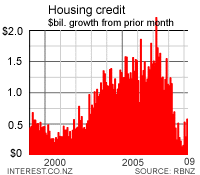
New Zealand's banks borrowed NZ$72 billion from foreign banks and investors in the 5 years to 2008. It virtually doubled house prices. Some of that will be sucked back home over that coming decade. This is the reason why I believe house prices will fall 30% from their 2007 peaks and not recover to that level for another decade.
* This article first appeared in my weekly column in the Herald on Sunday.
There is an eerie moment before a Tsunami hits when the water retreats from the beach. The water is sucked out to sea, leaving the fish flapping and the seaweed exposed as the Tsunami gathers itself before rushing in to destroy everything in its path.
In years to come investors and economists alike will see 2008 as the year debt was sucked back out of the world's financial and property markets. This year will be seen as that moment before the Tsunami of the worst recession in 80 years wreaked havoc on the global economy for at least the next decade.
It's worth explaining how de-leveraging works and why it is such a powerful force. Over the last 6 years interest rates were kept low globally in the wake of the 9/11 attacks and investment banks in the Northern Hemisphere were let off the leash to indulge in massively leveraged lending to all and sundry for all sorts of assets.
The most popular type of lending was home mortgage lending to consumers by banks and pension funds either directly or through a myriad of intermediaries using securitisation and "˜insured' lending backed by investments banks and insurers using strong credit ratings. The power of that leverage was enormous. It doubled house prices in most western property markets over that 6 year period.
Estimates vary about how much borrowed money was pumped into property markets over that period. Some estimate it was at least US$3 trillion (NZ$5.8 trillion). Others point to the value of Credit Default Swap instruments outstanding at the end of 2007 of US$600 trillion (NZ$1,153 trillion) as a fair estimate. I think a number closer to US$15 trillion (NZ$28.8 trillion) is more accurate. That is about 534 times New Zealand's annual GDP. It's a number too big to comprehend.
But what we're seeing now is a good portion of that money being sucked back out of the property market either through force or through debt not being rolled over. Sucking the money back by force through mortgagee sales, foreclosures and liquidations is the most dangerous type of de-leveraging and is what has caused so much havoc on global financial markets in the last 6 months.
The de-leveraging debt spiral goes like this. Borrowers can't pay their interest. The lender is forced to book a provision for the lower value of the loan. This reduces their equity capital to back their other loans. The bank is forced by investors, depositors or regulators to raise fresh capital to ensure its capital backing is strong enough to keep its credit rating or retain its special status as a bank or just retain confidence.
If they can't raise fresh capital they must raise cash by liquidating the loan. They force a mortgagee sale or foreclosure. That drives down asset prices, which in turn forces the bank to acknowledge lower asset values across their entire loan book. This forces more capital raisings or asset sales. You get the picture.
It is a debt death spiral that can only stop when asset values stop falling or capital has been replenished with enough cash. Essentially, this is the deleveraging Tsunami that sucks debt out of the property market and then destroys the value of that property.
New Zealand's banks borrowed NZ$72 billion from foreign banks and investors in the 5 years to 2008. It virtually doubled house prices. Some of that will be sucked back home over that coming decade. This is the reason why I believe house prices will fall 30% from their 2007 peaks and not recover to that level for another decade.
* This article first appeared in my weekly column in the Herald on Sunday.
We welcome your comments below. If you are not already registered, please register to comment
Remember we welcome robust, respectful and insightful debate. We don't welcome abusive or defamatory comments and will de-register those repeatedly making such comments. Our current comment policy is here.