
 With the RBNZ contemplating further OCR (Official Cash Rate) cuts it is timely to revisit the case for a more stable interest rate environment. The RBNZ has a history of experimenting with major interest rate changes and in recent years with unsustainable low interest rates for which we are only starting to pay the price. This piece looks at the folly of excessive changes in interest rates and suggests a sane range within which mortgage interest rates should live to both promote a more stable economic environment and to maintain reasonably low inflation on average over the medium to long-term.
The primary function of monetary policy is to maintain low inflation. Using monetary policy to try and boost economic growth will backfire. See here for a deeper discussion. But Governor Bollard has run just such an experiment, with a sustained period of low interest rates between 2002 and 2006 fuelling a multi-year boom in economic growth and a mega property boom, and resulting in the RBNZ-initiated measure of domestic inflation averaging 4% per annum since September 2002. The recession NZ is currently experiencing has been largely triggered by the surge in petrol and to a lesser extent food prices, but it was needed to mop up the inflationary consequences of Governor Bollard’s experiment as subscribers to our Interesting Times and Monetary Policy Briefing reports will appreciate. As covered in a previous comment, the experiment was always going to result in many property investors getting burnt, and in many firms and individuals – best viewed as innocent bystanders – being caught out when the boom inevitably imploded. Now the economy is in recession, albeit still to be confirmed by the historical GDP data, my concern is that Bollard may not have learnt the right lesson from his folly. He appears to have become a reluctant giver of OCR cuts, but based on his past behaviour it can’t be ruled out that when he belatedly realises how large the unfolding fall in economic activity is he will, in his conservative, slow-moving way, deliver excessive OCR cuts that keep the roller coast ride going. In the June Monetary Policy Statement the RBNZ forecast that the 90-day bank bill yield would fall to 6.3% by March 2011, a level any student of NZ’s recent economic history should be able to tell you is too low and heightens my concern that the Governor has not learnt his lesson. Many people would understandably welcome imminent and large OCR cuts, but large cuts would only mean the economy remains on a roller coaster ride largely caused by the extreme fluctuation in interest rates. Trying to bring an end to monetary policy madness In 2002 I wrote a booklet titled Monetary Policy Madness And Your Chance To Stop It. It was written prior to Dr Bollard becoming Governor and warned about the costs of the RBNZ adjusting interest rates excessively. The section headings in the booklet give insight into both its content and its somewhat tongue-in-cheek style: 1996 – My god they killed Kenny, the exporter; 1998 – Blame it on Rio; 1998-99 – From madness to insanity; 2001 – Playing to the last big mistake; The OCR era – The ultimate insanity; So why all the interest rate marching?; If you can’t forecast, don’t meddle with the OCR; International best practice “sucksâ€; The case for low interest rates, NOT; Low inflation – the Reserve Bank’s claim to fame; Keeping politicians’ hands out of the till; Dare we try the obvious, more stable interest rates?; and The NZ dollar – The answer is blowing in the wind. The following is from the “Dare we try the obvious, more stable interest rates?†section, which is equally relevant today as it was in 2002. 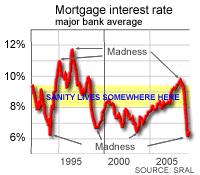 “By running a ‘sloppy’ monetary policy in 1993, including unsustainably low interest rates, the Reserve Bank fuelled a boom which then necessitated insanely high interest rates in 1994-98; to eventually be followed by a massive fall in interest rates to unsustainably low levels in 1998-99. When is enough, enough? In my assessment New Zealand could have achieved a low inflation outcome over the last decade without much of the marching up and down of interest rates. Without all the unnecessary marching of interest rates, firms would have a more stable home economic environment in which to build their businesses, providing a strong foundation for fighting in the international battlefield for market share. Equally, new firms are more likely to survive the treacherous early years in a more stable interest rate environment. In a less volatile interest rate environment I would expect firms to be focused more on increasing productivity - key to improving New Zealand’s sustainable growth rate - rather than on making a quick killing from the property market. By contrast, when interest rates are marched up and down people are encouraged to start new ventures founded on the sands of unsustainably low interest rates, just to have their plans and life-savings too often obliterated by the subsequent hike in interest rates. Equally, the interest rate marching favoured by the Reserve Bank plays a key part in creating cycles in the property market and encouraging entrepreneurs to focus too much on this market as a route to riches. In my ideal world the key role of monetary policy is to lean against cynical, politically motivated fiscal policy and, in the unlikely event that central bankers can foretell a shock in advance, to adjust interest rates within relatively narrow bands to try and offset the impact of the future shock. In this world interest rates only need adjusting if the government runs an irresponsible fiscal policy, which should not be too often if the Reserve Bank operates monetary policy sensibly and consequently has strong public support. Other than the primary focus on keeping politicians honest, the search for the holy grail of monetary policy should be the search for the level of interest rates that is consistent with there being only modest inflation in the long-term. That we should try a stable interest rate approach to monetary policy is compelling to me and I think to the majority of New Zealanders, but what rate and how much latitude should the Reserve Bank have to alter the rate? On the question of what rate, many bank economists, financial market operatives and central bank economists seem to believe that the average interest rates in the post OCR era starting in early 1999 – around 6% for short-term interest rates – is reflective of the average sustainable rate going forward. However, this OCR era is unusual in that it featured two periods of weak global growth. Since 1992 we have experienced a wide range of events of the sort the New Zealand economy could reasonably be expected to experience in the future (e.g. a global recession, mini-wars, a boom etc), although not a full blown war, foot and mouth, nor a major oil find. So, precluding extreme outcomes – outcomes that would warrant a rethink of the appropriate level of interest rates – the average short-term interest rate experienced since 1992 - 7% - is my prime contender for the starting OCR level in the brave new world of stable interest rates. Even if the rate was held at 7% for a year and this proved too high or low, the damage would be small compared to that caused by the extreme interest rate levels the Reserve Bank has too often imposed on the economy. On the question of how much latitude the Reserve Bank should be allowed to alter interest rates, the starting point is to recognise how powerful interest rates are and how long it takes the full impact of changes in interest rates to be reflected in the data. The Reserve Bank now adjusts the OCR in relatively small increments (e.g. 0.25% and at the most 0.5%), but after a maximum of 2-3 adjustments in any year it should have to wait, if necessary for a year or more, to see the outcome rather than continue to ratchet rates up or down and, in so doing, cause unnecessary and at times destructive economic cycles. In the case of monetary policy, the reward for patience would be that less of New Zealand’s scarce entrepreneurial talent gets chewed up and spat out by excessive cycles in interest rates.†The chart is updated from the booklet and indicates the range my analysis suggests mortgage interest rates should live in to be consistent both with the more stable interest rate approach the booklet recommended – the “sanity†range – and with keeping inflation relatively low on average. Mortgage interest rates are currently at the top of the sanity range because we are paying the price from Bollard’s experiment. If the Governor is keen on sorting out the underlying domestic inflation problem he will need to ensure mortgage interest rates remain in the upper half of this range for some time. And if he has learnt anything from the past and is keen to deliver NZ with a more stable interest rate and economic environment in the future he should operate monetary policy so as to keep mortgage interest rates within this range. But while history has proved right my view that Bollard’s experiment would end in tears it is likely that my updated warning will fall on equally deaf ears unless there is a groundswell of support for more stable OCR and at a sensible level, like around 7% once the current domestic inflation problem is sorted out with a somewhat higher OCR. Back in 2002 when interest rates were below the level indicated by the sanity range in the chart on the previous page there was not much support for my small-scale campaign for stable interest rates. Too many people lived in the misguided hope that low interest rates were here to stay. Maybe now interest rates are near the top end of the sanity range my campaign will gather a bit more momentum (being an optimistic I will live in the misguided hope my ideas will gain some traction for the common good). Opening the door to politicians bent on screwing the scrum The end game for monetary policy is that if it continues to be operated as badly as it has been operated at times since 1989 it opens the door to politicians bent on winning elections at any cost. Recent comments by Associate Finance Minister Trevor Mallard could possibly ring warning bells for the independence of monetary policy. A government more concerned about winning elections than the common good would be only too willing to use the poor operation of monetary policy to neuter the RBNZ of its independence or water down its mandate so much that monetary policy effectively lost its teeth, opening the door to blatant abuse of fiscal policy for “political†ends. And while that might have appeal to people suffering under the current weight of above average interest rates I suggest that even poorly-operated, independent monetary policy is better than letting politicians have a free reign. Muldoon tried the free reign thing in the late-1970s and early-1980s and it delivered an economy that struggled to grow more than 1.5% per annum, double digit inflation, and massive government and external deficits. Being stuck with a monetary policy regime that has interest rates as its main tool and low inflation as its primary target is probably as good as it gets, with the biggest potential improvement to the current regime being an end to the extremes in interest rates that the RBNZ has at times misguidedly subjected the economy to. See a full version of this opinion piece with charts here. * Rodney Dickens is the Managing Director and Chief Research Officer for Strategic Risk Analysis (SRA), which is a boutique economic, industry and property research company. Rodney produces regular free reports on topical issues and on specific property markets. Find out more about SRA here and sign up to SRA’s free reports here.
We welcome your comments below. If you are not already registered, please register to comment
Remember we welcome robust, respectful and insightful debate. We don't welcome abusive or defamatory comments and will de-register those repeatedly making such comments. Our current comment policy is here.