
Here's my summary of the key news overnight in 90 seconds at 9 am, including news that Moody's stripped the United Kingdom of its triple-A credit rating, and predicting economic weakness will weigh on its public finances for years to come. The pound fell to 55.2p to the NZ$1. S&P is likely to follow Moody's. The action is widely believed to stiffen the UK's resolve of the benefits of austerity, although it will reignite the debate there.
Italians are voting in one of the most closely watched elections in years, amid disquiet over a discredited elite adding to concern it may not produce a government strong enough to lead Italy out of an economic slump. Berlusconi may well re-emerge, as could a the obscenity shouting comedian Beppe Grillo who is widely expected to get a huge protest vote, one that may throw the result into confusion.
The media is picking the candidate of the left, Pier Luigi Bersani to emerge as the winner, but Mario Monti is in the race too, as is a gay trade unionist from the South, both of whom are expected to poll well in their consistencies, making a clear result very unlikely.
Italy could be in a mess, but it has been here before. The most prosperous times for Italy have been when there has been a dysfunctional government in Rome; the north especially prospered in the past in these circumstances. Whatever happens, Italy will be a problem for the EU and the euro.
In the US, observers are expecting more data showing manufacturing expanded in February. But there is no progress in the March 1 deadline for a budget compromise, which could unstitch the US economy.
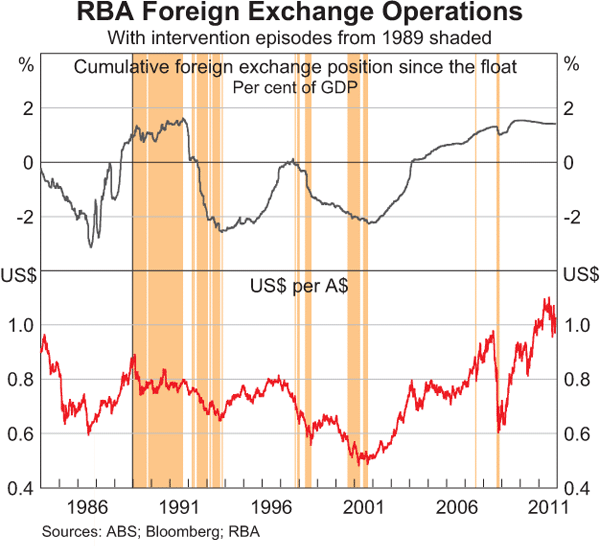
In Australia, RBA governor Stevens has taken a line out of the Wheeler playbook by placing the bar high in currency intervention. He said he’d need to be confident the currency is 'seriously overvalued' before considering intervention to weaken it, and he isn't about to do that now.
The latest Queensland and NSW floods may add more than $1 billion to insurers claim costs.
The kiwi dollar starts the week a bit higher at 83.7 USc, 81.2 AUc, and the TWI is at 76.5 mainly because of the falling British pound.
No chart with that title exists.
11 Comments
"The action is widely believed to stiffen the UK's resolve of the benefits of austerity,"
There is no austerity by the Bristish Gov't, it'a myth perpetuated by the Gov't and the MSM. The UK PBSR, Public Sector Borrowing Requirement, has been larger under the current Conservative Gov't than it was under the previous Labour Gov't. How is austerity possible when the Gov't is spending more. It really is becomimg an Orwellian world.
Indeed it is. They won't know what has hit them once they really are forced to make proper cuts to spending - as they inevitably will have to as the vice tightens.
On an unrelated note - good to see Rabo offering 4.25% on their Premium Saver account (shame its limited to $100k). BNZ and ASB have been cutting their equivelent offerings (now both down to 4%) - hopefully loss of custom to Rabo on this deal makes them squeal a little and rethink. I will start the ball rolling.....
austerity in a zero bound trap == self fullfilling collapse/depression.
regards
Or you are simply deluded,
"Countries that imposed the strongest austerity measures also experienced the strongest declines in their GDP. This result is in line with the IMF’s recent analysis (IMF 2012)."
http://www.voxeu.org/article/panic-driven-austerity-eurozone-and-its-im…
"It seems safe to say that what we have here is a case in which rival theories made different predictions, the predictions of one theory proved completely wrong while those of the other were totally vindicated — but in which adherents of the failed theory, for political and ideological reasons, refuse to accept the facts."
http://krugman.blogs.nytimes.com/2013/02/23/austerity-europe-2/
Steven - perhaps before you indulge yourself in another rant about austerity you might want to actually read what AR and I actually wrote. Neither of us actually passed an opinion on whether the UK's austerity policy is a good or a bad thing so your infantile comment about delusion is irrelevent - we merely opined that a) it is not really austerity as there are no real cuts to spending and b) given that when real cuts are eventually forced upon them when money printing runs its eventual course and fails then the public really will go bonkers.
As far as I am concerned the UK can try any damn policy they like - austerity, more QE, Krugmanesque helicopter drops of cash, whatever - none of it is going to work in the long run.
So please spare yourself (and us) this reflex you seem to have to comment when you are clearly unable to decipher what people are actually talking about.
Ban him for perpetual rudeness - it's tiring and adds little to our enlightenment.
Moving to a more serious topic, do you know why trusts are banned from Rabodirect's latest on call depo offer?
No I do not - typically they prevent businesses from using such accounts but this is I think the first time I have seen Trusts specifically excluded? Anyone else know?
Hmmm - I wonder if the "sticky deposits" portion of the RBNZ's core funding ratio (CFR) excludes non-individual money - certainly calls into question the fungibility of money - a bit Orwellian when some money is more money than other money.
Has being downgraded by S&P ( and later by Moodys ) affected the USA in the slightest ?
...... I don't envisage the UK will be anymore impacted by this downgrade than America has been .....
In Australia, RBA governor Stevens has taken a line out of the Wheeler playbook by placing the bar high in currency intervention. He said he’d need to be confident the currency is 'seriously overvalued' before considering intervention to weaken it, and he isn't about to do that now.
Hardly a winning strategy from a historical perspective - my view is they dare not move until authority is given by the US Treasury''s ESF.
If the NZD gains parity with the yen then I'll seriously consider moving all my money to Japan and investing there. These kind of opportunities don't come along so often.
We welcome your comments below. If you are not already registered, please register to comment
Remember we welcome robust, respectful and insightful debate. We don't welcome abusive or defamatory comments and will de-register those repeatedly making such comments. Our current comment policy is here.